Showing posts with label Credit Cycles. Show all posts

Wednesday, November 28, 2012

Will Congress offset the Fed's attempts to lower mortgage rates?

Over the past few weeks and months, the chorus of economic and financial analysts singing praises about the housing rebound has been growing. Some believe housing will come roaring back, significantly boosting GDP, as in those good old days of the early 2000’s. Others remain more subdued about the prospects, expecting stability with potentially moderate growth. It’s certainly hard to argue with those positions given recent data, as shown below:

Recently prices are clearly trending higher, but a quick glance at late 2009-early 2010 shows a similar pattern. Will house prices continue the recovery, flatten out, or take a turn towards new lows?

Supporting the bullish case:

  • Mortgage rates are at all time lows
  • The Fed is actively buying Agency-MBS to push rates lower
  • Real house prices and price-to-rent are back to late 1999 levels (Calculated Risk)
  • New and existing home sales are rebounding
  • Government support remains strong
There are certainly many other bullet points one could add, but I want to focus on the last point, which might strike some as odd.

Do you know what percent of the current mortgage market is either owned or guaranteed by the GSEs (Fannie Mae And Freddie Mac) and the FHA (Federal Housing Administration)?

If not, would you guess...
A) 50%
B) 70%
C) 90%
D) 95%


The correct answer is C - 90%.

So why does this support the bullish case? Well, the various government agencies have primarily gained market share by offering mortgages and guarantees at prices well below any private sector participant. Seemingly unphased by fallout from the recent housing crisis, the FHA is once again doling out mortgages to subprime borrowers with down payments as low as 3.5%. Similar to the previous housing boom, this cheap credit should increase purchasing power and at least place a floor under housing prices, if not drive them higher.

Turning to the bearish position, one must recall that the government’s previous efforts to accurately price mortgage loans and guarantees ended with massive losses for the taxpayers through the GSEs. While risks of further GSE losses remain high, the FHA is quickly racking up losses on bad loans and will need capital injections (a bailout) from the Treasury. In light of these outcomes, there may be some pressure to shift part of the mortgage market back to the private sector.

Walter Kurtz at Sober Look explains that In order for the private sector to step into the mortgage market, g-fees need to rise:
The only way to shift at least some of the mortgage business to the private sector (currently the GSEs and the FHA own or guarantee over 90% of the US mortgage market) is to price the risk closer to where it would be priced in the private sector. Otherwise the private sector will never enter this market - other than to sell the mortgages banks originate to the government and keep the origination fees (which is what banks do now).
The taxpayer also needs to recoup the Fannie and Freddie rescue expenses. That means the GSEs will need to raise their g-fees, which according to JPMorgan is exactly what they plan to do (chart below).
These projected increases in g-fees will, ceteris paribus, push mortgage rates higher at a time when the Fed is trying to force rates in the opposite direction. Although the magnitude of 20-30 basis points is seemingly small, it is practically equivalent to the change from the Fed’s QE programs that are believed by many to have extraordinarily powerful effects. While I remain skeptical of the potential impact from a change of this magnitude, the trend higher in g-fees presents a potential headwind for future house prices.

Whether or not the rise portrayed above occurs remains open for debate and is being fought by numerous politicians. The reality is that the direction of US housing prices, at least in the short-run, lies primarily with the actions of the US government. Continuing the current practice of lending at below market prices across the credit spectrum may succeed at inducing a credit-infused rebound. In all likelihood the outcome will be no different than recent experiences around the globe, as the debt burden will overwhelm income and savings, leading to housing price declines and massive taxpayer losses.

Saturday, November 10, 2012

Bubbling Up...11/10/12

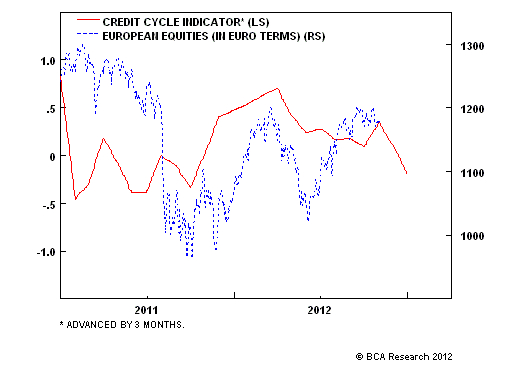
1) Global Credit Cycle Lurches Down by BCA Research @ The Big Picture
The credit impulses in all three major economies – the euro area, the U.S. and China – are now negative, albeit very slightly in the case of China. This is the first time in three years that all three components have been simultaneously negative. And after hovering at a point of inflection the combined credit cycle indicator has lurched down again.
Woj’s Thoughts - As I have argued repeatedly on this blog, credit (especially private) is now the main driver of economic cycles. If broad measures of credit contract in all three major economies, it becomes increasingly unlikely that current fiscal deficits will be large enough to maintain current levels of growth (or decline in Europe’s case).

2) The US election and the fiscal cliff by Edward Harrison @ Credit Writedowns
What these three things tell me is that recession is what results from trying to reduce government deficits when the root cause of the deficits lie in private sector debt distress. When the government raises taxes or cuts spending in that situation, the result is less income in the private sector. And to the degree debt distress still exists, the result of less income is less spending and private defaults, also known as recession and credit writedowns. The larger the recession and the credit writedowns, the greater the possibility of bank failure, financial panic and debt deflation.
Woj’s Thoughts - Many pundits are currently arguing that the “fiscal cliff” is over-hyped, or simply non-existent. I think they’re wrong and, similar to Harrison, believe any compromise will still result in marginal tax increases. As noted above, the credit impulse is now negative in the US, suggesting private sector debt distress persists. The fiscal situation should be watched very closely going forward.

3) Nicholas Kaldor On European Political Union by Ramanan @ The Case for Concerted Action
From Kaldor’s essay (pp. 202-207):
THE CONSEQUENCES OF A FULL ECONOMIC
AND MONETARY UNION
This is only another way of saying that the objective of a full monetary and economic union is unattainable without a political union; and the latter pre-supposes fiscal integration, and not just fiscal harmonisation. It requires the creation of a Community Government and Parliament which takes over the responsibility for at least the major part of the expenditure now provided by national governments and finances it by taxes raised at uniform rates throughout the Community. With an integrated system of this kind, the prosperous areas automatically subside the poorer areas; and the areas whose exports are declining obtain automatic relief by paying in less, and receiving more, from the central Exchequer. The cumulative tendencies to progress and decline are thus held in check by a “built-in” fiscal stabiliser which makes the “surplus” areas provide automatic fiscal aid to the “deficit” areas.
...
Some day the nations of Europe may be ready to merge their national identities and create a new European Union – the United States of Europe. If and when they do, a European Government will take over all the functions which the Federal government now provides in the U.S., or in Canada or Australia. This will involve the creation of a “full economic and monetary union”. But it is a dangerous error to believe that monetary and economic union can precede a political union or that it will act (in the words of the Werner report) “as a leaven for the evolvement of a political union which in the long run it will in any case be unable to do without”. For if the creation of a monetary union and Community control over national budgets generates pressures which lead to a breakdown of the whole system it will prevent the development of a political union, not promote it.
Woj’s Thoughts - Although Kaldor espoused these opinions more than 40 years ago, there are still countless people today holding out hope that Europe creates a full fiscal union on the road to political union and ultimately becoming the United States of Europe. In my opinion, U.S. of Europe optimists continually overestimate the ease with which fiscal integration, not only harmonisation, is achievable. Convincing various populations to accept a common social welfare scheme, uniform tax rates and indefinite transfers is likely not achievable within the next decade, if at all. Democracies in Europe are already falling due to the strain of economic depression and widespread unemployment. Relative stability may persist for a few more years, but the political crisis will come to a head well before fiscal and/or political integration is possible.

Thursday, November 8, 2012

Koo–Krugman Paradox? - Jonathan Finegold

I’d like to share one thing in particular from Koo’s book, (The Holy Grail of Macroeconomics)
[A]fter the bubble collapsed in Japan, not only were there no willing borrowers, but existing borrowers were paying down debt — and they were doing so when interest rates were at zero. Technically insolvent companies, struggling to pay down debt and repair balance sheets hit by the nationwide plunge in asset prices, were not interested in borrowing money, regardless how far the central bank lowered rates. In this environment, monetary policy by itself no longer has any effect.
— p. 29.
...
Some time ago Krugman suggested that Koo isn’t entirely right,
Koo’s argument is that interest rates and monetary policy don’t matter because everyone is debt-constrained. That can’t be right; if there are debtors, there must also be creditors, and the creditors must be influenced at the margin by interest rates, expected inflation, and all that.
Read the rest at Economic Thought
Koo–Krugman Paradox?
By Jonathan Finegold

I haven't read Koo's book yet, but have been equally fascinated by his ideas through various other works. Regarding the difference between Koo and Krugman on the creditor-borrower dichotomy, I think it boils down to whether one accepts the loanable funds paradigm or not. Krugman, seemingly accepting the premise, believes that creditors (banks) are limited in credit creation by funds from savers and to some degree central bank reserves. In that case it would be true that a relatively large portion of the population would not become debt-constrained at a given time.

Now consider the opposing view, that banks create deposits and are only constrained by capital requirements (to a degree) and the willingness of borrowers to accept the bank's liabilities (which is supported by an implicit/explicit federal guarantee). Banks can therefore lend well in excess of current income and savings. In this scenario, a very significant portion of the population could become debt-constrained. If this is true, debt-constraints can become far more powerful (as Koo suggests) and may render monetary policy ineffective even with higher inflation expectations.

Personally I find the second example far more convincing given my readings and experience. I should also note that In Koo’s scenario, while demand for credit is weak, banks may also tighten credit restrictions since there is some level of debt-to-income (or assets) where the expected return of lending to a potential borrower becomes negative.

Sunday, August 19, 2012

Bubbling Up...8/19/12

1) Chart of the Day: Public deficits and private savings in the euro zone by Edward Harrison @ Credit Writedowns
Budget deficits are what results ex-post from an accounting identity between the sectoral balances and should not be a primary goal of public policy. What we want to do is target the cause of the deficits, insufficient demand which I believe is the result of the overhang of debt after a period of excess private sector credit growth. What you want to do is eliminate that debt overhang by reducing the debt or increasing private sector incomes to support the debt. That’s getting at root causes.

2) How the Economic Machine Works by Ray Dalio @ Bridgewater (h/t Humble Student of the Markets)

[I]f you understand the game of Monopoly®, you can pretty well understand credit and economic cycles. Early in the game of Monopoly®, people have a lot of cash and few hotels, and it pays to convert cash into hotels. Those who have more hotels make more money. Seeing this, people tend to convert as much cash as possible into property in order to profit from making other players give them cash. So as the game progresses, more hotels are acquired, which creates more need for cash (to pay the bills of landing on someone else’s property with lots of hotels on it) at the same time as many folks have run down their cash to buy hotels. When they are caught needing cash, they are forced to sell their hotels at discounted prices. So early in the game, “property is king” and later in the game, “cash is king.” Those who are best at playing the game understand how to hold the right mix of property and cash, as this right mix changes.
Now, let’s imagine how this Monopoly® game would work if we changed the role of the bank so that it could make loans and take deposits. Players would then be able to borrow money to buy hotels and, rather than holding their cash idly, they would deposit it at the bank to earn interest, which would provide the bank with more money to lend. Let’s also imagine that players in this game could buy and sell properties from each other giving each other credit (i.e., promises to give money and at a later date). If Monopoly® were played this way, it would provide an almost perfect model for the way our economy operates. There would be more spending on hotels (that would be financed with promises to deliver money at a later date). The amount owed would quickly grow to multiples of the amount of money in existence, hotel prices would be higher, and the cash shortage for the debtors who hold hotels would become greater down the road. So, the cycles would become more pronounced. The bank and those who saved by depositing their money in it would also get into trouble when the inability to come up with needed cash caused withdrawals from the bank at the same time as debtors couldn’t come up with cash to pay the bank.
Woj’s Thoughts - Although Dalio’s fund may be struggling this year as markets increasingly deviate from economic growth, his insights regarding economic cycles remain a great source of knowledge. In many advanced economies, property was clearly king until the shortfall in cash among households became so pronounced that a debt deflation ensued. The productive portion of the private sector (non-financial) continues to hold too much property and debt relative to cash (savings and income). Rather than encouraging and aiding a “smooth” shift towards cash, public policy remains supportive of reverting back towards property and debt. As long as this mix remains highly unbalanced, economies will prove fragile and prone to crises. (Fun tidbit about me...as a child I loved playing the game of Monopoly. This may have been an early sign that I was destined for a future in economics and finance.)

3) How Long Can Japanese Bond Prices Defy Gravity? by Cullen Roche @ Pragmatic Capitalism

As you likely know, Japan has been suffering a horrid deflation for 20 years as a result of a multitude of factors.  So we’ve witnessed an endless stream of JGB bond traders diving out of windows as they short JGB’s and lose out to ever increasing prices.  One interesting conclusion in the Hoshi/Ito paper is their view on Japan’s ”unrealistically optimistic assumption that Japan’s GDP will grow at 2% annually for the next 40 years”.   If growth is to stagnate then where will the inflation come from?  What could scare these bondholders into a massive JGB revolt leading to higher rates (something which, mind you, did not even occur in the USA during the great stagflation of the 1970′s)?   I am lost for a cause here because Japan’s central bank controls interest rates and as the supplier of reserves to the banking system they can always control the entire yield curve (yes, if they wanted to pin the 30 year bond at a specific rate they would just have to name it and challenge the bond traders to compete with their endless reserve position – the bond traders would lose quickly).
So the question remains – how long can Japanese bond prices defy gravity?  Well, the short answer is – as long as the Japanese central bank is willing to keep rates low.  The more important question is when will Japan experience an environment which forces their central bank to alter the current structure of the yield curve?  Will a stagflation occur similar to the 70s in the USA?  Will a hyperinflation occur for whatever reason?  Will growth rebound?   Or what if Hoshi and Ito’s pessimistic GDP projections are correct?  Then we’re likely to continue seeing JGB traders jumping out of windows following unsuccessful attempts to fight the Bank of Japan.
Woj’s Thoughts - So yes, the Fed can (and to a degree currently does) control long-term interest rates. These questions are equally important for investors currently betting against US Treasuries. When will economic factors cause the Fed to raise interest rates in the foreseeable future? Private sector deleveraging is likely to persist for a few more years and government deficits are decreasing. This suggests a still lengthy period of low growth and inflation, which is consistent with the Fed maintaining short-term rates near zero. The recent sell-off in Treasuries is approaching a level at which the long-side again becomes enticing.  

Thursday, June 28, 2012

Forget Europe, China Could Be Lehman 2.0

David Keohane at FT Alphaville points out that
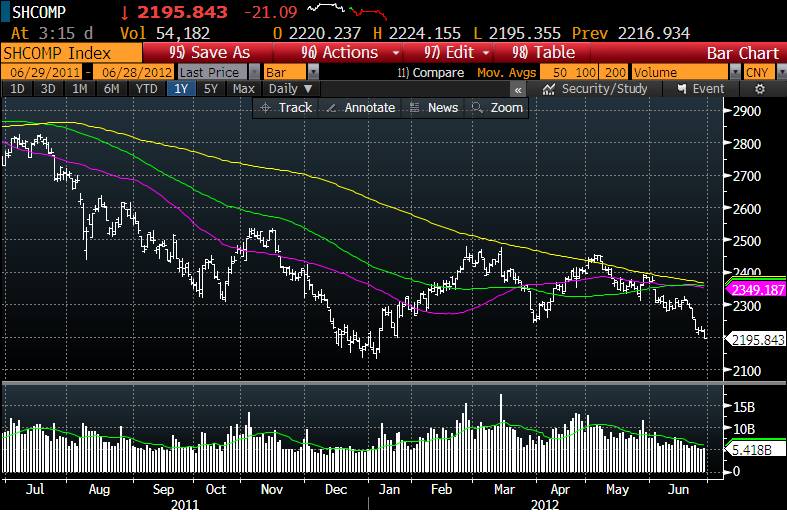
The Shanghai composite index has now fallen for the past 7 days in a row and is down some 10 per cent since a high on May 4th.
Here’s a chart from Bloomberg displaying the index over the past year:
Not only has the index declined about 10% on the last two months, but it is down more than 20% in the past year. For all the recent bullish talk over further stimulus from China, the domestic market is certainly not buying it.

Although this chart provides a disturbing outlook for China, it has been largely overlooked by the mainstream media which continues to focus on a possible Lehman 2.0 moment out of Europe. What if the next Lehman moment actually comes from China instead? Discussing the risks posed by credit guarantee companies, Patrick Chovanec suggests:
The web of interlocking, often incestuous, and sometimes circular credit arrangements is reminiscent of Wall Street in the lead-up to the subprime crisis, in which a relatively small amount of mortgage losses, which most people believed could be contained, triggered a chain reaction that brought down major banks and froze credit across the entire global economy.
According to the article from Caixin magazine, banks were effectively outsourcing their loan review processes to these credit guarantors. Similar to mortgage lenders during the US housing boom, it appears the interests of banks and credit guarantee companies aligned to produce a massive extension of credit with little consideration about the borrowers’ ability to repay. With housing prices falling and property development no longer booming, it appears these financial institutions have begun the Ponzi finance portion of a Minsky cycle, whereby in Patrick’s words:
a lot of these firms are actually insolvent and are just borrowing from Peter to pay Paul, in order to postpone the day of reckoning.
That day of reckoning will come, but the question of timing remains uncertain. The larger concern is, how big and systemic will losses be? If it was difficult to determine the extent of the issue in the US, trying to do so in China will be nearly impossible given the general uncertainty surrounding any publicly reported economic/financial data. Could the fallout from these lending schemes actually be the next black swan? Only time will tell. For now it appears that as China’s growth is slowing, risks within the financial system and chances of a hard landing are growing.

Tuesday, June 26, 2012

Cullen Roche - Misunderstanding Banking is Helping Bankrupt an Entire Society


What is Wall Street’s job?  Wall Street’s job is simple.  It is to increase earnings for their shareholders.  It is not to provide jobs for the private sector.  It is not to make sure the US economy is running smoothly.  It is not to make sure you feel good about your day to day life.  It is to generate a profit for its owners.  This is the essence of private banking.  To generate a profit.  But banks play a unique role in our capitalist system.  I’ve explained before that banks are not the engine of capitalism.  They are simply the oil in the machine.  As the oil in our machine, banks must be functioning smoothly in order for the machine as a whole to be functioning smoothly.  So when big banks do bad things that threaten their well-being parts of the system begin to malfunction.  And sometimes when these mistakes are big enough the contagion leads to the entire machine malfunctioning and requiring a major repair (hello 2008!).
But make no mistake, your local bank is not your best friend or a public purpose serving charity.  For instance, when a bank extends a mortgage (a word literally meaning “death security pledge” from the latin root “mortuus” for death and germanic “security pledge”) they are not doing you some charitable service to help you buy your home.  They are rating your credit risk and evaluating you as a potential profit engine for their shareholders.  That might not be the most pleasant way to think about it, but it is what it is.  A bank is not a charity.  It does not really care if your mortgage results in jobs or happiness for you.  Of course, it would be great if this did because that might result in more future business, but the bank does not need these things from you in order to generate a profit.  It really just wants to manage its risks in a way that helps to generate a profit for their shareholders without excessive risk.  Obviously, the debtor finds the mortgage advantageous, but don’t confuse this service for charity work.  It’s just good old fashioned profit seeking and offering a service where one is needed (in this case, the debtor being able to obtain money they could not otherwise currently obtain).
Read it at Pragmatic Capitalism
Misunderstanding Banking is Helping Bankrupt an Entire Society
By Cullen Roche

Cullen remains one of my primary go-to sources for a clear, objective view of our monetary system. While this post is strong in many facets, it appears to downplay the role of government in the current environment. Deposit guarantees, creditor bailouts and tax laws are just a few of the ways in which government alters the price of credit. These actions, which impact the decisions of both banks and consumers, may unintentionally exacerbate the normal boom/bust cycle.

Saturday, March 17, 2012

Points of Public Interest

Happy St. Patrick’s Day! Enjoy the weekend by reading some great articles from this past week (if you're not watching the NCAA tournament)...


  1. Ray Dalio: Man and machine - One of the best investors ever shares thoughts on two types of credit cycles present in his economic model.
  2. Why ECRI’s Recession Call Stands - Lakshman Achuthan continues to defend his recession call from last year. I think current budget deficits are large enough to maintain 1.5-2% growth for most of the year. However, further deterioration in Europe and China’s economies may lead to the onset of recession in the 4th quarter.
  3. Philip Pilkington: Falling for Behaviourism – The Neoclassicals Join a New Cult
  4. Speculators might be in for a crude awakening - Marshall Auerback speculates on potentially forthcoming government actions that could send the price of oil down sharply.
  5. Good and Bad Deficits - Robert Skidelsky argues that “Government deficits incurred on current spending for services or transfers are bad, because they produce no revenue and add to the national debt. Deficits resulting from capital spending, by contrast, are – or can be – good.” If only governments on both sides of the Atlantic could accept this view...
  6. The Forgetting Pill Erases Painful Memories Forever - Fascinating article by Jonah Lehrer on how memories are re-created in our mind and potential cures for PTSD that disassociate the emotional response from the act of remembering.
  7. The Myth Of Cash On The Sidelines – An Update - Don’t be fooled into buying stocks based on this myth.
  8. The Bounds on what we are Likely to Learn from Models with Boundedly Rational Learning - Robert expresses skepticism over the current ability of any science to fully predict the expectations formed by individuals.