Showing posts with label Austrian Economics. Show all posts

Sunday, February 10, 2013

Quote of the Week...


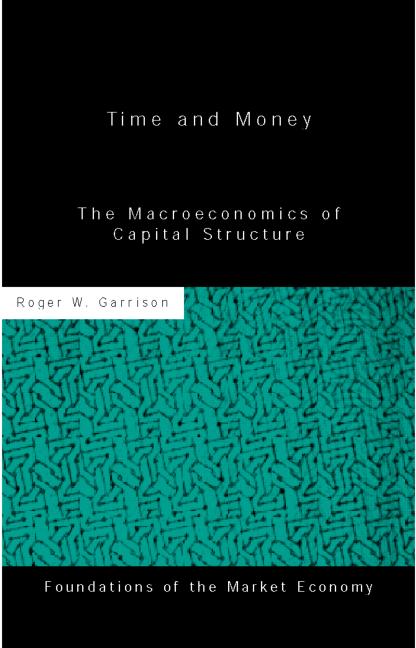
...is from Roger Garrison’s Time and Money (2007):
In response to the question "What about expectations?", we get New Classical monetary misperception theory, real business cycle theory, and new Keynesian theory. This is the state of modern macroeconomics. While each of these theories include rigorous demonstrations that the assumptions about expectations are consistent with the theory itself, none are accompanied by persuasive reasons for believing that there is a connection between the theoretical construct and the actual performance of the economy over a sequence of booms and busts. Applicability has been sacrificed to rigor. The Keynesian spur has led us to this dead end.
Time and Money is one of several assigned books for my macroeconomics course this semester. The second chapter displays Garrison’s strong grasp of other modern macro theories and their unfortunate divergence from trying to model/explain the world as we know it. Having only read through chapter three, which begins to lay out the foundation of Austrian Business Cycle Theory (ABCT), I’ve already come across several discrepancies with modern monetary operations. In forthcoming posts, I hope to address these disagreements and outline a new theory that combines the positive features of Post-Keynesian monetary economics and Austrian capital theory.

 
Bibliography
Roger W. Garrison (2007-03-16). Time and Money (Routledge Foundations of the Market Economy) (Kindle Locations 801-806). Taylor & Francis. Kindle Edition.

Friday, February 1, 2013

Teaching Austrians Endogenous Money


Last semester a couple PhD students in the economics program at George Mason started a Capital Theory Reading group. While the initial bi-weekly meetings were focused on Austrian Business Cycle Theory (ABCT), the discussion has more recently expanded beyond capital theory and into monetary theory. As the proponent of Post-Keynesian monetary economics among a group of Austrians, the conversation occasionally stalls when I try to explain the implications of endogenous money. The other students are, however, open to learning about endogenous money and we have collectively decided to make that subject the central theme of our next meeting.

This post (bleg) is a request for guidance in selecting the best and most appropriate readings to teach endogenous money to Austrians that are largely unfamiliar with the theory. What academic papers or book chapters would you recommend?

Thanks in advance for your help.

Sunday, December 30, 2012

Quote of the Week...

is from p. 134 of The Market as an Economic Process by Ludwig Lachmann:
“Those who glibly speak of ‘market clearing prices’ tend to forget that over wide areas of modern markets it is not with this purpose in mind that prices are set. They seem unaware of the important insights into the process of price formation, an Austrian responsibility, of which they deprive themselves by clinging to a level of abstraction so high that on it most of what matters in the real world vanishes from sight.”

(h/t Lord Keynes: Mises versus Lachmann on Equilibrium Prices)

Tuesday, December 25, 2012

Economic History Matters

Recently I've been debating which elective courses to take in the coming years and which fields to specialize in. One of the two fields will almost certainly be monetary economics. For the other, I’m currently leaning towards economic history. With that subject in mind, I was pleasantly surprised to stumble across a new paper by Kenneth Carlaw and Richard Lipsey, “Does history matter? Empirical analysis of evolutionary versus stationary equilibrium views of the economy.” (h/t David Glasner) Although I’ve yet to read the full paper, here is the abstract to whet your appetite (emphasis mine):
The evolutionary vision in which history matters is of an evolving economy driven by bursts of technological change initiated by agents facing uncertainty and producing long term, path-dependent growth and shorter-term, non-random investment cycles. The alternative vision in which history does not matter is of a stationary, ergodic process driven by rational agents facing risk and producing stable trend growth and shorter term cycles caused by random disturbances. We use Carlaw and Lipsey’s simulation model of non-stationary, sustained growth driven by endogenous, path-dependent technological change under uncertainty to generate artificial macro data. We match these data to the New Classical stylized growth facts. The raw simulation data pass standard tests for trend and difference stationarity, exhibiting unit roots and cointegrating processes of order one. Thus, contrary to current belief, these tests do not establish that the real data are generated by a stationary process. Real data are then used to estimate time-varying NAIRU’s for six OECD countries. The estimates are shown to be highly sensitive to the time period over which they are made. They also fail to show any relation between the unemployment gap, actual unemployment minus estimated NAIRU and the acceleration of inflation. Thus there is no tendency for inflation to behave as required by the New Keynesian and earlier New Classical theory. We conclude by rejecting the existence of a well-defined a short-run, negatively sloped Philips curve, a NAIRU, a unique general equilibrium, short and long-run, a vertical long-run Phillips curve, and the long-run neutrality of money.
This final statement sets forth very lofty goals that appeal to my biases and probably those of many readers.

Related to economic history, but from a different angle, Lord Keynes presents a historical look at the Austrian perspective on the Government’s Ability to Increase Employment and Output:
Robert Murphy tells us that it is not at all clear that we “should credit QE1 and/or [sc. the] Obama stimulus” with the US recovery in 2009. That reflects a most extreme view that some Austrians can now be found peddling: the idea that expansionary government fiscal policy does nothing or little to increase private investment and consumption, and that government stimulus programs do not work.
How strange it is, then, to see that other Austrians have never denied that government fiscal and monetary policies can increase employment and output.
Take this statement by Huerta de Soto (who is himself an advocate of a most extreme Rothbardian program):
What should be done if, under certain circumstances, it appears politically ‘impossible’ to take the measures necessary to make labor markets flexible, abandon protectionism and promote the readjustment which is the prerequisite of any recovery? This is an extremely intriguing question of economic policy, and its answer must depend on a correct evaluation of the severity of each particular set of circumstances. Although theory suggests that any policy which consists of an artificial increase in consumption, in public spending and in credit expansion is counterproductive, no one denies that, in the short run, it is possible to absorb any volume of unemployment by simply raising public spending or credit expansion, albeit at the cost of interrupting the readjustment process and aggravating the eventual recession.
The whole excerpt from Huerta de Soto includes similar views from Hayek and Lachmann. Due to the current lack of economic history classes in today’s universities, I fear many Austrians will be surprised to learn that government intervention was previously accepted as a short run remedy, albeit with longer run consequences. From the other side, I worry that Post-Keynesians downplay historical lessons about the difficulty and long run costs of ameliorating short run pain.

Regardless of one’s side on the matter, the above posts highlight the benefits of learning and studying economic history (or history of economic thought). The current push to eliminate these courses at most colleges and universities is a huge disservice to the future of economics as a social science (which it inherently is). Hopefully the trend can be reversed, in part, so that I may one day have the opportunity to teach courses in this field.

Saturday, December 22, 2012

An Austrian, Post-Keynesian Economics?

After a brief hiatus from blogging due to final exams and mental recuperation, I’m ready to get back into the swing of things. While I have a ton of reading to catch up, there is one post in particular that I want to share with my readers. During the break, Mike Sax put forth the question, What School of Economics is Woj From?
Speaking of Woj, on a few occasions Nanute has asked me what Woj is-economically speaking. I always answer that he's an MMTer-or Post Keynesian-but Nanute has the impression that he's an Austrian.
  Just reading some posts there recently tells me that it's actually a bit of both. Which is interesting-you normally think of MMTers and Austrians to be diametrically opposed antipodes.
This question is personally relevant given my selection of PhD programs and the direction of this blog. Many readers are likely aware of my decision to attend the PhD in Economics program at George Mason University, a school known primarily for promoting Austrian economics. However, readers are also presumably aware that a majority of my blog posts focus on monetary and fiscal policy from a typical Post-Keynesian vantage point. Mike points out something that several colleagues have also picked up on this semester about the Austrian - Post Keynesian dichotomy:
It's a very interesting amalgamation: but I'm not sure how you practically can choose between policy prescriptions if you are both skeptical about government spending for malinvestment reasons and yet agree that fiscal deficits are necessary at least countercylically.
Are these two schools of economics mutually incompatible or are there sufficient overlapping ideas to create a unique vision? Which of the schools do you associate this blog with? Mike does an excellent job laying out some of my views on the topic and hopefully others will chime in here as well. After a few days, I will try to shed some light on Mike and Nanute’s debate with a more comprehensive take on the question from my own perspective.

Related posts:
Finding Common Ground
Hayekian Limits of Knowledge in a Post-Keynesian World
Are Theories of Modern Money and Heterogeneous Capital Compatible?
Post Keynesian and Austrian Perspectives on Heterogeneous Capital and the Capital Debates

Tuesday, December 4, 2012

Post Keynesian and Austrian Perspectives on Heterogeneous Capital and the Capital Debates

Yesterday I posed the question, Are Theories of Modern Money and Heterogeneous Capital Compatible? In the discussion that followed on Facebook, the capital debates became a central theme. For those unfamiliar with the capital debates, here are a few choice selections from Matias Vernengo’s wonderful, yet brief introduction:
The capital debates are associated with the very notion of capital. Classical political economy authors, from William Petty to Karl Marx, including Quesnay, Smith and Ricardo, treated the process of production as a circular one. In this context, capital is a produced means of production,[2] rather than a factor of production used in the process of obtaining final goods. The most important result of the capital debates is that, once capital is defined as produced means of production, there is no direct relation between the relative abundance or scarcity of the means of production and its remuneration. Distribution, in other words, is not governed by supply and demand.
…
Even though the idea of intertemporal equilibrium, in which capital is treated as a vector of heterogeneous capital goods, was first developed by Eric Lindahl and then popularized by John R. Hicks in the 1930s, and used by Arrow and Debreu in the 1950s, it was only after the capital debates that it came to be dominant within the mainstream.
The problem with the use of heterogeneous capital goods is that it implies a change in the traditional method of economics. Normal equilibrium positions are associated to a uniform rate of profit; however, when dealing with heterogeneous capital goods that are not substitutable between each other, it becomes necessary to discard the notion of long run equilibrium.
Although I don’t want to stray too far from the original question, this last sentence by Vernengo appears to offer support for monetary non-neutrality in the long run. When discussing the subject recently, the question was posed “is the long run therefore simply a series of short run periods?” Perhaps surprising to many of my Austrian colleagues, it appears the introduction of heterogeneous capital provides reason “to discard the notion of long run equilibrium.”

Returning to the main subject at hand, The Radical Subjectivist offers Lachmann’s Quick Comment on The Cambridge Capital Debate:
The second reason rests on the fact that the purpose of all capital, hence also of the current maintenance of existing capital goods, is to secure a future income stream. But the future is unknowable, though not unimaginable, and men have to use knowledge substitutes in order to evaluate future income streams, viz. expectations. Experience shows that different persons will typically hold different expectations about the future income to be expected from the same resource, and that the same person may hold different expectations about the same future event at different points of time. The inevitably subjective nature of all ‘forward looking’ views renders the measurement of capital impossible.
Lachmann was seemingly critical of the capital debates for ignoring subjectivism and not giving credit to earlier authors, including Hayek, that discussed the impossibility of measuring capital. While these points may be correct, they don’t appear to undermine the deeper critiques of neoclassical (mainstream) economics laid out by Vernengo.

Summing up the current discussion, here is a straightforward answer from Lord Keynes (my emphasis):
Post Keynesian economics agrees with Austrian economics that capital goods are heterogeneous.
But heterogeneous capital can also have a significant degree of durability and substitutability. A capital structure in a capitalist economy where we find some important degree of adaptability, versatility and durability in the nature of capital goods means that the Austrian business cycle theory of Hayek, as propounded in Prices and Production, is not a realistic vision of modern economies.

Further reading:
Subjectivism and Economic Analysis: Essays in memory of Ludwig Lachmann
Revisiting the Cambridge Capital Theory Controversies: A Historical and Analytical Study

(Special thank you to Payam Sharifi, Gauchito Gil, and Pablo Bortz)

Monday, December 3, 2012

Are Theories of Modern Money and Heterogeneous Capital Compatible?

The other night, a counterpart in my PhD program claimed that Post-Keynesian economists generally deny any truth behind the Austrian views on heterogeneous capital. While others are free to correct to this statement, I suggested that while modern money approaches often don’t discuss capital as a central theme, the two theories need not be contradictory. Ryan Murphy’s argument that It does matter how new money is injected, but that’s probably bad terminology, offers a chance to briefly discuss my thinking on the subject (my emphasis):
The idea that it matters how new money is injected relates to the way in which money “hits” the markets. For the “traditional” story to apply, the price of time -the interest rate- needs to move before other prices move. If it “hits” consumption goods (or some other vector of goods) first, the traditional ABCT story doesn’t apply, though something similar in substance might.
The simplest way to think about this is with Hayekian triangles. It’s a fairly simple question: can monetary policy disrupt the shape of the triangle in the way Garrison described via interest rates? I don’t see why this would be controversial. Some industries (and economic decisions generally) are more sensitive to interest rate changes than others. If you were at monetary equilibrium and you print money in such a way that causes interest rates to fall, then more resources get drawn into those industries than elsewhere. That is almost true by definition. If you assume heterogeneous interest rate sensitivity and that monetary policy can affect interest rates, then you get heterogeneous real effects.
Ryan’s post is a reaction to one by Scott Sumner arguing that it makes very little difference how new money is injected into the economy. The second paragraph above presents an Austrian explanation that seems readily apparent through recent experience. A decade ago, expectations that short-term interest rates would remain relatively low for quite some time helped bring down long-term interest rates. The housing sector, particularly sensitive to long-term rates, saw increasing growth and speculation. More resources were drawn to the sector than elsewhere, fueling a spectacular bubble. When the bubble burst, the economy experienced a real shock to growth.

These effects from monetary policy are only one part of the story. Looking back at Ryan’s first paragraph above, a modern money perspective (is this better than saying Post-Keynesian?) may provide the “something similar in substance”. This view argues that fiscal policy is partially responsible for injecting money into the economy (“inside” money from private banks being the main source). Depending on the distribution, prices in certain industries may adjust before changes in interest rates. These industries will likely attract more resources temporarily due to changes in expected future demand. When the government reduces or stops supporting those industries, revealing the temporary nature of the demand, prices will tend to fall. In this light, fiscal policy that alters the money supply also creates real effects due to the misallocation of capital.

Starting from either approach, it seems clear that money is non-neutral. Given this agreement, I see no reason why modern money and heterogeneous capital perspectives need be incompatible. Hopefully others can shed some further light on this debate.

(Note: Two bloggers that often combine an Austrian and modern money approach (from whom I’ve learned a great deal) are Edward Harrison of Credit Writedowns and John Carney at CNBC’s NetNet.)

Related posts:
The Fallacy of Monetary Neutrality
Fighting for Endogenous Money on Two Fronts
Hayekian Limits of Knowledge in a Post-Keynesian World

Wednesday, September 5, 2012

Lachmann on Valuing Realistic Assumptions

While outlining Milton Friedman’s “The Methodology of Positive Economics” a few days back, I criticized his method of choosing between “valid” hypotheses on the basis that:
“logical completeness and consistency” [are] criteria which “are relevant but play a subsidiary role. (p. 5)”
Mainstream economists have clearly sided with Friedman on this debate, preferring “simplicity” to realism. However, as someone interested in Austrian tradition, I found comfort in the following from Ludwig Lachmann’s paper on “The Significance Of The Austrian School Of Economics In The History Of Ideas”:
Since we lack successful prediction as a means of evidence, we must of course devote special care to the validity of our theoretical assumptions.
Although I’ve just begun to read Lachmann’s work, he is quickly moving up the ranks of my favorite economists.

Wednesday, August 22, 2012

Hayekian Limits of Knowledge in a Post-Keynesian World

Steve Horwitz explains how The work of Friedrich Hayek shows why EU governments cannot spend their way out of the Eurozone crisis:
Politicians and bureaucrats lack the knowledge to know which pieces fit with which pieces as they cannot know the nature of the idled resources and what consumers want. They are unable to know what is needed to create a sustainable recovery. One of the most fundamental insights of Hayek and the Austrians was that prices, profits, and losses serve as knowledge surrogates to coordinate the decentralised decisions of producers and consumers, themselves often based on knowledge that they could not communicate any other way.
Politicians who are structurally unable to know how best to allocate stimulus resources will inevitably distribute them to those persons and groups who will give them the most electoral support. The Austrian caution about the limits of politicians’ knowledge suggests that no matter what is drawn up on the blackboard, the politicisation of stimulus spending is not an accident and cannot be avoided. Stimulus spending that goes to groups that will provide the most votes will ensure that the right combinations of capital and labour will not be formed.
On this blog I often outline my views of the macro-economy based on the Post-Keynesian tradition (including MMT, MR, circuitists, horizontalists, etc) because I believe they offer the most accurate version of monetary operations and a stock-flow consistent approach. Where I generally depart from these economic sects relates to their specific policy prescriptions. On these matters, I more frequently side with Austrians for the reasons highlighted by Horwitz above.

To explain my position in a bit more detail, I agree that government deficits can help sustain growth and employment while the private sector attempts to increase its savings. This view, however, does not imply that government spending should increase or that it will be productive. Aside from the difficulty of knowing what to produce, government spending and deficits are often prone to corporate favoritism that serves to enlarge the income inequality gap. From my perspective, these concerns too often go unaddressed in proposals for larger deficits and increased public spending. The Post-Keynesians may hold the upper hand regarding causal relationships among macroeconomic factors but they could learn a thing or two about the limits of knowledge.   

Sunday, August 12, 2012

Bubbling Up...8/12/12

1) U.S. Trade Deficit Largely Due to "Intra-Firm" Trade by Dan Crawford @ Angry Bear
The vast majority of the U.S. $727 billion trade deficit in goods for 2011 is due to "intra-firm" or "related party" trade, that is, trade between two units of the same corporation, according to the U.S. Census Bureau. This is significant because such trade is the most open to companies manipulating the prices between subsidiaries to minimize tax liabilities, usually known as abusive transfer pricing. Moreover, as Stuart Holland argued in 1987, intra-firm trade is also less responsive to changes in exchange rates than is trade between independent businesses, since within an individual multinational corporation each subsidiary will have a specific role to play in its supply chain, which won't be quickly changed.
U.S. goods trade and related party trade (billions of dollars), world and selected countries, 2011:
Country        Exports from US Imports to US Balance
World            $1480.4     $2707.8          - $727.4
World (RP)     $ 365.0      $1056.2          - $691.2
Canada          $ 280.9      $ 315.3            -$  34.5
Canada (RP)   $ 98.1        $ 162.0           - $ 64.1
Ireland           $ 7.6          $ 39.4             - $ 31.7
Ireland (RP)    $ 1.5          $ 34.6             - $ 33.1
Mexico           $ 196.4      $ 262.9            - $ 64.5
Mexico (RP)    $ 60.5        $ 155.7            - $ 95.2
…
The bottom line is that we need to reverse the incentives in the tax code that encourage the offshoring of jobs. (Why does Apple have $64 billion in cash abroad?) However, to emphasize the point I made last time about what Americans want out of tax reform and the "reform" that has actually happened, it's worth pointing out that Robert Gilpin of Princeton University, author of the seminal U.S. Power and the Multinational Corporation (1975), made the same policy recommendation almost 40 years ago, and it hasn't happened yet. We've got our work cut out for us.
2) Zero rates have created a dangerous risk seeking return mentality by Edward Harrison @ Credit Writedowns
You saw the posts by Sober Look on the excess risk investors are taking on in the high yield market and the consequences of low yields on US households. Let’s make it a trilogy of posts then. There are plenty of other posts today that highlight this problem.  And it is a problem. One thing Austrians harp on is the misallocation of resources caused by heavy handed and persistent interest rate market intervention. They are right that the industrial organization and the structure of investment capital priorities is critical to longer-term growth. What we are seeing now is a skew into high risk activities. As I wrote 4 years ago
Woj’s Thoughts - Follow the last link for a marvelous step-by-step description of a credit bubble and bust. Harrison combines insights from the Austrian and Modern Money traditions, which is a prospect I hope to further in my own research.

3) The Jackson Hole "fix" is not coming by Walter Kurtz @ Sober Look
Market participants are looking for a fix, a repeat of the "high" Bernanke delivered at Jackson Hole in 2010 when QE2 was introduced. Markets however are in for a major disappointment because no outright asset purchases will be announced. There are multiple reasons for this, including the fact that real rates are now deep in the negative territory (as discussed here) and the policy as expressed in long-term real rates is far more accommodative than it was in 2010.
But what makes 2012 entirely different is that the key concern that pushed the Fed into asset purchases in 2010 no longer exists. The summer of 2010 was marked by renewed fears of deflation driven by credit contraction. The Fed was afraid of Japan-style deflationary pressures that are extremely difficult to arrest as bank lending shuts down. In the months preceding the 2010 Jackson Hole speech, credit was contracting sharply with banks steadily shrinking balance sheets. As discussed before, just the opposite is true in 2012 - credit is expanding at a decent pace. The chart below compares the trends now and in 2010.
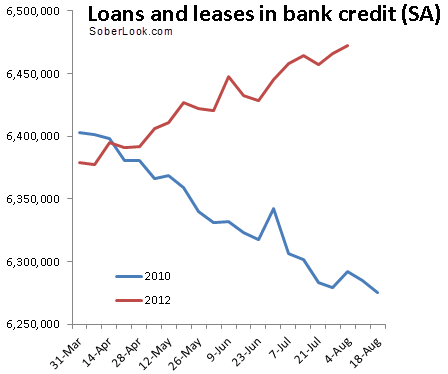
Woj’s Thoughts - Kurtz goes on to suggest that markets may sell-off if disappointed by Bernanke, but I’m not convinced. Expectations of further “stimulus” have consistently proven resilient when faced with no new information. Markets may therefore simply shift expectations of further action to September, October, December and on, or until enough FOMC voting members explicitly state action is not coming.  
Monday, April 9, 2012

Finding Common Ground

Steve Randy Waldman recently penned an encouraging post on the recent, heated debates in the econ blogosphere, posing the question, “Because the stakes are so small?” Waldman’s question refers to the common desire amongst various schools of economics to improve the current status quo in monetary and fiscal macro policy. The stakes in this game are a world with greater economic growth and less uncertainty about the future, goals that are certainly well worth the effort.

Waldman is the ultimate student of economics, striving to understand the strengths and weakness of different theories spanning Post-Keynesian, Market Monetarism, New Keynesian, MMT, Austrian and surely others. From his perspective, proponents of the different theories have much to gain from finding areas of common ground rather than arguing over their differences. The article offers a jumping off point for this discussion and is well worth a full reading.

The desire to highlight this blog post, in particular, is because my own intellectual pursuit in economics continues to include all of the various sects listed above. I’m often struck by the amount of overlap in thought process and general policy prescriptions, even if the details are, at times, worlds apart. Stemming from my personal experience, Post-Keynesians and Austrians often agree on the importance of private bank credit in determining business cycles. Market Monetarists and MMTers recognize the interplay and sometimes counteracting effects of monetary and fiscal policy. Nearly all the groups seem to prefer making both types of macro policy less ad hoc and more quickly responsive to business cycles. This is just the tip of the iceberg and I hope to read about and find far more similarities as I continue my studies.

Speaking of studies, I’m currently faced with the dilemma of choosing between two doctoral programs in economics that promote different types of heterodox economics. One program is more closely aligned with the Post-Keynesians, while the other is associated with the Austrian tradition. Waldman’s post offers hope that whichever program I chose, the opportunity will remain open to incorporate the best ideas among alternative theories. I certainly plan to seek alliances in my career and sincerely hope that many leaders in the field will follow Waldman’s lead in finding some common ground that helps improve outcomes for us all.  

Saturday, March 31, 2012

Points of Public Interest

This week’s best and most intriguing for your weekend reading:

  1. Krugman on (or maybe off) Keen
  1. Why Some Multinationals Pay Such Low Taxes
Insight into Google’s use of a “Double Irish Dutch Sandwich” and many other clever practices being used by GE, Microsoft, Apple, etc.
  1. WHY MINSKY MATTERS: Part One
A former student of Minsky’s elegantly outlines the important aspects for understanding the reality of our financial and economic system. More on Minsky: Was 'Post-Keynesian' Hyman Minsky an Austrian in Disguise?
  1. The worst anti-regulatory travesties in the financial sphere have had broad, bipartisan support
Without much fanfare, the “fraud-friendly JOBS Act” passed Congress this week with overwhelming support. William Black, a professor of law and economics, offers a history of anti-regulatory bills over the past several decades. If history is any guide, the JOBS Act will be front and center as having aided and abetted massive frauds during a financial crisis in the not too distant future. More on the JOBS Act: Bill Black: “The only winning move is not to play”—the insanity of the regulatory race to the bottom
  1. Liberating The Hunger Games and What Happened to Liberty in the The Hunger Games Movie?
What can I say...talk of The Hunger Games is everywhere these days!
  1. The Real Leadership Lessons of Steve Jobs

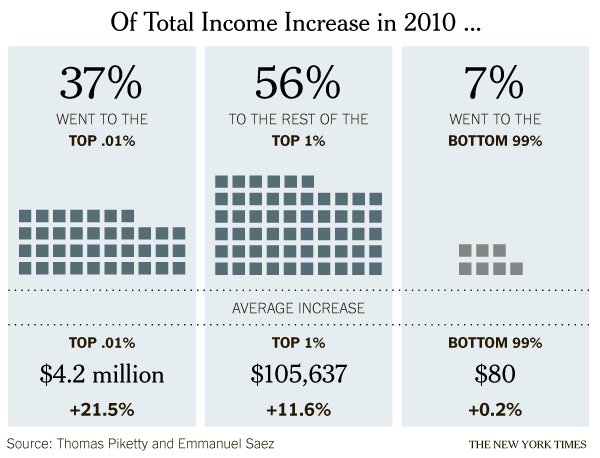
The bottom 99% fall further behind:

Source: NYT

Saturday, January 21, 2012

Points of Public Interest


  1. Money, credit and inflation - Sean Corrigan explains the difference between money and credit, highlighting the different nature of banks and individuals in creating credit. An often forgotten aspect of our current monetary system is that individual banks can create credit (which can turn into money) irrespective of Fed or Treasury policy. This unique ability generates the potential for inflationary and deflationary forces in the money supply outside of the federal government’s control.
  2. Death by Wealth Tax - Richard Epstein argues against the proposal for a wealth tax on assets.
  3. Trials and Errors: Why Science Is Failing Us - Jonah Lehrer details some failings in medicine stemming from the incorrect, basic “assumption—that understanding a system’s constituent parts means we also understand the causes within the system.” As Lehrer notes, centuries ago David Hume recognized a human desire to view the appearance of causation as an actual fact, rather than “fiction that helps us make sense of facts.” (HT: Russ Roberts)
  4. Debt, Deficits, and Modern Monetary Theory - Bill Mitchell, a founding member of Modern Monetary Theory (MMT), outlines the difference between MMT and mainstream economics. These differing conceptions about public debts and very important to the public policy battles in the news today. (HT: Neil Wilson)
  5. Peter Boettke on Austrian Economics - “Austrians want to talk about things like dispersed knowledge, heterogeneity, uncertainty – not just risk, but real uncertainty – and institutions, how institutions arise to allow us to cope with our ignorance and our uncertainty and to ameliorate the frictions that exist in the world.” Peter Boettke discusses contributions of Austrian economics and five books to read on the subject.

Sunday, January 15, 2012

Points of Public Interest

  1. Fundamental and Mathematical Case for Structurally High Unemployment for a Decade - Mish Shedlock exposes the declining labor force, despite population growth, as the main reason for the falling unemployment rate.
  2. Bubbles and Beauty Contests – To What Extent is Keynes Relevant to Investors? - Philip Pilkington uses one of Keynes’ best passages from the General Theory to show how most investors’ fool themselves into poor decisions.
  3. Why I’m feeling strangely Austrian - Gideon Rachman sheds light on some emerging trends in political/economic ideology (rightwing populist, social democratic-Keynesian, libertarian-Hayekian and anti-capitalist/socialist).
  4.  A slightly off-center perspective on monetary problems. Saving isn’t “setting money aside,” it’s BUILDING CAPITAL GOODS - Scott Sumner deals with some misconceptions about the actual meaning of saving as it relates to economics and economic statistics.
  5. European Identities Part II - Francis Fukuyama describes the real EU crisis as a lack of European identity. The relationship between people living in Kentucky and New York is far different than that of Greeks and Germans. He mentions the rise of populist governments as something troublesome to watch for in the years ahead.

Monday, August 15, 2011

Monetary Illusions


In Deflationary Monetary Policy, I argued that quantitative easing (QE) is not money printing and would therefore not lead to a sustainable increase in inflation. While that piece focused on the Federal Reserve’s expectation of maintaining zero percent interest rates, further explanation on the illusion of money printing is necessary. This concept will become far clearer once the distinction between money and money substitutes is proven.

Ludwig von Mises presented the foundations of monetary theory in his seminal work, The Theory of Money and Credit, nearly 100 years ago. Although his insights regarding inflation, deflation and exchange rates are equally enlightening, discussion of those topics will have to wait for another day. Understanding the actual effects of quantitative easing on the money supply first requires an understanding of Mises’ theory on the banking system.

Mises states that “the business of banking falls into two distinct branches: the negotiation of credit through the loan of other people's money and the granting of credit through the issue of fiduciary media, that is, notes and bank balances that are not covered by money. (p.146)” Further explanation of this latter branch of banking will help eliminate monetary illusions. To better display Mises’ concepts, some simple examples are necessary.

The first branch of banking is fairly straight forward. Person A deposits $100 in Standard Bank (fictional name). Standard Bank holds $5 as cash reserves and loans $95 to Person B to grow crops. In this situation, Standard Bank is merely acting as an intermediary between two parties and earning a small profit for bringing the two parties together. At the end of the loan period, Person B repays the principal amount plus interest to Standard Bank (hopefully having earned a small profit on selling crops). Standard Bank pays Person A interest on the deposit. The total cash (money) in the system started with $100 and ends with $100 plus interest (a return on capital).

Now consider the same situation above, but with a twist. After Standard Bank loans $95 to Person B, another loan of $100 is made to Person C. There is now a $100 deposit liability, $5 in reserves and $195 in loans. An obvious question that arises is, where did the extra $100 come from? Before answering this question, it’s imperative to consider the banking system in a larger economy.

Imagine an economy with one thousand people. On any given day, a number of people deposit funds, request loans or withdraw funds from various banks. Standard Bank currently holds $100,000 in deposits. On typical days, Standard Bank receives $1,000 in new deposits and withdrawal requests for $500. Since the bank can easily cover withdrawals on most days, Standard Bank is only required to maintain cash reserves of 5 percent. Out of $100,000 in deposits, the bank must only retain $5,000 in cash on hand. The other $95,000 can be lent out or invested at the bank’s choosing. Up until this point, the situation has not deviated from the initial example.

Once the bank has lent or invested the other $95,000, one might assume the bank can no longer make loans. This view happens to be incorrect, as a bank’s ability to make loans is not operationally constrained by its amount of capital. Standard Bank can still grant credit through issue of fiduciary media. Previously this form of loan might have included physical letters of credit or bank notes. In today’s electronic world, these credits may simply show up as numbers on a computer. Regardless, let us continue with the simulation.

Standard Bank, having already lent $95,000, provides new loans for another $100,000. These loans are not covered by money but still represent a current liability of the bank. A good question at this juncture is, why would anyone except this form of credit? The answer stems from confidence. As discussed earlier, most banks typically receive deposits in excess of withdrawal requests on any given day. Therefore, under common circumstances, customer repayment is practically guaranteed. As long as loans are invested productively, the bank also gets repaid in time. Confidence in the continuation of this pattern allows uncovered credit, or money substitutes, to be treated as money.

What happens if confidence in the bank is lost? Extending this concept to its natural limit will conclusively display the difference between money and money substitutes. Standard Bank starts the day with $100,000 in deposits, of which only $5,000 is being held in cash reserves. The other $95,000 has been loaned and another $100,000 of credit granted. This $195,000 in loans and credit has already been used in purchasing goods.

During the day rumors questioning the financial soundness of the bank begin to circulate. Customers holding deposits and merchants holding bank credit become nervous about the consequences of the bank’s potential bankruptcy. All claims holders rush to the bank and attempt to withdraw their money. At this point it becomes clear that the bank cannot repay all of the claims. Even if the bank sells its assets, the total equity of $100,000 will only cover half of the bank’s liabilities. Unfortunately for those remaining depositors and holders of credit, Standard Bank is bankrupt and the outstanding liabilities are worthless. The $100,000 of credit granted in fiduciary media has been entirely wiped out.

This example began with individuals depositing $100,000 in the bank and ended with an equal amount being returned, though not necessarily to the same individuals. In the interim, Standard Bank allowed the “granting of credit through the issue of fiduciary media” for another $100,000. Although $200,000 may have been circulating through the economy at various times, half remained “not covered by money.” This uncovered portion is best described as money substitutes.

Although this example ignores some details including the accrual of interest or potential losses on assets, the underlying concept is constant. All banks, including the Federal Reserve, have the ability to grant credit apart from any current capital. Confidence in the system allows individuals, corporations and governments to accept these money substitutes as forms of payment. However, as should be abundantly clear, if all parties were to request physical money in return, only a portion could actually be repaid.

In theory, banks could extend unlimited credit if confidence in the system was never questioned. History suggests this outcome is unlikely, as vast increases in fiduciary media will sow the seeds that create growing fear about the bank’s ability to repay. While extension of credit in this form can create temporary inflation, the extension of credit is actually a dilution of claims on real money. Without an increase in the real money supply (by the Treasury), the extension of credit and inflation will ultimately resolve itself through default and deflation.

Through quantitative easing the Federal Reserve Bank created fiduciary media, but not real money. Although the normal extension of credit through fiduciary media can create temporary inflation, the next post will further explain why quantitative easing is less effective in this task. Understanding the difference between money and money substitutes is critical to recognizing the effects of inflation versus deflation, appreciation versus depreciation of exchange values, and fiscal versus monetary policy. Monetary illusions have resulted in frequently poor allocation of resources and capital. Hopefully clearer recognition about the theory of money will lead to better policies, better investments and a better economy.