Showing posts with label Deflation. Show all posts

Friday, March 29, 2013

"Cyprus Should Leave The Euro. Now."

Yesterday banks in Cyprus opened for the first time in a week. Markets were seemingly calmed by the absence of immediate bank runs, however the ability of depositors to actually create a bank run has been prevented by strict capital controls. The real test for Cyprus banks will come when the capital controls are finally lifted. Although the restrictions are only supposed to be in place for 7 days, recent experience in Iceland suggests the better question is not when but IF the capital controls will be lifted. Based on the IMF’s recommendation, Iceland instituted capital controls back in 2008 for what was supposed to be a few months. Five years later the capital controls remain in place and are expected to continue for at least a couple more years. As a base case we should expect an announcement next week that Cyprus’ capital controls will remain in place for a few more weeks (possibly months).

While the implementation of capital controls presents an interesting storyline, Paul Krugman has raised a much bigger question into the public spotlight. After being challenged to expand the boundaries of political possibility, Krugman offered the following recommendation (emphasis added):
So here it is: yes, Cyprus should leave the euro. Now.
The reason is straightforward: staying in the euro means an incredibly severe depression, which will last for many years while Cyprus tries to build a new export sector. Leaving the euro, and letting the new currency fall sharply, would greatly accelerate that rebuilding.
The question for Cyprus is therefore whether “internal” or “external” devaluation offers the best prospects for the future? Let’s consider both of the options...

“Internal devaluation” (i.e. income deflation) - In return for continued assistance from the Troika (EU/ECB/IMF), Cyprus has agreed to impose losses on equity and debt holders, as well as uninsured depositors, of the two largest banks (Bank of Cyprus and Laiki Bank). This marks a distinct change in policy, especially with regard to the latter two groups.* Since uninsured depositors held a majority of those banks’ liabilities, the focus has naturally been on that group. Based on recent estimates uninsured depositors in the Bank of Cyprus may lose approximately 40%, while Laiki Bank’s uninsured depositors will be entirely wiped out.

The sharp reduction in (perceived) wealth stemming from these actions will put severe downward pressure on national income. Individuals and businesses experiencing losses will try to increase saving by reducing spending. Banks fearing deposit flight and falling asset prices will try build a stronger base of capital by restricting the supply of credit and possibly selling assets. Adding to the fall, the government will be forced to accept a MoU (Memorandum of Understanding) that establishes policies to increase taxes and reduce spending. Combining these deflationary pressures, the overall economic results may rival (or exceed) Greece’s recent history.

During the past 5 years Greece’s real GDP has declined by 20%
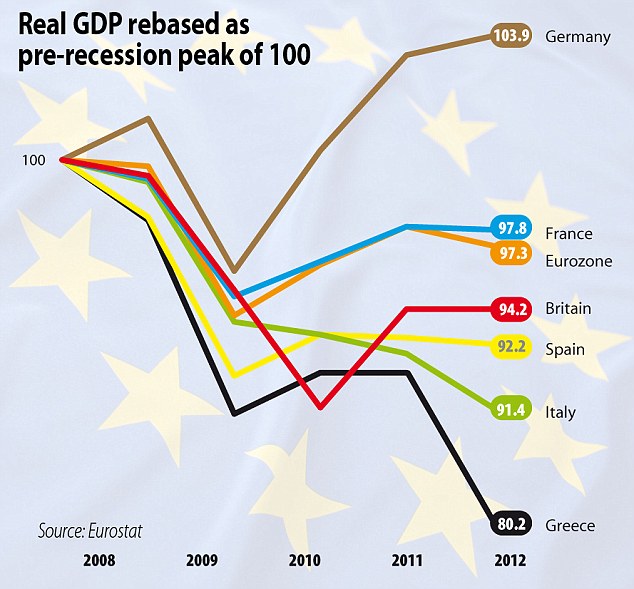
and unemployment has nearly quadrupled from ~7% to ~27%.


To offer some historical perspective, US unemployment during the Great Depression peaked at 25% and real GDP loss only exceeded 16% for one major European nation (Austria). Perhaps even more disheartening than the current data is recognition that output and unemployment appear unlikely to improve anytime soon.

Returning to Cyprus, unemployment has already quadrupled over the past 5 years (~3.5% to ~14%; shown above). Based on current estimates of a 20-30% drop in real GDP, Cyprus’ unemployment rate could easily approach or eclipse Greece’s in the next few years.

“External devaluation” (i.e. new currency) - If Cyprus were to leave the Eurozone, one of the first actions would be re-introducing the Cypriot pound at a heavily devalued rate against the euro. Not unlike the imposed losses on uninsured depositors, currency devaluation immediately imposes significant losses on all depositors. In this sense the impact on private demand would still be extremely deflationary, perhaps even more so. Though output and employment would fall dramatically, external devaluation presents reasons for potential optimism on both the foreign trade and government fronts.

Based on the recent bank losses and capital controls, Cyprus can no longer rely on its financial sector to support exports. By heavily devaluing its currency, Cyprus would be increasing its price competitiveness on the foreign market. However, as Barkley Rosser points out:
even with large elasticities [of trade relative to the exchange rate], there is the J-curve effect. Exports do not increase immediately, whereas the value of imports tends to jump up immediately with their price increases.
Aside from these timing issues, there is also a concern regarding the certainty of each effect. A large devaluation will definitely raise the cost of living for Cypriots but as JW Mason comments, it:
might not lead to higher net exports in the next few years, or ever. That’s the question -- not how big the devaluation would be, but how strongly it will affect trade flows.
As for the government sector, returning to the Cypriot pound would remove some of the current fiscal constraints. This would permit the government to increase spending (ideally investment in a new export sector) and not raise taxes, raising private sector income. While these adjustments will not come remotely close to overcoming the other deflationary effects in the short-run, the counterbalance provided will be a significant improvement over current policy.

In asking “Why Won’t Cyprus Obey Krugman?” Rosser concludes:
While this devaluation might make it easier for Cyprus to recover several years down the road, that recovery would indeed be several years down the road, and in the meantime there would be a lot of pain for the entire citizenry that will not happen if they stay with the euro.
If Greece has taught us anything about remaining with the euro, it’s that a lot of pain for the entire citizenry will happen regardless and a recovery may be decades down the road.

Cyprus is therefore faced with a choice between two terrible outcomes:
1) Remain in the Eurozone and experience a relatively slower “internal devaluation” whereby real output and employment experience large declines spread out over several years. A potential recovery is pushed even further into the future.
2) Leave the Eurozone and experience a quick “external devaluation” whereby real output and employment fall dramatically in the next year or two, but a recovery several years down the road becomes far more probable.

Where Rosser and I find agreement:
is that the real real issue here has to do with time preferences. It may get down to hyperbolic discounting. People do not want to have pain in the near term. So, the fear by the whole population of near term pain in terms of standard of living may outweigh fear of a more gradual decline with rising unemployment, even though the shorter term sharp pain is likely to lead to a sooner turnaround to growth.
Although this psychological tendency is very normal, it can at times be detrimental to achieving longer-term goals. The cases of Greece, Spain, Italy, Portugal, Ireland, and now Cyprus are examples of such times. The severe pain of reduced standards of living and high unemployment will be felt one way or another, but the option of “external devaluation” offers potential for a better future five and ten years down the road. Therefore I concur with Krugman, “Cyprus should leave the euro. Now.”        


* From my perspective, imposing losses on debt holders should have been done from the outset in the US and Europe. The apparent change in policy may raise costs of debt financing for the largest banks, but that should be a welcome change after years of enjoying a TBTF subsidy.

Friday, August 3, 2012

Bubbling Up...

1) How Good An Indicator Was "The Death of Equities" Cover
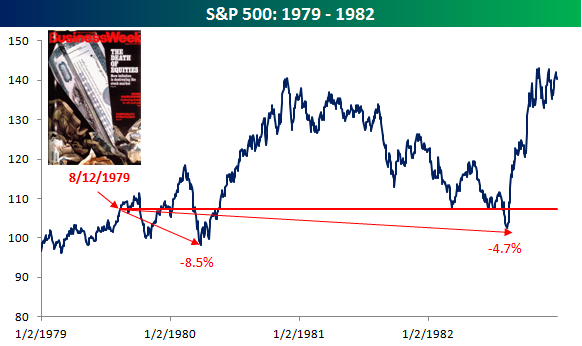
Just how good of a buying indicator was the BusinessWeek cover from 1979, though?  If you ask most investors about that cover story, they seem to remember that the market almost immediateley took off after the issue was published.  The reality, however, is that nearly eight months after the cover story was published, the S&P 500 was down 8.5%.  While the market did rally from that level, three years after the infamous BusinessWeek cover, the S&P 500 was still down nearly 5%.  It wasn't until 8/12/82 that the S&P 500 really took off and the bull market began in earnest.  Granted, time horizons have gotten a lot shorter in the last thirty years, but three years is an eternity in this market.


Woj’s Thoughts - Our memories can deceive us by filling in stories with logical steps. Cover stories often do mark extremes in sentiment, yet those extremes may persist for quite some time. As a signal for contrarian investors, recognizing this reality is critical.

2) Why I don’t believe housing has put in a secular bottom by Edward Harrison

For the bottom to be in you have to believe two things from a macro perspective. First, you have to believe that the overshoot phase to the downside has been arrested. Most bubbles end with a significant overshoot that makes it a no-brainer to tip a toe in the market. I think we are approaching those levels in markets like Phoenix. But we never really got down to reasonable levels in places like Washington or New York. Second, you have to believe any US recession is both remote in time and mild in duration/severity. I question this. I think any US recession will re-start the house price decline dynamic because consumers are still overindebted, interest rates are at zero percent, and mortgage rates are as low as they can get. My point is that from a cyclical perspective 2012 is as good as its going to get. Calling a bottom at the top of a cyclical bull market in asset prices and the economy is folly. Wait until the bottom of the cycle to make those calls.
Woj’s Thoughts - Early this year I made the claim, Don't Rush to Buy a Home! At the end of May I was Still Not Buying A Housing Recovery. Edward lays out many/most of the reasons for my continued lack of optimism on housing prices over the next couple years.
 
3) The Evolution of Treasury and Muni Bond Yields by Cullen Roche
I’ve discussed this in detail over the years and why the analysts crying for mass US state insolvencies were likely to be wrong, but now we have some interesting new analysis via VOX.  What’s depicted below is the 10 year US Treasury versus the 10 year muni bond index.  As you can see, the yields have an extremely high correlation – muni bonds practically ARE treasury bonds.  So why are yields surging in Italy, Spain, Greece and Portugal, but they’re remaining so tame in the muni market?  Simple – the US government, which can always procure funds via taxes and bond sales therefore making solvency a non-issue, provides substantial federal aid to the states every year.  While this doesn’t eliminate the solvency issue at the state level it certainly helps reduce it substantially.  Europe has no such mechanism in place so what you basically have is a bunch of US states in an environment where they’re left to fend for themselves.  They can’t print their own currency, they can’t devalue their own currency and they can certainly run out of Euros.  The result is bond investors who are terrified about default and end up selling bonds which only exacerbates the budgeting process.*
4) Microfoundations and the capital debates by Matias Vernengo
In that sense, heterodox (classical-Keynesian, by which I mean Sraffa’s prices cum Keynes/Kalecki’s effective demand) does have a coherent determination of long run prices, based on rational behavior, as the foundation of the macroeconomic theory. Markets do not produce optimal outcomes and unemployment of productive resources is the normal, long run, position of the economy. In fact, the capital debates not only say that classical political economy (the surplus approach) provides sound microfoundations, but also that it is NOT possible to do so within the neoclassical/marginalist paradigm.
Woj’s Thoughts - Previously I’ve argued against microfoundations in macroeconomics, but Matias places an interesting spin on the discussion. Quite possibly the issue is not the use of microfoundations but rather the poor choice of microfoundations.

5) Another Summer of Discontent: The Four Factors that Explain Why What We’re Doing Isn’t Working by Daniel Alpert

We must move from stabilize and reflate, to stabilize and recalibrate:
  • It is time for creditors throughout the developed world to finally take the write downs that have long been coming their way in connection with the trillions of dollars of truly un-payable household and sovereign debts that resulted from the credit bubble of the 2000s.  Yes, this will pressure lenders and, yes, they will need to be recapitalized to the detriment of their existing stakeholders.  But there is presently no shortage of capital seeking reasonable risk-adjusted returns, and I have every confidence that it will flow eagerly into the financial sector—if only the balance sheets of our institutions were honestly reckoned by having the currently unrecoverable carrying value of assets written down to that which can be recovered today from borrowers and/or underlying collateral.

  • As I have been saying and writing about for years, we must accept the reality of what the credit markets are telling the planet’s most creditworthy governments, particularly that of the U.S.  The message is “please, here, take our money…take it cheaply and keep it safe…we have no fear of lost purchasing power, the trend is not inflationary…now take it (and use it to fix your  economy).” And that is what we must do. We must take as much 30-year money at these depression level interest rates as we need to re-employ our underemployed workers directly, on public infrastructure projects that return benefits to the economy more than sufficient to repay the sums borrowed when the time comes.  The private sector will not hire until it sees a recovery in demand—so the only agent for re-employment of workers and regeneration of demand may, for an extended time until the imbalances at least decline somewhat, be our governments.  It is long past time to pack away austerity agendas.

  • And yes, we must address and manage the process of nominal price, wage and asset value declines. The advanced economies are experiencing the effects of a supply glut, a debt overhang, massive technology-induced productivity (soon to transfer to the emerging economies, worsening the glut), and aging populations. These are all disinflationary factors. And the aggregate effect of their contemporaneous existence is deflationary—full stop. Yet in relying on monetary intervention alone we are fighting the battle to control the pace of deflation (forget about reflation) with one hand tied behind our back.n  Instead of targeting growth in nominal GDP, which I am proclaiming here to be a futile endeavor, we must target renewed global competitiveness and, at the very least, growth in real GDP. That means both allowing our price and wage structures to align themselves with global supply and demand and, more importantly, feeding and nurturing investment in those areas of the private sector that can employ large numbers of people at market clearing wage rates. Especially in those sectors that are more readily protected by geography from global competition.

Tuesday, June 19, 2012

No End in Sight for Household Deleveraging


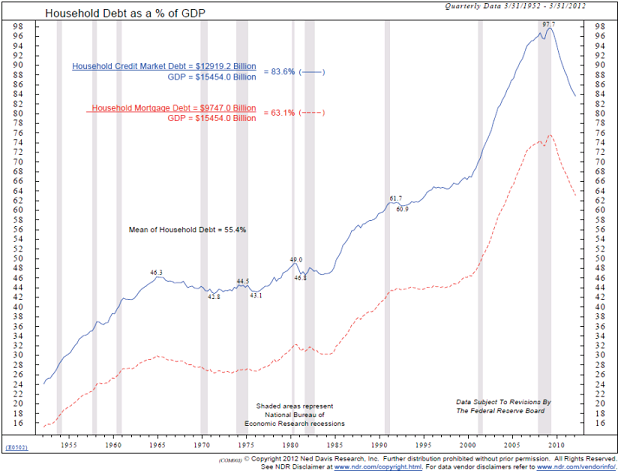
In our view, it is the overwhelming force of the debt deleveraging that has overcome government efforts to inflate. We have pointed out that household debt has dropped to 84% of GDP from its peak of 98% in 2008.  After rising for 284 consecutive quarters from the end of WW II to mid-2008, household debt has now declined for the last 16 quarters.  This is an astounding number, indicating a great change in the economy.  It still has a long way to go in order to reach the 66% level of 2000, let alone the 60-year average of 55%.  Households, therefore, have to continue to increase savings and reduce spending for, perhaps, years to come to get their balance sheets in order.  Since this reduces the demand for goods and services, businesses have little reason to hire new workers or increase capital expenditures.  Since household spending accounts for 70% of the GDP, the negative effects are felt throughout the economy. (emphasis mine)
Read it at Pragmatic Capitalism
DEFLATION REMAINS A BIGGER THREAT THAN HIGH INFLATION
By Comstock Partners

Over the past couple weeks, I have seen an increasing number of people argue that the private sector may be approaching levels of debt where credit expansion can once again begin in earnest. While countless others focus on the size of public debt, which is somewhat irrelevant for the US, the primary cause of the Great Recession and mediocre economy today was/is excessive household debt.

Unlike the US government, households cannot print money to repay their debts and therefore must rely on either income, savings or new borrowing. In the final stage of a bubble, termed “Ponzi finance” by Minsky, the last of these methods becomes the primary means of refinancing outstanding debt. When credit conditions eventually tightened, many households were forced to reduce consumption in order to repay previous debts. Unfortunately, when households attempt  to reduce debt through lower consumption in the aggregate, income decreases and the debt burden grows larger. The nature of this aggregate reduction in consumption is generally referred to as the “Paradox of Thrift” (a topic I’m told both Keynes and Hayek agreed on).

Having already written off massive losses on previous loans, private banks remain cautious in extending credit to households. Even though households have been deleveraging for 4 years, it will take at least another 4 years at the current pace to simply return debt levels to those existing in 2000. Returning to levels that preceded the Great Moderation may require another decade or more.

For the past several decades, private credit expansion has been the primary driver of economic growth. Government interventions, namely deficits, have been large enough the past few years to stabilize growth at a low level. If deficits continue to trend lower in the next couple years, the continued household deleveraging will once again spark fears of deflation. Given that current laws are already extremely supportive of private credit expansion, it’s hard to envision changes that would suddenly turn the tide. High inflation probably will return some day, but that day is a long way off. For now, disinflation remains the primary trend and deflation may still occur in the next few years.


Related posts:
Saving is NOT Enough for Consumer Led Recovery
Deflationary Monetary Policy

Friday, June 8, 2012

Mike ‘Mish’ Shedlock - Monopoly Money vs. Bernanke Money, is there a Difference?


If massive inflation was coming 10-year treasury rates would not be yielding a record low 1.60% and consumers would certainly not be deleveraging!
Might massive inflation be coming down the road?
Certainly, but it will take a change in attitude by consumers and banks or massively reckless policies by Congress.
Interestingly, Congressional policies are indeed "massively reckless" just not reckless enough yet. The emphasis is on "yet". I will not be a deflationista forever, but I remain one for now.
Read it at Mish’s Global Economic Trend Analysis
Monopoly Money vs. Bernanke Money, is there a Difference?
By Mike ‘Mish’ Shedlock

Mish argues that the Fed’s ability to generate inflation in practice is quite different from their theoretical ability. I couldn’t agree more.

Thursday, May 24, 2012

Talk of Deflation Begins


From a portfolio construction standpoint, the deflation/falling-price theme continues to suggest that protection of capital is a key strategy for a variety of asset classes.
Read it at Advisor Perspectives
The Deflation Trend
By Chris Kimble

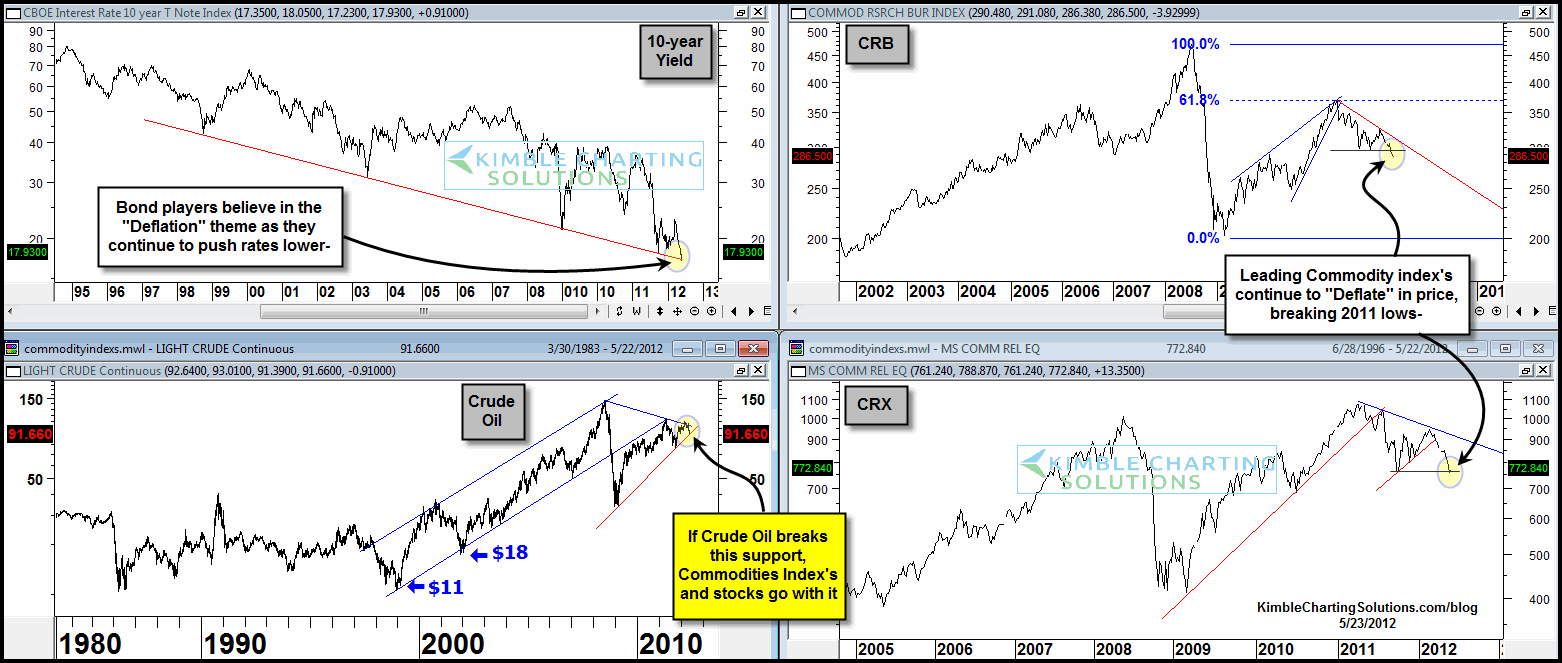
Yesterday on Twitter I asked, ‘How soon until talk of deflation begins again?” Well, I didn’t have to wait very long. The above post showed up in my Google Reader list later in the afternoon. As the charts depict, Treasury yields are approaching new lows while commodities continue to slump (e.g. copper, gold, oil). While I don’t believe we will see outright deflation anytime soon, the disinflation trend may be with us for some time.

Wednesday, April 25, 2012

Changing Our Basic Assumptions of Monetary Policy


It remains true that if there is inflation because there is too much spending-money, then the quantity of spending-money should be reduced. That is not true, however, if there is inflation because there is too much credit-use.
And it remains true that credit-use is good for growth when there is little credit-use. But when credit-use is already excessive, when debt is already excessive, increased credit-use is not likely to be an effective way to boost growth.
Even before policy can change, our basic assumptions must change.
Read it at the New Arthurian Economics
Something's Missing

By The Arthurian


Focusing solely on base money creation has led many individuals to incorrect predictions about inflation over the past several years. The amount of credit outstanding is a large multiple of spending money currently in the system (and of base money).
Declining credit use has been a major deflationary force during the past few years and excessive debt continues to pose significant risks for future economic growth. Meanwhile, government policies continue to encourage increasing credit-use, not recognizing the futility of these actions in solving a crisis caused by excessive credit. The Arthurian is spot on in expressing that our assumptions about monetary policy must change before any lasting resolutions can begin.

Sunday, April 1, 2012

Quote of the Week

...is from Irving Fisher’s remarkable work, The Debt-Deflation Theory of Great Depressions:

“Thus over-investment and over-speculation are often important; but they would have far less serious results were they not conducted with borrowed money. That is, over-indebtedness may lend importance to over-investment or to over-speculation. The same is true as to over-confidence. I fancy that over-confidence seldom does any great harm except when, as, and if, it beguiles its victims into debt.”
The first quarter of 2012 has officially come to an end with the S&P 500 logging its best quarterly performance since 1998. For the first three months of the year, the index gained an impressive 12%. With fears about a European debt crisis subsiding, confidence among investors that a new cyclical, and possibly secular, bull market is beginning is rising quickly. Each time the market tries to sell-off even 1% in a day, buyers jump in and reverse the trend. Analysts are also ratcheting up year-end expectations to match the intense rally currently taking place.

This combination of positive factors is seemingly creating an environment where investors once again believe they can’t lose. Central banks across the globe, most notably the Federal Reserve, have made clear the desire to push stock markets higher. Many investors believe the Fed will still engage in QE3 in the coming months, irregardless of high oil prices or rising inflation expectations. Overall there appears to be a strong level of complacency in global markets.

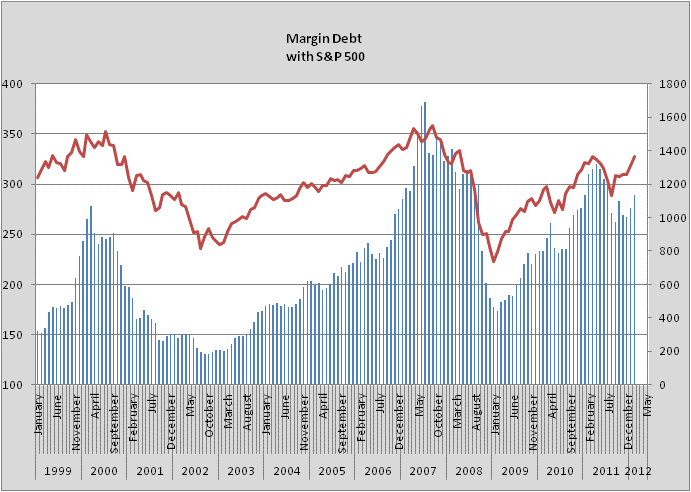
Nearly 80 years ago, Irving Fisher recognized the importance of private debt levels in exacerbating the inflationary, than deflationary effects of over-investment and over-speculation. As over-confidence once again stems from a perpetually rising stock market, investors are becoming more comfortable with increasing their level of debt. As the following chart shows, margin debt (blue lines) is following the stock market (red line) higher.

Source: (The Big Picture)

The last two market peaks, in 2007 and 2011, corresponded with margin debt rising above the $300 billion mark. Data for March, which has yet to be released, may show margin debt again eclipsing that level. Whether or not this signals another market top, the lesson of increasing debt is clear. When markets eventually turn, this borrowed money will accelerate moves to the downside.

Saturday, March 10, 2012

Points of Public Interest


  1. The Complexity of Hayek - Greg Fisher comments on similarities and differences between Hayek’s work and complex systems. Complexity theory is a fascinating subject I hope to study in the future.
  2. Social Security, the Financial Crisis & Modern Monetary Theory - John Carney continues to display how MMT, in focusing on the monetary system, forgets the many ways in which government can harm real economic growth and wealth.
  3. US Credit and Economic Views: It’s the Housing Market Stupid - Constance Hunter wisely notes the deflationary pressure of over $1 trillion in underwater mortgage debt. This remains a key aspect of my view that inflation will remain muted for several years.
  4. Tuning In to Dropping Out - Alex Tabarrok draws attention to the lack of college graduates in STEM fields and the disappointing level of dropouts both in high school and college. Focusing subsidies on STEM majors and offering “vocational” programs are a couple potential solutions for improving education within the US.
  5. GAO: Almost Half of Bailed Banks Repaid the Government With Money “From Other Federal Programs” - Matt Stoller examines the truth behind Treasury’s claims that “TARP made money.”
  6. For Profit Education, Pigs at the Trough - Russ Winter looks at how For Profit Education programs are abusing the government system to earn massive profits, while loading students with debt and only graduating around 33%.
  7. Josh’s Twenty Common Sense Investing Rules - Joshua Brown provides a great outline for individual investors, not traders.

Saturday, February 25, 2012

Points of Public Interest


  1. Restraining unit labor costs is a right-wing conspiracy - Steve Randy Waldman discusses how the Federal Reserve’s explicit actions are helping reduce labor’s share of output over time.
  2. The rule of more - A former professor of mine, Susan Dudley, is quoted on the subject of inconsistent cost-benefit analysis that allows the regulatory system to be gamed. (h/t Cafe Hayek)
  3. Keeping an Eye on Wealth Creation - Renowned investor Hugh Hendry continues to expect a Chinese hard landing and, most importantly, expresses his view that “ the road to hyperinflation is via hyperdeflation.”
  4. Hayek, Equilibrium and Complexity - Paul Omerod succinctly explains the importance of Hayek’s thinking to the study of complex systems.
  5. The Longest Quarterly Letter Ever - Legendary investor Jeremy Grantham offers his updated investment outlook and continues to recommend patience. (h/t Zero Hedge)

Saturday, January 21, 2012

Points of Public Interest


  1. Money, credit and inflation - Sean Corrigan explains the difference between money and credit, highlighting the different nature of banks and individuals in creating credit. An often forgotten aspect of our current monetary system is that individual banks can create credit (which can turn into money) irrespective of Fed or Treasury policy. This unique ability generates the potential for inflationary and deflationary forces in the money supply outside of the federal government’s control.
  2. Death by Wealth Tax - Richard Epstein argues against the proposal for a wealth tax on assets.
  3. Trials and Errors: Why Science Is Failing Us - Jonah Lehrer details some failings in medicine stemming from the incorrect, basic “assumption—that understanding a system’s constituent parts means we also understand the causes within the system.” As Lehrer notes, centuries ago David Hume recognized a human desire to view the appearance of causation as an actual fact, rather than “fiction that helps us make sense of facts.” (HT: Russ Roberts)
  4. Debt, Deficits, and Modern Monetary Theory - Bill Mitchell, a founding member of Modern Monetary Theory (MMT), outlines the difference between MMT and mainstream economics. These differing conceptions about public debts and very important to the public policy battles in the news today. (HT: Neil Wilson)
  5. Peter Boettke on Austrian Economics - “Austrians want to talk about things like dispersed knowledge, heterogeneity, uncertainty – not just risk, but real uncertainty – and institutions, how institutions arise to allow us to cope with our ignorance and our uncertainty and to ameliorate the frictions that exist in the world.” Peter Boettke discusses contributions of Austrian economics and five books to read on the subject.

Wednesday, September 7, 2011

Inflationary Outlook Resembles Depression Era

Yesterday I remarked that current economic troubles are reminiscent of the depression era that Keynes and Hayek lived through. At that time, Keynes believed that deflation would continue indefinitely and sought actions that might prevent a deflationary spiral. Despite Keynes' brilliance, there were many factors influencing the post-World War II global economy that he failed to foresee. An influx of cheap natural resources from abroad, expanding global trade, the baby boom generation and government deficits all helped reverse the deflationary trend and create nearly constant inflation in the US ever since.

Although the US appears on the verge of recession, Americans are more concerned with hyperinflation than outright deflation. Randall Wray, an economics professor at the University of Missouri-Kansas City (and fellow Wash U alum), explains why The prospects for inflation have not been smaller since 1930. Wray is one of the top economists today promoting Modern Monetary Theory (MMT), hence his views on inflation versus deflation deserve significant attention. As Wray points out (and I have detailed previously), a primary reason Americans fear inflation relates to a misunderstanding of recent monetary policy conducted by the Federal Reserve. One cannot accurately assess the impact of quantitative easing without understanding how bank reserves function in a modern monetary system. The linked piece offers a wonderful, yet simple explanation for the casual reader.

Ultimately, inflation or deflation is about the quantity of money chasing a certain number of goods. As Wray notes, significant unemployment, declining real income and large household debt imply the direct opposite of hyper, or even high, inflation. If Wray's outlook proves true, investors currently rushing into gold and other commodities will find themselves on the wrong end of the trade. For most individuals, this prognosis should not be taken as negatively as typical news commentary would have one believe. Over the past decade, Japan's real GDP growth averaged .8% per year, despite averaging .3% deflation. During the same period, U.S. real GDP growth averaged only 1.6%, with average inflation of 1.9%. Many other factors certainly impacted economic growth, however a majority likely favor the US, rendering the minor disparity even less noteworthy.

I urge those readers concerned about inflation or considering investing in gold to read through Wray's entire piece for a different perspective. Given the struggles presently facing the global economy, hyperinflation should be the least of our concerns. Once we stop fighting the problems we don't have, policy making can return to focusing on the problems we do.


Interesting note: During the decade discussed above spanning 2001 to 2010, the Fed almost perfectly achieved its long-run inflation target of 2% (based on core PCE inflation). Even though the Fed was successful, real GDP growth over that span was the weakest experienced since the depression. The period mentioned also witnessed violent swings in prices. One personal suggestion for the future, is that our society rethinks the goals of the Federal Reserve and monetary policy.

Monday, August 15, 2011

Monetary Illusions


In Deflationary Monetary Policy, I argued that quantitative easing (QE) is not money printing and would therefore not lead to a sustainable increase in inflation. While that piece focused on the Federal Reserve’s expectation of maintaining zero percent interest rates, further explanation on the illusion of money printing is necessary. This concept will become far clearer once the distinction between money and money substitutes is proven.

Ludwig von Mises presented the foundations of monetary theory in his seminal work, The Theory of Money and Credit, nearly 100 years ago. Although his insights regarding inflation, deflation and exchange rates are equally enlightening, discussion of those topics will have to wait for another day. Understanding the actual effects of quantitative easing on the money supply first requires an understanding of Mises’ theory on the banking system.

Mises states that “the business of banking falls into two distinct branches: the negotiation of credit through the loan of other people's money and the granting of credit through the issue of fiduciary media, that is, notes and bank balances that are not covered by money. (p.146)” Further explanation of this latter branch of banking will help eliminate monetary illusions. To better display Mises’ concepts, some simple examples are necessary.

The first branch of banking is fairly straight forward. Person A deposits $100 in Standard Bank (fictional name). Standard Bank holds $5 as cash reserves and loans $95 to Person B to grow crops. In this situation, Standard Bank is merely acting as an intermediary between two parties and earning a small profit for bringing the two parties together. At the end of the loan period, Person B repays the principal amount plus interest to Standard Bank (hopefully having earned a small profit on selling crops). Standard Bank pays Person A interest on the deposit. The total cash (money) in the system started with $100 and ends with $100 plus interest (a return on capital).

Now consider the same situation above, but with a twist. After Standard Bank loans $95 to Person B, another loan of $100 is made to Person C. There is now a $100 deposit liability, $5 in reserves and $195 in loans. An obvious question that arises is, where did the extra $100 come from? Before answering this question, it’s imperative to consider the banking system in a larger economy.

Imagine an economy with one thousand people. On any given day, a number of people deposit funds, request loans or withdraw funds from various banks. Standard Bank currently holds $100,000 in deposits. On typical days, Standard Bank receives $1,000 in new deposits and withdrawal requests for $500. Since the bank can easily cover withdrawals on most days, Standard Bank is only required to maintain cash reserves of 5 percent. Out of $100,000 in deposits, the bank must only retain $5,000 in cash on hand. The other $95,000 can be lent out or invested at the bank’s choosing. Up until this point, the situation has not deviated from the initial example.

Once the bank has lent or invested the other $95,000, one might assume the bank can no longer make loans. This view happens to be incorrect, as a bank’s ability to make loans is not operationally constrained by its amount of capital. Standard Bank can still grant credit through issue of fiduciary media. Previously this form of loan might have included physical letters of credit or bank notes. In today’s electronic world, these credits may simply show up as numbers on a computer. Regardless, let us continue with the simulation.

Standard Bank, having already lent $95,000, provides new loans for another $100,000. These loans are not covered by money but still represent a current liability of the bank. A good question at this juncture is, why would anyone except this form of credit? The answer stems from confidence. As discussed earlier, most banks typically receive deposits in excess of withdrawal requests on any given day. Therefore, under common circumstances, customer repayment is practically guaranteed. As long as loans are invested productively, the bank also gets repaid in time. Confidence in the continuation of this pattern allows uncovered credit, or money substitutes, to be treated as money.

What happens if confidence in the bank is lost? Extending this concept to its natural limit will conclusively display the difference between money and money substitutes. Standard Bank starts the day with $100,000 in deposits, of which only $5,000 is being held in cash reserves. The other $95,000 has been loaned and another $100,000 of credit granted. This $195,000 in loans and credit has already been used in purchasing goods.

During the day rumors questioning the financial soundness of the bank begin to circulate. Customers holding deposits and merchants holding bank credit become nervous about the consequences of the bank’s potential bankruptcy. All claims holders rush to the bank and attempt to withdraw their money. At this point it becomes clear that the bank cannot repay all of the claims. Even if the bank sells its assets, the total equity of $100,000 will only cover half of the bank’s liabilities. Unfortunately for those remaining depositors and holders of credit, Standard Bank is bankrupt and the outstanding liabilities are worthless. The $100,000 of credit granted in fiduciary media has been entirely wiped out.

This example began with individuals depositing $100,000 in the bank and ended with an equal amount being returned, though not necessarily to the same individuals. In the interim, Standard Bank allowed the “granting of credit through the issue of fiduciary media” for another $100,000. Although $200,000 may have been circulating through the economy at various times, half remained “not covered by money.” This uncovered portion is best described as money substitutes.

Although this example ignores some details including the accrual of interest or potential losses on assets, the underlying concept is constant. All banks, including the Federal Reserve, have the ability to grant credit apart from any current capital. Confidence in the system allows individuals, corporations and governments to accept these money substitutes as forms of payment. However, as should be abundantly clear, if all parties were to request physical money in return, only a portion could actually be repaid.

In theory, banks could extend unlimited credit if confidence in the system was never questioned. History suggests this outcome is unlikely, as vast increases in fiduciary media will sow the seeds that create growing fear about the bank’s ability to repay. While extension of credit in this form can create temporary inflation, the extension of credit is actually a dilution of claims on real money. Without an increase in the real money supply (by the Treasury), the extension of credit and inflation will ultimately resolve itself through default and deflation.

Through quantitative easing the Federal Reserve Bank created fiduciary media, but not real money. Although the normal extension of credit through fiduciary media can create temporary inflation, the next post will further explain why quantitative easing is less effective in this task. Understanding the difference between money and money substitutes is critical to recognizing the effects of inflation versus deflation, appreciation versus depreciation of exchange values, and fiscal versus monetary policy. Monetary illusions have resulted in frequently poor allocation of resources and capital. Hopefully clearer recognition about the theory of money will lead to better policies, better investments and a better economy.

Wednesday, August 10, 2011

Deflationary Monetary Policy


“The first requirement is that the monetary authority should guide it-self by magnitudes that it can control, not by ones that it cannot control. If, as the authority has often done, it takes interest rates or the current unemployment percentage as the immediate criterion of policy, it will be like a space vehicle that has taken a fix on the wrong star. No matter how sensitive and sophisticated its guiding apparatus, the space vehicle will go astray. And so will the monetary authority.”
-The Role of Monetary Policy by Milton Friedman


On Sunday I outlined a game plan for the week with expectations of increasing volatility. Needless to say the first two days have far exceeded my imagination. While most investors watched in disbelief on Monday as markets sank over 6 percent, yesterday’s nearly 9 percent reversal from overnight lows was even more remarkable. For those unaware, after China reported higher than expected inflation, S&P futures tumbled from 1111 to 1077. By the market open, futures had roared back to 1138. After stumbling near flat, the market surged another 30-plus points. Following the Federal Reserve’s statement, trading ranges expanded dramatically with the market initially selling off nearly 50 points before rallying back 75 to ultimately close almost 5 percent higher. Volatility certainly appeared heightened by the Fed meeting and their semi-policy change is worth further consideration.

Over the past several days, an increasing number of investors and economists have been calling for the Fed to enact QE3. When the Fed initially decided to apply quantitative easing (QE), market liquidity had dried up and financial institutions were witnessing modern day bank runs. QE was an effective means for exchanging liquid assets (Federal Reserve notes) in return for illiquid (generally devalued) securities. Responding to a liquidity crisis, QE was well directed and ultimately successful.

Last summer the economic recovery showed deterioration and stock markets sold off substantially. Renewed Fed intervention involved another round of quantitative easing aimed at reducing interest rates and increasing asset values. If successful, these measures would generate increasing consumption and debt while lowering savings. This policy was ill-advised as the economy no longer suffered from a liquidity crisis, but rather a balance sheet recession in which excessive private debt decreases aggregate demand.

Beyond being misguided, QE2 was also poorly understood by much of the general public. Common conception is that quantitative easing is inflationary money printing. However, as noted earlier, quantitative easing (as practiced) is strictly an asset swap between the Federal Reserve and banks. Operationally, QE2 simply involved the Fed exchanging interest-bearing Federal Reserve notes for treasury notes. Net financial assets were not actually increased during this process. Quantitative easing therefore involves no money printing, simply swapping assets.

Misunderstanding the Fed’s policy as inflationary, markets sold dollars and bid up asset prices. Unfortunately for the Fed, markets viciously bid up prices of real assets including food and energy. With many households still over-burdened by debt and high unemployment restraining income growth, these increasing costs actually reduced demand for other goods. This recognition is likely why the Fed correctly believes higher inflation will be temporary. Reviewing recent GDP and unemployment data, it’s patently false that QE2 had a significant, if any, positive economic impact.

An obvious follow up question, why are people demanding QE3? One argument claims that dollar devaluation increases exports and as a byproduct, economic growth. Ludwig von Mises and Frédéric Bastiat (among others) clearly disproved this notion decades ago, but I’ll save that topic for another day. Others hold out hope that wealth effects create far larger multipliers than most economic research shows. Another group believes simply doing something is better than nothing. In spite of requests, the Fed thankfully did not proceed with QE3 (at least not yet).

So what did the Fed do? Well, in some ways nothing and in some ways everything. From their statement:

The committee currently anticipates that economic conditions—including low rates of resource utilization and a subdued outlook for inflation over the medium run—are likely to warrant exceptionally low levels for the federal funds rate at least through mid-2013”

Although not explicitly stating interest rates will remain “exceptionally” low through mid-2013, markets reacted as such. In Treasury Yields Low for Good Reason, I noted that “interest rates are a function of the expected rates over that time period.” Hence shifting expectations for 0 percent rates through 2013 sent treasury yields plunging, with 10-year notes briefly touching an all-time low of nearly 2 percent. Longer-term inflation expectations also moved higher, devaluing the dollar and creating a surge in equity markets. Impressively, without committing to actual policy change, the Fed effectively generated the impact of QE (at least for a day) with some wisely chosen words.

This post began with equally wise words from Milton Friedman, chosen specifically from his paper, The Role of Monetary Policy, which outlines my greatest fear of the new Fed policy. Friedman posits that monetary policy is unable to control real interest rates, apart from short periods, which remain relatively stable over longer time horizons. Since economic capital is only produced if expected returns are positive, real interest rates must be positive in the long-run. Monetary policy, as determined by the Fed, sets nominal interest rates. Friedman’s theory implies that long-term nominal interest rates are equivalent to long-run real interest rates plus inflation. Therefore a “monetary authority could assure low nominal rates of interest--but to do so it would have to start out in what seems like the opposite direction, by engaging in a deflationary monetary policy.”

In 1996 the Bank of Japan (BOJ) lowered benchmark interest rates to 0.5 percent, attempting to jump start economic growth stunted by debt deleveraging. Over 15 years later the benchmark interest rate sits at 0 percent, having never exceeded 0.5 percent during that span. Given Friedman’s framework, if long-run real interest rates are around 1 percent, then maintaining an effectively 0 percent nominal interest rate requires Japan to experience small, consistent deflation. Japan’s economic record the past decade displays confirming evidence of this assumption.

During the financial crises of 2008, the Fed lowered its benchmark interest rate practically to 0. Although initially expected to be temporary, yesterday’s projection portends retaining a lower bound rate policy for at least 5 years. If structural changes are not made, a weak economy could keep Fed rate hikes on hold far longer. As Friedman theorized and Japan bore witness, maintaining low nominal interest rates is ultimately deflationary.

What I find most discouraging is that the names of Keynes, Hayek and Friedman are highly revered today, yet much of their work and philosophy appears to have been lost in translation. Monetary policy today focuses on both fronts Friedman argued would lead the “space vehicle...astray.” Avoiding an outcome similar to Japan requires policy makers to recall the great economic minds of the 20th century. As the philosopher George Santayana said, "those who cannot remember the past are condemned to fulfill it."