Showing posts with label Japan. Show all posts

Wednesday, February 20, 2013

(Late) 2013 Predictions

Last year I took a chance and threw my own projections into the ring. Similar to Byron Wien and Edward Harrison, I mostly selected events that were widely seen as having a low probability (less than 33%) but which I believed held a greater than 50% chance of occurring. The final results were a bit disappointing, but that won’t stop me from trying again this year. Since these predictions already represent a late release, without further adieu, here are the 2013 predictions:

1) Spain requests access to ECB’s OMT - Since ECB President Mario Draghi announced the OMT program, yields on Spanish debt have fallen rather dramatically. Although this eases financing pressure, it has done little to alter the actual economy’s downward spiral. During 2012 Spain’s GDP growth became increasingly negative, falling by 1.8% year-on-year in the fourth quarter. Meanwhile unemployment continues its meteoric rise to over 26% for the general population and nearly 60% for youth. With the large banks still severely undercapitalized and households over-indebted, private sector lending continues to decline:
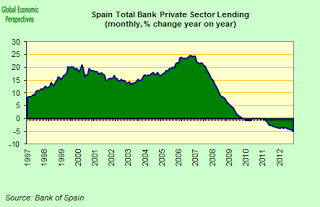


Seeing no recovery and potentially a worsening decline, “bond vigilantes” will eventually test Draghi’s threat. At that point Spain will be forced to accept a Memorandum of Understanding (MoU) in return for ECB bond-buying through the OMT program.

2) The Euro finishes the year above $1.30 - After falling nearly 10% during the first half of 2012, the euro has more than recouped its losses on the back of optimism and deflationary policies.
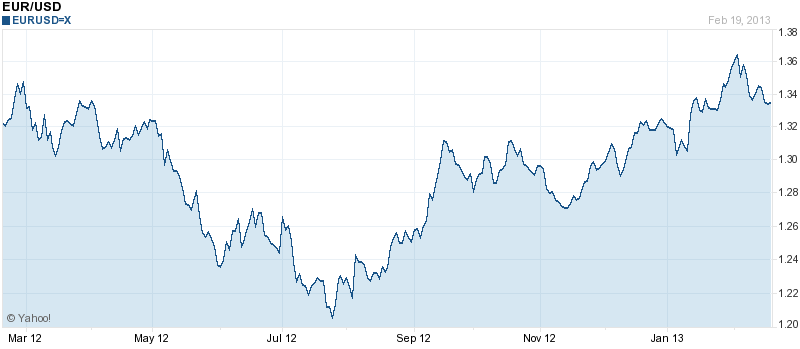
At points during 2013 the optimism is likely to fade, but I expect politicians and central bankers will take the necessary steps to quell fears for the time being. Unfortunately those steps will involve further deflationary policies that push the euro higher. These competing forces will largely cancel out, leaving the euro close to or above where it began the year.

3) The Eurozone remains in recession the entire year - Forecasters now expect euro-zone economic activity to be flat this year, down from a previous prediction of 0.3% growth made just three months ago. Last year saw practically continuous downgrades to GDP growth forecasts and I expect this year to be no different. Austerity measures are momentarily easing, but more will likely be enacted based on the outcomes of several elections. The recent appreciation of the euro against several major currencies will also dampen growth by putting pressure on net exports. With banks across Europe trying to build up capital and persistently high unemployment, the private sector will remain especially weak. Though Germany may experience a temporary rebound, the Eurozone as a whole will not register GDP growth this year.

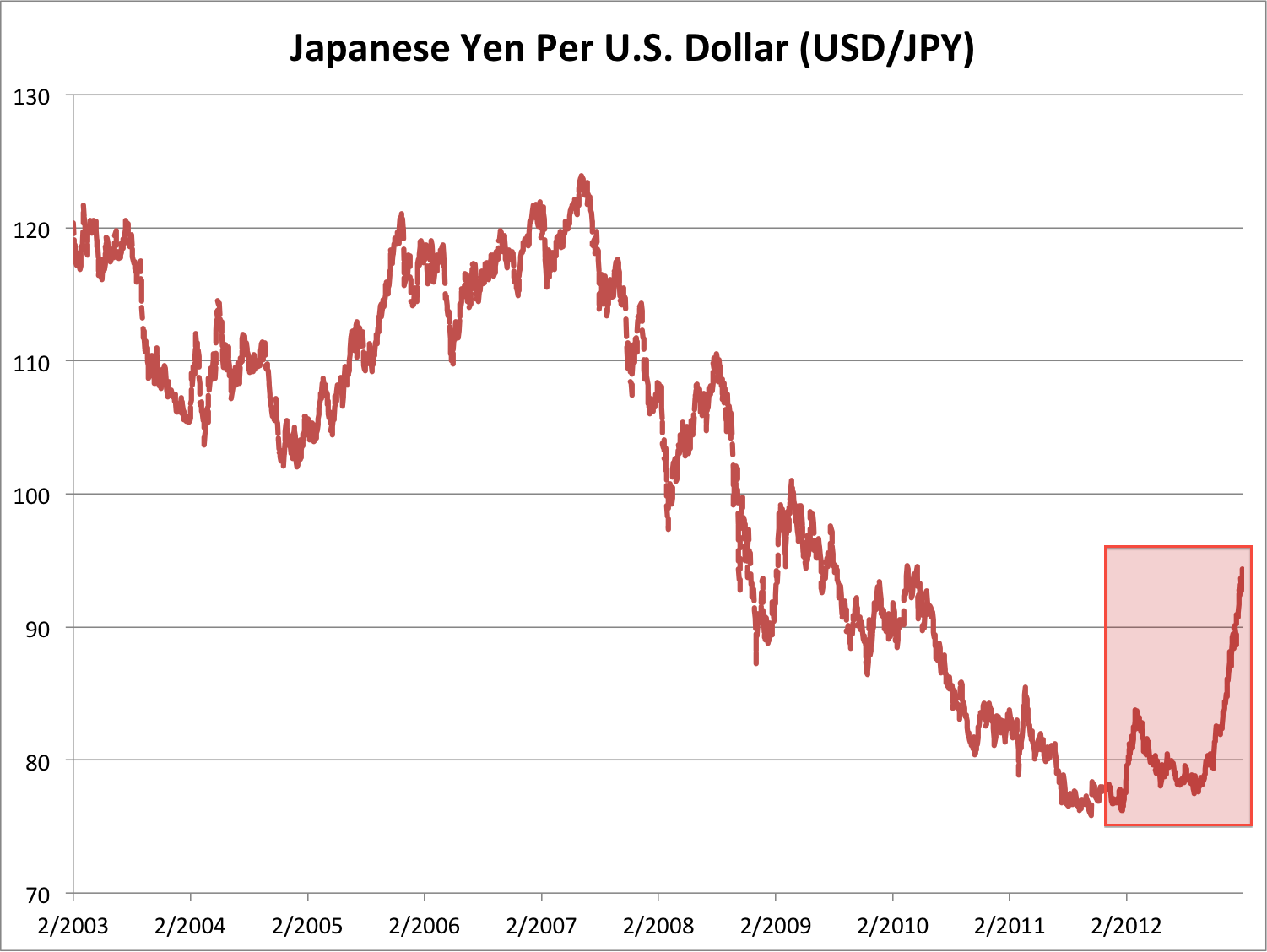
4) The Japanese yen rises above 90 per $ - Since the election of PM Shinzo Abe, the yen has fallen fast and is down more than 20% from recent highs.
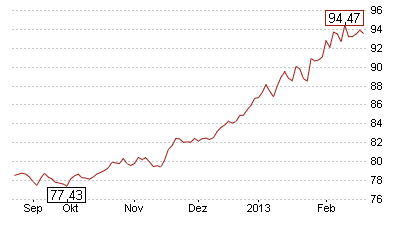
During this time the Nikkei has risen more than 20%, yet yields on Japanese sovereign debt are little changed. This suggests many foreigners may be speculating on the supposedly forthcoming monetary and fiscal stimulus. As previously stated, the fiscal stimulus will probably be small and short-term. On the monetary front, short of actually entering the foreign exchange market, the Bank of Japan (BOJ) has essentially no mechanism to spur inflation and thereby cause a sustained depreciation of the yen. When market participants recognize the inability of Japan to avoid continued deflation, the yen will return to appreciating against the dollar.

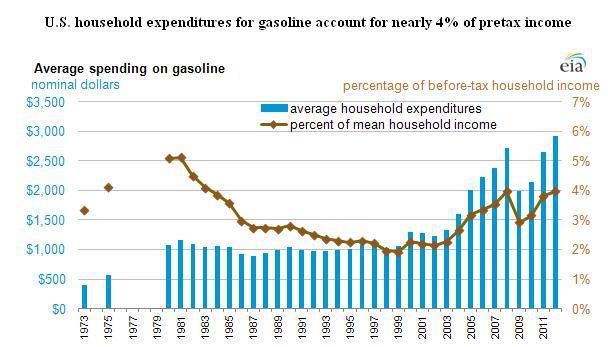
5) Gas prices will peak above $4.20 per gallon and set a new yearly record-high average above $3.75 per gallon - Gasoline prices have been on the rise for the past 31 days, currently averaging approximately $3.75 per gallon. Though this current streak will probably end soon, prices are unlikely to give back much of the gains before beginning the typical rise into summer. The ongoing potential for flare ups in the Middle East will keep prices elevated throughout the year. Higher gas prices, which already account for 4% of before-tax household income (chart below), will be a drag on consumer spending in 2013.

6) U.S. Yearly GDP growth falls below 1.5% - Forecasts of ~3% annual GDP growth over the past couple years have been overly optimistic as real growth in 2011 and 2012 was merely 1.6% and 1.9%, respectively. Apparently forecasters are being a bit tamer in their estimates this year, now expecting only 2% annual growth. Unfortunately I suspect these estimates will once again prove too optimistic. Various tax hikes and the upcoming sequester (which will go through in some respect) will reduce the budget deficit by a few percent this year. Housing is likely to remain a bright spot, but further declines in interest rates will not lead to similar magnitudes of the wealth effect. Credit remains tight for many households and small business, which should also limit private sector activity. All of these factors combined will probably not be enough to bring about a new recession but will lead to the lowest annual growth rate during this upswing.
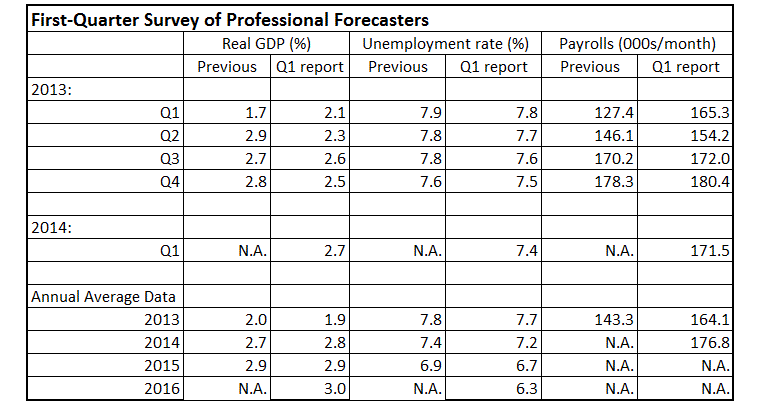

7) U.S. Unemployment rises above 8% - Currently sitting at 7.9%, the unemployment rate is forecast to decline during 2013. Due to weaker GDP growth, corporate revenues will barely rise again this year. As companies face increasing pressure to maintain profit margins at record levels, a new wave of layoffs may occur. Separately, continuing economic growth will encourage previously discouraged workers to re-enter the job market. Both of these factors will lead to slightly higher measured unemployment.

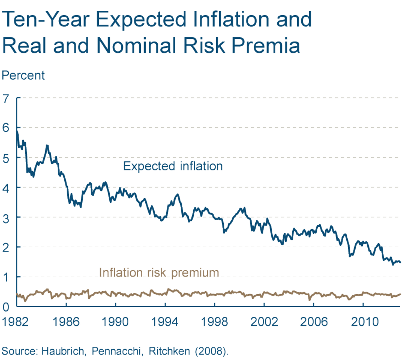
8) Federal Reserve forecasts shift first rate hike to 2016 - After extending their forecast for the first rate hike to 2015, the Federal Reserve changed its tactics to a more rule-based monetary policy. The Fed has, in effect, promised to keep rates low until we've hit either 6.5 percent unemployment or 2.5 percent inflation. Based on the above outlook for unemployment and a continuing decline in inflation expectations (chart below), FOMC members will revise their own forecasts and push back expectations for the first rate hike.

9) U.S. Corporate Earnings (ex-Federal Reserve) finish year below 2012 peak - Meager revenue growth was not enough to prevent U.S. Corporate Profits after tax from reaching record highs in the fourth quarter of 2012 on the back of record profit margins. US Corporate Profits After Tax Chart

As global growth slows in 2013, revenues will come under further pressure. At this point the ability of firms to continue cutting costs without sacrificing output seems limited, which means margins may begin to compress. As margins revert to previous norms, earnings will register a yearly decline.

10) Bonds outperform stocks - During the first seven weeks of this year the stock market has been on fire, even though earnings estimates continue to fall.
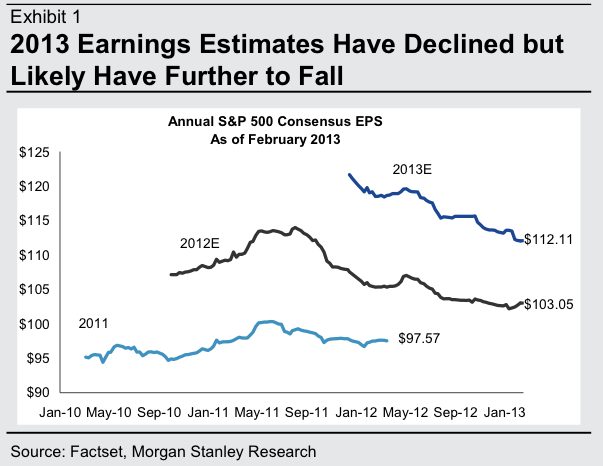

Multiple expansion is currently being driven by the Federal Reserve’s actions despite their ineffectiveness at generating actual NGDP growth. When investors eventually turn their attention to continuing troubles in Europe, ongoing deflation in Japan, and/or weakening growth in China, U.S. earnings may once again enter the picture. Recognition that S&P 500 earnings growth has slowed substantially may cause the market to give up much of this year’s gain. These concerns combined with declining inflation expectations will result in many investors returning to the safety of U.S. Treasuries. The subsequent rise in prices (decline in rates) will generate another year of positive returns for the Treasury market.


Will my predictions prove too pessimistic once again? Only time will tell...

Friday, February 15, 2013

Exchange Rate Intervention Is Gaining Popularity, Again


1) Musings on MMT - Firming Up The Soft Bits by Neil Wilson @ 3spoken
Effect on the Exchange Rate

The problem here I think is a matter of viewpoint. The world is a closed system. Each individual monetary area operates within that closed system. So if you press in one area, the results of that will pop up somewhere else in the world.
The world can be modelled as an interacting set of non-convertible floating rate monetary systems (with pegged nations treated as part of the currency area they are pegged to). So that means for your currency to go down all the others have to go up. It only takes the central bank of one of the other areas to start buying your currency to halt that decline.
And if a currency area has an export led policy, then they will intervene to assist their exporters by providing liquidity in the currency the exporters actually want - their own. This is pretty much what the Swiss did against the Euro, and frankly as the Chinese central bank does against pretty much everything.
So I think the driver is not so much demand for your currency, as desire to access your market by foreign exporters. And that is obviously linked to how wealthy your country is perceived by export-led nations. (my emphasis)
Woj’s Thoughts - Recently I’ve spent significant time thinking about exchange rate movements in relation to the current monetary system. My initial impression was that two separate theories may be necessary to explain the effects of trying to depreciate or appreciate a given currency. Neil’s observation in bold may provide a common link to explain observed changes. The focus on exports (trade) does, however, leave out demand for access to financial markets as a potential driver. While this may only be meaningful for the largest developed countries, all of these questions will require further exploration.

2) a word on the euro, US deficit doves, and Japan by Warren Mosler @ The Center of the Universe
Japan’s weak yen, pro inflation policy seems to have been all talk with only a modest fiscal expansion to do the heavy lifting. Changing targets does nothing, nor does the BOJ have any tools that do the trick as evidenced now by two decades of using all those tools to the max. And while I’ve been saying all the while that 0 rates, QE, and all that are deflationary biases that make the yen stronger, there is no sign of that understanding even being considered by policy makers, so expect more of same. What has been happening to weaken the yen is a quasi govt policy of the large pension funds and insurance companies buying euro and dollar denominated bonds, which shifts their portfolio compositions from yen to euros and dollars, thereby acting to weaken the yen. I have no idea now long this will continue, but if history is any guide, it could go on for a considerable period of time. Yes, it adds substantial fx risk to those institutions, but that kind of thing has never gotten in the way before. And should it all blow up some day, look for the govt to simply write the check and move on.
Woj’s Thoughts - Though I expect the yen to strengthen a bit by the end of the year, the willingness of Japanese pension funds and insurance companies to continue increasing fx risk remains a wildcard. Considering the large negative impact on GDP from declining exports in the fourth quarter, it will be interesting to see what effect the weakening yen has on Japan’s trade balance going forward.


Thursday, February 14, 2013

Will the Bank of Japan End Up Owning the Entire Stock Market?

Japan Does the Full Ponzi by Cullen Roche @ Pragmatic Capitalism
I saw this headline over at Calculated Risk regarding the new “monetary policy” in Japan:
And from the Japan Times: Japan’s economic minister wants Nikkei to surge 17% to 13,000 by MarchEconomic and fiscal policy minister Akira Amari said Saturday the government will step up economic recovery efforts so that the benchmark Nikkei index jumps an additional 17 percent to 13,000 points by the end of March.“It will be important to show our mettle and see the Nikkei reach the 13,000 mark by the end of the fiscal year (March 31),” Amari said in a speech.The Nikkei 225 stock average, which last week climbed to its highest level since September 2008, finished at 11,153.16 on Friday.“We want to continue taking (new) steps to help stock prices rise” further, Amari stressed …
…
Yes, the Bank of Japan might create some real wealth (for some market participants) in the near-term and might thereby make Japan appear better off than they really are, but there’s absolutely no underlying fundamental change in the corporations that make up this index that should lead one to believe that these price changes are justified.  And when the Ponzi scheme is exposed the market collapses thereby destroying wealth for all the current participants leaving us right back where we started.
This is ponzi based monetary policy.  It’s based on a false understanding of market dynamics, a false understanding of real wealth, and it’s very likely to cause disequilibrium in the long-term.
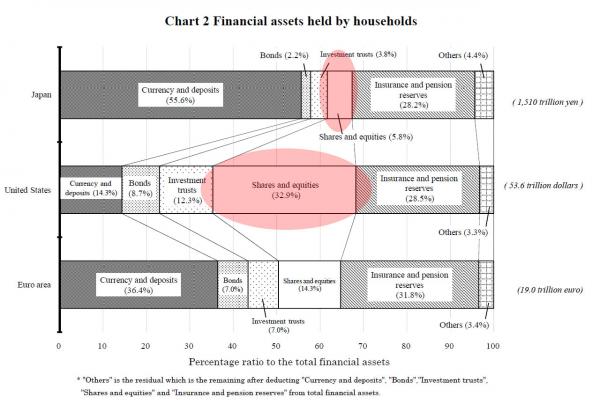
Woj’s Thoughts - While these comments made investors giddy, as expected, I can’t help but feeling that the continued onslaught of “open mouth” operations from Japanese officials is masking their deficient understanding of modern monetary economics. If wealth effects from higher stock prices are largely irrelevant in the U.S., what are the odds the effect will be greater in Japan where equities play a much smaller role in household portfolios?


As Niels Jensen makes clear in his most recent investor letter, the Nikkei’s recent surge combined with a plunging Yen suggests the pressures in both markets are arising primarily from foreign investors.

Prior to PM Abe taking office I was skeptical of fiscal and monetary policies actually being enacted that would materially raise either inflation or real GDP growth (effectively NGDP). Since then a minor fiscal stimulus package was announced along with a higher inflation target and commitment to future QE. Looking beyond the initial market optimism, none of these measures will actually generate the economic results to match the widespread wishful thinking. Fourth quarter NGDP was just recently announced at zero percent and real GDP fell for the third consecutive quarter. Unless further drastic policy actions are taken, I suspect future quarters will more closely resemble the current quarter than the hoped for 4% NGDP growth.

(Note: Cullen describes Japan’s theoretical new policy as a Ponzi scheme, but I think that terminology may be incorrect in this situation. Since the Bank of Japan (BoJ) can create an unlimited supply of reserves, it does not require any new lending to continually maintain any price for the Nikkei it chooses. The scariest outcome is not that the scheme would collapse, but that the BoJ would end up controlling all currently public corporations.

To be clear, I doubt that outcome would happen in practice. The more likely endgame is that the policy becomes politically unacceptable and then the BoJ retracting its price target leads to a spectacular (ponzi-esque) crash.)

Tuesday, January 22, 2013

Myth Busting Japan's Lost Decade

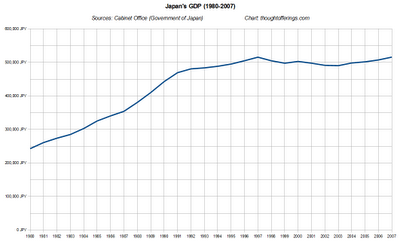
Lord Keynes, at Social Democracy for the 21st Century, provides data on Japanese Real GDP Growth from 1925–2001 and notes the following:
In the 1980s, Japan engaged in ill-conceived financial deregulation (Fukao 2003: 134–135), which was one major cause of the asset bubble in these years (although poorly designed tax policies and monetary policy were clearly involved too). The collapse of the asset bubble and the balance sheet recession (a form of debt deflationary crisis) caused the “lost decade.”
From the data above, we can see that the “lost decade” was really an era of low growth, not continuous negative growth. Japan was not in recession from 1993–1997, but had serious deleveraging problems, a banking crisis, and debt deflation.
Many myths have arisen about the lost decade, and one of them is that Keynesianism somehow “failed” to work in this era. That is nonsense. If anything, Keynesianism saved Japan from a terrible depression. In fact, when fiscal stimulus was abandoned for austerity in 1997, the economy plunged into a recession in 1998.
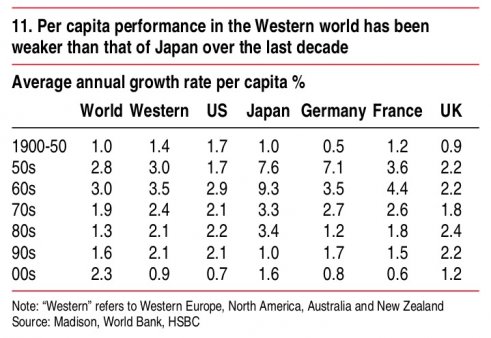
Of the myths regarding Japan’s lost decade (now decades), I’ll admit to having been unaware that 1998 marked the first year of negative real GDP growth since 1974 (and only second since 1945!). Since then, Japan has unsuccessfully tried to get on a fiscally sustainable path (whatever that means) as more frequent recessions have led to larger budget deficits (and growing debt/GDP) that merely prevent larger economic declines. Despite the persistence of misguided fiscal (and monetary) policy, Japan’s per capita economic growth has remained on par with the Western world.  
With nonfinancial private sector balance sheets largely repaired, Japan appears poised to continue leading the Western world if government policies improve. Unfortunately last night’s Joint Statement of the Government and the Bank of Japan on Overcoming Deflation and Achieving Sustainable Economic Growth shows the lessons of a previous age remain forgotten.

Thursday, January 3, 2013

Bubbling Up...1/3/13

1) Fluffing off a Trillion Dollars. And a Third Thing by The Arthurian @ The New Arthurian Economics
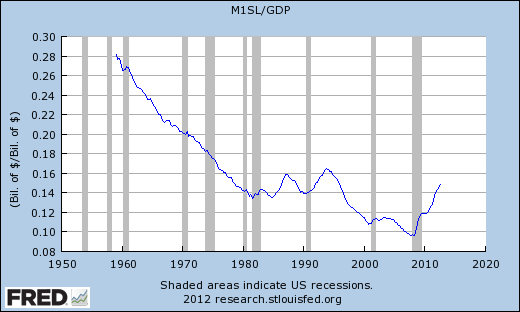
The deficit isn't a result of spending. It is a result of policy: of fighting inflation, and encouraging growth. The deficit is a result of these two policies, done in a very bad way for a very long time.
Policymakers pushed down the quantity of money in circulation to fight inflation:

Graph #1: Money in the Spending Stream per Dollar's Worth of Output
At the same time, they encouraged growth, spending, and the use of credit:

Graph #2: Total Credit Market Debt Owed per Dollar in the Spending Stream
The honest and honorable goals of fighting inflation and encouraging growth turned us into a nation with no money and inexplicable debt. That is why the economy refuses to grow. That is why tax revenue is down and "slump-related expenses" are up.
And that is why we have trillion-dollar deficits.
Woj’s Thoughts - Hard to argue with Art’s take on the matter. I might add that encouraging growth through private credit creation has also led to more wealth accumulation through capital gains. Subsequent policies that largely excluded capital gains from taxation exacerbated the above trends and can probably help explain a significant portion of wealth inequality witnessed today.

2) Why economics is rubbish, episode 324. by Sell on News @ MacroBusiness

It is an especially extreme example of scientism. It leads to a sort of homogenous nonsense. As the historian of science Stanley Jaki commented, such confusions are deadly to science itself. “By assigning unlimited relevance and competence to the scientific method, scientism rules out precisely that test. By setting quantitative exactitude as the only and supreme test of truth, scientism robs of meaning the world of qualities and values. By the same stroke it makes science meaningless as well. He then quotes GK Chesterton:

“Science, which means exactitude, has become the mother of inexactitude. This kind of vagueness in the primary phenomena of the study is an absolutely final blow to anything in the nature of science. man can construct science with very few instruments .. a man might measure heaven and earth with a reed, but not a growing reed.”
That latter point is crucial. The metrics used to “measure” economic and financial behaviour are growing reeds, they do not stand still. They grow in the minds of those who use them, used for trading strategies, to formulate polices, for the basis of consumer sentiment. Even if the quasi-scientific economic abstractions worked, they would not work.

3) yen dynamics by Warren Mosler @ The Center of the Universe

So it may be the case that Japan is in the process of resuming it’s traditional dollar and euro buying, which can move the currency to whatever level it desires. Which is probably back to north of 100 to the dollar?
Lastly, there is a record yen short position being reported. While this could mean it’s getting over sold and subject to a rally, it could also mean insiders have been tipped off to this policy shift and will profit immensely.
Caveat: If all the noises around the coming election and weak yen policy result only in an increase in the inflation target and ‘unlimited qe’ involving only yen financial assets, that policy will only serve to make the yen stronger and a wicked short covering scramble will follow.
Nothing short of buying fx, directly or indirectly, will do the trick.
Woj’s Thoughts - In a recent post on the re-election of Prime Minister Abe, I mentioned that the likely outcome was merely stepped up monetary policy tied to relatively restrictive fiscal policy. There has been no mention yet of direct fx purchases (that I’m aware of). If I’m correct that Japan will limit itself to NGDP targeting through unlimited QE, than investors should be wary of severe Yen strengthening in the not too distant future.

Thursday, December 6, 2012

Bubbling Up...12/6/12

1) Europe’s Avoidable Collision Course by Tyler Cowen @ The New York Times (h/t Mark Thoma)
It is thus a mistake to overreact to most of the headline events about the euro zone crisis. The good news is never quite as good as it looks, and the bad news often brings beneficial responses. It seems that for dozens of months now, we’ve been hearing that the fate of the euro zone will be decided “shortly,” yet somehow the drama continues.
Unfortunately, longer-lasting solutions require coordinated agreement among many euro-zone nations and, possibly, the broader European Union. That would include significant debt write-offs (as the International Monetary Fund is suggesting), quick moves toward better-integrated European banking institutions, and a general agreement that the European Central Bank unconditionally support troubled debt securities without trying to manipulate home governments’ policies.
Could all of that happen? For comparison, the current fiscal standoff in the United States involves no more than a president and two houses of Congress. In Europe, however, the bargaining is much more precarious, as it must span numerous nations, many of which have coalition governments, separation of powers and, in the case of Spain and Belgium, significant ethnic and linguistic division. The European Union has even had trouble concluding routine budget negotiations, the disputed parts of which concern no more than 0.03 percent of the union’s gross domestic product.
Woj’s Thoughts - Though I hold some differing views about the feasibility of the European Union with a common currency, in this piece I think Tyler is right on the mark. It has been fascinating and frustrating to watch markets seemingly overreact to every bit of European news. The supposedly best efforts of politicians and economists have, to date, failed to change the direction of economic growth and unemployment in the region. As I’ve stated previously, the clear optimism that remains among markets and Europeans is a positive sign of how deep faith in an eventual resolution lies. The likelihood of that optimism being rewarded is unfortunately minute in the near future and remains unfavorable for the long-run.

2) Mandated Employer Health Insurance Is Biased Against Small Business (in the US) by Peter Dorman @ EconoSpeak
This morning’s story about the problems small business owners face in complying with the ACA doesn’t surprise me.  My first gig as an economist, way back in 1979, was a summer internship at the Small Business Administration, where, among other things, I prepared an analysis of the impact of health insurance mandates on small firms.  It was a pretty rudimentary piece of work: I was just a grad student and had not yet studied how to do applied micro analysis.  Still, I was able to see the main story line.
Actually, I got two out of the three pieces of the story.  First, I saw that there are economies of scale in group health insurance, and without some form of organization above the firm level, small employers will pay a higher unit cost.  Second, and quantitatively more important, small firms in the US are substantially more labor-intensive on average, so an increase in labor costs hits them harder.  The third piece, which I missed at the time, is that wages are lower in the small business sector, so a mandated benefit of given cost will constitute a larger share of the wage bill.
…
But the US suffers tremendously from duality*—the division in the economy between larger, better-capitalized, more productive, higher-paying operations and smaller, less productive sectors that offer crummy jobs.  (It isn’t entirely a division between firms because some large firms have established their own internal “secondary” sectors.)  ACA should be examined in this context, especially since the administration hasn’t proposed any measures at all to reverse the trend toward greater duality, which is one of the underlying factors behind the growth in inequality.
Woj’s Thoughts - The other day I offered thoughts on Furthering the Post-Keynesian View of Wealth and Income Concentration, which entailed some great discussion within the comments. A question that I posed regarding a Job Guarantee is, how will it interact with the current market structure? The above post suggests a similar approach should have been considered with the ACA. Yes it will increase access to health insurance, but what if it also leads to larger unemployment and inequality? There is no question that trying to quantify these effects is difficult and imprecise, at best. The end result may have even been the same. All I’m saying is that I would generally prefer to see these macro-policy decisions examined in a broader context.

3) Conflicting signals on dollar-yen by Walter Kurtz @ Sober Look
Clearly investors have some good reasons to continue shorting the yen, as fundamentals for the currency are terrible. The BOJ balance sheet as percentage of GDP is at a record.
Source: Merrill Lynch
…
Based on these fundamentals Merrill obviously predicts a weaker yen. As one would expect, monetary expansion is unlikely to improve credit, but it should impact the FX markets.
Woj’s Thoughts - Obviously many people have been trying, unsuccessfully, to short the Yen for a long time. The BOJ's efforts to create inflation have been equally unrewarded. I continue to think that until the government pledges and follows through on a massive fiscal stimulus (deficit increases), the economy will remain stagnant and the Yen will remain a strong safe-haven.

Sunday, August 19, 2012

Bubbling Up...8/19/12

1) Chart of the Day: Public deficits and private savings in the euro zone by Edward Harrison @ Credit Writedowns
Budget deficits are what results ex-post from an accounting identity between the sectoral balances and should not be a primary goal of public policy. What we want to do is target the cause of the deficits, insufficient demand which I believe is the result of the overhang of debt after a period of excess private sector credit growth. What you want to do is eliminate that debt overhang by reducing the debt or increasing private sector incomes to support the debt. That’s getting at root causes.

2) How the Economic Machine Works by Ray Dalio @ Bridgewater (h/t Humble Student of the Markets)

[I]f you understand the game of Monopoly®, you can pretty well understand credit and economic cycles. Early in the game of Monopoly®, people have a lot of cash and few hotels, and it pays to convert cash into hotels. Those who have more hotels make more money. Seeing this, people tend to convert as much cash as possible into property in order to profit from making other players give them cash. So as the game progresses, more hotels are acquired, which creates more need for cash (to pay the bills of landing on someone else’s property with lots of hotels on it) at the same time as many folks have run down their cash to buy hotels. When they are caught needing cash, they are forced to sell their hotels at discounted prices. So early in the game, “property is king” and later in the game, “cash is king.” Those who are best at playing the game understand how to hold the right mix of property and cash, as this right mix changes.
Now, let’s imagine how this Monopoly® game would work if we changed the role of the bank so that it could make loans and take deposits. Players would then be able to borrow money to buy hotels and, rather than holding their cash idly, they would deposit it at the bank to earn interest, which would provide the bank with more money to lend. Let’s also imagine that players in this game could buy and sell properties from each other giving each other credit (i.e., promises to give money and at a later date). If Monopoly® were played this way, it would provide an almost perfect model for the way our economy operates. There would be more spending on hotels (that would be financed with promises to deliver money at a later date). The amount owed would quickly grow to multiples of the amount of money in existence, hotel prices would be higher, and the cash shortage for the debtors who hold hotels would become greater down the road. So, the cycles would become more pronounced. The bank and those who saved by depositing their money in it would also get into trouble when the inability to come up with needed cash caused withdrawals from the bank at the same time as debtors couldn’t come up with cash to pay the bank.
Woj’s Thoughts - Although Dalio’s fund may be struggling this year as markets increasingly deviate from economic growth, his insights regarding economic cycles remain a great source of knowledge. In many advanced economies, property was clearly king until the shortfall in cash among households became so pronounced that a debt deflation ensued. The productive portion of the private sector (non-financial) continues to hold too much property and debt relative to cash (savings and income). Rather than encouraging and aiding a “smooth” shift towards cash, public policy remains supportive of reverting back towards property and debt. As long as this mix remains highly unbalanced, economies will prove fragile and prone to crises. (Fun tidbit about me...as a child I loved playing the game of Monopoly. This may have been an early sign that I was destined for a future in economics and finance.)

3) How Long Can Japanese Bond Prices Defy Gravity? by Cullen Roche @ Pragmatic Capitalism

As you likely know, Japan has been suffering a horrid deflation for 20 years as a result of a multitude of factors.  So we’ve witnessed an endless stream of JGB bond traders diving out of windows as they short JGB’s and lose out to ever increasing prices.  One interesting conclusion in the Hoshi/Ito paper is their view on Japan’s ”unrealistically optimistic assumption that Japan’s GDP will grow at 2% annually for the next 40 years”.   If growth is to stagnate then where will the inflation come from?  What could scare these bondholders into a massive JGB revolt leading to higher rates (something which, mind you, did not even occur in the USA during the great stagflation of the 1970′s)?   I am lost for a cause here because Japan’s central bank controls interest rates and as the supplier of reserves to the banking system they can always control the entire yield curve (yes, if they wanted to pin the 30 year bond at a specific rate they would just have to name it and challenge the bond traders to compete with their endless reserve position – the bond traders would lose quickly).
So the question remains – how long can Japanese bond prices defy gravity?  Well, the short answer is – as long as the Japanese central bank is willing to keep rates low.  The more important question is when will Japan experience an environment which forces their central bank to alter the current structure of the yield curve?  Will a stagflation occur similar to the 70s in the USA?  Will a hyperinflation occur for whatever reason?  Will growth rebound?   Or what if Hoshi and Ito’s pessimistic GDP projections are correct?  Then we’re likely to continue seeing JGB traders jumping out of windows following unsuccessful attempts to fight the Bank of Japan.
Woj’s Thoughts - So yes, the Fed can (and to a degree currently does) control long-term interest rates. These questions are equally important for investors currently betting against US Treasuries. When will economic factors cause the Fed to raise interest rates in the foreseeable future? Private sector deleveraging is likely to persist for a few more years and government deficits are decreasing. This suggests a still lengthy period of low growth and inflation, which is consistent with the Fed maintaining short-term rates near zero. The recent sell-off in Treasuries is approaching a level at which the long-side again becomes enticing.  

Wednesday, July 11, 2012

Forgotten Lessons from Japan's Lost Decades

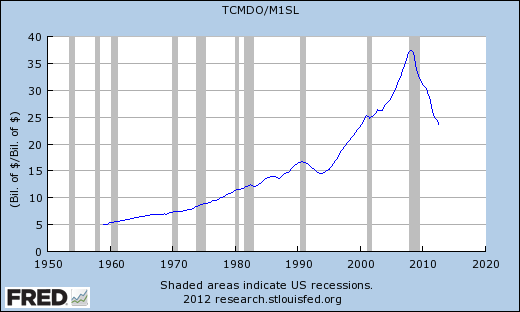
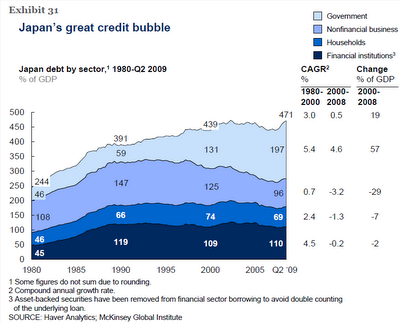
For nearly two decades Japan has witnessed stagnating growth and mild deflation. Over the course of this period, Japan has experimented with various forms of monetary “stimulus” as well as fiscal stimulus, increasing public sector debt by nearly 400%.
Source: The New Arthurian

By many accounts, Japan should be a shining example of functional finance,demonstrating the positive impact of fiscal and monetary stimulus working together. Reality, however, depicts a largely different story.


The New Arthurian offers four lessons from the struggles in Japan...

Lesson 1: No recovery was created by increasing the money.
Lesson 2: No recovery was created by replacing private debt with public.
Lesson 3: There was little or no "erosion" of debt by inflation.
Lesson 4: Try debt forgiveness.
Most economists are currently calling for either greater monetary or fiscal stimulus, or in some cases both. I fear that this apparent focus on broad macro stimulus overlooks some of the subtler inefficiencies within developed economies that played an equal, if not greater, role in the current economic crisis. Tax laws and regulations that encourage the use of credit over money, promote greater inequality and subsidize various industries with political favor will largely remain in place under most of the proposed policy solutions. Until these issues, and numerous others, are dealt with, our fate may follow a similar path as Japan, whereby monetary and fiscal stimulus are only enough to continue muddling through.   

Friday, May 4, 2012

Philip Pilkington: Inflation-Targeting Experiment May Start in Japan… But at What Cost?


The tradeoff looks ugly. If the rumors prove to be true, the Japanese government is going to engage in fiscal austerity by raising taxes so that they may pass a law that states that any central banker who fails to achieve specific price-rises will lose his or her job. But reducing fiscal deficits in a weak and already deflation prone economy is even more deflationary; it’s hard to see how the BoJ can hit the target in the face of this headwind.
In truth, we have no idea if this policy is going to be effective in any way. And if it is effective we have no idea what sort of impact its going to have. I argued the other day that inflation targeting done in isolation may well lead to investors simply pouring into various so-called inflation hedges (gold, silver and other commodities) which, in an extreme case, may lead them to pull funds out of the government bond markets, drive up yields and thus lead to more excuses for the government to engage in austerity.
Read it at Naked Capitalism
Inflation-Targeting Experiment May Start in Japan… But at What Cost?
By Philip Pilkington


Apparently Japan is considering monetary policy that targets higher inflation rates to finally end their lost decades. This pact would be a truly interesting experiment as fiscal austerity directly reduces the supply of money while monetary policy indirectly affects demand for money through altering expectations. My hunch is that asset purchases by the Bank of Japan (BOJ) will have to be significantly greater than any reduction in government deficits in order to achieve the stated price target (if only for a short time). I think Pilkington is also on the right track with regards to the type of assets that will see price inflation. As an inflation-targeting skeptic, I’m very thankful that if some politicians are going to experiment with these policies, it won’t be the US that has to bear the significant risks.

Wednesday, March 28, 2012

The Economy Needs a Bubble!

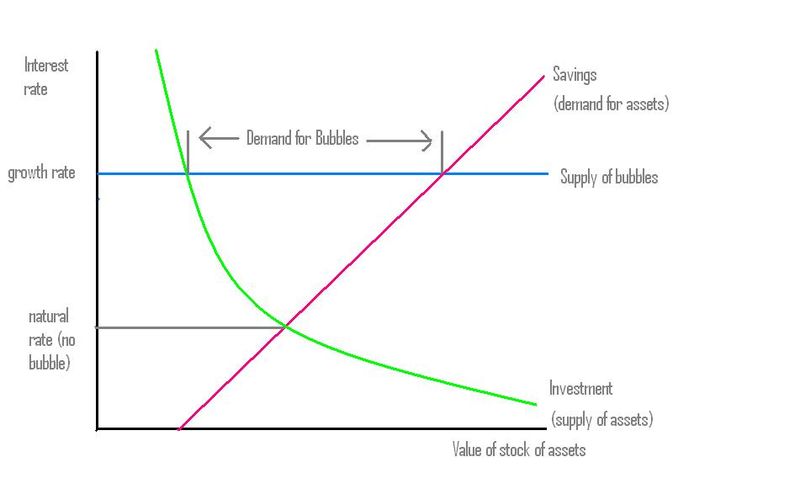
Nick Rowe, in Do we need a bubble?, states that economics generally assumes that “in a normal world, the equilibrium rate of interest [r] is above the growth rate [g] of the economy.” However, by this definition, our world is often and currently not in a normal state. With US inflation currently near 2% (core CPI) and the 10-year treasury bond yielding 2.2% (as of this writing), the real interest rate (risk free rate minus inflation) is just slightly positive. Meanwhile, nominal GDP in the 4th quarter of 2011 was 3.8%, meaning the real growth rate (nominal GDP minus inflation) is closer to 2%. (Note: Reported US data typically uses different rates of inflation for real GDP, but I used the same statistic here to simplify). When growth outpaces interest rates, the environment is ripe for borrowing money to invest and consume.

During these supposedly abnormal periods the demand for money is high. If this demand is not met with supply(e.g. through government deficits) or reduced (e.g. increased taxes), than people will seek out money-like instruments. Michael Sankowski notes that money-like instruments can be as simple as “stocks being used to purchase real world goods, or using the paper value of real estate as collateral to purchase real world goods.” Increasing demand for these instruments drives prices higher, which in turn, boosts their value as money-like instruments. This creates a self-fulfilling upward cycle in both demand and price. Therefore, “as long as the real growth rate is higher than the real interest rate, the economy will demand bubbles.” (Graph below from The supply and demand for bubbles (in pictures))

Americans experience during the past 20 years should bear out this fact since the economy has seemingly moved from one bubble to the next (e.g. dot-com, real estate, commodities). As we speak, stocks and commodities may once again be providing the bubble our economy desires. In contrast to the US experience, Japan’s economy has resembled a ‘normal’ world for much of the past 20 years. Deflation has largely kept the real interest rate (using 10-year JGB yields) in the 1-2% range, while real growth rates were frequently between 0-1%. This environment encourages reduced borrowing and, by extension, less desire for money-like instruments. The result has been real estate and equity markets that dropped over the entire period. (Graph from Dr. Housing Bubble)


While the economy may frequently desire bubbles, these are a sign of private sector waste (inefficiency) that always results in wealth destroying busts. Within Post-Keynesian schools of economic thought, both the interest rate and inflation can be controlled, to a degree, by the combination of fiscal and monetary policy. Accepting that our economy is often in an abnormal state is the first step to alleviating the economy’s need for a bubble.  

Saturday, March 24, 2012

Points of Public Interest

Ugly day in DC after a beautiful week, but more good NCAA basketball on TV. Good luck to those whose brackets still have a chance of winning!

  1. “The Current Models Have Nothing to Say”
Should we be surprised? Policy makers continue to employ models of an economy with no financial system.
  1. Economics without a blind-spot on debt
The aggregate level of debt, especially private, matters in
forecasting economic growth.
  1. Consumer Credit Growing at Highest Rate in Past Decade: Unhealthy and Unsustainable?
Stopping addictive habits is not easy, but extending those actions will only make the eventual adjustment more difficult and painful.
  1. The Japan debt disaster and China’s (non)rebalancing
Chinese consumers continue to increase savings in lieu of domestic consumption. Japan is attempting to rebuild its trade surplus, but which countries will allow their surplus to decline or deficit to increase? Global (and domestic) imbalances not addressed remain significant risks to the global economic outlook.
  1. A step in the right direction
Scientific exploration incorporating complex systems and networks continues to move our understanding of reality forward.
  1. It's not structural unemployment, it's the corporate saving glut
Businesses save instead of investing in labor when consumer demand is weak. Until policy focuses on improving the consumer balance sheet (e.g. debt write-downs), unemployment will remain high.
  1. Wrong vs Early – Contrarians Bet on Natural Gas
The best investors are often early and patient.
  1. The Real Problem with Microfoundations
Microeconomics is not especially sound in predicting all outcomes
either.
  1. Principal writedowns of the day, mortgage edition
Positive for households but will Bank of America (and others) really accept the associated losses?
  1. Why Using P/E Ratios Can Be Misleading
In early 2009, at the market bottom, the P/E jumped to over 100 as profits plummeted. Using E/P corrects for this issue and shows the market is slightly overvalued currently.