1) Expanding Megabanks: Is Impatience the Cause? , by Garett Jones @ EconLog
In the wake of the crisis the Too Big To Fail problem has grown across the rich countries. When something happens always and everywhere we should start looking for underlying laws. We're not at "always and everywhere" here but it's getting close: Time to theorize.
I don't think political influence from big banks is a major reason for the recent rise in bank size. Political influence is a constant, like gravity, so the question is what changed after 2008. Why the rise in bank concentration just as economists, policymakers, and politicians became more worried about bank concentration?
It sounds to me like an interaction between hyperbolic discounting (impulsivity, short term impatience in the government sector) and time inconsistency (depositors know the regulator will cave later so depositors put more money in TBTF banks today, making it even more tempting for the regulator to cave).
Woj’s Thoughts - Jones goes on to make the case for banning acquisitions by the biggest banks. I left the following comment on his blog:
While I agree that "hyperbolic discounting by bank regulators is a big problem", I wonder whether banning acquisitions would solve the problem. Looking at the most recent crisis, Bank of America, Wells Fargo and JP Morgan were practically begged by regulators to acquire other large banks presumably because no better alternative existed. Had those mergers been prevented, what actions would have been taken? Speed bankruptcy is an option, but likely wasn't on the table. It seems plausible that the government and Fed would have bailed out those failed banks more explicitly.
One of the other channels, that I think may be a greater issue, is the subsidies inherent in an implicit government backing for SIFIs. My reading suggests these institutions are able to finance their operations at rates 50-100 bps below other financial institutions. This cost advantage could eliminate smaller institutions regardless of banning acquisitions.
2) quick look ahead for the euro zone by Warren Mosler @ The Center of the Universe
All this gets me back to the idea that the path towards deficit reduction in this hopelessly out of paradigm region keep coming back to the unmentionable PSI/bond tax. Seems to me we are relentlessly approaching the point where further taxing a decimated population or cutting what remains of public services becomes a whole lot less attractive than taxing the bond holders. And the process of getting to that point, as in the case of Greece, works to cause all to agree there’s no alternative. With the far more attractive alternative of proactive increases in deficits that would restore output and employment not even making it into polite discussion, I see the walls closing in around the bond holders, along with the argument over whether the ECB writes down it’s positions back on page 1. And just the mention of PSI in polite company throws a massive wrench (spanner) into the gears. For example, if bonds go to a discount, they’ll look towards ECB supported buy backs to reduce debt, again, Greek like. And if prices don’t fall sufficiently, they’ll talk about a forced restructure of one kind or another, all the while arguing about what constitutes default, etc.
The caveats can change the numbers, but seems will just make matters worse.
Woj’s Thoughts - Mosler has been one of the few voices that predicted this outcome for the Euro zone from the beginning. His thoughts on the forthcoming strength of the euro have certainly made me reconsider my views. I continue to worry about the political aspect within Europe and whether the people will continue to accept depression dynamics to remain in the Euro zone.
3) Wealth and Redistribution Revisited: Does Enriching the Rich Actually Make Us All Richer? by Steve Roth @ Angry Bear
Here’s what that looks like, with starting wealth of $2 million, divided 50/50 between the rich person and the ten poorer people. (click for larger):
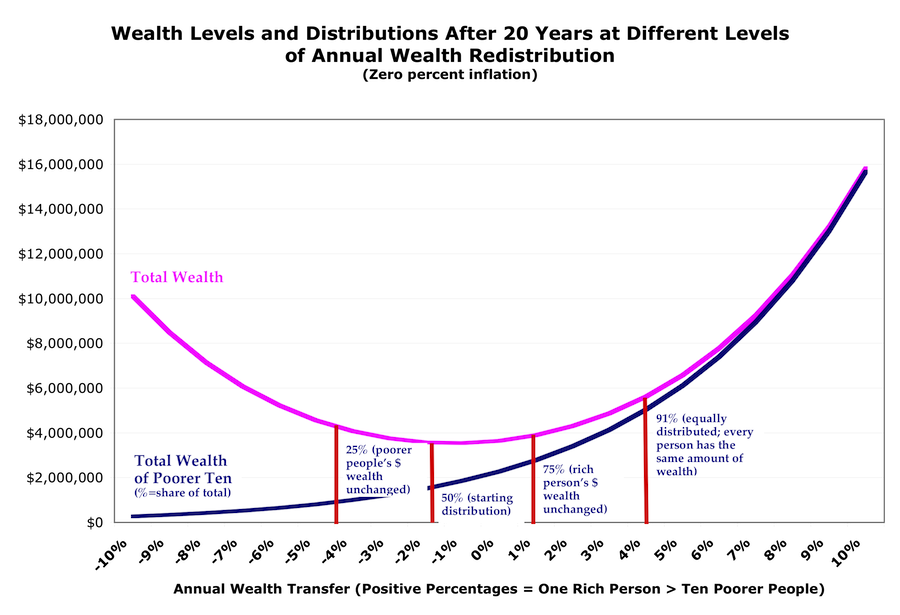
Woj’s Thoughts - Click through for surprising lessons about redistribution from this very basic model.
1) China after the Global Minotaur by Yanis Varoufakis
In the book’s penultimate chapter, I discussed the Soaring Dragon which, as everyone tells us, is waiting in the wings, purportedly to take over from the Global Minotaur (click here for a pdf copy of that chapter). In my concluding remarks, written back in January 2011, I wrote: “To buy time, the Chinese government is stimulating its growing economy and keeps it shielded from currency revaluations, in the hope that vibrant growth can continue. But they see the omens. And they are not good. On the one hand, China’s consumption-to-GDP ratio is falling; a sure sign that the domestic market cannot generate enough demand for China’s gigantic factories. On the other hand, their fiscal injections are causing real estate bubbles. If these are unchecked, they may burst and thus cause a catastrophic domestic unwinding. But how do you deflate a bubble without choking off growth? That was the multi-trillion dollar question that Alan Greenspan failed to answer. It is not clear that the Chinese authorities can.”
In the eighteen months that followed since those lines were written, events have confirmed the projected pattern. The table below reveals that the falling rate of Chinese consumption is continuing unabated. In 2011 of every one dollar of income produced, only 29 cents entered China’s markets. With net exports making a small annual contribution to domestic demand (even though they contribute greatly to the country’s capacity to invest and, thus, boost productivity), the onus falls increasingly on investment to meet the demand shortfall. However, as suggested in the avove paragraph, this emphasis on investment is a double edged sword, as it threatens to let the Giny out of the bottle in real estate markets, where bubbles have been looming threateningly for a while now.
| | 1990 | 1995 | 2000 | 2005 | 2009 | 2011 |
| Private Consumption | 49 | 44 | 45 | 40 | 34 | 29 |
| Investment | 35 | 42 | 36 | 42 | 48 | 58 |
| Government Consumption | 12 | 13 | 17 | 12 | 11 | 10 |
| Net Exports | 4 | 1 | 2 | 6 | 7 | 3 |
Composition of Chinese Aggregate Demand (Percentages of Gross Domestic Product). Source: National Bureau of Statistics of China
Woj’s Thoughts - Most economists agree that China needs to re-balance its economy away from investment and towards private consumption. China has made very little progress, if any, in this regard. As for the potential housing bubble, opinions are far more divergent. After a recent trip to China, my wonderful professor, Garrett Jones, remarked that families were using second homes as a savings vehicle but faced difficulty in abruptly moving their larger, extended families living under the same roof. While I respect that view, the growth of private debt to purchase homes leads me to side with Yanis.
2) When the Credit Transmission Mechanism Breaks… by Cullen Roche @ Pragmatic Capitalism
If you look at the 30 year mortgage rate closely you’ll notice a relatively steady inverse correlation between rates and new home sales. That is, all the way up until about 2007. Then, rates remain low and new home sales stay depressed. The low rate transmission mechanism breaks.
Why does it matter? This is exactly what we’d expect to see given the state of the balance sheet recession. You see, demand for credit is very low because households are still recovering from the implosion in their balance sheets. Instead of taking on more debt, households are paring back debt. This is clear from yesterday’s NY Fed report on household credit trends. And this is why monetary policy has been so broken in recent years. The Fed can’t gain traction because their primary transmission mechanism is busted. And the economy won’t feel quite right until this part of the monetary system starts working normally again….
3) Death of a Prediction Market by Rajiv Sethi
A couple of days ago Intrade announced that it was closing its doors to US residents in response to "legal and regulatory pressures." American traders are required to close out their positions by December 23rd, and withdraw all remaining funds by the 31st. Liquidity has dried up and spreads have widened considerably since the announcement. There have even been sharp price movements in some markets with no significant news, reflecting a skewed geographic distribution of beliefs regarding the likelihood of certain events.
…
It seems to me that the energies of regulators would be better directed elsewhere, at real and significant threats to financial stability, instead of being targeted at a small scale exchange which has become culturally significant and serves an educational purpose. The CFTC action just reinforces the perception that financial sector enforcement in the United States is a random, arbitrary process and that regulators keep on missing the wood for the trees.
4) The Different Paths of Greece and Spain to High Unemployment by Thomas Klitgaard and Ayşegül Şahin @ Liberty Street Economics
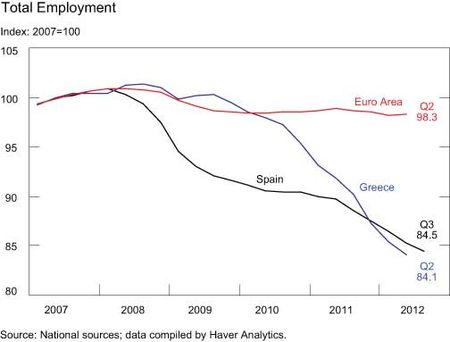

The high unemployment rate in Greece is not surprising given the depths of its recession, but what explains Spain’s 25.8 percent unemployment rate given its much more modest downturn? One contributing factor is the fact that the composition of Spanish jobs made the economy vulnerable to dramatic job losses during a recession. In 2007, almost 13 percent of jobs in Spain were in construction, compared with roughly 8 percent in Greece and the euro area. Such a heavy weight on this sector made employment more vulnerable to a downturn given the fact that construction is the sector that typically experiences the steepest decline in a recession. Indeed, construction, as measured in the GDP accounts, fell 35 percent from 2007 to 2011, and the sector accounted for almost 60 percent of the decline in total employment over this period.
Another contributing factor is the very high percentage of employees tied to temporary work contracts in Spain. Data from the Organisation for Economic Co-operation and Development show that 32 percent of employees in Spain worked under temporary contracts and 68 percent under permanent contracts in 2007. In Greece, 10 percent were on temporary contracts; the figure for Europe as a whole was 15 percent.
Woj’s Thoughts - Both countries suffer from excessive private debt that is being transferred to the public sector as the private sector attempts to deleverage. Considering the size of the housing bubble in Spain (the bust continues), the relatively large portion of jobs in construction before the crisis and decline in employment within that sector afterwards are no surprise. However, the percentage of temporary workers in Spain is striking (Does anyone know if this is tied to cultural or policy reasons?). As both countries attempt to move towards balance budgets, the downward trend in unemployment and GDP is likely to continue.
Think back to the Great Depression. What we lost then and now and what we need to regain is trust. To be frank, I don't know how we can win that trust in our system back. But, when it comes to credit markets, I know where we can start.
First, we need to make sure there are no more bailouts. While the bailouts have prevented a Great Depression for now, they have engendered a deep sense of cynicism and resentment which has negatively impacted credit and growth. Second, we need to know that our largest financial institutions are well-capitalized enough to withstand large economic shocks. Without this knowledge, no one can separate liquidity from solvency — exactly the problems banks had during the Great Depression. Third, we need to enforce regulations through sound regulatory oversight and civil or criminal penalties. Self-regulation is a pipedream promoted by corporatists. And we see that time and again where regulations are not enforced, financial institutions turn to excess that leads to panic and crisis.
Doing these three things will not magically turn our economy around and get credit flowing again. But these steps are essential to restoring trust in our financial institutions and government. Restoring that trust is the first and most important step in getting our credit markets to work the way they are supposed to — in a way that enhances and insures our individual liberty, rather than the false privileges of corrupt financial institutions.
Read it at Naked Capitalism
How Out-of-Control Credit Markets Threaten Liberty, Democracy and Economic Security
By Ed Harrison
In trying to understand our modern monetary system and the problems at the heart of the current crisis, the most important aspect is credit. Although I currently believe demand for credit is a greater issue, problems within financial institutions remain serious. Harrison’s third point, which seems to contrast an earlier view about the need for more regulation, is worth highlighting. In the US there are already thousands of regulations for financial institutions. The trouble is that many are simply not enforced or hold penalties so small as to make breaking the rule still worthwhile. Greater transparency and enforcement are clearly needed in light of the recent PFG bankruptcy, LIBOR scandal and countless other known and unknown transgressions.
That moment is now past, oil is less expensive and the spotlight is on other political issues. But if Congress provides the $52 million the President asked for – or even if it does not – resources will be spent to expand bureaucracy and an already mind boggling body of rules. The politics comes and goes but leaves a permanent residue. With every bit of additional regulation, the government constructs a more comprehensive straitjacket for the economy.
The price of gasoline is only one example of the broader problem of political-regulatory ratcheting up. With oil, the political issue is its being expensive, so traders get the blame for driving the price higher, not lower—as the price heads down, we have not been told that speculators are manipulating the market downward. By contrast in stock markets traders are often blamed for falling prices. Thus in the financial crisis, banks complained of short sellers driving down their share price. Thereupon the US Securities and Exchange Commission banned the short selling of financial stocks.
So depending on what the political agenda of the day is, speculators can be taken to task for either a high price or a low price. Either way, the political mood tends to be ephemeral but the regulation it helps create stays on and we all bear the costs.
Read it at ThinkMarkets
By Chidem Kurdas
The title of this post is certainly not true but, as Kurdas points out, might as well be given the recent fall in oil and stock prices. In reality, there is little difference between investing and speculating. People rarely invest in any project without speculating that the returns will be positive. Therefore, we should not seek to prevent speculation anymore than we desire to prevent people from making investments.
Related posts:
Unlearning Economics - Libertarians and Homogeneous Government
Facebook's $500 Million Tax Refund and The BIG Political Lie

