Showing posts with label Microfoundations. Show all posts

Sunday, February 17, 2013

Quote of the Week...


...is from Michael D. Fayer’s illuminating book, Absolutely Small: How Quantum Theory Explains Our Everyday World:
The uncertainty principle says that you can know something about the momentum of a particle and something about the position of a particle, but you can’t know both the position and the momentum exactly at the same time. This uncertainty in the simultaneous knowledge of the position and the momentum is in sharp contrast to classical mechanics.
In classical mechanics, you can know x and p. In quantum mechanics, you can know x or p. Generally for quantum particles, absolutely small particles, you know something about p and something about x, but you can’t know both precisely simultaneously.
As the above quote demonstrates, even in physics, true uncertainty exists at absolutely small levels. More importantly, the persistence of uncertainty at a micro level does not prevent greater clarity from being achieved at a macro level. In fact, the different levels may operate under entirely different organizational principles. Unfortunately economics has not yet come to terms with the scientific advancements of quantum theory. If economics truly wishes to mimic physics, than as a science it has fallen even further behind.  


Bibliography
FAYER, Michael D. (2010-06-16). Absolutely Small: How Quantum Theory Explains Our Everyday World (Kindle Locations 1223-1244). Amacom - A. Kindle Edition.

Friday, August 3, 2012

Bubbling Up...

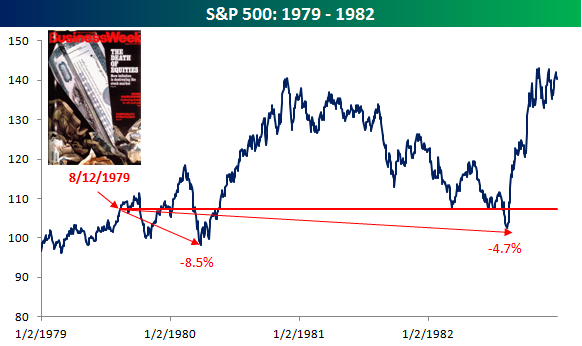
1) How Good An Indicator Was "The Death of Equities" Cover
Just how good of a buying indicator was the BusinessWeek cover from 1979, though?  If you ask most investors about that cover story, they seem to remember that the market almost immediateley took off after the issue was published.  The reality, however, is that nearly eight months after the cover story was published, the S&P 500 was down 8.5%.  While the market did rally from that level, three years after the infamous BusinessWeek cover, the S&P 500 was still down nearly 5%.  It wasn't until 8/12/82 that the S&P 500 really took off and the bull market began in earnest.  Granted, time horizons have gotten a lot shorter in the last thirty years, but three years is an eternity in this market.


Woj’s Thoughts - Our memories can deceive us by filling in stories with logical steps. Cover stories often do mark extremes in sentiment, yet those extremes may persist for quite some time. As a signal for contrarian investors, recognizing this reality is critical.

2) Why I don’t believe housing has put in a secular bottom by Edward Harrison

For the bottom to be in you have to believe two things from a macro perspective. First, you have to believe that the overshoot phase to the downside has been arrested. Most bubbles end with a significant overshoot that makes it a no-brainer to tip a toe in the market. I think we are approaching those levels in markets like Phoenix. But we never really got down to reasonable levels in places like Washington or New York. Second, you have to believe any US recession is both remote in time and mild in duration/severity. I question this. I think any US recession will re-start the house price decline dynamic because consumers are still overindebted, interest rates are at zero percent, and mortgage rates are as low as they can get. My point is that from a cyclical perspective 2012 is as good as its going to get. Calling a bottom at the top of a cyclical bull market in asset prices and the economy is folly. Wait until the bottom of the cycle to make those calls.
Woj’s Thoughts - Early this year I made the claim, Don't Rush to Buy a Home! At the end of May I was Still Not Buying A Housing Recovery. Edward lays out many/most of the reasons for my continued lack of optimism on housing prices over the next couple years.
 
3) The Evolution of Treasury and Muni Bond Yields by Cullen Roche
I’ve discussed this in detail over the years and why the analysts crying for mass US state insolvencies were likely to be wrong, but now we have some interesting new analysis via VOX.  What’s depicted below is the 10 year US Treasury versus the 10 year muni bond index.  As you can see, the yields have an extremely high correlation – muni bonds practically ARE treasury bonds.  So why are yields surging in Italy, Spain, Greece and Portugal, but they’re remaining so tame in the muni market?  Simple – the US government, which can always procure funds via taxes and bond sales therefore making solvency a non-issue, provides substantial federal aid to the states every year.  While this doesn’t eliminate the solvency issue at the state level it certainly helps reduce it substantially.  Europe has no such mechanism in place so what you basically have is a bunch of US states in an environment where they’re left to fend for themselves.  They can’t print their own currency, they can’t devalue their own currency and they can certainly run out of Euros.  The result is bond investors who are terrified about default and end up selling bonds which only exacerbates the budgeting process.*
4) Microfoundations and the capital debates by Matias Vernengo
In that sense, heterodox (classical-Keynesian, by which I mean Sraffa’s prices cum Keynes/Kalecki’s effective demand) does have a coherent determination of long run prices, based on rational behavior, as the foundation of the macroeconomic theory. Markets do not produce optimal outcomes and unemployment of productive resources is the normal, long run, position of the economy. In fact, the capital debates not only say that classical political economy (the surplus approach) provides sound microfoundations, but also that it is NOT possible to do so within the neoclassical/marginalist paradigm.
Woj’s Thoughts - Previously I’ve argued against microfoundations in macroeconomics, but Matias places an interesting spin on the discussion. Quite possibly the issue is not the use of microfoundations but rather the poor choice of microfoundations.

5) Another Summer of Discontent: The Four Factors that Explain Why What We’re Doing Isn’t Working by Daniel Alpert

We must move from stabilize and reflate, to stabilize and recalibrate:
  • It is time for creditors throughout the developed world to finally take the write downs that have long been coming their way in connection with the trillions of dollars of truly un-payable household and sovereign debts that resulted from the credit bubble of the 2000s.  Yes, this will pressure lenders and, yes, they will need to be recapitalized to the detriment of their existing stakeholders.  But there is presently no shortage of capital seeking reasonable risk-adjusted returns, and I have every confidence that it will flow eagerly into the financial sector—if only the balance sheets of our institutions were honestly reckoned by having the currently unrecoverable carrying value of assets written down to that which can be recovered today from borrowers and/or underlying collateral.

  • As I have been saying and writing about for years, we must accept the reality of what the credit markets are telling the planet’s most creditworthy governments, particularly that of the U.S.  The message is “please, here, take our money…take it cheaply and keep it safe…we have no fear of lost purchasing power, the trend is not inflationary…now take it (and use it to fix your  economy).” And that is what we must do. We must take as much 30-year money at these depression level interest rates as we need to re-employ our underemployed workers directly, on public infrastructure projects that return benefits to the economy more than sufficient to repay the sums borrowed when the time comes.  The private sector will not hire until it sees a recovery in demand—so the only agent for re-employment of workers and regeneration of demand may, for an extended time until the imbalances at least decline somewhat, be our governments.  It is long past time to pack away austerity agendas.

  • And yes, we must address and manage the process of nominal price, wage and asset value declines. The advanced economies are experiencing the effects of a supply glut, a debt overhang, massive technology-induced productivity (soon to transfer to the emerging economies, worsening the glut), and aging populations. These are all disinflationary factors. And the aggregate effect of their contemporaneous existence is deflationary—full stop. Yet in relying on monetary intervention alone we are fighting the battle to control the pace of deflation (forget about reflation) with one hand tied behind our back.n  Instead of targeting growth in nominal GDP, which I am proclaiming here to be a futile endeavor, we must target renewed global competitiveness and, at the very least, growth in real GDP. That means both allowing our price and wage structures to align themselves with global supply and demand and, more importantly, feeding and nurturing investment in those areas of the private sector that can employ large numbers of people at market clearing wage rates. Especially in those sectors that are more readily protected by geography from global competition.

Thursday, July 26, 2012

Representative Agents and Credit-Constrained Households

An interesting debate has broken out recently in the econ blogosphere between mainstream (e.g. Simon Wren-Lewis) and heterodox (e.g Lars P Syll) macroeconomists. Earlier today, Chris Dillow jumped into the conversation with the following:
Simon Wren-Lewis asks heterodox economists a question: how do you answer the question "what do consumers do if they are told that taxes are rising temporarily?" without some appeal to representative agents?
My answer is: I would start from a representative agent model (which predicts consumption smoothing) but I wouldn't stop there. On this issue, as on most other macro ones, I'd ask two further questions.
One is: do we have any reason to suspect that the representative agent perspective might be wrong? For example, some households might not have savings to run down in response to a tax rise, and might be unable to borrow; this is true for a minority (pdf).These people might be forced to cut spending.In this sense, heterogeneity matters, because models in which everyone is credit-constrained or nobody is are both wrong.
As an aspiring heterodox economist, I don’t deny that thinking in terms of representative agents can be useful. My opposition to mainstream macroeconomics, similar to Dillow’s, is that much analysis stops at that perspective. To understand macroeconomics, one has to consider that representative agent models may be wrong and in that case, find other models that better represent reality.

Dillow’s first question (read the full post for the second) addresses an issue that I’ve previously discussed as allowing heterodox economists to correctly predict the financial crisis and ensuing stagnation. Households burdened with excessive debt can become unable or unwilling to borrow regardless of low interest rates and bank liquidity. Monetary stimulus, which targets credit expansion through bank liquidity and lowering interest rates, has therefore been largely unsuccessful since liquidity was restored in the heart of the crisis. The lack of new loans and household (or private sector) deleveraging creates a deflationary drag on economic growth.

A recent quote from a July 2012 Euro Area Bank Survey highlights this issue:
Turning to loan demand developments, euro area banks continued to report, on balance, a significant fall in the demand for loans to enterprises in the second quarter of 2012, although the balance was somewhat less negative than in the first quarter of 2012 (-25%, compared with -30% in the first quarter). As in the first quarter, according to reporting banks, the fall in the second quarter was mainly driven by a substantial negative impact from fixed investment on the financing needs of firms. The ongoing decline in net demand for loans to households for house purchase abated in the second quarter compared with the first quarter (-21%, from -43% in the first quarter), whereas net demand for consumer credit remained broadly unchanged (-27%, compared with -26% in the first quarter). Looking ahead to the third quarter, banks expect a continued decline in the net demand for loans, both for enterprises and households, even if less negative than in the second quarter.
Despite the ECB’s efforts, loan demand continues to fall throughout Europe. Delusional Economics (which provided the above link/quote) sums it up best:
So, once again, this looks far more like a demand side issue than as supply side one. In fact these poor results appear to have even surprised the banks who were expecting far less of a deterioration. But are these results really surprising? Not to me. With private sectors in many economies under financial strain from deteriorating economic conditions and , in many a cases, rising tax burdens this is completely expected behaviour in my opinion. Households under stress don’t have the capacity to take on new credit, no matter what the rates and business therefore have little reason to invest.
Importantly, what this data suggests is that this problem isn’t really something that monetary policy, no matter how unconventional, is going to solve. This looks very much like a job for fiscal because until private sector balance sheets are repaired monetary policy is a lame duck. Obviously the fiscal compact is not going to provide this fiscal relief.

Saturday, March 24, 2012

Points of Public Interest

Ugly day in DC after a beautiful week, but more good NCAA basketball on TV. Good luck to those whose brackets still have a chance of winning!

  1. “The Current Models Have Nothing to Say”
Should we be surprised? Policy makers continue to employ models of an economy with no financial system.
  1. Economics without a blind-spot on debt
The aggregate level of debt, especially private, matters in
forecasting economic growth.
  1. Consumer Credit Growing at Highest Rate in Past Decade: Unhealthy and Unsustainable?
Stopping addictive habits is not easy, but extending those actions will only make the eventual adjustment more difficult and painful.
  1. The Japan debt disaster and China’s (non)rebalancing
Chinese consumers continue to increase savings in lieu of domestic consumption. Japan is attempting to rebuild its trade surplus, but which countries will allow their surplus to decline or deficit to increase? Global (and domestic) imbalances not addressed remain significant risks to the global economic outlook.
  1. A step in the right direction
Scientific exploration incorporating complex systems and networks continues to move our understanding of reality forward.
  1. It's not structural unemployment, it's the corporate saving glut
Businesses save instead of investing in labor when consumer demand is weak. Until policy focuses on improving the consumer balance sheet (e.g. debt write-downs), unemployment will remain high.
  1. Wrong vs Early – Contrarians Bet on Natural Gas
The best investors are often early and patient.
  1. The Real Problem with Microfoundations
Microeconomics is not especially sound in predicting all outcomes
either.
  1. Principal writedowns of the day, mortgage edition
Positive for households but will Bank of America (and others) really accept the associated losses?
  1. Why Using P/E Ratios Can Be Misleading
In early 2009, at the market bottom, the P/E jumped to over 100 as profits plummeted. Using E/P corrects for this issue and shows the market is slightly overvalued currently.