Showing posts with label IOR. Show all posts

Saturday, January 19, 2013

The Permanent Floor and Potential Federal Reserve 'Insolvency'

After furthering understanding of the permanent floor, I discussed how that monetary regime might affect the inflationary effects of the “platinum coin.” Although the debate appears to be dying down, at least momentarily, Simon Wren-Lewis and Frances Coppola (see here, here, and here) have added worthwhile readings.

In concluding my brief series on this topic, I will address questions regarding potential Federal Reserve insolvency and the desirability of permanently practicing monetary policy under a “floor” system. Hopefully the answers put forth will shed light on areas of the debate that remain dark.

Q: The Federal Reserve has recently been turning over to the Treasury approximately $80 billion in profits each year, stemming from the yield spread between their assets and liabilities. As the Fed eventually raises interest rates on reserves (assuming the “permanent floor” system remains in place), that yield spread could turn negative, representing losses for the Fed. If the Fed’s capital is entirely drained, can it continue to pay interest on liabilities (e.g. reserves) or must it first be recapitalized? If the latter, does this require Congressional approval, Treasury action, or some other mechanism?

A: Before trying to put forth an answer, I should note that the present likelihood of this scenario becoming a reality is extremely small and would probably be preceded by much higher inflation (and interest rates). As several commenters noted, finding a direct answer to this question is extremely difficult. Courtesy of Dan Kervick:

Here is a 2002 General Accounting Office report that discusses some of these issues:
http://www.gao.gov/assets/240/235606.pdf
From the “Results in Brief” section at the beginning:
The Reserve Banks use their capital surplus accounts to act as a cushion to absorb losses. The Financial Accounting Manual for Federal Reserve Banks says that the primary purpose of the surplus account is to provide capital to supplement paid-in capital for use in the event of loss. Federal Reserve Board officials noted that the capital surplus account absorbs losses that a Reserve Bank may experience, for example, when its foreign currency holdings are revalued downward. Federal Reserve Board officials noted, however, that it could be argued that any central bank, including the Federal Reserve System, may not need to hold capital to absorb losses, mainly because a central bank can create additional domestic currency to meet any obligation denominated in that currency. On the other hand, it can also be argued that maintaining capital, including the surplus account, provides an assurance of a central bank’s strength and stability to investors and holders of its currency, including those abroad. The growth in the Reserve Banks’ capital surplus accounts can be attributed to growth in the size of the banking system together with the Federal Reserve Board’s policy of equating the amount in the surplus account with the amount in the paidin capital account. The level of the Federal Reserve capital surplus account is not based on any quantitative assessment of potential financial risk associated with the Federal Reserve System’s assets or liabilities. According to Federal Reserve officials, the current policy of setting levels of surplus through a formula reduces the potential for any misperception that the surplus is manipulated to serve some ulterior purpose. In response to our 1996 recommendation that the Federal Reserve Board review its policies regarding the capital surplus account, it conducted an internal study that did not lead to major changes in policy.
Based on this paragraph and corresponding discussion, the best current answer is that negative equity would not prevent the Fed from pursuing its desired monetary policy since “a central bank can create additional domestic currency to meet any obligation denominated in that currency.” If the Fed truly desired to maintain a capital surplus, to signal “strength and stability to investors and holders of its currency,” than one option is raising service fees charged to banks. This action would represent a tightening of monetary policy, but that could be desirable at the time.

If that course is not pursued, the other plausible action appears to be a Congressionally approved capital transfer from the Treasury. Although this action could be contended by politicians that oppose the Fed, the reality is that failure to provide capital would not alter the Fed’s ability to act or remain independent. Furthermore, a contentious Congressional battle on this otherwise insignificant matter could undermine the Dollar’s status as a reserve currency (similar to the debt ceiling debates). Provided this view is reasonably accurate, there appears little reason to fear the Fed losing its capital or as some argue, becoming ‘insolvent’.

Q: If the Fed leaves the zero lower bound (ZLB), is there any good reason to keep reserves in chronic excess?

A: Yes. An “interest-on-reserves regime” or “permanent floor”, where reserves are kept in chronic excess, allows the Fed to exogenously determine the monetary base AND interest rate. Therefore, if the Fed wishes to exit the ZLB it must either sell treasuries and Agency-MBS until excess reserves are practically eliminated (reverse QE) or increase the interest rate on reserves (IOR) to set a floor for the interbank market (target rate).

Given the response of asset markets to QE, the former option poses the risk of asset market deflation and possible spillovers to the real economy. To clarify, these arguments suggest there are good reasons to keep reserves in chronic excess but does not imply the Fed should permanently adjust to a “floor” system.


The “platinum coin” has been shot down as a potential response to hitting the debt ceiling, but it has made a substantial impact in expanding debates about how our modern monetary system actually functions. One of these topics, the “permanent floor,” will likely remain a prominent topic of macroeconomic arguments for at least as long as the Fed operates monetary policy within that system. The fantastic recent discussion on this subject has vastly improved my understanding of the policy’s intricacies, but has not altered my initial impression about the future practice of monetary policy (emphasis added):
An “interest-on-reserves regime” appears likely to rule monetary policy for the foreseeable future.

Special thanks are owed to Tom Hickey (Mike Norman Economics) and Michael Sankowski (Monetary Realism) for posting links to this blog. For their contributions through comments, I would also like to thank Scott Fullwiler, JKH, RebelEconomist, Dan Kervick, Ashwin Parameswaran, wh10, Detroit Dan, K, JW Mason, jck and last, but not least, Mike Sax.

Friday, January 18, 2013

Does the Permanent Floor Affect the Inflationary Effects of the Platinum Coin?

While continuing my own effort to further understanding of the permanent floor, related posts keep rolling in. Unfortunately my earlier post was remiss in recognizing contributions by Ashwin Parameswaran and Frances Coppola even prior to the outburst. A major player from the start, Steve Randy Waldman has once again raised the bar for a confederacy of dorks. David Beckworth, Peter Dorman, Nick Rowe and Stephen Williamson (see here, here, and here) also share their thoughts.

Once again, I won’t spend much time recapping the major points of contention. My intent is to highlight a few questions that came to mind while reading but, in my opinion, were not adequately addressed. Hopefully the answers put forth will shed light on areas of the debate that remain dark.

Question(s): What are the inflationary effects, if any, of the “platinum coin” both at and away from the zero lower bound (ZLB)? Under a “permanent floor” vs. “corridor” system?

Answer(s): As stated previously:

When the Treasury deposits a $1 trillion platinum coin at the Fed, the Fed credits the Treasury’s account with $1 trillion in reserves. These reserves, however, are not counted in the monetary base since the Treasury's account does not count as reserve balances in circulation. The simple action of depositing a platinum coin at the Fed therefore has no direct impact on the economy that would require sterilization*. In fact, the primary (sole?) purpose of this exchange is to allow the Treasury (Congress) to spend without requiring debt sales that would exceed the debt limit.
The platinum coin, in itself, is therefore not inflationary regardless of whether or not the economy is at the ZLB. The story, however, need not end there. Unburdened by the obligation to sell debt when deficit spending occurs, government deficit spending (up to the coin’s value) will directly increase the monetary base by adding reserves to the private banking system (reserves in circulation).

Operating within a “permanent floor” system, the Fed can maintain control of interest rates by paying a positive interest rate on reserves (IOR) AND elect whether or not to sterilize the monetary base expansion. If sterilized, the Fed could actually increase interest income in the private sector by selling assets with a higher yield. This would have an inflationary effect, though it may be offset by portfolio rebalancing. If left unsterilized, the monetary base expansion would likely generate asset price inflation and rising inflation expectations, at least in the short-run, given recent experiences with QE. In either case, the increase in deficit spending (otherwise not permitted by the debt limit) should ensure an overall inflationary bias.
 
Under the old monetary regime (pre-2008; “corridor” system), the Fed would probably sterilize the expansion by selling Treasuries (at least initially). Although the monetary base and interest rate are left unchanged, the deficit spending results in the private sector gaining net financial assets (NFAs; e.g. Treasuries). This is exactly the same result we see today! The only tweak is that the Fed, not Treasury, becomes the supplier of Treasuries.

Still under the old monetary regime, if left unsterilized, the expansion of the monetary base would push interest rates to the ZLB. The inflationary effects of the downward pressure on short-term rates depends on the time period in consideration (often short-term) and the degree of influence from several potential cross-currents (in no particular order):


1) Decreases interest income - deflationary
2) Weakens the currency - inflationary
3) Lowers debt service costs to borrowers - inflationary
4) Increases bank lending - inflationary
5) Raises inflation expectations - inflationary


The above list is in no way exhaustive, but does suggest an inflationary bias. Countering this view, Scott Sumner states:
higher interest rates are inflationary.  They increase velocity.  If you don’t believe me, check out interest rates and velocity during any extremely high inflation episode.  When rates rise, inflation usually rises.
Perhaps surprisingly, I do believe that interest rates and velocity show a relatively strong correlation over time. What I disagree with is the direction of causation that Sumner ascribes to this relationship. From my perspective, decreasing velocity implies decelerating bank lending and/or declining inflation expectations. Witnessing either of these factors would encourage the Fed to lower interest rates, hence any causation runs in the opposite direction of Sumner’s claim. Determining whether interest rates or velocity tends to move first would be enlightening, if feasible, but for now I’ll conclude that lower interest rates are inflationary.   

Under any of these circumstances, the transaction entailing a platinum coin between the Treasury and Fed, in and of itself, is not directly inflationary*. However, presuming the platinum coin is accompanied by greater deficit spending, some inflation will stem from the growth of private NFAs regardless of the monetary regime and sterilization decision. Corresponding monetary base expansion will also likely display an inflationary bias, unless the Fed elects to sterilize the expansion under the old “corridor” system. The platinum coin is therefore always inflationary.

Special thanks for their contributions through comments are still owed to Scott Fullwiler, JKH, RebelEconomist, Dan Kervick, Ashwin Parameswaran, wh10, Detroit Dan, K, JW Mason, jck and last, but not least, Mike Sax. Stay tuned for at least one more post in this series.

*it may indirectly impact the economy by altering expectations

Furthering Understanding of the Permanent Floor


Several months ago I wrote (emphasis added):
The Federal Reserve’s decision to implement an “interest-on-reserves regime” has clearly been beneficial in permitting the use of previously conventional measures for unconventional purposes, including the provision of liquidity and “financing” of federal budget deficits. Eliminating the payment of interest-on-reserves will not prevent the Fed from continuing to use open market operations in this manner, as long as the Fed Funds rate remains at zero. However, departing from this new regime will ensure that any future rate hikes be preempted by a reversal of the balance sheet expansion (or excess sale of Treasuries).
Given that any decision to cease paying interest-on-reserves would likely be temporary and the potential benefit is limited, there is seemingly little reason for the Fed to change course. An “interest-on-reserves regime” appears likely to rule monetary policy for the foreseeable future.
That prognostication, more recently made by Steve Randy Waldman, has generated an intense online debate about monetary operations, base money, the platinum coin and the so-called “permanent floor.” Waldman (also here and here) and Paul Krugman (see here and here) have been the major players, but others including Cullen Roche (see here and here), Scott Sumner (see here and here), Izabella Kaminska, Tim Duy (see here, here, and here), Merijn Knibbe, Ashwin Parameswaran, Greg Ip, and Scott Fullwiler (the foremost expert on the subject) have jumped in the ring. For monetary dorks/nerds, myself included, the discussion has been extremely interesting and illuminating.

Since so much has already been written on the matter, I won’t spend much time recapping the major points of contention. My intent is to highlight a few questions that came to mind while reading but, in my opinion, were not adequately addressed. Hopefully the answers put forth will shed light on areas of the debate that remain dark.

Question(s): Assuming a “platinum coin” example, Paul Krugman says:

right now it makes no difference: financing the government by selling T-bills with zero yield, and financing it by making a deposit at the Fed, which either adds to the monetary base or sells some of its zero-yield assets, has, um, zero implication for anything except some peoples’ blood pressure.
But what happens if and when the economy recovers, and market interest rates rise off the floor?
There are several possibilities:
1. The Treasury redeems the coin, which it does by borrowing a trillion dollars.
2. The coin stays at the Fed, but the Fed sterilizes any impact on the economy, either by (a) selling off assets or (b) raising the interest rate it pays on bank reserves
3. The Fed simply expands the monetary base to match the value of the coin, an expansion that mainly ends up in the form of currency, without taking offsetting measures to sterilize the effect.”
First, does financing the deficit by making a deposit at the Fed add to the monetary base? Second, what impact on the economy does the coin have that requires ‘sterilizing’? Third, if the monetary base expands, will the expansion mainly end up in currency form?

Answer(s): When the Treasury deposits a $1 trillion platinum coin at the Fed, the Fed credits the Treasury’s account with $1 trillion in reserves. These reserves, however, are not counted in the monetary base since the Treasury's account does not count as reserve balances in circulation. The simple action of depositing a platinum coin at the Fed therefore has no direct impact on the economy that would require sterilization*. In fact, the primary (sole?) purpose of this exchange is to allow the Treasury (Congress) to spend without requiring debt sales that would exceed the debt limit. This seemingly harmless subversion of federal spending requirements actually holds great significance regarding the roles of private banking and the Fed in our current monetary system.

Free from the obligation to sell debt when deficit spending occurs, the Treasury would directly increase the monetary base as spending adds reserves to the private banking system (reserves in circulation). If the Fed was not operating under a “permanent floor” system or at the zero lower bound (ZLB), this would require the Fed to sterilize the effect either through asset sales or debt sales. Since the Fed would have reduced its balance sheet to pre-2008 levels, asset sales would be relatively limited in quantity. The Fed is also legally prohibited from selling its own debt, so it’s seemingly fortunate that the Fed has been permitted to issue time deposits since September 2010 (h/t jck in comments). Aside from the slightly altered roles in affecting the monetary base, it’s important to note that the Fed would become the primary payer of interest in this scenario. Although this has no impact on a consolidated government balance sheet (combining the Treasury and Fed), it would likely require the Fed to either indefinitely operate with negative equity or receive substantial transfers of capital from the Treasury (see forthcoming post on the logistics of Fed ‘insolvency’).

While the Fed’s role and independence is diminished by these actions, the role of private banks could potentially be reduced by far more. With government spending unconstrained by debt sales (and a compliant Fed), the government could subvert the reign of private banks as primary issuers of money. This would drastically reduce the profitability of banks and their power to influence government actions. Recognition of these potentially dramatic changes to the financial system may have provided the impetus for the Fed’s decision to shoot down the “platinum coin.”

Returning to Krugman’s third scenario and the third question mentioned above, let’s assume the Treasury increases the monetary base by spending reserves into the system and the Fed wishes to raise interest rates. If the Fed does not want to operate under a “permanent floor” system, then it must sterilize the monetary base expansion (or remain at the ZLB).

However, if the Fed elects to operate under a “permanent floor” system, then it can raise interest rates by raising the interest rate on reserves (IOR) AND decide whether or not to sterilize the increase in the monetary base. If the Fed chooses not to sterilize, the rising monetary base will consist of either non-interest bearing currency or interest-bearing reserves. Assuming that the expansion “ends up mainly in the form of currency” requires that banks (and individuals) either cannot exchange currency for reserves or prefer a non-interest bearing asset to an interest-bearing one. Since Waldman informs us that “holders of currency have the right to convert into Fed reserves at will (albeit with the unnecessary intermediation of the quasiprivate banking system)” and the latter constraint is irrational (certainly for large quantities), the expansion will almost certainly consist mainly of reserves.

As this post is already bordering on (crossed?) being of excessive length, the remaining questions and answers will be temporarily postponed. Special thanks for their contributions through comments are owed to Scott Fullwiler, JKH, RebelEconomist, Dan Kervick, Ashwin Parameswaran, wh10, Detroit Dan, K, JW Mason, jck and last, but not least, Mike Sax.
*it may indirectly impact the economy by altering expectations

Wednesday, December 26, 2012

Negative Interest Rates Represent Monetary Tightening, Not Easing

Five months ago, when word was spreading that the Fed might cut the interest rate on excess reserves (IOER), I argued that making IOER negative equates to raising taxes. Part of the misguided notion that such a policy will be stimulative is due to the incorrect belief that banks are choosing to hold excess reserves on the central bank balance sheet instead of lending them out. Presenting work from the NY Fed itself, I tried to debunk that myth by explaining why cash “parked” at the Fed will remain there. Discussion of this policy has been revisited in Europe over the past couple months and its enactment remains a major risk to the global economy.

For those readers unconvinced by previous discussion or simply interested in the topic, Frances Coppola recently provided an in-depth look at the strange world of negative interest rates. Trying not to dissuade readers from viewing the entire post, here is a small sample (emphasis mine):

It's worth remembering, too, that reserves are created by the central bank, not by commercial banks, and that commercial banks have no power to reduce the total amount of reserves in the system. That can only be done by the central bank. So if commercial banks were discouraged by negative interest rates from holding excess reserves, but there were still excess reserves in the system, banks would look for ways of passing on those excess reserves to other banks. Excess reserves would become something of a hot potato, with no bank wanting to be caught with excess reserves at the end of the day. I suppose that might improve the velocity of money, but I could see it leading to all manner of stupid investments.
But consider what would happen if an economy experiencing deflationary pressure introduced negative interest rates. The squeeze on the margins of already-damaged banks would inevitably lead to higher rates to borrowers and reduced lending volumes. This is monetary tightening, not easing, and the effect would be contractionary. It would make the recession worse.
Like negative rates on reserves, negative policy rates could actually have a toxic effect on the real economy. Across Europe, including the UK, many loan rates - especially mortgages and business loans - are tied to the policy rate. So if the policy rate were cut to below zero, lenders would find their margins squeezed on existing lending: they could even find themselves receiving negative returns on these loans. Realistically they cannot cut their deposit rates to savers to below zero (savers would stuff mattresses instead), so their only option is to RAISE lending rates to new borrowers, widening credit spreads. Exactly the same effect as negative interest rates on reserves, in fact - and the same effect as QE.
So cutting policy rates to below zero would be as counter-productive as cutting interest rates on reserves. And it would be unpopular. I can't imagine any electorate, wounded as they are by the behaviour of banks, tamely accepting bank funding being subsidised while interest rates to new borrowers soared and the economy crashed.

Tuesday, August 28, 2012

Why Cash "Parked" at the Fed Will Remain There


Following the ECB’s decision in July to stop paying interest-on reserves (IOER), many economic pundits have been and continue to pressure the Fed to pursue a similar action in hopes it will revive bank lending. At that time, I was highly suspicious of these arguments are countered that Making IOER Negative Equates to Raising Taxes And Raises Potential Of New Recession. My reasoning was, in part, based on the view that banks cannot lend out reserves and the total amount of reserves in this system is largely determined by the Fed’s open market operations.

Apparently having heard enough of these arguments, the NY Fed has presented its own reply about Interest on Excess Reserves and Cash “Parked” at the Fed:
In this post, we use the structure of the Fed’s balance sheet to illustrate why lowering the interest rate paid on reserve balances to zero would have no meaningful effect on the quantity of balances that banks hold on deposit at the Fed.
For our discussion, here is the section that really stands out:
The View from the Balance Sheet
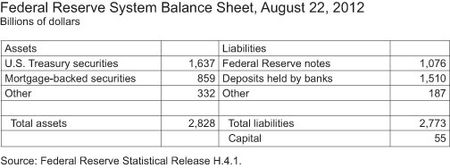
It’s important to keep in mind, however, what determines the total quantity of these balances. One way of understanding the issue is by looking at the Fed’s balance sheet, a simple version of which is presented in the table below.


   As the table shows, the balances that banks hold on deposit at the Fed are liabilities of the Federal Reserve System. The other significant liability is currency in the form of Federal Reserve notes. Together, this currency and these deposits make up the monetary base, the most basic measure of the money supply in the economy. The composition of the monetary base between these two elements is determined largely by the amount of currency used by firms and households (both in the United States and abroad) to make transactions and by banks to stock their ATM networks.
   What determines the size of the monetary base? As with any other institution’s balance sheet, the Fed’s dictates that its liabilities (plus capital) equal its assets. The Fed’s assets are predominantly Treasury and mortgage-backed securities, most of which have been acquired as part of the large-scale asset purchase programs. In other words, the size of the monetary base is determined by the amount of assets held by the Fed, which is decided by the Federal Open Market Committee as part of its monetary policy.
   It’s now becoming clear where our story’s going. Because lowering the interest rate paid on reserves wouldn’t change the quantity of assets held by the Fed, it must not change the total size of the monetary base either. Moreover, lowering this interest rate to zero (or even slightly below zero) is unlikely to induce banks, firms, or households to start holding large quantities of currency. It follows, therefore, that lowering the interest rate paid on excess reserves will not have any meaningful effect on the quantity of balances banks hold on deposit at the Fed.
Reviewing the Fed’s balance sheet clearly illustrates that open market operations and large-scale asset purchases (QE) are no more than an asset swap with private banks in which the amount of reserves in the system expands. Banks cannot lend these reserves to the public and can only dispose of them through changes to the Fed’s balance sheet. Therefore, any hope that lowering or ending IOER will stimulate private credit creation can only come from a change in demand based on lower interest rates or revised expectations about future rates and asset prices.
Needless to say, I agree with the Fed that altering policy in this manner will have a negligible effect in spurring demand for loans. On the cost side, this policy presents uncertainty for the continued functioning of money market funds and reduces bank capital. Further, when the Fed eventually wishes to raise rates, IOER permits altering the Fed Funds rate without targeting the amount of reserves in the system. This NY Fed post appears to send a clear message that an "Interest-On-Reserves Regime" Will Rule Monetary Policy For The Foreseeable Future.

Friday, August 17, 2012

"Interest-On-Reserves Regime" Will Rule Monetary Policy For The Foreseeable Future

When the Fed began paying IOR and IOER on October 9, 2008, the Fed Funds rate stood at 1.5%. With the US financial system already experiencing a liquidity crisis, the Fed was actively engaged in providing liquidity through various operations (see this Financial Turmoil Timeline). The rising demand for reserves was making it increasingly difficult for the Fed to maintain its interest rate target, through reserve management, while simultaneously ensuring liquidity. A clear solution, implementing an “interest-on reserves regime”, had been laid out by the Federal Reserve’s Marvin Goodfriend several years earlier in a paper on Interest On Reserves and Monetary Policy.

Goodfriend noted that:

the interest-on-reserves regime would differ from the Fed’s current operating procedures in one important respect. Open market operations would cease to support the interbank rate in the new regime. (p.3)
Instead, the rate of interest-on-reserves would maintain the interest rate target while:
open market operations would have the potential to manage productively the aggregate quantity of broad liquidity in the economy independently of interest rate policy. A central bank could increase broad liquidity in the economy by using newly created reserves to acquire less liquid assets or by financing a temporary government budget deficit. (p.3)
Previously the Fed’s ability to:
manage broad liquidity...by changing the composition of its assets, for example, by selling liquid short-term Treasury securities and acquiring less liquid longer term securities... [was] strictly limited by the size of its balance sheet. (p.4)
Changing the Fed’s operating procedures to use interest-on-reserves in setting interest rates, therefore allowed the Fed to engage in massive balance sheet expansion, via QE, and to increase the size of Operation Twist. Through these unconventional measures the Fed not only continues to increase liquidity and “finance” the federal budget deficit, but also manages to lower long-term interest rates.

Following the ECB’s decision to stop paying interest-on-reserves, proponents of monetary stimulus within the US are calling for the Fed to adopt a similar stance or potentially make the nominal rate negative. While I previously examined the potential fallout from a negative IOER rate, in light of the above information, a reversion back to previous monetary policy procedures seems even less probable.

The Federal Reserve’s decision to implement an “interest-on-reserves regime” has clearly been beneficial in permitting the use of previously conventional measures for unconventional purposes, including the provision of liquidity and “financing” of federal budget deficits. Eliminating the payment of interest-on-reserves will not prevent the Fed from continuing to use open market operations in this manner, as long as the Fed Funds rate remains at zero. However, departing from this new regime will ensure that any future rate hikes be preempted by a reversal of the balance sheet expansion (or excess sale of Treasuries). Balance sheet contraction, through open market operations, could very well depress asset values and raise long-term interest rates. If this occurs, the Fed would be effectively causing a new crisis just as the economy is becoming increasingly stable. Separately, a 25 basis point reduction in short-term interest rates is unlikely to cause a noticeable rise in credit demand but would reduce financial sector profits. Given that any decision to cease paying interest-on-reserves would likely be temporary and the potential benefit is limited, there is seemingly little reason for the Fed to change course. An “interest-on-reserves regime” appears likely to rule monetary policy for the foreseeable future.

Monday, July 16, 2012

Making IOER Negative Equates to Raising Taxes And Raises Potential Of New Recession

Earlier today an analyst from Jeffries’, David Zervos, published a research note implicating that the Fed may cut interest on excess reserves (IOER) from 0.25% to -0.25%. Here’s an excerpt courtesy of Zero Hedge:
The quote from the last FOMC minutes suggested the Fed wanted a "new tool". Well here ya go Ben, take the IOER to -25bps, take 2s to -50bps and watch banks start setting LIBOR negative!! If you really want to push the portfolio balance channel this will wake up all the sleeply reserve managers with liquidity needs in USD. Of course as short rates plunge into negative territory, inflation expectations will rise sharply. It will be important to not expect too much love for the long end if this happens. And like I said above, even if this is a low probability event, the mere possibility of it happening makes levered longs in the front end a fantastic trade! No one is prepared for it. Just ask yourself how many risk management departments have shocked 2yr notes to -50bps and 3ml to -30bps in their VAR analytics. Not many!!
Many investors seem to view this action positively, believing the resulting increase in bank lending will lead to higher growth and inflation. Before presenting the likelihood of such an action by the Fed, it’s important to clarify the major effects of making IOER negative.

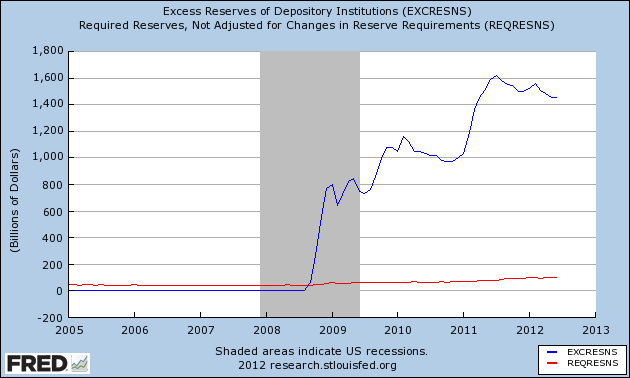
Currently, banks are holding approximately $1.45 trillion in excess reserves:
As Mish Shedlock and Steve Keen have recently reconfirmed, banks cannot lend reserves. Reserves are brought into existence and removed from the system through open market operations. The Fed therefore controls the amount of reserves in the system, as a helpful tool in maintaining its interest rate policy. Since members of the Fed/FOMC and most economists view QE as monetary stimulus, I presume that the Fed will not elect to accompany a reduction in IOER with a policy of reversing QE and reducing its balance sheet. If the IOER becomes negative, given that assumption, banks will face a decision between increasing lending to drive up required reserves or continuing to hold excess reserves at a penalty rate.

Faced with this decision, banks may initially seek to increase lending. The drop in IOER acts similarly to a rate cut and at a negative rate may encourage banks to even extend loans that, though not directly profitable, are expected to lose less than the cost of holding corresponding excess reserves. Regardless, the amount of new borrowing required to significantly reduce excess reserves is inconceivable (a 10% reserve requirement suggests $14 trillion). The current amount of excess reserves will therefore likely remain well above $1 trillion, which is bad for banks and stocks.

Why? Well, given the current IOER rate, banks are effectively earning $3.5 billion per year, risk-free ($1.4 trillion * 0.25%). Flipping the current IOR to negative and maintaining a similar level of excess reserves suggests a yearly drain from the financial system of $3.5 billion. This reduction in profitability will hurt bank capital, which is ultimately the real constraint on bank lending.

While a negative IOER will lower bank profits, it will likely increase profits at the Fed (which are transferred to the Treasury). As Zervos points out, this policy change could also push short-term Treasury rates (at least out to 2-years) negative. If that occurs, holders of short-term Treasury notes would join banks in effectively paying the Treasury to hold funds (ie. negative interest income). Although the combination of these factors will reduce the deficit, it will simultaneously reduce net financial assets of the private sector. In that sense, a negative IOER is equivalent to raising taxes.

Absent countervailing measures to increase the deficit, a reduced deficit will also result in declining corporate profits (ex-Fed). As I’ve noted previously, the federal deficit has been the primary factor supporting corporate profits over the past few years. With a corporate profit recession already in our midsts, this decision by the Fed could result in a corporate profit depression.    

In my opinion, any optimism regarding a negative IOER is badly misplaced. Rather than sparking new lending, this change in monetary policy will likely bring about the reverse by hurting bank profits and capital. By inflicting a “tax” on the broader private sector, a negative IOER could even dampen corporate profitability and incomes. In the end, a policy of negative IOER might be enough to inspire a massive sell-off in stocks and push the US economy into recession.

To end on a positive note, I believe it is highly improbable that Bernanke or the Fed enacts such a policy. Apparently Goldman agrees.

(Note: Above I mentioned Zervos’ view that a negative IOER rate would lead to negative short-term Treasury rates. I haven’t had enough time to fully think through the possibility, but my initial reaction is skeptical. Other countries currently with negative rates on short-term government debt are either engaged in a monetary union or maintaining a currency floor. Government debt in those instances therefore, apart from safety, also provides an effective call option on higher relative currency valuations. Given that the US dollar is a floating currency, investors/savers could presumably hold dollars instead of Treasuries. This could cause a rise in the dollar exchange rate but would probably keep rates from going negative (absent the Fed adjusting lower the Fed Funds rate). I’ll plan to do a follow post on this topic in the near future but, in the meantime, does anyone have helpful thoughts on this topic?)   

Tuesday, June 19, 2012

IOR Killed the Money Multiplier

Following yesterday’s post that the SNB Massively Increases Monetary Base to Maintain Currency Floor, I became engaged in some back and forth dialogue through the comments at FT Alphaville. In response to a suggestion that the SNB had given up control over interest rates by instituting the currency floor, Philip Pilkington (Naked Capitalism) said:
They could easily maintain control over interest rates by paying a set rate of interest on reserves, just like the US/UK/Japan do with their base rate.
Paying a positive rate of interest on reserves (IOR) would provide a huge incentive for Swiss banks to hold reserves instead of short-term government securities. This swap would move rates on government debt towards the IOR rate (although given the currency floor, Swiss debt may still trade at a relative premium). This discussion of IOR got me thinking:
if the SNB chose to pay IOR, wouldn't that to some degree tighten monetary policy (by making credit more expensive relative to money-like instruments)? If so, might this policy increase deflation and thereby put further upwards pressure on the CHF?
Philip responded:
Maybe. Depends if you think that low interest rates in a ZIRP-like environment actually stimulates demand. I don't think they do to any significant extent. This was shown in the Godley/Lavoie computer simulated models. The effects on investment are short-term -- in the long-term they take away interest income which decreases consumption.
With regards to monetary policy, my views are closely aligned with Philip’s. The strengths of monetary policy are alleviating financial illiquidity and encouraging investment (largely housing) by holding down the long end of the curve. At the moment, US financial markets are highly liquid and housing investment remains constrained by excessive household/mortgage debt, underwater borrowers, foreclosure errors and shadow inventory. Altering rates slightly, in either direction, at such low levels is therefore unlikely to have much impact.  

Moving beyond the economic impact of paying IOR, I decided to pose a question previously alluded to in Permanent Zero: Record Low Treasury Yields and Banking Instability:
Given the amount of excess reserves, will it be easier for central banks to adjust interest targets using the rate of IOR rather than reduce excess reserves back to a level that manages the interest rate target?
Philip confirmed my views noting:
It would, I think, be a great deal easier to use IOR rather than OMO when there are massive amounts of excess reserves (wow, I hope no one ever quotes that sentence!). When/if the recovery happens the central banks may choose to do this instead of engaging in OMOs to soak up the QE-induced reserves. It would be a great deal less hassle provided that central bankers can get over their irrational fear of excess reserves. It would also likely mean that a lot of civil servants currently engaged in OMOs might lose their jobs -- that may sound trivial, but it puts extra pressure on the IOR proponents.
If the central banks did this and conducted their interest rate policy in terms of IOR, the money multiplier would have to die. No longer could any serious economist maintain the myth. But, as I and others have argued in the past, if the money multiplier dies much of neoclassical economics goes with it. As endogenous money theorist Alain Parguez puts it: endogenous money destroys the concept of the scarcity of money, and without the notion of scarcity applied in every economic field neoclassical economics breaks down.
(Philip - My apologies for including that quote)
These comments on the end of the money multiplier brought me full circle to my first encounter with interest on reserves (IOR) back in 2010, when I discussed how the Fed Stands in Own Way on Monetary Policy. In that post I presented the following quote from a  New York Fed report on Why Are Banks Holding So Many Excess Reserves?, by Todd Keister and James McAndrews:
if the central bank pays interest on reserves at its target interest rate,..., the money multiplier completely disappears.
So the money multiplier is dead and even members of our central bank are aware of this fact. Now if only most economists would start accepting this reality...

Update: Ramanan (in the comments) directs us to a power point by Marc Lavoie on Changes in central bank procedures during the subprime crisis and their repercussions on monetary theory. Lavoie provides an important correction to Keister’s views noted above (emphasis mine):
You seem to imply that the textbook multiplier still applies when reserves earn no interest. I think that this is a misleading statement. It implies that there is a bunch of agents out there,
waiting for banks to provide them with loans, but that there are being credit rationed because banks don’t have access to free reserves. ...Rather what happens when excess reserves are being provided with no remuneration of reserves is that the fed funds rate drops down, as banks with surplus reserves despair to find banks with insufficient reserves, having no alternative but a zero rate. The drop in the fed funds rate may induce banks to lower their lending rates, and hence induce new borrowers to ask for loans or bigger loans, but it really has nothing to do with the standard multiplier story. If there is no change in the lending rate, new creditworthy borrowers just won’t show up. There is never any money multiplier effect.