Showing posts with label Uncertainty. Show all posts

Tuesday, February 5, 2013

Probability Theory vs. Knightian Uncertainty: Is It Simply Semantics?

My Micro II course this semester is being taught by Bryan Caplan, who many readers may recognize as a frequent blogger over at EconLog. As an introduction to the course, the initial assigned readings included Caplan’s papers, “The Austrian Search for Realistic Foundations” and "Probability, Common Sense, and Realism: A Reply to Hülsmann and Block." The latter paper is a reply to Austrian criticisms of claims made in the former. Although the former paper’s focus on microeconomic discrepancies between Austrians and neoclassicals was personally intriguing (since I normally think along macro lines), the latter paper raises questions worth addressing.

Caplan’s reply can seemingly be divided into two distinct halves: the first half attempts “to spell out the philosophical side of [his] original thesis in greater depth” (p. 69) and the second half directly responds to the numerous critiques. Since Caplan is especially adept at undermining the validity of these critiques, the ensuing discussion will be directed solely at the first half of his paper.  

The paper begins by furthering discussion of probability as it relates to the Austrian-Neoclassical divide:

In Caplan (1999), my central counter to the full-blown Misesian rejection of quantifiable probability was a reductio ad absurdum. If we cannot quantify the probability of an “individual, unique, and nonrepeatable” (Mises 1966, p. 111) event, then we can never quantify probability at all, because strictly speaking, all events are “individual, unique, and nonrepeatable.” Naturally, though, this reductio is only persuasive if, ex ante, you acknowledge the absurdity of rejecting all real-world applications of probability theory.2 (p. 70)
Reading this passage for the first time I wondered, are the quantifiable probabilities being subjectively or objectively determined? Based on my previous readings of Mises’ and general perception about the debate, I presume Caplan is referencing subjective probabilities. However, as I understand the typical Austrian position, the trouble with subjective probabilities is not that they can’t be or aren’t formed. The issue is that, ex ante, it remains unclear and possibly unknowable how accurately those estimates will align with future observed outcomes. When predictions diverge from realistic probabilities, the chance of human action working against a desired end rises along with the likelihood of disequilibrium states.

Only a few pages later Caplan sufficiently answers this question while clarifying an important, yet often overlooked, distinction within neoclassical economics:
this conflates a fundamental tenet of neoclassicism—subjective-but-quantifiable probabilities—with a popular subsidiary neoclassical hypothesis—rational expectations (1997, p. 56). Rational expectations is a hypothesis linking subjective-but-quantifiable probabilities to objective frequencies. Empirical evidence of systematically mistaken beliefs (Caplan 2001a) counts only against rational expectations, not probability. (p. 73)
Personally I was caught a bit off guard by this neoclassical division since my subjective experiences suggest practically all neoclassical economists currently adhere to rational expectations. Whether this perception is due to my proclivity for macroeconomics or sampling bias remains an open question. Regardless, it was precisely this view about neoclassical (mainstream) economics that drove me away from the discipline in my undergraduate years and towards Lachmann’s radical uncertainty more recently.

Although Caplan is trying to disprove the existence of radical (Knightian) uncertainty, specifying his neoclassical position garnered my full attention. Extending his original argument against uncertainty and in favor probability theory, Caplan appeals to our common sense:
The basic principles of probability are simply self-evident. It is self-evident that one holds beliefs with some degree of certainty.3 It is self-evident that the degree of belief must vary from impossible to certain. (p. 70-71)
Denying the truth in these self-evident claims would be foolish, yet I still fail to see how these statements lead to the conclusion that “Knightian uncertainty is incoherent.” (p. 75) Strangely enough, a similar appeal to common sense may help show why the two concepts are not mutually exclusive.

As I understand it, Knightian (radical) uncertainty refers to the actual experience of outcomes that were previously unforeseeable. Caplan doesn’t appear to disregard this possibility, but instead claims this is effectively the same as having “a perceived probability of 0.” (p. 73) This appears to relegate the disagreement to one of mere semantics, but a little introspection suggests otherwise. Have you ever heard someone state the following?

“That possibility never crossed my mind.”
“I had not considered that possibility.”
“If I had known that was possible...”

Assuming your answer is yes, it is self-evident that one believes possibilities exist that were previously unconsidered. It is also self-evident that some events seem unpredictable. Therefore it is equally self-evident that true uncertainty exists.

Contrary to Caplan’s conclusion, Knightian uncertainty and “the basics of probability theory are self-evident and, rightly understood, are highly intuitive.” (p. 75) The seemingly semantic differences in effective behavior appear to be borne out by subjective experience. Ultimately these infrequent instances, though providing a sharp critique of rational expectations, fail to either contradict or materially add to probability theory. I’m therefore resigned to agree with Caplan that “any attempt to deny probability theory inevitably winds up presupposing it.” (p. 75)


Note: Within this debate about probability theory versus Knightian uncertainty, Caplan also argues that “Mises is correct to point out that beliefs about the efficacy of action are implicit in action. But he at best misspeaks when he characterizes this necessary feature of action as knowledge of “causality.” Instead, the necessary belief component of action is weaker; we don’t need to know—or even believe we know—any exceptionless causal laws. We merely require beliefs about conditional probabilities. (p. 72) This leads Caplan to conclude that “probability theory deserves to take the place of causality as a fundamental implication of the action axiom.” (p. 75)

This view raises a much deeper philosophical question about human action. Unfortunately that conversation will be postponed to a later date. In the meantime, here are a couple questions to ponder...

Are beliefs about conditional probabilities and/or knowledge of “causality” actually necessary for action? Or, would an individual without those characteristics still act, but in an unforeseeable manner?




Saturday, December 29, 2012

The Role of Money in Mainstream Macro

"In practice, of course, the purists were unable to deliver, and the new tricks involve the 'modern macroeconomists' in ad hoc assumptions of their own that are at least as objectionable as the Keynesian macroeconomic generalizations that [Michael] Wickens objected to. We have already encountered one example, the 'Gorman preferences' needed to make the representative agent at least minimally plausible... Two others are equally incredible. The first is the 'no-bankruptcies' assumption in Walrasian models and the related 'No Ponzi' conditon that is imposed on D[ynamic] S[tochastic] G[eneral] E[quilibrium] models. This eliminates the possibility of default, and hence the fear of default (since these are agents with rational expectations, who know the correct model, and hence know that there is no possibility of default), and hence the need for money, since if your promise to pay is 'as good as gold', it would be pointless for me to demand gold (or any other form of money) from you. Money would be at most a unit of account, but never a store of value. The second is the unobtrusive postulate of 'complete financial markets', smuggled into Michael Woodford's Interest and Prices(Woodford 2003, p. 64), which means that all possible future states of the world are known, probabilistically, and can be insured against: this eliminates uncertainty, and hence the need for finance..." -- J. E. King, The Microfoundations Delusion: Metaphor and Dogma in the History of Macroeconomics (2012: p. 228)

This quote is the lead in a recent post by Robert Vienneau putting forth the question, “Can General Equilibrium Theory find a role for money?” During my first semester in a PhD Economics program, application of the ‘No Ponzi’ condition appeared almost universal in macroeconomic models. At points I tried to raise the question of how removing this condition would impact results from the various models. Although a sufficient answer, at least for me, was not forthcoming, it appeared as though that condition was necessary to ensure a general equilibrium existed.

As for the inclusion of ‘complete financial markets’, I am not yet familiar with Woodford’s book, mentioned above. Having worked in financial markets for a few years, the notion of probabilistic uncertainty is not only false but completely misses an important aspect of investing. The purpose of holding various levels of cash over time is specifically because future states and their probabilities are unknown.

On the whole, general equilibrium models appear to remain consistent with the classical view of commodity trade, C-M-C' (a commodity is sold for money, which buys another, different commodity with an equal or higher value). Meanwhile two other views, put forth to account for a financial sector by Marx, have been largely ignored:

1) M-C-M' (money is used to buy a commodity which is resold to obtain a larger sum of money)
2) M-M' (a sum of money is lent out at interest to obtain more money, or, one currency or financial claim is traded for another. "Money begets money.")
Based on my initial exposure to advanced macroeconomics, it appears true that “money would be at most a unit of account, but never a store of value.”

Wednesday, August 1, 2012

Bubbling Up...

1) Keynes and Knight on uncertainty – ontology vs. epistemology by Lars P Syll
Paul Davidson: “Lars, there is a difference between the uncertainty concept developed by Keynes and the one developed by Knight.
As I have pointed out, Keynes’s concept of uncertainty involves a nonergodic stochastic process . On the other hand, Knight’s uncertainty — like Taleb’s black swan — assumes an ergodic process. The difference is the for Knight (and Taleb) the uncertain outcome lies so far out in the tail of the unchanging (over time) probability distribution that it appears empirically to be [in Knight's terminology] “unique”. In other words, like Taleb’s black swan, the uncertain outcome already exists in the probability distribution but is so rarely observed that it may take several lifetimes for one observation — making that observation “unique”.

2) What’s Driving China’s Real Estate Rally? Part 3 by Patrick Chovanec
By anticipating future demand growth, investors effectively front-load that growth into the present.  That’s great for developers, who get to sell more today, but it means that a great deal of future demand has already been provided for and priced into the market.  We see this phenomenon in other markets as well.  In the West, many investors want to buy into high-growth companies like Apple or Facebook.  What they don’t realize is that, to the extent they’re paying a high price-to-earning (P/E) ratio, they’re paying for that growth up-front, with the benefit accruing to the present-day seller, not the new investor.  Even a genuinely promising company can have an overpriced stock.
The imbalance in real income growth I mentioned earlier exacerbates this phenomenon.  The proceeds of inflationary money creation are channeled to favored recipients, often in the form of “hidden” income.  These high income earners, in need of a place to stash their cash, pour it into property, in anticipation of future demand.  The more money is created through expansive credit, the more cash they have to stash.  In the meantime, the inflation that is generated boosts the nominal wages of low-skill workers, but erodes their real income growth, which is the basis for growth in future housing demand.  Excessive money growth inflates the price that investors are willing to pay today, and lengthens the amount of time it will take actual homebuyers to come to afford that price.  In other words, it creates a bubble.
As I noted before, rising incomes mean that current housing prices will become gradually more affordable — but only if they stop rising.  If the market has to depend solely on end-user demand, there is a catch-up period ahead, in which incomes gradually rise to meet anticipatory prices, and investors gradually sell their stockpiled apartments to actual residents.  The only way to avoid this catch-up period would be for investors to continue fronting for future demand by expanding their holdings even further.  Many believe this will happen.  In fact, if you think about it, this is really the main rationale behind calls for the government to lift restrictions on multiple home purchases: only investment demand, in the form of renewed stockpiling, can save the day.”
3) GM's Channel Stuffing Goes To Germany: Is Europe's Largest Economy A Fraud? by Tyler Durden
Via Reuters: “So while official figures show a 0.7 percent rise in German car sales for the half year, figures from auto market research firms Dataforce and BDW Automotive show private demand fell 5 percent in the period, which would mean all the growth had been manufactured by the manufacturers.”
"If you push at the end of one month, you start the next one in deficit because you've registered a car you still have to sell," he said. And when dealers can no longer keep it up, carmakers do it themselves. As a result, the two account for a combined 30 percent of the new car market, making the industry the second largest source of demand behind only private customers, who account for 39 percent.”

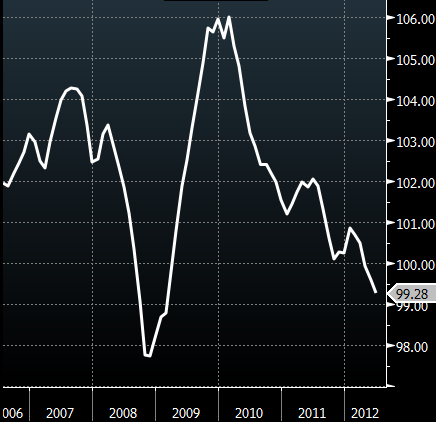
4) China's index of leading indicators points to further economic erosion by Walter Kurtz

The Index of Leading Indicators hit a post-2009 low today,
*
China National Bureau of Statistics Leading Indicators Index, 1996=100


5) Imposed versus Adopted Monetary Rules by Steve Horwitz
Put differently, a policy-guiding rule is adopted by the central bank;  a policy-constraining rule is imposed on the central bank.  Their purposes are very different.
It is in this sense that Friedman opposed discretion and those in favor policy-guiding rules do not.  Friedman’s rules are not changeable by the central bank itself;  policy-guiding rules are.  The central bank has discretion to pick its “rule.”  That, Friedman thought, was the whole problem, hence his call for a rule to be imposed.
Woj’s Thoughts: Horowitz hits on a key aspect of the rules vs. discretion debate by explaining that some “rules” intentionally leave open vast space for discretion. Applying a rule to fiscal or monetary policy, such as full employment, does not imply that Keynesians (or any other economists) prefer rules to discretion. On the contrary, the choice to allow policy makers substantial discretion in meeting such “rules” suggests discretion is preferable.

Monday, June 11, 2012

Russ Roberts - In a complex system, bias reigns


Step back for a minute and consider the challenge of measuring the impact of the stimulus. It is one of many things that happened between February 2009 and the end of 2010. For starters, massive reforms of health care and the financial sector were passed. They were passed but the details of how they would actually be implemented remained uncertain through the end of 2010 (and remain so today.) There was an unprecedented set of monetary interventions. From the end of 2008 through the end of 2009, the Federal Reserve’s balance sheet went from around $800 billion to about $2.2 trillion. And of course a million other things happened as well. The price of housing fell steadily during this period, the price of oil rose steadily, the recession officially ended and on and on and on.
No one has a model of the independent impact of these different factors or a way of measuring them accurately and reliably in a way that can be tested and confirmed or rejected. No one. That means everyone, on the left or the right, who claims to have evidence for the impact of one of them or who cherry-picks one of those out of the myriad to choose from and blames that one factor for the lousy pace of the recovery is either fooling himself or fooling you. Don’t be a fool. So when the E.J. Dionnes of the world tell you that government creates jobs, just ask them how they know. Their answer will be that someone with exemplary credentials says so. But there are those with exemplary credentials who say otherwise. Where does that leave us? It should leave us in ignorance and doubt. No certainty. No exclamation points. More humility.
Read it at Cafe Hayek
In a complex system, bias reigns
By Russ Roberts