"In practice, of course, the purists were unable to deliver, and the new tricks involve the 'modern macroeconomists' in ad hoc assumptions of their own that are at least as objectionable as the Keynesian macroeconomic generalizations that [Michael] Wickens objected to. We have already encountered one example, the 'Gorman preferences' needed to make the representative agent at least minimally plausible... Two others are equally incredible. The first is the 'no-bankruptcies' assumption in Walrasian models and the related 'No Ponzi' conditon that is imposed on D[ynamic] S[tochastic] G[eneral] E[quilibrium] models. This eliminates the possibility of default, and hence the fear of default (since these are agents with rational expectations, who know the correct model, and hence know that there is no possibility of default), and hence the need for money, since if your promise to pay is 'as good as gold', it would be pointless for me to demand gold (or any other form of money) from you. Money would be at most a unit of account, but never a store of value. The second is the unobtrusive postulate of 'complete financial markets', smuggled into Michael Woodford's Interest and Prices(Woodford 2003, p. 64), which means that all possible future states of the world are known, probabilistically, and can be insured against: this eliminates uncertainty, and hence the need for finance..." -- J. E. King, The Microfoundations Delusion: Metaphor and Dogma in the History of Macroeconomics (2012: p. 228)
This quote is the lead in a recent post by Robert Vienneau putting forth the question, “Can General Equilibrium Theory find a role for money?” During my first semester in a PhD Economics program, application of the ‘No Ponzi’ condition appeared almost universal in macroeconomic models. At points I tried to raise the question of how removing this condition would impact results from the various models. Although a sufficient answer, at least for me, was not forthcoming, it appeared as though that condition was necessary to ensure a general equilibrium existed.
As for the inclusion of ‘complete financial markets’, I am not yet familiar with Woodford’s book, mentioned above. Having worked in financial markets for a few years, the notion of probabilistic uncertainty is not only false but completely misses an important aspect of investing. The purpose of holding various levels of cash over time is specifically because future states and their probabilities are unknown.
On the whole, general equilibrium models appear to remain consistent with the classical view of commodity trade, C-M-C' (a commodity is sold for money, which buys another, different commodity with an equal or higher value). Meanwhile two other views, put forth to account for a financial sector by Marx, have been largely ignored:
1) M-C-M' (money is used to buy a commodity which is resold to obtain a larger sum of money)
2) M-M' (a sum of money is lent out at interest to obtain more money, or, one currency or financial claim is traded for another. "Money begets money.")
Based on my initial exposure to advanced macroeconomics, it appears true that “money would be at most a unit of account, but never a store of value.”
1) Economics Of The Steady State by Robert Vienneau @ Thoughts on Economics
A steady state is characterized by the economy having a constant rate of growth. I here select a number of expositions of analyses of steady state I have made on this blog:
- The Harrod-Domar model of warranted and natural rates of growth.
- Karl Marx's volume 2 model of simple and expanded reproduction.
- Neoclassical Overlapping Generations (OLG) models with intertemporal utility maximization.
2) The “Liquidity Trap” Theory Was Never Right…. by Cullen Roche @ Pragmatic Capitalism
Anyhow, most of the mainstream has been working under some form of the “liquidity preference” theory or “liquidity trap” theory to explain why rates have remained low in the USA. This was the thinking that economic agents were choosing to just sit on the excess liquidity provided via the government and the Fed. It sounds right in theory, but it’s wrong in reality.
First, the government doesn’t increase the money supply through government spending (already confused? See here). It redistributes inside money (bank money) and adds a net financial asset in the form of a government bond. This improves private balance sheets and is particularly useful during a balance sheet recession, but it’s not the equivalent of firing dollar bills out into the economy (though it does increase the velocity of spending as the government becomes the “spender of last resort” when an economy is stagnant for whatever reason). Second, when the Fed implements QE they swap reserves for bonds. No change in net financial assets. And since banks don’t lend reserves there is no firm transmission mechanism through which this policy can impact the money supply. In short, fiscal policy hasn’t been the equivalent of increasing the money supply in the traditional “money printing” sense that most believe and QE has most certainly not resulted in an increase in the money supply because the primary transmission mechanism is busted (the lending channel).
Woj’s Thoughts - Paul Krugman has recently changed his views to acknowledge that bond vigilantes are not an issue for the US. While he should be commended for taking this step away from the typical mainstream position (which he held prior to the crisis), his views remain tied to “liquidity trap” models. Although these models will, in some instances, come to correct conclusions, that may be due to chance rather than logic.
3) Macroeconomics and the financial cycle by Matias Vernengo @ Naked Keynesianism
Claudio Borio from the BIS has written a widely cited paper.
…
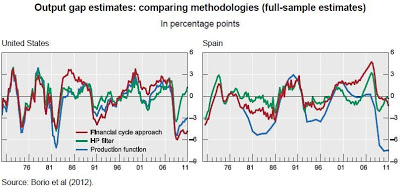
The new output gap measure would include financial variables. He correctly notes that output gap measures take into consideration only inflation, when ascertaining whether the economy is above the potential or not, and that "it is quite possible for inflation to remain stable while output is on an unsustainable path" [and you can have inflation without being at full employment too, I would add]. His measure of the output gap would include information about asset price inflation too (property prices and measures of credit booms) and is shown for the US and Spain as the red line below.
…
I have several problems with these views, even if there are some good things, beyond good intentions, in Borio's paper. In fact, I think that there is significant evidence for the notion that potential output varies with demand expansion (Kaldor-Verdoorn Law), so that if a revision of the way potential output is measured it would be in the opposite direction.
Woj’s Thoughts - An accurate measure of the output gap would be very beneficial in demonstrating the periods when macroeconomic smoothing is necessary. Unfortunately trying to create that measure is no easy task and previous efforts have likely led to false policy prescriptions. Given the substantial variation based on methodology, as shown above, the current benefit of such measures to policy making seems limited.
Yesterday I posed the question, Are Theories of Modern Money and Heterogeneous Capital Compatible? In the discussion that followed on Facebook, the capital debates became a central theme. For those unfamiliar with the capital debates, here are a few choice selections from Matias Vernengo’s wonderful, yet brief introduction:
The capital debates are associated with the very notion of capital. Classical political economy authors, from William Petty to Karl Marx, including Quesnay, Smith and Ricardo, treated the process of production as a circular one. In this context, capital is a produced means of production,[2] rather than a factor of production used in the process of obtaining final goods. The most important result of the capital debates is that, once capital is defined as produced means of production, there is no direct relation between the relative abundance or scarcity of the means of production and its remuneration. Distribution, in other words, is not governed by supply and demand.
…
Even though the idea of intertemporal equilibrium, in which capital is treated as a vector of heterogeneous capital goods, was first developed by Eric Lindahl and then popularized by John R. Hicks in the 1930s, and used by Arrow and Debreu in the 1950s, it was only after the capital debates that it came to be dominant within the mainstream.
The problem with the use of heterogeneous capital goods is that it implies a change in the traditional method of economics. Normal equilibrium positions are associated to a uniform rate of profit; however, when dealing with heterogeneous capital goods that are not substitutable between each other, it becomes necessary to discard the notion of long run equilibrium.
Although I don’t want to stray too far from the original question, this last sentence by Vernengo appears to offer support for monetary non-neutrality in the long run. When discussing the subject recently, the question was posed “is the long run therefore simply a series of short run periods?” Perhaps surprising to many of my Austrian colleagues, it appears the introduction of heterogeneous capital provides reason “to discard the notion of long run equilibrium.”Returning to the main subject at hand, The Radical Subjectivist offers Lachmann’s Quick Comment on The Cambridge Capital Debate:
The second reason rests on the fact that the purpose of all capital, hence also of the current maintenance of existing capital goods, is to secure a future income stream. But the future is unknowable, though not unimaginable, and men have to use knowledge substitutes in order to evaluate future income streams, viz. expectations. Experience shows that different persons will typically hold different expectations about the future income to be expected from the same resource, and that the same person may hold different expectations about the same future event at different points of time. The inevitably subjective nature of all ‘forward looking’ views renders the measurement of capital impossible.
Lachmann was seemingly critical of the capital debates for ignoring subjectivism and not giving credit to earlier authors, including Hayek, that discussed the impossibility of measuring capital. While these points may be correct, they don’t appear to undermine the deeper critiques of neoclassical (mainstream) economics laid out by Vernengo. Summing up the current discussion, here is a straightforward answer from Lord Keynes (my emphasis):
Post Keynesian economics agrees with Austrian economics that capital goods are heterogeneous.
But heterogeneous capital can also have a significant degree of durability and substitutability. A capital structure in a capitalist economy where we find some important degree of adaptability, versatility and durability in the nature of capital goods means that the Austrian business cycle theory of Hayek, as propounded in Prices and Production, is not a realistic vision of modern economies.
Further reading:Subjectivism and Economic Analysis: Essays in memory of Ludwig LachmannRevisiting the Cambridge Capital Theory Controversies: A Historical and Analytical Study(Special thank you to Payam Sharifi, Gauchito Gil, and Pablo Bortz)
Referring to a recent post by Scott Sumner, in NGDP Targeting: Altering Theory to Fit History I asked:
What happened to the causal effect whereby a “decline in nominal GDP brought about a sharp decline in real GDP”?
Underlying this question appears to be a deeper one regarding the potential neutrality of money. Accepting that money is neutral implies that changes in the quantity of money can alter real GDP in the short-run, but in the long-run has no real impact (only nominal). It is through assumptions such as this that economists believe they can ignore money and the financial system in macroeconomic models of the economy.
Nick Rowe attempts to establish the neutrality of money, to which David Glasner responds that Money Is Always* and Everywhere* Non-Neutral. Glasner’s thoughtful insight is well-worth reading in full, but the conclusion is that:
every economic equilibrium is dependent on the expectations held by the agents. A change in expectations changes the equilibrium. Or, as I have expressed it previously, expectations are fundamental. If a change in monetary policy induces, or is associated with, a change in expectations, the economic equilibrium changes. So money can’t be neutral. Ever.
Changes in the supply of money do have causal effects on real GDP, even in the long-run. Incorporating money and credit into models of the economy is therefore imperative to improving forecasting and better informing policy making.
In a post titled, Assuming Away the Economy, UnlearningEcon discusses the “disconnect between economic models/assumptions and the economy they purport to represent” based on a recent reading of the following quote by Frank Knight:
“To begin with a general abstract answer, it will be evident to anyone with a rudimentary understanding of economic processes and analysis that profit (always in the sense of pure profit) would be absent under the conditions of equilibrium with “perfect competition,” (which may be defined in more than one way). The”tendency” of the competitive processes of buying and selling and the control of production is to impute the whole product to the productive agencies which create it, leaving nothing for entrepreneurship as a distinct function (except for monopoly gain, referred to below). This means that under the conditions of ideal equilibrium (stationary or moving) the function of entrepreneurship itself is entirely absent from the economy.”
This morning, on my drive to work, I listened to a recent EconTalk podcast by Russ Roberts with Ronald Coase. One of the topics discussed was a paper Coase wrote as an undergraduate, “The Nature of the Firm.” Traditional economic theory of that time implied that firms should not exist because of the price system. Firms obviously did exist and Coase set out to understand how and why. To the surprise of many, he found that price signals were often not used in decision-making within firms. As Coase mentions in the podcast:
It's cheaper because the price system is a very expensive system. If you think of all the things you have to know in order to make a bargain it's obvious it's not a cheap system. And a system that avoids negotiations is one that saves a lot of costs.
Coase’s paper was written in 1937 and the quote by Knight is from 1942. Seven decades later economics is still dealing with the fundamental problem that equilibrium underlies all mainstream theories but fails to provide a reasonable representation of the real world.
Thinking about this topic led me to consider Milton Friedman’s essay "The Methodology of Positive Economics", in which he argues that an economic theory should be judged based on the validity of its predictions rather than the accuracy with which its assumptions describe reality. The economics profession appears to have taken this argument one step too far, broadly applying and assuming the validity of assumptions from theories that only proved accurate in a very limited sense. To my mind, this extension may have been prevented had Friedman’s argument been accompanied by the following caveat: The predictive validity of an economic theory only validates the use of inaccurate assumptions in the limited environment for which the predictions hold.
Unfortunately history has not played out that way. Mainstream economics broad application of assumptions that abstract from the real world has resulted in a whole host of theories that could not foresee the Great Recession or offer practical policy resolutions for the ongoing crisis. On the current status of economics, Coase comments:
I think the time has come when we should study what actually happens
Hopefully this view will soon become a reality.

