1) Back to Just (An) Economist Mom by Diane Lim @ EconomistMom
After 4 and 3/4 years and 932 posts (counting this one), I’m putting down my pen as “the EconomistMom” (capital-E, capital-M, smooshed together) and going back to being (more ordinarily) just (an) economist mom. (I think in my older (i.e., younger) days I would have been anal about it and set a target of ending at the 1,000th post mark.)
I’m leaving (technically, have already left) the Concord Coalition–where I have worked the whole time I’ve been writing this blog–and joining the Pew Charitable Trusts as their new chief economist on February 4.
Woj’s Thoughts - While earning a Master’s in Public Administration at George Washington University, I was fortunate to have Dr. Lim as a professor on tax and budget policy. She helped reignite my interest in economics and offered guidance throughout my decision to pursue a PhD. Her presence in the blogging world will certainly be missed, although I’m sure she will continue to have a positive impact in the field through her role at Pew Charitable Trusts.
2) Why do people think economists are charlatans? by Noah Smith @ Noahpinion
Zingales either performed a survey or reviewed a survey (I can't remember which) that compared economists' and non-economists' positions on policy issues. The paper found quite a bit of disagreement, but here's the really interesting part: When normal people were told the position of the economists, they changed their positions in the opposite direction. In other words, saying that "economists believe X" made people less likely to say they believed X!
…
Most American economists believe mercantilism to be a debunked idea, a false doctrine refuted since the time of Adam Smith. In fact, the collective memory of this "great victory" may be one thing that makes the free trade consensus so precious to Smith's successors in the Anglo-Saxon world. But remember, Adam Smith (though possessed of an excellent last name) lived in the time of literary economics, when empirical evidence was not much of a check on logical argumentation.
What does the empirical evidence tell us about mercantilism today? Well, it's difficult to say, but it is worth noting that all the countries that have become rich in recent decades have employed extremely mercantilist policies.
Woj’s Thoughts - Noah offers a few quotes from a recent Dani Rodrik paper that discusses empirical data on the success of mercantilist policies. Having recently taken first-year Micro, I was once again reminded of the simplicity behind the benefits of free trade. However, as a student of history, it’s hard to argue with the apparent success of mercantilist policies across developing countries during the past couple centuries. Trade may be an issue where theory, while correct, simply does not match up well with historical experience. If economists hope to be taken more seriously on these issues, then regardless of the outcome, the time has come to truly study the empirical data.
3) Why Are Real Interest Rates So Low, and Will They Ever Bounce Back? by David Glasner @ Uneasy Money
First, it can’t be emphasized too strongly that low real interest rates are not caused by Fed “intervention” in the market. The Fed can buy up all the Treasuries it wants to, but doing so could not force down interest rates if those low interest rates were inconsistent with expected rates of return on investment and the marginal rate of time preference of households. Despite low real interest rates, consumers are not rushing to borrow money at low rates to increase present consumption, nor are businesses rushing to take advantage of low real interest rates to undertake shiny new investment projects. Current low interest rates are a reflection of the expectations of the public about their opportunities for trade-offs between current and future consumption and between current and future production and their expectations about future price levels and interest rates. It is not the Fed that is punishing savers, as the editorial page of the Wall Street Journal constantly alleges. Rather, it is the distilled wisdom of market participants that is determining how much any individual should be rewarded for the act of abstaining from current consumption. Unfortunately, there is so little demand for resources to be used to increase future output, the act of abstaining from current consumption contributes essentially nothing, at the margin, to the increase of future output, which is why the market is now offering next to no reward for a marginal abstention from current consumption.
Second, interest rates reflect the expectations of businesses and investors about the profitability of investing in new capital, and the expectations of households about their future incomes (largely dependent on expectations about future employment). These expectations – about profitability and about future incomes — are distinct, but they are clearly interdependent. If businesses are optimistic about the profitability of future investment, households are likely to be optimistic about future incomes. If households are pessimistic about future incomes, businesses are unlikely to expect investments in new capital to be profitable. If real interest rates are stuck at zero, it suggests that businesses and households are stuck in a mutually reinforcing cycle of pessimistic expectations — households about future income and employment and businesses about the profitability of investing in new capital. Expectations, as I have said before, are fundamental. Low interest rates and secular stagnation need not be the result of an inevitable drying up of investment opportunities; they may be the result of a vicious cycle of mutually reinforcing pessimism by households and businesses.
Woj’s Thoughts - Countering the views of market monetarists, Glasner provides his own thoughts on why real interest rates remain low today. It’s fascinating to note the combination of a Keynesian-demand side story in the first paragraph and an Austrian/Lachmann subjective expectations view in the second section. While I agree that both aspects play a significant role in understanding current low real interest rates, there is a third uniting topic that I think is left out of Glasner’s post. The third topic is private debt and debt servicing costs, which may dampen demand for loans and simultaneously reduce expectations of future income. Unless the third topic is recognized as part of the problem, remedying the other two issues will prove temporary, at best.
The value of national accounting identities in economics and as a means of qualifying the wealth of a nation has recently been a frequent topic of personal discussions. Hence I was excited by Euvoluntary Exchange’s critiquing GDP vs. EE, in which Samuel Wilson takes on the conventional accounting of exports and imports:
Where GDP is usually referenced by economists and the press is as a proxy for the health and vitality of the economy. Higher GDP per capita tends to correlate well with higher standards of living and better material well-being. There are quite a few things folks consider desirable that track well with high GDP, like lower violent crime, longer life expectancy, lower infant mortality, et al. That's great, but if we're measuring prosperity, it seems kind of perverse to ding your metric for exchanges that happen in one particular direction across one particular type of border. By using GDP as a proxy for prosperity, the deck is sort of stacked against the euvoluntarity of international trade, and this is completely independent of any intertemporal, loanable funds considerations. It's almost tacitly suggesting that imports are something we have to suffer for the privilege of exporting. How strange.
I can perhaps understand how economists might want to concern themselves with prosperity maximization. I'm more puzzled by ones who translate this to "GDP maximization".
I'm sort of curious if folks' moral intuitions towards overseas trade would change if some snickering rogue could convince the profession to switch the sign on imports.
GDP is clearly focused on production (given the acronym), yet intuitively one might consider wealth as the amount of obtainable goods and services. The focus on production appears to mesh well with Say’s law, in which production is the means by which individuals can obtain other goods. However, there are numerous reasons to question the validity of Say’s law including the possibility of an excess demand for money. Rejecting Say’s law, one can more readily accept that production is not the only, or necessarily accurate, means of determining one’s purchasing power.
Warren Mosler, a main proponent of MMT and a sectoral balances approach to macroeconomics, presents a similar argument in his book Seven Deadly Innocent Frauds of Economics Policy (p.59 - free pdf version attached):
Imports are real benefits and exports are real costs. Trade deficits directly improve our standard of living.
…
Put more succinctly: The real wealth of a nation is all it produces and keeps for itself, plus all it imports, minus what it must export.
Wilson and Mosler clearly agree that reversing the GDP accounting sign on imports and exports would more accurately reflect the “real wealth of a nation.” That these two proponents affiliate with generally opposing economic camps, suggests optimism that many others might support this change. The road won't be easy, but reversing the sign on imports is critical to preventing this “deadly innocent fraud” from further reducing our standard of living.
1) What’s The Holdup With QE3? by James Bianco @ The Big PictureAs the chart below shows, the Federal Reserve has never initiated more accommodation when the TIPS inflation breakeven rate was above 2.0%. This level is important because the Federal Reserve adopted 2.0% as an inflation target last January.
When expected inflation is above 2.0%, it does not mean the FOMC has to tighten. But it can mean there is too much inflation to add more accommodation. Of course the Federal Reserve can decide to ignore this target, but since they adopted it less than a year ago, they risk their own credibility in doing so.
This might be the big stumbling block to QE3.
Click to enlarge:
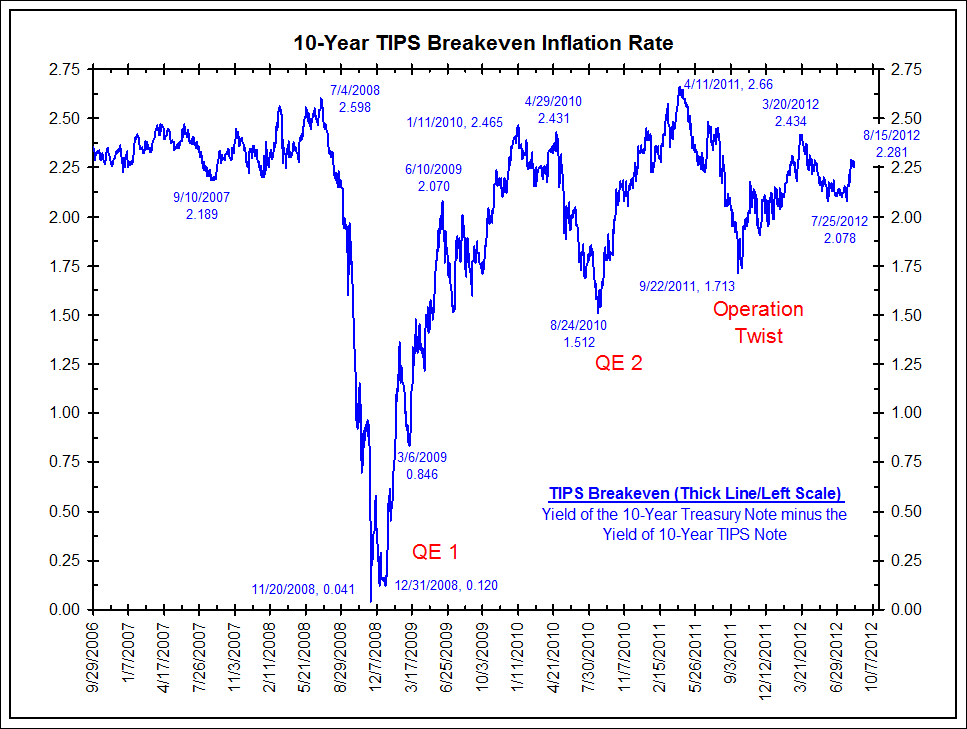
Source: Bianco Research
Woj’s Thoughts - Maybe this time will be different, but recent economic data has been generally supportive of moderate growth and US stocks are approaching post-recession highs. I stand by my previous statement: “With a Presidential election approaching, the Fed will likely err on the side of caution to avoid the perception of taking sides. Therefore, if the Fed doesn’t act in June, absent a collapse, it may not act at all in 2012.”
2) Nicholas Kaldor On The Common Market by Ramanan @ The Case for Concerted Action"… Some day the nations of Europe may be ready to merge their national identities and create a new European Union – the United States of Europe. If and when they do, a European Government will take over all the functions which the Federal government now provides in the U.S., or in Canada or Australia. This will involve the creation of a “full economic and monetary union”. But it is a dangerous error to believe that monetary and economic union can precede a political union or that it will act (in the words of the Werner report) “as a leaven for the evolvement of a political union which in the long run it will in any case be unable to do without”. For if the creation of a monetary union and Community control over national budgets generates pressures which lead to a breakdown of the whole system it will prevent the development of a political union, not promote it."
[italics in original]
That was written in 1971! In The Dynamic Effects Of The Common Market first published in the New Statesman, 12 March 1971 and also reprinted (as Chapter 12, pp 187-220) in Further Essays On Applied Economics - volume 6 of the Collected Economic Essays series of Nicholas Kaldor.
Woj’s Thoughts - Talk about being prescient! This “dangerous error” is playing out in real-time as Europe attempts to push through a full economic union in hopes that it will lead to political union. I remain highly skeptical of this course of action, which I believe is making a political union increasingly improbable (and I was already a Euro-pessimist). An eventual break-up of the EMU remains the most likely outcome, in my opinion, although it may still be a few years away. If hopes of a future political and economic union are to persist, it will be necessary for the EU to maintain free trade and labor mobility.
3) Enron, Lehman Brothers, and… Netflix? by microfundy @ MicrofundyEither way (enough of these SEC filings), what this means is that NFLX really has ANOTHER $869.53M of “current” (due within one year) liabilities that wasn’t included on their balance sheet.
They also have ANOTHER $2.97B (B, as in Billion!) of long term liabilities.
…
Although NFLX Book Value stays constant because a corresponding line gets added into their asset part of the balance sheet, THOSE ASSETS don’t produce any ADDITIONAL cash flows/earnings. THEY ARE ALREADY ASSUMED IN NFLX MODELS!
Also, all of the metrics that an investor would look at when analyzing the health of the balance sheet, involve debt. Whether looking at debt/equity, debt/assets, debt coverage ratios etc. Those are all tremendously understated!
Woj’s Thoughts - Anyone who thinks that corporate accounting is becoming more comprehensive or clean should carefully read through the notes sections of various SEC filings. Netflix is a highly visible, US company, that managed to obscure nearly $5 billion in liabilities from its balance sheet. Odds are that Netflix is not alone in this respect.
Under Keynes’s tutelage, Britain’s currency, Sterling, was in 1933 revived as a money managed by the Bank of England and protected from speculative and vested private financial interests. Then in 1934, President Roosevelt freed the dollar, and with it, the people of the United States, who then embarked on a period of sustained recovery. Sadly, Germany maintained the dictates of Gold Standard economic policies throughout the 1930s – and we all know the political consequences of that incompetence.
If Europe were now to abandon the Gold Standard-type policies that underpin the Euro, Europeans would feel the full force of private wealth’s anger, through allies in the media, academia and politics. But this will follow from fear – not reason.
So, European leaders, be as bold as Keynes and Roosevelt. You have nothing to lose but the ‘gold fetters’ that deny the people of Europe economic and democratic sovereignty, and that chain you to the interests of private wealth.
There is however, everything to gain from European convergence, prosperity, unity and peace.”
Read it at Debtonation
An open letter to the leaders of Europe: Abandon the Euro's 'gold fetters'
By Ann Pettifor
Many people are finally coming around to the notion that a common Euro currency is effectively the same as a gold standard. By removing each country's sovereignty over their currency, the Euro vastly limits the options by which countries can enact counter-cyclical fiscal or monetary policies. The gold standard proved, on numerous occasions, that in times of crisis countries will ultimately abandon the commitment. This crisis will prove no different as countries will defect from the common currency. These actions, however, should not devalue the gains from convergence in trade and labor mobility. Protecting the European Union, while abandoning the common currency, should be the top priority.
Related posts:
Chidem Kurdas - "free trade and markets matter much more than the euro"
Ending the Euro Currency, Not the European Union
Creating the euro was a different level of ambition from building a common European market. The latter had historical roots. There had been free flow of goods, capital and people across parts of Europe in the 19th century and earlier. Political barriers and wars disrupted those flows, but at times and in places free trade and free migration across national borders was a reality. Indeed, by mid-20th century older people remembered with nostalgia how easy travel had once been.
Hence by removing the barriers to the movement of goods, money and people, the European Union was not imposing a novel blueprint. Had it stopped with free markets, tremendous economic and political benefits would have been achieved with little downside. I have to admit that I never understood the aggressive drive to impose a common currency.
Read it at ThinkMarkets
Euro Crisis from Long Perspective
By Chidem Kurdas
Many people appear to still hold hope that the current EU crisis will ultimately resolve itself in the creation of a United States of Europe. Kurdas contrasts the historical conditions of the US and Europe prior to accepting a common currency. His conclusion, similar to that of Peter Boone and Simon Johnson in The End Of The Euro: A Survivor’s Guide, is worth repeating:
what needs to be kept in mind is that free trade and markets matter much more than the euro. Preserving them should be the priority.
Related posts:
Ending the Euro Currency, Not the European Union
For the last three years Europe’s politicians have promised to “do whatever it takes” to save the euro. It is now clear that this promise is beyond their capacity to keep – because it requires steps that are unacceptable to their electorates. No one knows for sure how long they can delay the complete collapse of the euro, perhaps months or even several more years, but we are moving steadily to an ugly end.
Whenever nations fail in a crisis, the blame game starts. Some in Europe and the IMF’s leadership are already covering their tracks, implying that corruption and those “Greeks not paying taxes” caused it all to fail. This is wrong: the euro system is generating miserable unemployment and deep recessions in Ireland, Italy, Greece, Portugal and Spain also. Despite Troika-sponsored adjustment programs, conditions continue to worsen in the periphery. We cannot blame corrupt Greek politicians for all that.
It is time for European and IMF officials, with support from the US and others, to work on how to dismantle the euro area. While no dissolution will be truly orderly, there are means to reduce the chaos. Many technical, legal, and financial market issues could be worked out in advance. We need plans to deal with: the introduction of new currencies, multiple sovereign defaults, recapitalization of banks and insurance groups, and divvying up the assets and liabilities of the euro system. Some nations will soon need foreign reserves to backstop their new currencies. Most importantly, Europe needs to salvage its great achievements, including free trade and labor mobility across the continent, while extricating itself from this colossal error of a single currency.
Read it at The Baseline Scenario
The End Of The Euro: A Survivor’s Guide
By Peter Boone and Simon Johnson
The last sentence requires special attention. Much of the discussion today regarding a dissolution of the EMU seems to imply that free trade and labor mobility must rapidly decline. As frustrations between and within nations are allowed to grow, this outcome may prove true but it need not. The benefits from free trade and labor mobility in the EU are significant regardless of whether any single currency exists. If that were not the case, then why are some countries part of the EU but not the EMU?
In politics it often appears that planning for unthinkable outcomes is considered a sign of expected failure. Confidence, however, cannot solve all problems. Unthinkable outcomes still happen frequently enough and the repercussions are far greater than necessary. Even if the politicians will not make their contingency plans publicly known, one has to hope those plans are being thoroughly discussed in the background. An end to the Euro currency will be troublesome, but an end to the EU will be disastrous.

