Friday, August 12, 2011

Europe Revives Failed Policies of 2008

"Those who cannot remember the past are condemned to fulfill it."
-George Santayana


Tuesday’s blog ended with the above quote, but Europe’s actions today require the quote come first. Over the past couple years, policy makers pointed to rapidly rising financial markets as proof that the financial crisis was behind us. In trying to convince the public to move beyond the past, leaders appear to have erased their own memories of countless policy mistakes with unintended negative consequences. Unfortunately, Europe is embarking on the same flawed regulatory path circa 2008 and one would be foolish to expect any differing outcome.

For a moment let us look back upon the events of September 2008. On September 7th, Fannie Mae and Freddie Mac were effectively nationalized. A week later, Merrill Lynch sold itself to Bank of America. Over the next four days, Lehman Brothers filed for bankruptcy, the Reserve Primary fund broke the buck, the Federal Reserve bailed out AIG  and Treasury Secretary Paulson laid out initial plans for TARP. With financial stocks under significant pressure, on September 19th, regulators responded:

“The Securities and Exchange Commission, acting in concert with the U.K. Financial Services Authority, took temporary emergency action to prohibit short selling in financial companies to protect the integrity and quality of the securities market and strengthen investor confidence.”

Stock markets responded positively that day, with the S&P 500 rising over three percent to close at 1255. The next day, markets opened flat before giving back the previous day’s gains. The sell off continued from there and that closing level of 1255 was not reclaimed until January 1st, 2011.

Over the past two weeks, Europe’s peripheral crisis has been morphing into a Euro-core crisis as Spanish and Italian sovereign yields rose, while France witnessed a proverbial run on its largest banks. Having apparently forgotten the lessons of 2008, this evening, France, Spain, Italy and Belgium banned short sales on numerous financial institutions (Greece and Turkey have already instituted this policy). Apart from the obvious previous failure of this policy, it’s important to understand why the policy failed and why it almost certainly will again.

Many policy failures are due to a fundamental misdiagnosis of the problem at hand. Recent weakness in bank shares stems from fear of significant asset write downs and potentially inadequate capital levels that could ultimately render the firms insolvent. Banning short selling implies these concerns are based on widespread rumors willingly accepted by millions of investors. The policy also fails to acknowledge that short selling is largely employed by financial institutions and investment funds as a means of hedging risk. Ignoring these factors has resulted in establishing a policy that reduces liquidity and discourages buying.

During normal times, potential stock buyers include investors wishing to acquire or increase long positions and others trying to cover short positions. On the opposing end, possible sellers consist of investors wanting to reduce or eliminate long positions and others initiating or adding to short positions. Although banning short selling is aimed at reducing sellers, in actuality it removes both buyers and sellers from the market. An initial consequence of reduced liquidity will probably be heightened volatility going forward.

By reducing selling pressure, the policy aims to strengthen investor confidence in European banks. Although I believe the ban actually signals desperation by policy makers aware of deteriorating fundamentals, I’ll ignore this point for a moment. Determining the future direction of bank stocks requires comparing the vantage points of remaining potential buyers and sellers.

Apart from rising sovereign yields across Europe, weakening economies have put pressure on bank earnings. Stress tests that were clearly rigged supported claims that banks were severely under-capitalized. Bank stocks have been falling rapidly back toward levels from the previous crisis. For investors, the question is, why buy now? Certainly some investors will believe the recent sell off is over done and that considerable value can be found in owning bank stocks. Even for these individuals, the risks run incredibly high.

As currently enacted, the short sell bans only last 15 days. Since few individual investors actively use short selling, outright short positions were likely held by sophisticated fund managers. It seems reasonable to expect these managers will continue shorting bank stocks after the ban ends. In that case, buyers may be well served to wait for even lower prices. Potential buyers may also fear that some rumors are true, as witnessed frequently over the past several years. Investors therefore must risk being almost entirely wiped out. With thousands of other stocks to potentially invest in, a strong desire by investors to purchase bank shares at this time is hard to fathom.

While potential buyers include current holders and investors starting new positions, possible sellers are now limited to investors with current positions. Having already experienced significant losses, these owners are confronted with the same concerns as the buyers mentioned above. However, if buyers prove to be scarce, sellers face an added fear of acting too slow. Within illiquid markets, a shortage of buyers means that sellers may frequently be forced to hit bids (selling at the current best bid, often a sign of weakness). Selling in this manner typically lowers prices and could cause buyers to withdraw or lower bids further. Sellers who act first will therefore receive the best prices. The biggest risk is that recognition of this process becomes widespread and sparks a surge of selling interest. In that case, prices could free fall as selling begets more selling and buyers retreat.


Yesterday’s equity market gains were probably the result of investors rushing to exit short positions before the ban was made effective. With those buyers now removed from the market, who will replace them in the days ahead? Investment funds and financial institutions that used short selling for hedges must now seek alternative measures or reduce long exposure. Shifting to other hedging strategies will result in prices of those short instruments being bid up significantly and further discouraging equity buying. Reducing long exposure will generate an imbalance favoring sellers and push markets lower.

Aside from failing to prevent further declines in bank stocks, banning short selling could very well directly reduce bank profits and lending. Banks earn profits from trading, both on their own account and through transaction fees from customers. Less liquidity means less transactions and lower profits. As mentioned earlier, financial institutions account for a significant portion of short sales. These positions are often used to hedge counterparty risk. Without an ability to hedge this risk, banks may become less willing to lend to other banks and in turn, consumers.

In September 2008, the U.S. and U.K. instituted widespread bans on short selling of financial institutions. Despite fiscal and monetary stimulus, liquidity declined in equity markets and practically vanished in interbank lending. Desperately attempting to raise capital, banks were forced to sell assets and accept bailouts. Deposit withdrawals pushed banks to the brink of bankruptcy and caused a contraction of credit. The rest of the story is history.

To be clear, the ban on short selling did not cause the financial crisis. Banks had lent recklessly and rung up massive amounts of leverage. Financial systems are built on confidence and once that falters it becomes increasingly difficult to reacquire. In my view, banning short selling in 2008 was an ill conceived sign of panic among regulators. Attempting to focus blame upon a few select short sellers, the policy discouraged buying and removed liquidity at a time it was desperately needed.

For the global economy’s sake, I hope this time is different. Maybe buyers will show up in droves to purchase bank stocks upon the removal of short sellers. Maybe 2 weeks will allow policy makers to create a plan of action for shoring up bank capital. Maybe the short sellers were just making up rumors on the fly. Sadly I have a hard time envisioning any of these scenarios taking place. My worst fear, that nothing would be learned from the Great Recession, appears to be coming true. Here’s to hoping the days ahead are not filled with more 2008 déjà vu.

Wednesday, August 10, 2011

Deflationary Monetary Policy


“The first requirement is that the monetary authority should guide it-self by magnitudes that it can control, not by ones that it cannot control. If, as the authority has often done, it takes interest rates or the current unemployment percentage as the immediate criterion of policy, it will be like a space vehicle that has taken a fix on the wrong star. No matter how sensitive and sophisticated its guiding apparatus, the space vehicle will go astray. And so will the monetary authority.”
-The Role of Monetary Policy by Milton Friedman


On Sunday I outlined a game plan for the week with expectations of increasing volatility. Needless to say the first two days have far exceeded my imagination. While most investors watched in disbelief on Monday as markets sank over 6 percent, yesterday’s nearly 9 percent reversal from overnight lows was even more remarkable. For those unaware, after China reported higher than expected inflation, S&P futures tumbled from 1111 to 1077. By the market open, futures had roared back to 1138. After stumbling near flat, the market surged another 30-plus points. Following the Federal Reserve’s statement, trading ranges expanded dramatically with the market initially selling off nearly 50 points before rallying back 75 to ultimately close almost 5 percent higher. Volatility certainly appeared heightened by the Fed meeting and their semi-policy change is worth further consideration.

Over the past several days, an increasing number of investors and economists have been calling for the Fed to enact QE3. When the Fed initially decided to apply quantitative easing (QE), market liquidity had dried up and financial institutions were witnessing modern day bank runs. QE was an effective means for exchanging liquid assets (Federal Reserve notes) in return for illiquid (generally devalued) securities. Responding to a liquidity crisis, QE was well directed and ultimately successful.

Last summer the economic recovery showed deterioration and stock markets sold off substantially. Renewed Fed intervention involved another round of quantitative easing aimed at reducing interest rates and increasing asset values. If successful, these measures would generate increasing consumption and debt while lowering savings. This policy was ill-advised as the economy no longer suffered from a liquidity crisis, but rather a balance sheet recession in which excessive private debt decreases aggregate demand.

Beyond being misguided, QE2 was also poorly understood by much of the general public. Common conception is that quantitative easing is inflationary money printing. However, as noted earlier, quantitative easing (as practiced) is strictly an asset swap between the Federal Reserve and banks. Operationally, QE2 simply involved the Fed exchanging interest-bearing Federal Reserve notes for treasury notes. Net financial assets were not actually increased during this process. Quantitative easing therefore involves no money printing, simply swapping assets.

Misunderstanding the Fed’s policy as inflationary, markets sold dollars and bid up asset prices. Unfortunately for the Fed, markets viciously bid up prices of real assets including food and energy. With many households still over-burdened by debt and high unemployment restraining income growth, these increasing costs actually reduced demand for other goods. This recognition is likely why the Fed correctly believes higher inflation will be temporary. Reviewing recent GDP and unemployment data, it’s patently false that QE2 had a significant, if any, positive economic impact.

An obvious follow up question, why are people demanding QE3? One argument claims that dollar devaluation increases exports and as a byproduct, economic growth. Ludwig von Mises and Frédéric Bastiat (among others) clearly disproved this notion decades ago, but I’ll save that topic for another day. Others hold out hope that wealth effects create far larger multipliers than most economic research shows. Another group believes simply doing something is better than nothing. In spite of requests, the Fed thankfully did not proceed with QE3 (at least not yet).

So what did the Fed do? Well, in some ways nothing and in some ways everything. From their statement:

The committee currently anticipates that economic conditions—including low rates of resource utilization and a subdued outlook for inflation over the medium run—are likely to warrant exceptionally low levels for the federal funds rate at least through mid-2013”

Although not explicitly stating interest rates will remain “exceptionally” low through mid-2013, markets reacted as such. In Treasury Yields Low for Good Reason, I noted that “interest rates are a function of the expected rates over that time period.” Hence shifting expectations for 0 percent rates through 2013 sent treasury yields plunging, with 10-year notes briefly touching an all-time low of nearly 2 percent. Longer-term inflation expectations also moved higher, devaluing the dollar and creating a surge in equity markets. Impressively, without committing to actual policy change, the Fed effectively generated the impact of QE (at least for a day) with some wisely chosen words.

This post began with equally wise words from Milton Friedman, chosen specifically from his paper, The Role of Monetary Policy, which outlines my greatest fear of the new Fed policy. Friedman posits that monetary policy is unable to control real interest rates, apart from short periods, which remain relatively stable over longer time horizons. Since economic capital is only produced if expected returns are positive, real interest rates must be positive in the long-run. Monetary policy, as determined by the Fed, sets nominal interest rates. Friedman’s theory implies that long-term nominal interest rates are equivalent to long-run real interest rates plus inflation. Therefore a “monetary authority could assure low nominal rates of interest--but to do so it would have to start out in what seems like the opposite direction, by engaging in a deflationary monetary policy.”

In 1996 the Bank of Japan (BOJ) lowered benchmark interest rates to 0.5 percent, attempting to jump start economic growth stunted by debt deleveraging. Over 15 years later the benchmark interest rate sits at 0 percent, having never exceeded 0.5 percent during that span. Given Friedman’s framework, if long-run real interest rates are around 1 percent, then maintaining an effectively 0 percent nominal interest rate requires Japan to experience small, consistent deflation. Japan’s economic record the past decade displays confirming evidence of this assumption.

During the financial crises of 2008, the Fed lowered its benchmark interest rate practically to 0. Although initially expected to be temporary, yesterday’s projection portends retaining a lower bound rate policy for at least 5 years. If structural changes are not made, a weak economy could keep Fed rate hikes on hold far longer. As Friedman theorized and Japan bore witness, maintaining low nominal interest rates is ultimately deflationary.

What I find most discouraging is that the names of Keynes, Hayek and Friedman are highly revered today, yet much of their work and philosophy appears to have been lost in translation. Monetary policy today focuses on both fronts Friedman argued would lead the “space vehicle...astray.” Avoiding an outcome similar to Japan requires policy makers to recall the great economic minds of the 20th century. As the philosopher George Santayana said, "those who cannot remember the past are condemned to fulfill it."

Sunday, August 7, 2011

Preparing for Manic Monday


U.S. equity market futures are currently down nearly 2%. Markets across the Middle east sold off earlier, while Asian and European markets looked poised for similar declines. An exaggerated sense of uncertainty is affecting markets even before the true effects of a U.S. sovereign downgrade are known. For many individuals in the investment world, this weekend was likely very busy as investors and asset managers tried to assess the potential consequences and create a game plan moving forward. Much of my weekend was spent in this fashion so I’ll try to lay out the possible repercussions of the U.S. credit rating downgrade and thoughts on how to invest around it.

As surely everyone is aware by this time, Standard and Poor’s (S&P) downgraded the U.S. credit rating from AAA to AA+ on Friday evening. Potential ramifications are beyond complete comprehension, making it relatively easier to think of possibilities within simplified categories. In this sense the following discussion will focus on treasury debt, U.S. dollar exchange rates, states/municipalities, banks/GSEs, money market funds, investment funds and international markets.

Treasury Debt
To many individuals, the most obvious response to the credit downgrade should be a decrease in price of U.S. debt and corresponding increase in yields. While I expect a quick sell off when markets open tomorrow, buyers may soon after swarm the market searching for yield. Despite the downgrade, treasuries still represent the largest and most liquid asset in the world. With most of the developed world experiencing an economic slowdown and increasing risk of disinflation (possibly, deflation), long-term treasuries still represent a safe, solid investment. Maintaining the expectation that 30-year treasury yields will fall to 3% within the next 5 years, entry points above 4% remain ideal.

U.S. Dollar
Similar to treasuries, most individuals are probably expecting weakness in the dollar. When currency markets opened this afternoon, the dollar was substantially weaker against most currencies, including the euro and yen. However, when U.S. equity futures opened down sharply, the U.S. dollar rallied back. Regardless of the U.S. credit rating, no other currency options currently exist to replace the dollar as the world’s reserve currency. Tonight, the G-7 vowed to provide liquidity and ensure against disorderly variations in currency exchange rates. Since exchange rates naturally reflect movements of one currency against another, it’s unclear which currencies they will aim to support and at what levels. Either way, central planning is unlikely to be successful for very long. Equity market weakness and increasing fears of deteriorating economic growth will likely push the dollar higher in the coming week.

States and Municipalities
Moving into secondary effects of the rating downgrade is where making judgments becomes far more troublesome. Acknowledging the financial support and backing provided by the federal government to states and localities, many of these entities will likely face downgrades starting tomorrow. While treasuries may be exempt from AAA requirements at various investment funds, it’s unclear whether state and local government debt is treated similarly. Either way, the recent debt limit agreement has made it clear that state government funding will not be increased going forward. Already under budgetary pressure, a number of states and municipalities may face higher interest rates and worsening financial conditions.

Banks and GSEs
Possible outcomes become really interesting in this sector as ratings of several firms are almost certain to be negatively impacted. Many American banks, as well as the GSEs (Fannie Mae, Freddie Mac), currently enjoy somewhat higher credit ratings because of the belief that the federal government would once again bail out debt investors, if necessary. However, S&P notes the following negative consideration in their Sovereign Government Rating Methodology And Assumptions:

“Contingent liabilities refer to obligations that have the potential to become government debt or more broadly affect a government's credit standing, if they were to materialize. Some of these liabilities may be difficult to identify and measure, but they can generally be grouped in three broad categories:
· Contingent liabilities related to the financial sector (public and private bank and non-bank financial institutions);
· Contingent liabilities related to nonfinancial public sector enterprises (NFPEs); and
· Guarantees and other off-budget and contingent liabilities.”

Given recent plans to cut federal spending and potential fear of further downgrades, the willingness to bail out these institutions going forward may be reduced. Ratings downgrades for these firms could result in higher capital requirements and some potential forced selling of assets. Already witnessing heavy selling in equity markets the past couple weeks, the pressure may become even more pronounced in the days ahead.

Money Market Funds
Although the long term credit rating of the U.S. was downgraded, the short term rating retained the highest ranking. Treasuries therefore seem unlikely to create any holding issues for these funds. Potential problems could arise if the short term ratings of other investments in bank or GSE paper is downgraded. However, this currently appears to be an area of minimal concern.

Investment Funds
Leading up to the recent market sell off, margin debt on the NYSE was near record highs and cash holdings by mutual funds were near record lows. Investment funds, in general, appear to have been heavily leveraged on the long side after witnessing nearly two years of upwards markets with small pullbacks. Over the past eleven trading days global equity markets fell significantly, with several down over 10%. Further declines could spark margin calls, resulting in forced selling. These circumstances have potential to spiral quickly out of control and feed on themselves in a vicious cycle.

The other primary fear for investment funds stems from potential bylaws requiring a funds’ holdings maintain certain average credit ratings or a specified percentage in AAA-rated securities. Strict bylaws with these constraints have potential to cause forced selling of securities. Many investors have argued that since only S&P downgraded the U.S., bylaws would not be broken (two of three still rate U.S. AAA). Although this may be true, the potential for Fitch or Moody’s to follow suit in downgrading the U.S. (regardless of recent actions) seems fairly high. Asset managers may therefore find it prudent to sell certain holdings in advance of any potential forced selling later on.

International Markets
Recognizing added uncertainty over the coming week, odds seem high that international equity markets will continue selling off. Last week Japan and Switzerland intervened in markets attempting to weaken their respective currencies. The U.S. rating downgrade may increase pressure on those safe-haven currencies again and force further government intervention. Japan, especially, can ill afford an ever stronger yen and maintain hopes of an economic recovery.

Although most discussion within the U.S. has focused on the rating downgrade, some very important news has come out of Europe this weekend. Earlier today Germany says eurozone can't save Italy. In EU Steps Forward, Still Much More Needed, I explained that using the EFSF to support Spain and Italy would require Germany to accept an absurd amount of liability, especially if France were no longer rated AAA. Well, comparing the U.S. and France across many of S&P’s metrics, it appears that downgrade may not be far off. Without France’s AAA rating, the EFSF would be unable to maintain its AAA rating, throwing the whole bailout mechanism into question. Tonight the ECB announced it will purchase Spanish and Italian sovereign debt to stem the crisis. Although they should be commended for following the poem, “if at first you don’t succeed, try, try, try again,” this attempt seems equally doomed to failure. As markets move further into risk-off territory, Europe’s crisis may become increasingly untenable.

Actionable Advice
When I was an options market maker, during times of extreme uncertainty and volatility we always widened out prices. For investors I’d recommend setting limit orders with an extra margin of safety to protect against further downside but take advantage of large moves that present incredible opportunities. While I was certainly bearish on equities with the S&P above 1300, I’m increasingly more constructive in the 1100’s. Over the past two years the market has been led by several high flying stocks that now support price-to-earnings ratios in the stratosphere. Beneath the surface remains numerous securities offering significant yields at reasonable prices. Investors who are currently underweight equities should therefore look to add exposure on further pullbacks.

In spite of its weaknesses, the U.S. remains the most dynamic economy and global safe-haven. Recognition of a global economic slowdown, now recognized, will likely further pressure equity markets to the downside. Europe’s problems continue to worsen with no valid remedy in sight. Japan’s pattern of recurring recessions and deflation continues unabated. China faces prospects of a hard landing as it tries to reign in inflation. As astonishing as it seems, the uncertainty caused by the U.S. downgrade may actually create strength for treasuries and the dollar. For those prepared investors, heightened uncertainty generates the greatest investing opportunities. Get ready for an exciting week!

Reflecting on Rating Downgrade

On Friday night, for the first time in 70 years, Standard and Poor’s (S&P) downgraded the sovereign credit rating of the United States from AAA to AA+. News of the potential downgrade was leaked Friday morning spurring much discussion on Twitter. Friday afternoon it became clear the Treasury, Administration and Congress had been notified of the impending downgrade and seemingly allowed a rebuttal. Since the official announcement, nearly all financial discussion has focused on the uncertain consequences and baffling decision by S&P. Later today I hope to provide some commentary on the possible repercussions of the downgrade, but for now I actually want to take a moment to defend S&P when seemingly nobody else will.
Before placing judgment on the ensuing discussion, please recognize that I do not believe S&P or the other Nationally Recognized Statistical Rating Organizations (NRSRO) are deserving of the legitimacy and power assigned to their credit ratings. Relying on payments from issuers of bonds creates a severe conflict of interest that most notably hurt investors during the widespread misrepresentation of credit risk on mortgage backed securities and other structured finance products. However, many of the current criticisms appear to reflect either a misunderstanding of credit ratings or failure to read S&P’s Sovereign Government Rating Methodology And Assumptions.

Standard & Poor's credit ratings express a relative ranking of creditworthiness” that is primarily free information available to individuals. It’s important to remember that any credit rating is merely the opinion of an independent company. A credit rating may aid an investor in valuing a bond, but should never replace actual due diligence in determining his/her own opinion on an issuer’s creditworthiness. Since credit ratings represent an opinion, I have no qualms against anyone stating their disagreement with S&P’s view. My urge to write this piece is against those commentators claiming, in various forms, that S&P holds no right to have an opinion. These complaints seem childish and perpetuate many of the political weaknesses noted in the downgrade. Ultimately the decision at S&P was made by a group of individuals with similar rights to an opinion on the creditworthiness of the U.S. as anyone else. Going forward I hope discussions will focus on disagreements in rating methodology or the use of credit ratings and not on who deserves an opinion.

Apart from frustration at S&P stating their opinion, a greater proportion of recent discussion seems focused on displaying disgust towards S&P’s rating methodology. While I certainly don’t believe S&P’s sovereign rating system is flawless (if that were even possible), potential errors do not appear as glaring as many have opined. Although the $2 trillion mathematical error sounds bad, the reality is that amount makes little difference in the long-term outlook or reasons cited by S&P for the downgrade.

One frequent objection that stands out is the claim that S&P should not make qualitative judgments regarding the creditworthiness of the U.S. A number of highly educated people have even appeared surprised by this notion. From S&P’s website (emphasis mine): 

THE BASICS OF SOVEREIGN RATINGS
Standard & Poor's appraisal of each sovereign's overall creditworthiness focuses on political and economic risks and is both quantitative and qualitative. The quantitative aspects of the analysis incorporate a number of measures of economic performance, although judging the integrity of the data is a more qualitative matter. The analysis is also qualitative due to the importance of political and policy developments and because Standard & Poor's ratings indicate future debt-service capacity.

Clearly S&P has not hidden the fact it makes qualitative judgments and I can only assume this basic statement has been available to the public for years, if not decades. Sudden outrage certainly seems misplaced.

Beyond the fact that S&P uses qualitative measures, the question remains whether or not this practice is valid. To address this issue it’s imperative that the meaning of a sovereign credit rating is clear. From S&P’s Sovereign Government Rating Methodology And Assumptions (emphasis mine):

“All references to sovereign ratings in this article pertain to a sovereign's ability and willingness to service financial obligations to nonofficial, in other words commercial, creditors.”

Ability and willingness are highlighted since they represent the similar dichotomy between quantitative and qualitative. As I’ve stated in previous posts, the U.S. is a currency issuer with debt denominated in its own currency and therefore never faces an inability to pay. Laws, such as the debt limit, reflect self-imposed constraints on the country’s willingness to pay. Fathoming ways to quantify future Congress’ willingness to pay is quite difficult. The reality is that U.S. debt currently only faces default risk related to willingness to pay and that risk is by nature qualitative. Therefore, ignoring qualitative measures would be equivalent to disregarding the possibility that Congress could ever choose to default (and has happened before).

The first downgrade in history has now occurred, which makes it time to address and deal with the consequences. From my perspective, too much time has already been spent degrading S&P and complaining about the decision. If investor’s opinions differ from S&P, than any related sell off in treasuries should provide a nice buying opportunity. If people believe credit ratings are used by investors inappropriately, then they should work to increase education and improve dialogue on the matter. If Congress believes S&P’s critiques were out of line, then they should prove an unbound willingness to pay by removing self-imposed restraints such as the debt limit.

Ten days ago President Obama said the following in a speech on the debt ceiling:


Now we have a AA+ credit rating, to match our (at best) AA+ political system. S&P’s credit rating downgrade only confirmed this belief that most already held. Less time should be spent demonizing S&P and more time focused on rebuilding a AAA political system. When that day comes, I have a feeling the credit rating will also display AAA.

Saturday, August 6, 2011

Betting on a Stronger Dollar

Earlier this week the U.S. dollar nearly reached a new all-time low against the Japanese yen. Unable to hold out any longer, the Bank of Japan (BOJ) intervened in the currency markets, buying dollars and selling yen. Except for during recent recessions, the dollar’s exchange value has been falling against most other major currencies for the past decade. Effects of and reasons for currency devaluation are frequently misunderstood and therefore it’s imperative to shed light on the fluctuating valuations.

When discussing money and currency, an initial point to highlight comes from The Theory of Money and Credit by Ludwig von Mises. Mises notes that fiat currency has no value apart from acting as a means of exchanging goods. A currency exchange rate, at its most fundamental level, is therefore merely the reflection of differing monetary values of goods between nations. Attempting to quantify rates of exchange between nations, economics created a purchasing power parity (PPP) exchange rate.

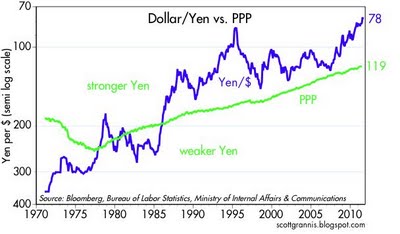
Understanding the rise of the yen, by Scott Grannis of Calafia Beach Pundit, highlights the diverging dollar/yen exchange rate from a theoretical PPP (shown below). 


At first glance one notices that the yen is approaching levels of significant historical and relative strength. However, before addressing the yen’s strength, some discussion is necessary to explain the PPP’s longstanding upward trend.

Inflation and deflation represent basic concepts for expressing price changes over time. The U.S. experienced high inflation during the 1970’s. After moderating significantly in the early 1980’s, inflation has been fluctuating around 2-3% ever since. Due to inflation, more dollars are required today when purchasing similar goods. Japan’s inflation rate was not nearly as high in the late 70’s and over the past two decades has been effectively nil. Recent deflation means Japanese consumers actually requires less yen to purchase similar goods than ten years ago. A rising PPP therefore reflects today’s need for fewer yen and more dollars to purchase similar goods compared to several decades ago..

Recognizing that changes in PPP have been relatively small and consistent, one might question the more sizable variations in market exchange rates between these currencies. Simply put, short-term movements likely reflect changing opinions about each nation’s future inflation. Displayed clearly above, similar to other financial markets, opinions are volatile but tend to fluctuate around an underlying equilibrium. Today’s stronger yen therefore depicts a belief that future U.S. inflation will be significantly greater than inflation in Japan.

Japan has been mired with slight deflation for the past decade, despite record low interest rates. Monetary experimentation and occasional fiscal stimulus have been unsuccessful to date. Although other stimulative options exist, desire for such policies appears weak, leaving the current status quo as the most probable outcome. Given Japan’s unchanging outlook, recent changes in the exchange rate appear more indicative of updated opinions on future U.S. inflation. Fearing deflation, the Federal Reserve has already embarked on two exercises in quantitative easing, with potential for a third looming. Operationally these measures were merely an asset swap between the Fed and banks aimed at lowering interest rates and increasing asset prices. However, market participants largely believe quantitative easing is a form of printing money that will eventually lead to surging inflation. Expectations of further quantitative easing may therefore account for continued weakening of the dollar.

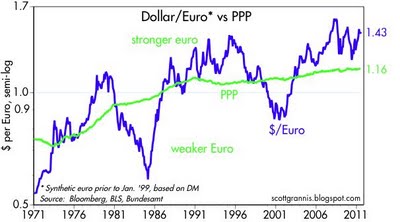
Along similar lines, I’ve recognized an interesting dichotomy in market opinion with regards to quantitative easing. As previously noted, the Fed’s decision to purchase large quantities of treasury notes has seemingly led increasing inflation expectations and a weakening dollar. Just yesterday, on the other side of the Atlantic, the European Central Bank (ECB) announced it would intervene in debt markets by buying Italian and Spanish sovereign debt. Over the past 18 months, the ECB has made numerous announcements involving their purchase of European sovereign debt. Oddly, these announcements are typically met with a strengthening euro. Below is a graph depicting the dollar/euro exchange rate against a comparable PPP.


Although the dollar/euro exchange rate has experienced wide swings, the PPP has remained fairly constant over the past two decades. Personally, the current euro strength is surprising in the face of ECB intervention and a rapidly deteriorating sovereign debt crisis. Yet considering both market valuations, the most apparent conclusion is that market participants expect much higher relative inflation in the U.S. going forward.

Anytime the market’s prevailing opinion distinctly contradicts your own, a potential investment opportunity arises. Congress’ recent decision to take up austerity measures will likely weaken the economy, causing disinflation. Even if the Fed embarks on a third, similar, round of quantitative easing, the short-term inflationary aspects of rising energy and food prices will create deflationary pressures over a longer period. Regardless of S&P’s U.S credit rating downgrade, the dollar should remain the world’s reserve currency for at least another decade, retaining its safe-haven status in especially uncertain times. Given this outlook, I expect the dollar/yen and dollar/euro to move back towards their PPP over the next few years.


(Note: I tend to disagree with Scott Grannis’ economic and political outlook, especially the last paragraph in the attached blog. However, Grannis often provides interesting data points and graphs making his blog a worthwhile opposing perspective.)