Tuesday, September 6, 2011

The Next Keynes

“One thing is certain: if there is another Keynes out there, he or she will be someone who shares Keynes’s most important qualities. Keynes was a consummate intellectual insider, who understood the prevailing economic ideas of his day as well as anyone. Without that base of knowledge, and the skill in argumentation that went with it, he wouldn’t have been able to mount such a devastating critique of economic orthodoxy. Yet he was at the same time a daring radical, willing to consider the possibility that some of the fundamental assumptions of the economics he had been taught were wrong.”

-Introduction by Paul Krugman to The General Theory of Employment, Interest, and Money, by John Maynard Keynes

Nearly 80 years ago, the Great Depression and World Wars inspired a debate between two of the greatest economists of the 20th century, John Maynard Keynes and F. A. Hayek. The global economic paralysis and social upheaval of their time could not be explained or remedied by then current economic theories.  Both men relied heavily on knowledge of past research and experience to forge recommendations for a new path forward. Since then, their alternative perspectives have largely shaped political discussion of macroeconomics. Although Keynes’ ideas garnered significant weight first, Hayek’s warnings have proved extremely prescient regarding the outcome of government intervention.

Today’s global economy appears more reminiscent of that period than any time since. Industrialized nations are teetering on the edge of another recession, struggling to find solutions in the face of impotent monetary policy. Meanwhile, within the developing world, radical changes are being brought about by revolts against enshrined leadership. Numerous lessons learned during the early 20th century have been forgotten and must be re-learned. However, much has also changed about the global economy throughout the decades. While the old lessons remain important, modern theories are warranted to address today’s political and economic issues.  

So far, the Great Recession has failed to spur any radical changes from previous conceptions of macroeconomics or political theory. Witnessing mass unemployment and increasing levels of poverty around the globe, one can only hope that new theories and practices will be developed that inspire a brighter future. While I certainly don’t expect to become the next Keynes (or Hayek), I believe the qualities noted above that made Keynes special are worth striving towards. Moving forward it’s incredibly important that theorists fully understand the strengths and weaknesses of historical theories, yet are willing to step beyond the boundaries and approach today’s questions from a fresh perspective.

Stemming from the current economic malaise and general dissatisfaction with government is a willingness to accept novel ideas. The directions taken will likely determine the length of the current crisis, as well as size and forms of governance for years to come. The time is ripe for another Keynes. Hopefully our generation will find and listen to him or her.

Monday, September 5, 2011

Poor Premise Supports Corporate Tax Holidays

In Foreign Income Rising, I discussed the potential for another corporate tax holiday to allow repatriation of foreign income. This evening, Andrew Ross Sorkin discusses the matter along with a recent proposal to reduce the employer portion of Social Security taxes (link below). Sorkin reaches a similar conclusion that temporary tax breaks are unlikely to result in significant job growth but will increase the federal deficit. While the source of the proposals (Chamber of Commerce) should make clear which group's priorities are being considered, it's important that politicians recognize the source of our current economic weakness. Business are not hiring because demand for their goods is not significant or stable enough to warrant new employees for increasing production. Demand stems primarily from individuals, who are currently overburdened with debt and choosing to pay down debt rather than increase spending. If temporary tax cuts are desired, the focus needs to be on individuals.

The Fallacy Behind Tax Holidays: Corporate America and Wall Street are engaging in a form of horse trading - tax cuts for jobs. There is one small problem: temporary tax cuts rarely result in new jobs and always result in less tax revenue.

A September to Remember

Three years ago, on September 7th, 2008, the federal government nationalized Fannie Mae and Freddie Mac. The following week, Bank of America bought a Merrill Lynch, Lehman Brothers filed for bankruptcy and AIG was bailed out by the Federal Reserve. During the next couple weeks, Washington Mutual also went belly-up, Wachovia was acquired and the remaining investment banks converted into bank holding companies. In markets, credit spreads widened drastically and equity market volatility heightened substantially, including the S&P 500’s largest loss in history of over 100 points (nearly 9%).  

This year, following a weak August, credit and equity markets have gotten off to a miserable start in September. During the first two days of trading, the S&P lost nearly 4% and at the moment is down close to 3% in the futures market. Losses in Europe are even more staggering, with several major indices already losing nearly 10% this month, following grater than 15% drops last month. Sovereign and bank credit markets, especially in Europe, are also freezing up as the crisis worsens. These are ominous early signs of another September to rival its historic predecessor.

Although only three short years have passed, the global economy appears to be following a similar pattern. After trying to kick the can down the road for more than year, numerous underlying problems are unraveling around the world in concert with one another. Each successive attempt at papering over issues has a shorter shelf-life and the time for politicians to get ahead of the troubles is rapidly decreasing. A quick tour around the world’s major economies will shed light on the ensuing global crisis.

US-

Reminiscent of headlines in 2008, Friday witnessed new troubles stemming from apparently plagued mortgage-backed securities. From the FHFA website (http://www.fhfa.gov/webfiles/22599/PLSLitigation_final_090211.pdf):

Washington, DC -- The Federal Housing Finance Agency (FHFA), as conservator for Fannie Mae and Freddie Mac (the Enterprises), today filed lawsuits against 17 financial institutions, certain of their officers and various unaffiliated lead underwriters.  The suits allege violations of federal securities laws and common law in the sale of residential private-label mortgage-backed securities (PLS) to the Enterprises.  

Complaints have been filed against the following lead defendants, in alphabetical 
order:
1. Ally Financial Inc. f/k/a GMAC, LLC
2. Bank of America Corporation
3. Barclays Bank PLC
4. Citigroup, Inc.
5. Countrywide Financial Corporation
6. Credit Suisse Holdings (USA), Inc.
7. Deutsche Bank AG
8. First Horizon National Corporation
9. General Electric Company
10. Goldman Sachs & Co.
11. HSBC North America Holdings, Inc.  
12. JPMorgan Chase & Co.
13. Merrill Lynch & Co. / First Franklin Financial Corp.  
14. Morgan Stanley
15. Nomura Holding America Inc.
16. The Royal Bank of Scotland Group PLC
17. Société Générale  

These complaints were filed in federal or state court in New York or the federal court in Connecticut.  The complaints seek damages and civil penalties under the Securities Act of 1933, similar in content to the complaint FHFA filed against UBS Americas, Inc. on July 27, 2011.  In addition, each complaint seeks compensatory damages for negligent misrepresentation.  Certain complaints also allege state securities law violations or common law fraud.

Although the full repercussions cannot be known at this time, the fall out may prove very large. While the Obama Administration has been working hard to undermine an investigation by New York’s AG into similar matters, another part of the administration has seemingly subverted those goals. This lawsuit almost certainly dampens the Administration’s hope that the largest banks could avoid serious litigation in return for a small fee ($8.5 billion). Of the institutions listed above, several pose interesting related questions, yet the biggest questions are tied to Bank of America’s solvency.

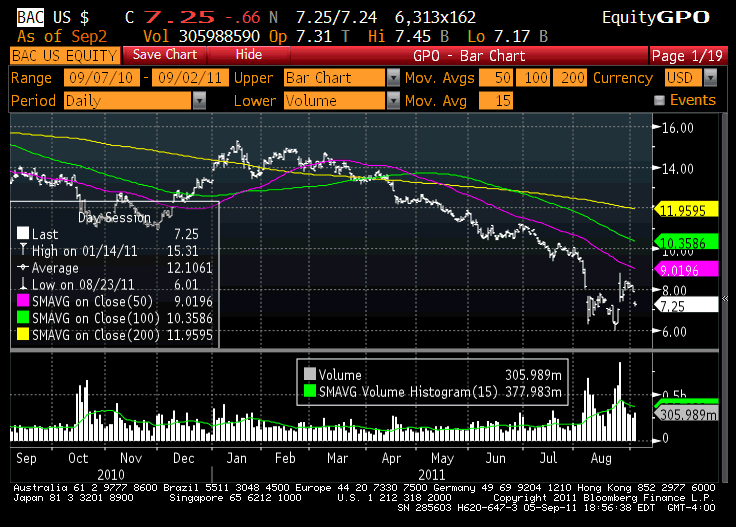
Witnessing its stock fall more than 50% this year (shown below), Bank of America has continually denied claims about needing to raise capital. Despite these apparently false claims, the bank raised capital by selling warrants and preferred stock, along with a significant stake in the China Construction Bank, at steep discounts. Even with these actions, confidence remains fragile, as shares tumbled again on Friday.


Due to its purchases of Countrywide and Merrill Lynch, Bank of America was effectively sued in three separate claims noted above. Combining these claims generates total claims against in excess of $50 billion. However, these claims only represent a small portion of potential liabilities outstanding related to the sale of MBS and foreclosure fraud. Whether the bank ultimately settles these claims or attempts to fight in court, losses will almost certainly be significant and uncertainty regarding the outcome will weigh on the firm for some time.

Apart from unknown losses discussed above, the bank is also currently sitting on untold losses related to its own mortgage holdings, as well as European bank and sovereign debt. Thanks to the ongoing suspension of mark-to-market accounting, the actual market value of current assets is highly unpredictable. Regardless, markets are suggesting current assets should be marked down by billions of dollars and those numbers can only increase as markets weaken.

How long will the confidence last? With Bear Stearns, Merrill Lynch and Lehman Brothers, the final straw seemed to be when institutional investors began pulling funds in mass. Considering recent votes in the US House, another TARP seems unlikely at this juncture. If Friday’s lawsuits spur another significant sell off in the bank’s stock, institutional investors may decide to seek safety elsewhere. Were a run on Bank of America to occur, it’s hard to envision several other weak banks not being targeted as well. The Dodd

Europe -

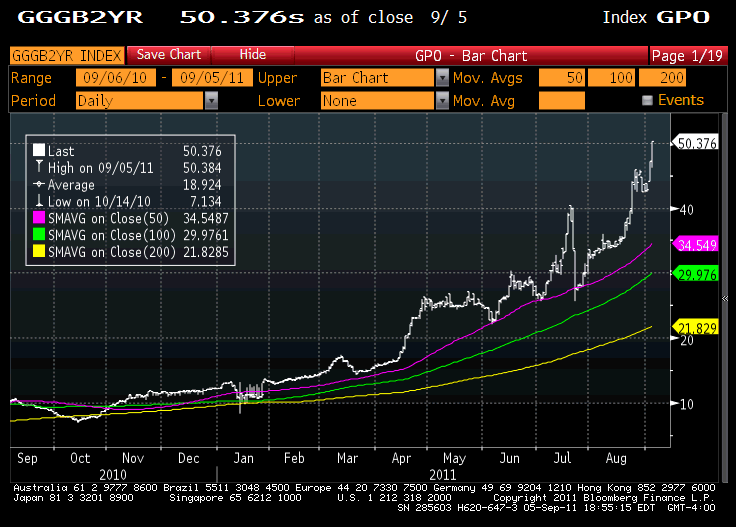
On a timeline basis, the sovereign debt crisis in Europe feels most similar to the US housing crisis. Nearly 18 months ago, problems began showing up in EU periphery countries, notably Greece. As yields widened, the country’s solvency was questioned and after ECB intervention, a bailout was concocted. Despite a couple more bailouts, Greece’s economy continues to deteriorate under the weight of austerity and a strong Euro. Over the past few days, short-term yields have exploded upwards, with the 2 year exceeding 50% (shown below). Not only are markets pricing in 100% chance of default, but far more significant losses than the most recent proposals by the EU/ECB. Apparently recognizing Greece represents a solvency issue, not liquidity problem, the IMF and several EU nations are reconsidering any further aid. 


After Greece, Portugal and Ireland also fell victim to economic deterioration and questions regarding their own solvency. These countries have been locked out of credit markets for more than a year now. Having also received bailouts for austerity measures, economic performance has not turned around and debt levels have worsened. Resolutions involving some form of default still appear almost certain.

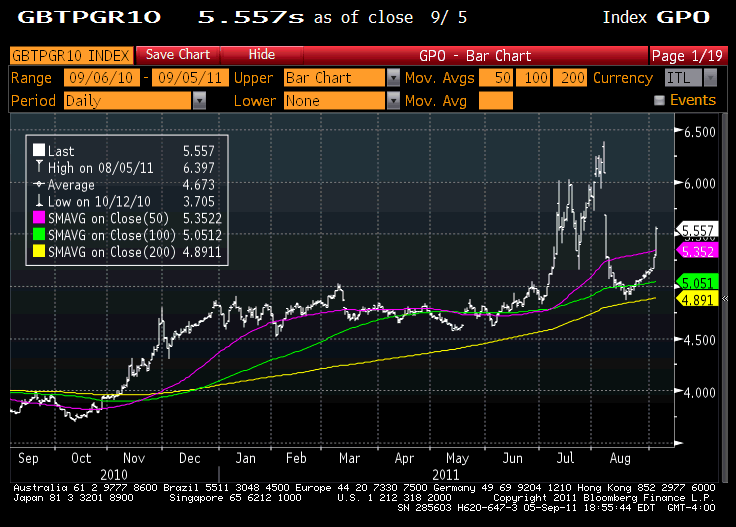
While most market participants expected Spain to become the next casualty of bond vigilantes, markets surprisingly leap frogged Spain, instead attacking Italy. Starting in July, 10 year yields quickly spiked from under 5% to early 6.5% (shown below). Fearful of the consequences, the ECB once again stepped in to purchase Italian and Spanish debt to stem the rising yields. After successfully pushing yields back below 5%, the markets have once again responded, sending Italian yields back above 5.5% today. 


The recent rise comes after Italy’s government attempted to roll back various austerity measures. As Kiron Sarkar notes in a post on The Big Picture (http://www.ritholtz.com/blog/2011/09/people-who-play-with-fire/):

The Italians better reconsider their recent attempts to backslide from their commitments – they have a large debt maturity this week – some E14.6bn and E62bn by the end of September (the highest ever in a single month). In total, Italy must roll over E170bn by end December – Whoops.”  

Trying to sell that amount of debt may generate a further sell off in Italian debt, for which the ECB and EU appear unprepared.

Sovereign debt problems are on the verge of spiraling out of control, which is especially scary considering the lack of political unity in Europe. Time is running out on a grand solution and if politicians are forced into a reactive resolution, markets and economies will likely pay the price. As sovereign debt continues to be repriced lower, the resulting market losses are weighing heavily on European banks.

Stock prices of European banks have been falling precipitously over the past couple months. After a brief reprieve due to several countries banning short-selling on the securities, prices are once again falling. As I detailed in Europe Revives Failed Policies of 2008, these measures have been proven to fail and may even worsen the situation. Currently, credit spreads for interbank lending are showing significant strain and approaching levels last witnessed during the crisis of 2008 (shown below, top). Credit default swaps (CDS) on many banks are also reaching new records, potentially stemming from banks trying to hedge counter party risk (shown below, bottom).


Given the global nature of banking, credit problems in Europe may leak into US markets.  Once again, the ECB and Fed (primarily) will be forced to provide liquidity to the financial system. Similarly to the US, if one major bank faces a run, several others are likely to follow. With most of Europe already either in recession or experiencing sub-1% growth, the entire EU risks falling into another recession by year end. Risks are now increasing at a rapid pace, hence the next few weeks promise to be very interesting.

Asia -

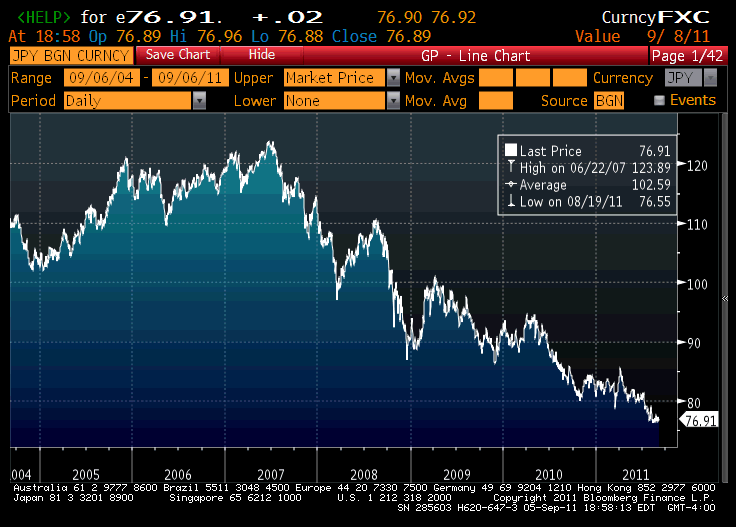
After suffering a horrendous earthquake and tsunami, the Japanese economy fell back into recession. While trying to rebuild, global economic fear has sent cash flocking to the safe-haven Yen. Recently hitting all-time highs against the dollar (shown below), a strong Yen has caused exports to falter and hindered the economic recovery. Attempts by the BOJ to intervene in exchange markets have proved woefully unsuccessful. Further hurting the potential for recovery has been an unwillingness to increase deficit spending, which could generate internal demand and weaken the currency. 


As for China, the country has been fighting inflation by raising reserve requirements. History shows that this measure is not particularly successful in reigning in inflation. Recent moves to let the Yuan float higher are more encouraging. China also faces trouble relating to a fixed investment rate near 50%, potential housing bubble and rapidly increasing bad bank debt. Regardless of specific measures taken to thwart these issues, history suggests the most likely outcome is a “hard landing,” which could represent GDP growth below 5%.

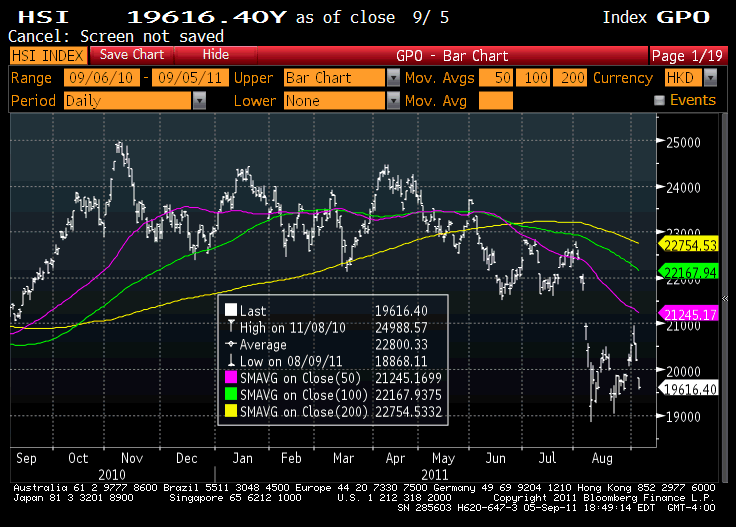
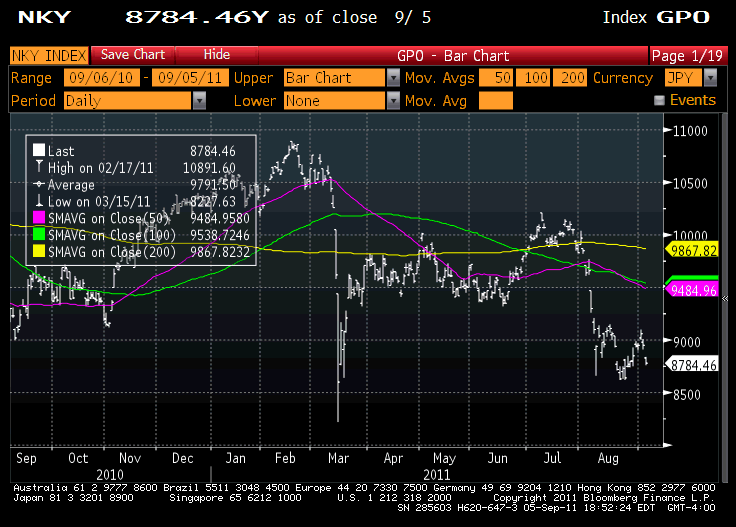
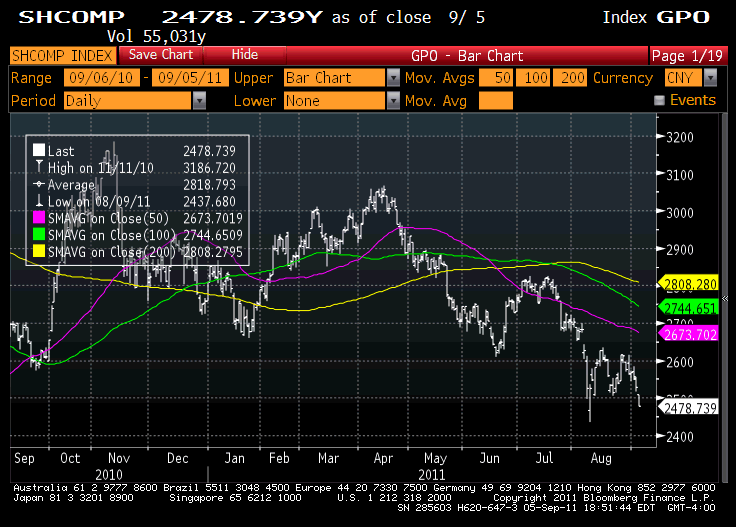
For both of these export driven countries, weakening demand from US and Europe will pose significant problems on top of those already established. As the financial crises of 2008 displayed, global economies are very intertwined in today’s world and the troubles of one large nation will exert pressure upon the others. With equity markets in both these counties having already joined Europe in bear market territory, the immediate future is not looking promising (shown below: Hang Seng, Nikkei, Shanghai).


Over the past two years, markets have responded positively to a stimulus led economic recovery across developed nations. Weakening within credit markets has been largely written off as excessive caution. As credit markets weaken further and economic recoveries falter, it appears this time is not different. Equities have been moving quickly to catch up with credit markets on the way down, however the remaining spread still seems quite wide. Unfortunately the global financial system is practically no more transparent than several years ago, which means questions of solvency, plaguing the market, will be hard to defend against. Measures taken in 2008 to provide liquidity and capital will also be significantly harder to pass in a world concerned with sovereign debt and monetary devaluation.

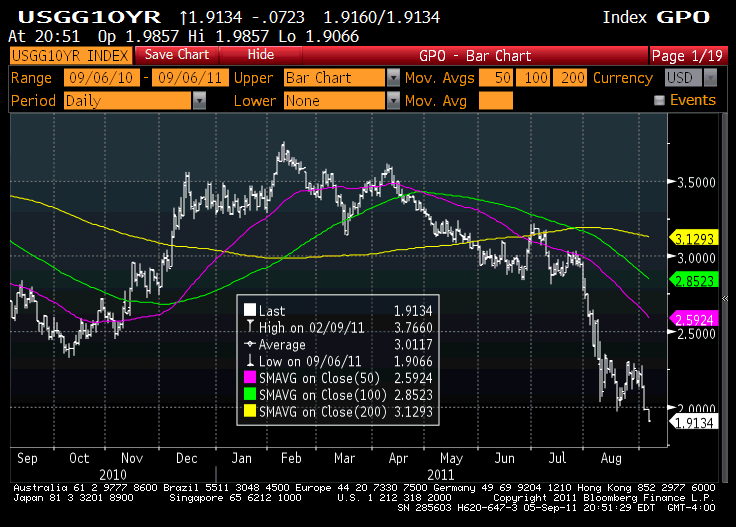
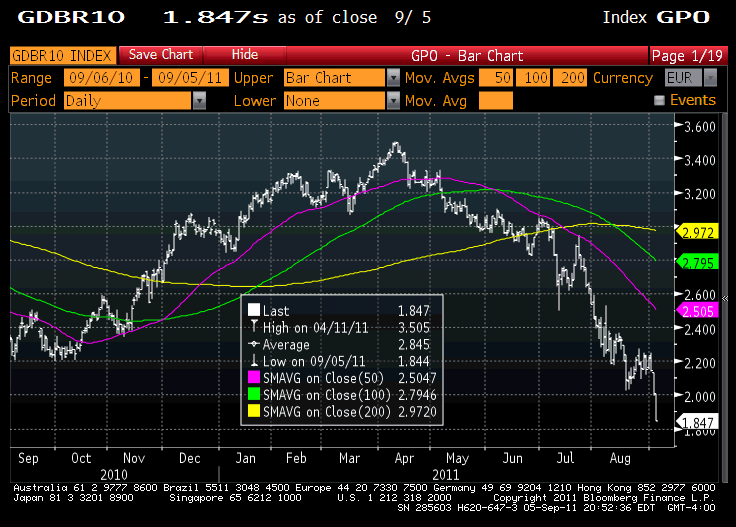
US and German 10 year yields have now joined Japan in the sub-2% club (shown below), which suggests a lengthy period of minimal economic growth and inflation. As equity markets price in a similar outcome, I expect much further declines. A focus on individual companies with strong balance sheets and high dividends should offer great relative value. As for the dollar, equity weakness, global risk and ultimately an interest rate cut by the ECB will likely provide strength. There are times to seek a return on capital and times to seek the return of capital, I believe now is the latter.


Only three years ago, the global economy witnessed the worst recession since the Great Depression. Few people imagined so short a time could pass before the world was once again faced with such enormous challenges. Back then, September marked the period where issues started to really unravel. Could September once again witness the unfolding of historical events? Only time will tell, but based on the first few days, it certainly appears this will be another September to remember.

Thursday, September 1, 2011

Roberts: The Microeconomics of the Broken Window Fallacy

As a DC resident, last week I experienced both an earthquake and a hurricane. Thankfully neither resulted in significant injuries within the impacted areas and property damage was also less than some might have expected. These experiences have provided opportunity for several economists to once again discuss the economic effects of natural disasters. Earlier this year, when Japan was hit by a terrible earthquake and tsunami, numerous economists and market "experts" noted that the destruction would be positive for economic growth due to rebuilding efforts. Similar comments sprung up following Hurricane Irene's treacherous path across the eastern seaboard.

These discussions are precisely when better definitions of economic growth are needed apart from GDP. Based on my understanding, if someone's car was destroyed and they choose to replace the vehicle by purchasing another, that purchase adds to GDP, while the lost vehicle subtracts nothing. From a real world perspective, the person whose car was demolished is now worse off, since they still own only one car but are now out a significant sum of money. Meanwhile, the car salesman is only better off by the amount the other individual spent. On the whole the economy is not better off since the amount of goods remains the same. GDP therefore fails to account for the depreciation or destruction of asset value, which plays a significant role in establishing wealth and economic well-being.

Russ Roberts of Cafe Hayek, who helped create the "Fight of the Century" videos (linked below), provides a wonderful example of what's known as the broken window fallacy. His counterpart on the website, Don Boudreaux, also had a humorous retort to Peter Morici (Professor at University of Maryland) regarding this fallacy and his willingness to destroy property for payment in order to benefit others (http://cafehayek.com/2011/08/open-letter-to-peter-morici.html). I urge those not familiar with the argument to read the articles and determine which theory is more compelling.


The Microeconomics of the Broken Window Fallacy:
The Keynesian defense of breaking windows or the economic virtues of hurricanes would go something like this:
Yes, breaking windows is destructive. Yes, it reduces wealth. But when there are large amounts of unemployed resources, say in the glass business, then breaking windows is close to a free lunch. In a world of unemployed glaziers, breaking windows can jump-start the economy by putting the unemployed back to work. They will spend the money they receive for repairing the broken windows.
When confronted with the claim by those of us who like Bastiat, that the money to repair the windows will now be unavailable to spend on something else, the Keynesian responds like this:
But people are sitting on money that is doing nothing. The insurance company that will now pay back the homeowner whose house was damaged by the hurricane was sitting on piles of cash. That cash was sitting in the bank where the bank has excess reserves not being lent out, not being invested. So yes, breaking windows can improve the incomes of glaziers and start a process of recovery.
What do we respond, those of us who are enamored with Bastiat and who think he’s right?
I would re-state the Bastiat story and tell it a little differently than it is usually told. The usual point is that the money has to come from somewhere–we see the repaired window but ignore the things that don’t get built or bought. But I think a better way to tell the story is to point out that the RESOURCES have to come from somewhere. The hurricane increases the demand for glaziers and that is good for glaziers. But that is good for all glaziers, employed and unemployed. It pushes up the price of glass repair. That discourages some folks from having glass work done who otherwise would have done it. So there is some offset of the hurricane’s impact on glazier employment. And as the Hayek character says in “Fight of the Century“:
You see slack in some sectors as a “general glut”
But some sectors are healthy, only some in a rut
So spending’s not free – that’s the heart of the matter
Too much is wasted as cronies get fatter.
So while glaziers (and carpenters) may be unemployed, other sectors (such as the wood market) may not be having such problems. The hurricane has a big impact on the price of wood, discouraging a bunch of would-be demanders of wood from buying as much as they did before. Again, there’s an offset. The point is that “aggregate demand” doesn’t tell the whole story.
But the real problem with breaking windows is that it’s not productive. I know. That’s obvious. But think about what the words mean. Right now, there are a lot of unemployed construction workers. What does a hurricane do? A hurricane IS good for carpenters and glaziers and roofers. But it’s unproductive work. It gets the home owner back to the status quo. It doesn’t create anything new or valuable. I’m not saying the production is wasted. I’m saying it’s a repair. Why is that important?
Imagine a world where there hasn’t been a hurricane and I want to help the unemployed carpenter. Here are two ways to do so. One is to burn my house down and then call the carpenter and give him $100,000 to rebuild my house. Here is the second way. I call the carpenter and say, I feel bad that politicians artificially increased the demand for housing at the end of the 20th century, pulling you into an industry that cannot be sustained at its current leve. I feel bad that you’ve been unemployed for three years. So I’m going to give you $100,000.
Which of those two policies would have the bigger stimulative effect? The charity should have a bigger effect. No offsets from pushing up the price of lumber and so on. But giving people money doesn’t change the underlying problem that there are more carpenters than work available for them. Creating temporary work either by burning down houses deliberatively or accidentally through a hurricane doesn’t change the fact that there are too many carpenters and glaziers relative to demand.
So the hurricane will put carpenters back to work. But it would be even better if there had been no hurricane and people had just given them a check. Charity is more productive than destroying stuff and paying people to get back to square one.
But the charity approach is what we’ve been doing for the last few years. It’s called unemployment insurance. I know, it’s supposed to be stimulative but there’s no sign that it is. Why would it be? It doesn’t solve the problem that there are too many carpenters.
This is related what Arnold Kling calls “Patterns of Sustainable Specialization and Trade.” Repairing houses damaged by a hurricane isn’t sustainable. And if I just give carpenters money because I feel sorry for them, that isn’t trade. That’s charity. Both have the same stimulative effect–very little, because they don’t get at the underlying problem. Prosperity is the way we specialize and serve each other, creating products and services that we each value. Destruction cannot be the source of prosperity.

Guest Post: One Death is a Tragedy, One Million is a Statistic

At this point, most readers are likely aware of my skepticism towards broad headlines and general government statistics. For those seeking greater insight into the ways GDP misrepresents economic well-being or other similar issues, I suggest reading the free book, Mismeasuring Our Lives: Why GDP Doesn't Add Up by Joseph Stiglitz, Amartya Sen and several others. In the meantime, Peter Tchir of TF Market Advisors, details a few of the recent headlines and dives into the actual calculations that should provoke such skepticism. Although I don't have a specific tally, weekly initial jobless claims have been revised higher nearly every week for the past year (if not more). An interesting side note on the topic, during the past two weeks these claims were supposedly higher than normal due to a significant number of Verizon employees filing for unemployment insurance. While the report only counts claims filed, I'm curious whether any employees that willingly went on strike received unemployment benefits.

Tchir, whose posts I look forward to daily, also offers pertinent information about channel stuffing, inventory builds and the statistical significance of non-farm payroll reports. In my opinion, these topics only scratch the surface or questionable data mining and reporting. Here are a few other topics that deserve further consideration:

1) GDP is calculated in two different formats by the BEA. Why do the measures deviate from one another?
2) The BEA also uses a GDP deflator to represent inflation and convert nominal GDP to real GDP. The BLS calculates inflation as CPI. The Fed prefers to use PCE (personal consumption expenditures) when measuring inflation. All three tend to deviate from one another and at least recently the GDP deflator has been the lowest (CPI or PCE measures would likely have shown negative real GDP growth in Q1 and Q2). Why are there several different measures, used for different purposes?
3) On average, S&P 500 companies tend to report quarterly earnings that exceed analyst estimates 60 to 75% of the time regardless of the macroeconomic environment. Why are these estimates consistently wrong in the same direction?
4) Analysts and investors frequently highlight cash on the balance sheet as a sign of strength in corporate America. However, a company that borrows $1 million in cash certainly does not have a stronger balance sheet than another company with no cash or debt. Why is the size of debt never considered when discussing the amount of cash?

There are certainly countless other statistics that could be included in this list and are deserving of further research and transparency. Too frequently these statistically insignificant data points are directing policy and allocation of capital to the detriment of the larger economy. Continuing the discussion Stiglitz and others hoped to incite will ideally lead to policies that better address the economic and personal well-being of society.


Guest Post: One Death is a Tragedy, One Million is a Statistic:
Submitted by Peter Tchir of TF Market Advisors

One Death is a Tragedy, One Million is a Statistic

Another day of statistics, where the headlines are widely published, some details are somewhat explored, and in-depth analysis is next to nil.

The initial jobless claims number has become a farce. It is virtually statistically impossible for this many upward revisions unless the data is purposely under reported. I can understand the desire to smooth data, or make it seem better, but at some point the line of credibility is crossed. Not only do they screw with the main statistic, but they seem to use continuing claims as a secondary diversion. Last week’s 3641k continuing claims seemed statistically implausible, yet it was cheered. The doom and gloom crowd argued that it must be from people using up eligibility, in the end, it was just wrong by over 100k, according to today’s release. How is that possible?

Next we move to auto sales. It is hard to avoid hearing about auto sales today, probably, because the headline numbers seem good. I can almost ignore the fact that the first thing mentioned is the percentage change from a horrible period last year, but I am shocked the focus is still on total sales. Since at least 2005, the problem with car companies has been selling cars at a profit, not just selling cars. Nothing from the data indicates how profitable the sales are. So we can cheer this headline, but to a large degree it is meaningless. Then, making it more meaningless, is the fact that it includes fleet sales and is really based on sales to dealers. It doesn’t give a clear picture of how many cars were driven off the lot by bona fide, actual, human owners. If anything, the hype surrounding these figures rewards channel stuffing. There seems to be a degree of confusion by those spouting the numbers about the lack of follow through in the stocks. Maybe stocks have finally learned the lessons from these numbers, but it would be great if the masses were presented with details and useful statistics rather than just what the auto companies want to hype.

Then there was the ISM Manufacturing data. The sighs of relief from trading floors shook the buildings almost as much as last week’s earthquake. Where to begin with this data? It is a “diffusion” index. So it treats each respondent’s answer the same. It doesn’t matter if a company has 5 employees, or 5,000, their answer counts the same in the survey. If the often unreliable ADP report is correct that most of the hiring is occurring at small and medium companies, does that impact ISM?

If 2 small companies report better conditions, and 1 large company reports worse conditions, then the diffusion index would be 66, but the real world impact might be a lot different. Size does matter. Maybe that is part of the reason we see a discrepancy between regional surveys and the national survey? Does ISM report diffusion indices based on size? It would be interesting, at the very least, to see if there is a dramatic difference between big and small companies.

The next thing about the ISM methodology that I find interesting, is that the positive responses include positive responses and ½ of unchanged responses. I guess that is necessary to make a diffusion index, but I would like to see if it is realistic. Do “unchanged” responses have a tendency to follow the trend the following month? I could easily see someone who reported improving conditions one month being inclined to report unchanged the next month, even if conditions were actually worse. These are surveys done by people like you and me, well actually by people with “survey filler outer” included in their job description.

I’m not saying that having the data broken down more precisely would change the market reaction, but I don’t see why it isn’t available, and I don’t see why more analysts aren’t demanding that data. We can all look at a headline, but the value comes from those who can figure out what is going on behind the scenes. If there have been structural changes in the economy (and I believe there have been), then knowing more details would be helpful. The old rules of thumb may be deceiving us.

Of the 5 components, I am most confused by inventories. Inventory growth strikes me as highly suspect. I can see times where it is indicative of future economic growth as companies prepare for increased demand, but equally, it strikes me that it could represent a sudden slow down in final demand resulting in an unexpected inventory build. Had inventories remained unchanged, we would have seen a sub 50 print. You can’t convince me easily that inventory build last month was a positive indicator, yet that is what the headline would have you believe.

This is all in advance of tomorrow’s NFP report. NFP holds a special place in the dubious statistic category. First we have the fact that there are two separate surveys. We have the establishment and the household. The establishment survey is statistically significant for changes of 100,000; whereas the number is 400,000 for the household survey. In this day and age where virtually everything is done on the internet, I bet Google or Facebook could probably produce a more accurate report within a few months if either one bothered. Until that time, we are stuck with 2 sources of data, both of which have wide margins for error. Then we have the fact that for many months, the birth/death model generates more jobs than the headline itself. That wouldn’t be bad if it didn’t seem to require annual revisions lower. Once again the consistency of the annual revisions indicates that the reports are designed to produce numbers more positive than the reality in the hopes that by the time it is adjusted down, the market has moved on. Having said all of that, the market, or at least the analysts will try and distinguish between 40,000 and 80,000 when the difference is not actually significant or verifiable. They will latch on to whatever survey provides the most positive spin. Those who said the household survey matters more than the establishment survey, will find equally compelling reasons why it is now the establishment report that matters, or vice versa. Obama will be talking about jobs next week, so no matter what number comes up, expect it to be cited often over the next week.

I just realized, the president will be speaking about jobs and more handouts right before the start of the NFL season. Even Stalin might blush at trying to use bread and circuses so obviously.