Sunday, February 12, 2012

Quote of the Week


...is from p.162-163 of Hyman Minsky’s superb book, John Maynard Keynes:

“The economy is now a controlled rather than a laissez-faire economy; however, the thrust of the controls is not in the direction envisaged by Keynes. Investment has not been socialized. Instead, measures designed to induce private investment, quite independently of the social utility of investment, have permeated the tax and subsidy system.”

“The success of a high-private-investment strategy depends upon the continued growth of relative needs to validate private investment. It also requires that policy be directed to maintain and increase the quasi-rents earned by capital—i.e., rentier and entrepreneurial income. But such high and increasing quasi-rents are particularly conducive to speculation, especially as these profits are presumably guaranteed by policy. The result is experimentation with liability structures that not only hypothecate increasing proportions of cash receipts but that also depend upon continuous refinancing of asset positions. A high-investment, high-profit strategy for full employment—even with the underpinning of an active fiscal policy and an aware Federal Reserve System—leads to an increasingly unstable financial system, and an increasingly unstable economic performance.”

Minsky has been on my mind frequently over the past few months as much of today’s economic work in Post-Keynesianism and Modern Monetary Theory stem from his unique insights about instability in a capitalist society. In Facebook's $500 Million Tax Refund and The BIG Political Lie, I was trying to shed light on the manner by which politicians control the tax system to redistribute income upwards. Minsky brilliantly expands on this concept above, noting how policy that guarantees profits (quasi-rents) from speculation leads to instability. The rise in non-traditional mortgages, extremely low levels of down payments and government support in the recent housing crisis represents a prime example of the consequences highlighted above. As long as policy continues in this manner, economic performance is likely to be volatile and current income inequality will persist or expand even further.

Saturday, February 11, 2012

Points of Public Interest


  1. Why Jews Don’t Farm - Steve Landsburg approaches this question from the perspective of literacy and education as hallmarks of Jewish religion. (h/t Don Boudreaux, Cafe Hayek)
  2. Repulsive progressive hypocrisy - Glenn Greenwald expresses fear over Democratic support for policies, including Guantanamo and drone usage, under the Obama Administration that were highly criticized when similarly carried out by the Bush Administration. I share Greenwald’s concern that political support may become tied to individuals rather than actual policy actions. (h/t Anthony Gregory, The Beacon: “Repulsive Progressive Hypocrisy” and Why Peaceniks Should Oppose Democrats)
  3. What Europe might look like without the Eurozone and EU - Bruno Frey dispels with the view that a collapse of the Euro will lead to chaos and war. On the contrary, he argues that countries will likely establish more flexible, smaller agreements that maintain free trade and may even improve European economic prospects.
  4. The Top Twelve Reasons Why You Should Hate the Mortgage Settlement by Yves Smith
  5. S = I + (S – I) : The Most Important Equation in Economics The “mysterious” JKH explains a key component of sectoral balances in an incredibly clear and concise fashion.
  6. How Economists Contributed to the Financial Crisis John T. Harvey discussed how making math the ends rather than means of economics has led much of the discipline off course from the real world. Post-Keynesianism, especially Steve Keen, and MMT receive acknowledgement for raising awareness of the crisis in advance and, in my opinion, continue to offer some of the best insights. (h/t Tom Hickey, Mike Norman Economics)

Thursday, February 9, 2012

Facebook's $500 Million Tax Refund and The BIG Political Lie


Over the next nine months, leading up to the Presidential election, conversations about optimal tax rates are certain to play a major role. Much of the recent media focus has already addressed the low effective tax rates paid by both Warren Buffett and Mitt Romney (although the light in which the two are held is a world apart). Current debate generally regards the low level of taxes paid by both men as being “unfair,” leading to calls for higher income tax rates on the wealthy. Although this proposed solution seems obvious, the reality is that neither Buffett or Romney will end up paying significantly more even if income tax rates return to the levels during the Clinton era.

How could this be? Behind this confusion lies innumerable intricacies within the US tax code, where rates differ for varying types of income and the laws are littered with various deductions, credits and provisions. Facebook’s upcoming IPO displays a perfect example of the unintended consequences of US tax laws. In Options and Taxes: Is a "Facebook" tax next?, Aswath Damodoran (NYU finance professor) comments that:

“Mark Zuckerberg is planning to exercise about $ 5 billion of options ahead of the offering, resulting in a tax bill of roughly $ 2 billion for him.”*
On the surface, this seems reasonable since Zuckerberg will be paying nearly 40 percent between federal and state income taxes. The criticism stems from the corporate tax deductions that Facebook is permitted based on the exercise of employee stock options, including Zuckerberg’s. As WithumSmith + Brown states in Tax Aspects of the Facebook IPO (Alternate Title: Mark Zuckerberg Could Buy Most of Europe With His 2012 Tax Bill):
“Assuming Facebook stock reaches a price of $40 per share on the open market, the corporate deduction related to the exercise of employee options will be in the billions; large enough not only to enough to wipe out the comany’s 2012 taxable income, but also –according to the prospectus — to generate an NOL [net operating loss] that will be carried back to generate $500 million in tax refunds.”
From a distinctly corporate perspective, Facebook, which may earn upwards of $2 billion in pre-tax income this year, will not only owe nothing in taxes but may actually receive a $500 million refund. How is it that an extremely profitable company ends up with a sizable tax refund? Why has GE and numerous other companies not paid taxes during the past decade despite earning substantial profits (G.E.’s Strategies Let It Avoid Taxes Altogether)? Why does Warren Buffett pay a smaller effective tax rate than his secretary?

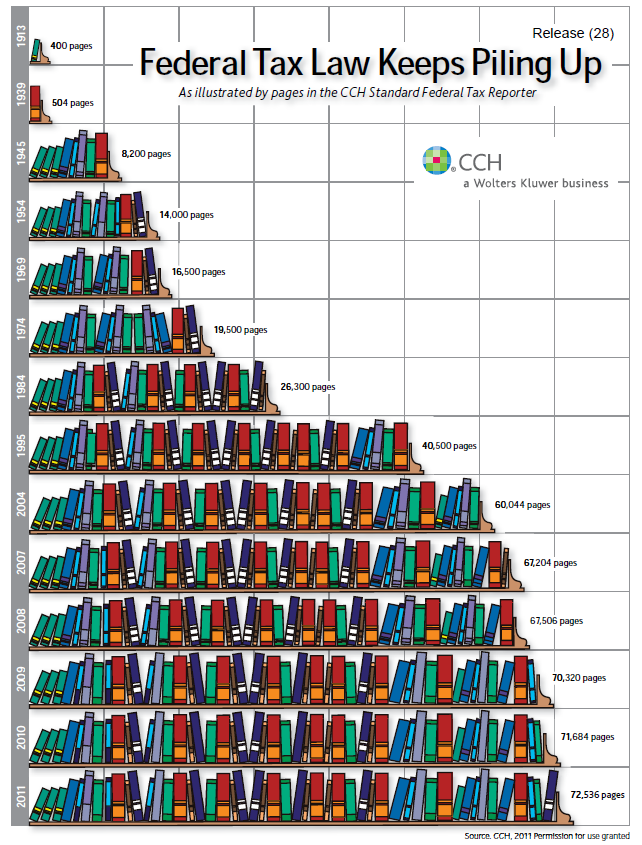
When these questions are posed, a typical response suggests these outcomes represent the natural workings of a free-market system. Sadly this could not be farther from the truth. As Mish Shedlock points out in Is Romney to Blame for Paying Low Taxes or is 72,536 Pages of Tax Code to Blame? What's the Real Solution? Thanks to AMT, Man Pays 102% Tax Rate, “from 1984 until now, 46,236 pages of tax code have been added.” (shown below) Anyone would be hard pressed to find an economist who believes this level of complexity is either efficient or representative of a free-market economy. 


click on chart for sharper images
Image from Tax Law Pile Up

The reality is that consistent increases and alterations of US tax code, over the years, is primarily intended to benefit a special group or class. A rational choice perspective of public policy and administration implies that much, if not most, of this tinkering is done at the behest of groups with the largest political sway (funding capacity and desire).

Improving the tax system is possible both from the perspective of reducing government intervention and increasing progressiveness. Unfortunately the right (conservatives) has been persuasive in convincing individuals across the political spectrum that a complex tax code is part of a free-market system. In The End of Loser Liberalism: Making Markets Progressive, Dean Baker expresses his feelings on this subject noting:
“the vast majority of the right does not give a damn about free markets; it just wants to redistribute income upward.”
It’s important to note that the left (liberals) has also been complicit in this false perception, frequently adjusting the tax code in regressive ways to garner political funding and support.

Heading towards the election, both political parties will try to represent the current US tax system as “unfair” in an effort to push new laws that will “right” the system. Adding more layers of complexity, however, is unlikely to make the outcomes either more efficient or progressive. Overcoming the current trend requires exposing the truth that our current tax codes do not represent a free market. Hopefully both sides of the political spectrum can join together in encouraging politicians to create a far simpler, progressive tax system.


*Zuckerberg plans to exercise options for 120 million shares with an exercise price of $0.06. The nearly $5 billion profit assumes a per share value of approximately $40.

Monday, February 6, 2012

Quote of the Week


...is from p.152 of Raghuram Rajan’s 2010 book, Fault Lines: How Hidden Fractures Still Threaten the World Economy:

“If banks have an incentive to take risk, they will always look for opportunities to get the greatest bang for the regulatory buck. But the regulatory mistake of requiring too little capital for certain activities is then compounded because in taking advantage of regulatory mistakes, banks build up exposure to the same risks. The dynamic associated with systemic risk exposures then kicks in: if everyone is exposed to the same risk in a big way, the authorities have no option but to intervene to support banks and the market if the risk materializes—in which case a bank maximizes profits by increasing exposure to the risk.”


In Rajan’s book the above statement was largely referring to the mass accumulation of mortgage related debt by all the large US banks. The concept may however be prescient when considering the actions of European banks purchasing large quantities of sovereign debt. Based on current market prices for sovereign and mortgage debt, many large European banks are likely insolvent. Thanks to lax accounting requirements and massive balance sheet expansion by the ECB (and other Eurozone central banks), these banks have been able to continue operating. Unless the European economy picks up dramatically across the board, the only chance to return to solvency is through earning substantial profits.

Faced with this troublesome predicament, the best option for European banks may be to vastly increase risk by loading up on European sovereign debt. Private investors in Greek and Portuguese debt will almost certainly face write-downs, however greater effort is being made to ensure Italy and Spain’s creditors are bailed out. By investing in shorter-term Spanish and Italian debt, banks have the potential for sizable profits if the bailout mechanisms are successful for at least a couple years. Even if these profits fail to return the banks to solvency, the returns can be used to continue paying large bonuses over the coming years. If these bets on sovereign debt fail, but enough troubled banks are playing the game, the ECB and EU will almost certainly be pressured to bailout the banks. Although risk may appear to be subsiding, systemic risk may actually be building in the background.

Sunday, February 5, 2012

Points of Public Interest

  1. THE UNLIKELY BULL MARKET - Niels Jensen, a top portfolio manager, offers his assessment of the current bull market. Remarking on his recent trip to Spain and dabbling in Post-Keynesian economics, Jensen acknowledges the myriad of fears present today but believes the cyclical (not structural) bull market remains intact for now. (h/t Cullen Roche at Pragmatic Capitalism)
  2. John Taylor's Open Letter To Greece: "Get Out Greece! Get Out Right Now!" - John Taylor, the CIO of FX Concepts, explains to Greece why life outside the EU will be better than within. While I agree with this view, Greece may be best off waiting for the next bailout installment before jumping ship. (h/t Zero Hedge)
  3. Our Counterfeit Economy - Charles Hugh Smith reveals how calculations of GDP ignore the possibility of mal-investment, both public and private. For further insight on the flaws of GDP, I recommend reading Mismeasuring Our Lives: Why GDP Doesn't Add Up by Joseph Stiglitz, Amartya Sen and Jean-Paul Fitoussi.
  4. How Much Does the Safety Net Help the “Very Poor”? - Anthony Gregory responds to Mitt Romney’s, somewhat out of context, claim that “I’m not concerned about the very poor” because “We have a safety net there.” Gregory points out that benefits of the welfare system (“safety net”) primarily accrue to the broad middle class. This is another good example of common misperceptions about which class(es) actually benefit from certain government programs.
  5. A Crisis in Two Narratives - Former IMF chief, Raghuram Rajan, counters typical Keynesian thinking with a different historical explanation of our current economic woes. In Rajan’s eyes, “pre-crisis GDP was unsustainable, bolstered by borrowing and unproductive make-work jobs.” Many proponents of the first narrative make claims about how far below potential GDP the US is currently. These estimates of potential GDP or output often assume that the previous trend is/was sustainable. Before making public policy or investment decisions, it’s always important to understand the assumptions underlying one’s reasoning.
  6. What future for economics? - (MUST READ) Martin Wolf summarizes a recent panel on “The Future of Economics” with ten outstanding highlights. (h/t Pete Boettke of Coordination Problem)
  7. No Need to Panic About Global Warming - Sixteen world-renowned scientists debate the need for dramatic action, especially the cost-benefit analysis of ‘decarbonzing’ the global economy. My science background is not nearly strong enough to know if these claims are valid, but my skeptical side is always wary of supposedly “incontrovertible” evidence about future outcomes involving human action. (h/t David Theroux of The Beacon)