Saturday, November 10, 2012

Bubbling Up...11/10/12

1) Global Credit Cycle Lurches Down by BCA Research @ The Big Picture
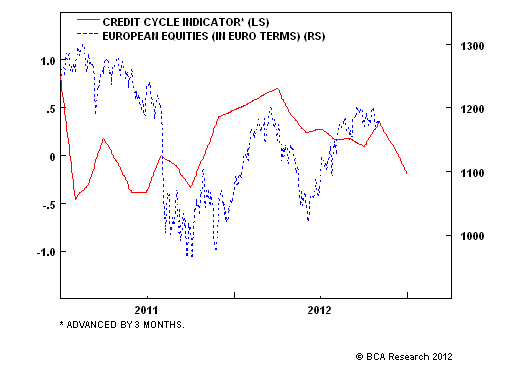
The credit impulses in all three major economies – the euro area, the U.S. and China – are now negative, albeit very slightly in the case of China. This is the first time in three years that all three components have been simultaneously negative. And after hovering at a point of inflection the combined credit cycle indicator has lurched down again.
Woj’s Thoughts - As I have argued repeatedly on this blog, credit (especially private) is now the main driver of economic cycles. If broad measures of credit contract in all three major economies, it becomes increasingly unlikely that current fiscal deficits will be large enough to maintain current levels of growth (or decline in Europe’s case).

2) The US election and the fiscal cliff by Edward Harrison @ Credit Writedowns
What these three things tell me is that recession is what results from trying to reduce government deficits when the root cause of the deficits lie in private sector debt distress. When the government raises taxes or cuts spending in that situation, the result is less income in the private sector. And to the degree debt distress still exists, the result of less income is less spending and private defaults, also known as recession and credit writedowns. The larger the recession and the credit writedowns, the greater the possibility of bank failure, financial panic and debt deflation.
Woj’s Thoughts - Many pundits are currently arguing that the “fiscal cliff” is over-hyped, or simply non-existent. I think they’re wrong and, similar to Harrison, believe any compromise will still result in marginal tax increases. As noted above, the credit impulse is now negative in the US, suggesting private sector debt distress persists. The fiscal situation should be watched very closely going forward.

3) Nicholas Kaldor On European Political Union by Ramanan @ The Case for Concerted Action
From Kaldor’s essay (pp. 202-207):
THE CONSEQUENCES OF A FULL ECONOMIC
AND MONETARY UNION
This is only another way of saying that the objective of a full monetary and economic union is unattainable without a political union; and the latter pre-supposes fiscal integration, and not just fiscal harmonisation. It requires the creation of a Community Government and Parliament which takes over the responsibility for at least the major part of the expenditure now provided by national governments and finances it by taxes raised at uniform rates throughout the Community. With an integrated system of this kind, the prosperous areas automatically subside the poorer areas; and the areas whose exports are declining obtain automatic relief by paying in less, and receiving more, from the central Exchequer. The cumulative tendencies to progress and decline are thus held in check by a “built-in” fiscal stabiliser which makes the “surplus” areas provide automatic fiscal aid to the “deficit” areas.
...
Some day the nations of Europe may be ready to merge their national identities and create a new European Union – the United States of Europe. If and when they do, a European Government will take over all the functions which the Federal government now provides in the U.S., or in Canada or Australia. This will involve the creation of a “full economic and monetary union”. But it is a dangerous error to believe that monetary and economic union can precede a political union or that it will act (in the words of the Werner report) “as a leaven for the evolvement of a political union which in the long run it will in any case be unable to do without”. For if the creation of a monetary union and Community control over national budgets generates pressures which lead to a breakdown of the whole system it will prevent the development of a political union, not promote it.
Woj’s Thoughts - Although Kaldor espoused these opinions more than 40 years ago, there are still countless people today holding out hope that Europe creates a full fiscal union on the road to political union and ultimately becoming the United States of Europe. In my opinion, U.S. of Europe optimists continually overestimate the ease with which fiscal integration, not only harmonisation, is achievable. Convincing various populations to accept a common social welfare scheme, uniform tax rates and indefinite transfers is likely not achievable within the next decade, if at all. Democracies in Europe are already falling due to the strain of economic depression and widespread unemployment. Relative stability may persist for a few more years, but the political crisis will come to a head well before fiscal and/or political integration is possible.

Thursday, November 8, 2012

Koo–Krugman Paradox? - Jonathan Finegold

I’d like to share one thing in particular from Koo’s book, (The Holy Grail of Macroeconomics)
[A]fter the bubble collapsed in Japan, not only were there no willing borrowers, but existing borrowers were paying down debt — and they were doing so when interest rates were at zero. Technically insolvent companies, struggling to pay down debt and repair balance sheets hit by the nationwide plunge in asset prices, were not interested in borrowing money, regardless how far the central bank lowered rates. In this environment, monetary policy by itself no longer has any effect.
— p. 29.
...
Some time ago Krugman suggested that Koo isn’t entirely right,
Koo’s argument is that interest rates and monetary policy don’t matter because everyone is debt-constrained. That can’t be right; if there are debtors, there must also be creditors, and the creditors must be influenced at the margin by interest rates, expected inflation, and all that.
Read the rest at Economic Thought
Koo–Krugman Paradox?
By Jonathan Finegold

I haven't read Koo's book yet, but have been equally fascinated by his ideas through various other works. Regarding the difference between Koo and Krugman on the creditor-borrower dichotomy, I think it boils down to whether one accepts the loanable funds paradigm or not. Krugman, seemingly accepting the premise, believes that creditors (banks) are limited in credit creation by funds from savers and to some degree central bank reserves. In that case it would be true that a relatively large portion of the population would not become debt-constrained at a given time.

Now consider the opposing view, that banks create deposits and are only constrained by capital requirements (to a degree) and the willingness of borrowers to accept the bank's liabilities (which is supported by an implicit/explicit federal guarantee). Banks can therefore lend well in excess of current income and savings. In this scenario, a very significant portion of the population could become debt-constrained. If this is true, debt-constraints can become far more powerful (as Koo suggests) and may render monetary policy ineffective even with higher inflation expectations.

Personally I find the second example far more convincing given my readings and experience. I should also note that In Koo’s scenario, while demand for credit is weak, banks may also tighten credit restrictions since there is some level of debt-to-income (or assets) where the expected return of lending to a potential borrower becomes negative.

Wednesday, November 7, 2012

Election Results: Forecasting Accuracy and a 2013 Recession?

Nearly 10 months ago I put forth a list of predictions for 2012 that were “seen as having a low probability (less than 33%) but which I believe hold a greater than 50% chance of occurring.” From that list:
8) President Obama will win re-election - Generally a weakening economy has been poor for incumbents but this time will be seen as abnormal circumstances. The troubles in Europe and high unemployment will actually spark desire for a more interventionist government. Given the choice between Obama and Romney, the President will win re-election by a slim margin (2% or less).
And the results...
Candidate
Popular vote
Percentage
Electoral votes (270 to win)
Barack Obama
59725608
50%
303
Mitt Romney
57098650
48%
206
Pretty good, though Nate Silver deserves the real congratulations for accurately forecasting every state.

Now that the election is over (with no significant change in the national balance of power), a few prominent questions for the macro-economy must be resolved...

1) What portion(s) of the Bush-Obama tax cuts will be allowed to expire, if any?
2) Will the federal government allow the budget deficit to contract next year? If so, by how much?
3) Will the debt ceiling be raised again? If so, what concessions (presumably from the Democrats) will be necessary?

How long will it take to resolve these questions? That’s tough to say but, considering the players still involved, continuing gridlock looks like the smart bet. Stakes remain high, despite the election results, as the eventual resolution of these topics will likely determine whether or not the US enters a recession in 2013.

Tuesday, November 6, 2012

Despite Hicks' Denouncing His IS-LM Creation, The Classroom Gadget Lives On

Within my PhD program, the first unit/half of the Macroeconomics course was devoted to growth theory. Although the different models within this category (Solow, Ramsey-Cass-Koopmans, Diamond, etc.) are still widely used today, with various modifications, I think it’s fair to say that the empirical results of forecasts stemming from these models leave much to be desired. That view, however, is not one I wish to delve further into today.

The second half of the course has begun and will revolve largely around variations of the Keynesian IS-LM model. The Keynesian title associated with IS-LM models is a bit of a misnomer since the original model was expounded by John Hicks in a paper, “Mr. Keynes and the Classics” (1937). Considering the title of Hicks’ paper, it should come as no surprise that many (most) economists over the years have assumed the IS-LM framework was an interpretation of John Maynard Keynes’ The General Theory of Employment, Interest and Money.

Should we accept the mainstream view? Well, according to Hicks himself, the answer is no. More than 40 years after bringing the IS-LM model to economics, Hicks returned to the topic in a paper within the Journal of Post-Keynesian Economics titled “ “IS-LM”: An Explanation” (1980). He wrote (my emphasis):

“Mr. Keynes and the Classics” was actually the fourth of the relevant papers which I wrote during those years. The third was the review of The General Theory that I wrote for the Economic Journal, a first impression which had to be written under the pressure of time, almost at once on first reading of the book. But there were two others that I had written before I saw The General Theory. One is well known, my “Suggestion for Simplifying the Theory of Money” (1935a), which was written before the end of 1934. The other, much less well known, is even more relevant. “Wages and Interest: the Dynamic Problem” was a first sketch of what was to become the “dynamic” model of Value and Capital (1939). It is important here, because it shows (I think quite conclusively) that that model was already in my mind before I wrote even the first of my papers on Keynes.
The notion that IS-LM was a Hicksian, not Keynesian, construction should not dampen its value in any meaningful way. However, one may be interested to learn that Hicks later admitted to the broad uselessness of IS-LM analysis in the same paper quoted above (my emphasis):

I accordingly conclude that the only way in which IS-LM analysis usefully survives — as anything more than a classroom gadget, to be superseded, later on, by something better – is in application to a particular kind of causal analysis, where the use of equilibrium methods, even a drastic use of equilibrium methods, is not inappropriate. I have deliberately interpreted the equilibrium concept, to be used in such analysis, in a very stringent manner (some would say a pedantic manner) not because I want to tell the applied economist, who uses such methods, that he is in fact committing himself to anything which must appear to him to be so ridiculous, but because I want to ask him to try to assure himself that the divergences between reality and the theoretical model, which he is using to explain it, are no more than divergences which he is entitled to overlook. I am quite prepared to believe that there are cases where he is entitled to overlook them. But the issue is one which needs to be faced in each case.
When one turns to questions of policy, looking toward the future instead of the past, the use of equilibrium methods is still more suspect. For one cannot prescribe policy without considering at least the possibility that policy may be changed. There can be no change of policy if everything is to go on as expected-if the economy is to remain in what (however approximately) may be regarded as its existing equilibrium. It may be hoped that, after the change in policy, the economy will somehow, at some time in the future, settle into what may be regarded, in the same sense, as a new equilibrium; but there must necessarily be a stage before that equilibrium is reached …
I have paid no attention, in this article, to another weakness of IS-LM analysis, of which I am fully aware; for it is a weakness which it shares with General Theory itself. It is well known that in later developments of Keynesian theory, the long-term rate of interest (which does figure, excessively, in Keynes’ own presentation and is presumably represented by the r of the diagram) has been taken down a peg from the position it appeared to occupy in Keynes. We now know that it is not enough to think of the rate of interest as the single link between the financial and industrial sectors of the economy; for that really implies that a borrower can borrow as much as he likes at the rate of interest charged, no attention being paid to the security offered. As soon as one attends to questions of security, and to the financial intermediation that arises out of them, it becomes apparent that the dichotomy between the two curves of the IS-LM diagram must not be pressed too hard.

Unfortunately IS-LM analysis still dominates the policy field today, which is why it remains a core component of introductory Macroeconomics courses at the graduate level. As Lars P Syll points out:

Back in 1937 John Hicks said that he was building a model of John Maynard Keynes’ General Theory. He wasn’t.
What Hicks acknowledges in 1980 is basically that his original review totally ignored the very core of Keynes’ theory – uncertainty. In doing this he actually turned the train of macroeconomics on the wrong tracks for decades. It’s about time that neoclassical economists – as Krugman, Mankiw, or what have you – set the record straight and stop promoting something that the creator himself admits was a total failure. Why not study the real thing itself – General Theory – in full and without looking the other way when it comes to non-ergodicity and uncertainty?
Why not study models that incorporate endogenous money and heterogeneous capital? I recognize that time is limited, but if not now, when? Most of my fellow classmates will likely only take one more semester of Macroeconomics before earning their PhD. If historical awareness and other models are not presented now, the task of changing the mainstream approach going forward becomes that much harder. Hopefully I can play a role in changing that trend going forward.

I'm back...

for now. First of all, I want to apologize to loyal readers for my recent absence from the blogosphere. As many of you know, I began a PhD in Economics program at George Mason University this fall. Over the past month, reading and studying have consumed an enormous portion of my time. The good news is that I've had the chance to read a significant amount of material on economics, for both work and pleasure. The bad news is that I've had very little time to share those lessons and my thoughts here. With midterms/exams having passed (I did well...thanks for asking) and finals a month away, I hope to return to the blogging scene more regularly over the next few weeks.

Second, I want to thank all those readers that returned to my blog, provided links or stumbled upon it during my absence. Monthly page views remains in excess of 5,000, which is personally gratifying given my career (and knowledge) remains in the early stages.

And now for the real material...