Monday, July 18, 2011

Consumers Lose Financial Protection from Real Leader

With news this weekend of President Obama finally choosing a candidate to nominate for head of the new Consumer Financial Protection Bureau (CFPB), Elizabeth Warren's chance are officially ended. As Matt Stoller points out, this has been known for a long time but doesn't lessen the disappointment. Stoller compares the differing leadership styles in a compelling manner. I've followed some of Warren's efforts over the past year and was generally impressed by her willingness to stand up and speak out for what she believed. Since the financial crisis began nearly 4 years ago, she has been one of the few voices in government willing to speak out against the too-big-to-fail banks and the financial industry. Devoting her time to protecting consumers and individual Americans should have been a message garnering far more support from Democrats and certainly the President.

Many people will point out that the Republicans have promised to block her nomination, making the act of doing so pointless. Personally I don't buy that. Mitch McConnell recently proposed a compromise on the debt ceiling that would avoid potential default, while allowing Republicans to vote against the deal. Although McConnell's efforts make all too clear the underlying ridiculousness of politics, the point was that the Republicans desired to show their beliefs regardless of the outcome. Similarly, President Obama could have nominated Warren to head the CFPB and placed his support behind the American people’s best candidate.  Any ensuing debate could have been used to display Republican efforts to stymie the effectiveness of the organization and side with financial industry. Sadly this never happened and many people are left wondering why.

From naked capitalism

Matt Stoller: Elizabeth Warren Versus Barack Obama on Leadership

By Matt Stoller, a fellow at the Roosevelt Institute.  His Twitter feed is @matthewstoller.

Last week, I caught some of the grilling of Elizabeth Warren by GOP Congressmen during the House Oversight Reform Hearing. At one point, a Republican Congressmen asked Warren if she was “running a campaign” to convince people of the validity of the Consumer Financial Protection Bureau she is in the midst of setting up. The two of them went back and forth, because she didn’t really understand the question. He was trying to peg her as overtly political, using government resources to travel the country and do advocacy. Suddenly, she got the nature of the question, and turned to him and said, pointedly, “I always try to convince people that I’m right.”

There was some laughter in the room, but she wasn’t kidding. Warren believes that consumer protection is necessary for a just society, and spends a great deal of time trying to persuade the public of the necessity and legitimacy of government. Imagine that – a public servant who thinks that communicating with and persuading the public of the merits of their ideas.

Contrast this with Barack Obama, a person who never fails to wrap his true agenda in gauzy opaque process jargon. Obama won’t back his own NLRB or Boeing workers, or even Boeing itself; he thinks that neither side should waste time in court. He won’t announce Social Security or Medicare cuts, he wants it to be part of a Grand Bargain for whom no one has to take responsibility. He demands an end to earmarks, or something, but we need an infrastructure bank or something. As a result, the Democratic Party is enmeshed right now in a guessing game about the true goals of their leader, paralyzed and unable to govern. When Warren is present, by contrast, the Republicans are able to argue strongly that they do not believe in government as an agent of good, while Democrats are able to articulate the opposite. It’s a real, open, honest debate. There’s no sliding around with 11 dimensional chess nonsense, it’s straight up democracy.

The books written by Warren and Obama reveal their differing styles. I spent some time reading Warren’s The Two Income Trap, which she co-authored with her daughter, and it’s remarkable pre-crisis work. She wrestled with the guts of our society, with debt and bankruptcy, with how America treats you not when everything works well, but when everything fails. She tells the story of how Hillary Clinton stopped the bankruptcy bill when she was in the White House, but voted for it when she was in the Senate because of campaign contributions (Update: As first lady, Mrs. Clinton worked against the bill. She helped kill one version of it, then another version passed, which her husband vetoed. As a senator, in 2001, she voted for it, but it did not pass. When it came up again in 2005, she missed the vote because her husband was in the hospital, although she indicated she would have opposed it.). She talks about the problems of the housing bubble in the context of a failing education system, and the flip side of the Reagan revolution – the economic persecution of women and families. She named names, but more than that, she grounded her book in real data and the pain of millions of people she tried to protect. It is this research that led her to note that the stimulus, absent debt restructuring, would not work.

I’ve seen Warren in crowds before; they love her, they feel like finally, here’s a person who is stronger and smarter and better than the bankers. They crowd around her, tell her their stories, of bankruptcy, of joblessness, of sick kid or parent, as if to say “finally someone is listening”, someone who understands. It’s who she is. It’s real leadership. And it’s why she’s been able to coherently assemble a bureaucracy that has already won accolades for its attempts to simplify lending regulations, and why the Chair of the Congressional Oversight Panel served as a remarkable oasis of intellectual honesty in Washington during the bailouts.

Obama could have chosen Warren just as easily as he could have chosen anyone else, since the GOP has vowed to filibuster any nominee. He just doesn’t think she’s right for the job. But again, this shouldn’t be surprising.

Many people are “disappointed” with Obama. But, while it is certainly true that Obama has broken many many promises, he projected his goals in his book The Audacity of Hope. In Audacity, he discussed how in 2002 he was going to give politics one more shot with a Senate campaign, and if that didn’t work, he was going into corporate law and getting wealthy like the rest of his peer group. He wrote about how passionate activists were too simple-minded, that the system basically worked, and that compromise was a virtue in and of itself in a world of uncertainty. His book was a book about a fundamentally conservative political creature obsessed with process, not someone grounded in the problems of ordinary people. He told us what his leadership style is, what his agenda was, and he’s executing it now.

I expressed skepticism towards Obama from 2005, onward. Paul Krugman, Debra Cooper, and Tom Ferguson among others pegged Obama correctly from day one. Obama broadcast who he was, through his conservative policy focus (which is how Krugman pegged him), his bank backers (which is how Ferguson pegged him), his political support of Lieberman (which is how I pegged him), and his cavalier treatment of women’s issues (which is how Debra Cooper pegged him). He is doing so again, with his choice to effectively remove Elizabeth Warren from the administration.

The news that Elizabeth Warren won’t be leading the CFPB isn’t good news, but it isn’t surprising. It’s more of a clarification, in fact, that Obama has illiberal beliefs. And where Warren goes from here is a good guessing game. Many Democrats are trying to distract from Obama’s choice by pretending that a risky Senate run in Massachusetts for a freshman seat in a broken institution is a step up for Warren. It may be. I suspect it could be tough for her to run for the Senate in a party in which the party leader has already shown he simply cuts against your core beliefs; inherently a Senate Democratic candidate will have to defend the administration’s record of the last few years. Regardless, I hope she continues to project her views widely in the broadest platform possible.

Obama has constructed a Presidency around the glory of radicalism through inaction, and has dominated our politics so thoroughly it’s hard to recall any other mechanisms of governance. Still, It is important to remember what real leadership can look like, which is why Elizabeth Warren can be a pivotal figure. After all, we may need real leaders one day.

Friday, July 15, 2011

Treasury Yields Low for Good Reason

Great thoughts here by Tom Gallagher from Ezra Klein. Experts and pundits alike have been forecasting a spike in Japanese yields for over 20 years now. Japan's debt/GDP exceeds 200% yet yields on 10-year JGBs are barely above 1%. While enjoying dinner with some friends recently, I brought up Gallagher's third point that Treasury interest rates are a function of the expected rates over that time period. Bond investors therefore must consider the likelihood of inflation and the potential reaction by the Federal Reserve in regards to short-term interest rates.

From my perspective, continued private sector deleveraging will likely restrain economic growth and inflation for several more years. If federal government spending is reduced significantly during that time, deflation may become a real concern. Those conditions will likely force the Fed to maintain interest rates near 0% for a few more years before embarking upon measured hikes. While most investors are currently shunning Treasuries, current longer-term yields actually appear attractive. Contrarian investors may find that Treasuries currently possess superior relative value to stocks looking out 5 to 10 years.


From Ezra Klein at The Washington Post

Does Wall Street understand Washington better than Washington understands Washington?

Tom Gallagher is a principal at the Scowcroft Group, where he specializes in advising clients on monetary, fiscal and currency policies. In other words, when we talk about how Wall Street understands Washington, he’s one of the people serving as an interpreter. Here are his thoughts:

I feel like a recovering fiscal hawk, at least on the impact of deficits on interest rates. I used to spout all the reasons why the yield curve should be steeper because of the boomers, health care costs, etc., but after a while I felt as though I was giving 10 solid reasons why it should be raining outside, and then looking out the window and seeing nothing but sunshine. At some point you have to change your model.

Here are some thoughts defending the markets against what many Washington budget experts think markets should be doing.

First, any disruption caused by debt ceiling delays is very likely to be temporary, reversed by a relief rally when the debt ceiling is finally lifted. Savvy types on Wall St had to say to themselves when they read of McConnell’s proposal on Tuesday that they always knew Rs wouldn’t go through with it.

Second, deleveraging is the most important factor for rates right now. Numerous studies show that countries (not just Japan) that have experienced a financial crisis have low long rates coinciding with high budget deficits for some time. If the private sector isn’t borrowing much, there’s little to crowd out.

Third, many misunderstand what the 10yr yield is implying. It’s of course a function of the expected 1 year rate for each of the next 10 years. Right now the 10yr is around 2.9%, but that’s a function of how long the market expects short rates to be low, not a reflection of the impact of deficits on interest rates. When you look at forward rates (to be clear, not something drawn from an obscure, possibly illiquid market but rates derived from the yield curve), the expected 10yr yield 10 yrs from now is about 4.5%, or 160bp higher than current 10yr yields, which seems reasonable for likely real yields and inflation (if the Fed does its job). Is it reasonable from a deficit point of view?

That’s the last point, markets are giving policymakers a huge benefit of the doubt by assuming future deficits will be made sustainable. That’s a leap, but that’s what history tells you — the US has never let deficits run at a damaging level for a sustained period. Sure, there will likely be a time when yields rise in a way that compels Washington to cut deficits, but where exactly on the curve should that be priced in now?

My checklist for when the day of reckoning arrives is some combination of the following: deleveraging is close to running its course, emerging markets seriously revalue their currencies (taking EM central banks out as big buyers of treasuries), foreign govts clean up their fiscal problems (the PIMCO line about US treasuries being the least dirty shirt in the laundry), and Washington demonstrates an inability to cut longer-term deficits. The last isn’t the only item on the list.

Keynes vs. Samuelson's Keynesianism

Yesterday Russ Roberts posted a prediction from Paul Samuelson to show the disconnect between Keynes and reality. Today, Roberts adds comments explaining how Samuelson's forecast failed to predict the post-World War II increase in private employment and spending that created an economic burst. Roberts also highlights and addresses a reader’s opposing response. The response makes the case that while Samuelson's forecast was wrong, Keynes' theory was not (I agree). Roberts defends his case, returning to a "flaw in Keynesianism." By changing the argument back to Keynesianism, Roberts slyly ignores the commenter’s main point.

Keynesianism is the attempt, largely by Samuelson, to merge portions of Keynes' theory with classical economic models. Keynes believed that when private demand (spending) was too weak to support economic growth, governments should increase deficit spending to maintain aggregate demand at an expansionary level. When private demand (spending) returned and unemployment was reduced, Keynes actually suggested the need to reduce deficit spending  or risk generating inflation that would ultimately destabilize the economy.

Roberts appears to assume that the post-war reduction in government spending caused increased private demand. Only a couple hours after this post, a co-contributor on Cafe Hayek, Don Boudreaux, posted a quote from Hayek's 1974 Nobel Prize lecture (Quotation of the Day…). Hayek points out the limitations of economics, specifically drawing attention to the risks associated with only accepting explanations for which there is quantitative evidence.

Prior to World War II, the US and most of the developed world were mired in depression. War efforts provided temporary employment and income to a significant number of Americans. The allied victory probably created confidence in the future that had been lacking in the prior decade. Even Roberts notes the removal of rationing and price controls, which would not have involved government spending yet raised prices of goods and subsequently lowered demand. An inability to quantify these effects should not render their potential impact meaningless.

Roberts may be correct that the reduction in government spending helped increase private spending and employment. Based on Keynes, the reduction more likely held down inflation and prolonged the post-war economic boom. Where I believe Roberts, and current theory, errs is in believing that reductions in government spending will cause growth in private spending and employment. Peripheral EU countries have largely accepted austerity only to witness further deterioration in private employment and economic growth. To answer one of Robert’s questions, the reason a change in private sector spending would not occur is due to its already over-leveraged state. Currently the private sector needs to repair its balance sheet by saving more, which means public deficits must be greater. Countless options exist for reducing government control without cutting spending. Many other options are available to make government spending more efficient.  Contractionary fiscal policy will probably be, well, contractionary. Hopefully the US does not fall for this fallacy.


From Russ Roberts at Cafe Hayek

Keynes vs. Reality-2

In this earlier post, I noted this 1943 Paul Samuelson prediction:

When this war comes to an end, more than one out of every two workers will depend directly or indirectly upon military orders. We shall have some 10 million service men to throw on the labor market. We shall have to face a difficult reconversion period during which current goods cannot be produced and layoffs may be great. Nor will the technical necessity for reconversion necessarily generate much investment outlay in the critical period under discussion whatever its later potentialities. The final conclusion to be drawn from our experience at the end of the last war is inescapable–were the war to end suddenly within the next 6 months, were we again planning to wind up our war effort in the greatest haste, to demobilize our armed forces, to liquidate price controls, to shift from astronomical deficits to even the large deficits of the thirties–then there would be ushered in the greatest period of unemployment and industrial dislocation which any economy has ever faced.

From Paul Samuelson, “Full Employment after the War,” in S.E. Harris, ed., Postwar Economic Problems, 1943.

Samuelson was wrong. When the war ended, there was massive demobilization of the armed forces and a large reduction in government spending. Yet the economy thrived, unemployment remained very low and there was a huge expansion of private sector employment.

One defense of Samuelson is that this quote is mainly about the dynamics of the labor market–it doesn’t say much about aggregate demand. It doesn’t focus particularly on the drop in government spending. But if you go back to the original article (which you can find by taking a line or two and using Google books–I hope to post more on this later) you will find other passages that make it clear that he saw this as a problem caused by a sudden drop in aggregate demand.

There were a number of interesting comments on the post. Some noted the drop in GDP after the war but forgot that wartime price controls and large amounts of government output made measuring of GDP during the war quite difficult. There was a mild recession in 1945–during the war. The most dramatic change was the one I highlighted–a large expansion of private sector employment with very little unemployment. It was an incredible transition achieved with surprising speed.

I’d like to highlight one comment by Daniel Kuehn:

Samuelson was wrong in forecasting. Keynes wasn’t wrong in theorizing.

Why did Samuelson end up being wrong? Have you ever thought that through?

Because post-war demand was substantial and he didn’t expect that.

High levels of private sector demand and a full employment economy… where the hell do you get “Keynes vs. Reality” from that? That has Keynes written all over it.

All you’re demonstrating is that Samuelson didn’t have a crystal ball. That isn’t exactly a news flash.

This defense of Keynes unintentionally highlights a flaw in Keynesianism at least as practiced by Daniel but I don’t think he’s alone or I wouldn’t single him out. (And I would add that I usually appreciate Daniel’s comments, particularly their tone in the face of criticism from the rest of you.) One, would an economist presume that a change in government spending would have no effects on other types of spending? If government spending shrinks and there is suddenly more resources available to the private sector, why would you not foresee a change in private sector spending? Secondly, the fact that full employment corresponds to high levels of spending (regardless of their source) is very close to a tautology. The challenge is to understand causal linkages and the direction of causation.

In the last few sentences of the previous paragraphs, I had originally referred to private demand. I changed it to private spending. I don’t know what private aggregate demand means, or the phrase “pent-up” demand. The usual way that Keynesians explain the post-war expansion despite the huge cut in government spending is to say, well of course the economy boomed, there was a lot of pent-up demand. What does that mean? There is always pent-up demand in the sense there is a stuff I wish I could have but can’t. But the standard story is that people couldn’t buy washing machines or cars during the war–they were rationed or simply unavailable or unaffordable. So when the war ended, and rationing and price controls ended, people were eager to buy these things. But the reason these consumer goods were rationed or unavailable is because all the steel went into the tanks and planes during the war. So when the war ended, there was steel available to the private sector. That’s why cutting government activity can stimulate the private sector. Fewer resources are being commandeered by the public sector. As the Hayek character says in the Fight of the Century when answering the Keynesian claim that WWII ended the Great Depression:

Wow. One data point and you’re jumping for joy
the Last time I checked, wars only destroy
There was no multiplier, consumption just shrank
As we used scarce resources for every new tank

Pretty perverse to call that prosperity
Rationed meat, Rationed butter… a life of austerity
When that war spending ended your friends cried disaster
yet the economy thrived and grew faster

This earlier post where I discuss Krugman’s claims about rationing and the austerity of the early 1940′s may also be of interest.

Fiscal Policy Debate Focuses on Unrealistic Interest Rate Theories

Brad Delong furthers Paul Krugman's argument that contractionary fiscal policy is probably contractionary for economic growth. His reasoning is somewhat technical using Keynesian economics, however Delong presents the case through neoclassical economics as well.

During the most recent discussions regarding fiscal policy, economic theory has been seemingly devoid from reality. Krugman first notes the potential for crowding out. If this were true, how do economists explain the ability of private firms to sell record amounts of debt, even junk, at near record low interest rates? As for the second concern over government solvency, Modern Monetary Theory (MMT) has proved that operationally the US government cannot become insolvent since it can create an infinite amount of dollars.

Economics is not a physical science and therefore always involves competing theories. Our politicians should be more critical when judging theories against reality. I remain hopeful that any deficit deal will focus on long-term adjustments and avoid significant, if any, reduction in deficits near-term.

From Brad Delong at GRASPING REALITY WITH BOTH HANDS

Right Now Contractionary Fiscal Policy (Probably) Makes the Long-Run Debt Problem Worse

Paul Krugman:

Interest Rate Stories: [T]here are two different stories about why deficits might drive up interest rates... not at all the same.... The first story is good old crowding out: the government is borrowing, that competes with private borrowers, and that drives rates up.... [I]t’s a reasonable story when the economy is near full employment. But it’s all wrong when the economy is depressed, and especially if it’s in a liquidity trap....

The other story involves fears about a government’s solvency. The key point to understand here is that one year’s deficit, in practice, can’t matter very much in determining a government’s solvency, which depends on the present discounted value of revenues and obligations over many years. So the deficit matters in that case only to the extent that it represents a signal about government determination....

It’s worth noting that the current attack on Italy was not triggered by news about the deficit; it was triggered by worries about economic growth. And this makes one wonder whether austerity can really restore confidence...

Once again, I think Paul understates his case:

The Keynesian logic for expansion right now is reinforced by the fact that recessions and austerity programs cast shadows: raise unemployment now via austerity cuts in government spending, and some of that increased unemployment sticks around permanently as higher structural unemployment. Call the share of unemployment that does so s. Then an austerity program today worsens the long-run debt-and-deficit picture if:

mt > (r - g)/(r - g + s)

where m is the multiplier, t is the marginal tax rate, s is the share of the cyclical recession rise in unemployment that turns into a permanent rise in unemployment, r is the real interest rate on government debt, and g is the economy's real growth rate. Since right now mt is about 0.5, and r is less than 2% per year, this means that fiscal contraction is bad for the long-run debt-and-deficit right now as long as:

s + g > 2%

As long as the sum of the economy's long-term growth rate--which is now about 3%--and the share of a rise in unemployment that becomes structural is greater than 2%--which it definitely is--fiscal contraction is a bad, imprudent, and spendthrift thing.

Moreover, even if you have no Keynesian effects in the model at all, there is still an overwhelming case for borrow-and-spend right now. Why? Because the thirty-year Treasury inflation-indexed security rate at 1.86% 1.62% per year is lower than the expected long-run growth rate of the real economy right now of close to 3% per year. This is a basic topic sometimes taught in intermediate undergraduate macroeconomics: the neoclassical optimizing growth "Golden Rule." If the economy ever gets itself into a situation in which risk-adjusted long-run interest rates are lower than the risk-adjusted expected long-run growth rate of the economy, it is dynamically inefficient--and government should borrow and spend and keep borrowing and spending until at least it drives long-term interest rates up to and above the risk-adjusted expected long-run growth rate. (And the Keynesian multiplier and the shadows cast by recessions strengthen the case for spending.)

Yet I find none of the classical, semi-classical, new classical, or neoclassical economists who believe in optimizing growth models stepping forward and saying: "Because r < g right now, what we really need is more government spending and an expanded government debt."

It is very odd...

Thursday, July 14, 2011

Krugman on Keynes

Wonderful piece by Krugman on Keynesian Theory. Although I was initially caught by Chapter 12, Krugman provides a strong argument for the validity of Chapter 1ers as well. This piece does a great job expressing the underlying views of Keynes and bringing many of those concepts into modern-day solutions. There are three major ideas I think both Keynes and Krugman leave out of their arguments:

1) US as currency issuer - The US dollar is currently not a fixed currency and therefore the federal government has more leeway in taking on debt than any government under a fixed rate regime. Keynes' work occurred during a period where most major currencies were tied to the gold standard. Krugram has not fully accepted Modern Monetary Theory (MMT), which would actually support his opinion about the need for further fiscal stimulus.

2) Neither Keynes nor Krugman focuses enough on the amount of debt held by the public (classical economics fails here as well). The current recession is a balance sheet recession caused by substantial private sector debt, currently greater than 100% of US GDP. This point aids the liquidity trap thesis, as US consumers attempt to reduce debt without significant growth in incomes. Although I haven't seen significant studies, the dispersion of public debt may also make the situation worse as much of the recent savings may have been done by those already in strong financial positions.

3) Keynes' is frequently associated with government intervention and reckless federal spending. His General Theory actually offered relatively little in specific suggestions for implementing fiscal stimulus. Krugman has argued for fiscal stimulus but I think also comes up short in explaining how stimulus could be provided more effectively. Republicans have largely won the policy battle on this front over the past few decades, pushing greater amounts of federal dollars towards those portions of the population with less propensity to spend the extra dollars. That's likely why recent stimulus has not been as stimulating as hoped. Much of current government spending and tax laws are now set up to divert money from those with a greater propensity to spend (low incomes) to those with a greater propensity to save (high incomes). Mal-investment has been slowly reducing GDP growth.

Keynes/Krugman is a wonderful starting point for the current policy issues facing the US but must be considered in a broader spectrum that recognizes the successes of MMT and concerns of older Libertarians (Hayek, Friedman).

From VoxEu.org

Mr Keynes and the moderns by Paul Krugman

It’s a great honour to be asked to give this talk, especially because I’m arguably not qualified to do so.[1] I am, after all, not a Keynes scholar, nor any kind of serious intellectual historian. Nor have I spent most of my career doing macroeconomics. Until the late 1990s my contributions to that field were limited to international issues; although I kept up with macro research, I avoided getting into the frontline theoretical and empirical disputes. By contrast I probably do have a better sense than most technically competent economists of the arguments that actually drive political discourse and policy. And this discourse currently involves many of the same issues Keynes grappled with 75 years ago. We are – frustratingly – retracing much of the same ground covered in the 1930s. The Treasury view is back; liquidationism is once again in full flower. We’re having to relearn the seeming paradox of liquidity-preference versus loanable-funds models of interest rates.

What I want to do in this lecture is talk first, briefly, about how to read Keynes – or rather about how I like to read him. I’ll talk next about what Keynes accomplished in The General Theory, and how some current disputes recapitulate old arguments that Keynes actually settled. I’ll follow with a discussion of some crucial aspects of our situation now – and arguably our situation 75 years ago – that are not in the General Theory, or at least barely mentioned. And finally, I’ll reflect on the troubled path that has led us to forget so much of what Keynes taught us.

On reading Keynes

What did Keynes really intend to be the key message of the General Theory? My answer is, that’s a question for the biographers and the intellectual historians. I won’t quite say I don’t care, but it’s surely not the most important thing. There’s an old story about a museum visitor who examined a portrait of George Washington and asked a guard whether he really looked like that. The guard answered, “That’s the way he looks now.” That’s more or less how I feel about Keynes. What matters is what we make of Keynes, not what he “really” meant.

I’d divide Keynes readers into two types: Chapter 12ers and Book 1ers. Chapter 12 is, of course, the wonderful, brilliant chapter on long-term expectations, with its acute observations on investor psychology, its analogies to beauty contests, and more. Its essential message is that investment decisions must be made in the face of radical uncertainty to which there is no rational answer, and that the conventions men use to pretend that they know what they are doing are subject to occasional drastic revisions, giving rise to economic instability. What Chapter 12ers insist is that this is the real message of Keynes, that all those who have invoked the great man’s name on behalf of quasi-equilibrium models that push this insight into the background – from John Hicks to Paul Samuelson to Mike Woodford – have violated his true legacy.

Part 1ers, by contrast, see Keynesian economics as being essentially about the refutation of Say’s Law – the possibility of a general shortfall in demand. And they generally find it easiest to think about demand failures in terms of quasi-equilibrium models in which some things, including wages and the state of long-term expectations in Keynes’s sense, are held fixed while others adjust toward a conditional equilibrium of sorts. They draw inspiration from Keynes’s exposition of the principle of effective demand in Chapter 3, which is, indeed, stated as a quasi-equilibrium concept: “The value of D at the point of the aggregate demand function, where it is intersected by the aggregate supply function, will be called the effective demand”.

So who’s right about how to read the General Theory? Keynes himself weighed in, in his 1937 QJE article (Keynes 1937), and in effect declared himself a Chapter12er. But so what? Keynes was a great man, but only a man, and our goal now is not to be faithful to his original intentions, but rather to enlist his help in dealing with the world as best we can.

For what it’s worth, I’m basically a Part 1er, with a lot of Chapters 13 and 14 in there too, of which more shortly. Chapter 12 is a wonderful read, and a very useful check on the common tendency of economists to assume that markets are sensible and rational. But what I’m always looking for in economics is ‘intuition pumps’ – ways to think about an economic situation that let you get beyond wordplay and prejudice, that seem to grant some deeper insight. And quasi-equilibrium stories are powerful intuition pumps, in a way that deep thoughts about fundamental uncertainty are not. The trick, always, is not to take your equilibrium stories too seriously, to understand that they’re aids to insight, not Truths; given that, I don’t believe that there’s anything wrong with using equilibrium analysis.

And as it turns out, Keynes-as-equilibrium-theorist – whether or not that’s the “real” Keynes – has a lot to teach us to this day. The struggle to liberate ourselves from Say’s Law, to refute the “Treasury view” and all that, may have seemed like ancient history not long ago, but now that we’re faced with an economic scene reminiscent of the 1930s and we’re having to fight those intellectual battles all over again. And the distinction between loanable funds and liquidity preference theories of the rate of interest – or, rather, the ability to see how both can be true at once, and the implications of that insight – seem to have been utterly forgotten by a large fraction of economists and those commenting on economics.

Old fallacies in new battles

When you read dismissals of Keynes by economists who don’t get what he was all about – which means many of our colleagues – you fairly often hear his contribution minimised as amounting to no more than the notion that wages are sticky, so that fluctuations in nominal demand affect real output. Here’s Robert Barro (2009): “John Maynard Keynes thought that the problem lay with wages and prices that were stuck at excessive levels. But this problem could be readily fixed by expansionary monetary policy, enough of which will mean that wages and prices do not have to fall.”And if that’s all that it was about, the General Theory would have been no big deal.

But of course, it wasn’t just about that. Keynes’s critique of the classical economists was that they had failed to grasp how everything changes when you allow for the fact that output may be demand-constrained. They mistook accounting identities for causal relationships, believing in particular that because spending must equal income, supply creates its own demand and desired savings are automatically invested. And they had a theory of interest that thought solely in terms of the supply and demand for funds, failing to realise that savings in particular depend on the level of income, and that once you take this into account you need something else – liquidity preference – to complete the story.

I know that there’s dispute about whether Keynes was fair in characterizing the classical economists in this way. But I’m inclined to believe that he was right. Why? Because you can see modern economists and economic commentators who don’t know their Keynes falling into the very same fallacies.

There’s no way for me to make this point without citing specific examples, which means naming names. So, on the first point, here’s Chicago’s John Cochrane (2009):

“First, if money is not going to be printed, it has to come from somewhere. If the government borrows a dollar from you, that is a dollar that you do not spend, or that you do not lend to a company to spend on new investment. Every dollar of increased government spending must correspond to one less dollar of private spending. Jobs created by stimulus spending are offset by jobs lost from the decline in private spending. We can build roads instead of factories, but fiscal stimulus can’t help us to build more of both. This is just accounting, and does not need a complex argument about “crowding out.””

That’s precisely the position Keynes attributed to classical economists – “the notion that if people do not spend their money in one way they will spend it in another.” And as Keynes said, this misguided notion derives its plausibility from its superficial resemblance to the accounting identity which says that total spending must equal total income.

All it takes to dispel this fallacy is the hoary old Samuelson cross (Figure 1), in which the schedules E1 and E2 represent desired spending as a function of income. Equilibrium – or, if you like, quasi-equilibrium – is at the point where the spending schedule crosses the 45-degree line, so spending does equal income. But this accounting identity by no means implies that an increase in desired spending, whether by the government or a private actor, cannot affect actual spending. Yes, I said aprivate actor. As some of us have pointed out, the argument that deficit spending by the government cannot raise income also implies that a decision by a private business to spend more must crowd out an equal amount of spending elsewhere in the economy. Needless to say, in the political debate this point isn’t appreciated; conservatives tend to insist both that fiscal policy can’t work and that improving business confidence is crucial. But that’s politics.

Figure 1.

On the contrary, as the Samuelson cross shows, a rise in desired spending will normally translate into a rise in income.

But you can see right away part of our problem. Who teaches the Samuelson cross these days? In particular, who teaches it in graduate school? It’s regarded as too crude, too old-fashioned to be even worth mentioning. Yet it conveys a basic point that is more sophisticated than what a lot of reputable economists are saying – in fact, if they had ever learned this crude construct it would have saved them from falling into a naïve fallacy. And while it’s possible to convey the same point in terms of more elaborate New Keynesian models, such models, by their very complexity, fail to make the point as forcefully as the good old 45-degree diagram.

What about interest rates?

Keynes’s discussion of interest rate determination in Chapter 13 and 14 of the General Theory is much more profound than, I think, most readers realise (perhaps because it’s also rather badly written). The proof of its profundity lies in the way so many people – including highly reputable economists – keep falling into the fallacies Keynes laid out, both in discussions of fiscal policy and in discussions of international capital flows.

Figure 2.

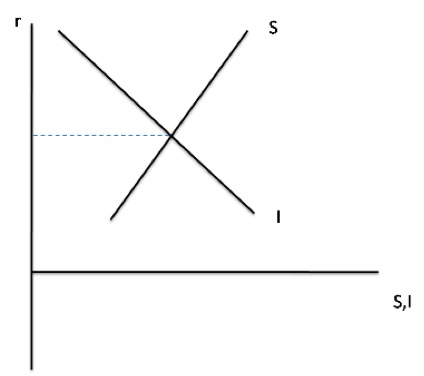
The natural inclination of practical men – who are not necessarily slaves of defunct economists since there are plenty of live and kicking economists ready to aid and abet their misconceptions – is to think of the interest rate as being determined by the supply and demand for loanable funds, as in Figure 2. When you think in those terms, it’s only natural to suppose that any increase in the demand for or fall in the supply of loanable funds must drive up interest rates; and it’s easy to imagine that this, in turn, would hurt prospects for economic recovery.

Again, I need to name names to assure you that I’m not inventing straw men. So here’s Niall Ferguson (in Soros et al 2009):

“Now we’re in the therapy phase. And what therapy are we using? Well, it’s very interesting because we’re using two quite contradictory courses of therapy. One is the prescription of Dr Friedman – Friedman, that is – which is being administered by the Federal Reserve: massive injections of liquidity to avert the kind of banking crisis that caused the Great Depression of the early 1930s. I’m fine with that. That’s the right thing to do. But there is another course of therapy that is simultaneously being administered, which is the therapy prescribed by Dr Keynes – John Maynard Keynes—and that therapy involves the running of massive fiscal deficits in excess of 12% of gross domestic product this year, and the issuance therefore of vast quantities of freshly minted bonds.

“There is a clear contradiction between these two policies, and we’re trying to have it both ways. You can’t be a monetarist and a Keynesian simultaneously – at least I can’t see how you can, because if the aim of the monetarist policy is to keep interest rates down, to keep liquidity high, the effect of the Keynesian policy must be to drive interest rates up.

“After all, $1.75 trillion is an awful lot of freshly minted treasuries to land on the bond market at a time of recession, and I still don’t quite know who is going to buy them. It’s certainly not going to be the Chinese. That worked fine in the good times, but what I call “Chimerica”, the marriage between China and America, is coming to an end. Maybe it’s going to end in a messy divorce.”

What’s wrong with this line of reasoning? It’s exactly the logical hole Keynes pointed out, namely that the schedules showing the supply and demand for funds can only be drawn on the assumption of a given level of income. Allow for the possibility of a rise in income, and you get Figure 3 – which is Keynes’s own figure, and a horrible drawing it is.

Figure 3.

Figure 4 is my own version, very much along Hicks’s lines: we imagine that a rise in GDP shifts the savings schedule out from S1 to S2, also shifts the investment schedule, and, as drawn, reduces the equilibrium interest rate in the market for loanable funds.

Figure 4.
As Hicks told us – and as Keynes himself says in Chapter 14 – what the supply and demand for funds really give us is a schedule telling us what the level of income will be for a given rate of interest. That is, it gives us the IS curve of Figure 5; this tells us where the central bank must set the interest rate so as to achieve a given level of output and employment. Of course, as the figure indicates, it’s possible that the interest rate required to achieve full employment is negative, in which case monetary policy is up against the zero lower bound, that is, we’re in a liquidity trap. That’s where America and Britain were in the 1930s – and we’re back there again.

Figure 5.

One way to think about this situation is to draw the supply and demand for loanable funds that would prevail if we were at full employment, as in Figure 6. The point then is that there’s an excess supply of desired savings at the zero interest rate that’s the lowest achievable. A zero-lower-bound economy is, fundamentally, an economy suffering from an excess of desired saving over desired investment.

Which brings me back to the argument that government borrowing under current conditions will drive up interest rates and impede recovery. What anyone who understood Keynes should realise is that as long as output is depressed, there is no reason increased government borrowing need drive rates up; it’s just making use of some of those excess potential savings – and it therefore helps the economy recover. To be sure, sufficiently large government borrowing could use up all the excess savings, and push rates up – but to do that the government borrowing would have to be large enough to restore full employment!

Figure 6.

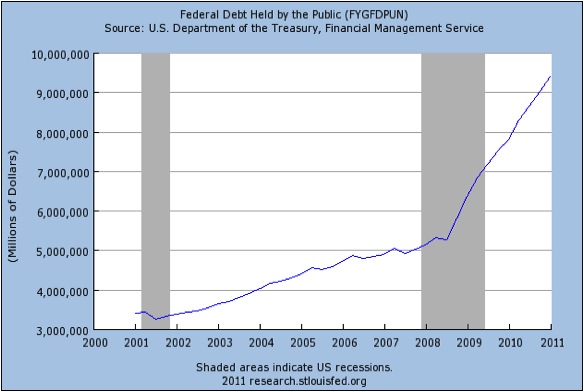
But what of those who cling to the view that government borrowing must drive up rates, never mind all this hocus-pocus? Well, we’ve has as close to a controlled experiment as you ever get in macroeconomics. Figure 7 shows U.S. federal debt held by the public, which has risen around $4 trillion since the economy entered liquidity-trap conditions. And Figure 8 shows 10-year interest rates, which have actually declined. (Long rates aren’t zero because the market expects the Fed funds rate to rise at some point, although that date keeps being pushed further into the future.)

Figure 7.

Figure 8.

So those who were absolutely certain that large borrowing would push up interest rates even in the face of a depressed economy fell into the very fallacy Keynes went to great lengths to refute. And once again, I’ve made that point using very old-fashioned analysis – the kind of analysis many economist no longer learn. New Keynesian models, properly understood, could with greater difficulty get you to the same result. But how many people properly understand these models?

I’m not quite done here. If much of our public debate over fiscal policy has involved reinventing the same fallacies Keynes refuted in 1936, the same can be said of debates over international financial policy. Consider the claim, made by almost everyone, that given its large budget deficits the US desperately needs continuing inflows of capital from China and other emerging markets. Even very good economists fall into this trap. Just last week Ken Rogoff declared that “loans from emerging economies are keeping the debt-challenged US economy on life support.”

Um, no: inflows of capital from other nations simply add to the already excessive supply of U.S. savings relative to investment demand. These inflows of capital have as their counterpart a trade deficit that makes America worse off, not better off; if the Chinese, in a huff, stopped buying Treasuries they would be doing us a favour. And the fact that top officials and highly regarded economists don’t get this, 75 years after the General Theory, represents a sad case of intellectual regression.

I’ll have more to say about that intellectual regression later. But first let’s talk about key features of our current situation that aren’t in Keynes.

What wasn’t in the General Theory: Banks and debt

Perhaps the most surprising omission in the General Theory – and the one that has so far generated the most soul-searching among those macroeconomists who had not forgotten basic Keynesian concepts – is the book’s failure to discuss banking crises. There’s basically no financial sector in the General Theory; textbook macroeconomics ever since has more or less discussed money and banking off to the side, giving it no central role in business cycle analysis.

I’d be curious to hear what Keynes scholars have to say about this omission. Keynes was certainly aware of the possibility of banking problems; his 1931 essay “The Consequences to the Banks of the Collapse of Money Values” is a razor-sharp analysis of just how deflation could produce a banking crisis, as indeed it did in the US.

But not in Britain, which may be one reason Keynes left the subject out of the General Theory. Beyond that, Keynes was – or at least that’s how it seems to a Part 1er – primarily concerned with freeing minds from Say’s Law and the notion that, if there was any demand problem, it could be solved simply by increasing the money supply. A prolonged focus on banking issues could have distracted from that central point. Indeed, I would argue that something very like that kind of distraction occurred in economic discussion of Japan in the 1990s. All too many analyses focused on zombie banks and all that, and too few people realised that Japan’s liquidity trap was both more fundamental and more ominous in its implications for economic policy elsewhere than one would recognise if it was diagnosed solely as a banking problem.

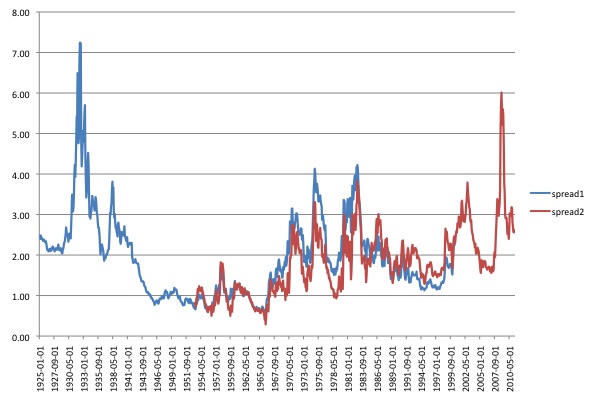
This time around, of course, there was no mistaking the crucial role of the financial sector in creating a terrifying economic crisis. You can use any of a number of indicators of financial stress to track the recent crisis. In Figure 9 I use the spread between Baa-rated corporate debt and long-term federal debt (“spread1” is against the long-term rate on federal debt, “spread2” against the 10-year constant maturity Treasury yield), which has the advantage both of being a measure one can track over a very long history and of being a measure stressed by a fellow named Ben Bernanke in his analyses of the onset of the Great Depression. As you can see, there have been two great financial disruptions in modern American history, the first associated with the banking crisis of 1930-31, the second with the shadow banking crisis of 2008.

Figure 9.

Nobody can doubt that these financial crises played a key role in the onset both of the Great Depression and of our recent travails, which Brad DeLong has taken to calling the Little Depression. And yet I am increasingly convinced that it’s a mistake to think of our problems as being entirely or even mainly a financial-sector issue. As you can see from Figure 9 the financial disruptions of 2008 and early 2009 have largely gone away. Yet while the economy’s freefall has ended, we’ve hardly had a full recovery. Something else must be holding the economy down.

Like many others, I’ve turned to debt levels as a key part of the story – specifically, the surge in household debt that began in the early 1980s, accelerated drastically after 2002, and finally went into reverse after the financial crisis struck.

In recent work I’ve done with Gauti Eggertsson (Eggertsson and Krugman 2010), we’ve tried to put debt into a New Keynesian framework. The key insight is that while debt does not make the world poorer – one person’s liability is another person’s asset – it can be a source of contractionary pressure if there’s an abrupt tightening of credit standards, i.e. if levels of leverage that were considered acceptable in the past are suddenly deemed unacceptable thanks to some kind of shock such as, well, a financial crisis. In that case debtors are faced with the necessity of deleveraging. This forces them to slash spending while creditors face no comparable need to spend more. Such a situation can push an economy up against the zero lower-bound and keep it there for an extended period.

I can’t quite find this story in the General Theory, although the idea of a sudden revision of conventional views about how much debt is safe certainly fits the spirit of Chapter 12. In any case, however, Keynes was definitely aware of the implications of debt and the constraints it puts on debtors for other macroeconomic questions. In the General Theory – and in reality – debt is a crucial reason why the notion expressed by Barro – that it’s just about nominal wages being too high – not only misses the point but even gets the direction of effect wrong.

In textbook macroeconomics we draw a downward-sloping aggregate demand curve, and in that framework it does look as if a fall in nominal wages, which shifts the aggregate supply curve down, would raise employment. The argument for expansionary policy is then one of practicality: it’s easier to push AD up using monetary policy than to push wages down. Indeed, in simple post-Keynesian models it does all boil down to M/w, the ratio of the money supply to the wage rate.

But this presupposes, first, that a rise in the real quantity of money is actually expansionary, which is normally true, but highly dubious if an economy is up against the zero lower bound. If changes in M/P don’t matter, then the aggregate demand curve becomes vertical – or worse.

For if there are spending-constrained debtors with debts specified in nominal terms – as there are in today’s world – a fall in wages, leading to a fall in the general price level, worsens the real burden of debt and actually has a contractionary effect on the economy. This is a point of which Keynes was well aware, although it got largely lost even in the relatively Keynesian literature of the 40s and 50s.

When does the need for deficit spending end?

There’s something else worth pointing out about an analysis that stresses the role of debtors forced into rapid deleveraging. It helps solve a problem Keynes never addressed, namely, when does the need for deficit spending end?

The reason this is relevant is concern about rising public debt. I constantly encounter the argument that our crisis was brought on by too much debt – which is largely my view as well – followed by the insistence that the solution can’t possibly involve even more debt.

Once you think about this argument, however, you realise that it implicitly assumes that debt is debt – that it doesn’t matter who owes the money. Yet that can’t be right; if it were, we wouldn’t have a problem in the first place. After all, the overall level of debt makes no difference to aggregate net worth – one person’s liability is another person’s asset.

It follows that the level of debt matters only if the distribution of net worth matters, if highly indebted players face different constraints from players with low debt. And this means that all debt isn’t created equal – which is why borrowing by some actors now can help cure problems created by excess borrowing by other actors in the past.

Suppose, in particular, that the government can borrow for a while, using the borrowed money to buy useful things like infrastructure. The true social cost of these things will be very low, because the spending will be putting resources that would otherwise be unemployed to work. And government spending will also make it easier for highly indebted players to pay down their debt. If the spending is sufficiently sustained, it can bring the debtors to the point where they’re no longer so severely balance-sheet constrained, and further deficit spending is no longer required to achieve full employment.

Yes, private debt will in part have been replaced by public debt – but the point is that debt will have been shifted away from severely balance-sheet-constrained players, so that the economy’s problems will have been reduced even if the overall level of debt hasn’t fallen.

The bottom line, then, is that the plausible-sounding argument that debt can’t cure debt is just wrong. On the contrary, it can – and the alternative is a prolonged period of economic weakness that actually makes the debt problem harder to resolve.

And it seems to me that thinking explicitly about the role of debt, not just with regard to the usefulness or lack thereof of wage flexibility, but as a key causal factor behind slumps, improves Keynes’s argument. In the long run we are, indeed, all dead, but it’s helpful to have a story about why expansionary fiscal policy need not be maintained forever.

The strange death of Keynesian policy: Instability of the Samuelsonian synthesis

So far I’ve argued that Keynesian analysis – or at least what Keynesian analysis looks like now, whatever Keynes may “really” have meant – is an excellent tool for understanding the mess we’re in. Where simple Keynesian models seem to conflict with common sense, with the wisdom of practical men, the Keynesian models are right and the wisdom of the practical men entirely wrong.

So why are we making so little use of Keynesian insights now that we’re living in an economy that, in many respects, resembles the economy of the 1930s? Why are we having to have the old arguments all over again? For it does seem as if all the old fallacies are new again.

By all means let us condemn famous men. There is no excuse for the timidity of Barack Obama, the wishful thinking of Jean-Claude Trichet, and the determined ignorance of almost everyone in the Republican Party. But watching the failure of policy over the past three years, I find myself believing, more and more, that this failure has deep roots – that we were in some sense doomed to go through this. Specifically, I now suspect that the kind of moderate economic policy regime economists in general used to support – a regime that by and large lets markets work, but in which the government is ready both to rein in excesses and fight slumps – is inherently unstable. It’s something that can last for a generation or so, but not much longer.

By “unstable” I don’t just mean Minsky-type financial instability, although that’s part of it. Equally crucial are the regime’s intellectual and political instability.

Let me start with the intellectual instability.

The brand of economics I use in my daily work – the brand that I still consider by far the most reasonable approach out there – was largely established by Paul Samuelson back in 1948, when he published the first edition of his classic textbook. It’s an approach that combines the grand tradition of microeconomics, with its emphasis on how the invisible hand leads to generally desirable outcomes, with Keynesian macroeconomics, which emphasises the way the economy can develop what Keynes called “magneto trouble”, requiring policy intervention. In the Samuelsonian synthesis, one must count on the government to ensure more or less full employment; only once that can be taken as given do the usual virtues of free markets come to the fore.

It’s a deeply reasonable approach – but it’s also intellectually unstable. For it requires some strategic inconsistency in how you think about the economy. When you’re doing micro, you assume rational individuals and rapidly clearing markets; when you’re doing macro, frictions and ad hoc behavioural assumptions are essential.

So what? Inconsistency in the pursuit of useful guidance is no vice. The map is not the territory, and it’s OK to use different kinds of maps depending on what you’re trying to accomplish. If you’re driving, a road map suffices. If you’re going hiking, you really need a topographic survey.

But economists were bound to push at the dividing line between micro and macro – which in practice has meant trying to make macro more like micro, basing more and more of it on optimisation and market-clearing. And if the attempts to provide “microfoundations” fell short? Well, given human propensities, plus the law of diminishing disciples, it was probably inevitable that a substantial part of the economics profession would simply assume away the realities of the business cycle, because they didn’t fit the models.

The result was what I’ve called the Dark Age of macroeconomics, in which large numbers of economists literally knew nothing of the hard-won insights of the 30s and 40s – and, of course, went into spasms of rage when their ignorance was pointed out.

To this intellectual instability, add political instability.

It’s possible to be both a conservative and a Keynesian; after all, Keynes himself described his work as “moderately conservative in its implications.” But in practice, conservatives have always tended to view the assertion that government has any useful role in the economy as the thin edge of a socialist wedge. When William Buckley wrote God and Man at Yale, one of his key complaints was that the Yale faculty taught – horrors! – Keynesian economics.

I’ve always considered monetarism to be, in effect, an attempt to assuage conservative political prejudices without denying macroeconomic realities. What Friedman was saying was, in effect, yes, we need policy to stabilise the economy – but we can make that policy technical and largely mechanical, we can cordon it off from everything else. Just tell the central bank to stabilise M2, and aside from that, let freedom ring!

When monetarism failed – fighting words, but you know, it really did — it was replaced by the cult of the independent central bank. Put a bunch of bankerly men in charge of the monetary base, insulate them from political pressure, and let them deal with the business cycle; meanwhile, everything else can be conducted on free-market principles.

And this worked for a while – roughly speaking from 1985 to 2007, the era of the Great Moderation. It worked in part because the political insulation of central banks also gave them more than a bit of intellectual insulation, too. If we’re living in a Dark Age of macroeconomics, central banks have been its monasteries, hoarding and studying the ancient texts lost to the rest of the world. Even as the real business cycle people took over the professional journals, to the point where it became very hard to publish models in which monetary policy, let alone fiscal policy, matters, the research departments of the Fed system continued to study counter-cyclical policy in a relatively realistic way.

But this, too, was unstable. For one thing, there was bound to be a shock, sooner or later, too big for the central bankers to handle without help from broader fiscal policy. Also, sooner or later the barbarians were going to go after the monasteries too; and as the current furore over quantitative easing shows, the invading hordes have arrived.

Last but not least, there is financial instability. As I see it, the very success of central-bank-led stabilization, combined with financial deregulation – itself a by-product of the revival of free-market fundamentalism – set the stage for a crisis too big for the central bankers to handle. This is Minskyism: the long period of relative stability led to greater risk-taking, greater leverage, and, finally, a huge deleveraging shock. And Milton Friedman was wrong: in the face of a really big shock, which pushes the economy into a liquidity trap, the central bank can’t prevent a depression.

And by the time that big shock arrived, the descent into an intellectual Dark Age combined with the rejection of policy activism on political grounds had left us unable to agree on a wider response.

So the era of the Samuelsonian synthesis was, I suspect, doomed to come to a nasty end. And the result is the wreckage we see all around us.

Dangerous Ideas

The General Theory famously ends with a stirring ode to the power of ideas, which, Keynes asserted, are “dangerous for good or evil.” Generations of economists have taken that ringing conclusion as justification for believing that their work matters – that good ideas will eventually translate into good policy. But how much of that hope can survive now, when both policy makers and many of our colleagues have fallen right back into the fallacies that Keynes exposed?

The best answer I can give is that steady upward progress was probably too much to expect, especially in a field where interests and prejudices run as strong as they do in economics. And there may yet be scope for Keynesian ideas even in the current crisis; after all, the crisis shows no sign of ending soon, and the policies of what I call the pain caucus are visibly failing as we speak. There may be another chance to return to the ideas that should have been governing policy all along.

So since I’m in England, here’s my advice to economists (and policy makers) frustrated – as I am – by the inadequacy of policy responses and the intellectual regression of too much of our profession: Keep calm and carry on. History will vindicate your persistence.

References

Barro, Robert (2009), “Government spending is no free lunch”, Wall Street Journal, January 22.
Cochrane, John (2009), “Fiscal stimulus, fiscal inflation, or fiscal fallacies?”, mimeo.
Eggertsson and Krugman (2010), “Debt, deleveraging, and the liquidity trap”, mimeo.
Keynes, J.M. (1936). The General Theory of Employment, Interest, and Money. New York: Harcourt, Brace and Company.
Keynes, J.M. (1937), “The general theory of employment”, Quarterly Journal of Economics.
George Soros, Niall Ferguson, Paul Krugman, Robin Wells, and Bill Bradley, et al. (2009), “The crisis and how to deal with it”,New York Review of Books, June 11.


[1] Prepared for the Cambridge conference commemorating the 75th anniversary of the publication of The General Theory of Employment, Interest, and Money.