Tuesday, August 7, 2012

Bubbling Up...8/7/12

1) The week when Mr Draghi greatly diminished the office of ECB President and sacrificed the fiscal-monetary policy distinction (in a manner that does not even help the euro in the short run!) by Yanis Varoufakis
What was the ECB’s position before Draghi’s heroic declarations? It was that it cannot arrest the crisis unless member-states act as part of a Grand Deal on how to effect a Eurozone-wide fiscal policy. Then and only then, the ECB would bolster their efforts through its own monetary operations. Clearly, that position led markets to believe that the Eurozone had no credible plan for dealing with the Crisis, as the cart (fiscal union) was being placed before the horses (serious ECB-centred intervention to stop the death embrace between insolvent banks and insolvent nations).
And what is the Draghi position after Thursday’s crucial ECB board meeting? That the ECB is ready to buy bonds in the secondary market once member-states act as part of a Grand Deal on how to effect a Eurozone-wide fiscal policy. In other words, no change whatsoever. None!
Woj’s Thoughts - Yanis and I are clearly on the same page. See ECB's Changing Philosophy is Good for Bond Holders but Bad for the Economy and ECB's Means (Lost Decade With High Unemployment) To An End (Structural Reform)

2) Draghi’s comments about the ECB doing “whatever it takes” are irrelevant by Edward Harrison
There is only one issue here: how many reforms the periphery will undertake. There will be no support unless we see reforms. If the periphery capitulates and slashes government jobs, raises pension ages, and makes it easy to fire people, Germany and the ECB will give them anything they want. Until they go whole hog, they won’t get full support.
This is blackmail, of course. But Monti, Samaras, and Rajoy are neoliberal reformers. So they want this too, just not the domestic political loss that goes along with it. Germany is obliging them by playing the fall guy for their domestic cutting agendas.
But, in my view, Europe is screwed. Eventually the neoliberals will have to cave and try to reflate in order to save their own hides when the debt deflation moves to the core or the Great Depression begins. They think they can extract the reforms they want before depression becomes firmly entrenched. I think they’re wrong.
3) Michal Kalecki on the Great Moderation by Steve Randy Waldman
Here is Kalecki describing with preternatural precision the so-called “Great Moderation”, and its limits:
"The rate of interest or income tax [might be] reduced in a slump but not increased in the subsequent boom. In this case the boom will last longer, but it must end in a new slump: one reduction in the rate of interest or income tax does not, of course, eliminate the forces which cause cyclical fluctuations in a capitalist economy. In the new slump it will be necessary to reduce the rate of interest or income tax again and so on. Thus in the not too remote future, the rate of interest would have to be negative and income tax would have to be replaced by an income subsidy. The same would arise if it were attempted to maintain full employment by stimulating private investment: the rate of interest and income tax would have to be reduced continuously."
Dude wrote that in 1943.
Let’s check out what FRED has to say about interest rates during the era of the lionized, self-congratulatory central banker:
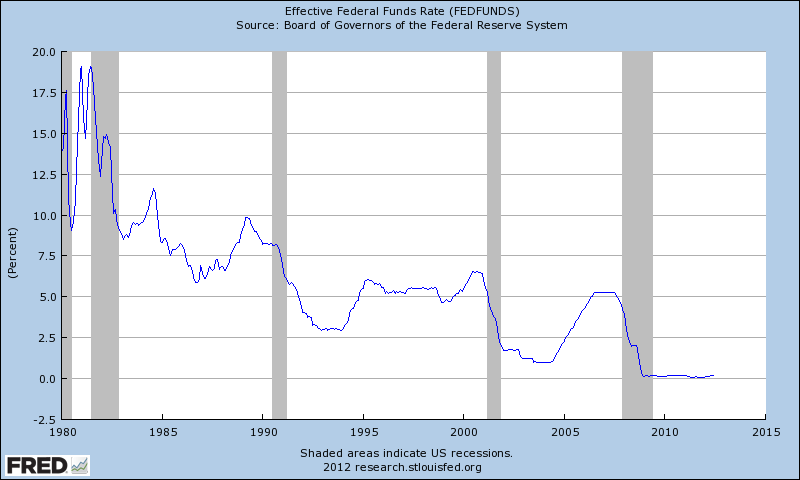


Yeah, those central bankers with their Taylor Rules and DSGE models were frigging brilliant. New Keynesian monetary policy was, like, totally a science. Who could have predicted that engineering a secular collapse of interest rates and incomes tax rates (matched, of course, by an explosion of debt) might, for a while, moderate business and employment cycles in a manner unusually palatable to business and other elites? Lots of equations were necessary. No one would have guessed that, like, 70 years ago.
Woj’s Thoughts - Wow! Could Kalecki have been more correct?! Sadly our current policies are still attempting to induce further growth through a interest rate reductions (despite the zero lower bound) and lower income taxes (despite a substantial portion of the population already receiving an income subsidy). Maybe these policies can still produce another debt led boom but, the end of the road is fast approaching.

4) The Crisis in 1000 words—or less by Steve Keen
The causation behind this correlation is that money is created “endogenously” when the banking sector creates loans, and this newly created money adds to aggregate demand—as argued by non-orthodox economists from Schumpeter through to Minsky. When this debt finances genuine investment, it is a necessary part of a growing capitalist economy, it grows but shows no trend relative to GDP, and leads to modest profits by the financial sector. But when it finances speculation on asset prices, it grows faster than GDP, leads obscene profits by the financial sector and generates Ponzi Schemes which are to sustainable economic growth as cancer is to biological growth.
When those Ponzi Schemes unravel, the rate of growth of debt collapses and the boost to demand from rising debt becomes a drag on demand as debt falls. In all other post-WWII downturns, growth resumed when debt began to rise relative to GDP once more. However the bubble we have just been through has pushed debt levels past anything in recorded history, triggering a deleveraging process that is the hallmark of a Depression.
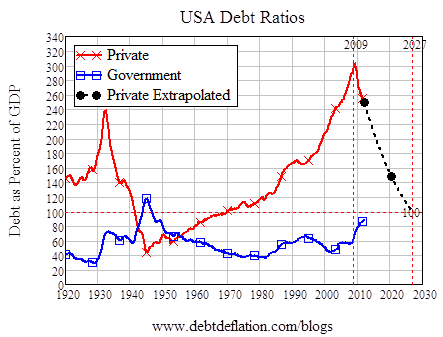
 
Woj’s Thoughts - The extreme levels of private debt can alter an economic system from being robust to fragile. In this manner, the chance that shocks destabilize the system and the magnitude of the ensuing deleveraging both increase dramatically.

A Stinging Critique of Monetarism

As I approach the start of grad school in a couple weeks, I’ve been focusing more time on reading and writing about ideas that are positive additions to my understanding of the macro-economy and potential policy solutions. This has meant less time devoted to refuting ideas and policies that I believe are empirically incorrect and offer little chance of success in practice. However, Philip Pilkington’s recent three-part series critiquing New Monetarism is simply too good not to recommend here. Through selected quotes from each of the parts, I’ve attempted to highlight Pilkington’s strongest arguments and those most relevant to current monetary policy:

Philip Pilkington: The New Monetarism Part I – The British Experience

The monetarist experiment proved disastrous. The Bank of England failed completely to control the money supply and succeeded only in causing interest rates to spiral out of control. This threw the economy into a deep recession. Between the last quarter of 1978 and the last quarter of 1980 the M3 measure of the money supply – the target of the monetarists – rose by some 32.8%; this was significantly faster than in the years before the targets had been initiated. Meanwhile unemployment skyrocketed and businesses shut their doors.
Note the resemblance to today’s QE program. Many in the markets and the media have succumbed to a sort of ‘QE fatigue’ as it is obvious that the policy has not produced the desired effect. Nevertheless, QE continues to live on as a sort of undead policy tool. A great deal of the reason for this is that those engaged in the markets can still trade on QE. For example, if another round of QE is announced by a central bank an investor can short the currency of that country, buy their government bond or throw money at the stock market. The brief increase or decrease, generated mostly by self-fulfilling expectations, can then give their portfolios a boost. Economists and commentators also cling to QE because it gives them something to talk about which they can use to enhance their prestige – this even though QE, stripped of its aura, is a straightforward asset swap program that a child could understand.
Philip Pilkington: The New Monetarism Part II – Holes in the Theory
Friedman was convinced that if he could prove that Keynes was wrong by showing that the velocity of money was relatively fixed and that there was thus a fairly simple mechanical relationship between the money supply and national income, the Keynesian theory would largely fall apart. If Friedman was correct he would also be able to explain inflation as simply being due to the central bank allowing too much money flow into the economy relative to the size of that economy and that all they had to do was target a given money supply to bring the inflation under control.
...
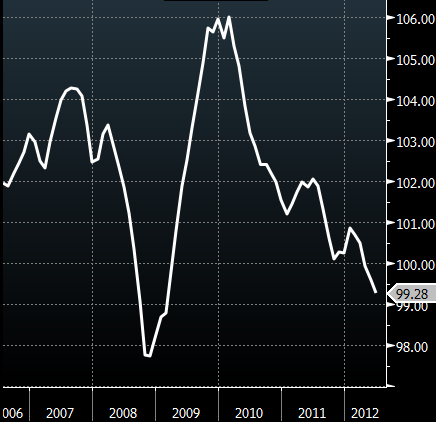
So, what was wrong with Friedman’s basic theory? Well, first of all the correlations he thought he found were not the same across time and space. If the data for many countries is compared across time we see strong fluctuations in the velocity of money. Indeed, even within single countries the velocity of money fluctuates quite aggressively in line with overall economic growth. Here, for example, is the velocity of the M2 money supply in the US charted together with the employment-population ratio – an indicator of economic health that is used to determine the ability of the economy to produce jobs:
 
Clearly the velocity of the M2 is not at all constant and moves in rough correlation with the employment-population ratio and, hence, with the health of the economy. So, Friedman was wrong on even the simplest measure. The velocity of money does, in fact, vary over time.
Does this mean that Keynes was correct and large-scale unemployment could not be cured by monetary stimulus due to a falling velocity? No, not really. Keynes’ idea that the velocity of money would move together with the level of economic activity (and the interest rate) was simply a modification of the old quantity theory of money. Thus all Friedman had to do was show a constant velocity and he could debunk Keynes. But in actual fact, both Friedman and Keynes were using a moribund theory that had no basis in reality (albeit Keynes’ version was far closer to the truth than Friedman’s).

Philip Pilkington: The New Monetarism Part III – Critique of Economic Reason
The report of the Radcliffe Commission was pessimistic in the extreme with regards monetary policy. The commission found that the central bank had little control over the expansion of the money supply and that the velocity of money was extremely variable. Basically, what the commission found was that the banking system was largely passive in relation to the economy. Central banks did not ‘drive’ the economy at all and any policies they did implement, if they were in any way effective at all, would be wholly subordinate to real economic variables such as levels of private investment, consumer demand and government spending and taxation policies.
This is arguably where we are today. Quantitative easing is based on the same principles as the monetarist doctrine: increase the money supply and national income will increase with it because the correlations between these two measures can be explained through recourse to a simple, straight-forward channel of causation. And yet once again we have seen the failure of the doctrine – a failure which would have been obvious to Lord Radcliffe and his colleagues. QE has not done what it was supposed to. The banks are flooded with reserves and the money supply has increased drastically, yet national income has not followed suit.
Yet, at the same time, further rounds of QE are still spoken of in solemn tones by central bankers and the media (the markets, however, have been getting a bit sceptical recently…). What’s more, the old monetarist doctrines are still taught in economics departments across the world under the guise of the money multiplier.
The entire posts are well-worth reading, as Pilkington describes the significance of the endogenous theory of money while driving a stake through the theory underlying NGDP Targeting (a primary policy goal/tool of New Monetarists today). The logic outlined here is precisely why I continue to be skeptical of QE-based stock rallies and of the many policies put forth by New (Market) Monetarists. Despite numerous refutations of Monetarist ideals and practical failures throughout history, Monetarism lives on. Pilkington concludes:
Now is the time to allow policymakers and the educated public a look inside. Now is the time for a new Radcliffe Commission to investigate the effects of the QE programs. We can be sure that a bipartisan commission of non-economists who seek only the truth – and not confirmation of the biases with which they earn their crust – can tell us what all this monetary shamanism is actually about.
Hopefully the failed theories of Monetarism can eventually be put to rest once and for all.

For those interested in further thoughts on this subject, here is a sampling of my previous related posts:

Friday, August 3, 2012

Bubbling Up...

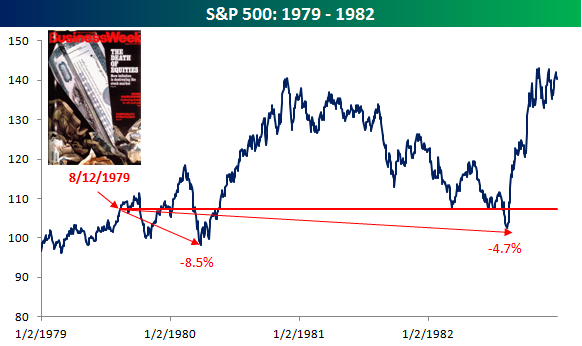
1) How Good An Indicator Was "The Death of Equities" Cover
Just how good of a buying indicator was the BusinessWeek cover from 1979, though?  If you ask most investors about that cover story, they seem to remember that the market almost immediateley took off after the issue was published.  The reality, however, is that nearly eight months after the cover story was published, the S&P 500 was down 8.5%.  While the market did rally from that level, three years after the infamous BusinessWeek cover, the S&P 500 was still down nearly 5%.  It wasn't until 8/12/82 that the S&P 500 really took off and the bull market began in earnest.  Granted, time horizons have gotten a lot shorter in the last thirty years, but three years is an eternity in this market.


Woj’s Thoughts - Our memories can deceive us by filling in stories with logical steps. Cover stories often do mark extremes in sentiment, yet those extremes may persist for quite some time. As a signal for contrarian investors, recognizing this reality is critical.

2) Why I don’t believe housing has put in a secular bottom by Edward Harrison

For the bottom to be in you have to believe two things from a macro perspective. First, you have to believe that the overshoot phase to the downside has been arrested. Most bubbles end with a significant overshoot that makes it a no-brainer to tip a toe in the market. I think we are approaching those levels in markets like Phoenix. But we never really got down to reasonable levels in places like Washington or New York. Second, you have to believe any US recession is both remote in time and mild in duration/severity. I question this. I think any US recession will re-start the house price decline dynamic because consumers are still overindebted, interest rates are at zero percent, and mortgage rates are as low as they can get. My point is that from a cyclical perspective 2012 is as good as its going to get. Calling a bottom at the top of a cyclical bull market in asset prices and the economy is folly. Wait until the bottom of the cycle to make those calls.
Woj’s Thoughts - Early this year I made the claim, Don't Rush to Buy a Home! At the end of May I was Still Not Buying A Housing Recovery. Edward lays out many/most of the reasons for my continued lack of optimism on housing prices over the next couple years.
 
3) The Evolution of Treasury and Muni Bond Yields by Cullen Roche
I’ve discussed this in detail over the years and why the analysts crying for mass US state insolvencies were likely to be wrong, but now we have some interesting new analysis via VOX.  What’s depicted below is the 10 year US Treasury versus the 10 year muni bond index.  As you can see, the yields have an extremely high correlation – muni bonds practically ARE treasury bonds.  So why are yields surging in Italy, Spain, Greece and Portugal, but they’re remaining so tame in the muni market?  Simple – the US government, which can always procure funds via taxes and bond sales therefore making solvency a non-issue, provides substantial federal aid to the states every year.  While this doesn’t eliminate the solvency issue at the state level it certainly helps reduce it substantially.  Europe has no such mechanism in place so what you basically have is a bunch of US states in an environment where they’re left to fend for themselves.  They can’t print their own currency, they can’t devalue their own currency and they can certainly run out of Euros.  The result is bond investors who are terrified about default and end up selling bonds which only exacerbates the budgeting process.*
4) Microfoundations and the capital debates by Matias Vernengo
In that sense, heterodox (classical-Keynesian, by which I mean Sraffa’s prices cum Keynes/Kalecki’s effective demand) does have a coherent determination of long run prices, based on rational behavior, as the foundation of the macroeconomic theory. Markets do not produce optimal outcomes and unemployment of productive resources is the normal, long run, position of the economy. In fact, the capital debates not only say that classical political economy (the surplus approach) provides sound microfoundations, but also that it is NOT possible to do so within the neoclassical/marginalist paradigm.
Woj’s Thoughts - Previously I’ve argued against microfoundations in macroeconomics, but Matias places an interesting spin on the discussion. Quite possibly the issue is not the use of microfoundations but rather the poor choice of microfoundations.

5) Another Summer of Discontent: The Four Factors that Explain Why What We’re Doing Isn’t Working by Daniel Alpert

We must move from stabilize and reflate, to stabilize and recalibrate:
  • It is time for creditors throughout the developed world to finally take the write downs that have long been coming their way in connection with the trillions of dollars of truly un-payable household and sovereign debts that resulted from the credit bubble of the 2000s.  Yes, this will pressure lenders and, yes, they will need to be recapitalized to the detriment of their existing stakeholders.  But there is presently no shortage of capital seeking reasonable risk-adjusted returns, and I have every confidence that it will flow eagerly into the financial sector—if only the balance sheets of our institutions were honestly reckoned by having the currently unrecoverable carrying value of assets written down to that which can be recovered today from borrowers and/or underlying collateral.

  • As I have been saying and writing about for years, we must accept the reality of what the credit markets are telling the planet’s most creditworthy governments, particularly that of the U.S.  The message is “please, here, take our money…take it cheaply and keep it safe…we have no fear of lost purchasing power, the trend is not inflationary…now take it (and use it to fix your  economy).” And that is what we must do. We must take as much 30-year money at these depression level interest rates as we need to re-employ our underemployed workers directly, on public infrastructure projects that return benefits to the economy more than sufficient to repay the sums borrowed when the time comes.  The private sector will not hire until it sees a recovery in demand—so the only agent for re-employment of workers and regeneration of demand may, for an extended time until the imbalances at least decline somewhat, be our governments.  It is long past time to pack away austerity agendas.

  • And yes, we must address and manage the process of nominal price, wage and asset value declines. The advanced economies are experiencing the effects of a supply glut, a debt overhang, massive technology-induced productivity (soon to transfer to the emerging economies, worsening the glut), and aging populations. These are all disinflationary factors. And the aggregate effect of their contemporaneous existence is deflationary—full stop. Yet in relying on monetary intervention alone we are fighting the battle to control the pace of deflation (forget about reflation) with one hand tied behind our back.n  Instead of targeting growth in nominal GDP, which I am proclaiming here to be a futile endeavor, we must target renewed global competitiveness and, at the very least, growth in real GDP. That means both allowing our price and wage structures to align themselves with global supply and demand and, more importantly, feeding and nurturing investment in those areas of the private sector that can employ large numbers of people at market clearing wage rates. Especially in those sectors that are more readily protected by geography from global competition.

Thursday, August 2, 2012

ECB's Changing Philosophy is Good for Bond Holders but Bad for the Economy

Last week, a report from Jon Hilsenrath at the WSJ and comments from ECB President Mario Draghi sent markets screaming higher in expectations of an onslaught of monetary stimulus being announced this week. Following the conclusion of meetings by the FOMC and ECB, those expectations are now delayed. Bernanke was the first to disappoint, announcing no new monetary stimulus and merely repeating the obvious pledge to do more, if necessary. Today, Draghi proved that European policy makers will continue to talk a big game while offering little in terms of details or even a plan of action.

While many reports are focusing on the lack of follow through by Draghi, a strong countervailing opinion is presented at Mosler Economics.

Karim writes:Draghi announced significant philosophical changes today. The key announcements were:
  • The ECB was ready to renounce seniority on its bond purchases.
  • The size of future purchases was open-ended: ‘size adequate to reach its objectives’.
  • Future purchases may not be sterilized, as they have been with the SMP so far.
  • Purchases would be front-end focused as that ‘falls squarely in line with monetary policy instruments’. A key instrument is obviously the LTROs. So would imagine purchases would be 3yrs and in on the curve.
The adherence of governments to their commitments and the fulfilment by the EFSF/ESM of their role are necessary conditions [for some action on the ECB side]. The Governing Council, within its mandate to maintain price stability over the medium term and in observance of its independence in determining monetary policy, may undertake outright open market operations of a size adequate to reach its objective. In this context, the concerns of private investors about seniority will be addressed.Other news was that:
  • As in the excerpt above, purchases would be subject to strict conditionality via the EFSF (i.e., Spain has to accept a Memorandum of Understanding). Fiscal consolidation and structural reform were listed as the key conditions.
  • He threw cold water on the ESM getting a banking license, saying he was ‘surprised by the attention this has received’.
  • Logistics and objectives on bond purchases were TBD by a committee.
  • Further non-standard measures were forthcoming.
  • Rate cuts were discussed but unanimously voted down; as for a negative depo rate he said ‘we are in unchartered waters’, implying the hurdle may be high.
Relative to levels before Draghi’s London speech last week, Spanish 2y yields are 200bps lower, and 10yr yields are 50bps lower.

Whether or not these “philosophical changes” ever become reality remains an open question, but the ideas of renouncing seniority and leaving QE open-ended are clearly a step in the right direction. That being said, Draghi maintains the ECB’s position that further action is conditional on fiscal consolidation and structural reform. In this more important sense, the ECB’s philosophy has not really shifted at all. Describing that philosophy recently (ECB's Means (Lost Decade With High Unemployment) To An End (Structural Reform)), I concluded:
By working to prevent an all out collapse of the EMU, Draghi is merely taking the necessary actions to maintain his position. If Spain or other European countries must “suffer from a decade of recessions with unemployment over 20%” in order to implement the desired structural reforms than so be it.
As long as this philosophy remains in play, the most likely outcome in Europe will be a sustained period of high unemployment with declining or stagnating growth. Operationally this scenario can go on indefinitely but politically the time may be running out.

Wednesday, August 1, 2012

Bubbling Up...

1) Keynes and Knight on uncertainty – ontology vs. epistemology by Lars P Syll
Paul Davidson: “Lars, there is a difference between the uncertainty concept developed by Keynes and the one developed by Knight.
As I have pointed out, Keynes’s concept of uncertainty involves a nonergodic stochastic process . On the other hand, Knight’s uncertainty — like Taleb’s black swan — assumes an ergodic process. The difference is the for Knight (and Taleb) the uncertain outcome lies so far out in the tail of the unchanging (over time) probability distribution that it appears empirically to be [in Knight's terminology] “unique”. In other words, like Taleb’s black swan, the uncertain outcome already exists in the probability distribution but is so rarely observed that it may take several lifetimes for one observation — making that observation “unique”.

2) What’s Driving China’s Real Estate Rally? Part 3 by Patrick Chovanec
By anticipating future demand growth, investors effectively front-load that growth into the present.  That’s great for developers, who get to sell more today, but it means that a great deal of future demand has already been provided for and priced into the market.  We see this phenomenon in other markets as well.  In the West, many investors want to buy into high-growth companies like Apple or Facebook.  What they don’t realize is that, to the extent they’re paying a high price-to-earning (P/E) ratio, they’re paying for that growth up-front, with the benefit accruing to the present-day seller, not the new investor.  Even a genuinely promising company can have an overpriced stock.
The imbalance in real income growth I mentioned earlier exacerbates this phenomenon.  The proceeds of inflationary money creation are channeled to favored recipients, often in the form of “hidden” income.  These high income earners, in need of a place to stash their cash, pour it into property, in anticipation of future demand.  The more money is created through expansive credit, the more cash they have to stash.  In the meantime, the inflation that is generated boosts the nominal wages of low-skill workers, but erodes their real income growth, which is the basis for growth in future housing demand.  Excessive money growth inflates the price that investors are willing to pay today, and lengthens the amount of time it will take actual homebuyers to come to afford that price.  In other words, it creates a bubble.
As I noted before, rising incomes mean that current housing prices will become gradually more affordable — but only if they stop rising.  If the market has to depend solely on end-user demand, there is a catch-up period ahead, in which incomes gradually rise to meet anticipatory prices, and investors gradually sell their stockpiled apartments to actual residents.  The only way to avoid this catch-up period would be for investors to continue fronting for future demand by expanding their holdings even further.  Many believe this will happen.  In fact, if you think about it, this is really the main rationale behind calls for the government to lift restrictions on multiple home purchases: only investment demand, in the form of renewed stockpiling, can save the day.”
3) GM's Channel Stuffing Goes To Germany: Is Europe's Largest Economy A Fraud? by Tyler Durden
Via Reuters: “So while official figures show a 0.7 percent rise in German car sales for the half year, figures from auto market research firms Dataforce and BDW Automotive show private demand fell 5 percent in the period, which would mean all the growth had been manufactured by the manufacturers.”
"If you push at the end of one month, you start the next one in deficit because you've registered a car you still have to sell," he said. And when dealers can no longer keep it up, carmakers do it themselves. As a result, the two account for a combined 30 percent of the new car market, making the industry the second largest source of demand behind only private customers, who account for 39 percent.”

4) China's index of leading indicators points to further economic erosion by Walter Kurtz

The Index of Leading Indicators hit a post-2009 low today,
*
China National Bureau of Statistics Leading Indicators Index, 1996=100


5) Imposed versus Adopted Monetary Rules by Steve Horwitz
Put differently, a policy-guiding rule is adopted by the central bank;  a policy-constraining rule is imposed on the central bank.  Their purposes are very different.
It is in this sense that Friedman opposed discretion and those in favor policy-guiding rules do not.  Friedman’s rules are not changeable by the central bank itself;  policy-guiding rules are.  The central bank has discretion to pick its “rule.”  That, Friedman thought, was the whole problem, hence his call for a rule to be imposed.
Woj’s Thoughts: Horowitz hits on a key aspect of the rules vs. discretion debate by explaining that some “rules” intentionally leave open vast space for discretion. Applying a rule to fiscal or monetary policy, such as full employment, does not imply that Keynesians (or any other economists) prefer rules to discretion. On the contrary, the choice to allow policy makers substantial discretion in meeting such “rules” suggests discretion is preferable.