Tuesday, August 14, 2012

The Relative Strength of US Health Care

When it comes to US health care, I have to admit that my knowledge of policies and data is rather limited. I’ve been fortunate to avoid needing much medical care during my life, to this point, but have certainly experienced my share of long wait times and other frustrations. Given those experiences and countless stories from others, I was generally willing to accept the reports and claims about how poor the US health care/insurance system is when compared globally. A few recent items, however, have altered my impression and made me skeptical about the actual inferiority of the US health care system.

Two weeks ago, Russ Roberts hosted a podcast with Scott Atlas, Senior Fellow at Stanford University's Hoover Institution and author of In Excellent Health. Atlas discusses the methodological and data inconsistencies contained in several widely heralded reports, then dismantles the impression that health care and services are more widely and readily available in other countries. He also touches upon a surprising difference in level of care for patients with and without health insurance:

Guest: there are studies in the literature--in fact numerous studies, study after study--that show in a variety of settings, whether it's heart disease, cancer, transplants, all kinds of things: people have better outcomes, better medical care, if you just take the people who are just as sick from each of those populations--private insurance, Medicaid, and no insurance whatsoever. Private insurance has far better outcomes than Medicaid. Even the same sickness of person. It has nothing to do with how sick somebody was when they started. And then, the even more alarming thing is it is very common in these studies--these are peer reviewed studies in the medical literature--that the people with Medicaid do worse than the patient with no insurance whatsoever.
Later in the podcast, Atlas draws into question the true number of uninsured individuals within the US:
Guest: I do a lot of international traveling, I read the newspapers and speak to people outside the United States, and it is portrayed as scandalous that we have 50 million or so Americans with no health insurance. Which I mentioned is equated with no health care. As if they're synonymous. Russ: As if they are out on the streets if something happens. Guest: But I think here, this is a measure that really has to be scrutinized. And I did in my book. This so-called 50 million uninsured--because when you look who is this population, the raw data, the documents, the U.S. Census Bureau documents, and others, you find out that it's not really 50 million people. After you say: Well, okay, about 10-15 million people are not U.S. citizens in that group--and I'm not saying they shouldn't get health care, but I'm not sure you are going to reform the U.S. health system to get non-citizens insured. Russ: Correct. That's going to be a challenge. Although not that group, but there are others who are illegal who do get health insurance. Guest: Who do have health insurance. Right. And then you take a look at who answered the U.S. Census Bureau survey and said they didn't have health insurance, and it turns out--let's just say, I don't remember the exact number, but about another 10 million or so that said they didn't have insurance that actually were using insurance. And we know that because the Census Bureau people went and looked, looked up and found medical records; these people had insurance that they were using, and mainly Medicaid. Russ:They didn't consider that insurance. Guest: They probably when they answered the question, they thought the question meant: Do you have private insurance? But, be that as it may, this is in one of the Appendices of the U.S. Census Bureau documents, Appendix C-- Russ: Good to know--Guest: Is that they actually were aware--the U.S. Census Bureau were aware. But they didn't change the response to the question. And then there's another 13 million adults and children--of these 50 million people, 13 million who actually are already eligible for public insurance--Medicaid, a tiny bit Medicare, and the Children's Health Insurance Program (SCHIP or CHIP)--that simply did not sign the paperwork because they haven't accessed the system. So, they haven't used it. Common sense says you wouldn't want to redesign another system to make them eligible for that when they are already eligible for the current public health insurance system. So, you are left with a population of less than 5% of people in the United States who don't have insurance or who are not already eligible for current government insurance programs. I would not call that a crisis in the uninsured.
Separate from this conversation, John C. Goodman at The Beacon recently wrote about Private-Sector Socialism: What the Right and Left Don’t Understand about Healthcare in Other Countries. In this post, one of several regarding the broad topic of health care, Goodman comments on the immense similarities between US and global health care systems:
The pluralism of US healthcare is important to keep in mind in thinking about health reform. Suppose you are dissatisfied with the way the healthcare system is working in your city or your locality, and you are curious about whether somewhere in the world people have found a better way of doing things. Odds are that you are going to find better answers somewhere within the United States than outside of it.
People on the left and right who are prone to stress the differences between US healthcare and the healthcare of other countries invariably ignore the 80 percent commonality and focus on the remaining 20 percent. On the left, the focus is usually on the ways we appear to be worse; on the right, the focus is usually on the ways we appear to be better. But even here the differences are narrowing, and I expect that trend will continue.
There may be equally good reasons to be skeptical of the perspectives provided by Atlas and Goodman, but my intention is simply to offer a counter argument to the frequent claims that America’s health care system is a disgrace among advanced economies. In my opinion, the thoughts provided by Atlas and Goodman, at the very least, suggest taking a more critical look at the supposed successes and failures of health care systems worldwide. Failure to do so may encourage policy decisions that push current levels of care in the wrong direction. The current US health care system is certainly not great, but relatively it may be far better than many realize.

Monday, August 13, 2012

Modern Money Regimes Redefine Fiscal Sustainability

Mitt Romney’s selection of Paul Ryan as the Republican Vice Presidential candidate ensures that a major focus of the upcoming election will be the federal budget. Many voters appear concerned that continued deficits and an increasing debt-to-GDP ratio will lead to some combination of higher interest rates, slower growth, (hyper) inflation and/or default. In a debate that was already destined to center around this mainstream view of fiscal sustainability, the selection of Ryan will only further cement incorrect theories within public knowledge.

Over the past couple years I have attempted to help further an opposing view of the federal budget, one based on theories of modern money.* Recently I stumbled upon a 2006 paper by Scott Fullwiler, titled Interest Rates and Fiscal Sustainability, which offers a surprisingly complete explanation of a modern money regime. Presenting the major departures from mainstream views, Fullwiler concludes:

“in a modern money regime such as the U. S., deficits do not crowd out but rather create net financial assets for the non-government sector, the operational purpose of bond sales is interest-rate support, and the Fed’s interest rate target anchors other short-term rates given that tax liabilities must be paid in reserve balances. As a result of these regime characteristics, the interest rate on the national debt is a monetary phenomenon that primarily reflects the current (and expected, if long-term, fixed-rate time deposits are issued) interest-rate “anchor” set by the Fed, not the size of the current or expected future levels of the debt or deficits as assumed in the loanable fund market paradigm. This monetary nature of interest on the national debt is indisputable when one considers that the federal government never needs to issue its debt as time deposits and could simply create (assuming a positive interest rate target) interest-bearing reserve balances that earn interest at the Fed’s target interest rate, as in the proposals discussed earlier. Self-imposed constraints, including legal restrictions on operating procedures or lack of political will, might keep a simplified procedure such as this from being implemented, but they do not change the monetary nature of rates paid on the national debt; the choice to issue short-term or long-term securities (i.e., non-government sector time deposits at the Fed) is simply a more complicated version of this more general or (in the case of a zero interest rate target) “natural” case. (p.26)”
For readers interested in fiscal and/or monetary policy, Fullwiler’s paper is a fantastic resource. Over the coming days it is my intention to offer a more detailed examination of the various principles outlined above with further excerpts from the paper and real-world applications. Even if the basic principles of a modern monetary system supplants current mainstream theories, clear cut policy choices will remain out of reach. The policy conversations, however, will improve dramatically and the likelihood of better outcomes will increase significantly.

* I mention theories of modern money rather than Modern Monetary Theory (MMT) to include support for Monetary Realism, Post-Keynesians, Circuitistes, Horizontalists and others that accept the basic principles laid out by Fullwiler.

Sunday, August 12, 2012

Bubbling Up...8/12/12

1) U.S. Trade Deficit Largely Due to "Intra-Firm" Trade by Dan Crawford @ Angry Bear
The vast majority of the U.S. $727 billion trade deficit in goods for 2011 is due to "intra-firm" or "related party" trade, that is, trade between two units of the same corporation, according to the U.S. Census Bureau. This is significant because such trade is the most open to companies manipulating the prices between subsidiaries to minimize tax liabilities, usually known as abusive transfer pricing. Moreover, as Stuart Holland argued in 1987, intra-firm trade is also less responsive to changes in exchange rates than is trade between independent businesses, since within an individual multinational corporation each subsidiary will have a specific role to play in its supply chain, which won't be quickly changed.
U.S. goods trade and related party trade (billions of dollars), world and selected countries, 2011:
Country        Exports from US Imports to US Balance
World            $1480.4     $2707.8          - $727.4
World (RP)     $ 365.0      $1056.2          - $691.2
Canada          $ 280.9      $ 315.3            -$  34.5
Canada (RP)   $ 98.1        $ 162.0           - $ 64.1
Ireland           $ 7.6          $ 39.4             - $ 31.7
Ireland (RP)    $ 1.5          $ 34.6             - $ 33.1
Mexico           $ 196.4      $ 262.9            - $ 64.5
Mexico (RP)    $ 60.5        $ 155.7            - $ 95.2
The bottom line is that we need to reverse the incentives in the tax code that encourage the offshoring of jobs. (Why does Apple have $64 billion in cash abroad?) However, to emphasize the point I made last time about what Americans want out of tax reform and the "reform" that has actually happened, it's worth pointing out that Robert Gilpin of Princeton University, author of the seminal U.S. Power and the Multinational Corporation (1975), made the same policy recommendation almost 40 years ago, and it hasn't happened yet. We've got our work cut out for us.
2) Zero rates have created a dangerous risk seeking return mentality by Edward Harrison @ Credit Writedowns
You saw the posts by Sober Look on the excess risk investors are taking on in the high yield market and the consequences of low yields on US households. Let’s make it a trilogy of posts then. There are plenty of other posts today that highlight this problem.  And it is a problem. One thing Austrians harp on is the misallocation of resources caused by heavy handed and persistent interest rate market intervention. They are right that the industrial organization and the structure of investment capital priorities is critical to longer-term growth. What we are seeing now is a skew into high risk activities. As I wrote 4 years ago
Woj’s Thoughts - Follow the last link for a marvelous step-by-step description of a credit bubble and bust. Harrison combines insights from the Austrian and Modern Money traditions, which is a prospect I hope to further in my own research.

3) The Jackson Hole "fix" is not coming by Walter Kurtz @ Sober Look
Market participants are looking for a fix, a repeat of the "high" Bernanke delivered at Jackson Hole in 2010 when QE2 was introduced. Markets however are in for a major disappointment because no outright asset purchases will be announced. There are multiple reasons for this, including the fact that real rates are now deep in the negative territory (as discussed here) and the policy as expressed in long-term real rates is far more accommodative than it was in 2010.
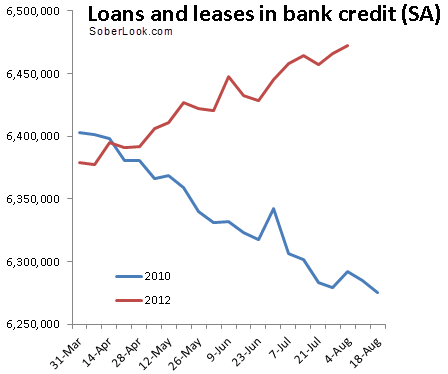
But what makes 2012 entirely different is that the key concern that pushed the Fed into asset purchases in 2010 no longer exists. The summer of 2010 was marked by renewed fears of deflation driven by credit contraction. The Fed was afraid of Japan-style deflationary pressures that are extremely difficult to arrest as bank lending shuts down. In the months preceding the 2010 Jackson Hole speech, credit was contracting sharply with banks steadily shrinking balance sheets. As discussed before, just the opposite is true in 2012 - credit is expanding at a decent pace. The chart below compares the trends now and in 2010.

Woj’s Thoughts - Kurtz goes on to suggest that markets may sell-off if disappointed by Bernanke, but I’m not convinced. Expectations of further “stimulus” have consistently proven resilient when faced with no new information. Markets may therefore simply shift expectations of further action to September, October, December and on, or until enough FOMC voting members explicitly state action is not coming.  

Thursday, August 9, 2012

Bubbling Up...8/9/12

1) Pettis: The Chinese rebound will be short by Houses and Holes

If we assume that China will have no problem sailing through its economic rebalancing, the European crisis, and everything else, then clearly we don’t need to worry about anything. But if China’s rebalancing is accompanied by a sharp slowdown in economic growth, or if it occurs during a worsening of the European crisis – both very likely scenarios – then we need to think about what the debt burden will be under those conditions.
So, for example, will commodity prices drop? I think they will, perhaps by as much as 50% over the next three years, and to the extent that there is still a lot of outstanding debt in China collateralized by copper and other metals (and there is), our debt count should include estimates for uncollateralized debt in the event of a sharp fall in metal prices. Will slower growth increase bankruptcies, or put further pressure on the loan guarantee companies? They almost certainly will, so we will need again to increase our estimates for non-performing loans.
Will capital outflows increase if growth slows sharply? Probably, and of course this puts additional pressure on liquidity and the banking system, and with refinancing becoming harder, otherwise-solvent borrowers will become insolvent.  Will rebalancing require higher real interest rates, a currency revaluation, or higher wages? Since rebalancing cannot occur without an increase in the household income share of GDP, and since these are the biggest implicit “taxes” on household income, there must be a net increase in the combination of these three variables, in which case the impact on net indebtedness can be quite significant depending on which of these variables move most.  Since I think rising real interest rates are a key component of rebalancing, clearly I would want to estimate the debt impact of a rise in real rates.

2) Guest Contribution: ‘The Making of America’s Imbalances’ by Paul Wachtel and Moritz Schularick
Last but not least, in the paper we point to a potentially important distinction that was lost in previous analyses of household savings behavior. When we delve deeper into the role of capital gains for savings and borrowing decisions, we uncover a close statistical relationship between gains in equity (but not housing) wealth and active savings decisions (i.e., acquisition of financial assets) by American households. Borrowing behavior, by contrast, depends much more closely on fluctuations in housing wealth, both directly because of higher values of the housing stock and indirectly through mortgage equity withdrawals. We think that this result challenges the (conventional) wisdom that non-leveraged equity market bubbles pose a lesser problem for macroeconomic balance than credit-fueled housing bubbles. Our results indicate that equity market bubbles too trigger substantial changes in the financial behavior of households. The economic and financial repercussions of those could be costly to reverse at a later stage.

3) Is the Fed Eyeing a New Kind of Twist? by David Schawel
An astute Credit Suisse analyst pointed out this week that the Fed could perform a “MBS Twist” operation in which they sell up in coupon premium MBS pools and buy lower coupon MBS which could have the affect of lowering mortgage rates to borrowers.  In their own words:
“…this policy will specifically target the near par secondary MBS rate, the key driver of the primary rate that is offered to the consumer.  Consumers spend “permanent income”, not temporary tax rebates…Operation MBS twist will reduce mortgage payments and redirect consumer cash to increase M-velocity and bump up inflation.”
To put this in perspective, the Fed owns ~$530bil of Fannie 4.5-5.5% pools (purchased during QE1) in which they have an unrealized gain of ~$32bil.  30yr 3.5’s (borrower rates of 4%) still comprise the lions share of origination volume, but 30yr 3.0’s are in production now as well.  Pushing down on 3’s and 3.5’s by buying almost all new production could, as CS points out, help compress the primary-secondary spread.
Woj’s Thoughts - Very interesting policy idea here. In essence this is a reverse Operation Twist, although the maturities are equivalent. My three initial concerns are the following: Will the increase in interest income from higher coupon pools exceed the reduction in net interest margin from new pools (i.e. will it help or hurt bank capital)? Do the higher coupon pools represent borrowers unable to refinance (due to credit worthiness or underwater mortgages), suggesting credit risk is shifting back to the private sector? Will markets perceive the policy as a “risk-off” since it reduces the incentive to shift outwards on the risk/yield curve?

Wednesday, August 8, 2012

Fading Tailwinds of QE and Cost Cutting Represent Future Headwinds for Stocks

Over the past year or so, I’ve continually made the claim that QE and Operation Twist would have little impact on the broader economy aside from pushing investors further out on the risk curve. Despite being correct in that view, the persistent bullishness within US equity markets has been surprising. Taking a different approach by looking at market internals, Microfundy offers a new perspective on how QE Failed.
Mario Draghi’s infamous speech on July 26th hinted at more asset purchasing/easing causing the markets to roar higher. As you can assume, taking a look at the internals of that two day rally, you would see out-performance by the high yielding blue chips. THIS WAS NOT A GOOD RALLY! It’s akin to EPS growing via cost cutting. I don’t care if the S&P goes to 2,000 by year end, if it is led higher by XLU & XLP, that’s telling me that it is a QE fueled rally that is not being sustained by growth or a economic recovery etc. It is being caused by the powerful “hunt for yield”, and the unfortunate belief & wager that we are Japan! That is not a rally to be celebrated, because just like cost cutting… it’s unsustainable!
The analogy between effects of QE and cost cutting, in particular, caught my attention. Since the market peaked in mid-’07, earnings per share of the S&P 500 have grown over 50% despite sales per share only growing by ~3%.

S&P 500 Sales Per Share Chart

While QE has generated a “hunt for yield”, cost cutting has also been providing a significant tailwind for stocks over the past few years. Extending the time range a bit further shows that the market has generally been nearing its peak when earnings diverge upwards from sales.

S&P 500 Sales Per Share Chart
S&P 500 Sales Per Share data by YCharts

Growth from cost cutting and lower yields appear to be reaching their limits just as revenue growth turns south. Without these tailwinds for earnings and multiple expansion continuing, the market is probably much closer to an interim top than bottom. Whether or not earnings will witness a precipitous drop similar to ‘08 remains to be seen and likely hinges on the future stance of fiscal policy (in the US, Europe and China). Regardless, patience remains warranted as far better entry points to the market will present themselves in the next few years.