Monday, July 30, 2012

Reducing the Debt-per-Dollar Ratio: A Long Road Ahead


Last week, in response to a post by Scott Sumner, I argued that Debt Surges Don't Cause Recessions...Excessive Aggregate Amounts Do. A recent post from Pragmatic Capitalism, Failing to Connect the Boom to the Bust, offers the following chart to support the importance of credit expansions in understanding business cycles:
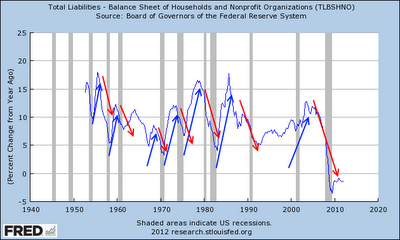
Commenting on the post from Pragmatic Capitalism, The Arthurian comes to a similar conclusion:
During the boom you get lots of credit expansion, so total debt goes up a lot. During the bust you get little credit expansion, and total debt goes up only a little. But total debt goes up, either way. (Until the crisis, of course. And that's why there eventually is a crisis.)
There ya go: When credit expansion declines, you have recession. When total debt declines, you have depression. There's a definition for you.
Don't worry, it's not set in stone. It's not fate. It's just stupidity. We *insist* on using credit for growth. We *insist* on using credit for everything. We *insist* on using bank-issued “inside money” as our primary form of money. Change that, and we change the world forever.
Always keep in mind the ratio between inside money and outside money.
Some people want to go back to gold. Some people want 100% reserve. I just want to reduce the debt-per-dollar ratio to a workable level, and keep it there. The same system we knew and loved for 60 years, only not so extreme.
Clearly in agreement with the conclusion, I decided to explore the italicized statement above. Earlier in the post, The Arthurian said:
you can get a feel for the ratio between inside money and outside money, by looking at a picture of debt per dollar of circulating money. Or at debt per dollar of base money.
Since the graphs at those links were a bit out of date, here are the updated versions:
Debt-per-Dollar of Circulating Money

Debt-per-Dollar of Base Money


Both charts depict the persistent rise in debt-per-dollar from the 1950’s until the late 2000’s. Although the decline is pronounced in the past few years using either metric, the degree to which the ratio has retraced its 60 year rise is markedly different. Choosing the appropriate measure is therefore necessary if we are going to implement The Arthurian’s plan “to reduce the debt-per-dollar ratio to a workable level.”

Since both graphs use the same measure of total debt, the stark difference in rate of decline is clearly due to changes in circulating money (M1) versus base money (MB), shown in the following chart:
Digging a bit deeper, the sharp rise in base money over the past few years is largely attributable to an increase in excess reserves:
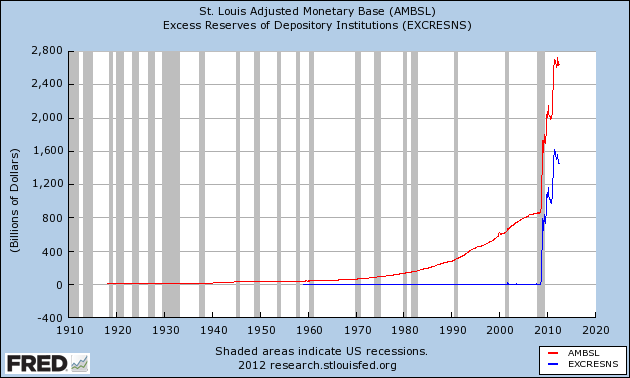
This chart, which is incredibly important for our discussion, suggests that the rise in excess reserves is the primary driver between the diverging rates of decline in the two measures of debt-per-dollar. Why is this important? The increase in excess reserves, engineered by the Federal Reserve, is primarily just an asset swap with private financial institutions. Since the Federal Reserve is purchasing US Treasuries and agency-MBS (liabilities of the US government), the economic sector which is really witnessing a decline in its debt-per-dollar is the US government.

Deconstructing the argument one more time, this graph again shows total credit market debt owed, now also separated out by the federal government and the private sector (blue line):
For nearly 60 years, private debt growth (credit expansion) continued unabated both in nominal terms and relative to federal debt. Although this provided a tailwind for economic growth, the legacy of accumulated debt is burdensome interest costs. While spending by the federal government is unconstrained by income, due to monetary sovereignty, the private sector is not so fortunate. When accrued interest costs (debt) become large enough, an economic shock (either exogenous or endogenous) may cause the private sector to increase savings and/or debt repayment and thereby decrease consumption and investment. If these actions are pursued in the aggregate, a “paradox of thrift” debt-deflation can take hold. In the US, this has been partially offset by the rapid rise in federal debt, but not fully given the exorbitant relative size of private sector debt.

Since private sector debt expansion and contraction has been a primary driver of the economy for at least 60 years, the debt-per-dollar ratio that best depicts the private sector should be the desired metric for policy reduction and stabilization. As shown above, the decline in debt-per-dollar of base money largely reflects an increase in excess reserves that does little to reduce the private sector debt burden. This last chart, however, displays private sector debt-per-dollar of circulating money:
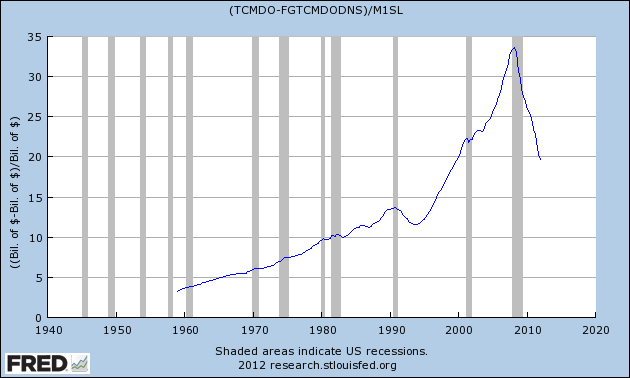
Having decreased sharply since the onset of the Great Recession, this ratio remains at heightened levels only last witnessed at the beginning of the new millennium. We may still have a long way to go but reducing this debt-per-dollar ratio to a reasonable level will be worth it.

Saturday, July 28, 2012

ECB's Means (Lost Decade With High Unemployment) To An End (Structural Reform)

Early in the week, global stock markets were falling fast as Spanish yields surged higher across the curve. Fearing that markets would quickly spiral out of hand, Jon Hilsenrath (WSJ) stemmed the tide by signaling forthcoming action from the Federal Reserve next week. Not to be outdone by his US counterpart, the ECB’s Mario Draghi provided a bazooka of open mouth operations by stating:
"The ECB is ready to do whatever it takes to preserve the euro. And believe me, it will be enough"
As Bruce Krasting points out, this is not the first time an EU politician has proclaimed an end to the crisis. While details of Draghi’s plan remain largely unknown (and undecided?), even his best efforts will do little to spur economic growth. Spain is suffering from excessive private debt, a bursting housing bubble and as Krasting notes:
its competitiveness. The domestic economy will never recover without a currency devaluation (and debt restructuring). If Mario has his way, Spain will suffer from a decade of recessions with unemployment over 20%.  How could he possibly call that outcome a success?
The answer to that question is actually quite simple and was given by JW Mason in a post titled Pain Is the Agenda: The Method in the ECB's Madness:
Here's an editorial in the FT on the occasion of last summer's ECB intervention to support the market for Italy's public debt:
Structural reform is the quid pro quo for the European Central Bank’s purchases last week of Italian government bonds, an action that bought Italy breathing space by driving down yields. ... As the government belatedly recognises, boosting Italy’s growth prospects requires a liberalisation of rigid labour markets and a bracing dose of competition in the economy’s sheltered service sectors. This is where the unions and professional bodies must play their part. Susanna Camusso, leader of the CGIL, Italy’s biggest trade union, is threatening to call a general strike to block the proposed labour law reforms. She would be better advised to co-operate with the government and employers... The government’s austerity measures are sure to curtail economic growth in the short run. Only if long overdue structural reforms take root will the pain be worthwhile.
A couple of things worth noting here. First the explicit language of the quid pro quo -- the ECB was not just doing what was needed to stabilize the Italian bond market, but offering stabilization as a bargaining chip in order to achieve its other goals. If ECB was selling expansionary policy last year, why be surprised they're not giving it away for free today? Note also the suggestion that a sacrifice of short-term output is potentially worthwhile -- this isn't some flimflam about expansionary austerity, but an acknowledgement that expansion is being give up to achieve some other goal. And third, that other goal: Everything mentioned is labor market reform, it's all about concessions by labor (including professionals). No mention of more efficient public services, better regulation of the financial system, or anything like that.
The FT editorialist is accurately presenting the ECB's view. My old teacher Jerry Epstein has a good summary at TripleCrisis of the conditions for intervention; among other things, the ECB demanded "full liberalisation of local public services…. particularly… the provision of local services through large scale privatizations”; "reform [of] the collective wage bargaining system ... to tailor wages and working conditions to firms’ specific needs...”;  "thorough review of the rules regulating the hiring and dismissal of employees”; and cuts to private as well as public pensions, "making more stringent the eligibility criteria for seniority pensions" and raising the retirement age of women in the private sector. Privatization, weaker unions, more employer control over hiring and firing, skimpier pensions. This is well beyond what we normally think of as the remit of a central bank.
So what Krugman presents as a vague, speculative story about the ECB's motives -- that they want to hold politicians' feet to the fire -- is, on the contrary, exactly what they say they are doing.
It's true that the conditions imposed by the ECB on Italy and Greece were in the context of programs relating specifically to those countries' public debt, while here we are talking about a rate cut. But there's no fundamental difference -- cutting rates and buying bonds are two ways of describing the same basic policy. If there's conditions for one, we should expect conditions for the other, and in fact we find the same "quid pro quo" language is being used now as then.
Here's a banker in the FT:
The future of Europe will therefore be determined by the interests of the ECB. Self-preservation suggests that it will prevent complete collapse. If necessary, it will overrule Germany to do this, as the longer-term refinancing operations and government bond purchase programme suggest. But self-preservation and preventing collapse do not amount to genuine cyclical relief and policy stimulus. Indeed, the ECB appears to believe that in addition to price stability it has a mandate to impose structural reform. To this extent, cyclical pain is part of its agenda.
Again, there's nothing irrational about this. If you really believe that structural reform is vital, and that democratic governments won't carry it out except under the pressure of a crisis, then what would be irrational would be to relieve the crisis before the reforms are carried out. In this context, an "irrational" moralism can be an advantage. While one can take a hard line in negotiations and still be ready to blink if the costs of non-agreement get too high, it's best if the other side believes that you'll blow it all up if you don't get what you want.  Fiat justitia et pereat mundus, says Martin Wolf, is a dangerous motto. Yes; but it's a strong negotiating position.  
The whole post is well-worth reading, but these comments say it all. By working to prevent an all out collapse of the EMU, Draghi is merely taking the necessary actions to maintain his position. If Spain or other European countries must “suffer from a decade of recessions with unemployment over 20%” in order to implement the desired structural reforms than so be it. Whether or not that outcome is politically feasible remains an open question, but I have my doubts. Draghi was not the first to claim “it will be enough" and won’t be the last to make that claim either.

Friday, July 27, 2012

The Fed Controls Long-Term Interest Rates

Casey Mulligan recently offended a significant portion of the economics blogosphere by stating that:
New research confirms that the Federal Reserve’s monetary policy has little effect on a number of financial markets, let alone the wider economy. Politicians, and a few economists, have been imploring the Federal Reserve to help the economy grow before November. But the effects of monetary policy on the wider economy are small.
Although I have repeatedly attempted to show that, under current conditions, monetary policy would be largely ineffective at stimulating the broader economy, this should not be taken as a dismissal of the general potential for monetary policy. Cullen Roche chimes in on the subject with a conclusion that sums up my views:
monetary policy has been very weak in the current environment for several reasons.  The primary reason is due to a lack of demand for debt.  Consumers are saddled with excessive debt so demand for “inside money” has been abnormally weak in recent years.  This is perfectly normal following a credit driven bubble.  And since monetary policy primarily works through altering the cost of “inside money” it’s not surprising that the actions of the Fed have appeared rather ineffective in recent years.  But this unusual environment should not be taken to mean that the Fed has zero options or that monetary policy is never effective.    To do so would be a vast misunderstanding of the basics of banking and the way our monetary system works.  Monetary policy might be a blunt instrument at times, but let’s not make extreme comments that sound ideological or take the uniqueness of today’s environment to make sweeping generalizations.
Beyond this main issue concerning the effectiveness of monetary policy, Mulligan’s post raised the question of whether the Federal Reserve controls long-term interest rates. Since the Federal Reserve could purchase all outstanding Treasuries at a given price/yield, I think it’s fair to say the potential power for strict control exists. A more basic question, however, is whether past and current policy displays control over long-term Treasury rates. I’ve argued affirmatively, drawing on comments from Edward Harrison, Gary Becker and others, that long-term Treasury rates are primarily a function of expected short-term rates over a given period. JW Mason, whose work I highly regard, disputes this claim:
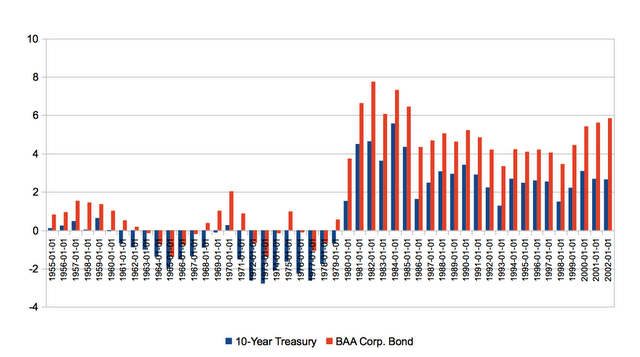
it's not at all obvious that long rates follow expected short rates either. Here's another figure. This one shows the spreads between the 10-Year Treasury and the Baa corporate bond rates, respectively, and the (geometric) average Fed Funds rate over the following 10 years.
If DeLong were right that "the long government bond rate is made up of the sum of (a) an average of present and future short-term rates and (b) term and risk premia" then the blue bars should be roughly constant at zero, or slightly above it. [2] Not what we see at all. It certainly looks as though the markets have been systematically overestimating the future level of the Federal Funds rate for decades now. But hey, who are you going to believe, the efficient markets theory or your lying eyes?
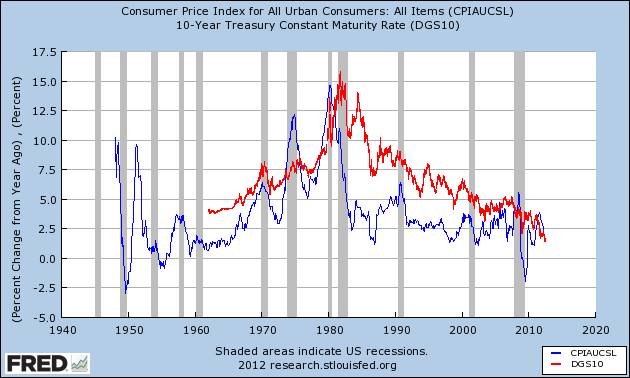
From my perspective, this preliminary conclusion from Mason confuses expected average rates with actual outcomes. Although I can’t speak for DeLong (or others), the notion that markets might/have systematically overestimated and underestimated future Fed Funds rates does not undermine the theory. As the following chart shows, inflation and 10-year Treasury rates were primarily rising from the early 1960’s until the early 1980’s. Based on economic theory at the time (e.g. Phillips curve), it was not unreasonable to expect that inflation would subside with increasing unemployment and the Federal Reserve would lower rates in response. The unexpected persistence of inflation likely caused many investors to consistently underestimate future Fed Funds rates during this period.

By the time Paul Volcker took over as Chairman of the Federal Reserve, many (most) investors had probably come to expect persistent inflation. When inflation crashed in the early 1980’s, it would have been equally reasonable to expect a return to high inflation and Fed Funds rates. The actual outcome has been largely subdued inflation, now going on 30 years. To understand how unexpected this outcome was, one only has to consider that returns on long-term Treasuries has exceeded returns on stocks during this 30-year period (a previously unthinkable feat missed by nearly all investors).

Mason continues his post with the counter claim that:
What profit-maximizing bond traders do, is set long rates equal to the expected future value of long rates.
I went through this in that other post, but let's do it again. Take a long bond -- we'll call it a perpetuity to keep the math simple, but the basic argument applies to any reasonably long bond. Say it has a coupon (annual payment) of $40 per year. If that bond is currently trading at $1000, that implies an interest rate of 4 percent. Meanwhile, suppose the current short rate is 2 percent, and you expect that short rate to be maintained indefinitely. Then the long bond is a good deal -- you'll want to buy it. And as you and people like you buy long bonds, their price will rise. It will keep rising until it reaches $2000, at which point the long interest rate is 2 percent, meaning that the expected return on holding the long bond and rolling over short bonds is identical, so there's no incentive to trade one for the other. This is the arbitrage that is supposed to keep long rates equal to the expected future value of short rates. If bond traders don't behave this way, they are missing out on profitable trades, right?
Not necessarily. Suppose the situation is as described above -- 4 percent long rate, 2 percent short rate which you expect to continue indefinitely. So buying a long bond is a no-brainer, right? But suppose you also believe that the normal or usual long rate is 5 percent, and that it is likely to return to that level soon. Maybe you think other market participants have different expectations of short rates, maybe you think other market participants are irrational, maybe you think... something else, which we'll come back to in a second. For whatever reason, you think that short rates will be 2 percent forever, but that long rates, currently 4 percent, might well rise back to 5 percent. If that happens, the long bond currently trading for $1000 will fall in price to $800. (Remember, the coupon is fixed at $40, and 5% = 40/800.) You definitely don't want to be holding a long bond when that happens. That would be a capital loss of 20 percent. Of course every year that you hold short bonds rather than buying the long bond at its current price of $1000, you're missing out on $20 of interest; but if you think there's even a moderate chance of the long bond falling in value by $200, giving up $20 of interest to avoid that risk might not look like a bad deal.
Once again, I think this example confuses some aspects of bond trading. While Mason considers a bond in perpetuity, let’s instead consider a 10-year Treasury with a 4% yield and 2% Fed Funds rate expected to continue indefinitely. Now assume that this expectation for the Fed Funds rate holds true. Entering year ten, if prices don’t adjust, investors will have the option of purchasing notes with equal maturities (the 10-year Treasury only has a year remaining before maturity) that offer either a 2% or 4% yield. Given the option, investors will purchase the 4% note, pushing the price up and yield down until it reaches approximately 2%. Even if 10-year Treasury rates are still 4% at that time, the previously held bond no longer has a long-term maturity and becomes the equivalent of a short-term note/bill. This is why the expected short term rates, and not long-term rates, matter for controlling long-term Treasury rates.     

Despite our differences in opinion over influencing long-term Treasury rates, Mason and I agree that:
for policy to affect long rates, it must include (or be believed to include) a substantial permanent component, so stabilizing the economy this way will involve a secular drift in interest rates -- upward in an economy facing inflation, downward in one facing unemployment. (As Steve Randy Waldman recently noted, Michal Kalecki pointed this out long ago.)
Currently, unemployment and disinflation are persisting far longer than most economists, politicians and investors expected. These outcomes have led the Federal Reserve to maintain a zero percent Federal Funds rate for three years and predict continuation of that policy for at least a couple more. As investors become increasingly convinced that short-term rates will remain at or near zero indefinitely, long-term Treasury rates have continued the secular drift lower that began in the early 1980’s.

So yes, the Federal Reserve can control long-term Treasury rates and has been doing so by adjusting market perceptions of future Fed Funds rates. Unfortunately, as Mason says:
adjusting expectations in this way is too slow to be practical for countercyclical policy.
Monetary policy, in a future crisis, will once again have its time to shine. For now, fiscal policy must take center stage to reduce household debt burdens and counteract previous measures aimed at inducing a credit bubble.  

Thursday, July 26, 2012

Representative Agents and Credit-Constrained Households

An interesting debate has broken out recently in the econ blogosphere between mainstream (e.g. Simon Wren-Lewis) and heterodox (e.g Lars P Syll) macroeconomists. Earlier today, Chris Dillow jumped into the conversation with the following:
Simon Wren-Lewis asks heterodox economists a question: how do you answer the question "what do consumers do if they are told that taxes are rising temporarily?" without some appeal to representative agents?
My answer is: I would start from a representative agent model (which predicts consumption smoothing) but I wouldn't stop there. On this issue, as on most other macro ones, I'd ask two further questions.
One is: do we have any reason to suspect that the representative agent perspective might be wrong? For example, some households might not have savings to run down in response to a tax rise, and might be unable to borrow; this is true for a minority (pdf).These people might be forced to cut spending.In this sense, heterogeneity matters, because models in which everyone is credit-constrained or nobody is are both wrong.
As an aspiring heterodox economist, I don’t deny that thinking in terms of representative agents can be useful. My opposition to mainstream macroeconomics, similar to Dillow’s, is that much analysis stops at that perspective. To understand macroeconomics, one has to consider that representative agent models may be wrong and in that case, find other models that better represent reality.

Dillow’s first question (read the full post for the second) addresses an issue that I’ve previously discussed as allowing heterodox economists to correctly predict the financial crisis and ensuing stagnation. Households burdened with excessive debt can become unable or unwilling to borrow regardless of low interest rates and bank liquidity. Monetary stimulus, which targets credit expansion through bank liquidity and lowering interest rates, has therefore been largely unsuccessful since liquidity was restored in the heart of the crisis. The lack of new loans and household (or private sector) deleveraging creates a deflationary drag on economic growth.

A recent quote from a July 2012 Euro Area Bank Survey highlights this issue:
Turning to loan demand developments, euro area banks continued to report, on balance, a significant fall in the demand for loans to enterprises in the second quarter of 2012, although the balance was somewhat less negative than in the first quarter of 2012 (-25%, compared with -30% in the first quarter). As in the first quarter, according to reporting banks, the fall in the second quarter was mainly driven by a substantial negative impact from fixed investment on the financing needs of firms. The ongoing decline in net demand for loans to households for house purchase abated in the second quarter compared with the first quarter (-21%, from -43% in the first quarter), whereas net demand for consumer credit remained broadly unchanged (-27%, compared with -26% in the first quarter). Looking ahead to the third quarter, banks expect a continued decline in the net demand for loans, both for enterprises and households, even if less negative than in the second quarter.
Despite the ECB’s efforts, loan demand continues to fall throughout Europe. Delusional Economics (which provided the above link/quote) sums it up best:
So, once again, this looks far more like a demand side issue than as supply side one. In fact these poor results appear to have even surprised the banks who were expecting far less of a deterioration. But are these results really surprising? Not to me. With private sectors in many economies under financial strain from deteriorating economic conditions and , in many a cases, rising tax burdens this is completely expected behaviour in my opinion. Households under stress don’t have the capacity to take on new credit, no matter what the rates and business therefore have little reason to invest.
Importantly, what this data suggests is that this problem isn’t really something that monetary policy, no matter how unconventional, is going to solve. This looks very much like a job for fiscal because until private sector balance sheets are repaired monetary policy is a lame duck. Obviously the fiscal compact is not going to provide this fiscal relief.

Steve Keen's Proposal for "Sub-Euros" and "an SDR of Europe"

Markets around the globe rallied following Mario Draghi’s statement that he would “do ‘whatever it takes’ to protect the euro zone from collapse.” Unfortunately, for market/Europe optimists, this statement was not accompanied by any specific forthcoming policy action or timeline for action. While open-mouth operations continue to scare the shorts and offer a short-term boost, the spike in optimism will once again be short-lived as growth concerns soon return to the fore.

Over the past couple years, I’ve remained pessimistic about the potential for a United States of Europe. Instead, I continue to believe that the EMU will eventually break-up but remain hopeful that free trade and labor mobility will persist. During this time, I’ve tried to highlight various proposals for solutions to the crisis that appeared both reasonable and feasible. Drawing from the work of Keynes, Friedman and Godley, Steve Keen offers a new proposal that re-institutes national currencies while maintaining the Euro as an SDR of Europe:

Some see the way out of today’s catastrophe as creating what does not exist—the United States of Europe. But if that were ever a possibility, it is far less one after the damage done by Maastricht, and the Franco-German insistence on austerity for the periphery in this crisis. However what is a possibility—and which has echoes in some of the contributions here (such as “Nau” proposal from Gerald Holtham)—is to move the Euro closer to a continental version of Special Drawing Rights.
The Euro could be the currency of inter-European and international trade, while “sub-Euros” created by each of the nations of Europe could be used for domestic trade and, importantly, domestic financial arrangements. The disciplinary aspects of Maastricht—which are currently inappropriately directed at government deficits and are amplifying the downturn—would then be redirected at trade deficits within Europe instead (and matched by pressures to minimize intra-European trade surpluses as well).
The Euro-Drachma, Euro-Peso and Euro-Mark could be introduced at one-to-one parity with the Euro, and all financial assets and liabilities would be denominated in these national currencies rather than the Euro. These national currencies would then float freely for a period (say one year), after which they would be fixed in proportion to the Euro.
The obvious devaluation that would occur for the Euro-Drachma and Euro-Peseta would reduce their foreign debts—and force the nations whose banks over-lent to them to deal with the consequences. It would also end the currency flight that is currently occurring: a Euro-drachma would still be a Euro-Drachma, whether it resided in a Greek or German bank account.
The introduction of such a system could provide a rapid resolution to the current crisis. It could not be pain free, but it would be difficult to imagine that it would impose more pain than is currently being felt by Greece and Spain, or is about to be felt by other countries once the contagion passes on to them.
This system would also introduce what is otherwise impossible in the Euro: exchange-rate flexibility. Economists as widely apart ideologically as Wynne Godley and Milton Friedman observed long before the Euro began that it would fail (a) because it imagined that a market economy would reach a harmonious equilibrium on its own without government intervention—which Godley correctly characterized as a deluded neoclassical fantasy; and (b) because it pushed together widely disparate nations which Friedman noted were utterly unsuited to a currency union.
A step backwards by Europe from dystopian fantastical object of a single currency, to a mini-version of what Bretton Woods should have been, could thus be a workable way out of this crisis and towards the political dream of a non-fractious Europe.