Showing posts with label Foreign Trade Policy. Show all posts

Tuesday, November 27, 2012

Bubbling Up...11/27/12

1) What Drives Trade Flows? Mostly Demand, Not Prices by JW Mason @ The Slack Wire
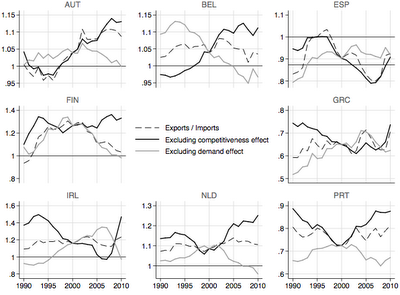
The heart of the paper is an exercise in historical accounting, decomposing changes in trade ratios into m*/mand D*/D. We can think of these as counterfactual exercises: How would trade look if growth rates were all equal, and each county's distribution of spending across countries evolved as it did historically; and how would trade look if each country had had a constant distribution of spending across countries, and growth rates were what they were historically? The second question is roughly equivalent to: How much of the change in trade flows could we predict if we knew expenditure growth rates for each country and nothing else?

The key results are in the figure below. Look particularly at Germany,  in the middle right of the first panel:
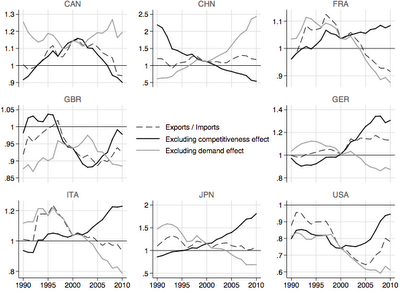
The dotted line is the actual ratio of exports to imports. Since Germany has recently had a trade surplus, the line lies above one -- over the past decade, German exports have exceed German imports by about 10 percent. The dark black line is the counterfactual ratio if the division of each county's expenditures among various countries' goods had remained fixed at their average level over the whole period. When the dark black line is falling, that indicates a country growing more rapidly than the countries it exports to; with the share of expenditure on imports fixed, higher income means more imports and a trade balance moving toward deficit. Similarly, when the black line is rising, that indicates a country's total expenditure growing more slowly than expenditure its export markets, as was the case for Germany from the early 1990s until 2008. The light gray line is the other counterfactual -- the path trade would have followed if all countries had grown at an equal rate, so that trade depended only on changes in competitiveness. When the dotted line and the heavy black line move more or less together, we can say that shifts in trade are mostly a matter of aggregate demand; when the dotted line and the gray line move together, mostly a matter of competitiveness (which, again, includes all factors that cause people to shift expenditure between different countries' goods, including but not limited to exchange rates.)
Woj’s Thoughts - If correct, this explanation for global trade imbalances would certainly throw a wrench in standard, mainstream theories that assume prices and exchange rates respond to alleviate any imbalances. Clearly greater relative income growth should lead to larger imports relative to exports. Using a sectoral balances approach, the question is why doesn’t the boost to aggregate demand from rising trade surpluses alter prices and income in a manner that creates convergence? I certainly don’t expect the changes to happen quickly, but remain of the view that some institutional factors (e.g. tax policy, financial regulations) likely encourage diverging prices and incomes.

2) Hoenig: A Better Alternative to Basel Capital Rules by Thomas Hoenig via The Big Picture
Basel III is intended to be a significant improvement over earlier rules.  It does attempt to increase capital, but it does so using highly complex modeling tools that rely on a set of subjective, simplifying assumptions to align a firm’s capital and risk profiles.  This promises precision far beyond what can be achieved for a system as complex and varied as that of U.S. banking.  It relies on central planners’ determination of risks, which creates its own adverse incentives for banks making asset choices.

3) S&P: Australia is Spain in waiting by Houses and Holes @ MacroBusiness
Australia must find a Budget surplus before 2014 or it will lose its AAA rating, according Kyran Curry, S&P sovereign analyst via the AFR:
“If there’s a sustained delay in returning the balance to surplus, as the economy gathers momentum and as people start spending again, as the import demand picks up and current account blows out, we might not see the government’s fiscal position as being strong enough to offset weaknesses on the external side and that’s what worries us…Australia’s already, as we see it, got some credit metrics that are right off the scale when it comes to assessing Australia’s external position…It’s got high levels of external liabilities, it’s got very weak external liquidity and that basically means the banks are very highly indebted compared to their peers…For us, we look to Spain, which was Australia’s closest peer four or five years ago in terms of having a very strong fiscal position, very similar to what Australia has at the moment, its external position was weaker, like Australia’s, and it got routed very quickly…The government needed to provide support to the banks, it had to shore up growth in the economy and its debt levels more than doubled…We can see that happening in Australia’s case.”
Woj’s Thoughts - Contrary to popular perception and especially the Market Monetarist crowd, I’ve been arguing that Australia is facing serious headwinds that will end its impressive growth streak. In this context, Spain offers a reasonable comparison considering its high levels of private debt, housing bubble and high level of external liabilities prior to the current crisis. Having a sovereign currency permits Australia more scope in terms of policy responses, however the current government seems keen on following Europe’s approach. If the Australian government attempts to “find a Budget surplus before 2014,” it may keep its AAA rating while almost certainly exacerbating the downward spiral.  

4) Borrowers with modified mortgages re-default as homes re-enter shadow inventory by Walter Kurtz @ Sober Look
We are therefore seeing a sharp rise in re-defaults from modified mortgages.
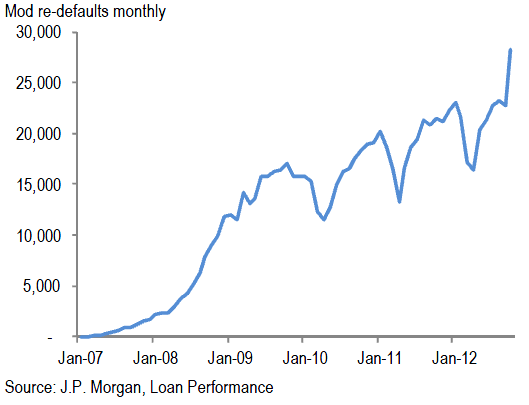
This is telling us that mortgage modification programs have not been very successful, as the probability of re-default rises. By modifying mortgages, banks in many cases are simply kicking the can down the road - and now some are writing down these mortgages (which may be what is driving the higher charge-off numbers). We are therefore seeing an increase in delinquencies, but mostly among modified mortgages and concentrated in sub-prime portfolios.
Woj’s Thoughts - Bad news for banks and the government. Mortgage modifications were simply not enough for many homeowners who remain underwater and without the requisite income and/or savings to seemingly ever repay the entire loan. If this new wave of re-defaults persists, as JP Morgan expects, housing prices and bank earnings may return to a downward trend.

5) China's Economic Growth: A Different Storyline by Timothy Taylor @ Conversable Economist
When I chat with people about China's economic growth, I often hear a story that goes like this: The main driver's behind China's growth is that it uses a combination of cheap labor and an undervalued exchange rate to create huge trade surpluses. The most recent issue of my own Journal of Economic Perspectives includes a five-paper symposium on China's growth, and they make a compelling case that this received wisdom about China's growth is more wrong than right.
For example, start with the claim that China's economic growth has been driven by huge trade surpluses. China's major economic reforms started around 1978, and rapid growth took off not long after that. But China's balance of trade was essentially in balance until the early 2000s, and only then did it take off. Here's a figure generated using the ever-useful FRED website from the St. Louis Fed.
Woj’s Thoughts - I always have a soft spot for arguments, backed by data, that undermine the mainstream opinion. Although I continue to side with Michael Pettis on the forthcoming rapid slowdown in China’s GDP growth, I agree that growth will persist and lead to a much higher standard of living in the future.

Thursday, May 24, 2012

Kelly and Kevin Gallagher - Blinded by the (solar) light


Finally, the merits of the actual case are dubious. Prices of Chinese-made PV modules in China are lower than they are outside of China, so it’s hard to see how they are “dumping” on the U.S. market. The true problem is overcapacity, which market forces will correct in time. The Chinese government has undoubtedly provided support to its solar industry, but so has the US government with its loan guarantees, investment tax credits, and production tax credits. At the local level, SolarWorld Industries America (the lead filer of the complaint) itself received millions in tax breaks and subsidies in Oregon when it decided to locate its manufacturing facility there. Indeed, the Commerce Department only found evidence of small Chinese subsidies in its March 2012 ruling. SolarWorld only had six co-filers, but more than 100 U.S. firms lined up against it.
Chinese government support for solar energy has already benefited the world in terms of improved welfare, climate mitigation, and reduced global energy prices. The rest of us are essentially free-riding on this support. Rather than punish China for its laudable efforts, the Obama Administration should applaud it and do its part to correct market distortions too.
Read it at TripleCrisis
Blinded by the (solar) light
By Kelly Sims Gallagher and Kevin P. Gallagher

Follow up to the post on Misguided Mercantilism Hurts Solar Energy Consumers. Last night I was discussing this topic with an expert friend of mine who currently works in the Solar industry. He basically outlined this entire report making special note of the ability of Chinese firms to avoid the tariffs. While this lessens the negative impact, we ultimately agreed the policy is still a step in the wrong direction and risks unnecessary trade wars with China.

Saturday, March 24, 2012

Points of Public Interest

Ugly day in DC after a beautiful week, but more good NCAA basketball on TV. Good luck to those whose brackets still have a chance of winning!

  1. “The Current Models Have Nothing to Say”
Should we be surprised? Policy makers continue to employ models of an economy with no financial system.
  1. Economics without a blind-spot on debt
The aggregate level of debt, especially private, matters in
forecasting economic growth.
  1. Consumer Credit Growing at Highest Rate in Past Decade: Unhealthy and Unsustainable?
Stopping addictive habits is not easy, but extending those actions will only make the eventual adjustment more difficult and painful.
  1. The Japan debt disaster and China’s (non)rebalancing
Chinese consumers continue to increase savings in lieu of domestic consumption. Japan is attempting to rebuild its trade surplus, but which countries will allow their surplus to decline or deficit to increase? Global (and domestic) imbalances not addressed remain significant risks to the global economic outlook.
  1. A step in the right direction
Scientific exploration incorporating complex systems and networks continues to move our understanding of reality forward.
  1. It's not structural unemployment, it's the corporate saving glut
Businesses save instead of investing in labor when consumer demand is weak. Until policy focuses on improving the consumer balance sheet (e.g. debt write-downs), unemployment will remain high.
  1. Wrong vs Early – Contrarians Bet on Natural Gas
The best investors are often early and patient.
  1. The Real Problem with Microfoundations
Microeconomics is not especially sound in predicting all outcomes
either.
  1. Principal writedowns of the day, mortgage edition
Positive for households but will Bank of America (and others) really accept the associated losses?
  1. Why Using P/E Ratios Can Be Misleading
In early 2009, at the market bottom, the P/E jumped to over 100 as profits plummeted. Using E/P corrects for this issue and shows the market is slightly overvalued currently.
 

Sunday, March 4, 2012

Points of Public Interest


  1. In America, the shale gas revolution is creating jobs and growth. It can here too - Matt Ridley explains the importance of cheap energy in creating jobs.
  2. Free Trade Ad Nauseam - Jagdish Bhagwati makes the case against increasing protectionism.
  3. Why bother with microfoundations? - Noah Smith reasons that micro-founded models may only occasionally be better than aggregate-only models. This offers some good background on the potential misuse of current models for determining public policy.
  4. Corruption and Politics - The motivation behind crony capitalism stemming from a highly centralized government.
  5. JKH On Saving And Sector Balances (WONKISH) - MMR continues to illuminate flaws within the prescriptive portion of MMT, based on slight adjustments in meaning. Read the comments on the site to see much of the new insights being hashed out.
  6. Warren Buffett: Baptist and Bootlegger - One of the all-time great investors has been as savvy in political calculation/courtship as he has been in picking stocks.
  7. He Had Moves Like Jagger - Steve Horwitz praises the economic rhetoric of Frederic Bastiat.

Tuesday, February 28, 2012

Liberals Demonstrate Conservative Bias for Manufacturing

Last Friday, over at TripleCrisis, Jeff Madrick posted 10 Questions for Economists Who Oppose Manufacturing Subsidies. Conversations regarding this topic have been persistent for much of President Obama’s term in office and are unlikely to dwindle heading towards the election. Although the questions are posed towards mainstream economists, of which I am not, here are some succinct, sensible, non-mainstream responses in opposition to to manufacturing subsidies.  

1. Doesn’t America already have an anti-manufacturing strategy? It has enthusiastically supported a high value for the dollar since the 1990s. The high dollar raises export prices but, as noted, very much helps Wall Street attract capital flows and lend at low rates. Shouldn’t we get the value of the dollar down?

Answer - Lowering the value of the dollar will make exports cheaper, but it will likewise make imports more expensive. Many Americans, not on Wall Street, will therefore be able to purchase less goods with the same income. Reducing the dollar value is also an imprecise mechanism that could very well drive up food and energy prices well in excess of any benefits to manufactures.

2. Don’t Germany, China, and many other countries subsidize their own manufacturing industries? Do you really think the World Trade Organization works all these out? If they do subsidize, isn’t it only fair to place manufacturing on a level playing field and subsidize our own?

Answer - While Germany, China and many other countries do subsidize their own manufacturing industries, America currently does as well. A cursory glance at the tax statements of GE, GM, Ford and a host of other manufacturers will display a multitude of tax breaks/loopholes specifically to support American manufacturing. A better questions is whether or not American taxpayer dollars are best used supporting/bailing out manufacturing companies so that foreign consumers can buy goods at cheaper prices.

3. Doesn’t manufacturing having a multiplier effect? Some say we can never boost the share of manufacturing adequately. So what if we create even as much as another 2 or 3 million manufacturing jobs. (The president is settling for a couple of hundred thousand.) But wouldn’t manufacturing’s multiplier effect stimulate the rise of other manufacturing and service industries and the creation of other jobs?

Answer - Despite receiving massive subsidies over the past decade(s), the companies mentioned in question 2 have been shedding American workers. Efforts to stimulate manufacturing jobs are more likely to redirect funds from other sectors, resulting in American job losses outside of manufacturing. Accounting for the potential production of those 2 or 3 million outside of manufacturing, any multiplier effect is not necessarily positive. A cardinal rule of economics is there is no free lunch, hence creating manufacturing jobs will not be free.

4. How can we get our trade deficit down if we don’t sell more manufactures? They account for about seven-eighths of our exports. I know the answer some of you will give: savings. But do you really think raising our savings rate will reduce capital inflows adequately to lower the dollar in order to promote more exports?

Answer - This question assumes that reducing the trade deficit is definitively positive and that a lower dollar is needed to promote exports, both of which are not true. Until this past year, Japan ran persistent trade surpluses notwithstanding an almost perpetually rising Yen. Regardless, a different answer than the one expected: services. As noted above, manufactures are not the only form of exports (or imports). During the past century, US exports shifted dramatically from agriculture to manufactures. Over the next century is may shift again towards services.

5. Without manufacturing, what will we export? Isn’t there a point at which we lose too many industries and labor skills to make a comeback? Given the symbiotic nature of business clusters and supply chains, aren’t we rapidly losing the subsidiary companies that make manufacturing and exports possible?

Answer - As mentioned above, similar arguments were made when manufacturing began encroaching on agriculture’s territory. Looking back, few people probably wish that agriculture had been protected so that many of us would still be working on farms today. Google makes enormous profits across the globe even though it manufactures almost nothing. What’s wrong with most Americans eventually working in offices rather than factories?

6. Weren’t persistent trade imbalances a major cause of the 2007-2008 financial crisis as debt levels soared? Don’t you worry that the export-led models of China, Germany, and Japan are unsustainable? On a worldwide basis, they are really debt-led growth models. How do we get balance without promoting our exports?

Answer - Trade imbalances and debt levels are separate, relatively uncorrelated factors, of which the latter was more likely a major cause of the financial crisis. Total debt levels soared in the US and many European countries with import-led models as well. If debt levels are a major problem, which I believe is true, than one option to achieve balance would be reducing subsidies to acquiring debt, such as the mortgage interest deduction.

7. Isn’t manufacturing a source of innovation in and of itself? Isn’t that where the scientists and engineers are? Don’t we learn and innovate by doing? One commentator recently said that those innovations are exploited by others, so it doesn’t matter. Really? Then maybe we should stop promoting R&D altogether.

Answer - Manufacturing is one source of innovation, but what about companies like Amazon, Netflix, Apple and Facebook. Is buying goods online today not cheaper and quicker? Is watching movies and listening to music not more accessible for less cost? Can we not interact with people all over the world far quicker and more easily? These companies and others are constantly innovating and improving our lives, undeterred by a lack of manufacturing or scientists..

8. Where will the good jobs come from? You always say high technology. But America now imports more high-technology products than it exports, especially to China. Even Germany has a high-technology deficit with China. I ask again, where will the jobs come from as technology gets more complex? Do you think more education is really an adequate answer, the only answer?

Answer - Why are manufacturing jobs so ‘good’? Does this imply that all non-manufacturing (or high-tech) jobs are ‘bad’? What about teachers or doctors? The future offers a potentially massive increase in service jobs with new markets that have not yet been conceived. Education within schools may not be adequate and is certainly not the only answer, however education through increasing work apprenticeships may be a good place to start.

9. Why did the job market do so poorly throughout the 2000s? If you say we can’t know where jobs will come from, that the market will decide, then why aren’t you worried about the job market’s poor performance over the last decade, with huge losses in manufacturing jobs? Again, you say, inadequate education. Yetaccording to CEPR’s John Schmitt, we have not produced more good jobs as GDP grew — good jobs measured by wages and benefits provided. Is there hard evidence we don’t have the labor to fill the high-technology jobs — and if we did, are there enough jobs going unfilled to make a difference?

Answer - According to CEPR’s Dean Baker, in The End of Loser Liberalism: Making Markets Progressive, supposedly “free-trade” agreements have exposed many lower wage (manufacturing) jobs to foreign competition while erecting barriers against trade in higher wage areas such as health care and law. At the same time, patent laws and tax codes have been continually adjusted to protect large corporations and enforce monopolies. The economy is also structured to encourage home buying/building, which for some time vastly expanded construction jobs beyond a sustainable amount. Even with all of these poor choices, about 92% of Americans desiring work are employed today. Americans have the knowledge and expertise to reach full-employment, but policies that raise the cost of hiring workers and discourage small business creation are not helping.

10. Will the jobs come from services? The rapid growth of finance has fouled up the numbers. Finance services did provide high-paying jobs, but we now know many of these were phantoms. And the salad days may be over. The other big area of productivity growth in services was retail. We all know what kinds of jobs Wal-Mart provided.

Answer - Yes, services will provide one source of new jobs but hopefully finance will not be a significant contributor. It remains unclear why manufacturing jobs are necessarily better than retail or other service jobs. Either way, the beauty of capitalism is that the future is unknown but there has been no better economic system in history for supporting growth. Jobs will return, but manufacturing subsidies are not the best approach and may well cause more job losses than they create.

Sunday, January 29, 2012

Points of Public Interest


  1. Why Limiting Itemized Deductions (Still) Makes Sense - My former professor, Diane Lim Rogers, offers her support for a proposal to limit itemized deductions to a 15 percent rate. This policy will simultaneously increase the progressive nature of income taxes, substantially reduce total tax expenditures and raise revenue.
  2. The Fed Is Misleading Congress About Europe - Warren Mosler, a founding member of Modern Monetary Theory, argues that the Fed’s dollar swap lines are unsecured lending and should therefore be the responsibility of Congress.
  3. Philip Pilkington: Is QE/ZIRP Killing Demand? - Pilkington describes the counterproductive efforts of Fed policy. Milton Friedman also believed ZIRP (zero interest rate policy) would restrict demand as I outlined in Deflationary Monetary Policy.
  4. The Liberalism of Classical Liberalism - Peter Boettke tries to correct some typical misrepresentations of classical liberalism with a good dose of historical background.
  5. Show Me the Daylight 'twixt Sanction and Tariff - Samuel Wilson considers recent trade sanctions against Iran and China, and why the two are viewed in different lights by Americans.
  6. The Future of Economics - Steve Keen, a leading post-Keynesian, makes a case for incorporating disequilibrium, dynamic modeling and emergent properties into the core of future economics.
  7. The European Crisis Deepen - Peter Boone and Simon Johnson, former IMF Chief, explain why current optimism is likely unwarranted and how the realistic end may include a break-up of the Eurozone.

Monday, January 9, 2012

Trade Imbalances are Key


Michael Pettis logically explains the need for Germany and China to reverse their trade surpluses. Despite the seemingly obvious consequences of not pursuing this path, Pettis notes that the historic precedent is for countries not to undertake the tough road (short-term pain for long-term gain) but rather fight to maintain their trade surpluses. This discussion is one of the best I’ve seen yet about the difficulties facing the EU. It is largely based on the historical precedents mentioned that my expectations for any resolution to the European crisis maintaining the union are diminished. Pettis also mentions the possibility of China devaluing their currency, exactly the opposite of what most politicians are calling for. If this occurs, I fear the US might impose heightened tariffs on trade that sparks a bout of global protectionism.

Read it at CreditWritedowns.com
If no trade reversal now, then when?
By Michael Pettis

Friday, October 14, 2011

Please Don't Sell Us Your Goods So Cheaply!


As the weak economic recovery continues, a natural response of individuals is to seek out a scapegoat to blame for the problems. One potential scapegoat that has garnered significant attention the past couple years is China. The problem, as stated by many pundits, politicians and economists, is that China has intentionally undervalued its currency. Supposedly this action not only steals jobs from Americans but also impairs our economic growth. Attempting to right these wrongs, Congress is once again proposing to formally label China a currency manipulator and impose import tariffs. Although this proposal has been debated numerous times previously (and failed to pass each time), an unacceptably high unemployment rate heading into a presidential election year has created some urgency for action. Unfortunately the actual effects of currency manipulation have been substantially misrepresented and passing this legislation will almost certainly hurt employment and economic growth.

To better understand the effects of currency manipulation, it’s important to offer a brief comment about currency valuations more generally. Currencies have value for two primary reasons: the ability to purchase goods and to pay taxes. A currency’s value is based on the amount of goods it can purchase. When multiple currencies are involved, an exchange rate provides a measure by which to compare the purchasing power of two different currencies. If exchange rates were left entirely to markets, the values would be primarily affected by changes in the supply of each currency and the supply of goods. In reality, exchange rates are also impacted by interest rates, inflation, and speculation. At a basic level, exchange rates help balance international trade and reduce transaction costs.

Many Americans are currently taking issue with China’s policy of pegging their currency, the renimbi (or yuan), to the US dollar at a below market level. China accomplishes this feat by increasing the supply of their own currency and buying US dollars. Based on these simple actions, it seems obvious that China is manipulating the value of its’ currency. However, if we consider the actions of other governments around the globe, it becomes clear that practically all governments manipulate the supply of their own currency and interest rates. In fact, the US government has been very active in recent years, increasing the supply of dollars and holding interest rates effectively at zero percent. From this standpoint, practically all countries are currency manipulators.

Getting back to China and the policy debate, maintaining an undervalued currency makes one countries’ goods effectively cheaper. The idea behind this policy is to encourage businesses involved in exporting goods and reduce competition from abroad. To date, this policy has been very effective for China in stimulating exports and preventing imports, as displayed by their sizable trade surplus. Delving a bit deeper, a significant portion of China’s exports are manufactured goods. The primary American argument made against China’s currency policy is therefore based on the notion that China is stealing American jobs, specifically within the manufacturing sector.

While I don’t dispute that US manufacturing jobs are most directly hurt by China’s policy, focusing on the lost jobs ignores all other less obvious effects. From the perspective of US consumers, China is intentionally offering products at below market prices. When Americans purchase goods made in China, the cost is therefore less than that expected in a “free” market, hence US consumers are technically saving money. A question not frequently considered is, what happens to the extra dollars Americans save from buying cheap Chinese goods? Apart from a small amount of saving, these funds are largely used in other means of consumption. If some of this demand goes towards American goods or services, than new jobs will be created to counter those lost in manufacturing. Although it is far easier to explain direct job losses in manufacturing, the positive effects on consumption and demand almost certainly outweigh those costs.

A fascinating aspect of tax and trade policy is the ability to achieve similar outcomes through entirely different measures. Using the Senate’s current bill as an example, one of the proposals is to charge an import tax on Chinese goods. This policy increases the price of those goods, reducing the difference between US and Chinese goods. Another way of achieving this result is directly subsidizing American production of those goods currently being imported from China. Under this plan, tax revenue lowers the price of US goods, thereby shrinking the price discrepancy between the two countries. In both cases, most Americans will spend more of their income for the same amount of goods. While these options attack the “problem” from different angles, the economic effects on Americans is basically identical. Despite this fact, my guess is most Americans would oppose a bill explicitly subsidizing a small group of manufacturers using everyone’s tax dollars.

The situations described above reflect a market with only two competing nations, which is certainly not reflective of today’s global economy. In relation to proposed legislation, it’s important to consider how this alters the effects. America remains the global super power in terms of its economic wealth and is still largely unrivaled. Based on wealth and numerous regulations, the cost of living (in dollars) in the US is much higher that most other countries. China, with a much lower cost of living, is primarily competing with other developing nations to sell its exports to Americans. Raising the cost of Chinese imports is therefore much more likely to shift demand to another developing nation than increase domestic demand. Unless import tariffs are applied broadly to all nations (which would be a terrible policy), US manufacturing jobs will remain expensive on the global market.

Another consideration regarding US trade with China concerns the enormous sum of dollars that China receives for all its exports. As mentioned earlier, the value of currency stems from the ability to purchase goods and pay taxes. Clearly China has no use for dollars in paying taxes. Since China pegs their currency to the US dollar, the option of converting dollars into another currency is largely taken off the table. The remaining option, which China uses, involves investing their dollars in US dollar-denominated assets such as Treasuries. Many of the dollars used to purchase Chinese goods actually return to the US in the form of investment and are then spent employing other capital.

Looking beyond the potential impact on US manufacturing jobs, it’s fairly obvious that Americans incur large benefits from China’s currency policy. I think this point becomes even clearer when considering the policy’s effects on the Chinese people. In China, many workers are employed to manufacture goods largely consumed by Americans. The dollars obtained from these exports are then invested in the US. As the US runs large deficits and holds interest rates at zero, China’s dollar-denominated assets are losing value in real terms. Also, due to the currency peg, US monetary policy is effectively imported and currently enhancing inflationary pressures. For many Chinese workers, these policies are effectively suppressing their wages while pushing food and energy prices higher. In effect, China’s currency policy is now causing the real wages of individuals to decline.

Although my economic views favor free trade, I should note that negative consequences stemming from China’s currency policy do exist. By subsidizing their own exports, China has generated an incredibly large trade surplus in total and with the US. This policy increases economic dependence between nations. Partially due to China’s reliance on exports, when global demand falls (especially in the US and Europe), domestic demand is not strong enough to support current production. The result is a surplus of unwanted goods and significant losses on investment. As witnessed during the last recession, a stimulus package, three times the size of that enacted in the US (based on % of GDP), was needed to prevent economic contraction. Systemic risk is certainly increased by China’s trade policy.

In today’s world, policies are frequently established to correct specific problems while ignoring the wide-ranging consequences of those initiatives. Current claims about China stealing American jobs dismisses the massive benefits consumers obtain and overlooks the nature of shifting demand in global trade. During the 1930’s, countries on the gold standard erected tariffs to prevent losing capital to other nations. Global trade fell dramatically, further exacerbating the Great Depression. Creating new barriers to trades, while earning brownie points for some politicians, will only increase our economic struggles and make a sustainable recovery that much more difficult. Hopefully the current debate on China’s currency policy will prove only for show and not be foolishly enacted.


(Note: Don Boudreaux at Cafe Hayek has written a number of great posts on the same theme recently. For anyone interested in further examples of the benefits of China’s currency policy, I strongly suggest reading through his blog posts.)