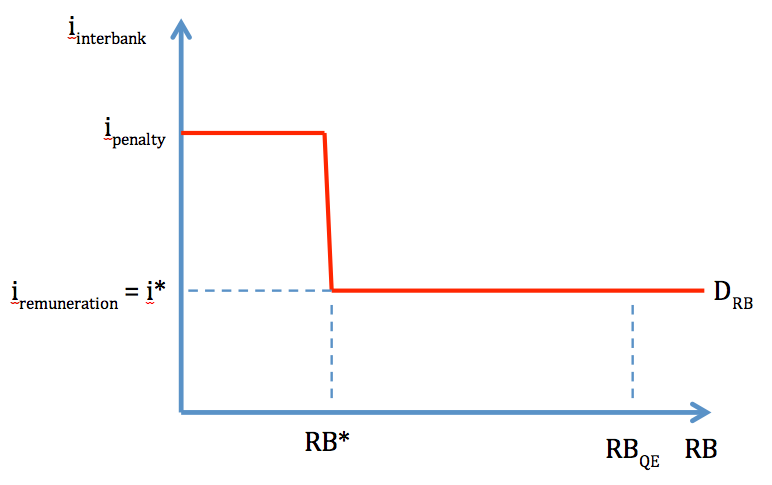
After furthering understanding of the permanent floor, I discussed how that monetary regime might affect the inflationary effects of the “platinum coin.” Although the debate appears to be dying down, at least momentarily, Simon Wren-Lewis and Frances Coppola (see here, here, and here) have added worthwhile readings.
In concluding my brief series on this topic, I will address questions regarding potential Federal Reserve insolvency and the desirability of permanently practicing monetary policy under a “floor” system. Hopefully the answers put forth will shed light on areas of the debate that remain dark.
Q: The Federal Reserve has recently been turning over to the Treasury approximately $80 billion in profits each year, stemming from the yield spread between their assets and liabilities. As the Fed eventually raises interest rates on reserves (assuming the “permanent floor” system remains in place), that yield spread could turn negative, representing losses for the Fed. If the Fed’s capital is entirely drained, can it continue to pay interest on liabilities (e.g. reserves) or must it first be recapitalized? If the latter, does this require Congressional approval, Treasury action, or some other mechanism?
A: Before trying to put forth an answer, I should note that the present likelihood of this scenario becoming a reality is extremely small and would probably be preceded by much higher inflation (and interest rates). As several commenters noted, finding a direct answer to this question is extremely difficult. Courtesy of Dan Kervick:
Here is a 2002 General Accounting Office report that discusses some of these issues:
http://www.gao.gov/assets/240/235606.pdf
From the “Results in Brief” section at the beginning:
The Reserve Banks use their capital surplus accounts to act as a cushion to absorb losses. The Financial Accounting Manual for Federal Reserve Banks says that the primary purpose of the surplus account is to provide capital to supplement paid-in capital for use in the event of loss. Federal Reserve Board officials noted that the capital surplus account absorbs losses that a Reserve Bank may experience, for example, when its foreign currency holdings are revalued downward. Federal Reserve Board officials noted, however, that it could be argued that any central bank, including the Federal Reserve System, may not need to hold capital to absorb losses, mainly because a central bank can create additional domestic currency to meet any obligation denominated in that currency. On the other hand, it can also be argued that maintaining capital, including the surplus account, provides an assurance of a central bank’s strength and stability to investors and holders of its currency, including those abroad. The growth in the Reserve Banks’ capital surplus accounts can be attributed to growth in the size of the banking system together with the Federal Reserve Board’s policy of equating the amount in the surplus account with the amount in the paidin capital account. The level of the Federal Reserve capital surplus account is not based on any quantitative assessment of potential financial risk associated with the Federal Reserve System’s assets or liabilities. According to Federal Reserve officials, the current policy of setting levels of surplus through a formula reduces the potential for any misperception that the surplus is manipulated to serve some ulterior purpose. In response to our 1996 recommendation that the Federal Reserve Board review its policies regarding the capital surplus account, it conducted an internal study that did not lead to major changes in policy.
Based on this paragraph and corresponding discussion, the best current answer is that negative equity would not prevent the Fed from pursuing its desired monetary policy since “a central bank can create additional domestic currency to meet any obligation denominated in that currency.” If the Fed truly desired to maintain a capital surplus, to signal “strength and stability to investors and holders of its currency,” than one option is raising service fees charged to banks. This action would represent a tightening of monetary policy, but that could be desirable at the time.
If that course is not pursued, the other plausible action appears to be a Congressionally approved capital transfer from the Treasury. Although this action could be contended by politicians that oppose the Fed, the reality is that failure to provide capital would not alter the Fed’s ability to act or remain independent. Furthermore, a contentious Congressional battle on this otherwise insignificant matter could undermine the Dollar’s status as a reserve currency (similar to the debt ceiling debates). Provided this view is reasonably accurate, there appears little reason to fear the Fed losing its capital or as some argue, becoming ‘insolvent’.
Q: If the Fed leaves the zero lower bound (ZLB), is there any good reason to keep reserves in chronic excess?
A: Yes. An “interest-on-reserves regime” or “permanent floor”, where reserves are kept in chronic excess, allows the Fed to exogenously determine the monetary base AND interest rate. Therefore, if the Fed wishes to exit the ZLB it must either sell treasuries and Agency-MBS until excess reserves are practically eliminated (reverse QE) or increase the interest rate on reserves (IOR) to set a floor for the interbank market (target rate).
Given the response of asset markets to QE, the former option poses the risk of asset market deflation and possible spillovers to the real economy. To clarify, these arguments suggest there are good reasons to keep reserves in chronic excess but does not imply the Fed should permanently adjust to a “floor” system.
The “platinum coin” has been shot down as a potential response to hitting the debt ceiling, but it has made a substantial impact in expanding debates about how our modern monetary system actually functions. One of these topics, the “permanent floor,” will likely remain a prominent topic of macroeconomic arguments for at least as long as the Fed operates monetary policy within that system. The fantastic recent discussion on this subject has vastly improved my understanding of the policy’s intricacies, but has not altered my initial impression about the future practice of monetary policy (emphasis added):
An “interest-on-reserves regime” appears likely to rule monetary policy for the foreseeable future.
Special thanks are owed to Tom Hickey (Mike Norman Economics) and Michael Sankowski (Monetary Realism) for posting links to this blog. For their contributions through comments, I would also like to thank Scott Fullwiler, JKH, RebelEconomist, Dan Kervick, Ashwin Parameswaran, wh10, Detroit Dan, K, JW Mason, jck and last, but not least, Mike Sax.
While continuing my own effort to further understanding of the permanent floor, related posts keep rolling in. Unfortunately my earlier post was remiss in recognizing contributions by Ashwin Parameswaran and Frances Coppola even prior to the outburst. A major player from the start, Steve Randy Waldman has once again raised the bar for a confederacy of dorks. David Beckworth, Peter Dorman, Nick Rowe and Stephen Williamson (see here, here, and here) also share their thoughts.
Once again, I won’t spend much time recapping the major points of contention. My intent is to highlight a few questions that came to mind while reading but, in my opinion, were not adequately addressed. Hopefully the answers put forth will shed light on areas of the debate that remain dark.
Question(s): What are the inflationary effects, if any, of the “platinum coin” both at and away from the zero lower bound (ZLB)? Under a “permanent floor” vs. “corridor” system?
Answer(s): As stated previously:
When the Treasury deposits a $1 trillion platinum coin at the Fed, the Fed credits the Treasury’s account with $1 trillion in reserves. These reserves, however, are not counted in the monetary base since the Treasury's account does not count as reserve balances in circulation. The simple action of depositing a platinum coin at the Fed therefore has no direct impact on the economy that would require sterilization*. In fact, the primary (sole?) purpose of this exchange is to allow the Treasury (Congress) to spend without requiring debt sales that would exceed the debt limit.
The platinum coin, in itself, is therefore not inflationary regardless of whether or not the economy is at the ZLB. The story, however, need not end there. Unburdened by the obligation to sell debt when deficit spending occurs, government deficit spending (up to the coin’s value) will directly increase the monetary base by adding reserves to the private banking system (reserves in circulation).
Operating within a “permanent floor” system, the Fed can maintain control of interest rates by paying a positive interest rate on reserves (IOR) AND elect whether or not to sterilize the monetary base expansion. If sterilized, the Fed could actually increase interest income in the private sector by selling assets with a higher yield. This would have an inflationary effect, though it may be offset by portfolio rebalancing. If left unsterilized, the monetary base expansion would likely generate asset price inflation and rising inflation expectations, at least in the short-run, given recent experiences with QE. In either case, the increase in deficit spending (otherwise not permitted by the debt limit) should ensure an overall inflationary bias.
Under the old monetary regime (pre-2008; “corridor” system), the Fed would probably sterilize the expansion by selling Treasuries (at least initially). Although the monetary base and interest rate are left unchanged, the deficit spending results in the private sector gaining net financial assets (NFAs; e.g. Treasuries). This is exactly the same result we see today! The only tweak is that the Fed, not Treasury, becomes the supplier of Treasuries.
Still under the old monetary regime, if left unsterilized, the expansion of the monetary base would push interest rates to the ZLB. The inflationary effects of the downward pressure on short-term rates depends on the time period in consideration (often short-term) and the degree of influence from several potential cross-currents (in no particular order):
1) Decreases interest income - deflationary
2) Weakens the currency - inflationary
3) Lowers debt service costs to borrowers - inflationary
4) Increases bank lending - inflationary
5) Raises inflation expectations - inflationary
The above list is in no way exhaustive, but does suggest an inflationary bias. Countering this view, Scott Sumner states:
higher interest rates are inflationary. They increase velocity. If you don’t believe me, check out interest rates and velocity during any extremely high inflation episode. When rates rise, inflation usually rises.
Perhaps surprisingly, I do believe that interest rates and velocity show a relatively strong correlation over time. What I disagree with is the direction of causation that Sumner ascribes to this relationship. From my perspective, decreasing velocity implies decelerating bank lending and/or declining inflation expectations. Witnessing either of these factors would encourage the Fed to lower interest rates, hence any causation runs in the opposite direction of Sumner’s claim. Determining whether interest rates or velocity tends to move first would be enlightening, if feasible, but for now I’ll conclude that lower interest rates are inflationary.
Under any of these circumstances, the transaction entailing a platinum coin between the Treasury and Fed, in and of itself, is not directly inflationary*. However, presuming the platinum coin is accompanied by greater deficit spending, some inflation will stem from the growth of private NFAs regardless of the monetary regime and sterilization decision. Corresponding monetary base expansion will also likely display an inflationary bias, unless the Fed elects to sterilize the expansion under the old “corridor” system. The platinum coin is therefore always inflationary.
Special thanks for their contributions through comments are still owed to Scott Fullwiler, JKH, RebelEconomist, Dan Kervick, Ashwin Parameswaran, wh10, Detroit Dan, K, JW Mason, jck and last, but not least, Mike Sax. Stay tuned for at least one more post in this series.
*it may indirectly impact the economy by altering expectations
Several months ago I wrote (emphasis added):
The Federal Reserve’s decision to implement an “interest-on-reserves regime” has clearly been beneficial in permitting the use of previously conventional measures for unconventional purposes, including the provision of liquidity and “financing” of federal budget deficits. Eliminating the payment of interest-on-reserves will not prevent the Fed from continuing to use open market operations in this manner, as long as the Fed Funds rate remains at zero. However, departing from this new regime will ensure that any future rate hikes be preempted by a reversal of the balance sheet expansion (or excess sale of Treasuries).
…
Given that any decision to cease paying interest-on-reserves would likely be temporary and the potential benefit is limited, there is seemingly little reason for the Fed to change course. An “interest-on-reserves regime” appears likely to rule monetary policy for the foreseeable future.
That prognostication, more recently made by Steve Randy Waldman, has generated an intense online debate about monetary operations, base money, the platinum coin and the so-called “permanent floor.” Waldman (also here and here) and Paul Krugman (see here and here) have been the major players, but others including Cullen Roche (see here and here), Scott Sumner (see here and here), Izabella Kaminska, Tim Duy (see here, here, and here), Merijn Knibbe, Ashwin Parameswaran, Greg Ip, and Scott Fullwiler (the foremost expert on the subject) have jumped in the ring. For monetary dorks/nerds, myself included, the discussion has been extremely interesting and illuminating.
Since so much has already been written on the matter, I won’t spend much time recapping the major points of contention. My intent is to highlight a few questions that came to mind while reading but, in my opinion, were not adequately addressed. Hopefully the answers put forth will shed light on areas of the debate that remain dark.
Question(s): Assuming a “platinum coin” example, Paul Krugman says:
“right now it makes no difference: financing the government by selling T-bills with zero yield, and financing it by making a deposit at the Fed, which either adds to the monetary base or sells some of its zero-yield assets, has, um, zero implication for anything except some peoples’ blood pressure.
But what happens if and when the economy recovers, and market interest rates rise off the floor?
There are several possibilities:
1. The Treasury redeems the coin, which it does by borrowing a trillion dollars.
2. The coin stays at the Fed, but the Fed sterilizes any impact on the economy, either by (a) selling off assets or (b) raising the interest rate it pays on bank reserves
3. The Fed simply expands the monetary base to match the value of the coin, an expansion that mainly ends up in the form of currency, without taking offsetting measures to sterilize the effect.”
First, does financing the deficit by making a deposit at the Fed add to the monetary base? Second, what impact on the economy does the coin have that requires ‘sterilizing’? Third, if the monetary base expands, will the expansion mainly end up in currency form?
Answer(s): When the Treasury deposits a $1 trillion platinum coin at the Fed, the Fed credits the Treasury’s account with $1 trillion in reserves. These reserves, however, are not counted in the monetary base since the Treasury's account does not count as reserve balances in circulation. The simple action of depositing a platinum coin at the Fed therefore has no direct impact on the economy that would require sterilization*. In fact, the primary (sole?) purpose of this exchange is to allow the Treasury (Congress) to spend without requiring debt sales that would exceed the debt limit. This seemingly harmless subversion of federal spending requirements actually holds great significance regarding the roles of private banking and the Fed in our current monetary system.
Free from the obligation to sell debt when deficit spending occurs, the Treasury would directly increase the monetary base as spending adds reserves to the private banking system (reserves in circulation). If the Fed was not operating under a “permanent floor” system or at the zero lower bound (ZLB), this would require the Fed to sterilize the effect either through asset sales or debt sales. Since the Fed would have reduced its balance sheet to pre-2008 levels, asset sales would be relatively limited in quantity. The Fed is also legally prohibited from selling its own debt, so it’s seemingly fortunate that the Fed has been permitted to issue time deposits since September 2010 (h/t jck in comments). Aside from the slightly altered roles in affecting the monetary base, it’s important to note that the Fed would become the primary payer of interest in this scenario. Although this has no impact on a consolidated government balance sheet (combining the Treasury and Fed), it would likely require the Fed to either indefinitely operate with negative equity or receive substantial transfers of capital from the Treasury (see forthcoming post on the logistics of Fed ‘insolvency’).
While the Fed’s role and independence is diminished by these actions, the role of private banks could potentially be reduced by far more. With government spending unconstrained by debt sales (and a compliant Fed), the government could subvert the reign of private banks as primary issuers of money. This would drastically reduce the profitability of banks and their power to influence government actions. Recognition of these potentially dramatic changes to the financial system may have provided the impetus for the Fed’s decision to shoot down the “platinum coin.”
Returning to Krugman’s third scenario and the third question mentioned above, let’s assume the Treasury increases the monetary base by spending reserves into the system and the Fed wishes to raise interest rates. If the Fed does not want to operate under a “permanent floor” system, then it must sterilize the monetary base expansion (or remain at the ZLB).
However, if the Fed elects to operate under a “permanent floor” system, then it can raise interest rates by raising the interest rate on reserves (IOR) AND decide whether or not to sterilize the increase in the monetary base. If the Fed chooses not to sterilize, the rising monetary base will consist of either non-interest bearing currency or interest-bearing reserves. Assuming that the expansion “ends up mainly in the form of currency” requires that banks (and individuals) either cannot exchange currency for reserves or prefer a non-interest bearing asset to an interest-bearing one. Since Waldman informs us that “holders of currency have the right to convert into Fed reserves at will (albeit with the unnecessary intermediation of the quasiprivate banking system)” and the latter constraint is irrational (certainly for large quantities), the expansion will almost certainly consist mainly of reserves.
As this post is already bordering on (crossed?) being of excessive length, the remaining questions and answers will be temporarily postponed. Special thanks for their contributions through comments are owed to Scott Fullwiler, JKH, RebelEconomist, Dan Kervick, Ashwin Parameswaran, wh10, Detroit Dan, K, JW Mason, jck and last, but not least, Mike Sax.
*it may indirectly impact the economy by altering expectations