Showing posts with label Banks. Show all posts

Saturday, December 29, 2012

Bubbling Up...12/29/12

1) Expanding Megabanks: Is Impatience the Cause? , by Garett Jones @ EconLog
In the wake of the crisis the Too Big To Fail problem has grown across the rich countries.  When something happens always and everywhere we should start looking for underlying laws.  We're not at "always and everywhere" here but it's getting close: Time to theorize.  
I don't think political influence from big banks is a major reason for the recent rise in bank size.  Political influence is a constant, like gravity, so the question is what changed after 2008.  Why the rise in bank concentration just as economists, policymakers, and politicians became more worried about bank concentration?  
It sounds to me like an interaction between hyperbolic discounting (impulsivity, short term impatience in the government sector) and time inconsistency (depositors know the regulator will cave later so depositors put more money in TBTF banks today, making it even more tempting for the regulator to cave).
Woj’s Thoughts - Jones goes on to make the case for banning acquisitions by the biggest banks. I left the following comment on his blog:
While I agree that "hyperbolic discounting by bank regulators is a big problem", I wonder whether banning acquisitions would solve the problem. Looking at the most recent crisis, Bank of America, Wells Fargo and JP Morgan were practically begged by regulators to acquire other large banks presumably because no better alternative existed. Had those mergers been prevented, what actions would have been taken? Speed bankruptcy is an option, but likely wasn't on the table. It seems plausible that the government and Fed would have bailed out those failed banks more explicitly.
One of the other channels, that I think may be a greater issue, is the subsidies inherent in an implicit government backing for SIFIs. My reading suggests these institutions are able to finance their operations at rates 50-100 bps below other financial institutions. This cost advantage could eliminate smaller institutions regardless of banning acquisitions.

2) quick look ahead for the euro zone by Warren Mosler @ The Center of the Universe
All this gets me back to the idea that the path towards deficit reduction in this hopelessly out of paradigm region keep coming back to the unmentionable PSI/bond tax.  Seems to me we are relentlessly approaching the point where further taxing a decimated population or cutting what remains of public services becomes a whole lot less attractive than taxing the bond holders.  And the process of getting to that point, as in the case of Greece, works to cause all to agree there’s no alternative.  With the far more attractive alternative of proactive increases in deficits that would restore output and employment not even making it into polite discussion, I see the walls closing in around the bond holders, along with the argument over whether the ECB writes down it’s positions back on page 1. And just the mention of PSI in polite company throws a massive wrench (spanner) into the gears.  For example, if bonds go to a discount, they’ll look towards ECB supported buy backs to reduce debt, again, Greek like.  And if prices don’t fall sufficiently, they’ll talk about a forced restructure of one kind or another, all the while arguing about what constitutes default, etc.
The caveats can change the numbers, but seems will just make matters worse.
Woj’s Thoughts - Mosler has been one of the few voices that predicted this outcome for the Euro zone from the beginning. His thoughts on the forthcoming strength of the euro have certainly made me reconsider my views. I continue to worry about the political aspect within Europe and whether the people will continue to accept depression dynamics to remain in the Euro zone.

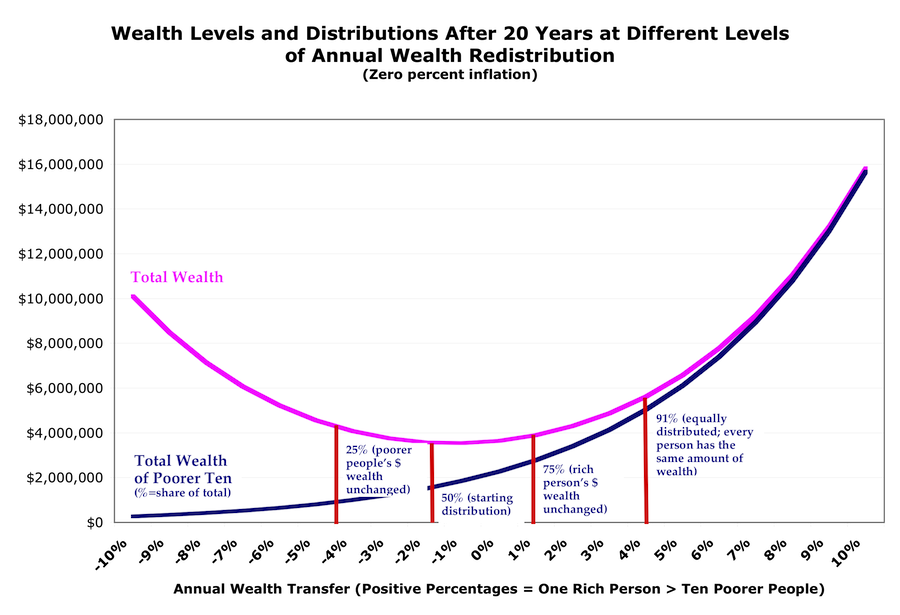
3) Wealth and Redistribution Revisited: Does Enriching the Rich Actually Make Us All Richer? by Steve Roth @ Angry Bear
Here’s what that looks like, with starting wealth of $2 million, divided 50/50 between the rich person and the ten poorer people. (click for larger):

Woj’s Thoughts - Click through for surprising lessons about redistribution from this very basic model.

Monday, July 23, 2012

Europe Revives Failed Policies of 2008...Again

Following a weekend that saw many regional governments in Spain and across Europe come close to requesting sovereign bailouts, both Italy and Spain have once again implemented bans on short-selling. Italy’s ban is limited to the financial sector, while Spain’s ban encompasses all stocks. Both stock markets had been down several percent again this morning following major losses on Friday. Although the Spanish market rebounded following the ban to close well off its lows, the slight increase in optimism is likely to be short lived.

Since I’m still in Charlotte (on a golf trip with some old friends from high school) and have previously covered this topic (when similar failed policies were enacted last year), the following is my thoughts from last year:

Europe Revives Failed Policies of 2008

"Those who cannot remember the past are condemned to fulfill it."
-George Santayana

Tuesday’s blog ended with the above quote, but Europe’s actions today require the quote come first. Over the past couple years, policy makers pointed to rapidly rising financial markets as proof that the financial crisis was behind us. In trying to convince the public to move beyond the past, leaders appear to have erased their own memories of countless policy mistakes with unintended negative consequences. Unfortunately, Europe is embarking on the same flawed regulatory path circa 2008 and one would be foolish to expect any differing outcome.

For a moment let us look back upon the events of September 2008. On September 7th, Fannie Mae and Freddie Mac were effectively nationalized. A week later, Merrill Lynch sold itself to Bank of America. Over the next four days, Lehman Brothers filed for bankruptcy, the Reserve Primary fund broke the buck, the Federal Reserve bailed out AIG  and Treasury Secretary Paulson laid out initial plans for TARP. With financial stocks under significant pressure, on September 19th, regulators responded:

“The Securities and Exchange Commission, acting in concert with the U.K. Financial Services Authority, took temporary emergency action to prohibit short selling in financial companies to protect the integrity and quality of the securities market and strengthen investor confidence.”

Stock markets responded positively that day, with the S&P 500 rising over three percent to close at 1255. The next day, markets opened flat before giving back the previous day’s gains. The sell off continued from there and that closing level of 1255 was not reclaimed until January 1st, 2011.

Over the past two weeks, Europe’s peripheral crisis has been morphing into a Euro-core crisis as Spanish and Italian sovereign yields rose, while France witnessed a proverbial run on its largest banks. Having apparently forgotten the lessons of 2008, this evening, France, Spain, Italy and Belgium banned short sales on numerous financial institutions (Greece and Turkey have already instituted this policy). Apart from the obvious previous failure of this policy, it’s important to understand why the policy failed and why it almost certainly will again.

Many policy failures are due to a fundamental misdiagnosis of the problem at hand. Recent weakness in bank shares stems from fear of significant asset write downs and potentially inadequate capital levels that could ultimately render the firms insolvent. Banning short selling implies these concerns are based on widespread rumors willingly accepted by millions of investors. The policy also fails to acknowledge that short selling is largely employed by financial institutions and investment funds as a means of hedging risk. Ignoring these factors has resulted in establishing a policy that reduces liquidity and discourages buying.

During normal times, potential stock buyers include investors wishing to acquire or increase long positions and others trying to cover short positions. On the opposing end, possible sellers consist of investors wanting to reduce or eliminate long positions and others initiating or adding to short positions. Although banning short selling is aimed at reducing sellers, in actuality it removes both buyers and sellers from the market. An initial consequence of reduced liquidity will probably be heightened volatility going forward.

By reducing selling pressure, the policy aims to strengthen investor confidence in European banks. Although I believe the ban actually signals desperation by policy makers aware of deteriorating fundamentals, I’ll ignore this point for a moment. Determining the future direction of bank stocks requires comparing the vantage points of remaining potential buyers and sellers.

Apart from rising sovereign yields across Europe, weakening economies have put pressure on bank earnings. Stress tests that were clearly rigged supported claims that banks were severely under-capitalized. Bank stocks have been falling rapidly back toward levels from the previous crisis. For investors, the question is, why buy now? Certainly some investors will believe the recent sell off is over done and that considerable value can be found in owning bank stocks. Even for these individuals, the risks run incredibly high.

As currently enacted, the short sell bans only last 15 days. Since few individual investors actively use short selling, outright short positions were likely held by sophisticated fund managers. It seems reasonable to expect these managers will continue shorting bank stocks after the ban ends. In that case, buyers may be well served to wait for even lower prices. Potential buyers may also fear that some rumors are true, as witnessed frequently over the past several years. Investors therefore must risk being almost entirely wiped out. With thousands of other stocks to potentially invest in, a strong desire by investors to purchase bank shares at this time is hard to fathom.

While potential buyers include current holders and investors starting new positions, possible sellers are now limited to investors with current positions. Having already experienced significant losses, these owners are confronted with the same concerns as the buyers mentioned above. However, if buyers prove to be scarce, sellers face an added fear of acting too slow. Within illiquid markets, a shortage of buyers means that sellers may frequently be forced to hit bids (selling at the current best bid, often a sign of weakness). Selling in this manner typically lowers prices and could cause buyers to withdraw or lower bids further. Sellers who act first will therefore receive the best prices. The biggest risk is that recognition of this process becomes widespread and sparks a surge of selling interest. In that case, prices could free fall as selling begets more selling and buyers retreat.

Yesterday’s equity market gains were probably the result of investors rushing to exit short positions before the ban was made effective. With those buyers now removed from the market, who will replace them in the days ahead? Investment funds and financial institutions that used short selling for hedges must now seek alternative measures or reduce long exposure. Shifting to other hedging strategies will result in prices of those short instruments being bid up significantly and further discouraging equity buying. Reducing long exposure will generate an imbalance favoring sellers and push markets lower.

Aside from failing to prevent further declines in bank stocks, banning short selling could very well directly reduce bank profits and lending. Banks earn profits from trading, both on their own account and through transaction fees from customers. Less liquidity means less transactions and lower profits. As mentioned earlier, financial institutions account for a significant portion of short sales. These positions are often used to hedge counterparty risk. Without an ability to hedge this risk, banks may become less willing to lend to other banks and in turn, consumers.

In September 2008, the U.S. and U.K. instituted widespread bans on short selling of financial institutions. Despite fiscal and monetary stimulus, liquidity declined in equity markets and practically vanished in interbank lending. Desperately attempting to raise capital, banks were forced to sell assets and accept bailouts. Deposit withdrawals pushed banks to the brink of bankruptcy and caused a contraction of credit. The rest of the story is history.

To be clear, the ban on short selling did not cause the financial crisis. Banks had lent recklessly and rung up massive amounts of leverage. Financial systems are built on confidence and once that falters it becomes increasingly difficult to reacquire. In my view, banning short selling in 2008 was an ill conceived sign of panic among regulators. Attempting to focus blame upon a few select short sellers, the policy discouraged buying and removed liquidity at a time it was desperately needed.

For the global economy’s sake, I hope this time is different. Maybe buyers will show up in droves to purchase bank stocks upon the removal of short sellers. Maybe 2 weeks will allow policy makers to create a plan of action for shoring up bank capital. Maybe the short sellers were just making up rumors on the fly. Sadly I have a hard time envisioning any of these scenarios taking place. My worst fear, that nothing would be learned from the Great Recession, appears to be coming true. Here’s to hoping the days ahead are not filled with more 2008 déjà vu.
Tuesday, July 17, 2012

The Necessity of Private Banking

Yesterday, Rodger Malcolm Mitchell offered a second part to his view that private banking should be ended. He begins by accurately acknowledging the difficulty in writing and enforcing sufficient regulation, along with the bankers’ success in using the government system to bolster profits. The apparent impossibility of eradicating rent-seeking from bankers leads Mitchell to conclude:
When private individuals control vast amounts of money, and when they are compensated according to their control of this money, even the saints among us would be tempted. Bottom line, private banking is, and always has been, crooked, the bigger the bank, the greater the temptation, the more crooked.
In banking, the profit motive corrupts. And combining the profit motive with short-termism corrupts absolutely. Always has; always will.
All banks should be federally owned.
Although I agree that the profit motive “corrupts” (though not absolutely), it dawns on me that this view can easily be extended to the entire private sector and holds a strong parallel in the public sector if one alters profits with power. All individuals, at some point, are tempted to work the system in their favor. Banking, whether done through the private or public sector, will therefore always be subject to some level of corruption.

Apart from the reasoning on corruption, there are two other discrepancies I brought up in the comments. First, removing the profit motive from banking effectively eliminates the market (price system) for credit/lending. Government agents will therefore have full discretion over who receives a loan, as well as the size and price, without an incentive to determine the borrower's ability to repay. As many economists in the Austrian tradition have previously explained, without knowledge from a market (i.e. prices), the allocation of resources will be highly inefficient.

Second, Mitchell’s usage of the term “money” to include credit obscures an important distinction between money and credit. Kurt Schuler of Free Banking recently addressed this confusion:
Money in the narrow sense is the monetary base, which, at least from the standpoint of the domestic monetary system, is a pure asset and not somebody's IOU. Payment with the monetary base extinguishes IOUs.“Money” in the looser, broader sense includes IOUs, particularly those issued by banks, that are readily convertible at 1:1 into the monetary base.
Private banks are the majority supplier of credit (IOUs)*, which acts as a money-like instrument. The Arthurian explains the significant difference:
The cost of interest is an "extra" cost, a largely unnecessary cost in our economy. Yes of course we need to use credit. But we don't need to use credit for everything. But we do. So, we have this extra cost to deal with, the factor cost of money. And it creates cost-push conditions. And cost-push conditions cause inflation. Inflation, or decline.
Further, the added interest cost transfers wealth from borrowers to lenders. This increasing reliance on credit in the past three decades, supported and subsidized by government, is largely behind the enormous rise of profits in the financial sector and current economic struggles. Considering the public support for use of credit, making banks publicly owned is unlikely to address this issue.
I entirely agree that the financial sector is a source of corruption and prime example of problems with rent-seeking. However, turning over the role of banking to the government will not reduce corruption or the country’s reliance on credit and will be significantly more inefficient.


*Ralph Musgrave, who also got involved with comments on Mitchell’s post followed up with a post of his own seeking clarity on the proportion of the money supply (broad version) created by private banks. Presumably, since loans create deposits:
to get at the proportion of money created by central bank it strikes me we need take physical cash add total deposits and subtract total loans.
This site gives the deposit to loan ratio of U.S. FDIC insured banks as 79%. (loans are $7.28 trillion while total deposits are $9.22 trillion).
From that I deduce that about 20% of money in the U.S. is central bank created.

Monday, July 16, 2012

Making IOER Negative Equates to Raising Taxes And Raises Potential Of New Recession

Earlier today an analyst from Jeffries’, David Zervos, published a research note implicating that the Fed may cut interest on excess reserves (IOER) from 0.25% to -0.25%. Here’s an excerpt courtesy of Zero Hedge:
The quote from the last FOMC minutes suggested the Fed wanted a "new tool". Well here ya go Ben, take the IOER to -25bps, take 2s to -50bps and watch banks start setting LIBOR negative!! If you really want to push the portfolio balance channel this will wake up all the sleeply reserve managers with liquidity needs in USD. Of course as short rates plunge into negative territory, inflation expectations will rise sharply. It will be important to not expect too much love for the long end if this happens. And like I said above, even if this is a low probability event, the mere possibility of it happening makes levered longs in the front end a fantastic trade! No one is prepared for it. Just ask yourself how many risk management departments have shocked 2yr notes to -50bps and 3ml to -30bps in their VAR analytics. Not many!!
Many investors seem to view this action positively, believing the resulting increase in bank lending will lead to higher growth and inflation. Before presenting the likelihood of such an action by the Fed, it’s important to clarify the major effects of making IOER negative.

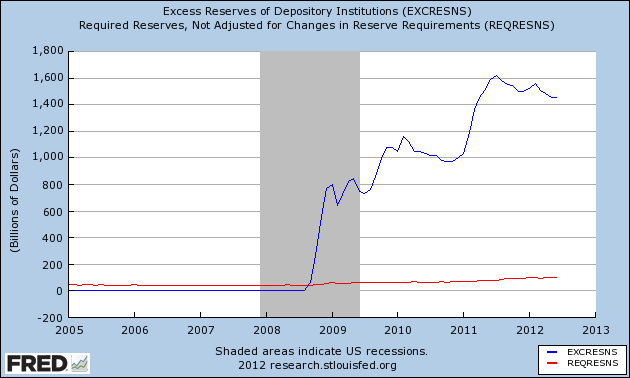
Currently, banks are holding approximately $1.45 trillion in excess reserves:
As Mish Shedlock and Steve Keen have recently reconfirmed, banks cannot lend reserves. Reserves are brought into existence and removed from the system through open market operations. The Fed therefore controls the amount of reserves in the system, as a helpful tool in maintaining its interest rate policy. Since members of the Fed/FOMC and most economists view QE as monetary stimulus, I presume that the Fed will not elect to accompany a reduction in IOER with a policy of reversing QE and reducing its balance sheet. If the IOER becomes negative, given that assumption, banks will face a decision between increasing lending to drive up required reserves or continuing to hold excess reserves at a penalty rate.

Faced with this decision, banks may initially seek to increase lending. The drop in IOER acts similarly to a rate cut and at a negative rate may encourage banks to even extend loans that, though not directly profitable, are expected to lose less than the cost of holding corresponding excess reserves. Regardless, the amount of new borrowing required to significantly reduce excess reserves is inconceivable (a 10% reserve requirement suggests $14 trillion). The current amount of excess reserves will therefore likely remain well above $1 trillion, which is bad for banks and stocks.

Why? Well, given the current IOER rate, banks are effectively earning $3.5 billion per year, risk-free ($1.4 trillion * 0.25%). Flipping the current IOR to negative and maintaining a similar level of excess reserves suggests a yearly drain from the financial system of $3.5 billion. This reduction in profitability will hurt bank capital, which is ultimately the real constraint on bank lending.

While a negative IOER will lower bank profits, it will likely increase profits at the Fed (which are transferred to the Treasury). As Zervos points out, this policy change could also push short-term Treasury rates (at least out to 2-years) negative. If that occurs, holders of short-term Treasury notes would join banks in effectively paying the Treasury to hold funds (ie. negative interest income). Although the combination of these factors will reduce the deficit, it will simultaneously reduce net financial assets of the private sector. In that sense, a negative IOER is equivalent to raising taxes.

Absent countervailing measures to increase the deficit, a reduced deficit will also result in declining corporate profits (ex-Fed). As I’ve noted previously, the federal deficit has been the primary factor supporting corporate profits over the past few years. With a corporate profit recession already in our midsts, this decision by the Fed could result in a corporate profit depression.    

In my opinion, any optimism regarding a negative IOER is badly misplaced. Rather than sparking new lending, this change in monetary policy will likely bring about the reverse by hurting bank profits and capital. By inflicting a “tax” on the broader private sector, a negative IOER could even dampen corporate profitability and incomes. In the end, a policy of negative IOER might be enough to inspire a massive sell-off in stocks and push the US economy into recession.

To end on a positive note, I believe it is highly improbable that Bernanke or the Fed enacts such a policy. Apparently Goldman agrees.

(Note: Above I mentioned Zervos’ view that a negative IOER rate would lead to negative short-term Treasury rates. I haven’t had enough time to fully think through the possibility, but my initial reaction is skeptical. Other countries currently with negative rates on short-term government debt are either engaged in a monetary union or maintaining a currency floor. Government debt in those instances therefore, apart from safety, also provides an effective call option on higher relative currency valuations. Given that the US dollar is a floating currency, investors/savers could presumably hold dollars instead of Treasuries. This could cause a rise in the dollar exchange rate but would probably keep rates from going negative (absent the Fed adjusting lower the Fed Funds rate). I’ll plan to do a follow post on this topic in the near future but, in the meantime, does anyone have helpful thoughts on this topic?)   

Friday, July 13, 2012

Why I'm Still Not Buying Big Bank Stocks

Recently Mike Sax, who has an interesting blog titled Diary of a Republic Hater, offered this claim:
No one I speak to thinks the banks are a good bet even at bargain basement levels. Not Nanute, not dwb at Money Illusion, now WOJ who writes Bubbles and Busts has added his name to the list.
My position on the large US banks has remained skeptical for quite some time. Although reported earnings have been strong over the past couple years, a decent percentage of those earnings stemmed from debt-value adjustments (DVA) and the release of loan loss reserves. Add to those uncertainties the continuing halt of market-to-market accounting, unknown off-balance sheet positions and on-going legal liabilities due to frauds stemming for mortgages to LIBOR. Further, JPM is now openly discussing traders’ marking positions to hide losses, which is almost certainly far more pervasive than the disclosure suggests. The lack of transparency at these financial institutions simply presents more risk than I’m willing to take.

For some investors the earnings potential of the major banks may be significant enough to overlook the lack of transparency. As I pointed out to Mike in the comments:
Check out this post from the Brooklyn Investor (http://brooklyninvestor.blogspot.com/2012/06/banks-real-nightmare.html.) Low interest rates could be terrible for bank earnings.
That post shows the disastrous effects of low interest rates on the earnings potential for Japanese banks. Apparently the Bank of International Settlements (BIS) also fears a similar occurrence in the US. Timothy Taylor drew my attention to a BIS paper on Dangers of Continually Expansionary Monetary Policy. The section, noted by Taylor, most pertinent to this discussion is:
"Implications of effective balance sheet repair as a precondition for sustained growth"
"Ultimately, there is even the risk that prolonged monetary easing delays balance sheet repair and the return to a self-sustaining recovery through a number of channels. First, prolonged unusually accommodative monetary conditions mask underlying balance sheet problems and reduce incentives to address them head-on. ... [L]arge-scale asset purchases and unconditional liquidity support together with very low interest rates can undermine the perceived need to deal with banks’ impaired assets. ... And low interest rates reduce the opportunity cost of carrying non-performing loans and may lead banks to overestimate repayment capacity. All this could perpetuate weak balance sheets and lead to a misallocation of credit. ...
"Second, monetary easing may over time undermine banks’ profitability. ... Low returns on fixed income assets also create difficulties for life insurance companies and pension funds. Serious negative profit margin problems associated with the low interest rate environment contributed to a number of life insurance company failures in Japan in the late 1990s and early 2000s. ...
"Third, low short- and long-term interest rates may create risks of renewed excessive risk-taking. ...  However, low interest rates can over time foster the build-up of financial vulnerabilities by triggering a search for yield in unwelcome segments. There is ample empirical evidence that this channel played an important role in the run-up to the financial crisis. Recent large trading losses by some financial institutions may indicate pockets of excessive risk-taking and require scrutiny.
"Fourth, aggressive and protracted monetary accommodation may distort financial markets. Low interest rates and central bank balance sheet policy measures have changed the dynamics of overnight money markets, which may complicate the exit from monetary accommodation ..."
The combination of all these risks is simply too large for me to consider investing in the big banks, even at current low levels. Obviously my position on the banks could be too risk averse and the stocks may prove big winners. In my opinion, there are many other sectors and companies with equally compelling valuations, better prospects and less uncertainty. Ultimately the decision is up to you though...best of luck!