At Worthwhile Canadian Initiative, Livio Di Matteo asks Why Is Manufacturing Special? (emphasis added):
Is there a special economic value or role to manufacturing that makes it special? Coyne feels: “If it’s about anything, it’s about aesthetics, or a sort of sectoral snobbery, the kind that finds the prospect of being “hewers of wood and drawers of water” so unspeakably vulgar. And yet it is presented as if it were an economic argument.” My gut feeling is that this tendency to put manufacturing on a pedestal is rooted in an almost 1930s Soviet-style view of economic development with heavy industry and manufacturing being the high ground of the economy. Industrialization is seen as a sort of “higher-level” of economic activity after agriculture and resource extractio - a logical higher-order stage.
…
What is also interesting in all of this is why in a similar vein we do not view manufacturing as backward in relation to the post-industrial knowledge economy of high end financial, medical and knowledge services? Surely, if our society is imbued with a tendency to view economic development as a series of sequential progressive higher-level stages, why not also consign manufacturing - and specifically automobile production - to the dustbin of history? Is not the highest stage of economic development one in which we effortlessly glide from one shopping and dining experience to another while not having to produce anything that is physically tangible all the while powered by friendly and renewable green energy and green transport modes? I repeat the question raised by Coyne, why is manufacturing special?
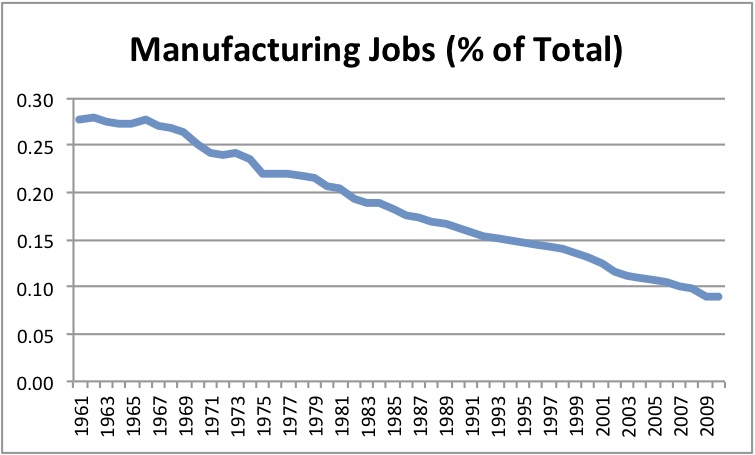
Matteo raises more questions than he answers in this post, but all are extremely pertinent to public policy today and moving forward. Previous posts on this blog have highlighted the ongoing bailouts and subsidies provided by the U.S. government to auto manufacturers (see here and here). In contrast to my views and seemingly those of Matteo, the mainstream media frequently depicts declining employment within the manufacturing sector (seen below) as a major concern.
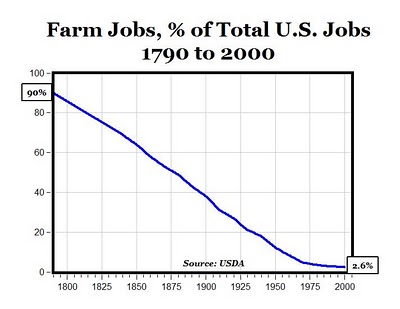
On this point Matteo’s question, in bold, reaches the heart of the matter. During and following the industrial revolution, the share of employment confined to the agricultural sector substantially declined.
Although numerous government subsidies for that sector remain in place today, only a small minority of the population actually prefers returning to a largely agricultural society.
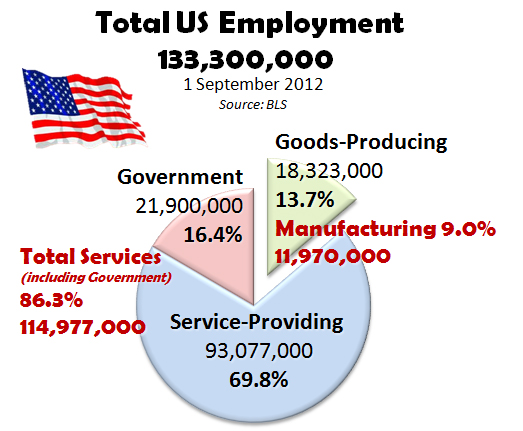
Emerging economies around the world are still expanding their manufacturing capabilities and offering goods at prices much lower than those obtainable with domestic production. Though the road to change has been and will continue to be filled with numerous potholes, rewards from reaching a higher stage (not necessarily the highest) of economic development will surely be worth the costs. For several countries, including the US (see below), the next large shift in employment, away from manufacturing and towards a service-based economy, has already occurred.
The time has come for developed countries to accept this new reality and adjust public policy accordingly.
During my classes and through reading countless academic papers, I am continuously bombarded with statistical regressions. Frequently the results are claimed to be “statistically significant” based on a small p-value. The implication is that these results should garner more attention and the hypotheses should be presumed true. Results of this kind typically lead to journal publications and often inform policy making.
Unfortunately, the basic intuition laid out above is technically incorrect and likely detrimental. In a recent manifesto, William Briggs displays the truth behind the meaning of p-values. He argues It is Time to Stop Teaching Frequentism to Non-statisticians, from which I offer a couple select passages:
The hunt for publishable p-values is nearly always fruitful. If one cannot find a publishable p-value in one’s data—with the freedom to pick and choose models and test statistics, to engage in “sub-group” and sequen-tial analysis, and so on—then one is being lazy. P-values can and are used to prove anything and everything. The sole limitation is the imagination of the researcher.
(p.4)
Civilians just can’t remember that it is forbidden in frequentist theory to talk of the probability of a theory’s or a hypothesis’s truth. They insist on translating the certainty they have in the value of some test statistic via the p-value to certainty that their hypotheses are true, despite that this is impossible to do so in frequen-tist theory. The result is that too many people are too certain of too many things.
(p.7-8)
The entire paper is worth reading, but the last sentence highlights my main concern. The desire for certainty in academia and policy making cannot overcome the reality of living in an uncertain world. Attributing excessive certainty to our results may increase our hypothesis’ chances of acceptance, but will not alter the likelihood of its being true in practice. In my view, there is a general need for greater humility, especially in academia and public policy. Classrooms are a great place to start.
(h/t Ryan Murphy @ Increasing Marginal Utility)