Showing posts with label Ireland. Show all posts

Wednesday, June 27, 2012

Spain Should Bailout Households Not Banks

Rom Badilla directs to the most recent Global Strategy Weekly note from Albert Edwards of Societe Generale, where he writes:
And so it is in the Eurozone: Spanish banks need recapitalization because of the deflationary policies forced on them to reduce Spain’s public sector deficit at a time when the private sector is also de-leveraging. Clearly this has a lot further to go and house prices will fall even further as a result. But the lesson from Japan was that overly focusing on the banks as ‘the problem’ is misguided and until or unless deeply deflationary policies are altered, the Spanish banks will be back for another bailout before too long.

This fits well with the case I previously laid out that private debt continues to drag down Europe.

This above dynamic is especially important for understanding Spain, where sovereign debt levels (at least those officially reported) are not particularly high. Spain’s housing bubble, however, continues to decline putting further pressure on private sector balance sheets. The public and private sectors cannot both successfully deleverage, in tandem, without destroying incomes and growth.
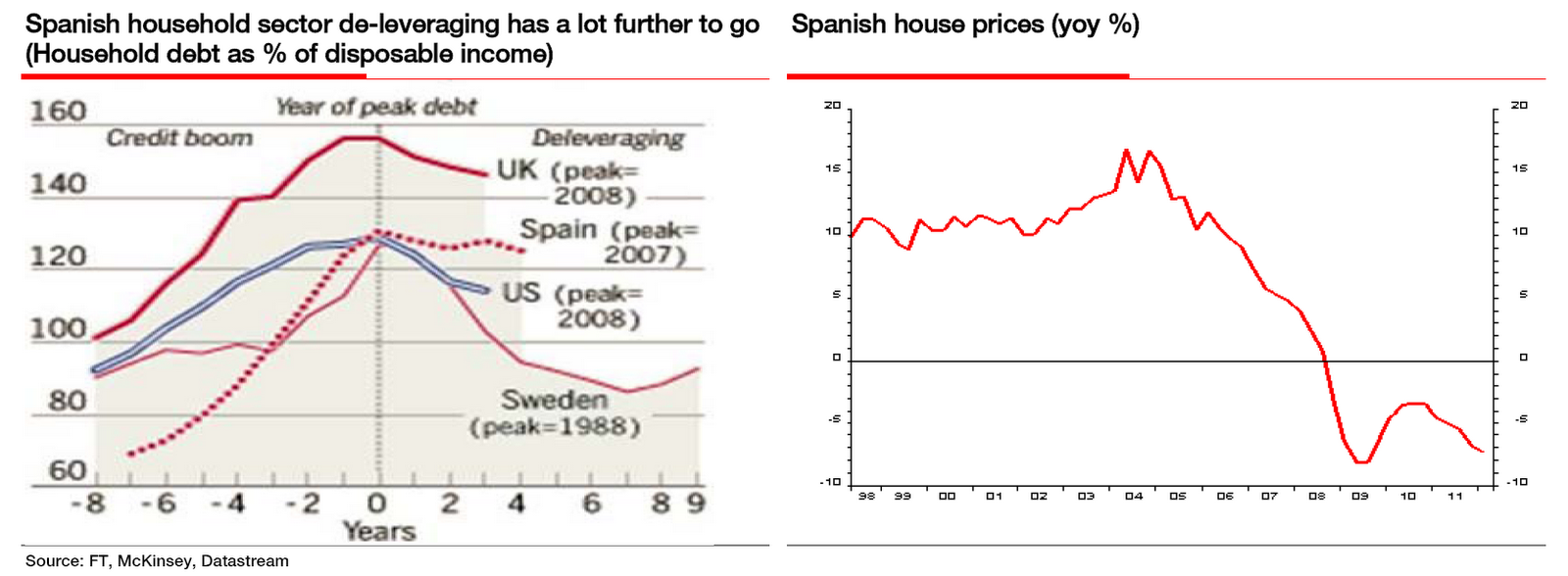
As the first chart from Edwards’ shows, households have not yet begun to seriously deleverage and unemployment is already well over 20%. This process will continue to put downward pressure on house prices, which may fall by another 35%.  As prices fall Spanish banks will ultimately be forced to write down mortgage values, further impairing their balance sheets. By focusing the bailout on banks, Spain in not only following the path of Japan but also that of Ireland. Despite significantly larger bailouts relative to the size (GDP) of Ireland, Irish banks remain insolvent. Putting these pieces together, it becomes obvious that Spanish banks will require further bailouts.

A lesson pointed out in the title of Edward’s note that should have been learned from Japan is that “banks are not the problem.” Unfortunately Spain, Ireland and several other countries have made this same mistake during the current crisis. Private debt deleveraging, especially by households, is at the heart of the current crisis and remains unaddressed. Until private sector balance sheets return to health, economic growth will continue to languish (at best) and highly leveraged banks will become increasingly insolvent. For countries without the ability to print currency (ie. the Eurozone), use of public funds to bailout the banks may eventually topple the sovereigns.

Heading into another Euro Summit, I fail to see any signs that policy makers will soon change course and address private balance sheets. The crisis is speeding up but the policy solutions remain unsuitable for the problem at hand.

Monday, June 11, 2012

Despite Bailouts, Irish Banks Remain Insolvent...Spain Too?

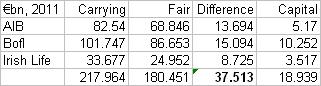
The 2011 annual reports for Bank of Ireland, AIB/EBS and Irish Life reveal the scale of losses that will be in store if our economy doesn’t turn around and grow. Each of these three financial institutions published two valuations for their loan-books – a “carrying value” which is what is reported in the accounts and represents the book value of the loans less a convoluted provision for impairments and a “fair value” which represents what the loans are worth today if they were called in and the underlying asset was used to pay off the loan. Here is the summary of the loan books in 2011 which show that the overall difference between “carrying value” and “fair value” for these three institutions is an almighty €38bn which if it materialised would wipe out the entire capital base and need nearly €20bn in additional capital to boot, just to keep banks solvent. To give them adequate capital buffers might involve a further €20bn. So €40bn, all told on top of the €72bn current and projected cost. (my emphasis)

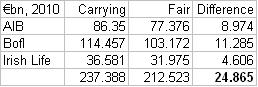
And take a look at the loan books the previous year in 2010.


There has been a major deterioration in the “fair value” and the gap between the “carrying value” and the “fair value” which is what you would expect when the economy is still in recession, where residential property fell by 16%-plus in the past year and commercial property fell by 10%-plus, and where unemployment is now at a current-crisis record of 14.8%.
Read it at NAMA Wine Lake
2011 annual reports for Irish banks reveal potentially catastrophic losses and additional bailouts requirements
(h/t FT Alphaville)

So much for those stress tests, huh? It is already pretty widely accepted that Portugal will need a second bailout later this year and it appears Ireland isn’t out of the woods yet either. Optimistic expectations for growth are nice to look at, but can have terrible ramifications when used for policy making. Growth prospects for the PIIGS remain extremely weak, looking out over the next few years, which means banking shortfalls in the countries will probably increase further. If the necessary size of Ireland’s bailouts offers even a reasonable comparative estimate for Spain, instead of 100 billion euros, the ultimate total may be upwards of 400-500 billion euros.