Showing posts with label Currency Valuations. Show all posts

Friday, March 29, 2013

"Cyprus Should Leave The Euro. Now."

Yesterday banks in Cyprus opened for the first time in a week. Markets were seemingly calmed by the absence of immediate bank runs, however the ability of depositors to actually create a bank run has been prevented by strict capital controls. The real test for Cyprus banks will come when the capital controls are finally lifted. Although the restrictions are only supposed to be in place for 7 days, recent experience in Iceland suggests the better question is not when but IF the capital controls will be lifted. Based on the IMF’s recommendation, Iceland instituted capital controls back in 2008 for what was supposed to be a few months. Five years later the capital controls remain in place and are expected to continue for at least a couple more years. As a base case we should expect an announcement next week that Cyprus’ capital controls will remain in place for a few more weeks (possibly months).

While the implementation of capital controls presents an interesting storyline, Paul Krugman has raised a much bigger question into the public spotlight. After being challenged to expand the boundaries of political possibility, Krugman offered the following recommendation (emphasis added):
So here it is: yes, Cyprus should leave the euro. Now.
The reason is straightforward: staying in the euro means an incredibly severe depression, which will last for many years while Cyprus tries to build a new export sector. Leaving the euro, and letting the new currency fall sharply, would greatly accelerate that rebuilding.
The question for Cyprus is therefore whether “internal” or “external” devaluation offers the best prospects for the future? Let’s consider both of the options...

“Internal devaluation” (i.e. income deflation) - In return for continued assistance from the Troika (EU/ECB/IMF), Cyprus has agreed to impose losses on equity and debt holders, as well as uninsured depositors, of the two largest banks (Bank of Cyprus and Laiki Bank). This marks a distinct change in policy, especially with regard to the latter two groups.* Since uninsured depositors held a majority of those banks’ liabilities, the focus has naturally been on that group. Based on recent estimates uninsured depositors in the Bank of Cyprus may lose approximately 40%, while Laiki Bank’s uninsured depositors will be entirely wiped out.

The sharp reduction in (perceived) wealth stemming from these actions will put severe downward pressure on national income. Individuals and businesses experiencing losses will try to increase saving by reducing spending. Banks fearing deposit flight and falling asset prices will try build a stronger base of capital by restricting the supply of credit and possibly selling assets. Adding to the fall, the government will be forced to accept a MoU (Memorandum of Understanding) that establishes policies to increase taxes and reduce spending. Combining these deflationary pressures, the overall economic results may rival (or exceed) Greece’s recent history.

During the past 5 years Greece’s real GDP has declined by 20%
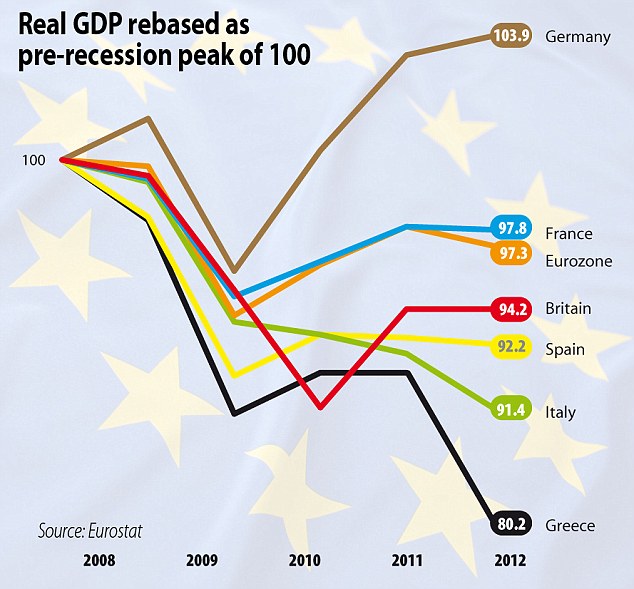
and unemployment has nearly quadrupled from ~7% to ~27%.


To offer some historical perspective, US unemployment during the Great Depression peaked at 25% and real GDP loss only exceeded 16% for one major European nation (Austria). Perhaps even more disheartening than the current data is recognition that output and unemployment appear unlikely to improve anytime soon.

Returning to Cyprus, unemployment has already quadrupled over the past 5 years (~3.5% to ~14%; shown above). Based on current estimates of a 20-30% drop in real GDP, Cyprus’ unemployment rate could easily approach or eclipse Greece’s in the next few years.

“External devaluation” (i.e. new currency) - If Cyprus were to leave the Eurozone, one of the first actions would be re-introducing the Cypriot pound at a heavily devalued rate against the euro. Not unlike the imposed losses on uninsured depositors, currency devaluation immediately imposes significant losses on all depositors. In this sense the impact on private demand would still be extremely deflationary, perhaps even more so. Though output and employment would fall dramatically, external devaluation presents reasons for potential optimism on both the foreign trade and government fronts.

Based on the recent bank losses and capital controls, Cyprus can no longer rely on its financial sector to support exports. By heavily devaluing its currency, Cyprus would be increasing its price competitiveness on the foreign market. However, as Barkley Rosser points out:
even with large elasticities [of trade relative to the exchange rate], there is the J-curve effect. Exports do not increase immediately, whereas the value of imports tends to jump up immediately with their price increases.
Aside from these timing issues, there is also a concern regarding the certainty of each effect. A large devaluation will definitely raise the cost of living for Cypriots but as JW Mason comments, it:
might not lead to higher net exports in the next few years, or ever. That’s the question -- not how big the devaluation would be, but how strongly it will affect trade flows.
As for the government sector, returning to the Cypriot pound would remove some of the current fiscal constraints. This would permit the government to increase spending (ideally investment in a new export sector) and not raise taxes, raising private sector income. While these adjustments will not come remotely close to overcoming the other deflationary effects in the short-run, the counterbalance provided will be a significant improvement over current policy.

In asking “Why Won’t Cyprus Obey Krugman?” Rosser concludes:
While this devaluation might make it easier for Cyprus to recover several years down the road, that recovery would indeed be several years down the road, and in the meantime there would be a lot of pain for the entire citizenry that will not happen if they stay with the euro.
If Greece has taught us anything about remaining with the euro, it’s that a lot of pain for the entire citizenry will happen regardless and a recovery may be decades down the road.

Cyprus is therefore faced with a choice between two terrible outcomes:
1) Remain in the Eurozone and experience a relatively slower “internal devaluation” whereby real output and employment experience large declines spread out over several years. A potential recovery is pushed even further into the future.
2) Leave the Eurozone and experience a quick “external devaluation” whereby real output and employment fall dramatically in the next year or two, but a recovery several years down the road becomes far more probable.

Where Rosser and I find agreement:
is that the real real issue here has to do with time preferences. It may get down to hyperbolic discounting. People do not want to have pain in the near term. So, the fear by the whole population of near term pain in terms of standard of living may outweigh fear of a more gradual decline with rising unemployment, even though the shorter term sharp pain is likely to lead to a sooner turnaround to growth.
Although this psychological tendency is very normal, it can at times be detrimental to achieving longer-term goals. The cases of Greece, Spain, Italy, Portugal, Ireland, and now Cyprus are examples of such times. The severe pain of reduced standards of living and high unemployment will be felt one way or another, but the option of “external devaluation” offers potential for a better future five and ten years down the road. Therefore I concur with Krugman, “Cyprus should leave the euro. Now.”        


* From my perspective, imposing losses on debt holders should have been done from the outset in the US and Europe. The apparent change in policy may raise costs of debt financing for the largest banks, but that should be a welcome change after years of enjoying a TBTF subsidy.

Wednesday, February 20, 2013

(Late) 2013 Predictions

Last year I took a chance and threw my own projections into the ring. Similar to Byron Wien and Edward Harrison, I mostly selected events that were widely seen as having a low probability (less than 33%) but which I believed held a greater than 50% chance of occurring. The final results were a bit disappointing, but that won’t stop me from trying again this year. Since these predictions already represent a late release, without further adieu, here are the 2013 predictions:

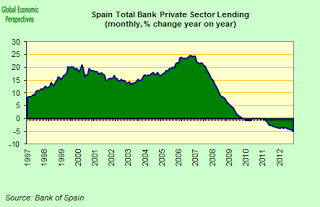
1) Spain requests access to ECB’s OMT - Since ECB President Mario Draghi announced the OMT program, yields on Spanish debt have fallen rather dramatically. Although this eases financing pressure, it has done little to alter the actual economy’s downward spiral. During 2012 Spain’s GDP growth became increasingly negative, falling by 1.8% year-on-year in the fourth quarter. Meanwhile unemployment continues its meteoric rise to over 26% for the general population and nearly 60% for youth. With the large banks still severely undercapitalized and households over-indebted, private sector lending continues to decline:


Seeing no recovery and potentially a worsening decline, “bond vigilantes” will eventually test Draghi’s threat. At that point Spain will be forced to accept a Memorandum of Understanding (MoU) in return for ECB bond-buying through the OMT program.

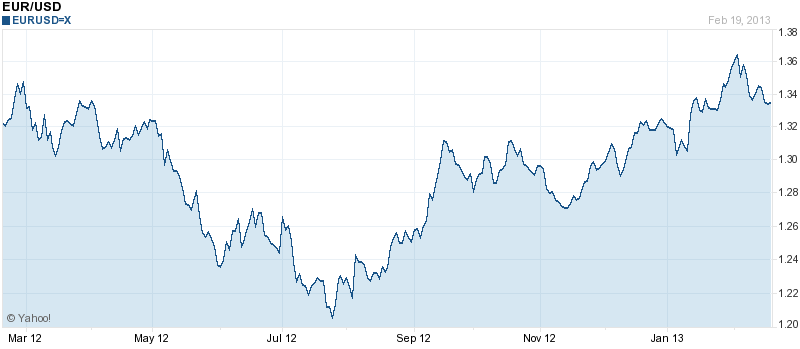
2) The Euro finishes the year above $1.30 - After falling nearly 10% during the first half of 2012, the euro has more than recouped its losses on the back of optimism and deflationary policies.

At points during 2013 the optimism is likely to fade, but I expect politicians and central bankers will take the necessary steps to quell fears for the time being. Unfortunately those steps will involve further deflationary policies that push the euro higher. These competing forces will largely cancel out, leaving the euro close to or above where it began the year.

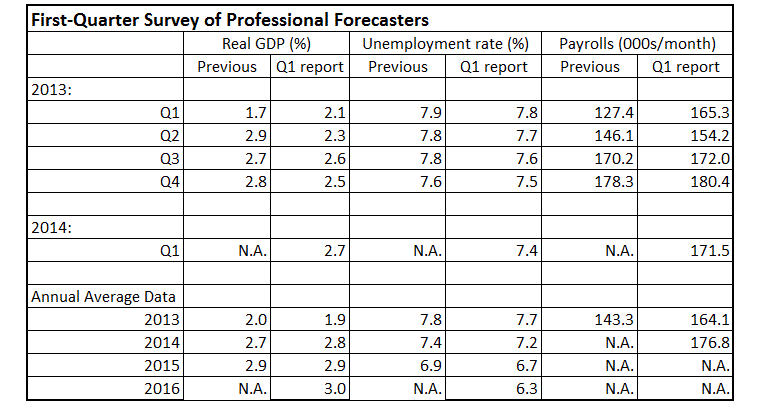
3) The Eurozone remains in recession the entire year - Forecasters now expect euro-zone economic activity to be flat this year, down from a previous prediction of 0.3% growth made just three months ago. Last year saw practically continuous downgrades to GDP growth forecasts and I expect this year to be no different. Austerity measures are momentarily easing, but more will likely be enacted based on the outcomes of several elections. The recent appreciation of the euro against several major currencies will also dampen growth by putting pressure on net exports. With banks across Europe trying to build up capital and persistently high unemployment, the private sector will remain especially weak. Though Germany may experience a temporary rebound, the Eurozone as a whole will not register GDP growth this year.

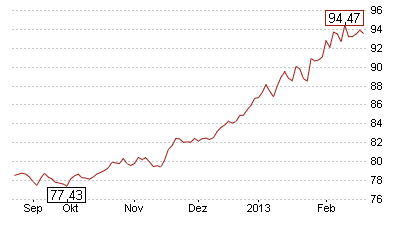
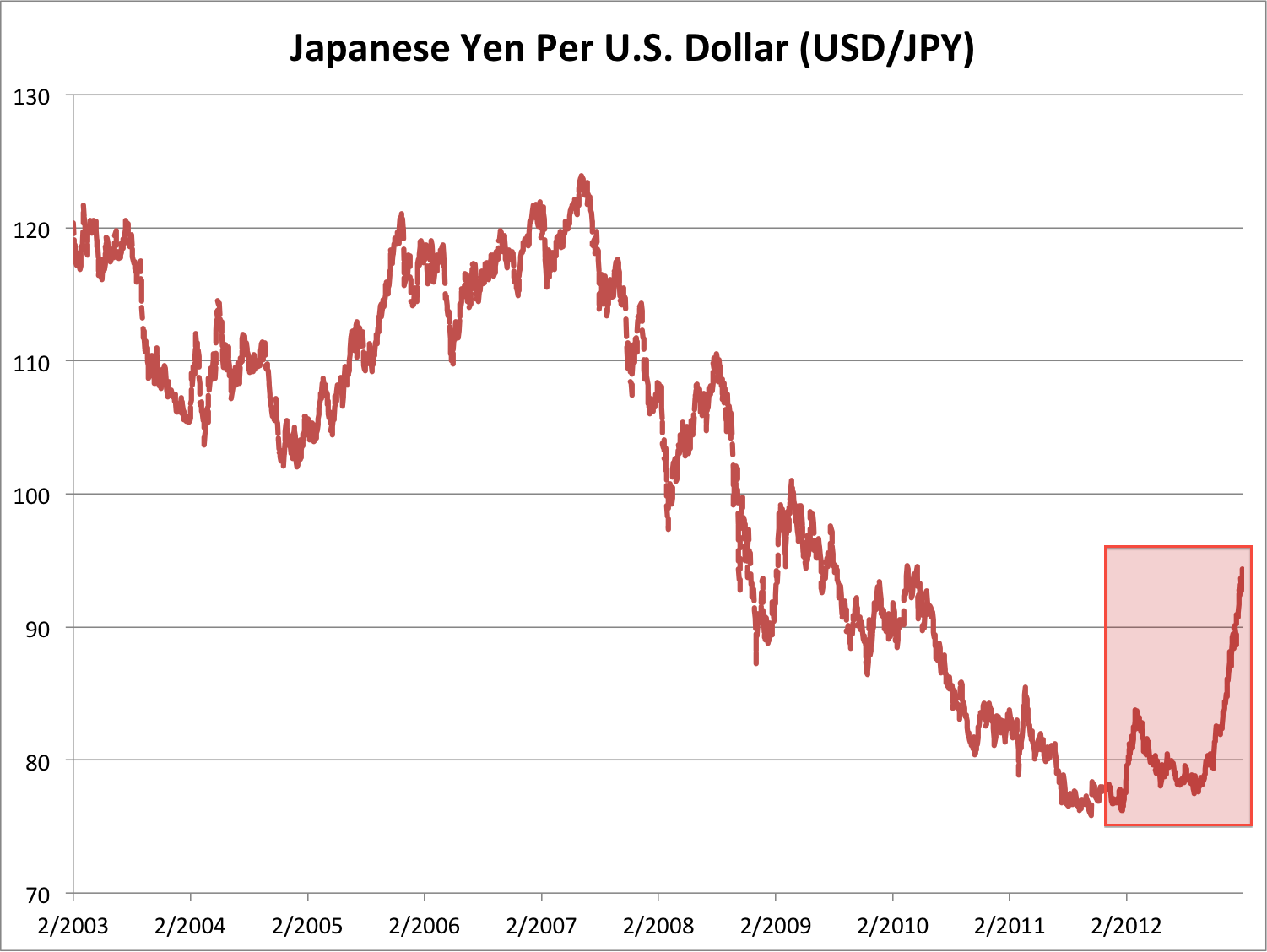
4) The Japanese yen rises above 90 per $ - Since the election of PM Shinzo Abe, the yen has fallen fast and is down more than 20% from recent highs.

During this time the Nikkei has risen more than 20%, yet yields on Japanese sovereign debt are little changed. This suggests many foreigners may be speculating on the supposedly forthcoming monetary and fiscal stimulus. As previously stated, the fiscal stimulus will probably be small and short-term. On the monetary front, short of actually entering the foreign exchange market, the Bank of Japan (BOJ) has essentially no mechanism to spur inflation and thereby cause a sustained depreciation of the yen. When market participants recognize the inability of Japan to avoid continued deflation, the yen will return to appreciating against the dollar.

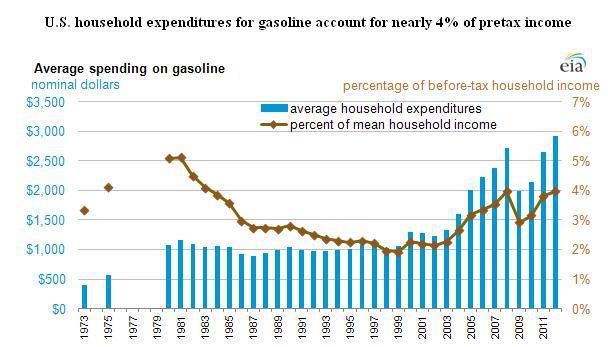
5) Gas prices will peak above $4.20 per gallon and set a new yearly record-high average above $3.75 per gallon - Gasoline prices have been on the rise for the past 31 days, currently averaging approximately $3.75 per gallon. Though this current streak will probably end soon, prices are unlikely to give back much of the gains before beginning the typical rise into summer. The ongoing potential for flare ups in the Middle East will keep prices elevated throughout the year. Higher gas prices, which already account for 4% of before-tax household income (chart below), will be a drag on consumer spending in 2013.


6) U.S. Yearly GDP growth falls below 1.5% - Forecasts of ~3% annual GDP growth over the past couple years have been overly optimistic as real growth in 2011 and 2012 was merely 1.6% and 1.9%, respectively. Apparently forecasters are being a bit tamer in their estimates this year, now expecting only 2% annual growth. Unfortunately I suspect these estimates will once again prove too optimistic. Various tax hikes and the upcoming sequester (which will go through in some respect) will reduce the budget deficit by a few percent this year. Housing is likely to remain a bright spot, but further declines in interest rates will not lead to similar magnitudes of the wealth effect. Credit remains tight for many households and small business, which should also limit private sector activity. All of these factors combined will probably not be enough to bring about a new recession but will lead to the lowest annual growth rate during this upswing.


7) U.S. Unemployment rises above 8% - Currently sitting at 7.9%, the unemployment rate is forecast to decline during 2013. Due to weaker GDP growth, corporate revenues will barely rise again this year. As companies face increasing pressure to maintain profit margins at record levels, a new wave of layoffs may occur. Separately, continuing economic growth will encourage previously discouraged workers to re-enter the job market. Both of these factors will lead to slightly higher measured unemployment.

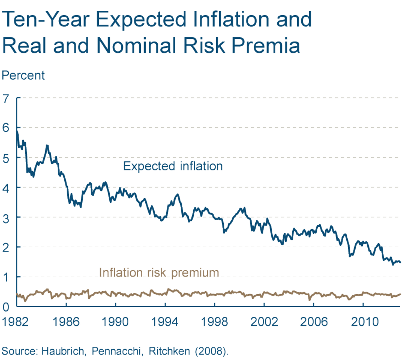
8) Federal Reserve forecasts shift first rate hike to 2016 - After extending their forecast for the first rate hike to 2015, the Federal Reserve changed its tactics to a more rule-based monetary policy. The Fed has, in effect, promised to keep rates low until we've hit either 6.5 percent unemployment or 2.5 percent inflation. Based on the above outlook for unemployment and a continuing decline in inflation expectations (chart below), FOMC members will revise their own forecasts and push back expectations for the first rate hike.


9) U.S. Corporate Earnings (ex-Federal Reserve) finish year below 2012 peak - Meager revenue growth was not enough to prevent U.S. Corporate Profits after tax from reaching record highs in the fourth quarter of 2012 on the back of record profit margins. US Corporate Profits After Tax Chart

As global growth slows in 2013, revenues will come under further pressure. At this point the ability of firms to continue cutting costs without sacrificing output seems limited, which means margins may begin to compress. As margins revert to previous norms, earnings will register a yearly decline.

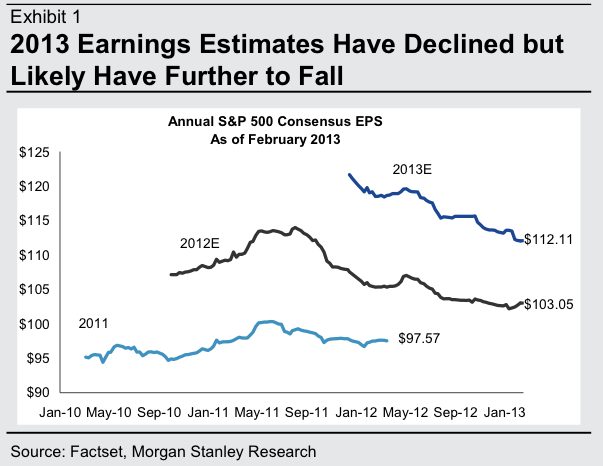
10) Bonds outperform stocks - During the first seven weeks of this year the stock market has been on fire, even though earnings estimates continue to fall.


Multiple expansion is currently being driven by the Federal Reserve’s actions despite their ineffectiveness at generating actual NGDP growth. When investors eventually turn their attention to continuing troubles in Europe, ongoing deflation in Japan, and/or weakening growth in China, U.S. earnings may once again enter the picture. Recognition that S&P 500 earnings growth has slowed substantially may cause the market to give up much of this year’s gain. These concerns combined with declining inflation expectations will result in many investors returning to the safety of U.S. Treasuries. The subsequent rise in prices (decline in rates) will generate another year of positive returns for the Treasury market.


Will my predictions prove too pessimistic once again? Only time will tell...

Friday, February 15, 2013

Exchange Rate Intervention Is Gaining Popularity, Again


1) Musings on MMT - Firming Up The Soft Bits by Neil Wilson @ 3spoken
Effect on the Exchange Rate

The problem here I think is a matter of viewpoint. The world is a closed system. Each individual monetary area operates within that closed system. So if you press in one area, the results of that will pop up somewhere else in the world.
The world can be modelled as an interacting set of non-convertible floating rate monetary systems (with pegged nations treated as part of the currency area they are pegged to). So that means for your currency to go down all the others have to go up. It only takes the central bank of one of the other areas to start buying your currency to halt that decline.
And if a currency area has an export led policy, then they will intervene to assist their exporters by providing liquidity in the currency the exporters actually want - their own. This is pretty much what the Swiss did against the Euro, and frankly as the Chinese central bank does against pretty much everything.
So I think the driver is not so much demand for your currency, as desire to access your market by foreign exporters. And that is obviously linked to how wealthy your country is perceived by export-led nations. (my emphasis)
Woj’s Thoughts - Recently I’ve spent significant time thinking about exchange rate movements in relation to the current monetary system. My initial impression was that two separate theories may be necessary to explain the effects of trying to depreciate or appreciate a given currency. Neil’s observation in bold may provide a common link to explain observed changes. The focus on exports (trade) does, however, leave out demand for access to financial markets as a potential driver. While this may only be meaningful for the largest developed countries, all of these questions will require further exploration.

2) a word on the euro, US deficit doves, and Japan by Warren Mosler @ The Center of the Universe
Japan’s weak yen, pro inflation policy seems to have been all talk with only a modest fiscal expansion to do the heavy lifting. Changing targets does nothing, nor does the BOJ have any tools that do the trick as evidenced now by two decades of using all those tools to the max. And while I’ve been saying all the while that 0 rates, QE, and all that are deflationary biases that make the yen stronger, there is no sign of that understanding even being considered by policy makers, so expect more of same. What has been happening to weaken the yen is a quasi govt policy of the large pension funds and insurance companies buying euro and dollar denominated bonds, which shifts their portfolio compositions from yen to euros and dollars, thereby acting to weaken the yen. I have no idea now long this will continue, but if history is any guide, it could go on for a considerable period of time. Yes, it adds substantial fx risk to those institutions, but that kind of thing has never gotten in the way before. And should it all blow up some day, look for the govt to simply write the check and move on.
Woj’s Thoughts - Though I expect the yen to strengthen a bit by the end of the year, the willingness of Japanese pension funds and insurance companies to continue increasing fx risk remains a wildcard. Considering the large negative impact on GDP from declining exports in the fourth quarter, it will be interesting to see what effect the weakening yen has on Japan’s trade balance going forward.


Sunday, February 3, 2013

Quote of the Week...


...is from “The Economics of Exchange Rates and the Dollarization Debate: The Case against Extremes” by Thomas I. Palley:
Historically, the onus of defending the exchange rate has fallen on the country with a weakening exchange rate. This requires the country to sell foreign exchange reserves to protect the exchange rate. Such a system is fundamentally flawed, because countries have limited reserves, and the market knows it. This gives speculators an incentive to try and "break the bank" by shorting the weak currency, and they have a good shot at success given the scale of low-cost leverage that financial markets can muster. Recognizing this, the onus of exchange- rate intervention needs to be reversed so that the country with strong currency (the central bank with an appreciating exchange rate) is responsible for preventing appreciation, rather than the country with weak currency being responsible for preventing depreciation (Palley 2003). Because the bank with strong currency has unlimited amounts of its own currency for sale, it can never be beaten by the market. Consequently, once this rule of intervention is credibly adopted, speculators will back off, making the target exchange rate viable. Such a procedure recognizes and addresses the fundamental asymmetry between defending weak and strong currencies. (2003: p. 78-79) (emphasis added)
This quote and paper by Palley ties in nicely with an earlier post this week on “The Impossible Trinity or The Permanent Floor: Adding Modern Money to Mundell-Fleming.” Weak global economic growth and high unemployment continues to permit experimentation in monetary policy. While many economists have yet to fully comprehend the change to a floating fiat currency, even fewer appear to completely recognize the transformation currently taking place. Although this paper helped fulfill a current homework assignment, it’s also part of a broader literature review that will hopefully lead to my first publishable paper. My goal is to further establish these ideas in unison with the “Permanent Floor” in order to present recommendations for a more comprehensive global monetary framework. Wish me luck!

Monday, January 14, 2013

Strengthening Euro May Reignite EU Crisis

Back in September, ECB President Mario Draghi outlined the central bank’s willingness to cap sovereign yields through unlimited open market transactions (OMTs) for countries that requested help and submitted to structural reform (i.e. deficit reduction). Following the announcement, sovereign yields began falling across Europe and the euro began appreciating against numerous other currencies. As sovereign credit markets have eased, no countries have been forced to ask for explicit help from the ECB and the ECB has not needed to purchase sovereign debt in the secondary market. Although credit and currency markets reflect a strengthening European economy, unemployment continues rising to all-new heights and GDP growth remains decidedly negative in many countries. If actual economic improvement is not forthcoming in the next few months, Joerg Bibow may be correct in claiming that Draghi’s Liquidity Bluff Will Be Called

Essentially there are three parts to properly resolving the euro crisis, and one vital precondition. The first is symmetric internal rebalancing, the second is dealing with the area’s debt overhangs, and the third is to turn the flawed euro regime into a viable one by fixing the original flaws. Crucially, crisis resolution will be difficult, if not impossible, without robust GDP growth. For in a shrinking economy not even a balanced budget will prevent the public debt ratio from rising further, while interest rates cannot be low enough when even nominal GDP growth is turning negative.
Mindless fiscal austerity is self-defeating when inflicted on a deleveraging private sector and fiscal multipliers large when neither monetary conditions nor exports can provide much relief. Pursued simultaneously across the continent, European countries are deflating each others’ key export markets, implicitly relying on extra-regional exports to make up for their suicidal pursuits. By forcing adjustment solely upon debtor countries, where debt overhangs are naturally concentrated, their solvency problems are made only worse. Resisting upward wage realignment, Germany is pushing its partners, including France, into debt deflation.


Structural reform is no offsetting growth strategy at all. It worked for Germany, and only with a long delay, because Germany was going it alone while the world economy was strong. Germany needed an external surplus of 7 percent of GDP to finally balance its public budget. Today, the world economy can barely tolerate a repeat of that feat for Euroland as a whole.
As over-indebted private sectors continue to deleverage alongside attempts at fiscal restraint, the EU is effectively relying on its export sector to make up the difference. In a weird twist, Draghi’s actions to stem the sovereign debt crisis have prompted a significant appreciation of the euro. This result all but ends the EU’s hopes of creating an external surplus sufficient to balance fiscal budgets and will increase downward pressure on economic growth. My conclusion remains similar to Bibow’s:
In short, the euro remains firmly on track for breakup. It is only a matter of time until Mr. Draghi’s liquidity bluff will be called.

Thursday, January 3, 2013

Bubbling Up...1/3/13

1) Fluffing off a Trillion Dollars. And a Third Thing by The Arthurian @ The New Arthurian Economics
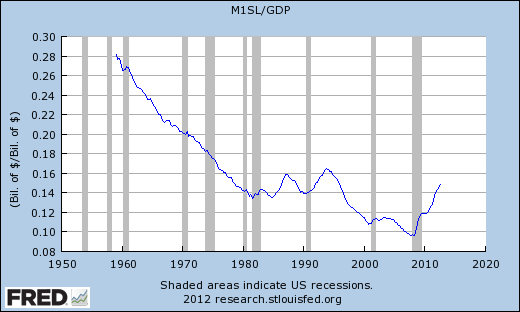
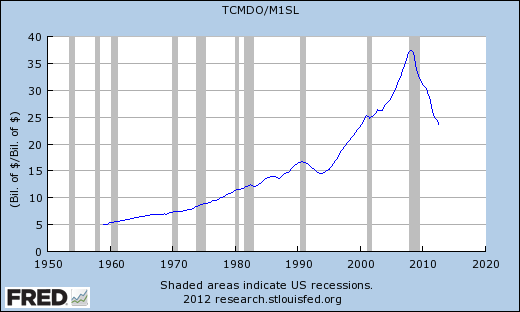
The deficit isn't a result of spending. It is a result of policy: of fighting inflation, and encouraging growth. The deficit is a result of these two policies, done in a very bad way for a very long time.
Policymakers pushed down the quantity of money in circulation to fight inflation:

Graph #1: Money in the Spending Stream per Dollar's Worth of Output
At the same time, they encouraged growth, spending, and the use of credit:

Graph #2: Total Credit Market Debt Owed per Dollar in the Spending Stream
The honest and honorable goals of fighting inflation and encouraging growth turned us into a nation with no money and inexplicable debt. That is why the economy refuses to grow. That is why tax revenue is down and "slump-related expenses" are up.
And that is why we have trillion-dollar deficits.
Woj’s Thoughts - Hard to argue with Art’s take on the matter. I might add that encouraging growth through private credit creation has also led to more wealth accumulation through capital gains. Subsequent policies that largely excluded capital gains from taxation exacerbated the above trends and can probably help explain a significant portion of wealth inequality witnessed today.

2) Why economics is rubbish, episode 324. by Sell on News @ MacroBusiness

It is an especially extreme example of scientism. It leads to a sort of homogenous nonsense. As the historian of science Stanley Jaki commented, such confusions are deadly to science itself. “By assigning unlimited relevance and competence to the scientific method, scientism rules out precisely that test. By setting quantitative exactitude as the only and supreme test of truth, scientism robs of meaning the world of qualities and values. By the same stroke it makes science meaningless as well. He then quotes GK Chesterton:

“Science, which means exactitude, has become the mother of inexactitude. This kind of vagueness in the primary phenomena of the study is an absolutely final blow to anything in the nature of science. man can construct science with very few instruments .. a man might measure heaven and earth with a reed, but not a growing reed.”
That latter point is crucial. The metrics used to “measure” economic and financial behaviour are growing reeds, they do not stand still. They grow in the minds of those who use them, used for trading strategies, to formulate polices, for the basis of consumer sentiment. Even if the quasi-scientific economic abstractions worked, they would not work.

3) yen dynamics by Warren Mosler @ The Center of the Universe

So it may be the case that Japan is in the process of resuming it’s traditional dollar and euro buying, which can move the currency to whatever level it desires. Which is probably back to north of 100 to the dollar?
Lastly, there is a record yen short position being reported. While this could mean it’s getting over sold and subject to a rally, it could also mean insiders have been tipped off to this policy shift and will profit immensely.
Caveat: If all the noises around the coming election and weak yen policy result only in an increase in the inflation target and ‘unlimited qe’ involving only yen financial assets, that policy will only serve to make the yen stronger and a wicked short covering scramble will follow.
Nothing short of buying fx, directly or indirectly, will do the trick.
Woj’s Thoughts - In a recent post on the re-election of Prime Minister Abe, I mentioned that the likely outcome was merely stepped up monetary policy tied to relatively restrictive fiscal policy. There has been no mention yet of direct fx purchases (that I’m aware of). If I’m correct that Japan will limit itself to NGDP targeting through unlimited QE, than investors should be wary of severe Yen strengthening in the not too distant future.

Thursday, December 6, 2012

Bubbling Up...12/6/12

1) Europe’s Avoidable Collision Course by Tyler Cowen @ The New York Times (h/t Mark Thoma)
It is thus a mistake to overreact to most of the headline events about the euro zone crisis. The good news is never quite as good as it looks, and the bad news often brings beneficial responses. It seems that for dozens of months now, we’ve been hearing that the fate of the euro zone will be decided “shortly,” yet somehow the drama continues.
Unfortunately, longer-lasting solutions require coordinated agreement among many euro-zone nations and, possibly, the broader European Union. That would include significant debt write-offs (as the International Monetary Fund is suggesting), quick moves toward better-integrated European banking institutions, and a general agreement that the European Central Bank unconditionally support troubled debt securities without trying to manipulate home governments’ policies.
Could all of that happen? For comparison, the current fiscal standoff in the United States involves no more than a president and two houses of Congress. In Europe, however, the bargaining is much more precarious, as it must span numerous nations, many of which have coalition governments, separation of powers and, in the case of Spain and Belgium, significant ethnic and linguistic division. The European Union has even had trouble concluding routine budget negotiations, the disputed parts of which concern no more than 0.03 percent of the union’s gross domestic product.
Woj’s Thoughts - Though I hold some differing views about the feasibility of the European Union with a common currency, in this piece I think Tyler is right on the mark. It has been fascinating and frustrating to watch markets seemingly overreact to every bit of European news. The supposedly best efforts of politicians and economists have, to date, failed to change the direction of economic growth and unemployment in the region. As I’ve stated previously, the clear optimism that remains among markets and Europeans is a positive sign of how deep faith in an eventual resolution lies. The likelihood of that optimism being rewarded is unfortunately minute in the near future and remains unfavorable for the long-run.

2) Mandated Employer Health Insurance Is Biased Against Small Business (in the US) by Peter Dorman @ EconoSpeak
This morning’s story about the problems small business owners face in complying with the ACA doesn’t surprise me.  My first gig as an economist, way back in 1979, was a summer internship at the Small Business Administration, where, among other things, I prepared an analysis of the impact of health insurance mandates on small firms.  It was a pretty rudimentary piece of work: I was just a grad student and had not yet studied how to do applied micro analysis.  Still, I was able to see the main story line.
Actually, I got two out of the three pieces of the story.  First, I saw that there are economies of scale in group health insurance, and without some form of organization above the firm level, small employers will pay a higher unit cost.  Second, and quantitatively more important, small firms in the US are substantially more labor-intensive on average, so an increase in labor costs hits them harder.  The third piece, which I missed at the time, is that wages are lower in the small business sector, so a mandated benefit of given cost will constitute a larger share of the wage bill.
But the US suffers tremendously from duality*—the division in the economy between larger, better-capitalized, more productive, higher-paying operations and smaller, less productive sectors that offer crummy jobs.  (It isn’t entirely a division between firms because some large firms have established their own internal “secondary” sectors.)  ACA should be examined in this context, especially since the administration hasn’t proposed any measures at all to reverse the trend toward greater duality, which is one of the underlying factors behind the growth in inequality.
Woj’s Thoughts - The other day I offered thoughts on Furthering the Post-Keynesian View of Wealth and Income Concentration, which entailed some great discussion within the comments. A question that I posed regarding a Job Guarantee is, how will it interact with the current market structure? The above post suggests a similar approach should have been considered with the ACA. Yes it will increase access to health insurance, but what if it also leads to larger unemployment and inequality? There is no question that trying to quantify these effects is difficult and imprecise, at best. The end result may have even been the same. All I’m saying is that I would generally prefer to see these macro-policy decisions examined in a broader context.

3) Conflicting signals on dollar-yen by Walter Kurtz @ Sober Look
Clearly investors have some good reasons to continue shorting the yen, as fundamentals for the currency are terrible. The BOJ balance sheet as percentage of GDP is at a record.
Source: Merrill Lynch
Based on these fundamentals Merrill obviously predicts a weaker yen. As one would expect, monetary expansion is unlikely to improve credit, but it should impact the FX markets.
Woj’s Thoughts - Obviously many people have been trying, unsuccessfully, to short the Yen for a long time. The BOJ's efforts to create inflation have been equally unrewarded. I continue to think that until the government pledges and follows through on a massive fiscal stimulus (deficit increases), the economy will remain stagnant and the Yen will remain a strong safe-haven.

Thursday, July 26, 2012

Steve Keen's Proposal for "Sub-Euros" and "an SDR of Europe"

Markets around the globe rallied following Mario Draghi’s statement that he would “do ‘whatever it takes’ to protect the euro zone from collapse.” Unfortunately, for market/Europe optimists, this statement was not accompanied by any specific forthcoming policy action or timeline for action. While open-mouth operations continue to scare the shorts and offer a short-term boost, the spike in optimism will once again be short-lived as growth concerns soon return to the fore.

Over the past couple years, I’ve remained pessimistic about the potential for a United States of Europe. Instead, I continue to believe that the EMU will eventually break-up but remain hopeful that free trade and labor mobility will persist. During this time, I’ve tried to highlight various proposals for solutions to the crisis that appeared both reasonable and feasible. Drawing from the work of Keynes, Friedman and Godley, Steve Keen offers a new proposal that re-institutes national currencies while maintaining the Euro as an SDR of Europe:

Some see the way out of today’s catastrophe as creating what does not exist—the United States of Europe. But if that were ever a possibility, it is far less one after the damage done by Maastricht, and the Franco-German insistence on austerity for the periphery in this crisis. However what is a possibility—and which has echoes in some of the contributions here (such as “Nau” proposal from Gerald Holtham)—is to move the Euro closer to a continental version of Special Drawing Rights.
The Euro could be the currency of inter-European and international trade, while “sub-Euros” created by each of the nations of Europe could be used for domestic trade and, importantly, domestic financial arrangements. The disciplinary aspects of Maastricht—which are currently inappropriately directed at government deficits and are amplifying the downturn—would then be redirected at trade deficits within Europe instead (and matched by pressures to minimize intra-European trade surpluses as well).
The Euro-Drachma, Euro-Peso and Euro-Mark could be introduced at one-to-one parity with the Euro, and all financial assets and liabilities would be denominated in these national currencies rather than the Euro. These national currencies would then float freely for a period (say one year), after which they would be fixed in proportion to the Euro.
The obvious devaluation that would occur for the Euro-Drachma and Euro-Peseta would reduce their foreign debts—and force the nations whose banks over-lent to them to deal with the consequences. It would also end the currency flight that is currently occurring: a Euro-drachma would still be a Euro-Drachma, whether it resided in a Greek or German bank account.
The introduction of such a system could provide a rapid resolution to the current crisis. It could not be pain free, but it would be difficult to imagine that it would impose more pain than is currently being felt by Greece and Spain, or is about to be felt by other countries once the contagion passes on to them.
This system would also introduce what is otherwise impossible in the Euro: exchange-rate flexibility. Economists as widely apart ideologically as Wynne Godley and Milton Friedman observed long before the Euro began that it would fail (a) because it imagined that a market economy would reach a harmonious equilibrium on its own without government intervention—which Godley correctly characterized as a deluded neoclassical fantasy; and (b) because it pushed together widely disparate nations which Friedman noted were utterly unsuited to a currency union.
A step backwards by Europe from dystopian fantastical object of a single currency, to a mini-version of what Bretton Woods should have been, could thus be a workable way out of this crisis and towards the political dream of a non-fractious Europe.

Friday, June 22, 2012

Currency Intervention and the Myth of the Fundamental Trilemma

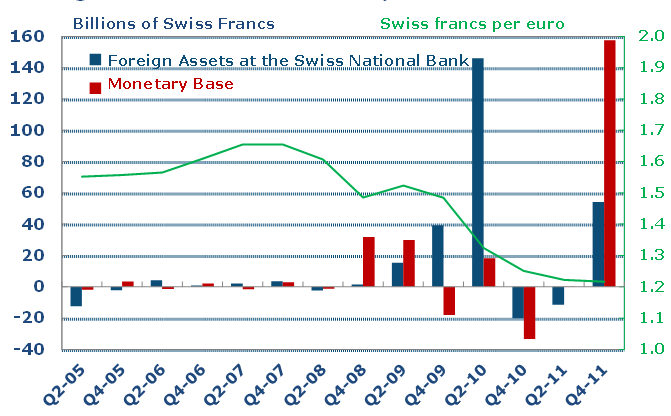
On Monday I linked to an article from VoxEU about the fundamental trilemma of international finance to display the recent massive increase in the Swiss National Bank’s (SNB) monetary base and foreign assets.
“The fundamental trilemma of international finance maintains that a country cannot simultaneously peg an exchange rate, maintain an independent monetary policy, and permit free cross-border financial flows (Feenstra and Taylor 2008).”
A conclusion of that article, which I accepted at the time, was that the SNB had given up control over its monetary policy in order to maintain a currency floor against the euro. Switzerland therefore provided a modern example of support for the trilemma.

The same article was posted over at Angry Bear earlier today. After thinking about the topic for a couple days and following comments by Philip Pilkington, I’m persuaded that my initial acceptance of the article’s conclusion was, in fact, incorrect. This view, in part, hinges on how one defines “monetary policy”, which I interpret as control over interest rates, and an “exchange rate peg”, which I take to include setting a currency floor. As Philip notes:

They could easily maintain control over interest rates by paying a set rate of interest on reserves, just like the US/UK/Japan do with their base rate.
As long as the SNB is willing to acquire unlimited amounts of foreign assets, it CAN “simultaneously peg an exchange rate, maintain an independent monetary policy, and permit free cross-border financial flows." The fundamental trilemma is therefore not fundamental at all, but simply another misunderstanding of our modern monetary systems.

Monday, June 18, 2012

SNB Massively Increases Monetary Base to Maintain Currency Floor


The Swiss National Bank then announced that it was prepared to buy foreign exchange in unlimited quantities to maintain a floor of SF 1.20 vis-à-vis the euro. The Bank’s holdings of foreign exchange increased substantially, but the Swiss monetary base increased by even more. Since September, the Swiss National Bank has maintained an exchange-rate floor, by giving up control of its monetary base in conformity to the fundamental trilemma.
Read it at VoxEU
Foreign-exchange intervention and the fundamental trilemma of international finance: Notes for currency wars
By Michael Bordo, Owen F Humpage and Anna J Schwartz
(h/t David Keohane at FT Alphaville)

Previously I detailed that the Swiss are struggling to maintain the currency floor as SNB Foreign-Currency Holdings Hit Record On Intervention. Apparently purchasing significant sums of foreign currency is not the only questionable byproduct of maintaining a currency floor against the euro. By setting a currency floor, the SNB has also given up control over monetary policy and thereby had to mimic the ECB’s balance sheet expansion. Although the monetary base expansion poses little cause for immediate concern, these actions can have the effect of reducing current interest income to the private sector and making future interest rate targeting more difficult.