Showing posts with label Corporate Balance Sheet. Show all posts

Monday, February 11, 2013

The Rise of Debt, Interest, and Inequality

According to Paul Krugman, he’s “had a mild-mannered dispute with Joe Stiglitz over whether individual income inequality is retarding recovery right now.” Since both Nobel Laureates were focusing on gross private savings, I broke down that measure by individual components and sub-components. Insights gained from those charts led to the conclusion that:
This data is consistent with rising income and wealth inequality but requires reversing Stiglitz’s “underconsumption” hypothesis. Trying to maintain relative consumption levels, many households clearly chose to rely on previous savings or new debt as a means of temporarily boosting consumption. As inequality continues to rise, wealthy households are now electing to retain more of their savings within corporations. It doesn’t take a leap of faith to suggest this combination of factors depresses aggregate demand.
Still unconvinced, Krugman has been searching for further data (see here and here) that would lead him to believe inequality really is holding back the recovery.

Hoping to aid Krugman in his quest and expand upon my “overconsumption” theory, let me respond to a critique of the previous post. Over at Mike Norman Economics, a commenter (Ryan Harris) kindly noted the obvious omission of interest income and sectoral balances. After sorting through interactive data from the Bureau of Economic Analysis, here are net amounts of monetary and imputed interest by sector [positive (negative) total implies sector receives (pays) net interest]:
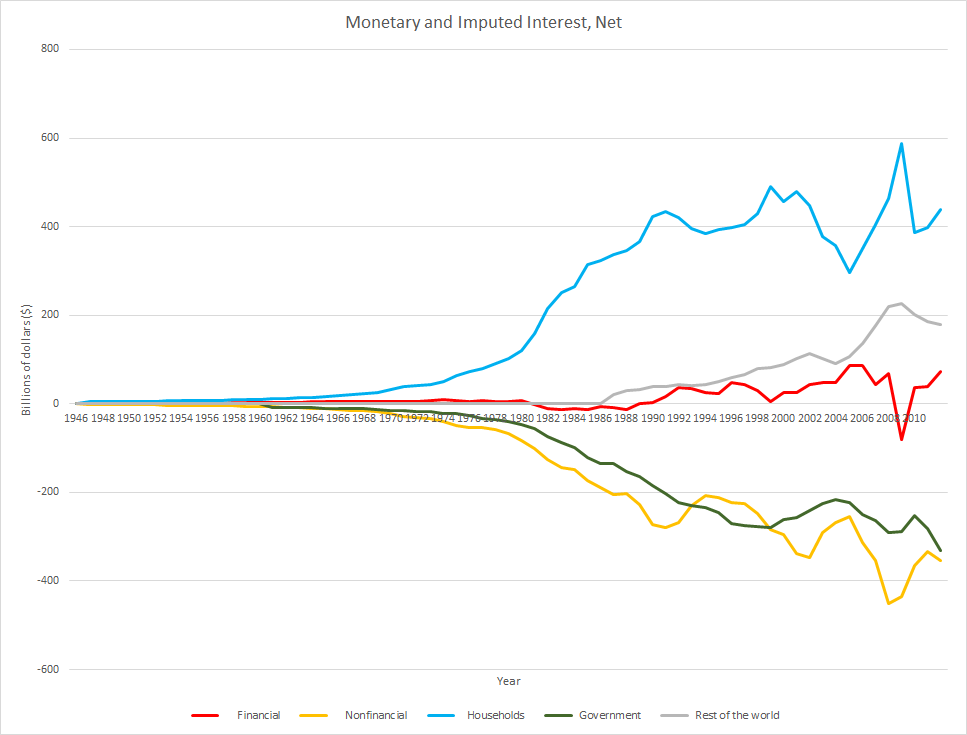

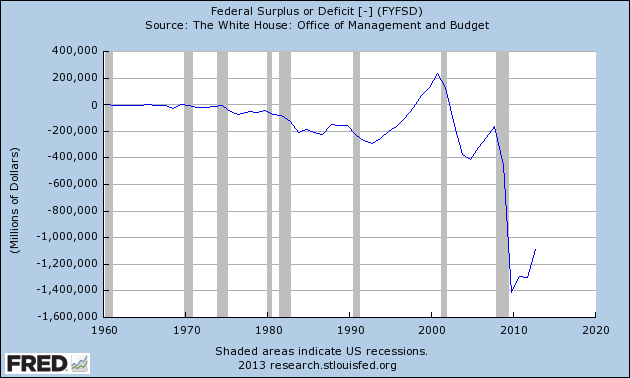
Unsurprising to those familiar with sectoral balance analysis, households net interest position took a sharp turn upwards when federal budget deficits began expanding more rapidly in 1980:
Around the same time, household interest income received a significant boost from the nonfinancial business sector. The pronounced decline in the net interest position of that sector aligns closely with high interest rates of the preceding period and a massive expansion of nonfinancial corporate debt shortly afterwards:
Since then the rise and fall of nonfinancial interest payments (and outstanding debt) has tracked the business cycle, with the overall trend remaining steadily lower (higher net payments and outstanding debt). Although these transfers support household income, they also increase income inequality since wealthy households hold a vast majority of financial assets (including corporate debt).

Turning to the foreign (rest of the world) sector, the U.S. current account (trade) balance fell heavily in the 1990’s:
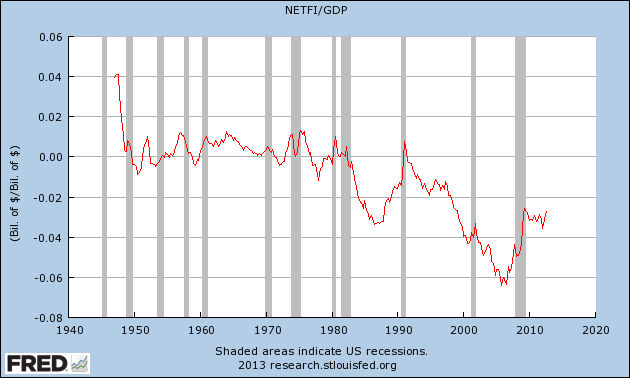
Foreign countries began amassing large quantities of U.S. financial assets (primarily Treasuries) corresponding to the substantial trade deficits. The growth in net interest receipts arising from these holdings represents an ongoing leak in domestic aggregate demand.
   
With the beginning of a new millennium and the dot-com bubble, a hostile environment was created for the household net interest position. Federal budget surpluses, declining interest rates, rapidly expanding trade deficits, and increasing payments to the financial sector (for housing) led to a nearly 40% decline in household net interest receipts. Combined with increasing income inequality, many households drew upon savings and increased demand for new debt to maintain previous levels of consumption.

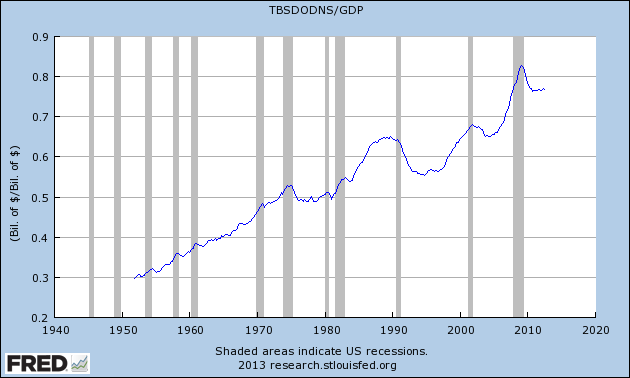
A side effect of the budget surpluses was a growing desire for safe financial assets separate from U.S. Treasuries. Securitization provided a means for new loans of varying risk to be converted into supposedly “super-safe” assets and transferred off of bank’s balance sheets. These factors encouraged banks to meet the surging demand for new loans coming from households (Chart: Household Debt-to-GDP):
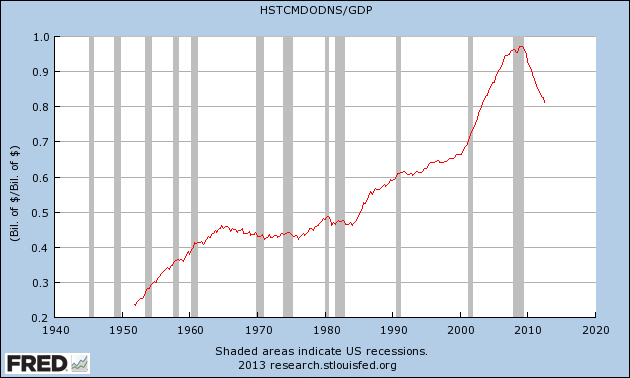
The effects of these transactions can also be seen in the transfer of net interest payments from households, and later businesses, to the financial sector. Apart from adding to inequality, these transfers reduce aggregate demand since, as Michael Hudson notes in The Bubble and Beyond, “financial institutions tend to save all their income.” (2012: Kindle Locations 6814-6815)

Since the financial crisis ended, the trend towards higher net interest receipts by the financial sector and greater net interest payments by the nonfinancial corporate sector have returned. These transfers of income up the income/wealth ladder serve to exacerbate the weak demand stemming from two decades of stagnating household interest income. Unfortunately, and so far unsuccessfully, public policy (fiscal and monetary) remains dedicated to originating a new private debt led boom.  

The changes in net interest payments/receipts over the past few decades highlight the growing income and wealth disparities present in our society. For many years households dug themselves deeper in debt to maintain relative consumption levels. The costs of excessively accumulating private debt have now been recognized, but the burden of interest payments suppressing aggregate demand will be felt for years to come.  

  
Bibliography
Hudson, Michael (2012-10-04). THE BUBBLE AND BEYOND (Kindle Locations 6814-6815). ISLET. Kindle Edition.

Friday, July 13, 2012

Why I'm Still Not Buying Big Bank Stocks

Recently Mike Sax, who has an interesting blog titled Diary of a Republic Hater, offered this claim:
No one I speak to thinks the banks are a good bet even at bargain basement levels. Not Nanute, not dwb at Money Illusion, now WOJ who writes Bubbles and Busts has added his name to the list.
My position on the large US banks has remained skeptical for quite some time. Although reported earnings have been strong over the past couple years, a decent percentage of those earnings stemmed from debt-value adjustments (DVA) and the release of loan loss reserves. Add to those uncertainties the continuing halt of market-to-market accounting, unknown off-balance sheet positions and on-going legal liabilities due to frauds stemming for mortgages to LIBOR. Further, JPM is now openly discussing traders’ marking positions to hide losses, which is almost certainly far more pervasive than the disclosure suggests. The lack of transparency at these financial institutions simply presents more risk than I’m willing to take.

For some investors the earnings potential of the major banks may be significant enough to overlook the lack of transparency. As I pointed out to Mike in the comments:
Check out this post from the Brooklyn Investor (http://brooklyninvestor.blogspot.com/2012/06/banks-real-nightmare.html.) Low interest rates could be terrible for bank earnings.
That post shows the disastrous effects of low interest rates on the earnings potential for Japanese banks. Apparently the Bank of International Settlements (BIS) also fears a similar occurrence in the US. Timothy Taylor drew my attention to a BIS paper on Dangers of Continually Expansionary Monetary Policy. The section, noted by Taylor, most pertinent to this discussion is:
"Implications of effective balance sheet repair as a precondition for sustained growth"
"Ultimately, there is even the risk that prolonged monetary easing delays balance sheet repair and the return to a self-sustaining recovery through a number of channels. First, prolonged unusually accommodative monetary conditions mask underlying balance sheet problems and reduce incentives to address them head-on. ... [L]arge-scale asset purchases and unconditional liquidity support together with very low interest rates can undermine the perceived need to deal with banks’ impaired assets. ... And low interest rates reduce the opportunity cost of carrying non-performing loans and may lead banks to overestimate repayment capacity. All this could perpetuate weak balance sheets and lead to a misallocation of credit. ...
"Second, monetary easing may over time undermine banks’ profitability. ... Low returns on fixed income assets also create difficulties for life insurance companies and pension funds. Serious negative profit margin problems associated with the low interest rate environment contributed to a number of life insurance company failures in Japan in the late 1990s and early 2000s. ...
"Third, low short- and long-term interest rates may create risks of renewed excessive risk-taking. ...  However, low interest rates can over time foster the build-up of financial vulnerabilities by triggering a search for yield in unwelcome segments. There is ample empirical evidence that this channel played an important role in the run-up to the financial crisis. Recent large trading losses by some financial institutions may indicate pockets of excessive risk-taking and require scrutiny.
"Fourth, aggressive and protracted monetary accommodation may distort financial markets. Low interest rates and central bank balance sheet policy measures have changed the dynamics of overnight money markets, which may complicate the exit from monetary accommodation ..."
The combination of all these risks is simply too large for me to consider investing in the big banks, even at current low levels. Obviously my position on the banks could be too risk averse and the stocks may prove big winners. In my opinion, there are many other sectors and companies with equally compelling valuations, better prospects and less uncertainty. Ultimately the decision is up to you though...best of luck!  

Tuesday, June 12, 2012

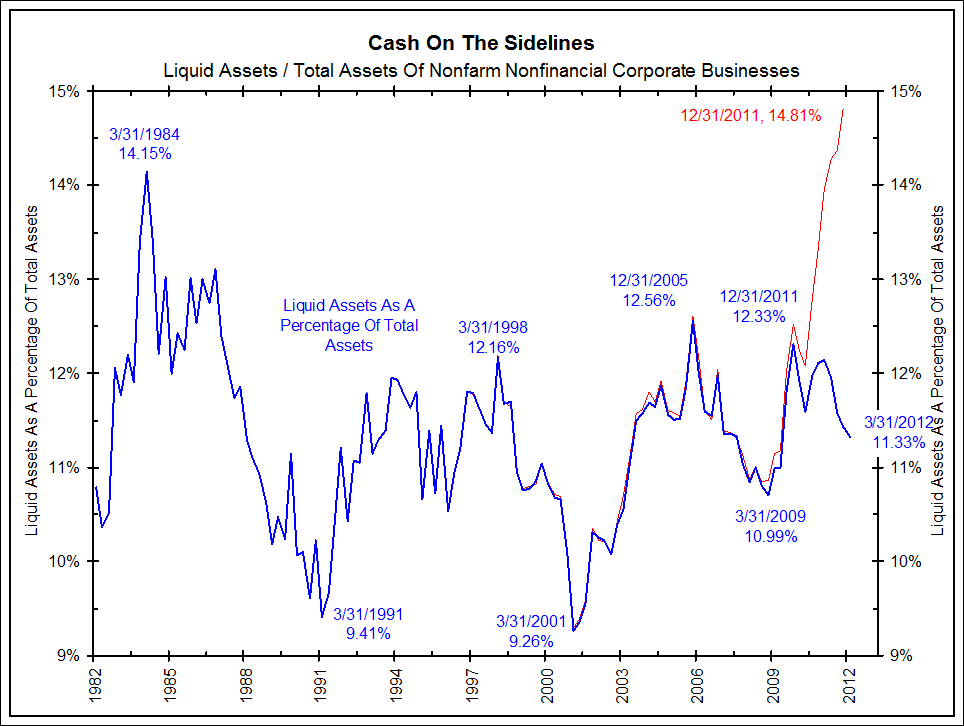
Poof! Cash on the Sidelines Disappears


Through Q1 2012, nonfarm nonfinancial corporate businesses held $1.74 trillion in liquid assets on their balance sheets. In the latest revision, nearly half a trillion dollars of cash disappeared.
Where did the cash go? It disappeared as the Federal Reserve is now saying it never existed in the first place.


Read it at The Big Picture
By James Bianco

So much for the bullishness of excess cash sitting on corporate balance sheets. This is a perfect example of the importance in maintaining a healthy level of skepticism regarding data. That data can be revised to this degree in the US should definitely provide reason to pause when considering economic data from China, which is never revised.