Rational nerdiness vs macho bada$$ery in monetary policy by Cardiff Garcia @ FT Alphaville
The US economy has had several false starts since 2009, and it’s likely that several tangled factors were responsible for their not lasting longer. It’s reasonable to think that one of these factors was that the initial reflationary effects of these unconventional measures faded, because of doubts about the Fed’s commitment to maintaining accomodative policy during a period of catch-up growth. If such growth threatened to generate above-target inflation, then monetary conditions could be expected to tighten.
The rational-nerdy thing to do was to soften the macho commitment to inflation and commit to a temporary period of inflation-tolerance, thereby balancing the two sides of the mandate — but to do so while retaining credibility on both. But as Harless notes, ceding a little ground on one side could be interpreted as ceding all ground. Being a “macho badass” central banker means credibly committing to never cede ground.
…
All of which has been a long windup to saying that the appeal of the Evans Rule, and if we ever get it, some variation of NGDP level targeting, is this: they institutionalise the macho badassery, which in a dual-mandate framework can only be applied to one of the two mandates.
Woj’s Thoughts - This post is reminiscent of a thread from last year involving Steve Roth and Ryan Avent on The Asymmetric Nature of Monetary Policy. In that post I made the following claim:
Whereas Roth suggests that asymmetric credibility stems from the Fed’s actions, I believe it is actually an inherent condition in our current monetary system. The Fed sets the base price for money and credit, but with private banks free to create credit, it holds relatively little control over the total amount outstanding at any time. As growth in the US has exceeded inflation for much of the past three decades, the conditions were ripe for borrowing and credit outstanding now greatly surpasses the sum of base money.
Even if the Fed promised indefinite QE, it’s hard to see the mechanism, aside from adjusting inflation expectations (wealth effects are minimal), by which this would spur real growth. Given the Fed’s skewed abilities and determination to maintain its credibility, it seems more obvious why inflation targeting remains prominent. Further, this may help explain why the Fed downplays its employment mandate (which should be removed anyways). Facing the endgame, the Fed knows it can reduce inflation (and growth) but remains unsure how successful it could be at achieving other targets.
Sucumbing to pressure, the Fed has finally decided to cede ground on its commitment to inflation. Unfortunately for the Fed, both inflation expectations and unemployment are not cooperating:
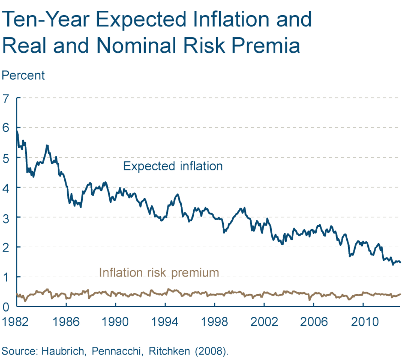
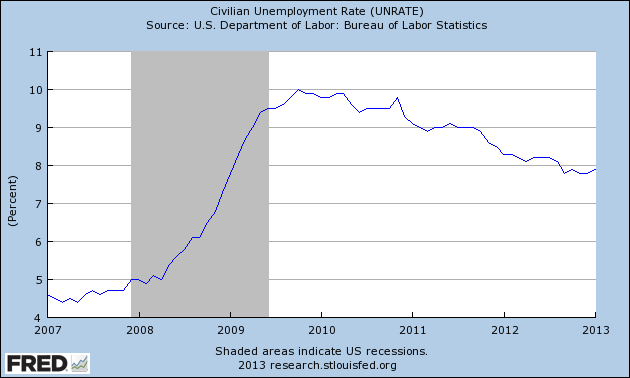
At this point I doubt whether even altering inflation expectations would provide any boost to actual inflation or employment. If fiscal policy continues to contract the budget deficit, these numbers will continue moving in the wrong direction. The Fed has taken a big risk with its established credibility. I fear the results will be very disappointing.
Nick Rowe recently discussed the Bank of Canada’s success and failure in inflation targeting versus maintaining a stable NGDP growth path. Looking at Rowe’s charts, Stephen Gordon points out that during the period in question:
producer prices (roughly approximated by the GDP deflator) grew much more quickly than consumer prices (roughly approximated by the CPI).
If the Bank of Canada were to begin targeting NGDP in the future, it would effectively be altering the primary measure of inflation in its goal. This leads Gordon to beg the question, What should a central bank do when producer and consumer prices diverge?
My (possibly incomplete) understanding is about how inflation affects welfare is on its effect on the price of consumption goods, especially in a world where nominal wages are slow to adjust. So it makes sense to me to make consumer prices the focus of attention and let producer prices go.
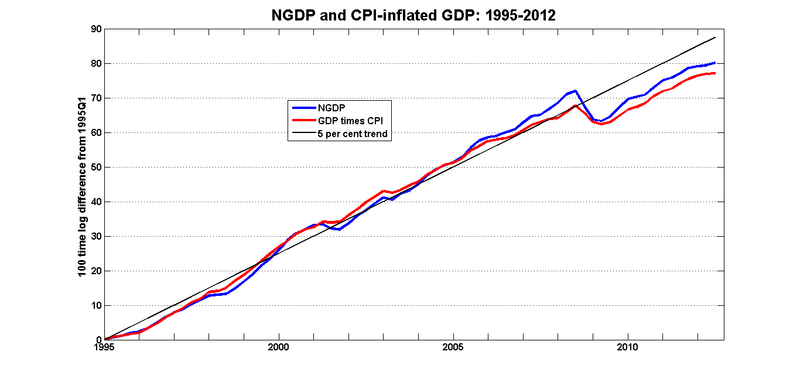
I'm not sure how to interpret this next graph, but I made it and I may as well post it. It compares NGDP with the series you get when you multiply real GDP by the CPI. I guess it's the counterfactual NGDP series for the scenario where producer prices and CPI stayed together:
Gordon and Rowe’s focus is strictly on Canada, but given the hype surrounding NGDP targeting in the US, it might prove interesting to compare similar data. The following charts compare the GDP deflator and CPI between both countries over the same time period:
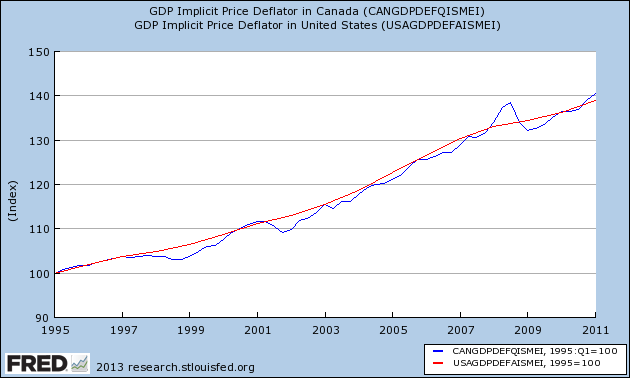
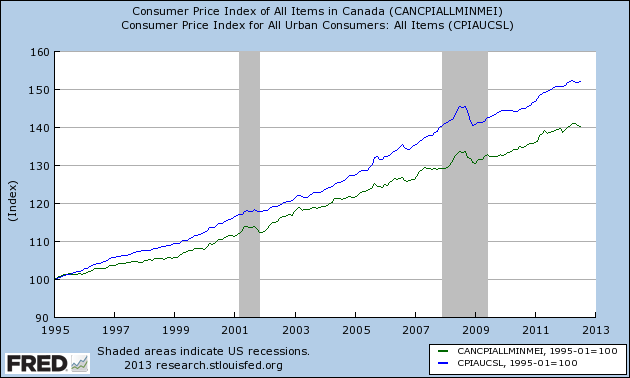
While producer prices between the two countries remained closely tied throughout the period, consumer prices in the US began diverging from their Canadian counterpart immediately and the gap continues to widen today. Shifting focus to the U.S., the data series for consumer and producer prices are combined into one chart. Returning to discussion of central bank policy, as well, it’s important to include the Federal Reserve’s preferred measure of inflation, core-PCE: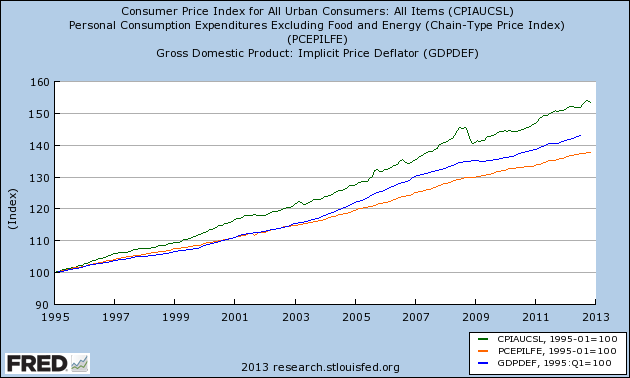 The inclusion of core-PCE helps resolve the discrepancy between consumer prices in Canada and the US. Of note is the dramatic difference between CPI and core-PCE over the past two decades. As I understand Fed policy, CPI (or PCE) is too volatile a target due to the wide swings in food and energy prices. Over time, however, the total and core measures are expected to converge. Depending on the time frame one assigns to the long-run (~18 years seems reasonable), the double-digit difference suggests that Fed policy has been looser than many believe. The Fed’s success has been limited to targeting core inflation, while food, energy and asset prices (not accounted for in CPI) have drifted significantly higher.
Returning to Gordon’s chart and altering data to depict the US, these last two charts show a “counterfactual NGDP series for the scenario where producer prices and CPI stayed together.” 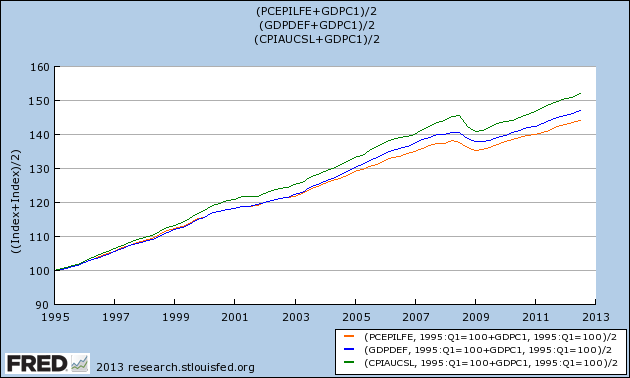
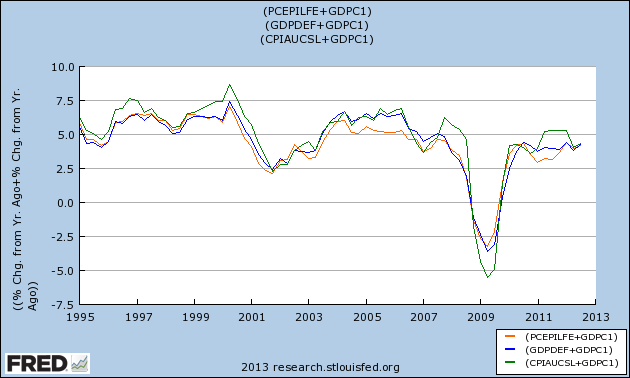 Regardless of the inflation measure chosen, the Fed’s policy was clearly too loose in the decade preceding the most recent recession. In fact, an interest rate targeting regime focused on core-PCE permitted the Fed to remain looser than it would have been following either of the other indexes.
Gordon concludes with “the question of what happens to the volatility of consumer prices if we adopted NGDP targeting.” Oddly enough, the divergence of core-PCE from the GDP deflator began around the same time the Fed started targeting core-PCE in 2004. Is it possible that the Fed’s actions altered the relationship between core-PCE and the GDP deflator? The similarities between Canada and the US during that period suggests not, but it’s worth considering. Separately, will the stark difference between CPI and core-PCE ultimately correct or has the world entered a new era of food and energy inflation?
My guess is that the volatility of core consumer prices will change only slightly under an NGDP targeting regime, while total consumer prices become far more volatile. Apart from my concerns about the viability of NGDP targeting, its effect on consumer prices raises important questions about wages and welfare costs. Hopefully these potential unintended consequences of NGDP targeting are being carefully considered before such a policy is actually implemented.
Another solid post by Izabella Kaminska at FT Alphaville on The unintended consequences of QE. This one offers observations from a Federal Reserve Bank of Dallas working paper, by William White, about “Ultra Easy Monetary Policy and the Law of Unintended Consequences“. Here is one section worth highlighting:
A further concern is that the reductions in real rates seen to date, associated with lower nominal borrowing rates and seemingly stable inflationary expectations, might at some point be offset by falling inflationary expectations. In the limit, expectations of deflation could not be ruled out. This in fact was an important part of the debt/ deflation process first described by Irving Fisher in 1936. The conventional counterargument is that such tendencies can be offset by articulation of explicit inflation targets to stabilize inflationary expectations. Even more powerful, a central bank could commit to a price level target, implying that any price declines would have subsequently to be offset by price increases.
However, there are at least two difficulties with such targeting proposals. The first is making the target credible when the monetary authorities’ room for maneuver has already been constrained by the zero lower bound problem (ZLB). The second objection is even more fundamental; namely, the possibility that inflationary expectations are not based primarily on central banker’s statements of good intent. Historical performance concerning inflation, changing perceptions about the central banks capacity and willingness to act, and other considerations could all play a role. The empirical evidence on this issue is not compelling in either direction.
Repeating a key statement there, contrary to the hopes and dreams of market monetarists, the Fed surprisingly admits that:
inflationary expectations are not based primarily on central banker’s statements of good intent.
Moving on, another portion of the paper expresses concern that low rates will hurt margins in various means of financial intermediation. Japan remains a good example in this matter as low interest rates and a flattening curve have drastically reduced net interest margins, almost entirely wiping out profitability among the banks. Separately, we should heed the lesson from Denmark that negative rates (which reduce margins) can pressure banks to compensate by charging higher rates on loans.
All of this gets back to an issue previously discussed by Ryan Avent, Steve Roth and others, which is the asymmetric nature of monetary policy. In short, the Fed’s ability to fight inflation is far greater than its ability to create it.
In conclusion, Kaminska and White are spot on:
Yet herein lies the irony. For, if it’s clear that low-yield policies and QE buy time, and only time, this inevitably puts the onus on governments, not central banks, to steer the economy out of the path of the unintended consequences of monetary policy.
Indeed, as White concludes:
If governments do not use this time wisely, then the ongoing economic and financial crisis can only worsen as the unintended consequences of current monetary policies increasingly materialize.
Monetary policy provides a bridge to an expected future outcome, but cannot ensure the structure (economy) on the other side is built high enough. Governments, through fiscal policy, must provide institutions and incentives to support (or at least not hinder) growth. The US government has performed far better than those in Europe, but has still fallen short. As we approach the end of the monetary bridge, it appears there may be a steep drop ahead.
The FOMC is beginning a two-day meeting, in which market expectations are high that new monetary stimulus will be enacted (though economists and analysts have recently shifted their expectations to September). Apart from those pushing for monetary stimulus as a means of NGDP targeting, a number of others claim the Fed should act because it is failing on both aspects of its dual mandate. Previously I’ve noted the difficulty faced by the Fed in meeting its employment mandate, so for today I want to look at the price stability mandate.
When discussing the price stability mandate, most commenters typically refer to an inflation target of 2% based on the FOMC’s preferred measure of core PCE inflation (See the report for more on previous measures and Bernanke’s argument for using a measure of core inflation). The preferred measure is clearly set forth by the FOMC, but what about the 2% target? Widely regarded as being explicit, actual Fed statements regarding a target suggest otherwise. In 2010, the Federal Reserve Bank of St. Louis published a short essay asking, Is the Fed’s Definition of Price Stability Evolving? The essay points out that:
Relatively few Federal Reserve officials have publicly indicated what level of the inflation rate corresponds to price stability.
Noting a few exceptions, the essay highlights comments by former Fed officials, William Poole and Alan Greenspan, suggesting a target for core inflation closer to 1%. One might dismiss these comments as irrelevant today so instead, consider those made by current Chairman Bernanke (my emphasis):
It is not clear whether Chairman Bernanke, or any other current member of the FOMC, accepts either of these definitions of price stability. However, before he replaced Greenspan in January 2006, then Fed Governor Bernanke publicly stated in 2005 that his “comfort zone” for core PCE inflation was between 1 and 2 percent. More recently, Bernanke stated that the FOMC’s “mandate-consistent inflation rate” is generally judged to be “about 2 percent or a bit below.”
Unless Bernanke has made more recent statements revising this judgment, 2% is clearly not a target but rather the ceiling of his target range. Having clarified the Fed’s own measurement of success, here is graph showing the actual results of core PCE since 2000:
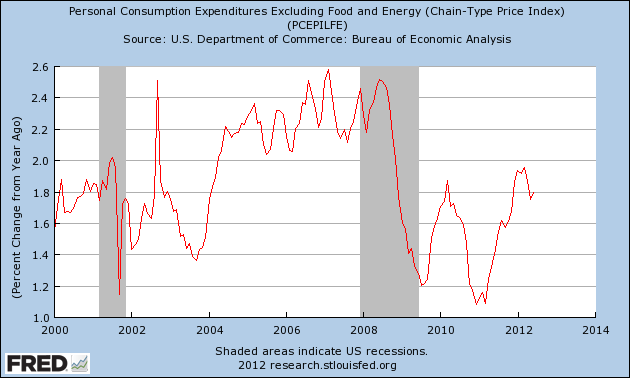
Inflation falls noticeably below Bernanke’s range in late 2009 and then again in late 2010. However, take a close look at the inflation readings during the first half of 2012. Core PCE has averaged 1.9% and held within a range just below 2%. One can argue about the correct measure or target the Fed should use, but by the Fed’s own standard of price stability, current policy is proving very successful. If these conditions persist, those hoping for further monetary easing may be disappointed.
Steve Roth, over at Angry Bear, recently had a good post on the future of monetary policy titled, The Fed Faces the End Game -- And Blinks? Roth elaborates on a game theory perspective outlined by Ryan Avent:
After three decades of taking away the (wage- and employment-)growth punchbowl when the party starts getting (“too”) hot, and after four years of subordinating their employment mandate to their cherished inflation-control credibility, the Fed has a serious shortage of “growth credibility.”
Which means that the Fed has created a game that is asymmetrical. It has great power to quash growth through open-mouth operations; we know they’ll sell bonds if they promise and need to, and that doing so will dampen inflation (and growth).
But on the expansionist side, we can’t believe their promises. They would need to make actual bond purchases to spur growth. And even if they do both promise and live up to the promise, we (with the exception of [market] monetarists, few of whom are running large businesses or managing large amounts of money) don’t have great or certain expectations for the results.
In Search for Austerity Continues as Central Banks Undermine Stimulus, I made a similar observation:
central banks ability to affect inflation, and to a lesser extent growth, is heavily skewed in favor of slowing either measure.
Whereas Roth suggests that asymmetric credibility stems from the Fed’s actions, I believe it is actually an inherent condition in our current monetary system. The Fed sets the base price for money and credit, but with private banks free to create credit, it holds relatively little control over the total amount outstanding at any time. As growth in the US has exceeded inflation for much of the past three decades, the conditions were ripe for borrowing and credit outstanding now greatly surpasses the sum of base money.
Even if the Fed promised indefinite QE, it’s hard to see the mechanism, aside from adjusting inflation expectations (wealth effects are minimal), by which this would spur real growth. Given the Fed’s skewed abilities and determination to maintain its credibility, it seems more obvious why inflation targeting remains prominent. Further, this may help explain why the Fed downplays its employment mandate (which should be removed anyways). Facing the endgame, the Fed knows it can reduce inflation (and growth) but remains unsure how successful it could be at achieving other targets.
Therefore it seems I actually agree with Avent’s conclusion and Roth’s translation:
Ryan thinks that the Fed’s afraid that it:
…will need to roll out dramatic, unconventional actions—the fear being, of course, that such actions would leave it hopelessly politicised and powerless to fight inflation. … [They're] fighting to maintain their vulnerable independence.
Translation: They’re fighting to avoid the MMT-World end game, where the Fed becomes an irrelevant mechanical actor.
Related posts:
Political Fears May Keep ECB Easing On Hold
Fed's Treasury Purchases Now About Asset Prices, Not Interest Rates
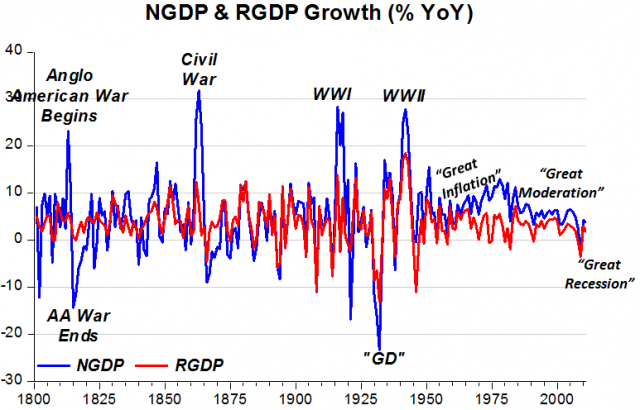
In a recent post on the topic of Nominal Spending & Output Growth – A long history, Marcus Nunes at Historinhas, displays the following chart to show that
since the 1980s, and increasingly, nominal and real growth have become more tightly knit.
A few weeks ago, following some back and forth with Unlearning Economics On the Lousy Reasoning Behind NGDP Targeting I commented:
Woj - As long as the CB is reasonably successful at targeting low inflation, NGDP and RGDP will obviously be highly correlated over time. However, if the CB were to target quantity rather than price, I’d imagine that RGDP and NGDP might be less correlated. Is it possible that much of the correlation stems from current CB policy and that changing policy would also change the relationship?
Attempting to support this view, I expanded on the topic in a couple posts: NGDP Targeting: Changing Policy Changes Relationships and NGDP Targeting: Changing Policy Changes Relationships (Part 2).
Yesterday I posed the following question to Marcus:
Why will changing policy to promote higher inflation today not cause a breakdown in the correlation of the past 30 years, similar to the 1970’s?
Marcus was kind enough to not only reply, but also to direct me through email to his take on NGDP Targeting in The crisis from an AD perspective. The post is well constructed and a generally good read on the subject. The specific quote that struck comes near the end:
I wonder in what kind of world we would be living today if 20 years ago the group that argued for the stabilization of AD growth (level targeting) as the rule to be followed by MP had won the debate over those that proposed IT with the interest rate as the policy “instrument”. Quite likely we would be experiencing much less “fiscal stimulus” with all its attendant risks.
Although I remain a skeptic on NGDP Targeting and the impact of monetary policy more broadly, I entirely agree that fiscal policy holds far more “attendant risks.” In choosing between flawed monetary policies, the one that reduces the need for “fiscal stimulus” may very well be favorable. As I noted in a reply to Marcus and Saturos, my hesitation on NGDP Targeting stems from a Minsky/MMR view under which private credit creation/lending (through banks) can and currently does significantly influence aggregate demand. The ability of monetary policy to control NGDP would therefore be weak and skewed towards reducing NGDP. Further, the amount of monetary stimulus necessary to try and meet targets may not be politically feasible.All that being said, I’m not exactly a supporter of inflation targeting either, as discussed in Inflation Targeting Shifted Fed Focus to Constraining Aggregate Demand. Hopefully, in time, the lessons from NGDP supporters and the Minsky/MMR crowd can align to find common ground on monetary policy. Until then I remain open to and interested in new methods of monetary policy (including free banking) that offer improvements over inflation targeting.

