Last year I took a chance and threw my own projections into the ring. Similar to Byron Wien and Edward Harrison, I mostly selected events that were widely seen as having a low probability (less than 33%) but which I believed held a greater than 50% chance of occurring. The final results were a bit disappointing, but that won’t stop me from trying again this year. Since these predictions already represent a late release, without further adieu, here are the 2013 predictions:
1) Spain requests access to ECB’s OMT - Since ECB President Mario Draghi announced the OMT program, yields on Spanish debt have fallen rather dramatically. Although this eases financing pressure, it has done little to alter the actual economy’s downward spiral. During 2012 Spain’s GDP growth became increasingly negative, falling by 1.8% year-on-year in the fourth quarter. Meanwhile unemployment continues its meteoric rise to over 26% for the general population and nearly 60% for youth. With the large banks still severely undercapitalized and households over-indebted, private sector lending continues to decline:
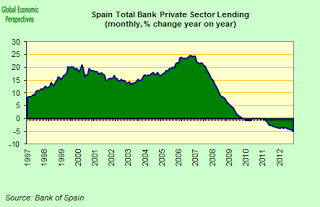
Seeing no recovery and potentially a worsening decline, “bond vigilantes” will eventually test Draghi’s threat. At that point Spain will be forced to accept a Memorandum of Understanding (MoU) in return for ECB bond-buying through the OMT program.
2) The Euro finishes the year above $1.30 - After falling nearly 10% during the first half of 2012, the euro has more than recouped its losses on the back of optimism and deflationary policies.
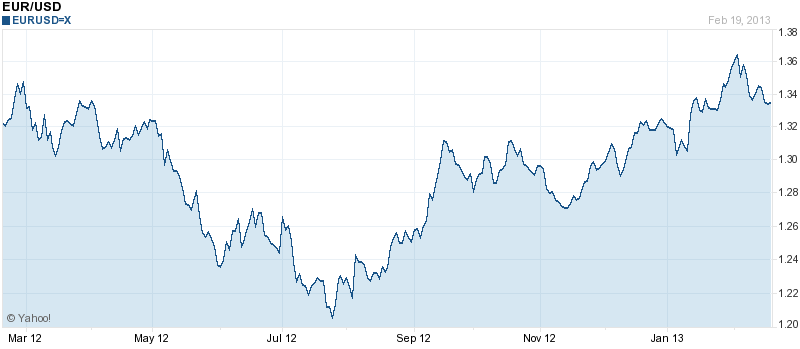
At points during 2013 the optimism is likely to fade, but I expect politicians and central bankers will take the necessary steps to quell fears for the time being. Unfortunately those steps will involve further deflationary policies that push the euro higher. These competing forces will largely cancel out, leaving the euro close to or above where it began the year.
3) The Eurozone remains in recession the entire year - Forecasters now expect euro-zone economic activity to be flat this year, down from a previous prediction of 0.3% growth made just three months ago. Last year saw practically continuous downgrades to GDP growth forecasts and I expect this year to be no different. Austerity measures are momentarily easing, but more will likely be enacted based on the outcomes of several elections. The recent appreciation of the euro against several major currencies will also dampen growth by putting pressure on net exports. With banks across Europe trying to build up capital and persistently high unemployment, the private sector will remain especially weak. Though Germany may experience a temporary rebound, the Eurozone as a whole will not register GDP growth this year.
4) The Japanese yen rises above 90 per $ - Since the election of PM Shinzo Abe, the yen has fallen fast and is down more than 20% from recent highs.
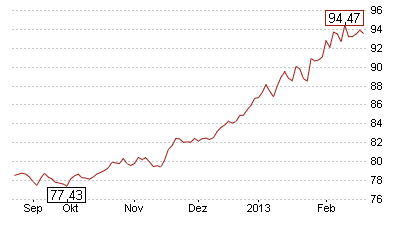
During this time the Nikkei has risen more than 20%, yet yields on Japanese sovereign debt are little changed. This suggests many foreigners may be speculating on the supposedly forthcoming monetary and fiscal stimulus. As previously stated, the fiscal stimulus will probably be small and short-term. On the monetary front, short of actually entering the foreign exchange market, the Bank of Japan (BOJ) has essentially no mechanism to spur inflation and thereby cause a sustained depreciation of the yen. When market participants recognize the inability of Japan to avoid continued deflation, the yen will return to appreciating against the dollar.
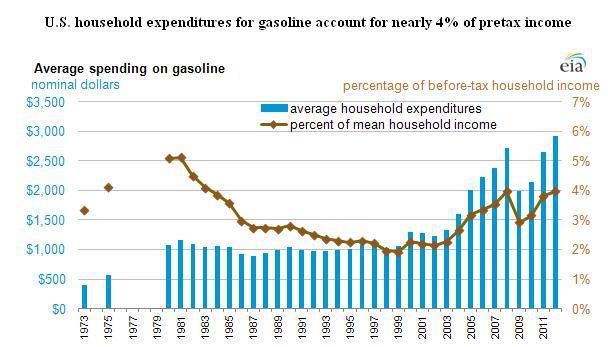
5) Gas prices will peak above $4.20 per gallon and set a new yearly record-high average above $3.75 per gallon - Gasoline prices have been on the rise for the past 31 days, currently averaging approximately $3.75 per gallon. Though this current streak will probably end soon, prices are unlikely to give back much of the gains before beginning the typical rise into summer. The ongoing potential for flare ups in the Middle East will keep prices elevated throughout the year. Higher gas prices, which already account for 4% of before-tax household income (chart below), will be a drag on consumer spending in 2013.
6) U.S. Yearly GDP growth falls below 1.5% - Forecasts of ~3% annual GDP growth over the past couple years have been overly optimistic as real growth in 2011 and 2012 was merely 1.6% and 1.9%, respectively. Apparently forecasters are being a bit tamer in their estimates this year, now expecting only 2% annual growth. Unfortunately I suspect these estimates will once again prove too optimistic. Various tax hikes and the upcoming sequester (which will go through in some respect) will reduce the budget deficit by a few percent this year. Housing is likely to remain a bright spot, but further declines in interest rates will not lead to similar magnitudes of the wealth effect. Credit remains tight for many households and small business, which should also limit private sector activity. All of these factors combined will probably not be enough to bring about a new recession but will lead to the lowest annual growth rate during this upswing.
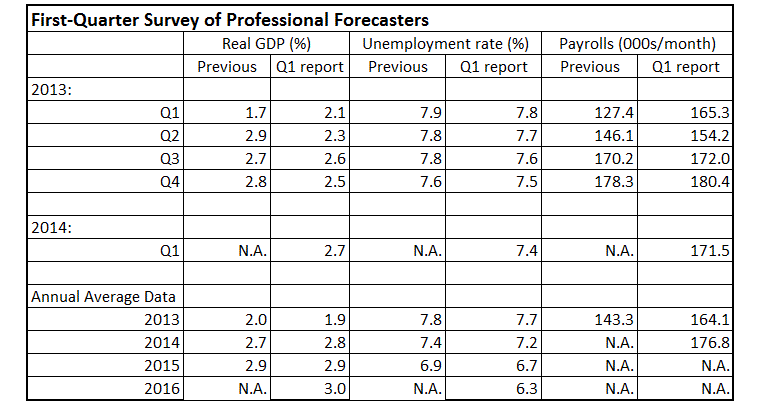
7) U.S. Unemployment rises above 8% - Currently sitting at 7.9%, the unemployment rate is forecast to decline during 2013. Due to weaker GDP growth, corporate revenues will barely rise again this year. As companies face increasing pressure to maintain profit margins at record levels, a new wave of layoffs may occur. Separately, continuing economic growth will encourage previously discouraged workers to re-enter the job market. Both of these factors will lead to slightly higher measured unemployment.
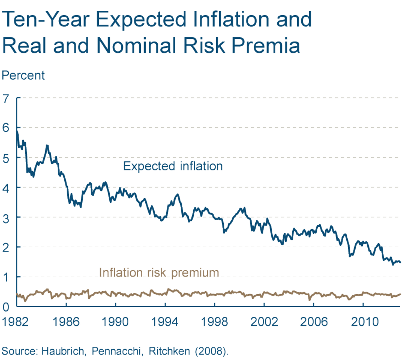
8) Federal Reserve forecasts shift first rate hike to 2016 - After extending their forecast for the first rate hike to 2015, the Federal Reserve changed its tactics to a more rule-based monetary policy. The Fed has, in effect, promised to keep rates low until we've hit either 6.5 percent unemployment or 2.5 percent inflation. Based on the above outlook for unemployment and a continuing decline in inflation expectations (chart below), FOMC members will revise their own forecasts and push back expectations for the first rate hike.
9) U.S. Corporate Earnings (ex-Federal Reserve) finish year below 2012 peak - Meager revenue growth was not enough to prevent U.S. Corporate Profits after tax from reaching record highs in the fourth quarter of 2012 on the back of record profit margins.  As global growth slows in 2013, revenues will come under further pressure. At this point the ability of firms to continue cutting costs without sacrificing output seems limited, which means margins may begin to compress. As margins revert to previous norms, earnings will register a yearly decline.
10) Bonds outperform stocks - During the first seven weeks of this year the stock market has been on fire, even though earnings estimates continue to fall.
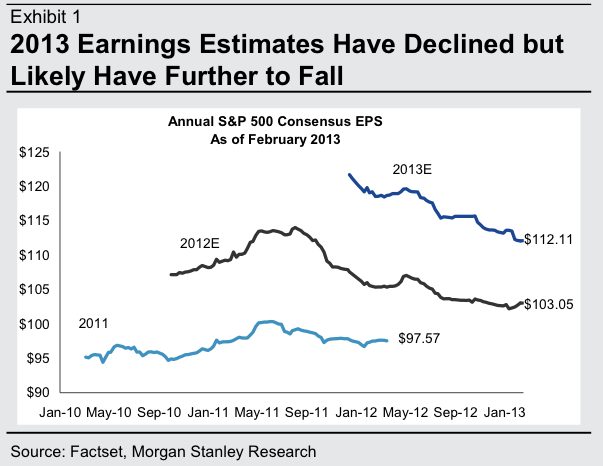
Multiple expansion is currently being driven by the Federal Reserve’s actions despite their ineffectiveness at generating actual NGDP growth. When investors eventually turn their attention to continuing troubles in Europe, ongoing deflation in Japan, and/or weakening growth in China, U.S. earnings may once again enter the picture. Recognition that S&P 500 earnings growth has slowed substantially may cause the market to give up much of this year’s gain. These concerns combined with declining inflation expectations will result in many investors returning to the safety of U.S. Treasuries. The subsequent rise in prices (decline in rates) will generate another year of positive returns for the Treasury market.
Will my predictions prove too pessimistic once again? Only time will tell...
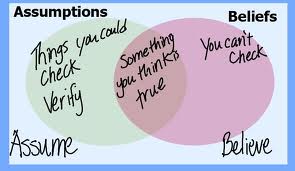
1) Against Friedman: Why Assumptions Matter by Unlearningecon @ Unlearning Economics
In my opinion, Friedman’s essay is incoherent even on its own terms. He does not define the word ‘assumption,’ and nor does he define the word ‘prediction.’ The incoherence of the essay can be seen in Friedman’s own examples of marginalist theories of the firm. Friedman uses his new found, supposedly evidence-driven methodology as grounds for rejecting early evidence against these theories. He is able to do this because he has not defined ‘prediction,’ and so can use it in whatever way suits his preordained conclusions. But Friedman does not even offer any testable predictions for marginalist theories of the firm. In fact, he doesn’t offer any testable predictions at all.
Friedman’s essay has economists occupying a strange methodological purgatory, where they seem unreceptive to both internal critiques of their theories, and their testable predictions. This follows directly from Friedman’s ambiguous position. My position, on the other hand, is that the use and abuse of assumptions is always something of a judgment call. Part of learning how to develop, inform and reject theories is having an eye for when your model, or another’s, has done the scientific equivalent of jumping the shark. Obviously, I believe this is the case with large areas of economics, but discussing that is beyond the scope of this post. Ultimately, economists have to change their stance on assumptions if heterodox schools have any chance of persuading them.
Woj’s Thoughts - This essay by Friedman, “The Methodology of Positive Economics,” marked the beginning of my PhD program and helped shape my views about mainstream economics. Despite our (Unlearning Econ and mine) very different backgrounds, as usual, I came to a very similar conclusion:
Friedman sets out on the difficult task of developing a positive economics with normative implications. While his efforts to prove that a hypothesis must not be judged solely by the realistic nature of its assumptions were valiant, this strength of his paper has been largely overlooked. Instead, Friedman’s normative views regarding determination of a theory’s validity, choosing among competing valid hypotheses and application to specific circumstances have indoctrinated economists with a means to defend orthodox, mainstream economics from all criticism.
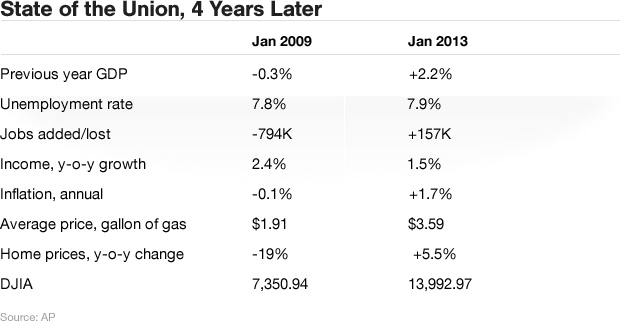
2) The State of the Economic Union by Dan Kervick @ New Economic Perspectives
The Most Urgent Problems We Face
2. Working People and Capital Moving in Opposite Directions
- Corporate profits are up 36% since January 2008, and up 200% since January 2001.
- The share of national income going to working people has fallen 6.2% since January 2008, and 11.2 % since January 2001.
- For the bottom fifth of wage earners, the number of annual hours worked increased by 22% between 1979 and 2007, but real hourly wages increased by only 7.7%. For the period between 2000 and 2007, real wages in this group actually fell by 3.2%
3. An Unstable Financial Economy
- Although household debt has declined since the peak of the recession, it remains very high by historic standards. Total household credit market liabilities as a share of GDP are now over 81%. This compares to 43% in 1970, 49% in 1980, 60% in 1990, and 67% in 2000.
- The financial sector remains dangerously large, and growing, with an 8.4% share of GDP – bigger than it was just before the recession. The US financial industry now accounts for 30% of all domestic corporate profits.
- The total outstanding debt of the domestic financial sector is over 87%, down from 107% at the beginning of 2007, but still much higher than in January 2000 (80%), January 1990 (44%) and January 1980 (19%).
4. Socioeconomic Inequality
- The after tax income of the top 1% of households, adjusted for inflation, has risen by about 130% since 1967. The income of the next 20% has risen by 28%. The incomes of all other income groups have fallen.
- The richest 1% of Americans control 34.6% of Americans’ net worth. The bottom 90% control 26.9% of net worth.
Woj’s Thoughts - Dan lays out seven different problems that currently plague America, of which three are listed above. These specific selections were chosen because I personally found them most compelling, as presented, not to imply they’re the most important. Dan also presents five immediate actions the federal government could take to address these issues. I don’t necessarily support all of the proposals but they represent a good starting point for debating how to best turn the economy around.
Perceptions of Beauty & Stock Valuations by Satyajit Das @ Fear & Loathing in Financial Markets
Stock spruikers argue that equities are “undervalued”. But changes in the economic environment may make quaint measures such as price-earning (“PE”) ratios misleading. In a world of low growth, the dynamics of corporate earnings, which ultimately underlie stock prices, have become more complex.
Profit margins and cash flow improve, perversely, in a period of low growth. Initially, companies cut costs improving profitability. As revenues are stagnant, companies have no need to invest in expanding capacity or working capital, releasing cash flow.
Reduction in depreciation charges and the ability to use cash flow to reduce debt reduces interest expenses. In the present cycle, sharp decreases in interest rates, though not necessarily interest margins, have also improved profit margins.
These effects are short term. In effect, they misstate earnings.
Woj’s Thoughts - After recently being called a permabear, a separate post on my equity outlook is certainly called for. In the meantime, consider the many ways (more at the link) in which Das shows companies are effectively misstating earnings. Although Das’ list is long, I think it is far from exhaustive. My general view is that companies are finding clever ways to increase current earnings at the expense of future capacity to drive revenues higher (i.e. borrowing to fund stock buybacks). If revenue growth continues at a pace well below previous cycles, earnings may peak much lower than most expect and P/Es of an earlier day may no longer be warranted.

1) S&P 500 Earnings Squiggles by Ed Yardeni @ Dr. Ed’s Blog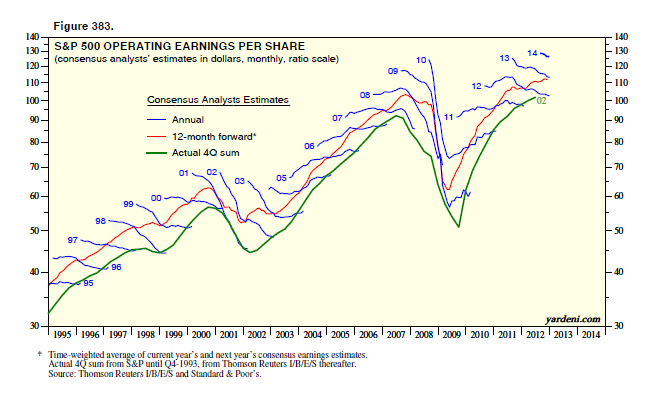
The estimates for 2012 and 2013 mostly fell all last year, yet the S&P 500 rose 13.4%. I have the Squiggles data back to 1979 on a monthly basis. More often than not, they tend to trend down; yet more often than not, the market has trended higher. That’s because the market discounts 12-month forward consensus expected earnings. A good proxy for this concept is forward earnings, i.e., the time-weighted average of consensus estimates for the current and coming years. It tends to be a good 12-month leading indicator for actual profits, with one important exception: Analysts don’t see recessions coming until we all do too.
Woj’s Thoughts - After viewing this chart a few times, several observations stand out from the rest: 1) Each “earnings squiggle” that rises near the end is associated with higher actual earnings. 2) Each “earnings squiggle” that falls near the end forecasts at least a temporary decline in actual earnings. 3) Earnings estimates for 2010, at the beginning of 2009, were higher than forecasts for the current year (2013) and equivalent to current estimates for 2014. 4) The clear upward bias in estimates promotes higher prices, to the degree market participants trust the forecasts.
2) Why the US economic crisis is a depression and not a recession by Edward Harrison @ Credit Writedowns
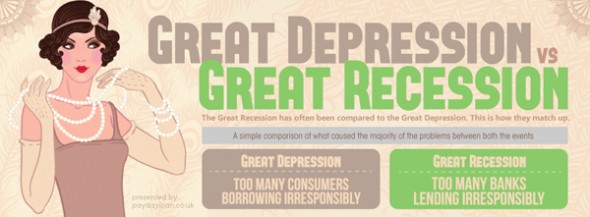
What is now playing out in Congress is very much in line with what I said a little over three years ago in October 2009. Deficit fatigue has become too large to resist. Austerity is coming to the US. The crux here is to remember that this has been a crisis brought on by high private debt – not public debt or deficits. The government has been effective in preventing a private sector debt deflation by providing economic stimulus, permitting large-scale deficit spending and bailing out the banks. This has added a huge slug of net financial assets to the private sector and supported asset prices and private sector balance sheets. When these government deficits get cut, there will be serious pain in the private sector because balance sheets are still stressed and the result will be a relapse into economic depression.
Woj’s Thoughts - The House Republicans have agreed to temporarily raise the debt ceiling and postpone the debate over sequestration in return for Congress (focusing on the Senate Democrats) actually passing a budget for the first time in four years. Backed into a corner, this is probably the best decision for the Republicans as it puts the onus (temporarily) on Democrats to reach a budget agreement. This progression raises the chances that spending cuts, either tied to sequestration or the budget, will take place this year. With the tax hikes already in place, the smaller deficits could very well lead to the outcome that Edward fears.
3) Ben Bernanke Is Facing A Legacy Problem by Bruce Krasting @ Money Game
Bernanke’s term at the Fed will set many historical precedents. To a significant extent, history will judge Bernanke on what he did while chairman of the Fed. But the books will also look at what happened after he left.
I believe that Bernanke would very much like to leave his successor with a Fed that had policy choices. As of today there are no options left. Just more useless QE. I doubt that Bernanke wants to exit with the Fed’s foot planted firmly on the gas pedal. The next guy does deserve a cleaner plate than now exists.
Is the Legacy factor influencing Bernanke? I think it has some sway in his thinking. Consider what Greenspan did before he left. After years of soft monetary policy he ratcheted up the Federal Funds rate 17 times in 22 months. He took the funds rate from 1% all the way up to 6%. Part of that rapid increase was driven to get monetary policy “neutral”, so that Bernanke could do as he wished. Not long after Bernanke took over, he took the funds rate down to zero.

Clearly, Greenspan tried to get monetary policy back to neutral before he left, I don’t see any reason why Bernanke would think differently. Are we watching a repeat of history? At a minimum, his legacy, and where he wants the Fed to be when he leaves, is part of Ben’s thinking today.
Woj’s Thoughts - It’s hard to argue with this logic given Greenspan’s actions as Fed Chairman prior to the last two years of his reign. While deserve is an overly strong word in this instance, my guess is the next Fed Chairman would appreciate having the option to ease, beyond merely expanding QE. With initial unemployment claims now at multi-year lows and a labor force still in decline, the table is set for a further meaningful drop in the unemployment rate. As the rate approaches 7 percent, I suspect Fed chatter about ending QE will pick up. If the legacy issue is simultaneously weighing on Bernanke’s mind, the urge to pull back on easing may be too great to ignore. Considering the ongoing multiple expansion in stock markets, it appears most market participants are not yet discounting this potential outcome.
According to Comstock Partners, The Market Rally Is Based On Four Dubious Assumptions:
These assumptions are as follows:
1) Since almost every central bank in the world is aggressively easing, the market cannot go down.
2) Although the U.S. is facing a fight in Washington over the debt limit, the sequester and the expiration of the annual federal appropriation, various political threats over the last two years have passed without substantial market damage, and the same will happen this time.
3) S&P 500 earnings will rise to $108 in 2013, resulting in a current P/E multiple of only 13.7.
4) The economic recovery will kick into full gear once the problems in Washington are solved or again "kicked down the road."
I won’t deny that the ongoing strength and length of the current bull market has caught me by surprise. Large government budget deficits were initially very supportive of corporate profits, however those effects are waning just as profit margins are peaking. Meanwhile, weak economies at home and abroad have severely limited corporate revenue growth. The following chart looks at the percentage change in the S&P 500 sales per share, earnings per share, and operating earnings per share since the recession began in December 2007:

Considering the meager growth in GDP, one might have expected that sales per share would be effectively flat over this period. What may be surprising, is that minimal revenue growth has not prevented an astonishing rise in earnings per share. Regarding earnings per share, it’s worth pointing out the noticeable difference in volatility between the two separate measures. While I am no expert in accounting, there are countless ways in which companies can “manage” their earnings across time. With an increasing prevalence and usage of such (generally legal) measures, I suspect the magnitude of changes in earnings per share will continue to grow in both directions.
Out of curiosity, I decided to add the S&P 500 index to the chart above:

Despite the widespread focus on earnings and their supposedly fundamental value to stock valuations, prices have more closely tracked the cumulative change in revenues since the recession began. If profit margins are truly mean reverting and earnings are increasingly manipulated, than it is possible sales now provide a better metric of corporate profitability over the course of a business cycle. That being said, it’s equally plausible (perhaps more so) that this data merely represents an anomaly.
Regardless of whether the above graphs prove useful for forecasting, trend growth of earnings has been slowing rapidly. With interest rates practically at the zero lower bound (ZLB) and central bank balance sheet expansion already set in place, potential drivers of further multiple expansion appear limited. In the near-term I expect that current momentum will drag markets higher, possibly to new all-time highs (for the Dow and S&P 500). However, looking further out on the horizon (3-5 years) I believe the present cyclical bull market is tiring and that the secular bear market will re-exert itself, leading to tests of the 2009 lows.
Each day I scroll through, skim, and read upwards up a few hundred blog posts. Many provide good insights, pose interesting questions or offer notable quotes. Although I wish there was enough time to highlight the best posts each day individually, I don’t believe attempting that feat would be beneficial to myself or readers. Instead, I’m going to try and present a batch of the best links each day with quotes that hopefully spark a desire to click through and read further. Any suggestions of clever titles for these posts would be appreciated. Without further adieu, here are today’s posts that are Bubbling Up...
1) Full reserve degenerates to fractional reserve, absent regulations to stop it. by Ralph Musgrave
“Thus when private banks start “lending money into existence” as the saying goes, inflation ensues, but that inflation does not need to be reversed by periodic severe recessions, as occurs under the gold standard.
Moreover, banks and those they lend to are not greatly concerned about the inflation. Reason is that in making a loan, BOTH bank and borrower become creditor AND debtor. I.e the agreement (at least initially) is: 1. The borrower owes the bank £Y till the loan is repaid, and 2, the bank owes the borrower £Y, which obligation the bank undertakes to transfer to anyone that the borrower chooses – using his/her cheque book. Initially, to repeat, both bank and borrower are both debtor and creditor, so neither are bothered by inflation.”
2) Paul de Grauwe: The ECB Can Save the Euro – But It Has To Change Its Business Model
“It is surprising that the ECB attaches so much importance to having sufficient equity. In fact, this insistence is based on a fundamental misunderstanding of the nature of central banking. The central bank creates its own IOUs. As a result it does not need equity at all to support its activities. Central banks can live without equity because they cannot default.
The only support a central bank needs is the political support of the sovereign that guarantees the legal tender nature of the money issued by the central bank. This political support does not need any equity stake of the sovereign. In fact it is quite ludicrous to believe that governments that can, and sometimes do, default are needed to provide capital to an institution that cannot default. Yet, this is what the ECB seems to have convinced the outside world.“
Woj’s Thoughts: Political support is complicated by the lack of a fiscal and political union. Although the ECB could set rates on sovereign debt, it cannot ensure those rates flow through to private borrowers or that private credit expansion returns. The ECB can buy considerable time, but alone cannot save the Euro.
3) Biggest EPS Miss Since Lehman, And This Time It's Not The Tsunami's Fault
Citi Credit Weekly - “Undoubtedly, part of the reason that Spain and Greece have come back into focus is that the earnings of US companies continue to be so uneven. With more than half of S&P500 companies having reported, we’re only now starting to get the full picture, and viewed from the top down perspective it’s far less pretty than even last week led us to believe. Relative to expectations, top line revenues have been especially weak, with nearly all sectors surprising to the downside, even as EPS and EBITDA have tended to beat.
But even those sorts of statistics tend to hide the true weakness because equity analysts tend to revise expectations down while earnings season is still ongoing, which explains why some 72% of S&P500 companies manage to beat expectations in a weak quarter.”
Woj’s Thoughts: Quarter after quarter, revenues continue to miss expectations across the board while the majority of earnings beat. Are analysts systematically underestimating margins? Are companies buying back more stock to boost earnings? Or, are clever accounting practices becoming increasingly efficient in displaying earnings growth?
4) Conservatives and the State by Francis Fukuyama
“When I was asked by the editors of the Financial Times to contribute to a series on the future of conservatism, I hesitated because it seemed to me that in both the US and Europe what was most needed was not a new form of conservatism but rather a reinvention of the left. For more than a generation we have been under the sway of conservative ideas, against which there has been little serious competition. In the wake of the financial crisis and the rise of massive inequality, there should be an upsurge of left-wing populism, and yet some of the most energized populists both in the US and Europe are on the right. There are many reasons for this, but one of them is surely that publics around the world have very little confidence that the left has any credible solutions to our current problems.
The rise of the French Socialists and Syriza in Greece does not belie this fact; both are throwbacks to an old and exhausted left that will sooner rather than later have to confront the dire fiscal situation of their societies. What we need is a left that can stem the loss of rich-world middle class jobs and incomes through forms of redistribution that do not undermine economic growth or long-term fiscal health.
But if you can’t solve the problem from the left, maybe you can do it from the right. The model for a future American conservatism has been out there for some time: a renewal of the tradition of Alexander Hamilton and Theodore Roosevelt that sees the necessity of a strong if limited state, and that uses state power for the purposes of national revival. The principles it would seek to promote are private property and a competitive market economy; fiscal responsibility; identity and foreign policy based on nation and national interest rather than some global cosmopolitan ideal. But it would see the state as a facilitator rather than an enemy of these objectives.”
Three months ago I discussed the potential of a forthcoming profit recession, in part, due to a declining govt deficit. Then a few weeks back I noted:
A significantly stronger dollar combined with weakening growth in Europe and China may have brought about a US profit recession even earlier than growth pessimists expected.
Lastly, following revised Q1 data, I showed that a US corporate profit recession had already begun.
Yesterday Charles Hugh Smith offered a great post highlighting many of the same headwinds to corporate profits. The following chart, in particular, caught my attention: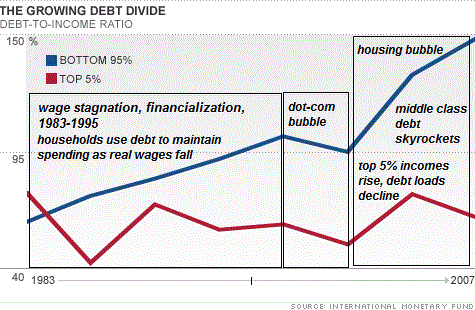
While I often discuss the importance of aggregate levels of debt in the economy, the distribution of that debt also has ramifications for economic growth. Since 2007, fiscal and monetary policy has largely attempted to spur growth by encouraging the private sector to once again embrace debt as a means of consumption and investment. Unfortunately, large government deficits and monetary stimulus have helped raise the income and wealth of the top 5% much more than the bottom 95%. As incomes continue to stagnate for the bottom 95%, interest costs on outstanding debt practically ensure that the above ratio will continue rising unless households actively deleverage.
Since many economists fail to include private debt in their models, policy recommendations continue to ignore the above problem that provides one of the major headwinds to greater economic growth and wealth equality. Resolving this issue, potentially through credit writedowns or a debt jubilee, should be the focus of policy going forward.
The BEA also released revised data showing that corporate profits in Q1 were weaker than previously thought. The broadest measure, corporate profits before tax with capital consumption allowance and inventory adjustment, decreased by 0.3 percent compared with Q4 2011. As the chart shows, that was the first decrease since profits hit their cyclical low in mid-2008. After tax profits with adjustments decreased much more sharply, by 5.9 percent. The difference reflected a whopping 20 percent increase in corporate profits taxes for Q1 2012 compared with Q4 2011.
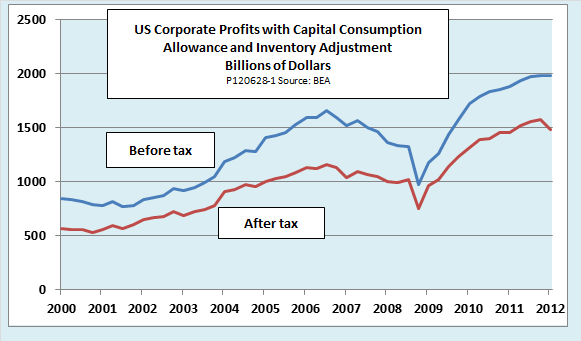
The drop in corporate profits was largely due to weakness in the global economy. Domestic profits of U.S. corporations rose by a healthy 2.6 percent in Q1 2012 compared with Q4 2011 (5.7 percent for the financial sector and 1.4 percent for the nonfinancial sector). However, foreign profits fell by 12 percent, more than wiping out the increase in domestic profits, as receipts from the rest of the world fell and payments rose. (my emphasis)
Read it at EconoMonitor
Latest Data Show U.S. Corporate Profits Falling Due to Global Woes while GDP Growth Remains Sluggish
By Ed Dolan
When the US housing decline began to create broader problems for developed economies, many people were quick to suggest that emerging markets had decoupled and would not be impacted by the developed world’s crisis. Despite those predictions being proven terribly wrong, as the current Eurozone crisis has picked up speed, the same individuals have been projecting the US will decouple and growth will be unaffected. Given the sharp decline in corporate profits, it appears decoupling proponents will once again prove mistaken. With S&P 500 earnings set to decline in the second quarter, this data suggests that current expectations of a minimal drop may still be optimistic. As Europe and China continue to slow, a turnaround in foreign profits is increasingly unlikely. It appears the US may already be in the midst of a profit recession.
Three months ago I mentioned the possibility of a forthcoming profit recession hinted at by Richard Bernstein and James Montier. Profit margins appeared to be peaking at historically high levels and despite their strong mean-reverting tendency, earnings projections assumed profit margins would remain near peak levels. With an increasing number of companies reporting negative earnings growth (year/year) and the probability of declining government deficits, the downside risks to those forecasts seemed pronounced.
According to Bloomberg,
Analysts predict members of the Standard & Poor’s 500 Index in the U.S. will report a 1.1 percent average drop in second- quarter earnings, after estimating a gain as recently as last month
A significantly stronger dollar combined with weakening growth in Europe and China may have brought about a US profit recession even earlier than growth pessimists expected. While the federal deficit may be large enough to maintain mediocre economic growth in the US, it appears inadequate to support a continuing rise in corporate earnings. For the time being, analysts are expecting earnings growth to rebound substantially in the second half of the year and return to double-digit growth in 2013 and 2014.
The important question for investors is whether this quarter of declining earnings will be the first of several consecutive, similar to the past 2 recessions, or if current expectations for a return to growth will prove true, similar to 1998. My bet is on the former, although I expect current forecasts will prove too high in either case. If earnings are beginning a sustained period of decline than current multiples may also need to be revised lowed. The likelihood of this combination taking hold seems largely overlooked by the present market. The current earnings season will shed light on how significant the deterioration in earnings has been and looks to be going forward. I have a feeling the market will not be happy with the results.
Related posts:
Earnings Beat But Growth Slows
The Fed is squeezing interest rates down to levels where you see private portfolio preference shifts, a euphemism for the risk seeking return mentality that arises from artificially low real fixed income returns and that forces up risk assets. But this can only go one for so long.
See, eventually there will be another recession and the question should be what happens to all those toxic assets on bank balance sheets. What happens if new loans go sour too? If you recall, US FDIC-insured institutions recorded $35 billion in Q1 2012 accounting gains. But the quality of those accounting gains was dubious. Here’s the key line to note:
Lower provisions for loan losses and higher noninterest income were responsible for most of the year-over-year improvement in earnings.
Read it at Credit Writedowns
What record low 10-year rates tell us about the toxic effects of permanent zero
By Edward Harrison
Yields on 10-year Treasuries reached a new record low of 1.617% today.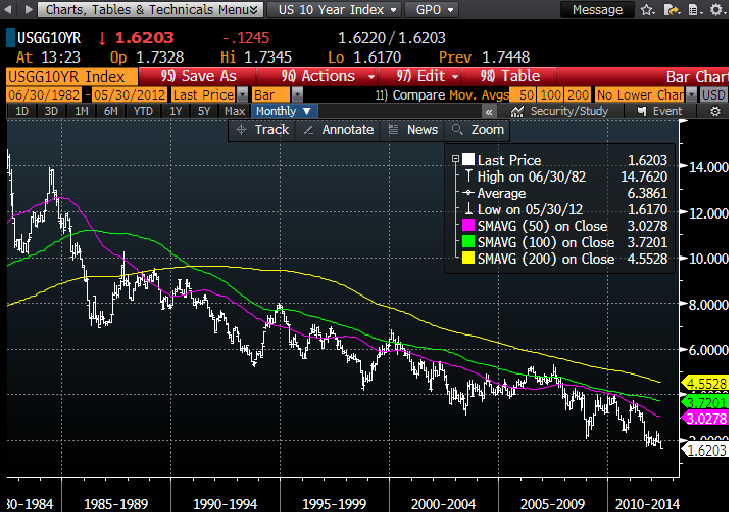
Regarding the continuing decline, Harrison explains that Long-term interest rates are a series of future short-term rates. The Fed has already “promised” to hold rates near zero through 2014 and I suspect that target date will be extended further by year end. Separately, when the Fed altered policy to begin paying interest-on-reserves (IOR) it also changed the direct measure by which monetary policy is adjusted. Given the enormous size of the Fed’s balance sheet (and outstanding Treasury debt), going forward it may be easier to effectively raise interest rates by hiking the IOR rate rather than actually altering the Fed’s target rate. With these concepts in mind, it should come as no surprise that 10-year (and 30-year) yields continue to move lower in similar fashion to Japan (although I currently don’t expect Treasury rates to reach the JGB lows).
Over the past couple years I have also remained suspect of US banking profits (and by extension S&P 500 operating profits) for the reason highlighted above from the FDIC. Much of the gains appear to be merely accounting profits. When the next recession/crisis hits, those accounting profits can (and probably will) easily flip to large accounting losses. In my view, the risk of serious shortfalls in capital during the next downturn remains extremely present today. As Minsky often pointed out, complacency about risk is often a warning of building risks in the background.
The next crisis/recession will probably occur with short-term rates still at zero and without many aspects of the Dodd-Frank Act or Basel III provisions in place. Given the public response to previous bailouts, the Treasury/Fed response will be a wild card. Any bets on what their initial actions will be?
Related posts:
Fed Stands in Own Way on Monetary Policy
Treasury Yields Low for Good Reason
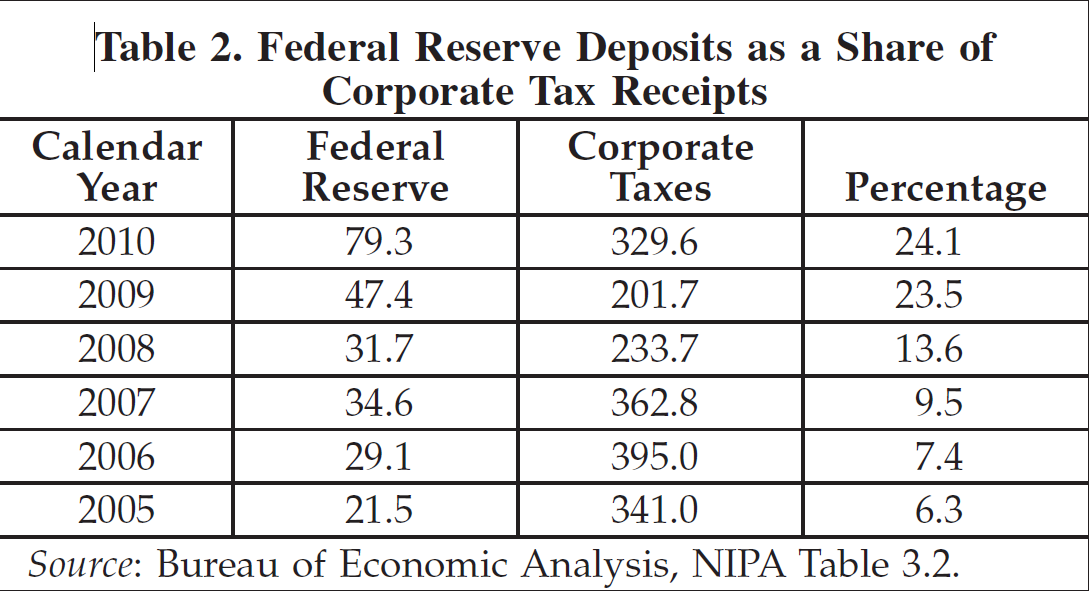
In the National Income and Product Accounts, the Fed’s revenue is considered part of corporate tax revenues. Because it constitutes close to a quarter of all corporate taxes, as shown in Table 2, this is important for analytical purposes when working with the data.
Read it at SSRN
The Fiscal Effects of the Federal Reserve
By Bruce Bartlett
(h/t Marginal Revolution)
During the past few years, the Federal Reserve has massively expanded its balance sheet to approximately $3 trillion. As a result of its holdings the Fed earns a significant amount of interest each year (over $75 billion in 2010 and 2011), most of which gets transferred back to the Treasury. Although MMT and MMR correctly note that the Fed and Treasury can be functionally considered as one entity, this distinction clearly remains absent from NIPA accounting.
Bartlett’s paper highlights an important, potentially overlooked, accounting principle that considers the Fed’s transfers to Treasury as corporate tax revenue. Separately, Bartlett points out that the Fed’s income is included in corporate profits from the financial sector. Given the increasing size of these figures, failure to recognize this distinction means that corporate profits and taxes may become increasingly overstated.
Stock market bulls frequently point to rising corporate profits and a rebounding financial sector to promote their views. Do these statistics include the profitability of the Fed, which is not really part of the private sector? If so, without the Fed’s “profits”, how would current corporate and financial sector profits compare with similar data from before the recession?
The Fed’s so-called “profits” actually work as a tax, removing income from the private sector. As the Fed’s balance sheet continues to expand in coming years (a seemingly common assumption) these “profits” will almost certainly make up an even larger portion of corporate profits and taxes. Recognizing this accounting quirk is clearly integral to providing useful analysis for both policy making and investing.

