Showing posts with label Deleveraging. Show all posts

Wednesday, January 2, 2013

Being Thankful for a Dysfunctional Congress

After months of campaigning and several weeks of heated debate, a deal has finally been brokered regarding the fiscal cliff. Here are the most significant details as I see it (full text):
  • The temporary Bush tax cuts of 2001 and 2003 are now officially the permanent Obama tax cuts for all individuals earning less than $400k and married couples earning less than $450k.
  • For individuals/couples with income above $400k/$450k, the marginal tax rate will revert to 39.6%.
  • The capital gains and dividend tax rates will remain at 15% for all individuals below the above limits and rise to 20% for those above.
  • The temporary Obama tax cuts of 2009 will be extended for 5 years, including the earned income tax credit and child tax credit.
  • Permanent alternative minimum tax (AMT) relief.
  • Phaseout of personal exemptions and itemized deductions for high-income earners.
  • Extension of emergency unemployment compensation program and extended benefit provision.
  • No extension of 2% FICA reduction.
  • Delay of sequestration until March 1, 2013.
Looking at these changes compared to (previously) current law, this deal is a massive tax cut with effectively no changes on the spending side of the ledger. Alternatively, comparing the deal to 2012, these changes represent an increasing tax burden for a large majority of the population.

In the end it appears that both sides of the political spectrum are left frustrated. For the Democrats this bill effectively expands the middle class upwards to include all but the top 1-2%. Keeping with recent trends, the majority of tax benefits will accrue to the upper-middle class, making this deal far more regressive than many on the left had hoped. On the other side, the Republicans will watch tax rates for the top 1-2% go up a fair amount (~8-9%) once the 3.8% Medicare surcharge and phasing out of exemptions/deductions are added. By permitting talk of any spending cuts to be postponed another two months, the Republicans also forfeited a significant portion of their bargaining capital for that debate.

Looking at events of the past couple months, maybe years, it’s natural to feel disappointed by the dysfunctional dynamic of Congress. While I can certainly appreciate that pessimistic view, let me try and briefly argue an opposing perspective put forth first by Joe Weisenthal.

Throughout the entire debate about the fiscal cliff, both sides have made clear their shared preference for deficit reduction (though each side prefers a different method). Earlier this year, the CBO’s baseline projection was that:
The deficit will shrink to an estimated $641 billion in fiscal year 2013 (or 4.0 percent of GDP), almost $500 billion less than the shortfall in 2012.
Following passage of the recent deal, Cullen Roche notes that:
Using the CBO’s “Alternative Fiscal Scenario” we’re still looking at big budget deficits in 2013.  I’ll let the CBO run the final numbers here, but my back of the napkin math points to something in the $950B-$1T range.
Despite agreement on the “harmful” future consequences of trillion dollar deficits, Congress is simply unable to reach any agreement that meaningfully lowers current deficits.

This consistent failure by Congress to achieve a mutual goal has, in some senses, actually been an enormous blessing in disguise. With household demand still constrained by previously acquired debt, the government’s big budget deficits have been supporting employment, corporate profits and private sector debt deleveraging. Had Congress been more effective in meeting its goals, smaller budget deficits might well have placed the US on a path of declining growth and rising unemployment similar to Europe.

So rather than complaining about Congressional gridlock, we should be thankful for a Congress dysfunctional enough to ensure the recovery continues.   

Wednesday, December 26, 2012

David Rosenberg's 2013 Investment Outlook

One of the best resources for investment advice and economic projections over the past several years has been David Rosenberg. Courtesy of Zero Hedge, here is part of his outlook for 2013:
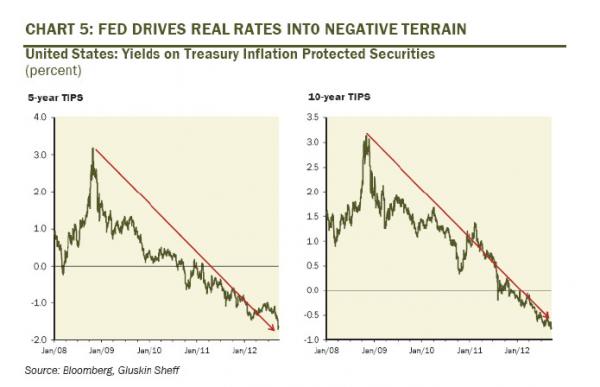
The Fed has also completely altered the relationship between stocks and bonds by nurturing an environment of ever deeper negative real interest rates. Therein lies the rub. The economy and earnings are weak, and getting weaker, but the Interest rate used to discount the future earnings stream keeps getting more and more negative, and that lowers the corporate cost of capital and in turn raises the present value of expected future profits. It's that simple.
...
Beneath the veneer, there are opportunities. I accept the view that central bankers are your best friend if you are uber-bullish on risk assets, especially since the Fed has basically come right out and said that it is targeting stock prices. This limits the downside, to be sure, but as we have seen for the past five weeks, the earnings landscape will cap the upside. I also think that we have to take into consideration why the central banks are behaving the way they are, and that is the inherent 'fat tail' risks associated with deleveraging cycles that typically follow a global financial collapse. The next phase, despite all efforts to kick the can down the road, is deleveraging among sovereign governments, primarily in half the world's GDP called Europe and the U.S. Understanding political risk in this environment is critical.
...
With regard to global events, we continue to monitor the European situation closely. Euro zone finance ministers have given Greece an additional two-year lifeline and the Greek parliament just passed another round of severe austerity measures, which I think will only serve to make matters worse there from an economic standpoint, but I doubt that the creditors are going to let Greece go just yet. So this never-ending saga remains a source of ongoing uncertainty, but at the same time. Is a key reason why the Fed and the Bank of Canada will continue to keep short-term interest rates near the floor, and all that means is to build even more conviction over income equity and corporate bond themes.
...
As for something new, after a rather significant slowdown in China for much of this year that put the commodity complex in the penalty box for a period of time, we are seeing some early signs of visible improvement in the recent economic data out of China and this actually has happened even in advance of any significant monetary and fiscal stimulus. And while the Chinese stock market has been a laggard, if there is one country that does have the room to stimulate, it is China (make no mistake, however, China's economic backdrop is still quite tenuous, especially as it pertains to the corporate sector - excessive inventories, stagnant profits, rising costs and lingering excess capacity are all challenges to overcome).
Keep in mind that much of this slowing in China was a lagged response to prior policy tightening measures to curb heightened inflationary pressures - pressures that have since subsided sharply with the consumer inflation rate down to 2% (near a three-year low) from the 6.5% peak in the summer of 2011 and producer prices are deflating outright. What is providing a big assist to this sudden reversal of fortune in China is a re-acceleration in bank lending as a resumption of credit growth and bond issuance has allowed previously- announced infrastructure projects out of Beijing (railways in particular) to get incubated.
The nascent economic turnaround we are seeing in China, if sustained, is Positive news for the commodity complex and in turn resource-sensitive currencies like the Canadian dollar, which I'm happy to report has hung in extremely well this year even in the face of all the global economic and financial crosscurrents. Just consider that the low for the year for the loonie was 96 cents - you have to go back to 1976 to see the last time intra-year lows happened at such a high level.
...
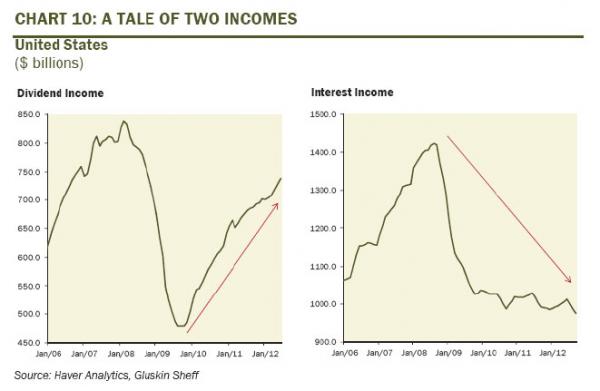
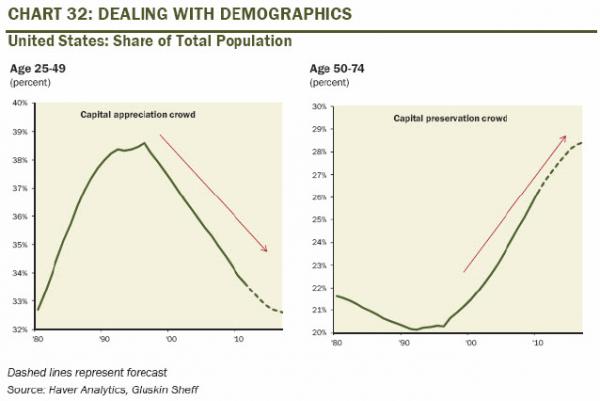
To reiterate, our primary strategy theme has been and remains S.I.R.P. - Safety and Income at a Reasonable Price - because yield works in a deleveraging deflationary cycle.Not only is there substantial excess capacity in the global economy, primarily in the U.S. where the "output gap" is close to 6%, but the more crucial story is the length of time it will take to absorb the excess capacity. It could easily take five years or longer, depending of course on how far down potential GDP growth goes in the intermediate term given reduced labour mobility, lack of capital deepening and higher future tax rates. This is important because what it means is that disinflationary, even deflationary, pressures will be dominant over the next several years. Moreover, with the median age of the boomer population turning 56 this year, there is very strong demographic demand for income. Within the equity market, this implies a focus on squeezing as much income out of the portfolio as possible so a reliance on reliable dividend yield and dividend growth makes perfect sense.
...
Gold is also a hedge against financial instability and when the world is awash with over $200 trillion of household, corporate and government liabilities, deflation works against debt servicing capabilities and calls into question the integrity of the global financial system. This is why gold has so much allure today. It is a reflection of investor concern over the monetary stability, and Ben Bernanke and other central bankers only have to step on the printing presses whereas gold miners have to drill over two miles into the ground (gold production is lower today than it was a decade ago - hardly the same can be said for fiat currency). Moreover, gold makes up a mere 0.05% share of global household net worth, and therefore, small incremental allocations into bullion or gold-type investments can exert a dramatic impact. Gold cannot be printed by central banks and is a monetary metal that is no government's liability. It is malleable and its supply curve is inelastic over the intermediate term. And central banks, who were selling during the higher interest rate times of the 1980s and 1990s, are now reallocating their FX reserves towards gold, especially in Asia. With the gold mining stocks trading at near record-low valuations relative to the underlying commodity and the group is so out of favour right now, that anyone with a hint of a contrarian instinct may want to consider building some exposure - as we have begun to do.
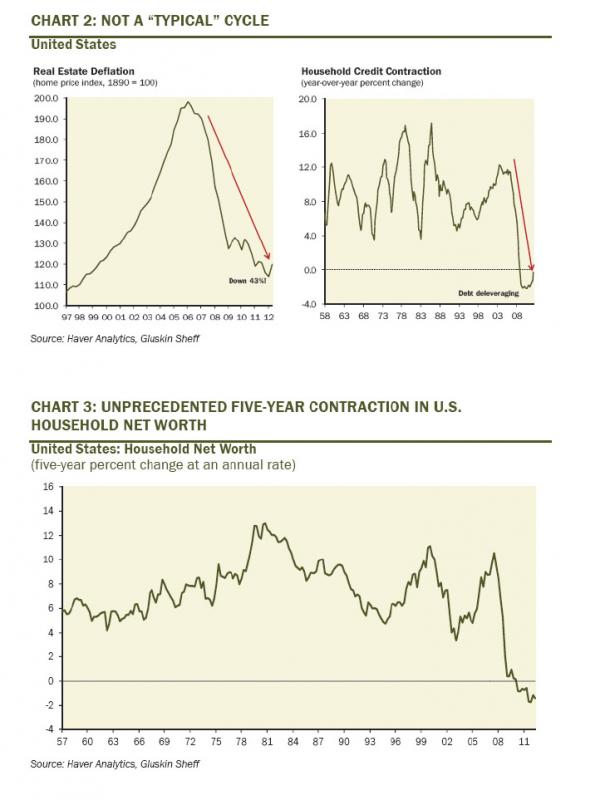
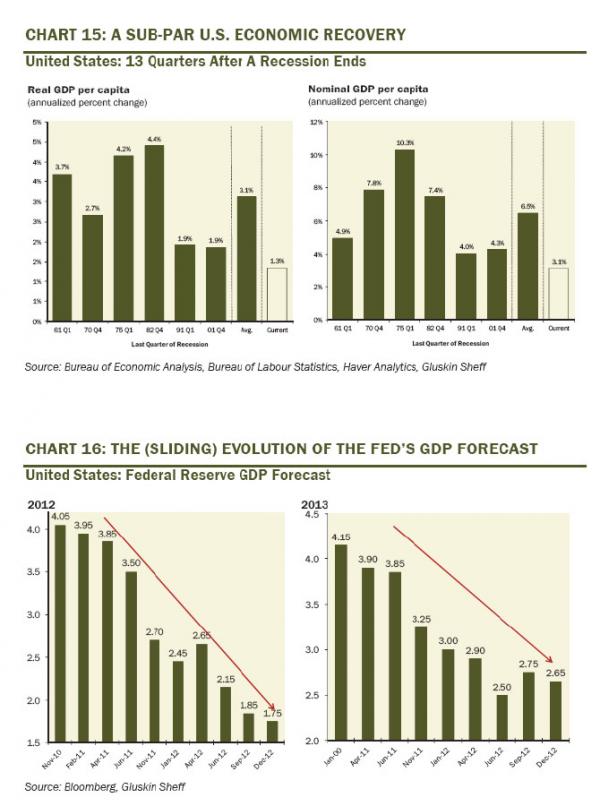
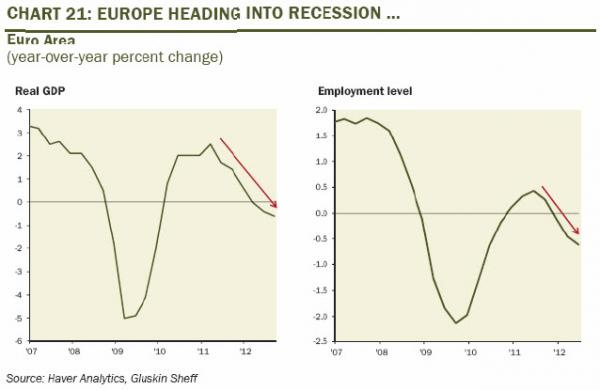
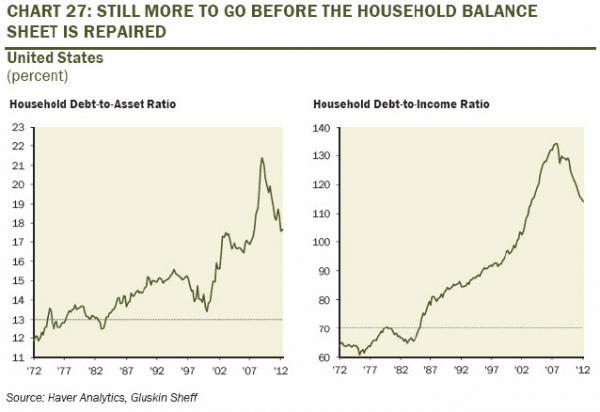
The Fed’s recent actions imply that it will permit inflation to temporarily rise above 2% in the hopes of reducing unemployment and spurring growth at a faster pace. While that occurrence remains to be seen, there is potential for even deeper negative real yields over the coming year to boost stocks further. However, as I’ve been arguing for many months, future earnings growth will likely be much weaker than expected and may turn negative. Last year I offered my own predictions for 2012. In the next couple weeks, I hope to discuss those successes and failures, while also putting forth new predictions for 2013. In the meantime, here are few charts from Rosenberg’s outlook that caught my eye:

Sunday, August 19, 2012

Bubbling Up...8/19/12

1) Chart of the Day: Public deficits and private savings in the euro zone by Edward Harrison @ Credit Writedowns
Budget deficits are what results ex-post from an accounting identity between the sectoral balances and should not be a primary goal of public policy. What we want to do is target the cause of the deficits, insufficient demand which I believe is the result of the overhang of debt after a period of excess private sector credit growth. What you want to do is eliminate that debt overhang by reducing the debt or increasing private sector incomes to support the debt. That’s getting at root causes.

2) How the Economic Machine Works by Ray Dalio @ Bridgewater (h/t Humble Student of the Markets)

[I]f you understand the game of Monopoly®, you can pretty well understand credit and economic cycles. Early in the game of Monopoly®, people have a lot of cash and few hotels, and it pays to convert cash into hotels. Those who have more hotels make more money. Seeing this, people tend to convert as much cash as possible into property in order to profit from making other players give them cash. So as the game progresses, more hotels are acquired, which creates more need for cash (to pay the bills of landing on someone else’s property with lots of hotels on it) at the same time as many folks have run down their cash to buy hotels. When they are caught needing cash, they are forced to sell their hotels at discounted prices. So early in the game, “property is king” and later in the game, “cash is king.” Those who are best at playing the game understand how to hold the right mix of property and cash, as this right mix changes.
Now, let’s imagine how this Monopoly® game would work if we changed the role of the bank so that it could make loans and take deposits. Players would then be able to borrow money to buy hotels and, rather than holding their cash idly, they would deposit it at the bank to earn interest, which would provide the bank with more money to lend. Let’s also imagine that players in this game could buy and sell properties from each other giving each other credit (i.e., promises to give money and at a later date). If Monopoly® were played this way, it would provide an almost perfect model for the way our economy operates. There would be more spending on hotels (that would be financed with promises to deliver money at a later date). The amount owed would quickly grow to multiples of the amount of money in existence, hotel prices would be higher, and the cash shortage for the debtors who hold hotels would become greater down the road. So, the cycles would become more pronounced. The bank and those who saved by depositing their money in it would also get into trouble when the inability to come up with needed cash caused withdrawals from the bank at the same time as debtors couldn’t come up with cash to pay the bank.
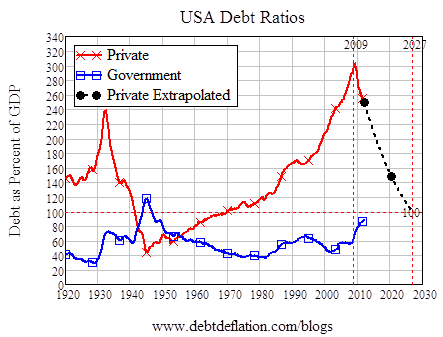
Woj’s Thoughts - Although Dalio’s fund may be struggling this year as markets increasingly deviate from economic growth, his insights regarding economic cycles remain a great source of knowledge. In many advanced economies, property was clearly king until the shortfall in cash among households became so pronounced that a debt deflation ensued. The productive portion of the private sector (non-financial) continues to hold too much property and debt relative to cash (savings and income). Rather than encouraging and aiding a “smooth” shift towards cash, public policy remains supportive of reverting back towards property and debt. As long as this mix remains highly unbalanced, economies will prove fragile and prone to crises. (Fun tidbit about me...as a child I loved playing the game of Monopoly. This may have been an early sign that I was destined for a future in economics and finance.)

3) How Long Can Japanese Bond Prices Defy Gravity? by Cullen Roche @ Pragmatic Capitalism

As you likely know, Japan has been suffering a horrid deflation for 20 years as a result of a multitude of factors.  So we’ve witnessed an endless stream of JGB bond traders diving out of windows as they short JGB’s and lose out to ever increasing prices.  One interesting conclusion in the Hoshi/Ito paper is their view on Japan’s ”unrealistically optimistic assumption that Japan’s GDP will grow at 2% annually for the next 40 years”.   If growth is to stagnate then where will the inflation come from?  What could scare these bondholders into a massive JGB revolt leading to higher rates (something which, mind you, did not even occur in the USA during the great stagflation of the 1970′s)?   I am lost for a cause here because Japan’s central bank controls interest rates and as the supplier of reserves to the banking system they can always control the entire yield curve (yes, if they wanted to pin the 30 year bond at a specific rate they would just have to name it and challenge the bond traders to compete with their endless reserve position – the bond traders would lose quickly).
So the question remains – how long can Japanese bond prices defy gravity?  Well, the short answer is – as long as the Japanese central bank is willing to keep rates low.  The more important question is when will Japan experience an environment which forces their central bank to alter the current structure of the yield curve?  Will a stagflation occur similar to the 70s in the USA?  Will a hyperinflation occur for whatever reason?  Will growth rebound?   Or what if Hoshi and Ito’s pessimistic GDP projections are correct?  Then we’re likely to continue seeing JGB traders jumping out of windows following unsuccessful attempts to fight the Bank of Japan.
Woj’s Thoughts - So yes, the Fed can (and to a degree currently does) control long-term interest rates. These questions are equally important for investors currently betting against US Treasuries. When will economic factors cause the Fed to raise interest rates in the foreseeable future? Private sector deleveraging is likely to persist for a few more years and government deficits are decreasing. This suggests a still lengthy period of low growth and inflation, which is consistent with the Fed maintaining short-term rates near zero. The recent sell-off in Treasuries is approaching a level at which the long-side again becomes enticing.  

Tuesday, August 7, 2012

Bubbling Up...8/7/12

1) The week when Mr Draghi greatly diminished the office of ECB President and sacrificed the fiscal-monetary policy distinction (in a manner that does not even help the euro in the short run!) by Yanis Varoufakis
What was the ECB’s position before Draghi’s heroic declarations? It was that it cannot arrest the crisis unless member-states act as part of a Grand Deal on how to effect a Eurozone-wide fiscal policy. Then and only then, the ECB would bolster their efforts through its own monetary operations. Clearly, that position led markets to believe that the Eurozone had no credible plan for dealing with the Crisis, as the cart (fiscal union) was being placed before the horses (serious ECB-centred intervention to stop the death embrace between insolvent banks and insolvent nations).
And what is the Draghi position after Thursday’s crucial ECB board meeting? That the ECB is ready to buy bonds in the secondary market once member-states act as part of a Grand Deal on how to effect a Eurozone-wide fiscal policy. In other words, no change whatsoever. None!
Woj’s Thoughts - Yanis and I are clearly on the same page. See ECB's Changing Philosophy is Good for Bond Holders but Bad for the Economy and ECB's Means (Lost Decade With High Unemployment) To An End (Structural Reform)

2) Draghi’s comments about the ECB doing “whatever it takes” are irrelevant by Edward Harrison
There is only one issue here: how many reforms the periphery will undertake. There will be no support unless we see reforms. If the periphery capitulates and slashes government jobs, raises pension ages, and makes it easy to fire people, Germany and the ECB will give them anything they want. Until they go whole hog, they won’t get full support.
This is blackmail, of course. But Monti, Samaras, and Rajoy are neoliberal reformers. So they want this too, just not the domestic political loss that goes along with it. Germany is obliging them by playing the fall guy for their domestic cutting agendas.
But, in my view, Europe is screwed. Eventually the neoliberals will have to cave and try to reflate in order to save their own hides when the debt deflation moves to the core or the Great Depression begins. They think they can extract the reforms they want before depression becomes firmly entrenched. I think they’re wrong.
3) Michal Kalecki on the Great Moderation by Steve Randy Waldman
Here is Kalecki describing with preternatural precision the so-called “Great Moderation”, and its limits:
"The rate of interest or income tax [might be] reduced in a slump but not increased in the subsequent boom. In this case the boom will last longer, but it must end in a new slump: one reduction in the rate of interest or income tax does not, of course, eliminate the forces which cause cyclical fluctuations in a capitalist economy. In the new slump it will be necessary to reduce the rate of interest or income tax again and so on. Thus in the not too remote future, the rate of interest would have to be negative and income tax would have to be replaced by an income subsidy. The same would arise if it were attempted to maintain full employment by stimulating private investment: the rate of interest and income tax would have to be reduced continuously."
Dude wrote that in 1943.
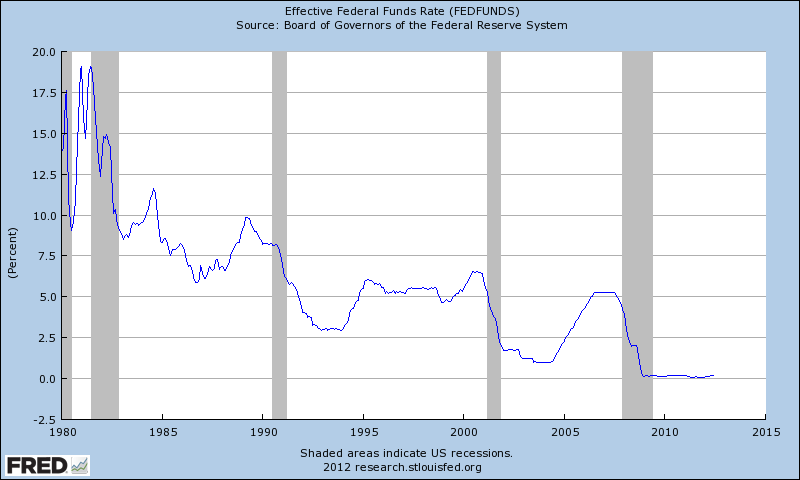
Let’s check out what FRED has to say about interest rates during the era of the lionized, self-congratulatory central banker:


Yeah, those central bankers with their Taylor Rules and DSGE models were frigging brilliant. New Keynesian monetary policy was, like, totally a science. Who could have predicted that engineering a secular collapse of interest rates and incomes tax rates (matched, of course, by an explosion of debt) might, for a while, moderate business and employment cycles in a manner unusually palatable to business and other elites? Lots of equations were necessary. No one would have guessed that, like, 70 years ago.
Woj’s Thoughts - Wow! Could Kalecki have been more correct?! Sadly our current policies are still attempting to induce further growth through a interest rate reductions (despite the zero lower bound) and lower income taxes (despite a substantial portion of the population already receiving an income subsidy). Maybe these policies can still produce another debt led boom but, the end of the road is fast approaching.

4) The Crisis in 1000 words—or less by Steve Keen
The causation behind this correlation is that money is created “endogenously” when the banking sector creates loans, and this newly created money adds to aggregate demand—as argued by non-orthodox economists from Schumpeter through to Minsky. When this debt finances genuine investment, it is a necessary part of a growing capitalist economy, it grows but shows no trend relative to GDP, and leads to modest profits by the financial sector. But when it finances speculation on asset prices, it grows faster than GDP, leads obscene profits by the financial sector and generates Ponzi Schemes which are to sustainable economic growth as cancer is to biological growth.
When those Ponzi Schemes unravel, the rate of growth of debt collapses and the boost to demand from rising debt becomes a drag on demand as debt falls. In all other post-WWII downturns, growth resumed when debt began to rise relative to GDP once more. However the bubble we have just been through has pushed debt levels past anything in recorded history, triggering a deleveraging process that is the hallmark of a Depression.
 
Woj’s Thoughts - The extreme levels of private debt can alter an economic system from being robust to fragile. In this manner, the chance that shocks destabilize the system and the magnitude of the ensuing deleveraging both increase dramatically.

Friday, July 20, 2012

Ray Dalio - Disorderly Outcome in Europe "A Significant Possibility"

Ray Dalio and Bridgewater have been among the top performing hedge funds for many years. More importantly, Dalio is probably one of the best minds in understanding and explaining business cycles with a focus on credit. In his most recent letter (courtesy of Zero Hedge), Dalio paints a dour picture of global growth with a strong chance of further weakening as the deleveraging cycle continues to play out. As for Europe:
The unresolved European imbalances and the differences in their impacts on each country have produced widening differences in the self-interests of these countries, which have led to political divergences that have magnified the risks. Unlike a year ago, Germany and France no longer stand in solidarity as backstops behind the euro system, but have been divided in their self-interest by divergent financial conditions which are leading to conflicting rather than unified political orientations. France's deteriorating finances and economy have shifted its self-interest toward alliances with "recipient" (lower credit rated) countries like Italy and Spain and away from "contributor" (higher credit rated) countries like Germany and the Netherlands, leaving Germany more isolated as a guarantor of the risks in the euro system and in its views about how to manage the imbalances. Given these shifts in the alliances between contributor and recipient countries we think that the popular assumption that the Germans and the ECB (which requires agreement of the key factions within it) will come through with money to make all of these debts good should not be taken for granted. Said differently, we think that there are good reasons to doubt that European bank and sovereign deleveragings will be prevented from progressing to the next stage in a disorderly way, without a viable Plan B in place. This fat tail event must be considered a significant possibility.

Wednesday, July 18, 2012

Debt Surges Don't Cause Recessions...Excessive Aggregate Amounts Do

In a post titled Debt Surges don’t cause recessions, Scott Sumner, questions the following argument from Paul Krugman:
Second, a dramatic rise in household debt, which many of us now believe lies at the heart of our continuing depression. Here’s household debt as a percentage of GDP


Sumner says:

What do you see?  I suppose it’s in the eye of the beholder, but I see three big debt surges:  1952-64, 1984-91, and 2000-08.  The first debt surge was followed by a golden age in American history; the boom of 1965-73.  The second debt surge was followed by another golden age, the boom of 1991-2007.  And the third was followed by a severe recession.  What was different with the third case?
The difference is the aggregate amount of household debt compared with incomes (GDP). The use of credit (debt) instead of money (income + savings) has an extra cost associated with the interest payments. As the aggregate amount of debt rises, aggregate interest costs follow. To simply stem the rise in debt, let alone maintain the current level, an increasing percentage of income and savings becomes necessary to cover interest costs and/or pay back previous debt. These actions reduce the amount of income and savings available for consumption and investment, creating a drag on economic growth.

Since households are no longer in a position to drive growth, other sectors must pick up the slack to prevent incomes from stagnating or falling. If incomes struggle, many households will have to shift an even larger percentage of income to paying interest and debt, while others simply become unable to repay the full amount. This deleveraging worsens the contraction from the household sector and leads to losses within the corporate and financial sector. If those sectors are equally leveraged with debt (as was the case in the US) then the losses in income and capital may cause those sectors to reduce spending and lending, respectively. This process can ultimately generate a vicious cycle where attempts to deleverage by each group reduces the income of others and subsequently increases the burden of debt. Absent growth in income from either the public or external sectors, this cycle will eventually slow but at a much lower level of GDP.

Update: The Arthurian continues to dissect the Monetarist disregard of rising household debt levels:

During the famous flat spot of 1965-1983, the comparable rate of debt growth was 9.36%. That's near 90% of the growth rate for the 1952-1964 "debt surge" and it is higher than the growth rate for the third debt surge Sumner identifies.
There was no remission. Debt did not stop growing. It barely slowed.
Prices increased at a compound annual growth rate of 6.6% per year between 1965 and 1983, more than tripling during those years. There was no remission of debt. There was only erosion of debt because of the inflation.

Thursday, June 28, 2012

"The real solution has nothing to do with the Fed"

A couple days ago I commented that The Fed Can Do More...But It Won't Do Much in response to Stephanie Kelton’s question, Can the Fed Really Do More? Edward Harrison furthers the argument against Fed action...
First, as I said previously, the Fed’s actions have not lowered rates. The Fed’s QE2 raised inflation expectations, causing interest rates to rise and nullifying the effects of lowered risk premia. Second, low rates are toxic to savers and bank net interest margins. When credit demand is weak, the loss of interest income overwhelms the reflationary effects of low rates. Third, as Yellen herself has noted, it is conceivable that accommodative monetary policy could provide tinder for a buildup of leverage. Low rates encourage releveraging, not deleveraging.
Despite having have been highlighted previously, these points are worth rehashing. Edward’s conclusion succinctly states the real problem that needs to be addressed:
the demand for credit is still weak. Some point to the importance of the psychology of balance sheet recessions. Others like myself point to the debt stress from falling asset prices and weak job and income growth. Either way, absent a rebound in incomes or a reduction in private debt, the recovery will remain weak irrespective of how many supply side solutions the Fed implements. If the US (the UK, Ireland or Spain) wants to get the credit ‘transmission mechanism’ working again they will need to increase demand for credit by reducing real debt burdens as a percentage of income or increase income and job security enough to allow debtor’s to focus instead on today’s low debt service costs. If these countries focus on deleveraging instead of releveraging, that would necessarily mean large private surpluses and therefore large government deficits in the absence of significant currency depreciation.
Bottom line: The real solution has nothing to do with the Fed because the constraints are demand side and not supply side. But people will continue to exhort the Fed to do more and so they will do more.

Wednesday, June 27, 2012

Spain Should Bailout Households Not Banks

Rom Badilla directs to the most recent Global Strategy Weekly note from Albert Edwards of Societe Generale, where he writes:
And so it is in the Eurozone: Spanish banks need recapitalization because of the deflationary policies forced on them to reduce Spain’s public sector deficit at a time when the private sector is also de-leveraging. Clearly this has a lot further to go and house prices will fall even further as a result. But the lesson from Japan was that overly focusing on the banks as ‘the problem’ is misguided and until or unless deeply deflationary policies are altered, the Spanish banks will be back for another bailout before too long.


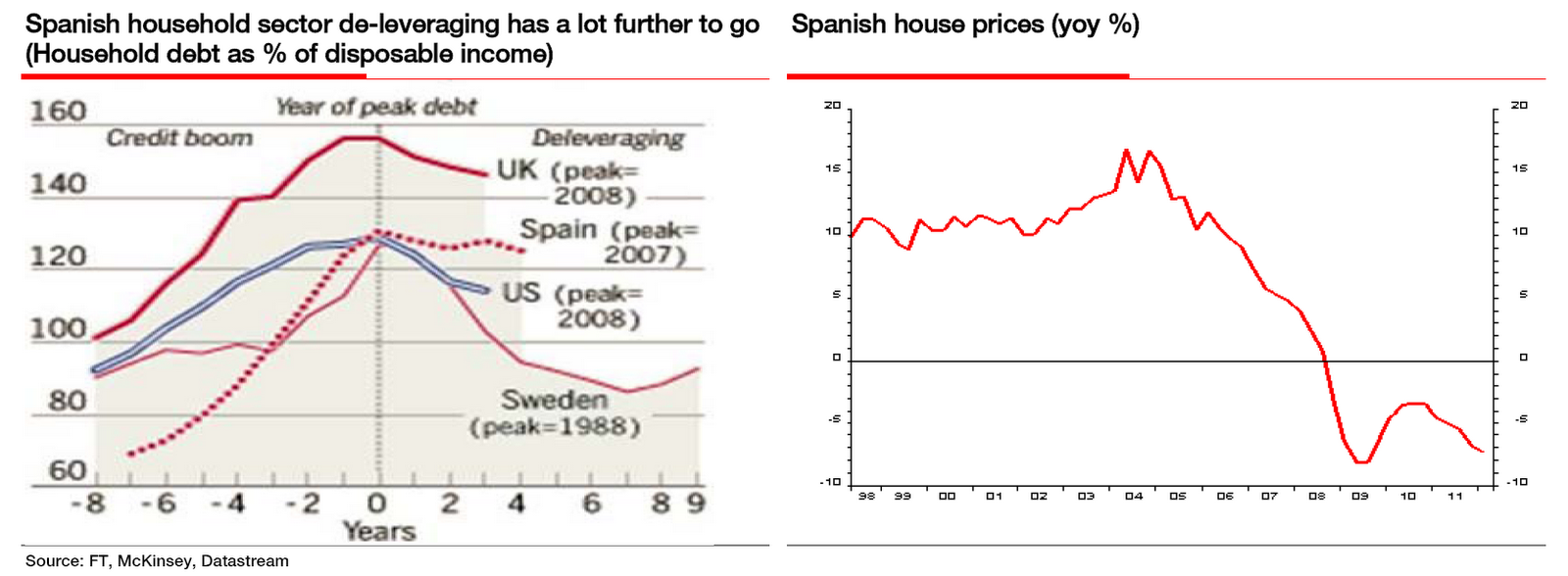
This fits well with the case I previously laid out that private debt continues to drag down Europe.

This above dynamic is especially important for understanding Spain, where sovereign debt levels (at least those officially reported) are not particularly high. Spain’s housing bubble, however, continues to decline putting further pressure on private sector balance sheets. The public and private sectors cannot both successfully deleverage, in tandem, without destroying incomes and growth.
As the first chart from Edwards’ shows, households have not yet begun to seriously deleverage and unemployment is already well over 20%. This process will continue to put downward pressure on house prices, which may fall by another 35%.  As prices fall Spanish banks will ultimately be forced to write down mortgage values, further impairing their balance sheets. By focusing the bailout on banks, Spain in not only following the path of Japan but also that of Ireland. Despite significantly larger bailouts relative to the size (GDP) of Ireland, Irish banks remain insolvent. Putting these pieces together, it becomes obvious that Spanish banks will require further bailouts.

A lesson pointed out in the title of Edward’s note that should have been learned from Japan is that “banks are not the problem.” Unfortunately Spain, Ireland and several other countries have made this same mistake during the current crisis. Private debt deleveraging, especially by households, is at the heart of the current crisis and remains unaddressed. Until private sector balance sheets return to health, economic growth will continue to languish (at best) and highly leveraged banks will become increasingly insolvent. For countries without the ability to print currency (ie. the Eurozone), use of public funds to bailout the banks may eventually topple the sovereigns.

Heading into another Euro Summit, I fail to see any signs that policy makers will soon change course and address private balance sheets. The crisis is speeding up but the policy solutions remain unsuitable for the problem at hand.

Tuesday, June 26, 2012

The Fed Can Do More...But It Won't Do Much

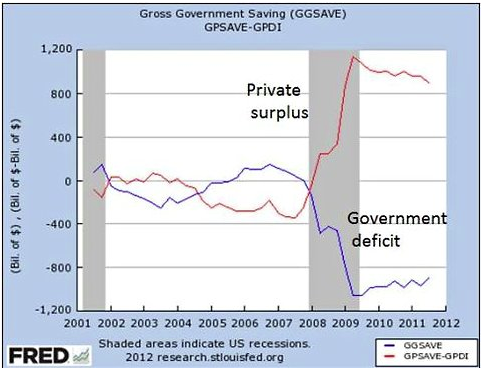
In any event, we’re in a balance sheet recession. We should be encouraging the private sector to borrow less, not taunting people with negative interest rates and encouraging them to leverage up. And we should recognize that the government’s deficit is the key to helping the private sector de-leverage.

Reducing the government’s deficit means cutting the non-government’s surplus, which frustrates their efforts to pay down debt.
We need rising incomes to support a recovery that can be sustained by private sector spending, and the Fed isn’t the agency we should be looking to for help on this front.
Read it at Naked Capitalism
Can the Fed Really Do More?
By Stephanie Kelton


Kelton expresses her frustration, which I share, with the unrelenting calls for further “stimulus” from the Fed. As I’ve mentioned repeatedly on this blog (see here, here, and here for examples), the mechanism by which monetary policy can induce real growth is weak, at best, especially when the private sector is deleveraging. Despite the efforts of Kelton and many others with an MMT/MMR/Post-Keynesian background, this message has still not gotten through to the mainstream media. Hopefully our experimentation with monetary policy will not cause too much damage before its ineffectiveness is finally understood.

Wednesday, May 2, 2012

Private Debt Continues to Drag Down Europe

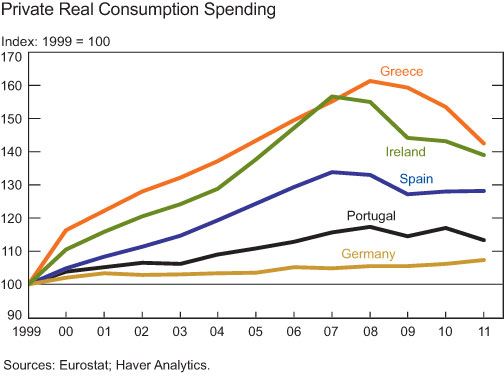
Real consumption spending in Ireland and Greece increased roughly 55 percent from 1999 to 2007 (chart below). In Spain, the corresponding figure was around 35 percent. Again, Germany stands at the other extreme. Consumption remained essentially flat after 2001, leaving the country with ample funds to lend abroad. Similarly, household liabilities ballooned in the periphery countries, far outpacing growth in disposable income, while liabilities declined relative to disposable income in Germany. These divergent consumer spending trends were a key driver of euro area imbalances.


Read it at Liberty Street Economics
Euro Area Spending Imbalances and the Sovereign Debt Crisis
By Matthew Higgins and Thomas Klitgaard


The New York Fed’s research arm has been producing a number of good articles recently, occasionally even straying from mainstream economic thinking. While most discussion of Europe has focused on sovereign debt and the financial sector, private sector debt imbalances remain critical to understanding both the causes of the crisis and potential policy solutions.

The authors note that

Foreign borrowing to finance productive investment projects raises national income and should result in a surplus over debt service costs. Foreign borrowing undertaken because of lower levels of saving, in contrast, supports current consumption while building up a debt burden on future income. The composition of investment can also matter. For example, foreign borrowing to support investment in nontradable sectors such as housing generates no foreign income stream to support repayment.
Acting in a similar manner as the US private sector during the previous decade, the private sector in peripheral Europe largely borrowed from abroad to support current consumption and investment in housing. Rising debt levels were manageable, for a time, without an increase in incomes as long as asset prices were rising and new credit was available to service current debts (Minsky considered this stage “ponzi” finance). When asset prices stopped rising and credit became more restricted (which must always happen), the private sector was forced to reduce consumption and investment to pay debt servicing fees and attempt to deleverage.

This above dynamic is especially important for understanding Spain, where sovereign debt levels (at least those officially reported) are not particularly high. Spain’s housing bubble, however, continues to decline putting further pressure on private sector balance sheets. The public and private sectors cannot both successfully deleverage, in tandem, without destroying incomes and growth. Debts that cannot be repaid, will not be repaid.

Private sector debts in periphery Europe, as well as the US and UK, must be brought back in line with incomes to support any sustainable future growth. The options for achieving this are either nominal income growth above debt servicing costs, debt write-downs, or a combination of the two. So far, policy in Europe seems to be attempting neither and the situation continues to worsen (unemployment is currently at a 15-year high). If there is any hope for a peaceful resolution of the Eurozone crisis, policy makers must begin to focus on correcting private sector debt imbalances.