Showing posts with label ZIRP. Show all posts

Thursday, January 17, 2013

2012 Predictions: The Results

Last year I took a chance and threw my own projections into the ring. Similar to Byron Wien and Edward Harrison, I mostly selected events that were widely seen as having a low probability (less than 33%) but which I believed held a greater than 50% chance of occurring. Let’s see how I did...

1) Greece leaves the Euro - As the year progresses the Greek economy continues to contract and unemployment continues to rise, surpassing 50% for youth. This combination of factors offsets attempts to reduce the budget deficit as the country repeatedly misses EU and IMF required targets. Despite potential for further bailouts, the Greek people finally decide the consequences of tied promises outweigh the benefits of remaining in the Euro. Greece defaults on all debts, returning to a heavily depressed drachma.

Result - Wrong (0-1). During 2012, Greece was successful in reducing its budget deficit by 30 percent and staying in the Eurozone. This success was in large part due to further defaults on public debt and another bailout. Unfortunately for the Greek people. the price of these efforts remains extraordinarily high. The economy may have contracted as much as 6.5 percent in 2012, the fifth year of recession, according to forecasts in the 2013 budget. Meanwhile both the general and youth unemployment rates continue to soar, reaching ~27 percent and ~58 percent, respectively. At this point Greece is clearly in the midst of a Depression and showing no signs of recovering anytime soon. Greek tolerance of increasing unemployment and decreasing prosperity remains a surprise, although radical political parties have been gaining support. For now Greece remains in the Eurozone, but a future exit remains likely.

2) Italy and Spain lose access to credit markets - A Greek default raises concerns about the potential for creditors to face actual losses on EU sovereign debt. The ECB’s measured efforts are not strong enough to overcome fear and concern about future growth in Italy and Spain. Deep recessions take hold in both countries, pushing deficits higher.

Result - Wrong (0-2). A Greek default and concerns about the European economy weighed heavily on EU sovereign debt during the first half of the year. By the summer, ten-year bond yields in Spain and Italy were at 7.75 percent and 6.75 percent, respectively, and rising. With the countries at risk of losing access to credit markets, ECB President Mario Draghi came forth with a plan to cap sovereign interest rates using open-ended outright monetary transactions (OMT). Draghi’s threat was enough to generate a 180 degree turn in EU sovereign debt markets, but nowhere near enough to turn around the economies. Italy and Spain both returned to recession this past year, pushing fiscal deficits and unemployment higher. While Italy’s unemployment rate remains closely tied to the EU-wide level of ~11 percent, Spain’s general and youth unemployment rates have quickly caught up to Greece’s levels. Eventually Draghi’s Liquidity Bluff Will Be Called, potentially sooner rather than later as a strengthening euro may reignite the EU crisis.

3) The Eurozone enters recession - Practically the entire Eurozone falls into recession, including the likes of France and Germany. A deteriorating economic outlook causes deficit estimates to be raised across the board, facilitating credit rating downgrades. Agreements for greater austerity fail to stem the tide and other attempts to kick the can down the road are pursued.

Result - Correct (1-2). The euro zone economy contracted 0.2 percent in the second quarter and 0.1 percent in the third, meeting the technical definition of a recession. The fourth quarter drop is looking even worse following recent news that Germany  saw output shrink 0.5 per cent between October and December. Although Germany managed to run a slight fiscal surplus, at the expense of growth, Spain’s budget deficit probably exceeded 9 percent for a fourth year in 2012. The first half of the year did witness credit downgrades and austerity agreements, but Draghi’s big kick at the end of summer pushed any further actions into future years.

4) China’s GDP growth falls below 7% - As exports to Europe contract, the busting of China’s housing bubble continues unabated. Expectations for massive monetary easing in Europe and the US, along with fear of flare ups in the Middle East sets a floor under energy and food commodity prices. Monetary easing and fiscal stimulus in China are applied too slowly to prevent growth from slowing below the supposedly necessary 8%. (Note: This will be not be considered a hard-landing, which I deem growth below 5%. That may come in 2013, but for 2012 most economists/analysts will be able to maintain expectations of a soft-landing.)

Result - Wrong (1-3). During the third quarter China’s growth rate slowed to a three-year low of 7.4 percent, but the year-end tally will probably be around 7.7 percent. As growth slowed and housing prices fell early in the year, the government took action to allow a smoother transition between governments. Fiscal stimulus has pushed growth and inflation higher in the last few months, but at the expense of rebalancing the economy toward consumers for future sustainability.

5) Oil prices will spike above $120, finish year below $90 - (Using WTI crude prices, currently ~$102) At some point during the year Iran attempts to block the Strait of Hormuz. Further attempts to overthrow governments in the Middle East, possibly some that only recently gained power, hit the headlines again. Combined with global monetary easing, oil prices will move higher and gasoline will once again hit $4 per gallon in the US. These higher prices will exaggerate the reduction in global demand for other goods and push growth lower. As fears of a global recession take over, oil prices will fall, finishing the year down more than 10%.

Result - Wrong, but close (1-4). Fears about Iran and the Middle East never really materialized this year but that did not prevent a wild ride in oil prices. After rising to over $113 in April, WTI crude prices dropped all the way down to $80 in August (daily price history). A rally in the last week of the year brought the closing price slightly back above $90. Brent crude prices diverged significantly from WTI in 2012, keeping gas prices at the pump high throughout the summer. Gas prices peaked at $3.94, not quite $4, but nevertheless reached a record-high average of $3.62 per gallon.

6) US enters recession in 2nd half - Despite higher 4th quarter GDP in 2011, the lower savings rate and energy prices are unlikely to add much growth in 2012. With Europe contracting and China slowing down more than expected, US exports will take a hit. Extensions of the payroll tax cut and unemployment benefits will help ensure the federal deficit holds above 8%. Housing prices will continue to fall (based on Case-Shiller) causing the savings rate to once again reach 5%. By the end of 2012, the US will be in a recession (although NBER may not confirm this until 2013).

Result - Wrong (1-5). Despite Europe contracting, China slowing down and the federal deficit dropping to 7% (still over $1 trillion), US GDP growth remained positive throughout 2012. After falling to 1.3 percent in the second quarter, annualized GDP growth jumped to 3.1 percent in the third quarter. Although current estimates for fourth quarter GDP are below 1 percent, the US is most likely not in a recession at this time. Partially behind the positive growth was the impact of housing prices rising over 5 percent and the savings rate remaining below 4 percent.   

7) Federal Reserve extends forecasts for ~0% rates until 2015 - As growth in the US weakens once again and the global economy slows, expected inflation over the next ten years (based on Cleveland Fed estimates) will fall towards 1%. With unemployment holding steady around 9%, the Fed will move it’s forecasts for the first interest rate hike out to 2015. (Some form of QE3 is also likely, but aside from promoting short-term speculation, the effects on growth are likely to be muted.)

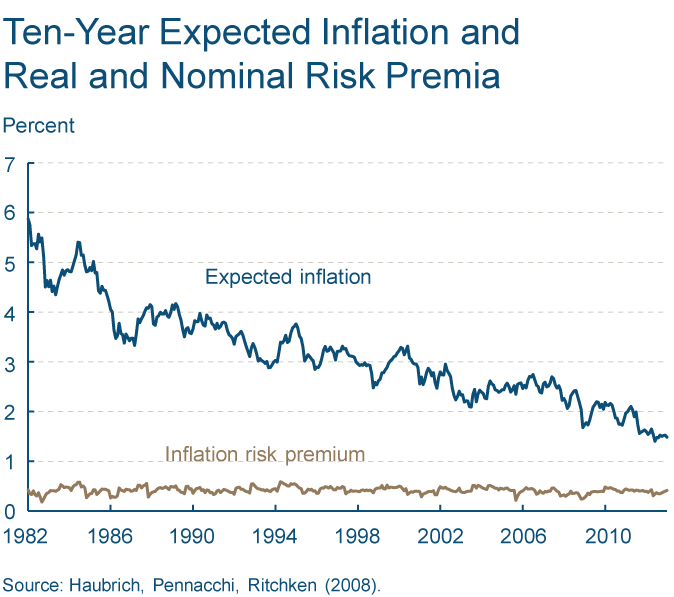
Result - Correct (2-5). Expected inflation over the next ten years fell consistently during the course of the year to approximately 1.5 percent (chart below). Although unemployment improved materially, dropping below 8 percent, the Federal Reserve still felt the urge to step up monetary stimulus. On September 13th, 2012, the FOMC extended its projections for maintaining “exceptionally low levels for the federal funds rate...at least through mid-2015” while enacting a plan to purchase “additional agency mortgage-backed securities at a pace of $40 billion per month” indefinitely. Since QEternity was insufficient to boost growth, the Fed also enacted QE4 to raise the rate of balance sheet expansion.


8) President Obama will win re-election - Generally a weakening economy has been poor for incumbents but this time will be seen as abnormal circumstances. The troubles in Europe and high unemployment will actually spark desire for a more interventionist government. Given the choice between Obama and Romney, the President will win re-election by a slim margin (2% or less).

Result - Correct (3-5). President Obama crushed Romney in the 2012 election based on the electoral college, however the popular vote was decided by less than 3 percent.

9) The US dollar rises over 5% - (Based on dollar index) In spite of QE efforts and another sizable deficit, the US dollar retains its safe haven status. As fears of European defaults spread and China’s slowing growth impacts commodity prices, the dollar will continue to trend higher.

Result - Wrong (3-6). As fears spread about European default and a slowdown in China, the dollar rose several percent into the summer months. When those fears were assuaged by politicians, not economic data, the euro began a strong rally. By the end of the year, the dollar had essentially finished flat.

10) Bonds outperform stocks - The consensus once again favors stocks, although US Treasuries have now outperformed stocks over the past 1, 10 and 30 year horizons. With global growth slowing, inflation expectations will fall. Before this bull market in bonds ends, 10- and 30-year Treasuries may reach 1% and 2%, respectively.

Result - Wrong (3-7). Slowing global growth, falling inflation expectations and stagnating corporate earnings were not enough to deter stocks from a very strong performance in 2012. The Bernanke put morphed into a proactive Fed determined to push asset prices higher and succeeding to the tune of over 15 percent. While stocks were riding towards new highs, the bull market in bonds also remained intact. The 10- and 30-year Treasuries hit their respective lows of 1.43 and 2.46 during the summer before heading higher into year end. Ultimately 10- and 30-year Treasuries last year posted returns of only 3 percent and 2.5 percent, respectively.   

That’s the end of it. 3-7 is certainly a bit of a disappointment, especially given the direction of events through the first half of the year. That being said, the logic behind each prediction was sound and far more on target than the end result suggests. My main takeaway is that politicians are far more determined to maintain the status quo than I had expected. The underlying economic (and social) problems have once again been kicked down the road for future governments to handle. As long as that pattern holds, current optimism and modest growth can persist for another couple years.

My hope is to have Predictions for 2013 out by the end of next week. Stay tuned.  

Wednesday, December 26, 2012

ZIRP and QE Remove Private Sector Income

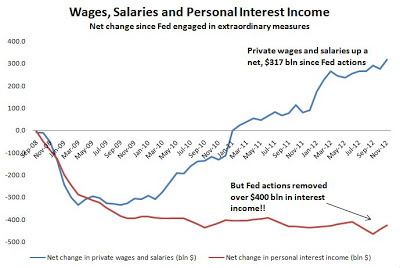
Earlier today, I presented several charts from David Rosenberg’s 2013 Investment Outlook. One of those charts depicted the steep drop in interest income earned by the private sector since the financial crisis began. A primary driver behind that decline has been the Federal Reserve, lowering interest rates and then swapping low-paying reserves for higher yielding securities (Treasuries and Agency-MBS). Countering the mainstream view that more monetary stimulus is needed, Mike Norman asks, “What stimulus?? Fed actions completely offset wage and salary gains!
Case in point, the $80 bln in profits that the Fed earned and turned over to the Treasury last year, was from income earned on the assets it bought. That was income that would have been earned by the private sector if it still had those bonds and securities.
So while the net change in wages and salaries since 2008 has been an increase of $317 bln, personal interest income dropped by $425 bln. That's not a stimulus by any means. It's mind boggling that the mainstream economics community and the Fed itself, doesn't understand this when they incessantly call for more "stimulus."

Unlike the Market Monetarists and New Keynesians, who have been constantly begging for the Fed to “do more”, this is why myself and many others have been wishing the Fed would do far less. While stimulating present paper profits in the stock market through negative real yields, the Fed’s actions are actually removing income from the private sector. Instead of stimulating the economy, ZIRP and QE help ensure the economic recovery remains weak. These actions will only further the reliance on credit and exacerbate downturns going forward.

Sunday, January 29, 2012

Points of Public Interest


  1. Why Limiting Itemized Deductions (Still) Makes Sense - My former professor, Diane Lim Rogers, offers her support for a proposal to limit itemized deductions to a 15 percent rate. This policy will simultaneously increase the progressive nature of income taxes, substantially reduce total tax expenditures and raise revenue.
  2. The Fed Is Misleading Congress About Europe - Warren Mosler, a founding member of Modern Monetary Theory, argues that the Fed’s dollar swap lines are unsecured lending and should therefore be the responsibility of Congress.
  3. Philip Pilkington: Is QE/ZIRP Killing Demand? - Pilkington describes the counterproductive efforts of Fed policy. Milton Friedman also believed ZIRP (zero interest rate policy) would restrict demand as I outlined in Deflationary Monetary Policy.
  4. The Liberalism of Classical Liberalism - Peter Boettke tries to correct some typical misrepresentations of classical liberalism with a good dose of historical background.
  5. Show Me the Daylight 'twixt Sanction and Tariff - Samuel Wilson considers recent trade sanctions against Iran and China, and why the two are viewed in different lights by Americans.
  6. The Future of Economics - Steve Keen, a leading post-Keynesian, makes a case for incorporating disequilibrium, dynamic modeling and emergent properties into the core of future economics.
  7. The European Crisis Deepen - Peter Boone and Simon Johnson, former IMF Chief, explain why current optimism is likely unwarranted and how the realistic end may include a break-up of the Eurozone.

Tuesday, January 10, 2012

Predictions for 2012


With countless others offering predictions for the year ahead, I thought I’d take a chance and throw my own projections into the ring. Similar to Byron Wien and Edward Harrison, I mostly selected events that are widely seen as having a low probability (less than 33%) but which I believe hold a greater than 50% chance of occurring.

1) Greece leaves the Euro - As the year progresses the Greek economy continues to contract and unemployment continues to rise, surpassing 50% for youth. This combination of factors offsets attempts to reduce the budget deficit as the country repeatedly misses EU and IMF required targets. Despite potential for further bailouts, the Greek people finally decide the consequences of tied promises outweigh the benefits of remaining in the Euro. Greece defaults on all debts, returning to a heavily depressed drachma.

2) Italy and Spain lose access to credit markets - A Greek default raises concerns about the potential for creditors to face actual losses on EU sovereign debt. The ECB’s measured efforts are not strong enough to overcome fear and concern about future growth in Italy and Spain. Deep recessions take hold in both countries, pushing deficits higher.

3) The Eurozone enters recession - Practically the entire Eurozone falls into recession, including the likes of France and Germany. A deteriorating economic outlook causes deficit estimates to be raised across the board, facilitating credit rating downgrades. Agreements for greater austerity fail to stem the tide and other attempts to kick the can down the road are pursued.

4) China’s GDP growth falls below 7% - As exports to Europe contract, the busting of China’s housing bubble continues unabated. Expectations for massive monetary easing in Europe and the US, along with fear of flare ups in the Middle East sets a floor under energy and food commodity prices. Monetary easing and fiscal stimulus in China are applied too slowly to prevent growth from slowing below the supposedly necessary 8%. (Note: This will be not be considered a hard-landing, which I deem growth below 5%. That may come in 2013, but for 2012 most economists/analysts will be able to maintain expectations of a soft-landing.)

5) Oil prices will spike above $120, finish year below $90 - (Using WTI crude prices, currently ~$102) At some point during the year Iran attempts to block the Strait of Hormuz. Further attempts to overthrown governments in the Middle East, possibly some that only recently gained power, hit the headlines again. Combined with global monetary easing, oil prices will move higher and gasoline will once again hit $4 per gallon in the US. These higher prices will exaggerate the reduction in global demand for other goods and push growth lower. As fears of a global recession take over, oil prices will fall, finishing the year down more than 10%.

6) US enters recession in 2nd half - Despite higher 4th quarter GDP in 2011, the lower savings rate and energy prices are unlikely to add much growth in 2012. With Europe contracting and China slowing down more than expected, US exports will take a hit. Extensions of the payroll tax cut and unemployment benefits will help ensure the federal deficit holds above 8%. Housing prices will continue to fall (based on Case-Shiller) causing the savings rate to once again reach 5%. By the end of 2012, the US will be in a recession (although NBER may not confirm this until 2013).

7) Federal Reserve extends forecasts for ~0% rates until 2015 - As growth in the US weakens once again and the global economy slows, expected inflation over the next ten years (based on Cleveland Fed estimates) will fall towards 1%. With unemployment holding steady around 9%, the Fed will move it’s forecasts for the first interest rate hike out to 2015. (Some form of QE3 is also likely, but aside from promoting short-term speculation, the effects on growth are likely to be muted.)

8) President Obama will win re-election - Generally a weakening economy has been poor for incumbents but this time will be seen as abnormal circumstances. The troubles in Europe and high unemployment will actually spark desire for a more interventionist government. Given the choice between Obama and Romney, the President will win re-election by a slim margin (2% or less).

9) The US dollar rises over 5% - (Based on dollar index) In spite of QE efforts and another sizable deficit, the US dollar retains its safe haven status. As fears of European defaults spread and China’s slowing growth impacts commodity prices, the dollar will continue to trend higher.

10) Bonds outperform stocks - The consensus once again favors stocks, although US Treasuries have now outperformed stocks over the past 1, 10 and 30 year horizons. With global growth slowing, inflation expectations will fall. Before this bull market in bonds ends, 10- and 30-year Treasuries may reach 1% and 2%, respectively.

For some potential investment themes based on these predictions, I suggest taking a look at Gary Shilling’s 2012 Investment Themes.  

Wednesday, December 14, 2011

Liquidity Traps: Refuting the Irrefutable


In a recent article at Cato Unbound, titled Tim Congdon on Liquidity Traps vs. Portfolio Rebalancing, Robert Hetzel says: (emphasis mine)

If the public is sufficiently pessimistic about the future so that asset prices are low and the demand for money is high, the central bank might have to create a significant amount of money to influence the expenditure of the public. The institutional fact that makes a liquidity trap an irrelevant academic construct is the unlimited ability of the central bank to create money. One can make this point in an irrefutable manner by noting that the logical conclusion to unlimited open-market purchases is that the central bank would end up with all the assets in the economy including interest-bearing government debt, and the public would hold nothing but non-interest-bearing money. Because that situation is untenable, individuals would work backward from that endpoint and begin to run down their money balances and stimulate expenditure in the current period.

Hetzel is trying to demonstrate that the Federal Reserve can still influence aggregate demand even when the interest rate is against the lower bound (0%). Unfortunately, his irrefutable, logical conclusion is actually quite refutable and illogical. In Hetzel’s theoretical world, individuals willingly part with all of their assets (food, clothes, shelter, etc) in order to receive non-interest-bearing money from the government. Since the central bank owns all of the assets, individuals are then forced to purchase goods back from the central bank. (An aside: How does the central bank choose the price to charge?) While this certainly does stimulate expenditure, since individuals could not otherwise survive, history and logic suggest this moment could never arise. Using the same basic premise, here is a different possible conclusion:

A central bank decides to engage in unlimited open-market purchases. After parting with many/most of their assets, individuals realize that without food (assets) they will be unable to survive. These individuals resist exchanging their remaining sustenance for non-interest-bearing money. Working backward from that endpoint, individuals will begin to hoard physical assets. As other individuals try to purchase goods with money, the money price of assets will rise dramatically (money is devalued). The central bank’s actions will stimulate expenditure until individuals are no longer willing to accept money as a means of exchange.

Although both examples initially result in increasing expenditures, the second example is far from desirable for any economy. Based on this more realistic conclusion, some level of open-market purchases will likely pressure individuals to refrain from participating in the exchanges. An unlimited amount would therefore completely undermine the value of non-interest-bearing money.

To be clear, I am not suggesting that open-market purchases are inherently bad. My example simply makes clear that open-market purchases may have stimulative effects on short term expenditures, but longer-term costs that far exceed those benefits. As the great Frédéric Bastiat noted many years ago: (emphasis mine)

In the department of economy, an act, a habit, an institution, a law, gives birth not only to an effect, but to a series of effects. Of these effects, the first only is immediate; it manifests itself simultaneously with its cause--it is seen. The others unfold in succession--they are not seen: it is well for us if they are foreseen. Between a good and a bad economist this constitutes the whole difference--the one takes account of the visible effect; the other takes account both of the effects which are seen and also of those which it is necessary to foresee. Now this difference is enormous, for it almost always happens that when the immediate consequence is favourable, the ultimate consequences are fatal, and the converse. Hence it follows that the bad economist pursues a small present good, which will be followed by a great evil to come, while the true economist pursues a great good to come, at the risk of a small present evil.

Bastiat, Frédéric (2005-05-31). Essays on Political Economy (Kindle Locations 485-491).

Thursday, August 18, 2011

Harrison: Why Permanent Zero is toxic and leads to depression


Recently I discussed the Fed’s decision to suggest interest rates will remain at zero percent for at least another 2 years. Edward Harrison of Credit Writedowns, who’s forecasts have been incredibly accurate the past couple years, offers his thoughts on the topic. Despite taking a different angle, he reaches a similar conclusion. One significant aspect he addresses is the reduction on bank profits due to a flattening yield curve. With fears just beginning to swirl regarding the solvency of a few large banks, loan loss reserves may prove inadequate going forward.

Another focus of the article is the increasing probability that the Fed will be forced to maintain zero percent rates indefinitely. As I noted yesterday, any further expansion of the Fed’s balance sheet will only serve to make permanent zero an even more likely outcome. From a historical perspective, Japan provides the best comparison for a nation maintaining minimal nominal interest rates. At the end, Harrison shows an important correction to previous comments about permanent zero hurting savers. Real interest rates have actually been positive in Japan for a majority of the last decade. Savers, or those invested in government bonds, therefore can actually purchase more goods than 10 years earlier. The notion that inflation is desirable or makes everyone better off appears supplanted in today’s thinking and a future post will take aim at clearing up misconceptions about the positive effect of inflation. For now, I strongly recommend reading the full article to understand potential economic problems that lie ahead.

Why Permanent Zero is toxic and leads to depression