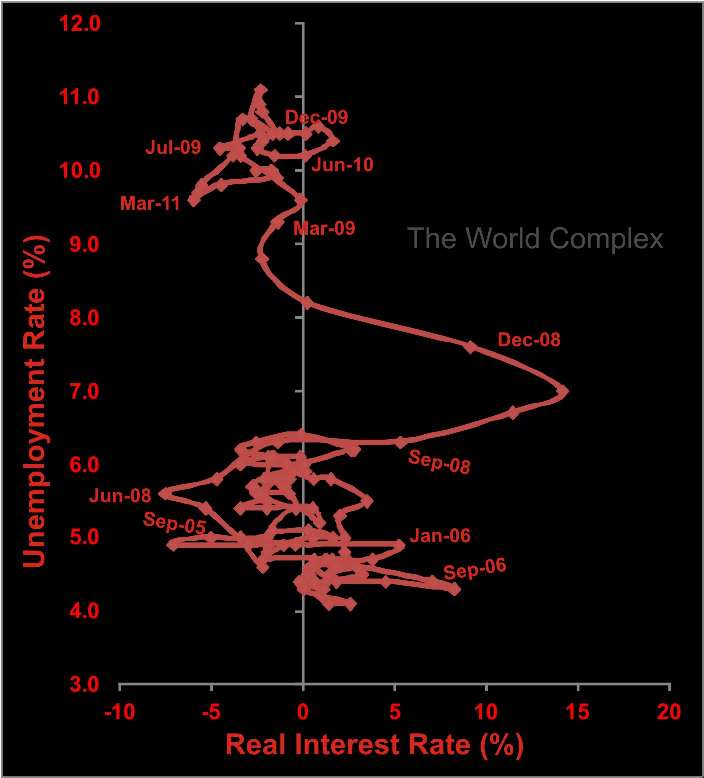
1) Ergodicity – the biggest mistake ever made in economics by Lars P Syll
Samuelson said that we should accept the ergodic hypothesis because if a system is not ergodic you cannot treat it scientifically. First of all, that’s incorrect, although I think I understand how he ended up with this impression: ergodicity means that a system is very insensitive to initial conditions or perturbations and details of the dynamics, and that makes it easy to make universal statements about such systems …
Another problem with Samuelson’s statement is the logic: we should accept this hypothesis because then we can make universal statements. But before we make any hypothesis—even one that makes our lives easier—we should check whether we know it to be wrong. In this case, there’s nothing to hypothesize. Financial and economic systems are non-ergodic. And if that means we can’t say anything meaningful, then perhaps we shouldn’t try to make meaningful claims. Well, perhaps we can speak for entertainment, but we cannot claim that it’s meaningful.
…
The only reason risk exists is that we cannot go back and make decisions over again. Economics got very confused about the point of dealing with risk, and had to resort to introducing psychology and human behavior and all sorts of things. I don’t mean to say that we don’t need behavioral economics. What I mean is that there are lots of questions in economics that we can only answer behaviorally at the moment, but at the same time we have a perfectly formal natural physical analytic answer that’s very intuitive and sensible and that comes straight out of recognizing the non-ergodicity of the situation.
To be blunter, I’m pointing out that economics is internally inconsistent. I accept all the models that economists have developed. I could critique them, but I’m not worried about that. I didn’t make them up, the economists did. But when the economists treat the models as if they were ergodic, that’s when someone has to say “stop, that’s enough.”
-Ole PetersWoj’s Thoughts - This timely quote will provide sufficient background for recognizing the importance of the following paper/post...
 2) The power and the terror of Irrational Expectations by Noah Smith @ Noahpinion
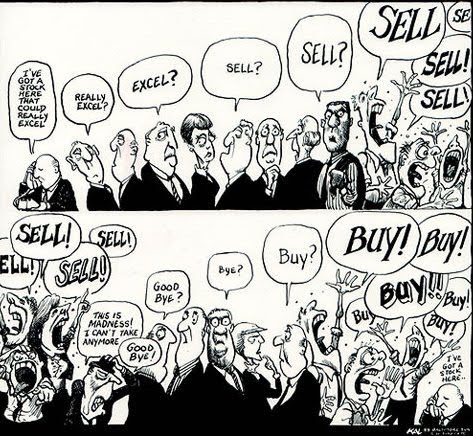
But to me, that's not even the most disturbing implication of Malmendier's finding, and of this type of expectations model in general. In most theories of non-rational expectations, like Bayesian learning or rational inattention, expectations evolve in a smooth, stable way. And so these models, as Chris Sims writes, look reassuringly like rational-expectations models. But there is no guarantee that real-world expectations must behave according to a stable, tractable model. I see no a priori reason to reject the possibility that expectations react in highly unstable, nonlinear ways. Like tectonic plates that build up pressure and then slip suddenly and unpredictably, expectations may be subject to some kind of "cascades". This can happen in some simple examples, like in the theory of "information cascades" (In that theory, people are actually rational, but incomplete markets prevent their information from reaching the market, and beliefs can shift abruptly as a result). In the real world, with its tangle of incomplete markets, bounded rationality, and structural change, expectations may be subject to all kinds of instabilities.
In other words, to use Lucas' turn of phrase, expectations might just make themselves up...and we might get any result that we don't want.
What if inflation expectations change suddenly and catastrophically? That would probably spell the death knell for macro theories in which the central bank can smoothly steer the path of things like inflation, NGDP, etc. It would raisethe specter of an "inflation snap-up" (or "overshoot", or "excluded middle") - the central bank might be unsuccessful in beating deflation, right up until the moment when hyperinflation runs wild.
And what would be the implications of financial markets and financial theories of the macroeconomy? Belief cascades could obviously cause asset market crashes. It seems like sudden changes in expectations of asset price appreciation might also cause abrupt and long-lasting changes in saving and investment behavior. Which in turn could cause...well, long economic stagnations.
A very disturbing thought.Woj’s Thoughts - While I have yet to read the recent paper by Ulrike Malmendier, I think Noah’s final comment is probably representative of most mainstream economists and perhaps a large percentage of the general population. The basic idea that expectations may not be formed by stable processes suggests that reality is non-ergodic and future outcomes may be path dependent. If so, not only would mainstream macro theories be severely undermined, but also the notion that we can control the future. Although I recognize this lack of control can be scary, in many ways the uncertainty of life is what makes living so special. As the first quote demonstrates, many heterodox economists have already come to terms with the non-ergodic nature of reality and set out to create macro theories acknowledging reality as such. Ultimately I am a firm believer that accepting greater uncertainty allows for advancements in protecting against the unknown risks. The current state of macroeconomics would benefit greatly from moving in that direction.

