Showing posts with label Steve Keen. Show all posts

Thursday, July 26, 2012

Steve Keen's Proposal for "Sub-Euros" and "an SDR of Europe"

Markets around the globe rallied following Mario Draghi’s statement that he would “do ‘whatever it takes’ to protect the euro zone from collapse.” Unfortunately, for market/Europe optimists, this statement was not accompanied by any specific forthcoming policy action or timeline for action. While open-mouth operations continue to scare the shorts and offer a short-term boost, the spike in optimism will once again be short-lived as growth concerns soon return to the fore.

Over the past couple years, I’ve remained pessimistic about the potential for a United States of Europe. Instead, I continue to believe that the EMU will eventually break-up but remain hopeful that free trade and labor mobility will persist. During this time, I’ve tried to highlight various proposals for solutions to the crisis that appeared both reasonable and feasible. Drawing from the work of Keynes, Friedman and Godley, Steve Keen offers a new proposal that re-institutes national currencies while maintaining the Euro as an SDR of Europe:

Some see the way out of today’s catastrophe as creating what does not exist—the United States of Europe. But if that were ever a possibility, it is far less one after the damage done by Maastricht, and the Franco-German insistence on austerity for the periphery in this crisis. However what is a possibility—and which has echoes in some of the contributions here (such as “Nau” proposal from Gerald Holtham)—is to move the Euro closer to a continental version of Special Drawing Rights.
The Euro could be the currency of inter-European and international trade, while “sub-Euros” created by each of the nations of Europe could be used for domestic trade and, importantly, domestic financial arrangements. The disciplinary aspects of Maastricht—which are currently inappropriately directed at government deficits and are amplifying the downturn—would then be redirected at trade deficits within Europe instead (and matched by pressures to minimize intra-European trade surpluses as well).
The Euro-Drachma, Euro-Peso and Euro-Mark could be introduced at one-to-one parity with the Euro, and all financial assets and liabilities would be denominated in these national currencies rather than the Euro. These national currencies would then float freely for a period (say one year), after which they would be fixed in proportion to the Euro.
The obvious devaluation that would occur for the Euro-Drachma and Euro-Peseta would reduce their foreign debts—and force the nations whose banks over-lent to them to deal with the consequences. It would also end the currency flight that is currently occurring: a Euro-drachma would still be a Euro-Drachma, whether it resided in a Greek or German bank account.
The introduction of such a system could provide a rapid resolution to the current crisis. It could not be pain free, but it would be difficult to imagine that it would impose more pain than is currently being felt by Greece and Spain, or is about to be felt by other countries once the contagion passes on to them.
This system would also introduce what is otherwise impossible in the Euro: exchange-rate flexibility. Economists as widely apart ideologically as Wynne Godley and Milton Friedman observed long before the Euro began that it would fail (a) because it imagined that a market economy would reach a harmonious equilibrium on its own without government intervention—which Godley correctly characterized as a deluded neoclassical fantasy; and (b) because it pushed together widely disparate nations which Friedman noted were utterly unsuited to a currency union.
A step backwards by Europe from dystopian fantastical object of a single currency, to a mini-version of what Bretton Woods should have been, could thus be a workable way out of this crisis and towards the political dream of a non-fractious Europe.

Friday, July 13, 2012

Australia: Market Monetarist Success or Post-Keynesian Failure?

Last month I countered positive remarks from Market Monetarists on the success of the Swiss central bank (SNB) in placing a currency floor against the euro with claims that the SNB was being forced to defend its action by purchasing large sums of euros. A few days later it was revealed that SNB Foreign-Currency Holdings Hit Record On Intervention. Over the past month the SNB has continued to protect its currency floor by purchasing foreign-currency, which signals the expectations channel of monetary policy (in this instance) is much weaker than some had presumed.

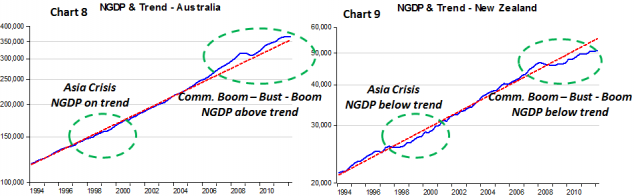
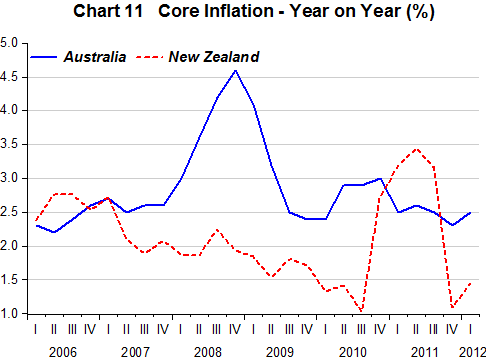
Today, I think Marcus Nunes (another Market Monetarist) is making a similar mistake in highlighting Australia’s consistent growth as a success of monetary policy. There are many charts in Marcus’ post, but I presume an important one to highlight is Australia’s NGDP during the past two decades (the post compares the relative success of Australia to New Zealand):Chart 8 is intended to depict how monetary policy maintained NGDP growth near trend through the Asia Crisis and above trend throughout the global financial crisis. A concern of many non-Market Monetarists is what portion of NGDP growth will be derived from inflation versus real growth. To address that question, Marcus offers the following chart and notes:

Chart 11 shows that generally, inflation has not been an ‘issue’ in either country.
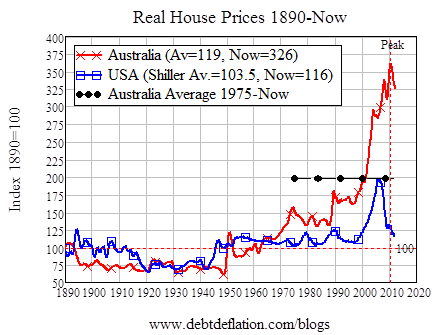
If I knew little about the Australian economy, Marcus’ display of graphs and explanation might prove very convincing. However, having long been a fan of Steve Keen (an Australian economist), I was surprised at the lack of discussion regarding Australia’s housing market. Keen, a highly regarded Post-Keynesian, has for years been pointing out the positive and negative effects of private credit on growth. Regarding this topic, Keen frequently points out similarities between the US and Australia. Here’s a chart from Steve’s blog comparing Australian and US real house prices:
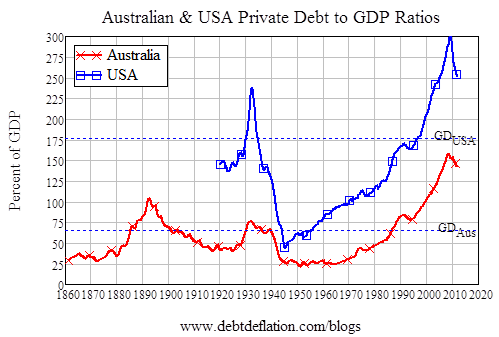
After nearly doubling between the mid-1990’s to 2005, US house prices have now given back most of the gains. Meanwhile, in Australia, house prices nearly tripled from the late-1980’s to the recent peak in 2010. Currently house prices remain at levels double those witnessed in the mid-1990’s. Similar to the US, the rise in home values is not well accounted for in national inflation data. As Keen regularly notes, a major factor in both housing bubbles and macroeconomic cycles (frequently overlooked by mainstream economists and monetarists) is private debt. Below is a chart comparing the levels of private debt in Australia and the US:
During the extended period of growth in Australia, private debt to GDP has been growing consistently. The rise in private debt and housing prices, which supported Australian growth for two decades, have now turned south. Similar, more exaggerated, drops in the US were at the heart of the US crisis and continuing economic malaise. As the housing bubble in Australia busts and private sector deleveraging speeds up, the Australian central bank (RBA) will be unable to overcome the deflationary momentum. GDP growth in Australia has been slowing of late and the most recent unemployment report showed a surprise uptick. If Keen is right, monetary policy is likely to prove inept in the coming years as NGDP falls below trend without large fiscal stimulus.

The US experienced a great-run of economic growth on the back of a staggering rise in private debt that ultimately caused the subsequent crash and stagnation. Australia appears to have built its remarkable run on the same principles and will soon find out if the optimism was equally misplaced. Market Monetarists are claiming Australia a success, while the Post-Keynesians are warning of impending trouble. My bet is on Steve Keen and the Post-K’s. Where’s yours?     

Tuesday, May 15, 2012

NGDP Targeting: Changing Policy Changes Relationships (Part 2)


Scott Sumner at TheMoneyIllusion suggests that Evan Soltas provides the best argument for NGDP targeting. After offering praise he provides a brief criticism regarding Evan’s interpretation of some graphs in a recent blog post:
Evan states:
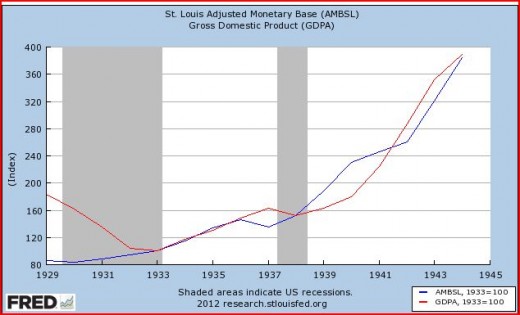
The first graph shows that even the most massive amounts of monetary expansion are ineffective medicine for NGDP expansion. What matters is expectations; growth in the medium run is conditional on expectations — not on the monetary base or price level.
The second graph shows the extent to which monetary policy seems to have forgotten this. Nominal income growth expectations have been right at zero since the recession, when before that they had been stable at the 5 percent level for decades. The findings come from this study by the Chicago FRB, which I found through this Chicago Magazine article. Paging Scott Sumner…
Sumner replies:
I mostly agree, and very much like the second graph, but I’d like to slightly quibble with the first graph.  I redrew it setting both the base and NGDP equal to 100 in 1933, not 1929:


Notice that the base rose in the early 1930s while NGDP fell sharply.  That’s because base demand was engorged by two factors, banking distress and ultra-low interest rates.  The ultra-low interest rates continued between 1933 and 1944, but banking distress fell sharply after dollar devaluation and the creation of FDIC.  Thus after 1933 the base and NGDP rose at roughly similar rates, both nearly quadrupling over those 11 years.  As you know, I don’t regard the base as a reliable indicator of the stance of monetary policy, because base demand can be highly volatile under certain conditions.  But the supply of base money is still very important; indeed it’s the major factor driving NGDP over the long term.
Judging this debate I’d actually like to argue that Evan may have the upper hand. Until the Great Recession, excess reserves in the financial system were maintained at a minimal level. As has been previously shown, demand for credit (loans) creates deposits. The Federal Reserve has primarily focused on targeting the price of reserves (interest rates), letting the quantity float by always providing a sufficient amount. The amount of base money should correlate reasonably well with the increasing demand for credit under these conditions. Steve Keen has shown in his models of the economy that changes in debt directly impact aggregate demand and thereby NGDP. One should therefore expect to see a positive correlation between NGDP and base money while those circumstances persist.

However, since the Great Recession the Fed has, to a degree, altered its approach to monetary policy by paying Interest-on-Reserves (IOR). Back in November of 2010 I blogged the Fed Stands in Own Way on Monetary Policy. In that post I highlighted a report from the New York Fed asking Why Are Banks Holding So Many Excess Reserves? As the authors’ note:
if the central bank pays interest on reserves at its target interest rate,..., the money multiplier completely disappears. In this case, banks never face an opportunity cost of holding reserves and, therefore, the multiplier process described above does not even start.
Paying IOR above the risk-free-rate has resulted in a surge of excess reserves and base money uncorrelated with any increase in the demand for credit. Changing Fed policy has altered the conditions under which the previous relationship existed. The supply of base money (which was correlated but didn’t drive NGDP) may therefore no longer even show any material correlation with NGDP (as long as current condition prevail). Evan appears correct:
What matters is expectations; growth in the medium run is conditional on expectations -- not on the monetary base or price level.


Saturday, March 31, 2012

Points of Public Interest

This week’s best and most intriguing for your weekend reading:

  1. Krugman on (or maybe off) Keen
  1. Why Some Multinationals Pay Such Low Taxes
Insight into Google’s use of a “Double Irish Dutch Sandwich” and many other clever practices being used by GE, Microsoft, Apple, etc.
  1. WHY MINSKY MATTERS: Part One
A former student of Minsky’s elegantly outlines the important aspects for understanding the reality of our financial and economic system. More on Minsky: Was 'Post-Keynesian' Hyman Minsky an Austrian in Disguise?
  1. The worst anti-regulatory travesties in the financial sphere have had broad, bipartisan support
Without much fanfare, the “fraud-friendly JOBS Act” passed Congress this week with overwhelming support. William Black, a professor of law and economics, offers a history of anti-regulatory bills over the past several decades. If history is any guide, the JOBS Act will be front and center as having aided and abetted massive frauds during a financial crisis in the not too distant future. More on the JOBS Act: Bill Black: “The only winning move is not to play”—the insanity of the regulatory race to the bottom
  1. Liberating The Hunger Games and What Happened to Liberty in the The Hunger Games Movie?
What can I say...talk of The Hunger Games is everywhere these days!
  1. The Real Leadership Lessons of Steve Jobs

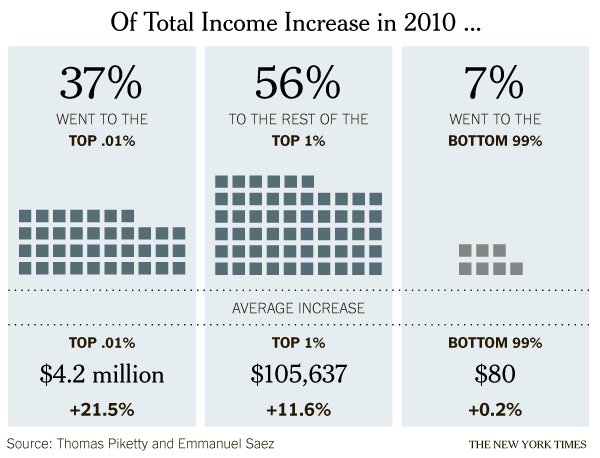
The bottom 99% fall further behind:

Source: NYT

Saturday, March 24, 2012

Points of Public Interest

Ugly day in DC after a beautiful week, but more good NCAA basketball on TV. Good luck to those whose brackets still have a chance of winning!

  1. “The Current Models Have Nothing to Say”
Should we be surprised? Policy makers continue to employ models of an economy with no financial system.
  1. Economics without a blind-spot on debt
The aggregate level of debt, especially private, matters in
forecasting economic growth.
  1. Consumer Credit Growing at Highest Rate in Past Decade: Unhealthy and Unsustainable?
Stopping addictive habits is not easy, but extending those actions will only make the eventual adjustment more difficult and painful.
  1. The Japan debt disaster and China’s (non)rebalancing
Chinese consumers continue to increase savings in lieu of domestic consumption. Japan is attempting to rebuild its trade surplus, but which countries will allow their surplus to decline or deficit to increase? Global (and domestic) imbalances not addressed remain significant risks to the global economic outlook.
  1. A step in the right direction
Scientific exploration incorporating complex systems and networks continues to move our understanding of reality forward.
  1. It's not structural unemployment, it's the corporate saving glut
Businesses save instead of investing in labor when consumer demand is weak. Until policy focuses on improving the consumer balance sheet (e.g. debt write-downs), unemployment will remain high.
  1. Wrong vs Early – Contrarians Bet on Natural Gas
The best investors are often early and patient.
  1. The Real Problem with Microfoundations
Microeconomics is not especially sound in predicting all outcomes
either.
  1. Principal writedowns of the day, mortgage edition
Positive for households but will Bank of America (and others) really accept the associated losses?
  1. Why Using P/E Ratios Can Be Misleading
In early 2009, at the market bottom, the P/E jumped to over 100 as profits plummeted. Using E/P corrects for this issue and shows the market is slightly overvalued currently.
 

Saturday, March 3, 2012

Quote of the Week

...is from Emanuel Derman’s insightful book, Models.Behaving.Badly. (2011):

”Physicists, brought up on a diet of astounding theories and successful models, have the ability to distinguish a theory from a model and a good model from a bad one. Economists for the most part have never seen a genuine theory, and so discrimination is harder. The simple models they work with fail to reflect the complex reality of the world around them. That lack of success is not the fault of economists, for people have proved difficult to theorize about, and we still await an understanding of Spinoza’s adequate causes for their behavior. But it is the economists’ fault that they take their simple models so seriously. Finding the truth about nature takes cunning and intuition. The invisible worm of financial economics is its dark secret love of mathematical elegance regardless of its efficacy, and its belief that rigor can replace fact and intuition.”
A former theoretical physicist and Wall Street Quant, Derman offers a unique perspective on the difference between physics and economics through a distinction between theories and models. Stemming from the Great Recession, countless articles have been written about the state of economics today and potential directions for the future. As Derman wisely points out, the incorporation of human action significantly hinders the ability of economics to create genuine theories, those that prove true for all instances across time.

This view is not to suggest that mathematical elegance should be disregarded, but rather that its limitations in predicting human behavior be understood and acknowledged. Advances within physics, such as chaos theory and quantum electrodynamics (QED), are currently being employed by economists (ie. Steve Keen) to formulate new models of the economy. However, it remains unlikely that these advances will ever fully predict the future actions of individuals and therefore some level of uncertainty will always remain present within economical models.

Saturday, February 11, 2012

Points of Public Interest


  1. Why Jews Don’t Farm - Steve Landsburg approaches this question from the perspective of literacy and education as hallmarks of Jewish religion. (h/t Don Boudreaux, Cafe Hayek)
  2. Repulsive progressive hypocrisy - Glenn Greenwald expresses fear over Democratic support for policies, including Guantanamo and drone usage, under the Obama Administration that were highly criticized when similarly carried out by the Bush Administration. I share Greenwald’s concern that political support may become tied to individuals rather than actual policy actions. (h/t Anthony Gregory, The Beacon: “Repulsive Progressive Hypocrisy” and Why Peaceniks Should Oppose Democrats)
  3. What Europe might look like without the Eurozone and EU - Bruno Frey dispels with the view that a collapse of the Euro will lead to chaos and war. On the contrary, he argues that countries will likely establish more flexible, smaller agreements that maintain free trade and may even improve European economic prospects.
  4. The Top Twelve Reasons Why You Should Hate the Mortgage Settlement by Yves Smith
  5. S = I + (S – I) : The Most Important Equation in Economics The “mysterious” JKH explains a key component of sectoral balances in an incredibly clear and concise fashion.
  6. How Economists Contributed to the Financial Crisis John T. Harvey discussed how making math the ends rather than means of economics has led much of the discipline off course from the real world. Post-Keynesianism, especially Steve Keen, and MMT receive acknowledgement for raising awareness of the crisis in advance and, in my opinion, continue to offer some of the best insights. (h/t Tom Hickey, Mike Norman Economics)