Showing posts with label EU Crisis. Show all posts

Friday, March 29, 2013

"Cyprus Should Leave The Euro. Now."

Yesterday banks in Cyprus opened for the first time in a week. Markets were seemingly calmed by the absence of immediate bank runs, however the ability of depositors to actually create a bank run has been prevented by strict capital controls. The real test for Cyprus banks will come when the capital controls are finally lifted. Although the restrictions are only supposed to be in place for 7 days, recent experience in Iceland suggests the better question is not when but IF the capital controls will be lifted. Based on the IMF’s recommendation, Iceland instituted capital controls back in 2008 for what was supposed to be a few months. Five years later the capital controls remain in place and are expected to continue for at least a couple more years. As a base case we should expect an announcement next week that Cyprus’ capital controls will remain in place for a few more weeks (possibly months).

While the implementation of capital controls presents an interesting storyline, Paul Krugman has raised a much bigger question into the public spotlight. After being challenged to expand the boundaries of political possibility, Krugman offered the following recommendation (emphasis added):
So here it is: yes, Cyprus should leave the euro. Now.
The reason is straightforward: staying in the euro means an incredibly severe depression, which will last for many years while Cyprus tries to build a new export sector. Leaving the euro, and letting the new currency fall sharply, would greatly accelerate that rebuilding.
The question for Cyprus is therefore whether “internal” or “external” devaluation offers the best prospects for the future? Let’s consider both of the options...

“Internal devaluation” (i.e. income deflation) - In return for continued assistance from the Troika (EU/ECB/IMF), Cyprus has agreed to impose losses on equity and debt holders, as well as uninsured depositors, of the two largest banks (Bank of Cyprus and Laiki Bank). This marks a distinct change in policy, especially with regard to the latter two groups.* Since uninsured depositors held a majority of those banks’ liabilities, the focus has naturally been on that group. Based on recent estimates uninsured depositors in the Bank of Cyprus may lose approximately 40%, while Laiki Bank’s uninsured depositors will be entirely wiped out.

The sharp reduction in (perceived) wealth stemming from these actions will put severe downward pressure on national income. Individuals and businesses experiencing losses will try to increase saving by reducing spending. Banks fearing deposit flight and falling asset prices will try build a stronger base of capital by restricting the supply of credit and possibly selling assets. Adding to the fall, the government will be forced to accept a MoU (Memorandum of Understanding) that establishes policies to increase taxes and reduce spending. Combining these deflationary pressures, the overall economic results may rival (or exceed) Greece’s recent history.

During the past 5 years Greece’s real GDP has declined by 20%
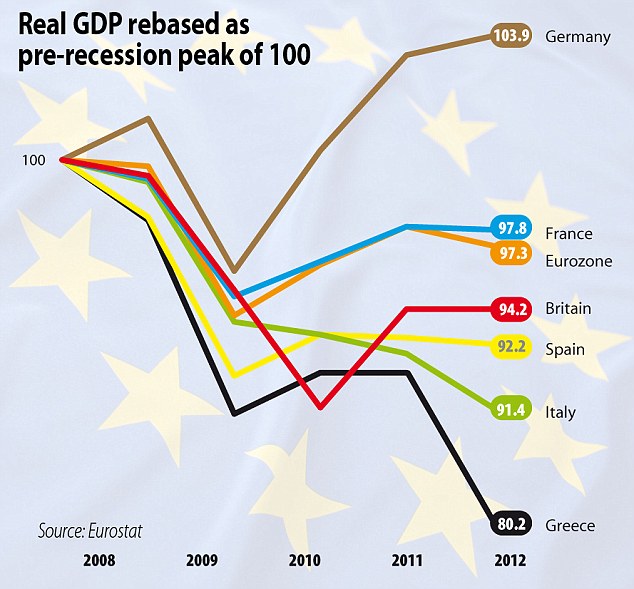
and unemployment has nearly quadrupled from ~7% to ~27%.


To offer some historical perspective, US unemployment during the Great Depression peaked at 25% and real GDP loss only exceeded 16% for one major European nation (Austria). Perhaps even more disheartening than the current data is recognition that output and unemployment appear unlikely to improve anytime soon.

Returning to Cyprus, unemployment has already quadrupled over the past 5 years (~3.5% to ~14%; shown above). Based on current estimates of a 20-30% drop in real GDP, Cyprus’ unemployment rate could easily approach or eclipse Greece’s in the next few years.

“External devaluation” (i.e. new currency) - If Cyprus were to leave the Eurozone, one of the first actions would be re-introducing the Cypriot pound at a heavily devalued rate against the euro. Not unlike the imposed losses on uninsured depositors, currency devaluation immediately imposes significant losses on all depositors. In this sense the impact on private demand would still be extremely deflationary, perhaps even more so. Though output and employment would fall dramatically, external devaluation presents reasons for potential optimism on both the foreign trade and government fronts.

Based on the recent bank losses and capital controls, Cyprus can no longer rely on its financial sector to support exports. By heavily devaluing its currency, Cyprus would be increasing its price competitiveness on the foreign market. However, as Barkley Rosser points out:
even with large elasticities [of trade relative to the exchange rate], there is the J-curve effect. Exports do not increase immediately, whereas the value of imports tends to jump up immediately with their price increases.
Aside from these timing issues, there is also a concern regarding the certainty of each effect. A large devaluation will definitely raise the cost of living for Cypriots but as JW Mason comments, it:
might not lead to higher net exports in the next few years, or ever. That’s the question -- not how big the devaluation would be, but how strongly it will affect trade flows.
As for the government sector, returning to the Cypriot pound would remove some of the current fiscal constraints. This would permit the government to increase spending (ideally investment in a new export sector) and not raise taxes, raising private sector income. While these adjustments will not come remotely close to overcoming the other deflationary effects in the short-run, the counterbalance provided will be a significant improvement over current policy.

In asking “Why Won’t Cyprus Obey Krugman?” Rosser concludes:
While this devaluation might make it easier for Cyprus to recover several years down the road, that recovery would indeed be several years down the road, and in the meantime there would be a lot of pain for the entire citizenry that will not happen if they stay with the euro.
If Greece has taught us anything about remaining with the euro, it’s that a lot of pain for the entire citizenry will happen regardless and a recovery may be decades down the road.

Cyprus is therefore faced with a choice between two terrible outcomes:
1) Remain in the Eurozone and experience a relatively slower “internal devaluation” whereby real output and employment experience large declines spread out over several years. A potential recovery is pushed even further into the future.
2) Leave the Eurozone and experience a quick “external devaluation” whereby real output and employment fall dramatically in the next year or two, but a recovery several years down the road becomes far more probable.

Where Rosser and I find agreement:
is that the real real issue here has to do with time preferences. It may get down to hyperbolic discounting. People do not want to have pain in the near term. So, the fear by the whole population of near term pain in terms of standard of living may outweigh fear of a more gradual decline with rising unemployment, even though the shorter term sharp pain is likely to lead to a sooner turnaround to growth.
Although this psychological tendency is very normal, it can at times be detrimental to achieving longer-term goals. The cases of Greece, Spain, Italy, Portugal, Ireland, and now Cyprus are examples of such times. The severe pain of reduced standards of living and high unemployment will be felt one way or another, but the option of “external devaluation” offers potential for a better future five and ten years down the road. Therefore I concur with Krugman, “Cyprus should leave the euro. Now.”        


* From my perspective, imposing losses on debt holders should have been done from the outset in the US and Europe. The apparent change in policy may raise costs of debt financing for the largest banks, but that should be a welcome change after years of enjoying a TBTF subsidy.

Wednesday, February 20, 2013

(Late) 2013 Predictions

Last year I took a chance and threw my own projections into the ring. Similar to Byron Wien and Edward Harrison, I mostly selected events that were widely seen as having a low probability (less than 33%) but which I believed held a greater than 50% chance of occurring. The final results were a bit disappointing, but that won’t stop me from trying again this year. Since these predictions already represent a late release, without further adieu, here are the 2013 predictions:

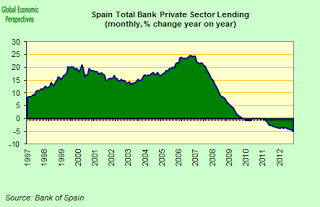
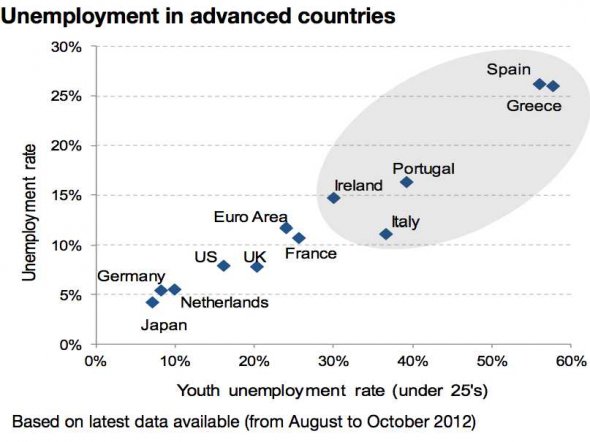
1) Spain requests access to ECB’s OMT - Since ECB President Mario Draghi announced the OMT program, yields on Spanish debt have fallen rather dramatically. Although this eases financing pressure, it has done little to alter the actual economy’s downward spiral. During 2012 Spain’s GDP growth became increasingly negative, falling by 1.8% year-on-year in the fourth quarter. Meanwhile unemployment continues its meteoric rise to over 26% for the general population and nearly 60% for youth. With the large banks still severely undercapitalized and households over-indebted, private sector lending continues to decline:


Seeing no recovery and potentially a worsening decline, “bond vigilantes” will eventually test Draghi’s threat. At that point Spain will be forced to accept a Memorandum of Understanding (MoU) in return for ECB bond-buying through the OMT program.

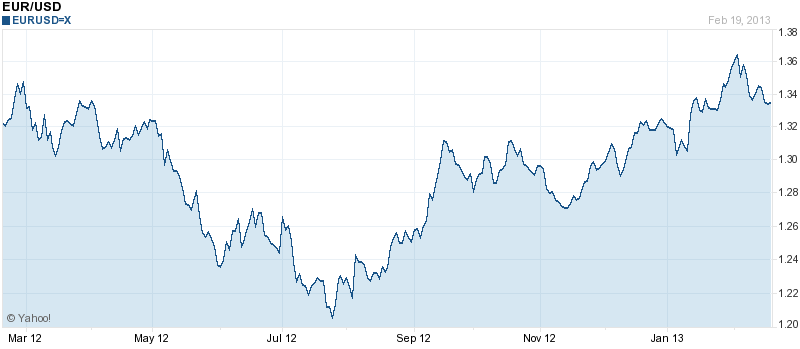
2) The Euro finishes the year above $1.30 - After falling nearly 10% during the first half of 2012, the euro has more than recouped its losses on the back of optimism and deflationary policies.

At points during 2013 the optimism is likely to fade, but I expect politicians and central bankers will take the necessary steps to quell fears for the time being. Unfortunately those steps will involve further deflationary policies that push the euro higher. These competing forces will largely cancel out, leaving the euro close to or above where it began the year.

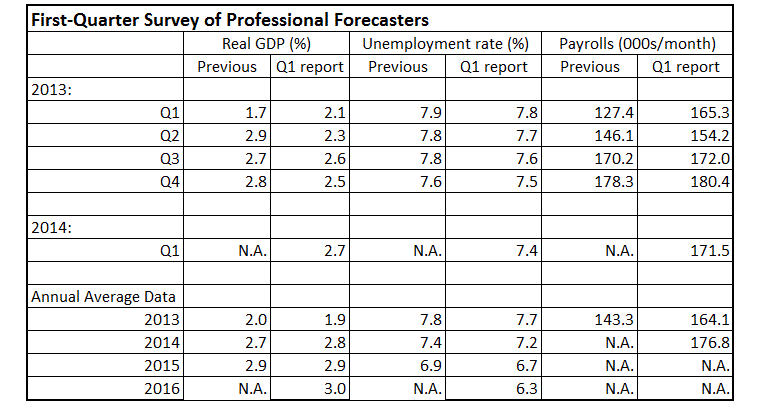
3) The Eurozone remains in recession the entire year - Forecasters now expect euro-zone economic activity to be flat this year, down from a previous prediction of 0.3% growth made just three months ago. Last year saw practically continuous downgrades to GDP growth forecasts and I expect this year to be no different. Austerity measures are momentarily easing, but more will likely be enacted based on the outcomes of several elections. The recent appreciation of the euro against several major currencies will also dampen growth by putting pressure on net exports. With banks across Europe trying to build up capital and persistently high unemployment, the private sector will remain especially weak. Though Germany may experience a temporary rebound, the Eurozone as a whole will not register GDP growth this year.

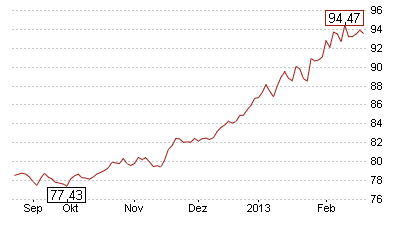
4) The Japanese yen rises above 90 per $ - Since the election of PM Shinzo Abe, the yen has fallen fast and is down more than 20% from recent highs.

During this time the Nikkei has risen more than 20%, yet yields on Japanese sovereign debt are little changed. This suggests many foreigners may be speculating on the supposedly forthcoming monetary and fiscal stimulus. As previously stated, the fiscal stimulus will probably be small and short-term. On the monetary front, short of actually entering the foreign exchange market, the Bank of Japan (BOJ) has essentially no mechanism to spur inflation and thereby cause a sustained depreciation of the yen. When market participants recognize the inability of Japan to avoid continued deflation, the yen will return to appreciating against the dollar.

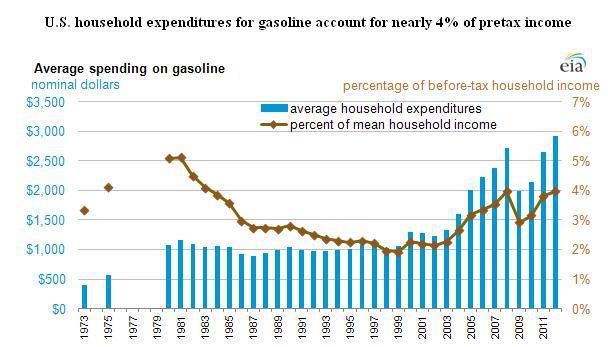
5) Gas prices will peak above $4.20 per gallon and set a new yearly record-high average above $3.75 per gallon - Gasoline prices have been on the rise for the past 31 days, currently averaging approximately $3.75 per gallon. Though this current streak will probably end soon, prices are unlikely to give back much of the gains before beginning the typical rise into summer. The ongoing potential for flare ups in the Middle East will keep prices elevated throughout the year. Higher gas prices, which already account for 4% of before-tax household income (chart below), will be a drag on consumer spending in 2013.


6) U.S. Yearly GDP growth falls below 1.5% - Forecasts of ~3% annual GDP growth over the past couple years have been overly optimistic as real growth in 2011 and 2012 was merely 1.6% and 1.9%, respectively. Apparently forecasters are being a bit tamer in their estimates this year, now expecting only 2% annual growth. Unfortunately I suspect these estimates will once again prove too optimistic. Various tax hikes and the upcoming sequester (which will go through in some respect) will reduce the budget deficit by a few percent this year. Housing is likely to remain a bright spot, but further declines in interest rates will not lead to similar magnitudes of the wealth effect. Credit remains tight for many households and small business, which should also limit private sector activity. All of these factors combined will probably not be enough to bring about a new recession but will lead to the lowest annual growth rate during this upswing.


7) U.S. Unemployment rises above 8% - Currently sitting at 7.9%, the unemployment rate is forecast to decline during 2013. Due to weaker GDP growth, corporate revenues will barely rise again this year. As companies face increasing pressure to maintain profit margins at record levels, a new wave of layoffs may occur. Separately, continuing economic growth will encourage previously discouraged workers to re-enter the job market. Both of these factors will lead to slightly higher measured unemployment.

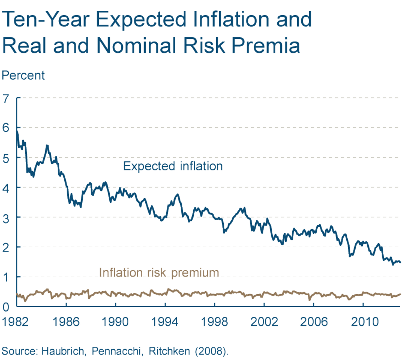
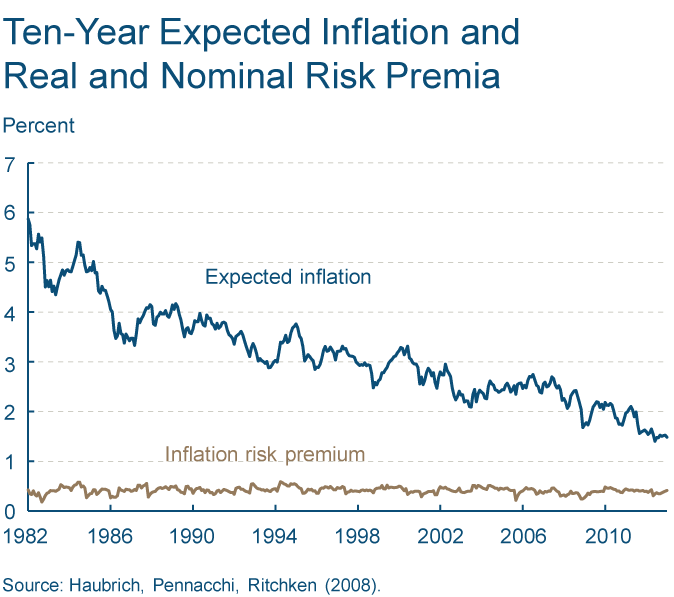
8) Federal Reserve forecasts shift first rate hike to 2016 - After extending their forecast for the first rate hike to 2015, the Federal Reserve changed its tactics to a more rule-based monetary policy. The Fed has, in effect, promised to keep rates low until we've hit either 6.5 percent unemployment or 2.5 percent inflation. Based on the above outlook for unemployment and a continuing decline in inflation expectations (chart below), FOMC members will revise their own forecasts and push back expectations for the first rate hike.


9) U.S. Corporate Earnings (ex-Federal Reserve) finish year below 2012 peak - Meager revenue growth was not enough to prevent U.S. Corporate Profits after tax from reaching record highs in the fourth quarter of 2012 on the back of record profit margins. US Corporate Profits After Tax Chart

As global growth slows in 2013, revenues will come under further pressure. At this point the ability of firms to continue cutting costs without sacrificing output seems limited, which means margins may begin to compress. As margins revert to previous norms, earnings will register a yearly decline.

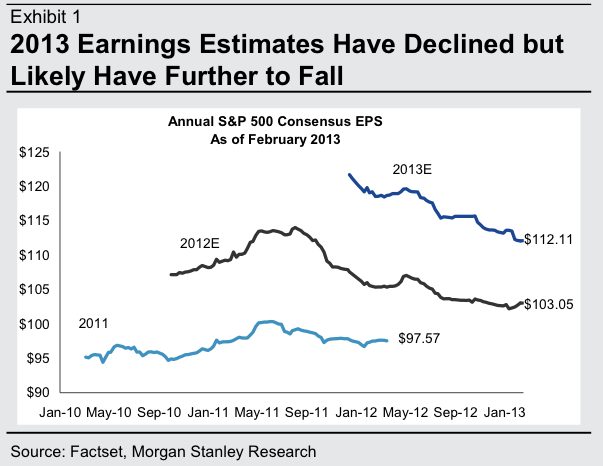
10) Bonds outperform stocks - During the first seven weeks of this year the stock market has been on fire, even though earnings estimates continue to fall.


Multiple expansion is currently being driven by the Federal Reserve’s actions despite their ineffectiveness at generating actual NGDP growth. When investors eventually turn their attention to continuing troubles in Europe, ongoing deflation in Japan, and/or weakening growth in China, U.S. earnings may once again enter the picture. Recognition that S&P 500 earnings growth has slowed substantially may cause the market to give up much of this year’s gain. These concerns combined with declining inflation expectations will result in many investors returning to the safety of U.S. Treasuries. The subsequent rise in prices (decline in rates) will generate another year of positive returns for the Treasury market.


Will my predictions prove too pessimistic once again? Only time will tell...

Thursday, February 14, 2013

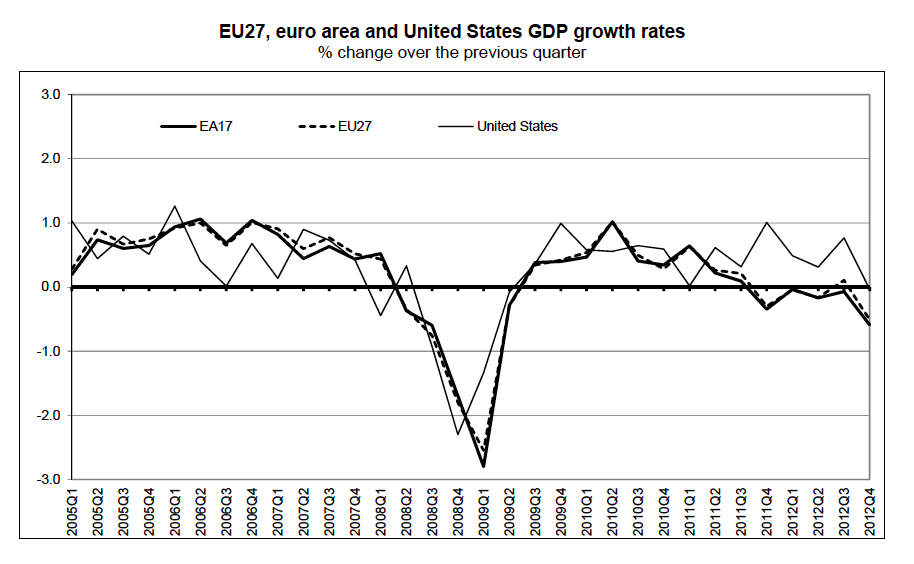
European Markets and GDP Move in Opposite Directions during 4th quarter


With data now confirming Europe’s awful fourth quarter on the GDP and unemployment front, it may be time to reconsider whether recent optimism is truly warranted...

Europe's A Fragile Bubble', Citi's Buiter Warns Of Unrealistic Complacency courtesy of Zero Hedge

We recognise that, in a decentralised market economy where expectations of the future, moods, hopes and fears drive private (and sometimes also government) behaviour directly and through their effect on the prices of real and financial assets, today’s subjective expectations and other psychological characteristics in part determine what tomorrow’s fundamentals will be.
Irreversible or costly-to-reverse decisions like capital expenditure, human capital formation, resource extraction etc, are driven by subjective expectations and moods, making the distinction between a fundamentally warranted asset boom and a bubble slightly fuzzy at the edges.
But this indeterminacy, bootstrapping, self-validating characteristic of complex dynamic economic systems inhabited by partially forward-looking households, firms and policy makers – called reflexivity by George Soros – can be taken too far.
Mere optimism and confidence will not permit the authors of this note to bootstrap themselves into winning the men’s doubles at Wimbledon 2013. The fact that financial markets have radically reduced their implied estimates of the likelihood of sovereign default in the periphery of the EA (other than in Greece) and of senior unsecured bank debt restructuring throughout the EA, core as well as periphery, should not stop us from continuing to analyse carefully the fundamental drivers of both sovereign credit risk and senior unsecured bank debt credit risk. When we do this, the conclusion that the markets materially underestimate these risks is, in our view, unavoidable.
Woj’s Thoughts - Actions by central bankers and politicians in the Euro Area, U.S., and Japan are increasingly betting on the fact that optimism and confidence alone will solve the problems underlying the presently weak economic growth. On this matter I side with Buiter in thinking markets have gotten well ahead of economic realities, especially in the Euro Area periphery. Recent flare-ups highlight the ongoing undercapitalization of banks and the inability of fiscal policy to either reduce unemployment or meet given targets. Political fallout from recent scandals and a strengthening euro may reignite the EU crisis.

Thursday, January 24, 2013

Bubbling Up...1/24/13


1) Hit the “Defer” Button, Thanks… by David Merkel @ The Aleph Blog

This is why I believe that the biggest issue in restoring prosperity globally, is finding ways to have creditors and stressed debtors settle for less than par on debts owed.  Move back to more of an equity culture from what has become a debt culture.  A key aspect of that would be making interest paid non-tax-deductible for corporations, housing, etc., while making dividend payments similar to REITs, while not requiring payouts equal to 90% of taxable income.  Maybe a floor of 50% would work, with the simplifying idea that companies get taxed on their GAAP income — no separate tax income base.  Would certainly reduce the games that get played.
Anyway, those are my opinions.  The world yearns for debt relief, but governments and central banks argue with that, and in the short-run try to paper over gaps with additional short-term debt that they think they can roll over forever. They just keep trying to hit the “defer” button, avoiding any significant reforms, in an effort to preserve the “status quo.”
Woj’s Thoughts - After reviewing the results of my 2012 predictions, I mentioned:
My main takeaway is that politicians are far more determined to maintain the status quo than I had expected. The underlying economic (and social) problems have once again been kicked down the road for future governments to handle.
Although David’s policy recommendations are becoming increasingly pervasive, they unfortunately remain nowhere near the level necessary for governments to test uncharted waters. 

2) Can Germans become Greeks? by Dirk @ econoblog101
The ECB as well as other policy makers and politicians do not understand economics. They think that a simple recipe like “decrease government spending, export more” is enough to solve the euro zone crisis. The increase in government debt is a symptom of the crisis, not a cause. The cause of rising government debt was negative economic growth and bank bail-outs. These are the two problems which must be tackled. They are intertwined, so solutions should address both. Households cannot pay their mortgages in Spain and Ireland at the existing unemployment levels, and that is due to a lack of demand as households consume less and save more. This downward spiral must be stopped and turned around, since at negative growth rates even a government debt of €1 is too high.
It seems that instead of Greeks becoming Germans now the German are becoming Greeks. That means that without government spending Germany will not have positive growth rates. While this will come as a surprise to many, it shouldn’t be.
Woj’s Thoughts - Germany managed to run a slight fiscal surplus during 2012 that ultimately came at the expense of growth. In the fourth quarter, German GDP shrank by 0.5 percent. Meanwhile, attempts at structural reform (i.e. fiscal consolidation) in the European periphery appear to be speeding up the rise in unemployment and decline in growth. This dynamic is neither economically or socially sustainable, therefore the governments and ECB must either substantially change the current course or wait for countries to eventually exit the Eurozone.

3) Did We Have a Crisis Because Deficits Were Too Small? by JW Mason @ The Slack Wire
The logic is very clear and, to me at least, compelling: For a variety of reasons (including but not limited to reserve accumulation by developing-country central banks) there was an increase in demand for safe, liquid assets, the private supply of which is generally inelastic. The excess demand pushed up the price of the existing stock of safe assets (especially Treasuries), and increased pressure to develop substitutes. (This went beyond the usual pressure to develop new methods of producing any good with a rising price, since a number of financial actors have some minimum yield -- i.e. maximum price -- of safe assets as a condition of their continued existence.) Mortgage-backed securities were thought to be such substitutes. Once the technology of securitization was developed, you also had a rise in mortgage lending and the supply of MBSs continued growing under its own momentum; but in this story, the original impetus came unequivocally from the demand for substitutes for scarce government debt. It's very hard to avoid the conclusion that if the US government had only issued more debt in the decade before the crisis, the housing bubble and subsequent crash would have been much milder.
Woj’s Thoughts - The scenario laid out by JW sounds equally plausible and compelling to me. Changes in tax policies during the 1980’s and 1990’s set the stage for massive increases in real estate loans and the corresponding housing price boom. Then the unmet demand for safe-liquid assets prompted both the rise of shadow banking and the dispersion of U.S. housing assets to the rest of the world. So as the last sentence attempts to make clear, the “crash would have been much milder” but a similar crisis would likely have occurred.

Tuesday, January 22, 2013

Quote of the Week...


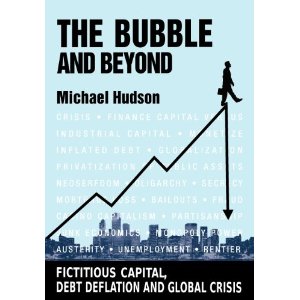
...is from Michael Hudson’s fantastic book, The Bubble and Beyond:
Central bank policies that raise interest rates to slow new direct investment and hiring make economies even less able to carry their debt burden. In this respect the buildup of savings and encouragement of debt financing encourages a buildup of financial returns rather than tangible capital investment. Thus is antithetical to the goal of promoting high wages and rising labor productivity. The rate of interest is permitted to govern the doubling times of savings without the moral, political and religious checks that have rolled back the growth of financial overhead throughout history. There is only one ultimate solution: Debts that cannot be paid, won't be. The open question is, will this tear economies apart as the financial sector fights against fate?
There are clear signs from around the globe that this process is, in fact, tearing economies apart. Despite mass unemployment and declining living standards, many countries continue to support their private financial institutions in the misguided hope that further lending will make households and nonfinancial corporations better able to carry their debt burdens. Until this process is dismantled or reversed, the prospects for sustained economic growth in these countries remains heavily subdued.

Thursday, January 17, 2013

2012 Predictions: The Results

Last year I took a chance and threw my own projections into the ring. Similar to Byron Wien and Edward Harrison, I mostly selected events that were widely seen as having a low probability (less than 33%) but which I believed held a greater than 50% chance of occurring. Let’s see how I did...

1) Greece leaves the Euro - As the year progresses the Greek economy continues to contract and unemployment continues to rise, surpassing 50% for youth. This combination of factors offsets attempts to reduce the budget deficit as the country repeatedly misses EU and IMF required targets. Despite potential for further bailouts, the Greek people finally decide the consequences of tied promises outweigh the benefits of remaining in the Euro. Greece defaults on all debts, returning to a heavily depressed drachma.

Result - Wrong (0-1). During 2012, Greece was successful in reducing its budget deficit by 30 percent and staying in the Eurozone. This success was in large part due to further defaults on public debt and another bailout. Unfortunately for the Greek people. the price of these efforts remains extraordinarily high. The economy may have contracted as much as 6.5 percent in 2012, the fifth year of recession, according to forecasts in the 2013 budget. Meanwhile both the general and youth unemployment rates continue to soar, reaching ~27 percent and ~58 percent, respectively. At this point Greece is clearly in the midst of a Depression and showing no signs of recovering anytime soon. Greek tolerance of increasing unemployment and decreasing prosperity remains a surprise, although radical political parties have been gaining support. For now Greece remains in the Eurozone, but a future exit remains likely.

2) Italy and Spain lose access to credit markets - A Greek default raises concerns about the potential for creditors to face actual losses on EU sovereign debt. The ECB’s measured efforts are not strong enough to overcome fear and concern about future growth in Italy and Spain. Deep recessions take hold in both countries, pushing deficits higher.

Result - Wrong (0-2). A Greek default and concerns about the European economy weighed heavily on EU sovereign debt during the first half of the year. By the summer, ten-year bond yields in Spain and Italy were at 7.75 percent and 6.75 percent, respectively, and rising. With the countries at risk of losing access to credit markets, ECB President Mario Draghi came forth with a plan to cap sovereign interest rates using open-ended outright monetary transactions (OMT). Draghi’s threat was enough to generate a 180 degree turn in EU sovereign debt markets, but nowhere near enough to turn around the economies. Italy and Spain both returned to recession this past year, pushing fiscal deficits and unemployment higher. While Italy’s unemployment rate remains closely tied to the EU-wide level of ~11 percent, Spain’s general and youth unemployment rates have quickly caught up to Greece’s levels. Eventually Draghi’s Liquidity Bluff Will Be Called, potentially sooner rather than later as a strengthening euro may reignite the EU crisis.

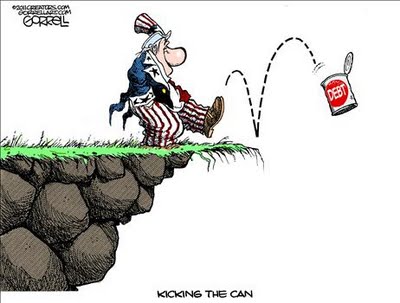
3) The Eurozone enters recession - Practically the entire Eurozone falls into recession, including the likes of France and Germany. A deteriorating economic outlook causes deficit estimates to be raised across the board, facilitating credit rating downgrades. Agreements for greater austerity fail to stem the tide and other attempts to kick the can down the road are pursued.

Result - Correct (1-2). The euro zone economy contracted 0.2 percent in the second quarter and 0.1 percent in the third, meeting the technical definition of a recession. The fourth quarter drop is looking even worse following recent news that Germany  saw output shrink 0.5 per cent between October and December. Although Germany managed to run a slight fiscal surplus, at the expense of growth, Spain’s budget deficit probably exceeded 9 percent for a fourth year in 2012. The first half of the year did witness credit downgrades and austerity agreements, but Draghi’s big kick at the end of summer pushed any further actions into future years.

4) China’s GDP growth falls below 7% - As exports to Europe contract, the busting of China’s housing bubble continues unabated. Expectations for massive monetary easing in Europe and the US, along with fear of flare ups in the Middle East sets a floor under energy and food commodity prices. Monetary easing and fiscal stimulus in China are applied too slowly to prevent growth from slowing below the supposedly necessary 8%. (Note: This will be not be considered a hard-landing, which I deem growth below 5%. That may come in 2013, but for 2012 most economists/analysts will be able to maintain expectations of a soft-landing.)

Result - Wrong (1-3). During the third quarter China’s growth rate slowed to a three-year low of 7.4 percent, but the year-end tally will probably be around 7.7 percent. As growth slowed and housing prices fell early in the year, the government took action to allow a smoother transition between governments. Fiscal stimulus has pushed growth and inflation higher in the last few months, but at the expense of rebalancing the economy toward consumers for future sustainability.

5) Oil prices will spike above $120, finish year below $90 - (Using WTI crude prices, currently ~$102) At some point during the year Iran attempts to block the Strait of Hormuz. Further attempts to overthrow governments in the Middle East, possibly some that only recently gained power, hit the headlines again. Combined with global monetary easing, oil prices will move higher and gasoline will once again hit $4 per gallon in the US. These higher prices will exaggerate the reduction in global demand for other goods and push growth lower. As fears of a global recession take over, oil prices will fall, finishing the year down more than 10%.

Result - Wrong, but close (1-4). Fears about Iran and the Middle East never really materialized this year but that did not prevent a wild ride in oil prices. After rising to over $113 in April, WTI crude prices dropped all the way down to $80 in August (daily price history). A rally in the last week of the year brought the closing price slightly back above $90. Brent crude prices diverged significantly from WTI in 2012, keeping gas prices at the pump high throughout the summer. Gas prices peaked at $3.94, not quite $4, but nevertheless reached a record-high average of $3.62 per gallon.

6) US enters recession in 2nd half - Despite higher 4th quarter GDP in 2011, the lower savings rate and energy prices are unlikely to add much growth in 2012. With Europe contracting and China slowing down more than expected, US exports will take a hit. Extensions of the payroll tax cut and unemployment benefits will help ensure the federal deficit holds above 8%. Housing prices will continue to fall (based on Case-Shiller) causing the savings rate to once again reach 5%. By the end of 2012, the US will be in a recession (although NBER may not confirm this until 2013).

Result - Wrong (1-5). Despite Europe contracting, China slowing down and the federal deficit dropping to 7% (still over $1 trillion), US GDP growth remained positive throughout 2012. After falling to 1.3 percent in the second quarter, annualized GDP growth jumped to 3.1 percent in the third quarter. Although current estimates for fourth quarter GDP are below 1 percent, the US is most likely not in a recession at this time. Partially behind the positive growth was the impact of housing prices rising over 5 percent and the savings rate remaining below 4 percent.   

7) Federal Reserve extends forecasts for ~0% rates until 2015 - As growth in the US weakens once again and the global economy slows, expected inflation over the next ten years (based on Cleveland Fed estimates) will fall towards 1%. With unemployment holding steady around 9%, the Fed will move it’s forecasts for the first interest rate hike out to 2015. (Some form of QE3 is also likely, but aside from promoting short-term speculation, the effects on growth are likely to be muted.)

Result - Correct (2-5). Expected inflation over the next ten years fell consistently during the course of the year to approximately 1.5 percent (chart below). Although unemployment improved materially, dropping below 8 percent, the Federal Reserve still felt the urge to step up monetary stimulus. On September 13th, 2012, the FOMC extended its projections for maintaining “exceptionally low levels for the federal funds rate...at least through mid-2015” while enacting a plan to purchase “additional agency mortgage-backed securities at a pace of $40 billion per month” indefinitely. Since QEternity was insufficient to boost growth, the Fed also enacted QE4 to raise the rate of balance sheet expansion.


8) President Obama will win re-election - Generally a weakening economy has been poor for incumbents but this time will be seen as abnormal circumstances. The troubles in Europe and high unemployment will actually spark desire for a more interventionist government. Given the choice between Obama and Romney, the President will win re-election by a slim margin (2% or less).

Result - Correct (3-5). President Obama crushed Romney in the 2012 election based on the electoral college, however the popular vote was decided by less than 3 percent.

9) The US dollar rises over 5% - (Based on dollar index) In spite of QE efforts and another sizable deficit, the US dollar retains its safe haven status. As fears of European defaults spread and China’s slowing growth impacts commodity prices, the dollar will continue to trend higher.

Result - Wrong (3-6). As fears spread about European default and a slowdown in China, the dollar rose several percent into the summer months. When those fears were assuaged by politicians, not economic data, the euro began a strong rally. By the end of the year, the dollar had essentially finished flat.

10) Bonds outperform stocks - The consensus once again favors stocks, although US Treasuries have now outperformed stocks over the past 1, 10 and 30 year horizons. With global growth slowing, inflation expectations will fall. Before this bull market in bonds ends, 10- and 30-year Treasuries may reach 1% and 2%, respectively.

Result - Wrong (3-7). Slowing global growth, falling inflation expectations and stagnating corporate earnings were not enough to deter stocks from a very strong performance in 2012. The Bernanke put morphed into a proactive Fed determined to push asset prices higher and succeeding to the tune of over 15 percent. While stocks were riding towards new highs, the bull market in bonds also remained intact. The 10- and 30-year Treasuries hit their respective lows of 1.43 and 2.46 during the summer before heading higher into year end. Ultimately 10- and 30-year Treasuries last year posted returns of only 3 percent and 2.5 percent, respectively.   

That’s the end of it. 3-7 is certainly a bit of a disappointment, especially given the direction of events through the first half of the year. That being said, the logic behind each prediction was sound and far more on target than the end result suggests. My main takeaway is that politicians are far more determined to maintain the status quo than I had expected. The underlying economic (and social) problems have once again been kicked down the road for future governments to handle. As long as that pattern holds, current optimism and modest growth can persist for another couple years.

My hope is to have Predictions for 2013 out by the end of next week. Stay tuned.  

Monday, January 14, 2013

Strengthening Euro May Reignite EU Crisis

Back in September, ECB President Mario Draghi outlined the central bank’s willingness to cap sovereign yields through unlimited open market transactions (OMTs) for countries that requested help and submitted to structural reform (i.e. deficit reduction). Following the announcement, sovereign yields began falling across Europe and the euro began appreciating against numerous other currencies. As sovereign credit markets have eased, no countries have been forced to ask for explicit help from the ECB and the ECB has not needed to purchase sovereign debt in the secondary market. Although credit and currency markets reflect a strengthening European economy, unemployment continues rising to all-new heights and GDP growth remains decidedly negative in many countries. If actual economic improvement is not forthcoming in the next few months, Joerg Bibow may be correct in claiming that Draghi’s Liquidity Bluff Will Be Called

Essentially there are three parts to properly resolving the euro crisis, and one vital precondition. The first is symmetric internal rebalancing, the second is dealing with the area’s debt overhangs, and the third is to turn the flawed euro regime into a viable one by fixing the original flaws. Crucially, crisis resolution will be difficult, if not impossible, without robust GDP growth. For in a shrinking economy not even a balanced budget will prevent the public debt ratio from rising further, while interest rates cannot be low enough when even nominal GDP growth is turning negative.
Mindless fiscal austerity is self-defeating when inflicted on a deleveraging private sector and fiscal multipliers large when neither monetary conditions nor exports can provide much relief. Pursued simultaneously across the continent, European countries are deflating each others’ key export markets, implicitly relying on extra-regional exports to make up for their suicidal pursuits. By forcing adjustment solely upon debtor countries, where debt overhangs are naturally concentrated, their solvency problems are made only worse. Resisting upward wage realignment, Germany is pushing its partners, including France, into debt deflation.


Structural reform is no offsetting growth strategy at all. It worked for Germany, and only with a long delay, because Germany was going it alone while the world economy was strong. Germany needed an external surplus of 7 percent of GDP to finally balance its public budget. Today, the world economy can barely tolerate a repeat of that feat for Euroland as a whole.
As over-indebted private sectors continue to deleverage alongside attempts at fiscal restraint, the EU is effectively relying on its export sector to make up the difference. In a weird twist, Draghi’s actions to stem the sovereign debt crisis have prompted a significant appreciation of the euro. This result all but ends the EU’s hopes of creating an external surplus sufficient to balance fiscal budgets and will increase downward pressure on economic growth. My conclusion remains similar to Bibow’s:
In short, the euro remains firmly on track for breakup. It is only a matter of time until Mr. Draghi’s liquidity bluff will be called.

Saturday, December 29, 2012

Bubbling Up...12/29/12

1) Expanding Megabanks: Is Impatience the Cause? , by Garett Jones @ EconLog
In the wake of the crisis the Too Big To Fail problem has grown across the rich countries.  When something happens always and everywhere we should start looking for underlying laws.  We're not at "always and everywhere" here but it's getting close: Time to theorize.  
I don't think political influence from big banks is a major reason for the recent rise in bank size.  Political influence is a constant, like gravity, so the question is what changed after 2008.  Why the rise in bank concentration just as economists, policymakers, and politicians became more worried about bank concentration?  
It sounds to me like an interaction between hyperbolic discounting (impulsivity, short term impatience in the government sector) and time inconsistency (depositors know the regulator will cave later so depositors put more money in TBTF banks today, making it even more tempting for the regulator to cave).
Woj’s Thoughts - Jones goes on to make the case for banning acquisitions by the biggest banks. I left the following comment on his blog:
While I agree that "hyperbolic discounting by bank regulators is a big problem", I wonder whether banning acquisitions would solve the problem. Looking at the most recent crisis, Bank of America, Wells Fargo and JP Morgan were practically begged by regulators to acquire other large banks presumably because no better alternative existed. Had those mergers been prevented, what actions would have been taken? Speed bankruptcy is an option, but likely wasn't on the table. It seems plausible that the government and Fed would have bailed out those failed banks more explicitly.
One of the other channels, that I think may be a greater issue, is the subsidies inherent in an implicit government backing for SIFIs. My reading suggests these institutions are able to finance their operations at rates 50-100 bps below other financial institutions. This cost advantage could eliminate smaller institutions regardless of banning acquisitions.

2) quick look ahead for the euro zone by Warren Mosler @ The Center of the Universe
All this gets me back to the idea that the path towards deficit reduction in this hopelessly out of paradigm region keep coming back to the unmentionable PSI/bond tax.  Seems to me we are relentlessly approaching the point where further taxing a decimated population or cutting what remains of public services becomes a whole lot less attractive than taxing the bond holders.  And the process of getting to that point, as in the case of Greece, works to cause all to agree there’s no alternative.  With the far more attractive alternative of proactive increases in deficits that would restore output and employment not even making it into polite discussion, I see the walls closing in around the bond holders, along with the argument over whether the ECB writes down it’s positions back on page 1. And just the mention of PSI in polite company throws a massive wrench (spanner) into the gears.  For example, if bonds go to a discount, they’ll look towards ECB supported buy backs to reduce debt, again, Greek like.  And if prices don’t fall sufficiently, they’ll talk about a forced restructure of one kind or another, all the while arguing about what constitutes default, etc.
The caveats can change the numbers, but seems will just make matters worse.
Woj’s Thoughts - Mosler has been one of the few voices that predicted this outcome for the Euro zone from the beginning. His thoughts on the forthcoming strength of the euro have certainly made me reconsider my views. I continue to worry about the political aspect within Europe and whether the people will continue to accept depression dynamics to remain in the Euro zone.

3) Wealth and Redistribution Revisited: Does Enriching the Rich Actually Make Us All Richer? by Steve Roth @ Angry Bear
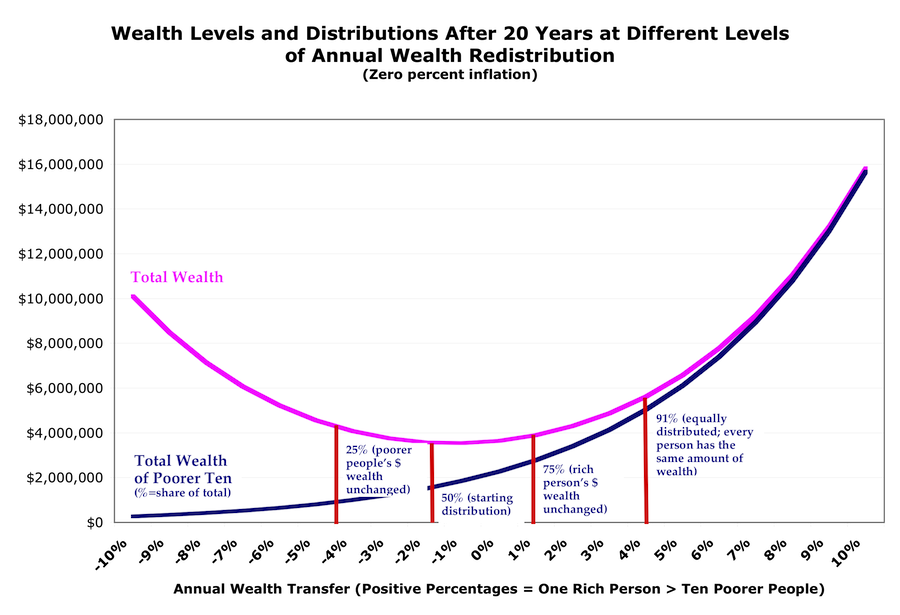
Here’s what that looks like, with starting wealth of $2 million, divided 50/50 between the rich person and the ten poorer people. (click for larger):

Woj’s Thoughts - Click through for surprising lessons about redistribution from this very basic model.