Showing posts with label Trade Balances. Show all posts

Monday, February 11, 2013

The Rise of Debt, Interest, and Inequality

According to Paul Krugman, he’s “had a mild-mannered dispute with Joe Stiglitz over whether individual income inequality is retarding recovery right now.” Since both Nobel Laureates were focusing on gross private savings, I broke down that measure by individual components and sub-components. Insights gained from those charts led to the conclusion that:
This data is consistent with rising income and wealth inequality but requires reversing Stiglitz’s “underconsumption” hypothesis. Trying to maintain relative consumption levels, many households clearly chose to rely on previous savings or new debt as a means of temporarily boosting consumption. As inequality continues to rise, wealthy households are now electing to retain more of their savings within corporations. It doesn’t take a leap of faith to suggest this combination of factors depresses aggregate demand.
Still unconvinced, Krugman has been searching for further data (see here and here) that would lead him to believe inequality really is holding back the recovery.

Hoping to aid Krugman in his quest and expand upon my “overconsumption” theory, let me respond to a critique of the previous post. Over at Mike Norman Economics, a commenter (Ryan Harris) kindly noted the obvious omission of interest income and sectoral balances. After sorting through interactive data from the Bureau of Economic Analysis, here are net amounts of monetary and imputed interest by sector [positive (negative) total implies sector receives (pays) net interest]:
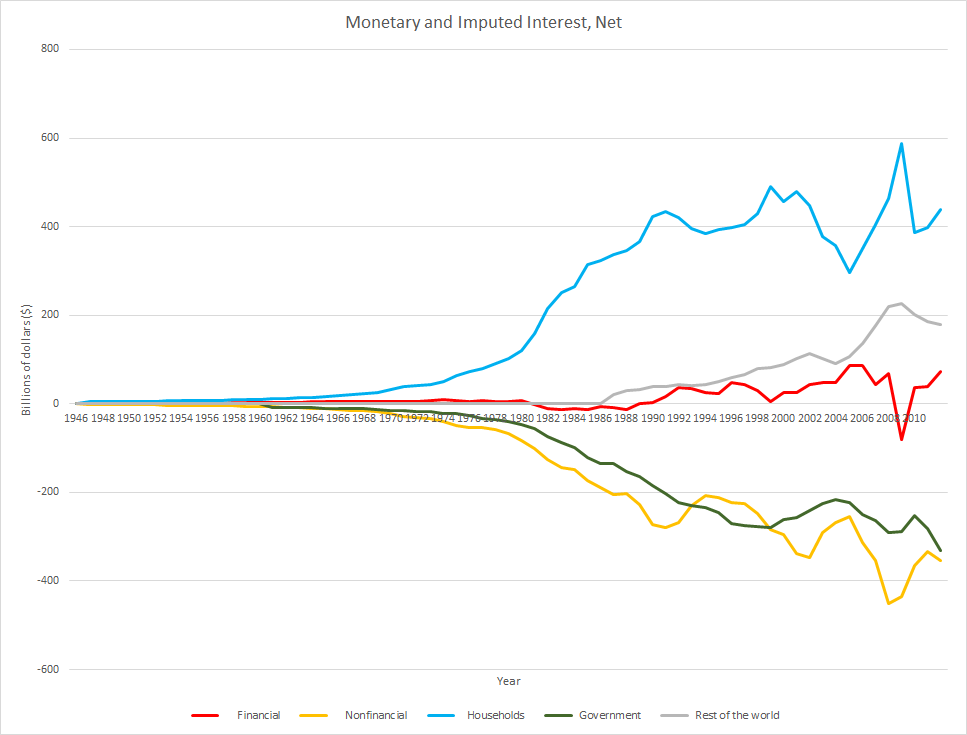

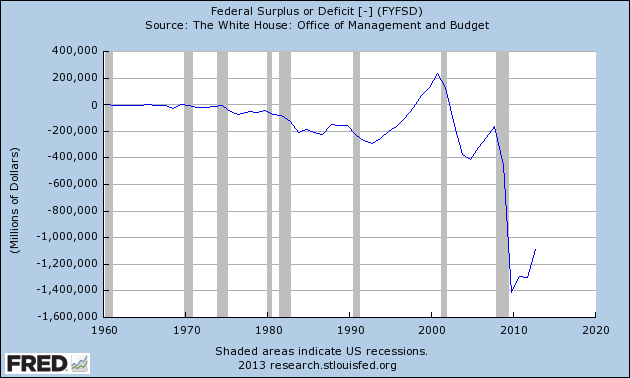
Unsurprising to those familiar with sectoral balance analysis, households net interest position took a sharp turn upwards when federal budget deficits began expanding more rapidly in 1980:
Around the same time, household interest income received a significant boost from the nonfinancial business sector. The pronounced decline in the net interest position of that sector aligns closely with high interest rates of the preceding period and a massive expansion of nonfinancial corporate debt shortly afterwards:
Since then the rise and fall of nonfinancial interest payments (and outstanding debt) has tracked the business cycle, with the overall trend remaining steadily lower (higher net payments and outstanding debt). Although these transfers support household income, they also increase income inequality since wealthy households hold a vast majority of financial assets (including corporate debt).

Turning to the foreign (rest of the world) sector, the U.S. current account (trade) balance fell heavily in the 1990’s:
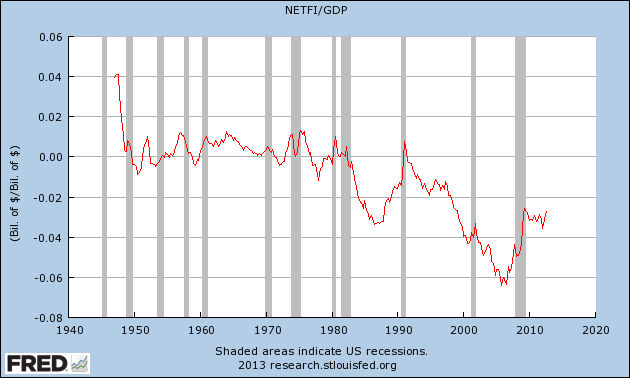
Foreign countries began amassing large quantities of U.S. financial assets (primarily Treasuries) corresponding to the substantial trade deficits. The growth in net interest receipts arising from these holdings represents an ongoing leak in domestic aggregate demand.
   
With the beginning of a new millennium and the dot-com bubble, a hostile environment was created for the household net interest position. Federal budget surpluses, declining interest rates, rapidly expanding trade deficits, and increasing payments to the financial sector (for housing) led to a nearly 40% decline in household net interest receipts. Combined with increasing income inequality, many households drew upon savings and increased demand for new debt to maintain previous levels of consumption.

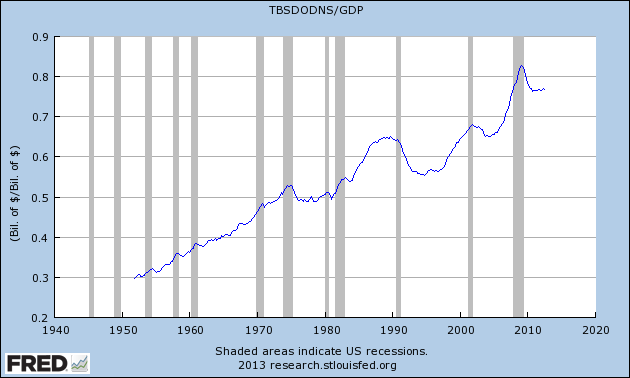
A side effect of the budget surpluses was a growing desire for safe financial assets separate from U.S. Treasuries. Securitization provided a means for new loans of varying risk to be converted into supposedly “super-safe” assets and transferred off of bank’s balance sheets. These factors encouraged banks to meet the surging demand for new loans coming from households (Chart: Household Debt-to-GDP):
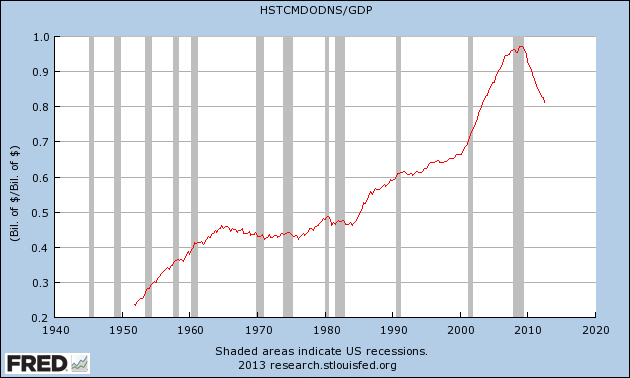
The effects of these transactions can also be seen in the transfer of net interest payments from households, and later businesses, to the financial sector. Apart from adding to inequality, these transfers reduce aggregate demand since, as Michael Hudson notes in The Bubble and Beyond, “financial institutions tend to save all their income.” (2012: Kindle Locations 6814-6815)

Since the financial crisis ended, the trend towards higher net interest receipts by the financial sector and greater net interest payments by the nonfinancial corporate sector have returned. These transfers of income up the income/wealth ladder serve to exacerbate the weak demand stemming from two decades of stagnating household interest income. Unfortunately, and so far unsuccessfully, public policy (fiscal and monetary) remains dedicated to originating a new private debt led boom.  

The changes in net interest payments/receipts over the past few decades highlight the growing income and wealth disparities present in our society. For many years households dug themselves deeper in debt to maintain relative consumption levels. The costs of excessively accumulating private debt have now been recognized, but the burden of interest payments suppressing aggregate demand will be felt for years to come.  

  
Bibliography
Hudson, Michael (2012-10-04). THE BUBBLE AND BEYOND (Kindle Locations 6814-6815). ISLET. Kindle Edition.

Monday, January 14, 2013

Strengthening Euro May Reignite EU Crisis

Back in September, ECB President Mario Draghi outlined the central bank’s willingness to cap sovereign yields through unlimited open market transactions (OMTs) for countries that requested help and submitted to structural reform (i.e. deficit reduction). Following the announcement, sovereign yields began falling across Europe and the euro began appreciating against numerous other currencies. As sovereign credit markets have eased, no countries have been forced to ask for explicit help from the ECB and the ECB has not needed to purchase sovereign debt in the secondary market. Although credit and currency markets reflect a strengthening European economy, unemployment continues rising to all-new heights and GDP growth remains decidedly negative in many countries. If actual economic improvement is not forthcoming in the next few months, Joerg Bibow may be correct in claiming that Draghi’s Liquidity Bluff Will Be Called

Essentially there are three parts to properly resolving the euro crisis, and one vital precondition. The first is symmetric internal rebalancing, the second is dealing with the area’s debt overhangs, and the third is to turn the flawed euro regime into a viable one by fixing the original flaws. Crucially, crisis resolution will be difficult, if not impossible, without robust GDP growth. For in a shrinking economy not even a balanced budget will prevent the public debt ratio from rising further, while interest rates cannot be low enough when even nominal GDP growth is turning negative.
Mindless fiscal austerity is self-defeating when inflicted on a deleveraging private sector and fiscal multipliers large when neither monetary conditions nor exports can provide much relief. Pursued simultaneously across the continent, European countries are deflating each others’ key export markets, implicitly relying on extra-regional exports to make up for their suicidal pursuits. By forcing adjustment solely upon debtor countries, where debt overhangs are naturally concentrated, their solvency problems are made only worse. Resisting upward wage realignment, Germany is pushing its partners, including France, into debt deflation.


Structural reform is no offsetting growth strategy at all. It worked for Germany, and only with a long delay, because Germany was going it alone while the world economy was strong. Germany needed an external surplus of 7 percent of GDP to finally balance its public budget. Today, the world economy can barely tolerate a repeat of that feat for Euroland as a whole.
As over-indebted private sectors continue to deleverage alongside attempts at fiscal restraint, the EU is effectively relying on its export sector to make up the difference. In a weird twist, Draghi’s actions to stem the sovereign debt crisis have prompted a significant appreciation of the euro. This result all but ends the EU’s hopes of creating an external surplus sufficient to balance fiscal budgets and will increase downward pressure on economic growth. My conclusion remains similar to Bibow’s:
In short, the euro remains firmly on track for breakup. It is only a matter of time until Mr. Draghi’s liquidity bluff will be called.

Monday, December 3, 2012

Canada Catches the Deficit Reduction Bug

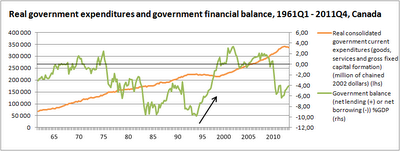
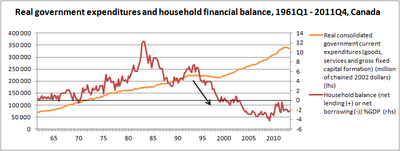
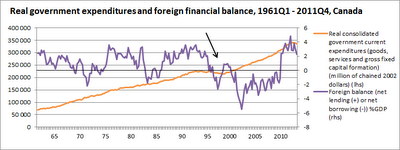
Over the course of this year, economic growth has been slowing considerably in many countries that were previously considered beacons of strength following the global financial crisis. Among those countries falling on harder times is Canada, eking out growth of 0.1 percent in the third quarter. Canada appears determined not to be outdone by Europe and Australia in reducing its budget deficit at the expense of economic growth. Canadian optimism based on the last round of austerity is badly misplaced for reasons outlined in this fantastic post on Austerity in Canada: Then and Now (at Fictional Reserve Barking). Taking a sectoral balances approach, here are three charts that highlight the differences:

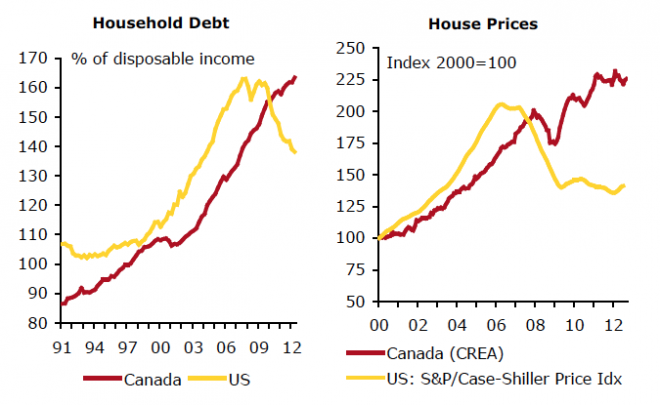
During the 1990’s, Canada witnessed a dramatic rise from a ten percent budget deficit to a fiscal surplus. That reduction in aggregate demand was countered by a significant decline in the household financial balance to a net borrowing position and a substantial trade surplus (foreign net borrowing). Keeping with global trends, the massive rise in Canadian household debt was primarily funneled into the domestic housing sector, pushing prices into bubble territory:
Source: Macleans.ca

The Canadian government’s hopes of repeating its “success” from over a decade ago will require a renewed surge in demand from one of the other sectors. Weak global growth, especially in China, suggests that commodity-rich Canada will not witness a dramatic reversal in their trade balance anytime soon. That leaves the household (or business) sector to pick up the slack.

As witnessed recently in the US and throughout Europe, there comes a point at which households can no longer credibly be expected to repay outstanding debts. Regardless of what event brings about this realization (possibly declining house prices), the ensuing household deleveraging will be a major headwind to growth.

A global commodity boom and domestic housing bubble bailed out the Canadian government last time it attempted to drastically reduce the budget deficit. This time around, the government’s actions may be enough to bust the housing bubble and push Canada into a recession.

Tuesday, November 27, 2012

Bubbling Up...11/27/12

1) What Drives Trade Flows? Mostly Demand, Not Prices by JW Mason @ The Slack Wire
The heart of the paper is an exercise in historical accounting, decomposing changes in trade ratios into m*/mand D*/D. We can think of these as counterfactual exercises: How would trade look if growth rates were all equal, and each county's distribution of spending across countries evolved as it did historically; and how would trade look if each country had had a constant distribution of spending across countries, and growth rates were what they were historically? The second question is roughly equivalent to: How much of the change in trade flows could we predict if we knew expenditure growth rates for each country and nothing else?

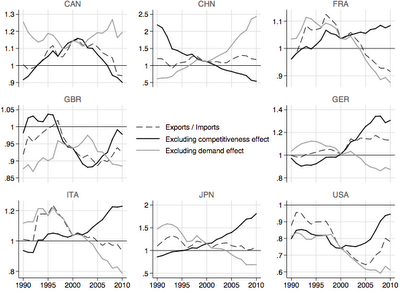
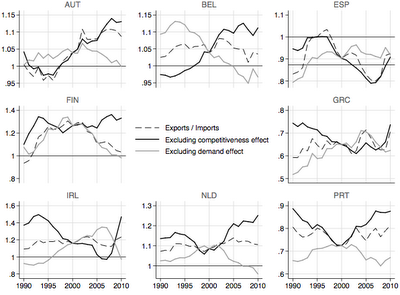
The key results are in the figure below. Look particularly at Germany,  in the middle right of the first panel:

The dotted line is the actual ratio of exports to imports. Since Germany has recently had a trade surplus, the line lies above one -- over the past decade, German exports have exceed German imports by about 10 percent. The dark black line is the counterfactual ratio if the division of each county's expenditures among various countries' goods had remained fixed at their average level over the whole period. When the dark black line is falling, that indicates a country growing more rapidly than the countries it exports to; with the share of expenditure on imports fixed, higher income means more imports and a trade balance moving toward deficit. Similarly, when the black line is rising, that indicates a country's total expenditure growing more slowly than expenditure its export markets, as was the case for Germany from the early 1990s until 2008. The light gray line is the other counterfactual -- the path trade would have followed if all countries had grown at an equal rate, so that trade depended only on changes in competitiveness. When the dotted line and the heavy black line move more or less together, we can say that shifts in trade are mostly a matter of aggregate demand; when the dotted line and the gray line move together, mostly a matter of competitiveness (which, again, includes all factors that cause people to shift expenditure between different countries' goods, including but not limited to exchange rates.)
Woj’s Thoughts - If correct, this explanation for global trade imbalances would certainly throw a wrench in standard, mainstream theories that assume prices and exchange rates respond to alleviate any imbalances. Clearly greater relative income growth should lead to larger imports relative to exports. Using a sectoral balances approach, the question is why doesn’t the boost to aggregate demand from rising trade surpluses alter prices and income in a manner that creates convergence? I certainly don’t expect the changes to happen quickly, but remain of the view that some institutional factors (e.g. tax policy, financial regulations) likely encourage diverging prices and incomes.

2) Hoenig: A Better Alternative to Basel Capital Rules by Thomas Hoenig via The Big Picture
Basel III is intended to be a significant improvement over earlier rules.  It does attempt to increase capital, but it does so using highly complex modeling tools that rely on a set of subjective, simplifying assumptions to align a firm’s capital and risk profiles.  This promises precision far beyond what can be achieved for a system as complex and varied as that of U.S. banking.  It relies on central planners’ determination of risks, which creates its own adverse incentives for banks making asset choices.

3) S&P: Australia is Spain in waiting by Houses and Holes @ MacroBusiness
Australia must find a Budget surplus before 2014 or it will lose its AAA rating, according Kyran Curry, S&P sovereign analyst via the AFR:
“If there’s a sustained delay in returning the balance to surplus, as the economy gathers momentum and as people start spending again, as the import demand picks up and current account blows out, we might not see the government’s fiscal position as being strong enough to offset weaknesses on the external side and that’s what worries us…Australia’s already, as we see it, got some credit metrics that are right off the scale when it comes to assessing Australia’s external position…It’s got high levels of external liabilities, it’s got very weak external liquidity and that basically means the banks are very highly indebted compared to their peers…For us, we look to Spain, which was Australia’s closest peer four or five years ago in terms of having a very strong fiscal position, very similar to what Australia has at the moment, its external position was weaker, like Australia’s, and it got routed very quickly…The government needed to provide support to the banks, it had to shore up growth in the economy and its debt levels more than doubled…We can see that happening in Australia’s case.”
Woj’s Thoughts - Contrary to popular perception and especially the Market Monetarist crowd, I’ve been arguing that Australia is facing serious headwinds that will end its impressive growth streak. In this context, Spain offers a reasonable comparison considering its high levels of private debt, housing bubble and high level of external liabilities prior to the current crisis. Having a sovereign currency permits Australia more scope in terms of policy responses, however the current government seems keen on following Europe’s approach. If the Australian government attempts to “find a Budget surplus before 2014,” it may keep its AAA rating while almost certainly exacerbating the downward spiral.  

4) Borrowers with modified mortgages re-default as homes re-enter shadow inventory by Walter Kurtz @ Sober Look
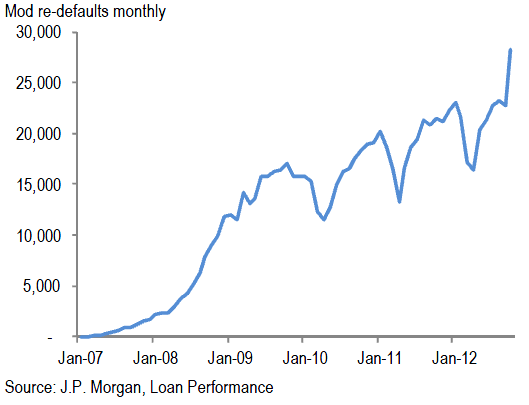
We are therefore seeing a sharp rise in re-defaults from modified mortgages.
This is telling us that mortgage modification programs have not been very successful, as the probability of re-default rises. By modifying mortgages, banks in many cases are simply kicking the can down the road - and now some are writing down these mortgages (which may be what is driving the higher charge-off numbers). We are therefore seeing an increase in delinquencies, but mostly among modified mortgages and concentrated in sub-prime portfolios.
Woj’s Thoughts - Bad news for banks and the government. Mortgage modifications were simply not enough for many homeowners who remain underwater and without the requisite income and/or savings to seemingly ever repay the entire loan. If this new wave of re-defaults persists, as JP Morgan expects, housing prices and bank earnings may return to a downward trend.

5) China's Economic Growth: A Different Storyline by Timothy Taylor @ Conversable Economist
When I chat with people about China's economic growth, I often hear a story that goes like this: The main driver's behind China's growth is that it uses a combination of cheap labor and an undervalued exchange rate to create huge trade surpluses. The most recent issue of my own Journal of Economic Perspectives includes a five-paper symposium on China's growth, and they make a compelling case that this received wisdom about China's growth is more wrong than right.
For example, start with the claim that China's economic growth has been driven by huge trade surpluses. China's major economic reforms started around 1978, and rapid growth took off not long after that. But China's balance of trade was essentially in balance until the early 2000s, and only then did it take off. Here's a figure generated using the ever-useful FRED website from the St. Louis Fed.
Woj’s Thoughts - I always have a soft spot for arguments, backed by data, that undermine the mainstream opinion. Although I continue to side with Michael Pettis on the forthcoming rapid slowdown in China’s GDP growth, I agree that growth will persist and lead to a much higher standard of living in the future.

Sunday, August 12, 2012

Bubbling Up...8/12/12

1) U.S. Trade Deficit Largely Due to "Intra-Firm" Trade by Dan Crawford @ Angry Bear
The vast majority of the U.S. $727 billion trade deficit in goods for 2011 is due to "intra-firm" or "related party" trade, that is, trade between two units of the same corporation, according to the U.S. Census Bureau. This is significant because such trade is the most open to companies manipulating the prices between subsidiaries to minimize tax liabilities, usually known as abusive transfer pricing. Moreover, as Stuart Holland argued in 1987, intra-firm trade is also less responsive to changes in exchange rates than is trade between independent businesses, since within an individual multinational corporation each subsidiary will have a specific role to play in its supply chain, which won't be quickly changed.
U.S. goods trade and related party trade (billions of dollars), world and selected countries, 2011:
Country        Exports from US Imports to US Balance
World            $1480.4     $2707.8          - $727.4
World (RP)     $ 365.0      $1056.2          - $691.2
Canada          $ 280.9      $ 315.3            -$  34.5
Canada (RP)   $ 98.1        $ 162.0           - $ 64.1
Ireland           $ 7.6          $ 39.4             - $ 31.7
Ireland (RP)    $ 1.5          $ 34.6             - $ 33.1
Mexico           $ 196.4      $ 262.9            - $ 64.5
Mexico (RP)    $ 60.5        $ 155.7            - $ 95.2
The bottom line is that we need to reverse the incentives in the tax code that encourage the offshoring of jobs. (Why does Apple have $64 billion in cash abroad?) However, to emphasize the point I made last time about what Americans want out of tax reform and the "reform" that has actually happened, it's worth pointing out that Robert Gilpin of Princeton University, author of the seminal U.S. Power and the Multinational Corporation (1975), made the same policy recommendation almost 40 years ago, and it hasn't happened yet. We've got our work cut out for us.
2) Zero rates have created a dangerous risk seeking return mentality by Edward Harrison @ Credit Writedowns
You saw the posts by Sober Look on the excess risk investors are taking on in the high yield market and the consequences of low yields on US households. Let’s make it a trilogy of posts then. There are plenty of other posts today that highlight this problem.  And it is a problem. One thing Austrians harp on is the misallocation of resources caused by heavy handed and persistent interest rate market intervention. They are right that the industrial organization and the structure of investment capital priorities is critical to longer-term growth. What we are seeing now is a skew into high risk activities. As I wrote 4 years ago
Woj’s Thoughts - Follow the last link for a marvelous step-by-step description of a credit bubble and bust. Harrison combines insights from the Austrian and Modern Money traditions, which is a prospect I hope to further in my own research.

3) The Jackson Hole "fix" is not coming by Walter Kurtz @ Sober Look
Market participants are looking for a fix, a repeat of the "high" Bernanke delivered at Jackson Hole in 2010 when QE2 was introduced. Markets however are in for a major disappointment because no outright asset purchases will be announced. There are multiple reasons for this, including the fact that real rates are now deep in the negative territory (as discussed here) and the policy as expressed in long-term real rates is far more accommodative than it was in 2010.
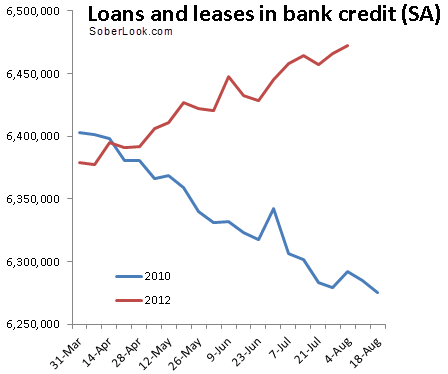
But what makes 2012 entirely different is that the key concern that pushed the Fed into asset purchases in 2010 no longer exists. The summer of 2010 was marked by renewed fears of deflation driven by credit contraction. The Fed was afraid of Japan-style deflationary pressures that are extremely difficult to arrest as bank lending shuts down. In the months preceding the 2010 Jackson Hole speech, credit was contracting sharply with banks steadily shrinking balance sheets. As discussed before, just the opposite is true in 2012 - credit is expanding at a decent pace. The chart below compares the trends now and in 2010.

Woj’s Thoughts - Kurtz goes on to suggest that markets may sell-off if disappointed by Bernanke, but I’m not convinced. Expectations of further “stimulus” have consistently proven resilient when faced with no new information. Markets may therefore simply shift expectations of further action to September, October, December and on, or until enough FOMC voting members explicitly state action is not coming.  

Tuesday, February 28, 2012

Liberals Demonstrate Conservative Bias for Manufacturing

Last Friday, over at TripleCrisis, Jeff Madrick posted 10 Questions for Economists Who Oppose Manufacturing Subsidies. Conversations regarding this topic have been persistent for much of President Obama’s term in office and are unlikely to dwindle heading towards the election. Although the questions are posed towards mainstream economists, of which I am not, here are some succinct, sensible, non-mainstream responses in opposition to to manufacturing subsidies.  

1. Doesn’t America already have an anti-manufacturing strategy? It has enthusiastically supported a high value for the dollar since the 1990s. The high dollar raises export prices but, as noted, very much helps Wall Street attract capital flows and lend at low rates. Shouldn’t we get the value of the dollar down?

Answer - Lowering the value of the dollar will make exports cheaper, but it will likewise make imports more expensive. Many Americans, not on Wall Street, will therefore be able to purchase less goods with the same income. Reducing the dollar value is also an imprecise mechanism that could very well drive up food and energy prices well in excess of any benefits to manufactures.

2. Don’t Germany, China, and many other countries subsidize their own manufacturing industries? Do you really think the World Trade Organization works all these out? If they do subsidize, isn’t it only fair to place manufacturing on a level playing field and subsidize our own?

Answer - While Germany, China and many other countries do subsidize their own manufacturing industries, America currently does as well. A cursory glance at the tax statements of GE, GM, Ford and a host of other manufacturers will display a multitude of tax breaks/loopholes specifically to support American manufacturing. A better questions is whether or not American taxpayer dollars are best used supporting/bailing out manufacturing companies so that foreign consumers can buy goods at cheaper prices.

3. Doesn’t manufacturing having a multiplier effect? Some say we can never boost the share of manufacturing adequately. So what if we create even as much as another 2 or 3 million manufacturing jobs. (The president is settling for a couple of hundred thousand.) But wouldn’t manufacturing’s multiplier effect stimulate the rise of other manufacturing and service industries and the creation of other jobs?

Answer - Despite receiving massive subsidies over the past decade(s), the companies mentioned in question 2 have been shedding American workers. Efforts to stimulate manufacturing jobs are more likely to redirect funds from other sectors, resulting in American job losses outside of manufacturing. Accounting for the potential production of those 2 or 3 million outside of manufacturing, any multiplier effect is not necessarily positive. A cardinal rule of economics is there is no free lunch, hence creating manufacturing jobs will not be free.

4. How can we get our trade deficit down if we don’t sell more manufactures? They account for about seven-eighths of our exports. I know the answer some of you will give: savings. But do you really think raising our savings rate will reduce capital inflows adequately to lower the dollar in order to promote more exports?

Answer - This question assumes that reducing the trade deficit is definitively positive and that a lower dollar is needed to promote exports, both of which are not true. Until this past year, Japan ran persistent trade surpluses notwithstanding an almost perpetually rising Yen. Regardless, a different answer than the one expected: services. As noted above, manufactures are not the only form of exports (or imports). During the past century, US exports shifted dramatically from agriculture to manufactures. Over the next century is may shift again towards services.

5. Without manufacturing, what will we export? Isn’t there a point at which we lose too many industries and labor skills to make a comeback? Given the symbiotic nature of business clusters and supply chains, aren’t we rapidly losing the subsidiary companies that make manufacturing and exports possible?

Answer - As mentioned above, similar arguments were made when manufacturing began encroaching on agriculture’s territory. Looking back, few people probably wish that agriculture had been protected so that many of us would still be working on farms today. Google makes enormous profits across the globe even though it manufactures almost nothing. What’s wrong with most Americans eventually working in offices rather than factories?

6. Weren’t persistent trade imbalances a major cause of the 2007-2008 financial crisis as debt levels soared? Don’t you worry that the export-led models of China, Germany, and Japan are unsustainable? On a worldwide basis, they are really debt-led growth models. How do we get balance without promoting our exports?

Answer - Trade imbalances and debt levels are separate, relatively uncorrelated factors, of which the latter was more likely a major cause of the financial crisis. Total debt levels soared in the US and many European countries with import-led models as well. If debt levels are a major problem, which I believe is true, than one option to achieve balance would be reducing subsidies to acquiring debt, such as the mortgage interest deduction.

7. Isn’t manufacturing a source of innovation in and of itself? Isn’t that where the scientists and engineers are? Don’t we learn and innovate by doing? One commentator recently said that those innovations are exploited by others, so it doesn’t matter. Really? Then maybe we should stop promoting R&D altogether.

Answer - Manufacturing is one source of innovation, but what about companies like Amazon, Netflix, Apple and Facebook. Is buying goods online today not cheaper and quicker? Is watching movies and listening to music not more accessible for less cost? Can we not interact with people all over the world far quicker and more easily? These companies and others are constantly innovating and improving our lives, undeterred by a lack of manufacturing or scientists..

8. Where will the good jobs come from? You always say high technology. But America now imports more high-technology products than it exports, especially to China. Even Germany has a high-technology deficit with China. I ask again, where will the jobs come from as technology gets more complex? Do you think more education is really an adequate answer, the only answer?

Answer - Why are manufacturing jobs so ‘good’? Does this imply that all non-manufacturing (or high-tech) jobs are ‘bad’? What about teachers or doctors? The future offers a potentially massive increase in service jobs with new markets that have not yet been conceived. Education within schools may not be adequate and is certainly not the only answer, however education through increasing work apprenticeships may be a good place to start.

9. Why did the job market do so poorly throughout the 2000s? If you say we can’t know where jobs will come from, that the market will decide, then why aren’t you worried about the job market’s poor performance over the last decade, with huge losses in manufacturing jobs? Again, you say, inadequate education. Yetaccording to CEPR’s John Schmitt, we have not produced more good jobs as GDP grew — good jobs measured by wages and benefits provided. Is there hard evidence we don’t have the labor to fill the high-technology jobs — and if we did, are there enough jobs going unfilled to make a difference?

Answer - According to CEPR’s Dean Baker, in The End of Loser Liberalism: Making Markets Progressive, supposedly “free-trade” agreements have exposed many lower wage (manufacturing) jobs to foreign competition while erecting barriers against trade in higher wage areas such as health care and law. At the same time, patent laws and tax codes have been continually adjusted to protect large corporations and enforce monopolies. The economy is also structured to encourage home buying/building, which for some time vastly expanded construction jobs beyond a sustainable amount. Even with all of these poor choices, about 92% of Americans desiring work are employed today. Americans have the knowledge and expertise to reach full-employment, but policies that raise the cost of hiring workers and discourage small business creation are not helping.

10. Will the jobs come from services? The rapid growth of finance has fouled up the numbers. Finance services did provide high-paying jobs, but we now know many of these were phantoms. And the salad days may be over. The other big area of productivity growth in services was retail. We all know what kinds of jobs Wal-Mart provided.

Answer - Yes, services will provide one source of new jobs but hopefully finance will not be a significant contributor. It remains unclear why manufacturing jobs are necessarily better than retail or other service jobs. Either way, the beauty of capitalism is that the future is unknown but there has been no better economic system in history for supporting growth. Jobs will return, but manufacturing subsidies are not the best approach and may well cause more job losses than they create.

Monday, January 9, 2012

Trade Imbalances are Key


Michael Pettis logically explains the need for Germany and China to reverse their trade surpluses. Despite the seemingly obvious consequences of not pursuing this path, Pettis notes that the historic precedent is for countries not to undertake the tough road (short-term pain for long-term gain) but rather fight to maintain their trade surpluses. This discussion is one of the best I’ve seen yet about the difficulties facing the EU. It is largely based on the historical precedents mentioned that my expectations for any resolution to the European crisis maintaining the union are diminished. Pettis also mentions the possibility of China devaluing their currency, exactly the opposite of what most politicians are calling for. If this occurs, I fear the US might impose heightened tariffs on trade that sparks a bout of global protectionism.

Read it at CreditWritedowns.com
If no trade reversal now, then when?
By Michael Pettis