Showing posts with label Inflation. Show all posts

Tuesday, February 26, 2013

Adaptive Inflation Expectations Hypothesis Minimizes Effectiveness of Fed Communication at ZLB

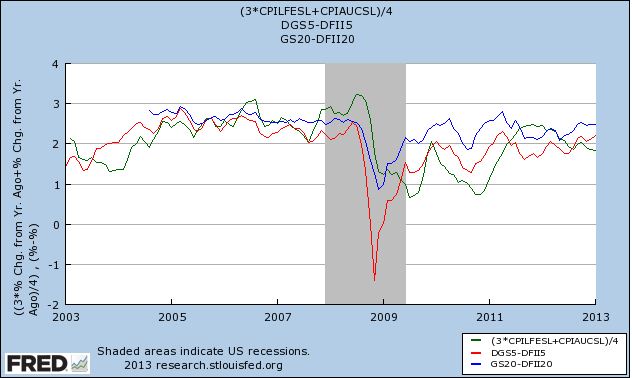
More on the adaptive inflation expectations hypothesis by Robert @ Angry Bear
My claim is that expected inflation over the next 5 (and 10 and 20) years is very similar to actual inflation over the past year.  I think the data generally fit the crudest most mechanical adaptive expectations hypothesis.
This would be interesting for two reasons.
First, the adaptive expectations hypothesis has been treated with utter contempt for roughly 4 decades.  It is considered an example of the sort of thing which economists must utterly reject.  The effort to replace it has lead to a lot of mildly interesting math and highly implausible assumptions.  
Second, there is a huge and very vigorous discussion of forward guidance by the Fed Open Market (FOMC) Committee.  It has been argued that even when the Federal Funds rate is essentially zero, the FOMC can stimulate the economy by causing higher expected inflation.  It is generally agreed that the FOMC has been convinced by this argument.  I think this implies that there should be anonalous increases in expected inflation on the dates when the FOMC began to try to cause higher expected inflation -- roughly the announcements of QE 1-4, operation twist and of forward guidance of how long it will keep the Federal Funds rate extremely low.  An excellent fit of expected inflation using only lagged inflation creates serious difficulty for those who think the FOMC always could and finally has promoted higher expected inflation.

Woj’s Thoughts - This topic is reminiscent of a chain of posts nearly six months ago that began with JW Mason’s inquiry, Does the Fed Control Interest Rates? Jazzbumpa and Art Shipman chimed in with their own opinions, the latter providing this relevant chart on the path of interest rates over time:
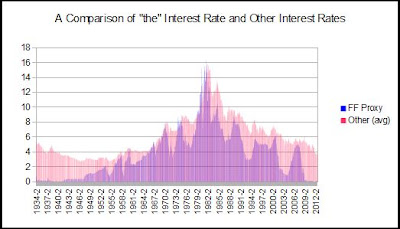
Responding to the others’, my view was that:
market expectations of future Fed action are sticky. During the post-war period until about 1980, inflation was consistently rising despite mainstream economic views that suggested those conditions would not persist. Following a lengthy inter-war period of near rock-bottom interest rates, market participants were slow to adjust expectations to the actual height of interest rates that would occur before sustained disinflation began. Once disinflation began in the early 1980’s, market expectations were equally slow in recognizing how long disinflation could persist and therefore how low the Fed would ultimately take rates (and hold at zero).
Returning to Robert’s claim, I suspect the recent strong correlation between the previous year’s actual inflation and inflation expectations for the next 5 or 20 years is partially due to the lengthy period of low inflation that came prior. In other words, if inflation were to start trending higher or lower over an elongated period, I predict inflation expectations would lag actual inflation while moving in the same direction. The adaptive inflation expectations hypothesis will therefore still hold, only more years of recent data will need to be incorporated into expectations formation. Validation of this hypothesis will deal a serious blow to the perception that Fed communications at the ZLB are an effective form of stimulus.

Wednesday, February 20, 2013

Fed Puts Macho Bada$$ery At Risk

Rational nerdiness vs macho bada$$ery in monetary policy by Cardiff Garcia @ FT Alphaville
The US economy has had several false starts since 2009, and it’s likely that several tangled factors were responsible for their not lasting longer. It’s reasonable to think that one of these factors was that the initial reflationary effects of these unconventional measures faded, because of doubts about the Fed’s commitment to maintaining accomodative policy during a period of catch-up growth. If such growth threatened to generate above-target inflation, then monetary conditions could be expected to tighten.
The rational-nerdy thing to do was to soften the macho commitment to inflation and commit to a temporary period of inflation-tolerance, thereby balancing the two sides of the mandate — but to do so while retaining credibility on both. But as Harless notes, ceding a little ground on one side could be interpreted as ceding all ground. Being a “macho badass” central banker means credibly committing to never cede ground.
All of which has been a long windup to saying that the appeal of the Evans Rule, and if we ever get it, some variation of NGDP level targeting, is this: they institutionalise the macho badassery, which in a dual-mandate framework can only be applied to one of the two mandates.
Woj’s Thoughts - This post is reminiscent of a thread from last year involving Steve Roth and Ryan Avent on The Asymmetric Nature of Monetary Policy. In that post I made the following claim:
Whereas Roth suggests that asymmetric credibility stems from the Fed’s actions, I believe it is actually an inherent condition in our current monetary system. The Fed sets the base price for money and credit, but with private banks free to create credit, it holds relatively little control over the total amount outstanding at any time. As growth in the US has exceeded inflation for much of the past three decades, the conditions were ripe for borrowing and credit outstanding now greatly surpasses the sum of base money.
Even if the Fed promised indefinite QE, it’s hard to see the mechanism, aside from adjusting inflation expectations (wealth effects are minimal), by which this would spur real growth. Given the Fed’s skewed abilities and determination to maintain its credibility, it seems more obvious why inflation targeting remains prominent. Further, this may help explain why the Fed downplays its employment mandate (which should be removed anyways). Facing the endgame, the Fed knows it can reduce inflation (and growth) but remains unsure how successful it could be at achieving other targets.
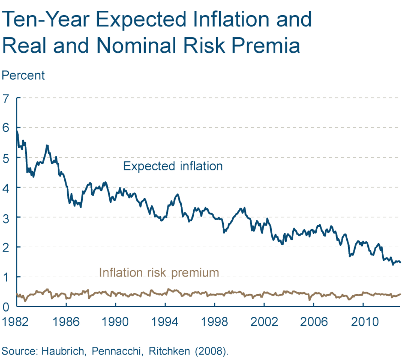
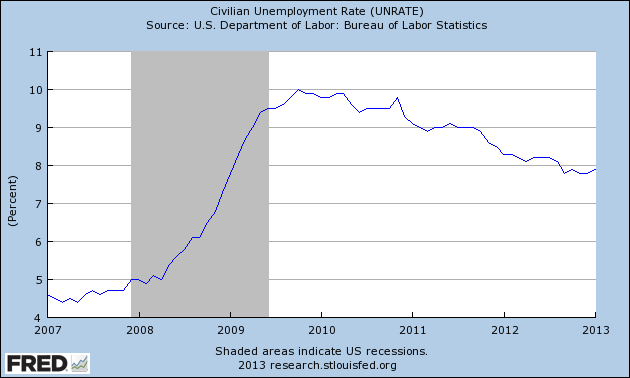
Sucumbing to pressure, the Fed has finally decided to cede ground on its commitment to inflation. Unfortunately for the Fed, both inflation expectations and unemployment are not cooperating:


At this point I doubt whether even altering inflation expectations would provide any boost to actual inflation or employment. If fiscal policy continues to contract the budget deficit, these numbers will continue moving in the wrong direction. The Fed has taken a big risk with its established credibility. I fear the results will be very disappointing.

(Late) 2013 Predictions

Last year I took a chance and threw my own projections into the ring. Similar to Byron Wien and Edward Harrison, I mostly selected events that were widely seen as having a low probability (less than 33%) but which I believed held a greater than 50% chance of occurring. The final results were a bit disappointing, but that won’t stop me from trying again this year. Since these predictions already represent a late release, without further adieu, here are the 2013 predictions:

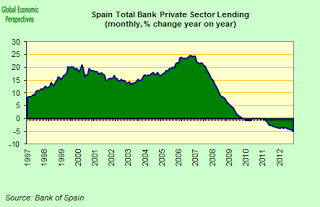
1) Spain requests access to ECB’s OMT - Since ECB President Mario Draghi announced the OMT program, yields on Spanish debt have fallen rather dramatically. Although this eases financing pressure, it has done little to alter the actual economy’s downward spiral. During 2012 Spain’s GDP growth became increasingly negative, falling by 1.8% year-on-year in the fourth quarter. Meanwhile unemployment continues its meteoric rise to over 26% for the general population and nearly 60% for youth. With the large banks still severely undercapitalized and households over-indebted, private sector lending continues to decline:


Seeing no recovery and potentially a worsening decline, “bond vigilantes” will eventually test Draghi’s threat. At that point Spain will be forced to accept a Memorandum of Understanding (MoU) in return for ECB bond-buying through the OMT program.

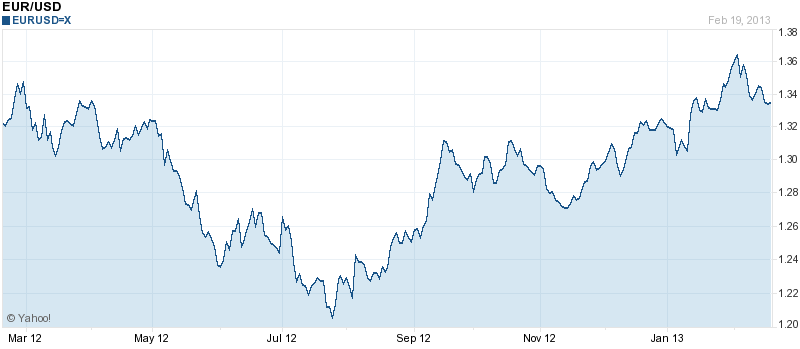
2) The Euro finishes the year above $1.30 - After falling nearly 10% during the first half of 2012, the euro has more than recouped its losses on the back of optimism and deflationary policies.

At points during 2013 the optimism is likely to fade, but I expect politicians and central bankers will take the necessary steps to quell fears for the time being. Unfortunately those steps will involve further deflationary policies that push the euro higher. These competing forces will largely cancel out, leaving the euro close to or above where it began the year.

3) The Eurozone remains in recession the entire year - Forecasters now expect euro-zone economic activity to be flat this year, down from a previous prediction of 0.3% growth made just three months ago. Last year saw practically continuous downgrades to GDP growth forecasts and I expect this year to be no different. Austerity measures are momentarily easing, but more will likely be enacted based on the outcomes of several elections. The recent appreciation of the euro against several major currencies will also dampen growth by putting pressure on net exports. With banks across Europe trying to build up capital and persistently high unemployment, the private sector will remain especially weak. Though Germany may experience a temporary rebound, the Eurozone as a whole will not register GDP growth this year.

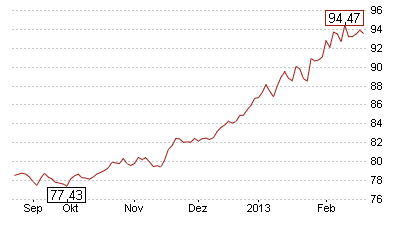
4) The Japanese yen rises above 90 per $ - Since the election of PM Shinzo Abe, the yen has fallen fast and is down more than 20% from recent highs.

During this time the Nikkei has risen more than 20%, yet yields on Japanese sovereign debt are little changed. This suggests many foreigners may be speculating on the supposedly forthcoming monetary and fiscal stimulus. As previously stated, the fiscal stimulus will probably be small and short-term. On the monetary front, short of actually entering the foreign exchange market, the Bank of Japan (BOJ) has essentially no mechanism to spur inflation and thereby cause a sustained depreciation of the yen. When market participants recognize the inability of Japan to avoid continued deflation, the yen will return to appreciating against the dollar.

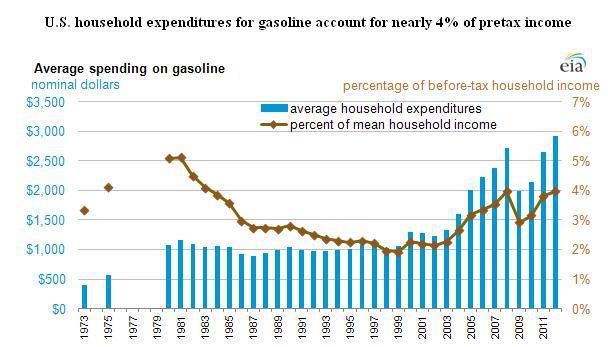
5) Gas prices will peak above $4.20 per gallon and set a new yearly record-high average above $3.75 per gallon - Gasoline prices have been on the rise for the past 31 days, currently averaging approximately $3.75 per gallon. Though this current streak will probably end soon, prices are unlikely to give back much of the gains before beginning the typical rise into summer. The ongoing potential for flare ups in the Middle East will keep prices elevated throughout the year. Higher gas prices, which already account for 4% of before-tax household income (chart below), will be a drag on consumer spending in 2013.


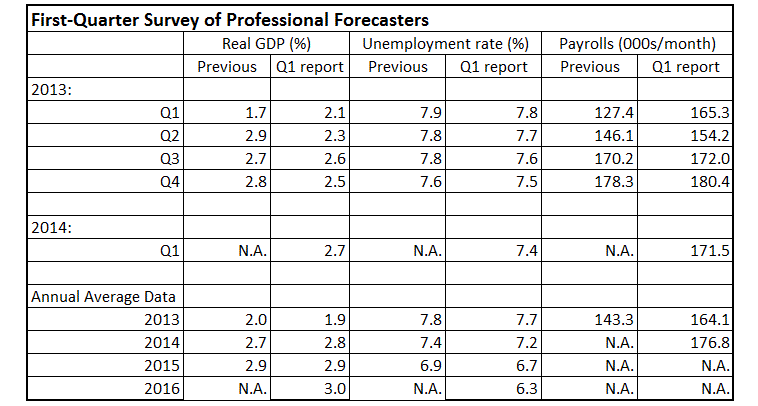
6) U.S. Yearly GDP growth falls below 1.5% - Forecasts of ~3% annual GDP growth over the past couple years have been overly optimistic as real growth in 2011 and 2012 was merely 1.6% and 1.9%, respectively. Apparently forecasters are being a bit tamer in their estimates this year, now expecting only 2% annual growth. Unfortunately I suspect these estimates will once again prove too optimistic. Various tax hikes and the upcoming sequester (which will go through in some respect) will reduce the budget deficit by a few percent this year. Housing is likely to remain a bright spot, but further declines in interest rates will not lead to similar magnitudes of the wealth effect. Credit remains tight for many households and small business, which should also limit private sector activity. All of these factors combined will probably not be enough to bring about a new recession but will lead to the lowest annual growth rate during this upswing.


7) U.S. Unemployment rises above 8% - Currently sitting at 7.9%, the unemployment rate is forecast to decline during 2013. Due to weaker GDP growth, corporate revenues will barely rise again this year. As companies face increasing pressure to maintain profit margins at record levels, a new wave of layoffs may occur. Separately, continuing economic growth will encourage previously discouraged workers to re-enter the job market. Both of these factors will lead to slightly higher measured unemployment.

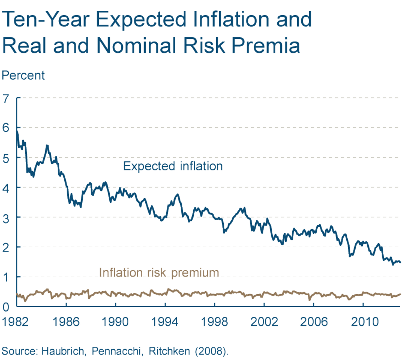
8) Federal Reserve forecasts shift first rate hike to 2016 - After extending their forecast for the first rate hike to 2015, the Federal Reserve changed its tactics to a more rule-based monetary policy. The Fed has, in effect, promised to keep rates low until we've hit either 6.5 percent unemployment or 2.5 percent inflation. Based on the above outlook for unemployment and a continuing decline in inflation expectations (chart below), FOMC members will revise their own forecasts and push back expectations for the first rate hike.


9) U.S. Corporate Earnings (ex-Federal Reserve) finish year below 2012 peak - Meager revenue growth was not enough to prevent U.S. Corporate Profits after tax from reaching record highs in the fourth quarter of 2012 on the back of record profit margins. US Corporate Profits After Tax Chart

As global growth slows in 2013, revenues will come under further pressure. At this point the ability of firms to continue cutting costs without sacrificing output seems limited, which means margins may begin to compress. As margins revert to previous norms, earnings will register a yearly decline.

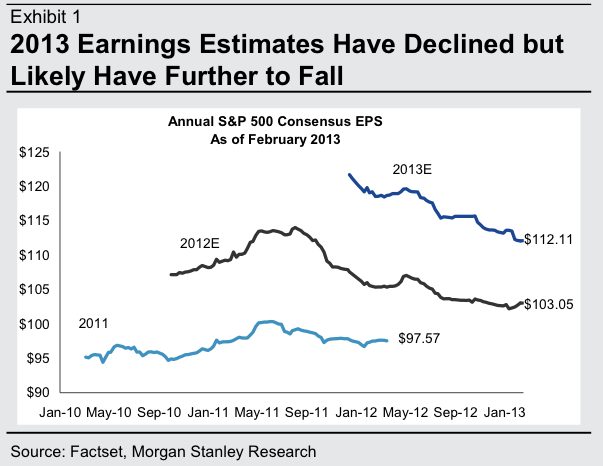
10) Bonds outperform stocks - During the first seven weeks of this year the stock market has been on fire, even though earnings estimates continue to fall.


Multiple expansion is currently being driven by the Federal Reserve’s actions despite their ineffectiveness at generating actual NGDP growth. When investors eventually turn their attention to continuing troubles in Europe, ongoing deflation in Japan, and/or weakening growth in China, U.S. earnings may once again enter the picture. Recognition that S&P 500 earnings growth has slowed substantially may cause the market to give up much of this year’s gain. These concerns combined with declining inflation expectations will result in many investors returning to the safety of U.S. Treasuries. The subsequent rise in prices (decline in rates) will generate another year of positive returns for the Treasury market.


Will my predictions prove too pessimistic once again? Only time will tell...

Tuesday, February 12, 2013

Fear of Bubbles, Not Inflation, Returns to the Fed

St. Louis Federal Reserve Governor Jeremy Stein recently gave a speech titled "Overheating in Credit Markets: Origins, Measurement, and Policy Responses."
Carola Binder was struck by the historical relevance of the chosen terminology and offered the following comment in a post on Overheating and the Fed:

In the New York Times, Binyamin Applebaum writes that Stein's speech "underscored that the Fed increasingly regards bubbles, rather than inflation, as the most likely negative consequence of its efforts to reduce unemployment by stimulating growth." In fact, the Fed's concern about bubbles is not so new. After the Great Depression, it was widely believed that the stock market overheated in the 1920s, leading to the Great Crash in 1929 and the onset of the Depression. In those days, the word for bubbles or overheating was speculation, and it became a dirty word indeed. After the Great Depression, speculation remained a major concern of the Fed. The Fed very explicitly regarded bubbles as the most likely negative consequence of its efforts to reduce unemployment by stimulating growth.
Apparently the Fed has come full circle. Carola goes on to provide a couple excerpts from FOMC minutes during the 1950’s, the last time the Federal Reserve was concerned with asset bubbles instead of inflation. The subsequent change in thought is not overly surprising given that stock markets flatlined starting in the mid-1960’s, as inflation picked up and became a major cause for concern throughout the 1970’s. What is disturbing, is the Federal Reserve’s failure to recognize the changing landscape over the past three decades.

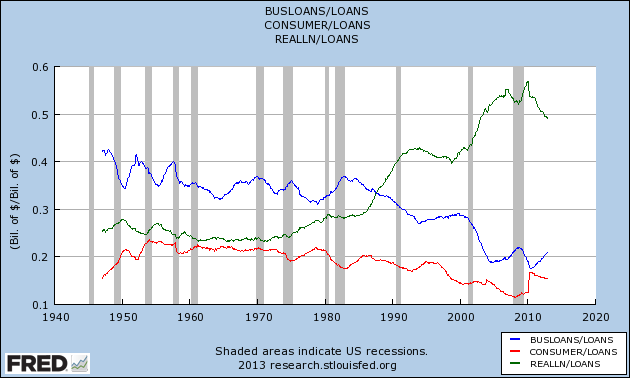
During that time, commercial bank lending has largely shifted its priorities from financing tangible (capital) investment through business loans to financing the purchase of already existing assets (e.g. houses, stocks and bonds):

(BUSLOANS = Commercial and Industrial Loans; REALLN = Real Estate Loans; LOANS = Loans and Leases at All Commercial Banks)

It should therefore come as no surprise that the transmission mechanism of monetary policy is now primarily through various asset markets (i.e. real estate monetary standard).

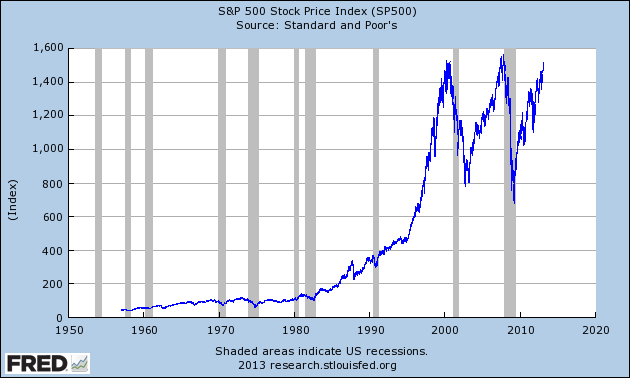
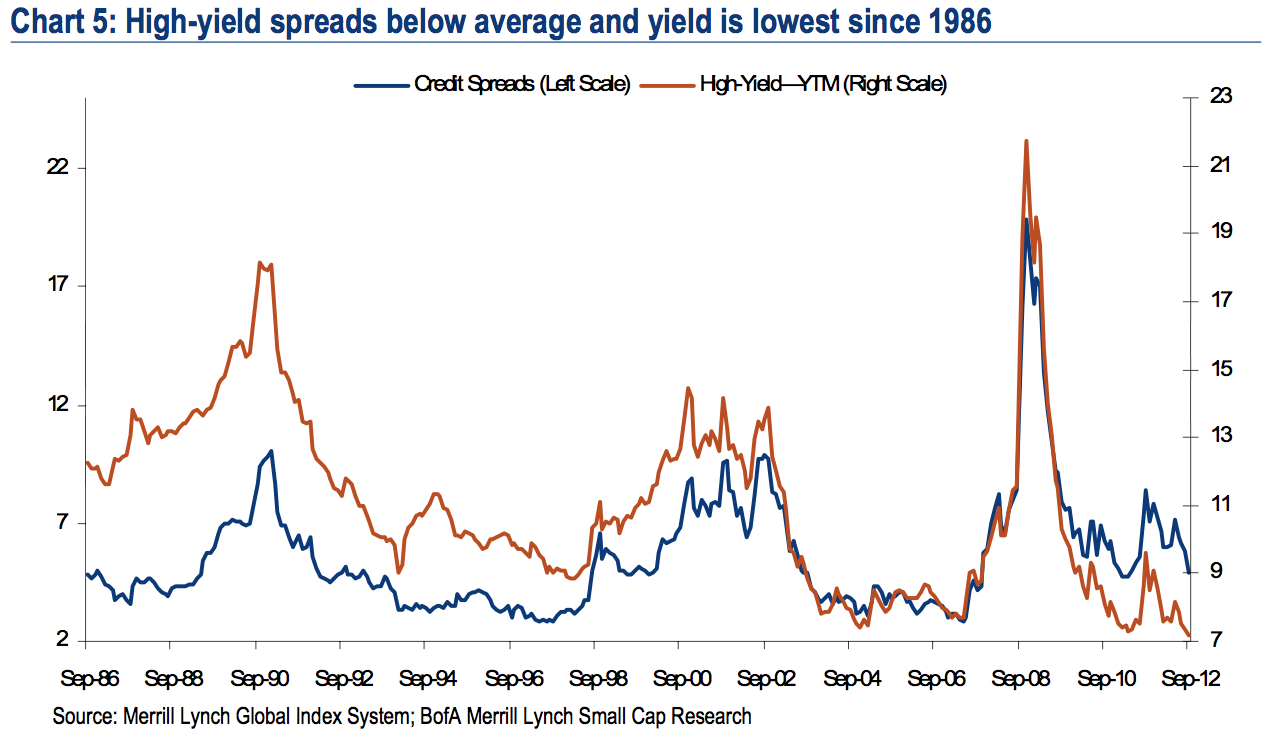
Consider the following charts showing various asset prices and inflation rates during the past 30 years:

Stocks:


High-Yield Corporate Debt:


Houses:


Inflation:


Over the past few years I’ve been very critical of the Federal Reserve’s actions spanning the last couple decades. One of the primary reasons behind this view was the incessant focus on limiting inflation and utter lack of concern regarding asset bubbles. The present risk of a zero interest rate policy (ZIRP) and QEternity lies mainly in inflating new asset bubbles, not creating excessive measured inflation. If the Fed has finally come back around to this realization, that would certainly be a big step in the right direction.

Friday, January 18, 2013

Does the Permanent Floor Affect the Inflationary Effects of the Platinum Coin?

While continuing my own effort to further understanding of the permanent floor, related posts keep rolling in. Unfortunately my earlier post was remiss in recognizing contributions by Ashwin Parameswaran and Frances Coppola even prior to the outburst. A major player from the start, Steve Randy Waldman has once again raised the bar for a confederacy of dorks. David Beckworth, Peter Dorman, Nick Rowe and Stephen Williamson (see here, here, and here) also share their thoughts.

Once again, I won’t spend much time recapping the major points of contention. My intent is to highlight a few questions that came to mind while reading but, in my opinion, were not adequately addressed. Hopefully the answers put forth will shed light on areas of the debate that remain dark.

Question(s): What are the inflationary effects, if any, of the “platinum coin” both at and away from the zero lower bound (ZLB)? Under a “permanent floor” vs. “corridor” system?

Answer(s): As stated previously:

When the Treasury deposits a $1 trillion platinum coin at the Fed, the Fed credits the Treasury’s account with $1 trillion in reserves. These reserves, however, are not counted in the monetary base since the Treasury's account does not count as reserve balances in circulation. The simple action of depositing a platinum coin at the Fed therefore has no direct impact on the economy that would require sterilization*. In fact, the primary (sole?) purpose of this exchange is to allow the Treasury (Congress) to spend without requiring debt sales that would exceed the debt limit.
The platinum coin, in itself, is therefore not inflationary regardless of whether or not the economy is at the ZLB. The story, however, need not end there. Unburdened by the obligation to sell debt when deficit spending occurs, government deficit spending (up to the coin’s value) will directly increase the monetary base by adding reserves to the private banking system (reserves in circulation).

Operating within a “permanent floor” system, the Fed can maintain control of interest rates by paying a positive interest rate on reserves (IOR) AND elect whether or not to sterilize the monetary base expansion. If sterilized, the Fed could actually increase interest income in the private sector by selling assets with a higher yield. This would have an inflationary effect, though it may be offset by portfolio rebalancing. If left unsterilized, the monetary base expansion would likely generate asset price inflation and rising inflation expectations, at least in the short-run, given recent experiences with QE. In either case, the increase in deficit spending (otherwise not permitted by the debt limit) should ensure an overall inflationary bias.
 
Under the old monetary regime (pre-2008; “corridor” system), the Fed would probably sterilize the expansion by selling Treasuries (at least initially). Although the monetary base and interest rate are left unchanged, the deficit spending results in the private sector gaining net financial assets (NFAs; e.g. Treasuries). This is exactly the same result we see today! The only tweak is that the Fed, not Treasury, becomes the supplier of Treasuries.

Still under the old monetary regime, if left unsterilized, the expansion of the monetary base would push interest rates to the ZLB. The inflationary effects of the downward pressure on short-term rates depends on the time period in consideration (often short-term) and the degree of influence from several potential cross-currents (in no particular order):


1) Decreases interest income - deflationary
2) Weakens the currency - inflationary
3) Lowers debt service costs to borrowers - inflationary
4) Increases bank lending - inflationary
5) Raises inflation expectations - inflationary


The above list is in no way exhaustive, but does suggest an inflationary bias. Countering this view, Scott Sumner states:
higher interest rates are inflationary.  They increase velocity.  If you don’t believe me, check out interest rates and velocity during any extremely high inflation episode.  When rates rise, inflation usually rises.
Perhaps surprisingly, I do believe that interest rates and velocity show a relatively strong correlation over time. What I disagree with is the direction of causation that Sumner ascribes to this relationship. From my perspective, decreasing velocity implies decelerating bank lending and/or declining inflation expectations. Witnessing either of these factors would encourage the Fed to lower interest rates, hence any causation runs in the opposite direction of Sumner’s claim. Determining whether interest rates or velocity tends to move first would be enlightening, if feasible, but for now I’ll conclude that lower interest rates are inflationary.   

Under any of these circumstances, the transaction entailing a platinum coin between the Treasury and Fed, in and of itself, is not directly inflationary*. However, presuming the platinum coin is accompanied by greater deficit spending, some inflation will stem from the growth of private NFAs regardless of the monetary regime and sterilization decision. Corresponding monetary base expansion will also likely display an inflationary bias, unless the Fed elects to sterilize the expansion under the old “corridor” system. The platinum coin is therefore always inflationary.

Special thanks for their contributions through comments are still owed to Scott Fullwiler, JKH, RebelEconomist, Dan Kervick, Ashwin Parameswaran, wh10, Detroit Dan, K, JW Mason, jck and last, but not least, Mike Sax. Stay tuned for at least one more post in this series.

*it may indirectly impact the economy by altering expectations

Tuesday, January 15, 2013

Will NGDP Targeting Increase Consumer Price Volatility?

Nick Rowe recently discussed the Bank of Canada’s success and failure in inflation targeting versus maintaining a stable NGDP growth path. Looking at Rowe’s charts, Stephen Gordon points out that during the period in question:
producer prices (roughly approximated by the GDP deflator) grew much more quickly than consumer prices (roughly approximated by the CPI).
If the Bank of Canada were to begin targeting NGDP in the future, it would effectively be altering the primary measure of inflation in its goal. This leads Gordon to beg the question, What should a central bank do when producer and consumer prices diverge?
My (possibly incomplete) understanding is about how inflation affects welfare is on its effect on the price of consumption goods, especially in a world where nominal wages are slow to adjust. So it makes sense to me to make consumer prices the focus of attention and let producer prices go.
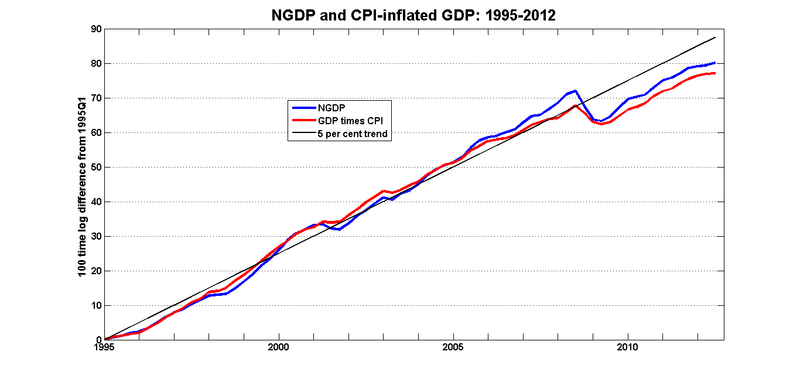
I'm not sure how to interpret this next graph, but I made it and I may as well post it. It compares NGDP with the series you get when you multiply real GDP by the CPI. I guess it's the counterfactual NGDP series for the scenario where producer prices and CPI stayed together:
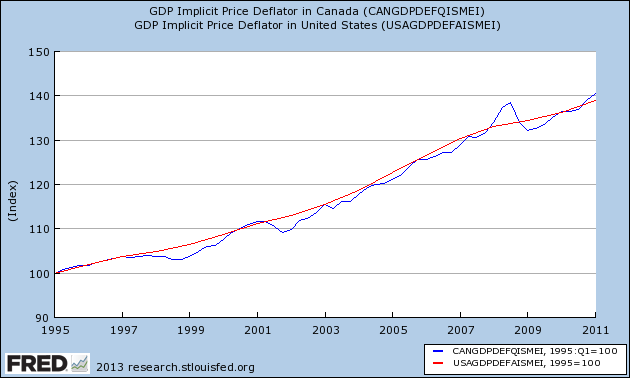
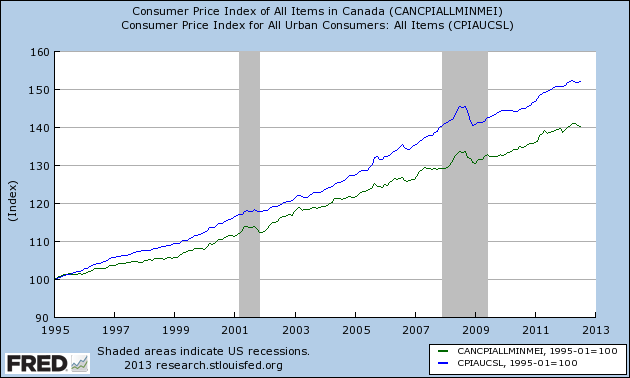
Gordon and Rowe’s focus is strictly on Canada, but given the hype surrounding NGDP targeting in the US, it might prove interesting to compare similar data. The following charts compare the GDP deflator and CPI between both countries over the same time period:


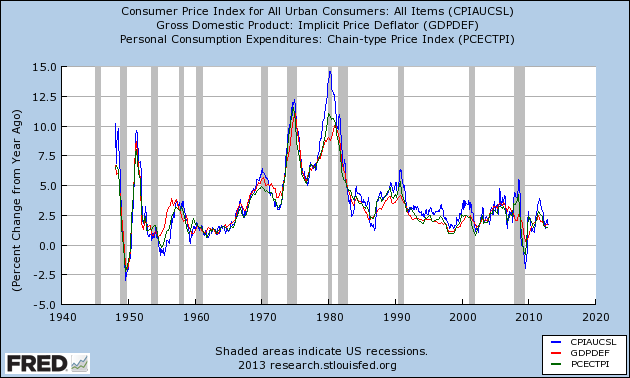
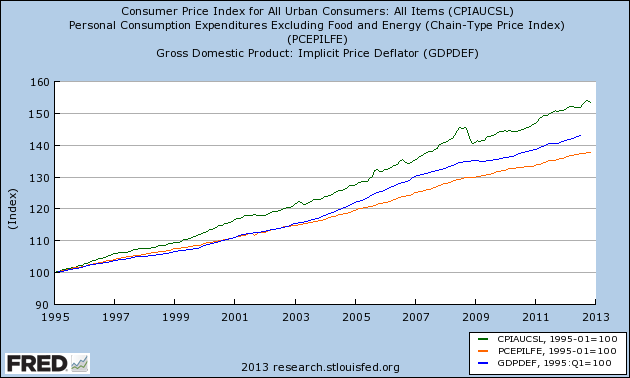
While producer prices between the two countries remained closely tied throughout the period, consumer prices in the US began diverging from their Canadian counterpart immediately and the gap continues to widen today. Shifting focus to the U.S., the data series for consumer and producer prices are combined into one chart. Returning to discussion of central bank policy, as well, it’s important to include the Federal Reserve’s preferred measure of inflation, core-PCE:
The inclusion of core-PCE helps resolve the discrepancy between consumer prices in Canada and the US. Of note is the dramatic difference between CPI and core-PCE over the past two decades. As I understand Fed policy, CPI (or PCE) is too volatile a target due to the wide swings in food and energy prices. Over time, however, the total and core measures are expected to converge. Depending on the time frame one assigns to the long-run (~18 years seems reasonable), the double-digit difference suggests that Fed policy has been looser than many believe. The Fed’s success has been limited to targeting core inflation, while food, energy and asset prices (not accounted for in CPI) have drifted significantly higher.  

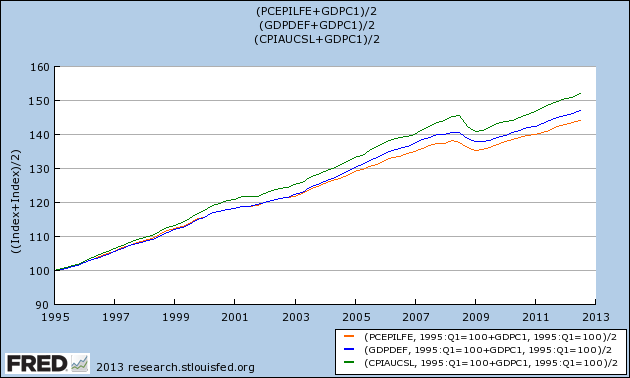
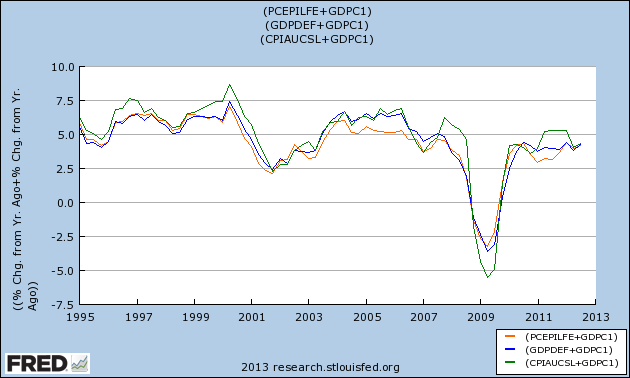
Returning to Gordon’s chart and altering data to depict the US, these last two charts show a “counterfactual NGDP series for the scenario where producer prices and CPI stayed together.”


Regardless of the inflation measure chosen, the Fed’s policy was clearly too loose in the decade preceding the most recent recession. In fact, an interest rate targeting regime focused on core-PCE permitted the Fed to remain looser than it would have been following either of the other indexes.

Gordon concludes with “the question of what happens to the volatility of consumer prices if we adopted NGDP targeting.” Oddly enough, the divergence of core-PCE from the GDP deflator began around the same time the Fed started targeting core-PCE in 2004. Is it possible that the Fed’s actions altered the relationship between core-PCE and the GDP deflator? The similarities between Canada and the US during that period suggests not, but it’s worth considering. Separately, will the stark difference between CPI and core-PCE ultimately correct or has the world entered a new era of food and energy inflation?

My guess is that the volatility of core consumer prices will change only slightly under an NGDP targeting regime, while total consumer prices become far more volatile. Apart from my concerns about the viability of NGDP targeting, its effect on consumer prices raises important questions about wages and welfare costs. Hopefully these potential unintended consequences of NGDP targeting are being carefully considered before such a policy is actually implemented.

Bubbling Up...1/15/13

1) The State We’re In by David Glasner @ Uneasy Money (emphasis added)
it’s interesting to note that, despite his Marshallian (anti-Walrasian) proclivities, it was Friedman himself who started modern macroeconomics down the fruitless path it has been following for the last 40 years when he introduced the concept of the natural rate of unemployment in his famous 1968 AEA Presidential lecture on the role of monetary policy. Friedman defined the natural rate of unemployment as:
"the level [of unemployment] that would be ground out by the Walrasian system of general equilibrium equations, provided there is embedded in them the actual structural characteristics of the labor and commodity markets, including market imperfections, stochastic variability in demands and supplies, the costs of gathering information about job vacancies, and labor availabilities, the costs of mobility, and so on."
Aside from the peculiar verb choice in describing the solution of an unknown variable contained in a system of equations, what is noteworthy about his definition is that Friedman was explicitly adopting a conception of an intertemporal general equilibrium as the unique and stable solution of that system of equations, and, whether he intended to or not, appeared to be suggesting that such a concept was operationally useful as a policy benchmark. Thus, despite Friedman’s own deep skepticism about the usefulness and relevance of general-equilibrium analysis, Friedman, for whatever reasons, chose to present his natural-rate argument in the language (however stilted on his part) of the Walrasian general-equilibrium theory for which he had little use and even less sympathy.
Inspired by the powerful policy conclusions that followed from the natural-rate hypothesis, Friedman’s direct and indirect followers, most notably Robert Lucas, used that analysis to transform macroeconomics, reducing macroeconomics to the manipulation of a simplified intertemporal general-equilibrium system. Under the assumption that all economic agents could correctly forecast all future prices (aka rational expectations), all agents could be viewed as intertemporal optimizers, any observed unemployment reflecting the optimizing choices of individuals to consume leisure or to engage in non-market production.
Woj’s Thoughts - I had to read this section of Glasner’s fantastic post twice because its conclusion is so striking given the particular economist involved. Although I was aware Friedman’s work played a large role in the neoclassical synthesis, it remains strange to think that someone so opposed to government intervention would set forth a policy benchmark by which future economists would determine intervention is necessary.

2) Buchanan: Seeing With New Eyes, by Garett Jones @ EconLog
Buchanan saw Arrow's Theorem as a solution to a problem raised by America's founders: how can democracies avoid the tyranny of the majority? Well here's one way, Buchanan said: Just let democracy behave normally. As long as people are diverse enough in their views for Arrow's assumptions to hold, then the factions holding power will change relatively often. His words:
"Would not a guaranteed rotation of outcomes be preferable, enabling the members of the minority in one round of voting to come back in subsequent rounds and ascend to majority membership?"
Where other economists--including myself--had seen Arrow's Theorem as an indictment of democracy, as a reducing the scope for democratic utopianism, Buchanan saw an argument that democracy might not be quite so dangerous after all.
Woj’s Thoughts - Although I did not have the opportunity to meet James Buchanan, as a student of economics and member of the George Mason community, I’m saddened by his recent passing. This past semester I became more formally introduced to his work through his book Cost and Choice. The many remembrances, including the one above, have shed even more light on the multitude and magnitude of his achievements throughout his life. I look forward to learning far more about the ways in which Buchanan separated himself from average economists in the years ahead.

3) Burn This Into Your Brain…. by Cullen Roche @ Pragmatic Capitalism
I really like this quote from the NY Fed:
“Most commonly used measures of the broad money supply include both currency and certain types of bank deposits, which in effect represent money created by banks when they make loans, but not reserves. These broad money measures tend to be more directly relevant for economic activity and inflation.” (emphasis added)
Woj’s Thoughts - The NY Fed recognizes that “inside” money is relevant for economic activity and inflation. How come mainstream economics doesn't?

Thursday, January 3, 2013

Bubbling Up...1/3/13

1) Fluffing off a Trillion Dollars. And a Third Thing by The Arthurian @ The New Arthurian Economics
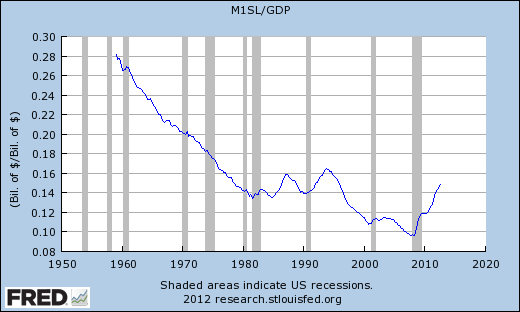
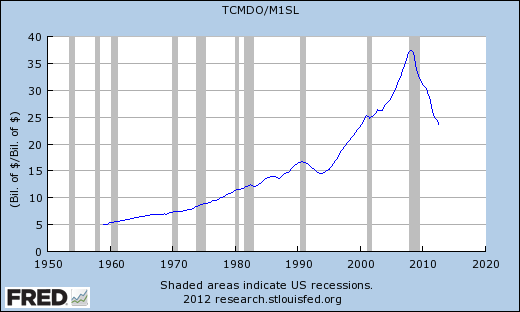
The deficit isn't a result of spending. It is a result of policy: of fighting inflation, and encouraging growth. The deficit is a result of these two policies, done in a very bad way for a very long time.
Policymakers pushed down the quantity of money in circulation to fight inflation:

Graph #1: Money in the Spending Stream per Dollar's Worth of Output
At the same time, they encouraged growth, spending, and the use of credit:

Graph #2: Total Credit Market Debt Owed per Dollar in the Spending Stream
The honest and honorable goals of fighting inflation and encouraging growth turned us into a nation with no money and inexplicable debt. That is why the economy refuses to grow. That is why tax revenue is down and "slump-related expenses" are up.
And that is why we have trillion-dollar deficits.
Woj’s Thoughts - Hard to argue with Art’s take on the matter. I might add that encouraging growth through private credit creation has also led to more wealth accumulation through capital gains. Subsequent policies that largely excluded capital gains from taxation exacerbated the above trends and can probably help explain a significant portion of wealth inequality witnessed today.

2) Why economics is rubbish, episode 324. by Sell on News @ MacroBusiness

It is an especially extreme example of scientism. It leads to a sort of homogenous nonsense. As the historian of science Stanley Jaki commented, such confusions are deadly to science itself. “By assigning unlimited relevance and competence to the scientific method, scientism rules out precisely that test. By setting quantitative exactitude as the only and supreme test of truth, scientism robs of meaning the world of qualities and values. By the same stroke it makes science meaningless as well. He then quotes GK Chesterton:

“Science, which means exactitude, has become the mother of inexactitude. This kind of vagueness in the primary phenomena of the study is an absolutely final blow to anything in the nature of science. man can construct science with very few instruments .. a man might measure heaven and earth with a reed, but not a growing reed.”
That latter point is crucial. The metrics used to “measure” economic and financial behaviour are growing reeds, they do not stand still. They grow in the minds of those who use them, used for trading strategies, to formulate polices, for the basis of consumer sentiment. Even if the quasi-scientific economic abstractions worked, they would not work.

3) yen dynamics by Warren Mosler @ The Center of the Universe

So it may be the case that Japan is in the process of resuming it’s traditional dollar and euro buying, which can move the currency to whatever level it desires. Which is probably back to north of 100 to the dollar?
Lastly, there is a record yen short position being reported. While this could mean it’s getting over sold and subject to a rally, it could also mean insiders have been tipped off to this policy shift and will profit immensely.
Caveat: If all the noises around the coming election and weak yen policy result only in an increase in the inflation target and ‘unlimited qe’ involving only yen financial assets, that policy will only serve to make the yen stronger and a wicked short covering scramble will follow.
Nothing short of buying fx, directly or indirectly, will do the trick.
Woj’s Thoughts - In a recent post on the re-election of Prime Minister Abe, I mentioned that the likely outcome was merely stepped up monetary policy tied to relatively restrictive fiscal policy. There has been no mention yet of direct fx purchases (that I’m aware of). If I’m correct that Japan will limit itself to NGDP targeting through unlimited QE, than investors should be wary of severe Yen strengthening in the not too distant future.