That is why it is so important that Gen Y investors take advantage of the opportunity to invest, especially in tax-advantaged accounts like 401(k) and IRAs, early on in their careers. When the tax laws are working with you, the odds are put in your favor no matter where you decide to invest. The traditional argument for saving early (and often) in one's adult life is compound interest. Which is of course is true. That being said it is unlikely that Albert Einstein ever said compound interest was "the most powerful force in the universe."
In my book, Abnormal Returns: Winning Strategies from the Frontlines of the Investment Blogosophere, I write that "savings is the best investment." By that I mean that it is far easier to generate additional savings through more conscious consumption than it is to generate additional returns, or alpha, from the financial markets. So starting early with a dedicated plan to live below your means is an important part of any comprehensive financial plan.
More importantly as a young investor you get a chance to make your novice investment mistakes while the stakes are, in actual dollar terms, relatively low. Or as said in a different context, "You only get one chance to be a beginner." Wouldn't you rather experience your first bear market when you are 25 and you have $5,000 in your 401(k) plan than when you are 50 and retirement is beginning to stare you in the face? The experience gained when you are young will help you when the stakes are ratcheted up later on in your career.
Read it at The Reformed Broker
Compound Experience, Not Just Interest
By Tadas Viskanta of Abnormal Returns
My interest and excitement for the financial markets began at the early age of 13 when my grandparents gifted stocks (Coke and Disney) as a Bar Mitzvah present. During high school, in the midst of the dot-com bubble, I learned about the stock market and practiced investing online with fake money portfolios. When that bubble burst, I felt fortunate to not have been trading with real money.
After turning 18, having saved up a bit of money, I opened a 401(k) and decided to try my hand at real investing. During college I invested on my own account and continued adding money to my 401(k). Over the summers I enjoyed internships at a day-trading firm, hedge fund and with financial advisors. Following college I took a full-time job as a trader at an options market-making firm. Little did I know that the housing bubble had already gone bust and the stock market was nearing its peak. With real money now on the line, the following 60% drop in stock markets was painful to witness.
Markets have now recovered most of the losses from that second bubble of the decade, but remain at levels first seen 13 years ago. Although I don’t know how the future will play out, I personally am very grateful that my first two bear markets occurred before I turned 25 and had significant money on the line. The experiences have already made an enormous impact, not only on my investing strategy, but also on my career.
For my fellow Gen Y investors, I fully recommend taking the above advice from Tadas to heart. Start early with plans to conserve your consumption and open a 401(k) (You can take money out of the 401(k) without any penalty to use as a down payment on your first home). Only invest a limited amount, at first, until you become aware of how you will respond in a bear market (if you want or need to sell after steep losses you are taking too much risk). Lastly, do not use any leverage until you’ve gained significant experience since it will likely compound losses from your mistakes.
In my opinion stock markets are still not out of the woods from this secular bear market. That means at least one more cyclical bear market before the next secular bull market begins. Hopefully other Gen Yers will take advantage of this opportunity and these lessons to ensure we’re prepared well in advance of the day when retirement comes.
This summer is set up to be as sloppy as the previous two. The recent sell off in the market is overdone on a short term basis and with weekly technical sell signals currently in place the easiest path for the market at this point is to the downside. Therefore, raising cash to hedge portfolios until the next “buy signals” are generated is recommended.
- Liquidate weak and underperforming positions as the market approaches the 1350 and 1360 levels.
- Rebalance winning positions by taking profits and resizing positions back to original weights,
- Look for rotation into precious metals as a “safe haven” investment which are currently very oversold and holding support. (We are currently long GLD and GDX)
- Short duration fixed income is still an alternative to “money markets” as rates will likely remain under pressure as rotation out of stocks continue.
- Our call to buy bonds over the past month has played out well. They are currently overbought and extended. Hold current positions but be selective on new additions at this time. Wait for a move in interest rates to 2.2% on the 10-year treasury before aggressively adding more
- Be careful with dividend yielding stocks — while they will likely hold up better during a market correction they are already overbought in many cases. Sometimes “cash” is a better alternative for protecting portfolios versus “less of a decline”.”
- Hold cash for the next “buy” signal becomes apparent.
The next few months heading into the political election are likely to be fraught with volatility, uncertainty and fear. There is currently little question that the Fed will intervene at some point soon with QE 3 as there is little evidence that any assistance will be coming from much of anywhere else to support the economy. The potential collapse of the Eurozone and the impact on the financial system will reign supremely in the coming months which is why it will most likely pay for investors to remain more cautious.
Read it at Pragmatic Capitalism
4 BIG RISKS FOR THE MARKET
By Lance Roberts, CEO, StreetTalk Advisors
Following another pointless EU summit, Italian Prime Minister Mario Monti has proclaimed that many European leaders support Eurobonds and that German Chancellor Angela Merkel can be persuaded to back Eurobonds as well. Markets have responded positively to these same comments each of the past two days and it seems many pundits are quick to take Monti at his word. Over the past three years politicians have been, well politicians, speaking utter nonsense to please the markets on so many occasions that it is a wonder any words are still taken seriously without action.
Looking specifically at Eurobonds, it should be obvious that many EU leaders are in favor of the idea. The point of Eurobonds is to pool risk among the EU countries so that government financing costs become a risk-weighted average of the countries involved. Debt financing in this fashion will also serve to strengthen fiscal ties within the Eurozone, making it even more difficult for any country to default on its commitment. Given the relative size and fiscal conditions of countries within the EU, Eurobonds would likely reduce overall financing costs for a majority of the nations (including the PIIGS) while raising costs for the strongest nations (especially Germany).
A plan that involves Eurobonds is therefore a difficult sell to Germany because it increases their financing costs, increases their effective fiscal commitment and practically eliminates their ability to leave the Euro. Yes, Germany has been the largest benefactor of the Euro and yes, the costs to Germany of a dissolution are probably large. That being said, Germany is not going to give up their advantage and, to some degree, their sovereignty without significant concessions from the other parties.
Many EU leaders may be willing to support Eurobonds, but will they be willing to meet Germany’s (and Austria’s) demands for greater control over the fiscal decisions throughout the EU? I think many of the EU leaders Monti is referring to will balk at that potential compromise. Eurobonds remain a reasonable consideration but any hope of enacting that plan, in my opinion, remains distant.
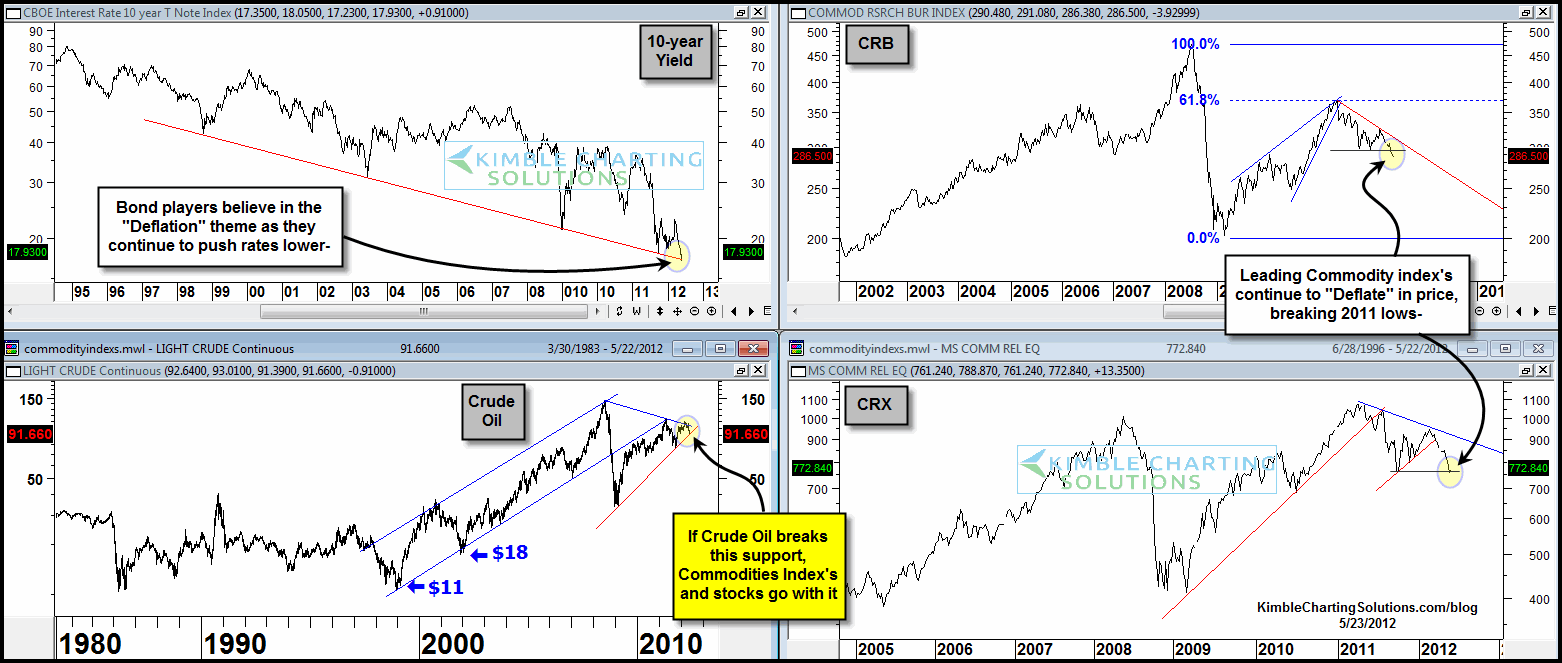
From a portfolio construction standpoint, the deflation/falling-price theme continues to suggest that protection of capital is a key strategy for a variety of asset classes.
Read it at Advisor Perspectives
The Deflation Trend
By Chris Kimble
Yesterday on Twitter I asked, ‘How soon until talk of deflation begins again?” Well, I didn’t have to wait very long. The above post showed up in my Google Reader list later in the afternoon. As the charts depict, Treasury yields are approaching new lows while commodities continue to slump (e.g. copper, gold, oil). While I don’t believe we will see outright deflation anytime soon, the disinflation trend may be with us for some time.
In other words, what people value most is having some chance - 1% versus nothing. Having greater opportunity - moving from a 20% to 50% chance isn't so valuable, in the sense that it doesn't so much affect bargaining behaviour.
This has (at least) two implications.
One is that it shows that people value procedural utility; having some chance to affect the outcome is what matters to them, rather than having a big chance.
The other is that, once some small chance exists, people don't greatly care about equalizing chances. They care more about having a small chance than about increasing their chances. These laboratory experiments confirm what we see in public opinion - that, like it or not, there is little demand for policies that would greatly equalize opportunity, such as abolishing private education or steep inheritance taxes.
Read it at Stumbling and Mumbling
THE WEAK DEMAND FOR EQUAL OPPORTUNITY
By Chris Dillow
These “experiments by Eugenio Proto and colleagues at Warwick University” possess potentially telling data for public opinion and policy making related to inequality and equal opportunity.

