Recently Mike Sax, who has an interesting blog titled Diary of a Republic Hater, offered this claim:
No one I speak to thinks the banks are a good bet even at bargain basement levels. Not Nanute, not dwb at Money Illusion, now WOJ who writes Bubbles and Busts has added his name to the list.
My position on the large US banks has remained skeptical for quite some time. Although reported earnings have been strong over the past couple years, a decent percentage of those earnings stemmed from debt-value adjustments (DVA) and the release of loan loss reserves. Add to those uncertainties the continuing halt of market-to-market accounting, unknown off-balance sheet positions and on-going legal liabilities due to frauds stemming for mortgages to LIBOR. Further, JPM is now openly discussing traders’ marking positions to hide losses, which is almost certainly far more pervasive than the disclosure suggests. The lack of transparency at these financial institutions simply presents more risk than I’m willing to take.
For some investors the earnings potential of the major banks may be significant enough to overlook the lack of transparency. As I pointed out to Mike in the comments:
Check out this post from the Brooklyn Investor (http://brooklyninvestor.blogspot.com/2012/06/banks-real-nightmare.html.) Low interest rates could be terrible for bank earnings.
That post shows the disastrous effects of low interest rates on the earnings potential for Japanese banks. Apparently the Bank of International Settlements (BIS) also fears a similar occurrence in the US. Timothy Taylor drew my attention to a BIS paper on Dangers of Continually Expansionary Monetary Policy. The section, noted by Taylor, most pertinent to this discussion is:
"Implications of effective balance sheet repair as a precondition for sustained growth"
"Ultimately, there is even the risk that prolonged monetary easing delays balance sheet repair and the return to a self-sustaining recovery through a number of channels. First, prolonged unusually accommodative monetary conditions mask underlying balance sheet problems and reduce incentives to address them head-on. ... [L]arge-scale asset purchases and unconditional liquidity support together with very low interest rates can undermine the perceived need to deal with banks’ impaired assets. ... And low interest rates reduce the opportunity cost of carrying non-performing loans and may lead banks to overestimate repayment capacity. All this could perpetuate weak balance sheets and lead to a misallocation of credit. ...
"Second, monetary easing may over time undermine banks’ profitability. ... Low returns on fixed income assets also create difficulties for life insurance companies and pension funds. Serious negative profit margin problems associated with the low interest rate environment contributed to a number of life insurance company failures in Japan in the late 1990s and early 2000s. ...
"Third, low short- and long-term interest rates may create risks of renewed excessive risk-taking. ... However, low interest rates can over time foster the build-up of financial vulnerabilities by triggering a search for yield in unwelcome segments. There is ample empirical evidence that this channel played an important role in the run-up to the financial crisis. Recent large trading losses by some financial institutions may indicate pockets of excessive risk-taking and require scrutiny.
"Fourth, aggressive and protracted monetary accommodation may distort financial markets. Low interest rates and central bank balance sheet policy measures have changed the dynamics of overnight money markets, which may complicate the exit from monetary accommodation ..."
The combination of all these risks is simply too large for me to consider investing in the big banks, even at current low levels. Obviously my position on the banks could be too risk averse and the stocks may prove big winners. In my opinion, there are many other sectors and companies with equally compelling valuations, better prospects and less uncertainty. Ultimately the decision is up to you though...best of luck!
"What I can’t understand is the willingness of thoughtful, studious men who presumably have been brought up in the spirit of American institutions and should be imbued with their principles, proposing a scheme to Congress which in effect delegates avowedly and consciously this vast power for price fixing to a small group of men who, in an economic sense, might come to be regarded as nothing short of a super-government. It is undemocratic, absolutely contrary to the spirit of America institutions, and so dangerous in its possible ultimate developments that I cannot see the slightest merits for its proposal." [My underlining - FJS]
This quote, regarding the Federal Reserve’s ability to influence interest rates through open market operations comes from a letter, written in 1923, by then New York Federal Reserve President Benjamin Strong. Ninety years later there are still questions regarding the desirability of this power and the effectiveness of its use.
Source: Credit Writedowns
The Real LIBOR Scandal
By Frederick Sheehan (FJS)
JPMorgan reported its second quarter earnings this morning and provided an update on the CIO situation. While the company continues to be very profitable, losses from the CIO disaster were revised higher to over $5 billion and part of the position remains open. What is more striking is the following quote highlighted by Zero Hedge:
'the recently discovered information raises questions about the integrity of the trader marks, and suggests that certain individuals may have been seeking to avoid showing the full amount of the losses being incurred in the portfolio during the first quarter. As a result, the Firm is no longer confident that the trader marks used to prepare the Firm's reported first quarter results (although within the established thresholds) reflect good faith estimates of fair value at quarter end.
First of all, let me say that the notion traders are marking books in their favor should not be surprising to anyone. What should be surprising is that JPMorgan is being publicly forced to disclose this fact, which I can assure you is far more pervasive than a few select individuals in the previous quarter.
Several years ago I worked as an equity options trader, trading some of the well-known, high priced names within the technology sector. Unlike many highly traded equity securities, most options at that time did not trade at penny spreads. While my positions may not have been large in comparison to those at many banks, they were large enough that moving the mark from bid to ask (or reverse), on certain strikes, could alter my profitability by upwards of 20-30% on any given day. Not surprisingly, since those strikes often represented the largest open positions on the underlying security, trades frequently went through at the market close to make that mark. By frequent, I mean that this occurred daily on several different strikes (often the same ones for a stretch of days). For any trader, this was a cheap and easy way to manipulate the P&L your bosses would see.
Now imagine that you’re a trader and your bonus/review is based on end of quarter or yearly numbers? Or the market value of your stock in the company might be altered significantly based on the publicly reported number? Do you attempt to mark your trades by a slight amount? The incentive is surely not high enough for all traders and other traders may try to mark positions in the opposite direction, but clearly some percentage of traders will attempt to play this game. Now, on an individual basis it might not make much difference, but if the percentage at a firm is high enough or the positions large enough, this game could have a meaningful effect. In the case of JPMorgan, it appears that the latter was the case this time, but we should not write off the possibility of the former (at JPMorgan or any other large financial institution).
This disclosure adds another tally to the list of areas that regulations are clearly not being enforced. After paying billions to cover up the mortgage fraud debacle, the largest banks now face billions more in charges related to LIBORgate. One should expect that many more financial restatements and disclosures of bad practices will be revealed in time.
Last month I countered positive remarks from Market Monetarists on the success of the Swiss central bank (SNB) in placing a currency floor against the euro with claims that the SNB was being forced to defend its action by purchasing large sums of euros. A few days later it was revealed that SNB Foreign-Currency Holdings Hit Record On Intervention. Over the past month the SNB has continued to protect its currency floor by purchasing foreign-currency, which signals the expectations channel of monetary policy (in this instance) is much weaker than some had presumed.
Today, I think Marcus Nunes (another Market Monetarist) is making a similar mistake in highlighting Australia’s consistent growth as a success of monetary policy. There are many charts in Marcus’ post, but I presume an important one to highlight is Australia’s NGDP during the past two decades (the post compares the relative success of Australia to New Zealand):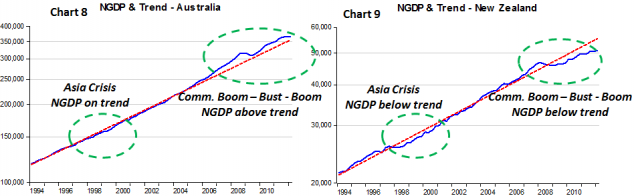 Chart 8 is intended to depict how monetary policy maintained NGDP growth near trend through the Asia Crisis and above trend throughout the global financial crisis. A concern of many non-Market Monetarists is what portion of NGDP growth will be derived from inflation versus real growth. To address that question, Marcus offers the following chart and notes:
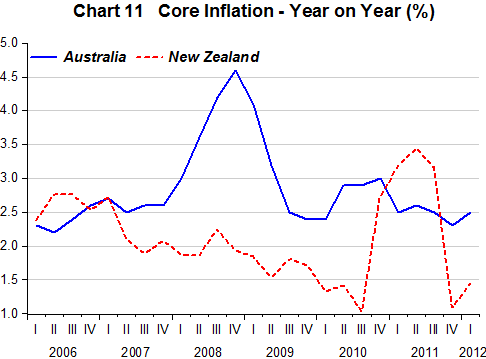
Chart 11 shows that generally, inflation has not been an ‘issue’ in either country.
If I knew little about the Australian economy, Marcus’ display of graphs and explanation might prove very convincing. However, having long been a fan of Steve Keen (an Australian economist), I was surprised at the lack of discussion regarding Australia’s housing market. Keen, a highly regarded Post-Keynesian, has for years been pointing out the positive and negative effects of private credit on growth. Regarding this topic, Keen frequently points out similarities between the US and Australia. Here’s a chart from Steve’s blog comparing Australian and US real house prices: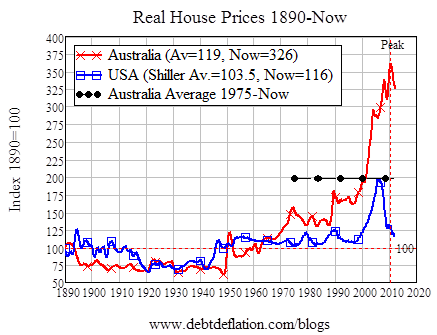
After nearly doubling between the mid-1990’s to 2005, US house prices have now given back most of the gains. Meanwhile, in Australia, house prices nearly tripled from the late-1980’s to the recent peak in 2010. Currently house prices remain at levels double those witnessed in the mid-1990’s. Similar to the US, the rise in home values is not well accounted for in national inflation data. As Keen regularly notes, a major factor in both housing bubbles and macroeconomic cycles (frequently overlooked by mainstream economists and monetarists) is private debt. Below is a chart comparing the levels of private debt in Australia and the US: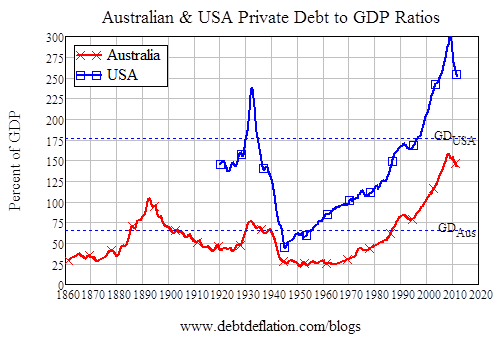
During the extended period of growth in Australia, private debt to GDP has been growing consistently. The rise in private debt and housing prices, which supported Australian growth for two decades, have now turned south. Similar, more exaggerated, drops in the US were at the heart of the US crisis and continuing economic malaise. As the housing bubble in Australia busts and private sector deleveraging speeds up, the Australian central bank (RBA) will be unable to overcome the deflationary momentum. GDP growth in Australia has been slowing of late and the most recent unemployment report showed a surprise uptick. If Keen is right, monetary policy is likely to prove inept in the coming years as NGDP falls below trend without large fiscal stimulus.
The US experienced a great-run of economic growth on the back of a staggering rise in private debt that ultimately caused the subsequent crash and stagnation. Australia appears to have built its remarkable run on the same principles and will soon find out if the optimism was equally misplaced. Market Monetarists are claiming Australia a success, while the Post-Keynesians are warning of impending trouble. My bet is on Steve Keen and the Post-K’s. Where’s yours?
Think back to the Great Depression. What we lost then and now and what we need to regain is trust. To be frank, I don't know how we can win that trust in our system back. But, when it comes to credit markets, I know where we can start.
First, we need to make sure there are no more bailouts. While the bailouts have prevented a Great Depression for now, they have engendered a deep sense of cynicism and resentment which has negatively impacted credit and growth. Second, we need to know that our largest financial institutions are well-capitalized enough to withstand large economic shocks. Without this knowledge, no one can separate liquidity from solvency — exactly the problems banks had during the Great Depression. Third, we need to enforce regulations through sound regulatory oversight and civil or criminal penalties. Self-regulation is a pipedream promoted by corporatists. And we see that time and again where regulations are not enforced, financial institutions turn to excess that leads to panic and crisis.
Doing these three things will not magically turn our economy around and get credit flowing again. But these steps are essential to restoring trust in our financial institutions and government. Restoring that trust is the first and most important step in getting our credit markets to work the way they are supposed to — in a way that enhances and insures our individual liberty, rather than the false privileges of corrupt financial institutions.
Read it at Naked Capitalism
How Out-of-Control Credit Markets Threaten Liberty, Democracy and Economic Security
By Ed Harrison
In trying to understand our modern monetary system and the problems at the heart of the current crisis, the most important aspect is credit. Although I currently believe demand for credit is a greater issue, problems within financial institutions remain serious. Harrison’s third point, which seems to contrast an earlier view about the need for more regulation, is worth highlighting. In the US there are already thousands of regulations for financial institutions. The trouble is that many are simply not enforced or hold penalties so small as to make breaking the rule still worthwhile. Greater transparency and enforcement are clearly needed in light of the recent PFG bankruptcy, LIBOR scandal and countless other known and unknown transgressions.

