Thursday, November 15, 2012

I, Pencil: The Movie


“I, Pencil: My Family Tree as Told to Leonard E. Read” was first published in 1958. Since then, it has become a hallmark of introductory economics courses. I can’t recall when I first heard the story, but I do remember watching Milton Friedman tell the story in his 1980 television show Free to Choose (I’m not old enough to have actually watched on TV, but all the episodes are available on YouTube). When I began the PhD in Economics program this fall, I was once again treated to a retelling of the story by Walter Williams.

In my experiences to date, there are few, if any, more simple and compelling tales about the wonders of markets. This new video is brilliantly produced and will make for an excellent introduction to economics for future students.


"This is the modern world. It's miraculous, it's intricate, and it gets better every day so long as people are free to interact with each other. If we can leave the creative energy of humankind uninhibited, there's no limit to what we can accomplish."

(h/t Steve Horwitz @ Coordination Problem)

Tuesday, November 13, 2012

A Minor GDP Revision with Major Consequences

The value of national accounting identities in economics and as a means of qualifying the wealth of a nation has recently been a frequent topic of personal discussions. Hence I was excited by Euvoluntary Exchange’s critiquing GDP vs. EE, in which Samuel Wilson takes on the conventional accounting of exports and imports:
Where GDP is usually referenced by economists and the press is as a proxy for the health and vitality of the economy. Higher GDP per capita tends to correlate well with higher standards of living and better material well-being. There are quite a few things folks consider desirable that track well with high GDP, like lower violent crime, longer life expectancy, lower infant mortality, et al. That's great, but if we're measuring prosperity, it seems kind of perverse to ding your metric for exchanges that happen in one particular direction across one particular type of border. By using GDP as a proxy for prosperity, the deck is sort of stacked against the euvoluntarity of international trade, and this is completely independent of any intertemporal, loanable funds considerations. It's almost tacitly suggesting that imports are something we have to suffer for the privilege of exporting. How strange.
I can perhaps understand how economists might want to concern themselves with prosperity maximization. I'm more puzzled by ones who translate this to "GDP maximization".
I'm sort of curious if folks' moral intuitions towards overseas trade would change if some snickering rogue could convince the profession to switch the sign on imports.
GDP is clearly focused on production (given the acronym), yet intuitively one might consider wealth as the amount of obtainable goods and services. The focus on production appears to mesh well with Say’s law, in which production is the means by which individuals can obtain other goods. However, there are numerous reasons to question the validity of Say’s law including the possibility of an excess demand for money. Rejecting Say’s law, one can more readily accept that production is not the only, or necessarily accurate, means of determining one’s purchasing power.

Warren Mosler, a main proponent of MMT and a sectoral balances approach to macroeconomics, presents a similar argument in his book Seven Deadly Innocent Frauds of Economics Policy (p.59 - free pdf version attached):

Imports are real benefits and exports are real costs. Trade deficits directly improve our standard of living.
…
Put more succinctly: The real wealth of a nation is all it produces and keeps for itself, plus all it imports, minus what it must export.
Wilson and Mosler clearly agree that reversing the GDP accounting sign on imports and exports would more accurately reflect the “real wealth of a nation.” That these two proponents affiliate with generally opposing economic camps, suggests optimism that many others might support this change. The road won't be easy, but reversing the sign on imports is critical to preventing this “deadly innocent fraud” from further reducing our standard of living.

Saturday, November 10, 2012

Bubbling Up...11/10/12

1) Global Credit Cycle Lurches Down by BCA Research @ The Big Picture
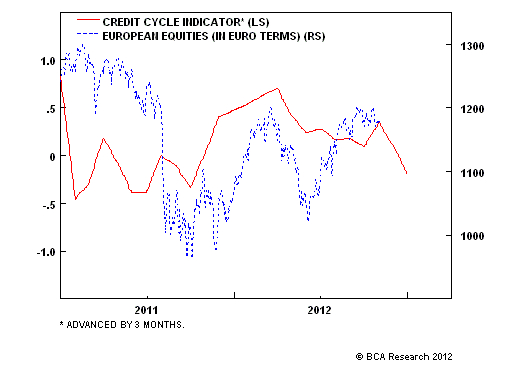
The credit impulses in all three major economies – the euro area, the U.S. and China – are now negative, albeit very slightly in the case of China. This is the first time in three years that all three components have been simultaneously negative. And after hovering at a point of inflection the combined credit cycle indicator has lurched down again.
Woj’s Thoughts - As I have argued repeatedly on this blog, credit (especially private) is now the main driver of economic cycles. If broad measures of credit contract in all three major economies, it becomes increasingly unlikely that current fiscal deficits will be large enough to maintain current levels of growth (or decline in Europe’s case).

2) The US election and the fiscal cliff by Edward Harrison @ Credit Writedowns
What these three things tell me is that recession is what results from trying to reduce government deficits when the root cause of the deficits lie in private sector debt distress. When the government raises taxes or cuts spending in that situation, the result is less income in the private sector. And to the degree debt distress still exists, the result of less income is less spending and private defaults, also known as recession and credit writedowns. The larger the recession and the credit writedowns, the greater the possibility of bank failure, financial panic and debt deflation.
Woj’s Thoughts - Many pundits are currently arguing that the “fiscal cliff” is over-hyped, or simply non-existent. I think they’re wrong and, similar to Harrison, believe any compromise will still result in marginal tax increases. As noted above, the credit impulse is now negative in the US, suggesting private sector debt distress persists. The fiscal situation should be watched very closely going forward.

3) Nicholas Kaldor On European Political Union by Ramanan @ The Case for Concerted Action
From Kaldor’s essay (pp. 202-207):
THE CONSEQUENCES OF A FULL ECONOMIC
AND MONETARY UNION
This is only another way of saying that the objective of a full monetary and economic union is unattainable without a political union; and the latter pre-supposes fiscal integration, and not just fiscal harmonisation. It requires the creation of a Community Government and Parliament which takes over the responsibility for at least the major part of the expenditure now provided by national governments and finances it by taxes raised at uniform rates throughout the Community. With an integrated system of this kind, the prosperous areas automatically subside the poorer areas; and the areas whose exports are declining obtain automatic relief by paying in less, and receiving more, from the central Exchequer. The cumulative tendencies to progress and decline are thus held in check by a “built-in” fiscal stabiliser which makes the “surplus” areas provide automatic fiscal aid to the “deficit” areas.
...
Some day the nations of Europe may be ready to merge their national identities and create a new European Union – the United States of Europe. If and when they do, a European Government will take over all the functions which the Federal government now provides in the U.S., or in Canada or Australia. This will involve the creation of a “full economic and monetary union”. But it is a dangerous error to believe that monetary and economic union can precede a political union or that it will act (in the words of the Werner report) “as a leaven for the evolvement of a political union which in the long run it will in any case be unable to do without”. For if the creation of a monetary union and Community control over national budgets generates pressures which lead to a breakdown of the whole system it will prevent the development of a political union, not promote it.
Woj’s Thoughts - Although Kaldor espoused these opinions more than 40 years ago, there are still countless people today holding out hope that Europe creates a full fiscal union on the road to political union and ultimately becoming the United States of Europe. In my opinion, U.S. of Europe optimists continually overestimate the ease with which fiscal integration, not only harmonisation, is achievable. Convincing various populations to accept a common social welfare scheme, uniform tax rates and indefinite transfers is likely not achievable within the next decade, if at all. Democracies in Europe are already falling due to the strain of economic depression and widespread unemployment. Relative stability may persist for a few more years, but the political crisis will come to a head well before fiscal and/or political integration is possible.

Thursday, November 8, 2012

Koo–Krugman Paradox? - Jonathan Finegold

I’d like to share one thing in particular from Koo’s book, (The Holy Grail of Macroeconomics)
[A]fter the bubble collapsed in Japan, not only were there no willing borrowers, but existing borrowers were paying down debt — and they were doing so when interest rates were at zero. Technically insolvent companies, struggling to pay down debt and repair balance sheets hit by the nationwide plunge in asset prices, were not interested in borrowing money, regardless how far the central bank lowered rates. In this environment, monetary policy by itself no longer has any effect.
— p. 29.
...
Some time ago Krugman suggested that Koo isn’t entirely right,
Koo’s argument is that interest rates and monetary policy don’t matter because everyone is debt-constrained. That can’t be right; if there are debtors, there must also be creditors, and the creditors must be influenced at the margin by interest rates, expected inflation, and all that.
Read the rest at Economic Thought
Koo–Krugman Paradox?
By Jonathan Finegold

I haven't read Koo's book yet, but have been equally fascinated by his ideas through various other works. Regarding the difference between Koo and Krugman on the creditor-borrower dichotomy, I think it boils down to whether one accepts the loanable funds paradigm or not. Krugman, seemingly accepting the premise, believes that creditors (banks) are limited in credit creation by funds from savers and to some degree central bank reserves. In that case it would be true that a relatively large portion of the population would not become debt-constrained at a given time.

Now consider the opposing view, that banks create deposits and are only constrained by capital requirements (to a degree) and the willingness of borrowers to accept the bank's liabilities (which is supported by an implicit/explicit federal guarantee). Banks can therefore lend well in excess of current income and savings. In this scenario, a very significant portion of the population could become debt-constrained. If this is true, debt-constraints can become far more powerful (as Koo suggests) and may render monetary policy ineffective even with higher inflation expectations.

Personally I find the second example far more convincing given my readings and experience. I should also note that In Koo’s scenario, while demand for credit is weak, banks may also tighten credit restrictions since there is some level of debt-to-income (or assets) where the expected return of lending to a potential borrower becomes negative.

Wednesday, November 7, 2012

Election Results: Forecasting Accuracy and a 2013 Recession?

Nearly 10 months ago I put forth a list of predictions for 2012 that were “seen as having a low probability (less than 33%) but which I believe hold a greater than 50% chance of occurring.” From that list:
8) President Obama will win re-election - Generally a weakening economy has been poor for incumbents but this time will be seen as abnormal circumstances. The troubles in Europe and high unemployment will actually spark desire for a more interventionist government. Given the choice between Obama and Romney, the President will win re-election by a slim margin (2% or less).
And the results...
Candidate
Popular vote
Percentage
Electoral votes (270 to win)
Barack Obama
59725608
50%
303
Mitt Romney
57098650
48%
206
Pretty good, though Nate Silver deserves the real congratulations for accurately forecasting every state.

Now that the election is over (with no significant change in the national balance of power), a few prominent questions for the macro-economy must be resolved...

1) What portion(s) of the Bush-Obama tax cuts will be allowed to expire, if any?
2) Will the federal government allow the budget deficit to contract next year? If so, by how much?
3) Will the debt ceiling be raised again? If so, what concessions (presumably from the Democrats) will be necessary?

How long will it take to resolve these questions? That’s tough to say but, considering the players still involved, continuing gridlock looks like the smart bet. Stakes remain high, despite the election results, as the eventual resolution of these topics will likely determine whether or not the US enters a recession in 2013.