Thursday, July 12, 2012

The Pain in Spain Continues


Along the way I have warned that Spain suffered from significant macroeconomic challenges that, at the time, appeared unrecognised by the markets. I also provided some analysis that the country’s problems were far greater in magnitude than something than could be fixed by simply lowering government sector deficits:
The private sector accumulated large debts on the back foreign capital inflows leading to a housing bubble.  This bubble has since collapsed leaving the private sector in a position of significant wealth loss and indebtedness, the banking system holding significant and growing levels of bad debts and the economy structured around the delivery of a failed industry.
…
The growing unemployment is leading to a slowing of industrial production, which means that even though the country is importing less it also appears to be exporting less. Combine this with the interest payments on borrowings from the rest of the world and at this point Spain continues to run a current account deficit which, in the most basic terms, means Spain is still paying others more than it is being paid back. That is, the external sector is still in deficit.
So with the external sector in this state and the private sector unable and/or unwilling to take on additional debt as it attempt to mend its balance sheet after an ‘asset shock’, the only sector left to provide for the short fall in national income is the government sector. If it fails to do so then the economy will continue to shrink until a new balance is found between the sectors at some lower national income, and therefore GDP.
It may appear logical to you that this must occur, and I don’t totally disagree, but that doesn’t change the fact that under these circumstances there is simply no way that the private sector will be able to continue to make payments on the debts it has accumulated during the period of significantly higher income. This is a major unaddressed issue. (my emphasis)
And this is the monetary trap much of the European periphery now find themselves in. Structural issues within their economies together with their pseudo non-floating currency means they are neither able to shrink nor grow out of their debts. Without significant debt restructuring they are left to flounder in a viscous spiral downwards.
Read it at Macro Business
Spain: The next leg down
By Delusion Economics

The most recent EU summit concluded with a memorandum of understanding (MoU) for Spain which by most accounts appears to largely reinforce the failed bailout measures used for Greece, Ireland and Portugal. In return for bank bailout funds, that are obviously inadequate, Spain must remain “committed to correct the present excessive deficit situation by 2014.” Although the allowable deficits for 2012 and 2013 were raised, the new levels are still overly optimistic given economic conditions. Recognizing this reality, Prime Minister Rajoy has already decided to raise VAT taxes. Considering that Spanish housing still has further to drop and the external sector is unlikely to improve, based on worsening global growth prospects, the pain in Spain will continue.

Related posts:
Spain Should Bailout Households Not Banks
Despite Bailouts, Irish Banks Remain Insolvent...Spain Too?
Private Debt Continues to Drag Down Europe

Crony Capitalism - The Degree Matters


Supporters of free markets seem to be increasingly vocal in their opposition to corporatism or crony capitalism. Whilst I wholly welcome this, I fear that the demand for a proper free market economy without cronyism or special favours is as unachievably utopian as the wildest leftist fantasy.
Read it at Stumbling and Mumbling
CRONY CAPITALISM - THE ONLY CAPITALISM
By Chris Dillow

Chris lays out three reasons why capitalism must in practice be crony capitalism. While I don’t disagree with his premise, or even necessarily the conclusion, a more subtle point I would note is that it’s ultimately about degrees. Even if one accepts that capitalism will involve some level of cronyism, that argument suggests nothing about whether cronyism will be limited to a few minor inconveniences or become so widespread as to discourage trust in practically any dealing. The differences between these two outcomes and the vast area in between are, in my opinion, the reason debates among free marketers and those favoring regulation are so meaningful. Any economic system will likely involve some manner of cronyism. Therefore, fighting to reduce the degree of its persistence is and will remain an extremely worthy cause.

Wednesday, July 11, 2012

Forgotten Lessons from Japan's Lost Decades

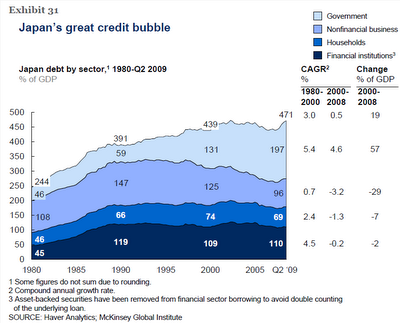
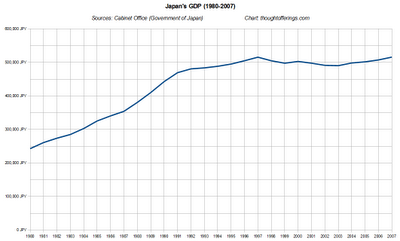
For nearly two decades Japan has witnessed stagnating growth and mild deflation. Over the course of this period, Japan has experimented with various forms of monetary “stimulus” as well as fiscal stimulus, increasing public sector debt by nearly 400%.
Source: The New Arthurian

By many accounts, Japan should be a shining example of functional finance,demonstrating the positive impact of fiscal and monetary stimulus working together. Reality, however, depicts a largely different story.


The New Arthurian offers four lessons from the struggles in Japan...

Lesson 1: No recovery was created by increasing the money.
Lesson 2: No recovery was created by replacing private debt with public.
Lesson 3: There was little or no "erosion" of debt by inflation.
Lesson 4: Try debt forgiveness.
Most economists are currently calling for either greater monetary or fiscal stimulus, or in some cases both. I fear that this apparent focus on broad macro stimulus overlooks some of the subtler inefficiencies within developed economies that played an equal, if not greater, role in the current economic crisis. Tax laws and regulations that encourage the use of credit over money, promote greater inequality and subsidize various industries with political favor will largely remain in place under most of the proposed policy solutions. Until these issues, and numerous others, are dealt with, our fate may follow a similar path as Japan, whereby monetary and fiscal stimulus are only enough to continue muddling through.   

NY Fed Puzzled By Greenspan/Bernanke Put


Potential Explanations
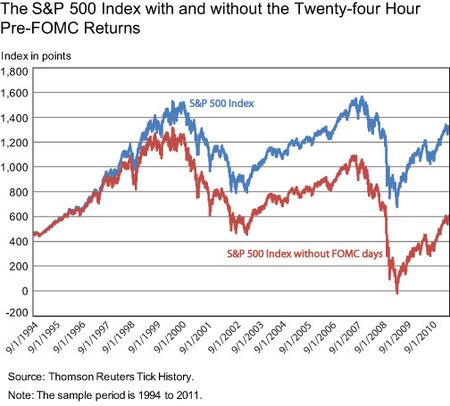
One might expect similar patterns to be evident also in other major asset classes, such as short-and long-term fixed-income instruments and exchange rates. Surprisingly, though, we don’t find any differential returns for these assets on FOMC days compared with other days. In other words, the pre-FOMC drift is restricted to equities. Further, we don’t find analogous drifts ahead of other macroeconomic news releases, such as the employment report, GDP and initial claims, among many others. The effect is therefore restricted to FOMC, rather than other macroeconomic, announcements. In the Staff Report, we attempt to account for standard measures considered in the economic literature that proxy for different sources of risk, such as volatility and liquidity, but they also fail to explain the return. Finally, we consider alternative theories that feature political risk, investors with capacity constraints in processing information, as well as models where stock market participation varies over time. Although these theories can help qualitatively explain the existence of a price drift ahead of FOMC announcements, they are counterfactual in some dimension of the empirical evidence.
   Our findings suggest that the pre-FOMC announcement drift may be key to understanding the equity premium puzzle since 1994. However, at this point, the drift remains a puzzle.
Read it at Liberty Street Economics
By David Lucca and Emanuel Moench

Does anyone still need further proof of the Greenspan/Bernanke put? What I found most telling about this research note is that the positive effect of Fed anticipation extends to equity markets in Canada and Europe, but not to fixed income or exchange rate markets. As this correlation suggests, the expectations channel for Federal Reserve policy through equity markets is very strong. Unfortunately, for proponents of the Fed, the wealth effect from higher equity prices has minimal effect on GDP growth or employment.

Two weeks off...little has changed

I’m back! After ten much needed days of vacation (largely without internet) and a couple days feeling under the weather, Bubbles and Busts is back.

Catching up on the news feed was a bit tedious as it appears a lot has happened, yet made very little difference. The Euro Summit, as predicted, offered the impression that progress was being made and momentarily provided an all-clear for risk-on betting. However, similar to the other 20-something summits, once the details began to leak out it became widely recognized that minimal real progress had been made. The timetable and size of the Spanish bank bailout are both unrealistic. Meanwhile, the negative effects of further attempts at austerity (tax hikes and spending cuts) are only slightly offset by the upward revisions in allowable public deficits for this year and next (which Spain will still not meet).

Separately, data out of China continues to suggest that growth is slowing much quicker than many expected. Falling inflation allowed the Chinese central bank to cut rates, but that action will do little to spur consumer spending (or boost growth). The Chinese government is increasingly facing the tough decision of whether to promote structural rebalancing and allow growth to slow or to put of rebalancing and jump start growth with fiscal stimulus. This decision will likely have a large impact on markets in the short-run and it appears most US investors are betting on the latter outcome.

Lastly, US economic data has also been weakening, topped off by the poor employment report last Friday. Yes the warm winter pulled economic activity forward, but I’m also convinced that the timing of the 2008-2009 crisis has altered the seasonal adjustments in a manner that overstates fall/winter months and understates spring/summer months. Regardless, 2Q GDP growth is likely to be below the already meager 1.9% growth during the 1Q. Corporate profits are now feeling the effects and have already turned negative (q/q). Both full-year GDP and S&P earnings expectations remain overly optimistic and will likely be trimmed over the coming weeks.

On the whole, global growth is clearly slowing and politicians in all of the major regions appear to be merely reacting, belatedly, to problems that surface. US stock markets have now given back most of the initial gains from the EU summit and Treasury yields are holding at or near all-time lows across the curve. Peripheral sovereign yields in the Eurozone have received a bit of a bid the past couple days (from the ECB?) but remain at unsustainable levels. Given the recent actions, my bias remains pessimistic for the next 1-2 years. Now it’s time to get back to more in-depth blogging...