Wednesday, June 20, 2012

Markets Jumping Ahead of the Fed


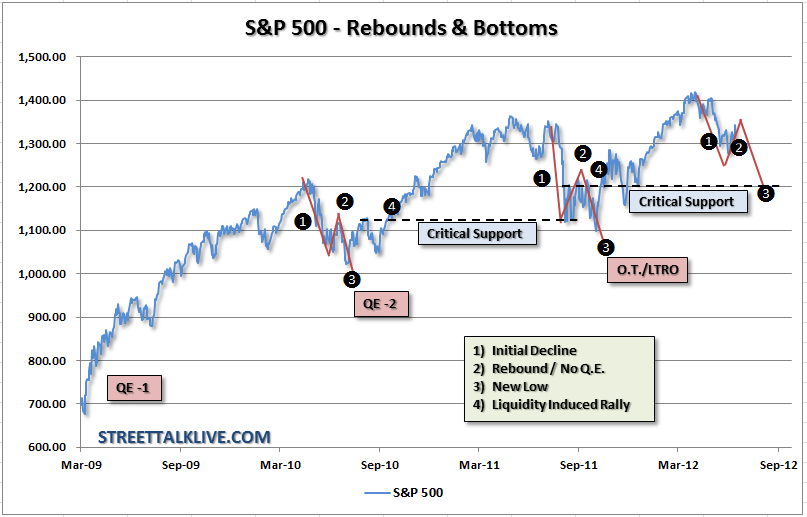
It is at this point that the calls for more stimulative actions are made by the media and Wall Street. The market then rallies on rumor and innuendo as expectations rise on hopes that the need for liquidity will soon be met - Point 2.
This is where we are today. Headlines, postings and tweets are filled with that hope of further accommodative action from the Fed.
Read it at Pragmatic Capitalism
NO QE3 COMING, REPLAY OF 2011 TO CONTINUE
By Lance Roberts, CEO StreetTalk Advisors

When the FOMC initiated both QE2 and Operation Twist, US stocks were approaching bear market territory (down 20%) and inflation expectations were falling rapidly. Although inflation expectations have been falling (along with oil prices), stocks are up ~7% in the past two weeks and nearly 8% for the year. Meanwhile, fears regarding Europe are subsiding following the Greek election and G-20 summit (though this optimism is misplaced). Bernanke was correct in calling high headline inflation temporary, but further action at this point may once again send money pouring into the energy and commodity space. If temporary effects are encouraged to persist for long enough, it becomes foolish to continue calling them temporary.

Given the upcoming elections, strength in equity markets and moderate expected growth going forward, this would be an odd moment for the Fed to start acting pre-emptively. As noted in my Predictions for 2012, I expect “the Fed will move it’s forecasts for the first interest rate hike out to 2015.” Beyond that, the Fed may continue Operation Twist (Sterilized QE) at some small scale. Neither of these actions is likely to be significant enough to satisfy investors. Markets may have jumped the gun with the recent rally.

Related posts:
Bernanke May Disappoint Pavlov's Dogs
Political Fears May Keep ECB Easing On Hold
Fed's Treasury Purchases Now About Asset Prices, Not Interest Rates

Tuesday, June 19, 2012

IOR Killed the Money Multiplier

Following yesterday’s post that the SNB Massively Increases Monetary Base to Maintain Currency Floor, I became engaged in some back and forth dialogue through the comments at FT Alphaville. In response to a suggestion that the SNB had given up control over interest rates by instituting the currency floor, Philip Pilkington (Naked Capitalism) said:
They could easily maintain control over interest rates by paying a set rate of interest on reserves, just like the US/UK/Japan do with their base rate.
Paying a positive rate of interest on reserves (IOR) would provide a huge incentive for Swiss banks to hold reserves instead of short-term government securities. This swap would move rates on government debt towards the IOR rate (although given the currency floor, Swiss debt may still trade at a relative premium). This discussion of IOR got me thinking:
if the SNB chose to pay IOR, wouldn't that to some degree tighten monetary policy (by making credit more expensive relative to money-like instruments)? If so, might this policy increase deflation and thereby put further upwards pressure on the CHF?
Philip responded:
Maybe. Depends if you think that low interest rates in a ZIRP-like environment actually stimulates demand. I don't think they do to any significant extent. This was shown in the Godley/Lavoie computer simulated models. The effects on investment are short-term -- in the long-term they take away interest income which decreases consumption.
With regards to monetary policy, my views are closely aligned with Philip’s. The strengths of monetary policy are alleviating financial illiquidity and encouraging investment (largely housing) by holding down the long end of the curve. At the moment, US financial markets are highly liquid and housing investment remains constrained by excessive household/mortgage debt, underwater borrowers, foreclosure errors and shadow inventory. Altering rates slightly, in either direction, at such low levels is therefore unlikely to have much impact.  

Moving beyond the economic impact of paying IOR, I decided to pose a question previously alluded to in Permanent Zero: Record Low Treasury Yields and Banking Instability:
Given the amount of excess reserves, will it be easier for central banks to adjust interest targets using the rate of IOR rather than reduce excess reserves back to a level that manages the interest rate target?
Philip confirmed my views noting:
It would, I think, be a great deal easier to use IOR rather than OMO when there are massive amounts of excess reserves (wow, I hope no one ever quotes that sentence!). When/if the recovery happens the central banks may choose to do this instead of engaging in OMOs to soak up the QE-induced reserves. It would be a great deal less hassle provided that central bankers can get over their irrational fear of excess reserves. It would also likely mean that a lot of civil servants currently engaged in OMOs might lose their jobs -- that may sound trivial, but it puts extra pressure on the IOR proponents.
If the central banks did this and conducted their interest rate policy in terms of IOR, the money multiplier would have to die. No longer could any serious economist maintain the myth. But, as I and others have argued in the past, if the money multiplier dies much of neoclassical economics goes with it. As endogenous money theorist Alain Parguez puts it: endogenous money destroys the concept of the scarcity of money, and without the notion of scarcity applied in every economic field neoclassical economics breaks down.
(Philip - My apologies for including that quote)
These comments on the end of the money multiplier brought me full circle to my first encounter with interest on reserves (IOR) back in 2010, when I discussed how the Fed Stands in Own Way on Monetary Policy. In that post I presented the following quote from a  New York Fed report on Why Are Banks Holding So Many Excess Reserves?, by Todd Keister and James McAndrews:
if the central bank pays interest on reserves at its target interest rate,..., the money multiplier completely disappears.
So the money multiplier is dead and even members of our central bank are aware of this fact. Now if only most economists would start accepting this reality...

Update: Ramanan (in the comments) directs us to a power point by Marc Lavoie on Changes in central bank procedures during the subprime crisis and their repercussions on monetary theory. Lavoie provides an important correction to Keister’s views noted above (emphasis mine):
You seem to imply that the textbook multiplier still applies when reserves earn no interest. I think that this is a misleading statement. It implies that there is a bunch of agents out there,
waiting for banks to provide them with loans, but that there are being credit rationed because banks don’t have access to free reserves. ...Rather what happens when excess reserves are being provided with no remuneration of reserves is that the fed funds rate drops down, as banks with surplus reserves despair to find banks with insufficient reserves, having no alternative but a zero rate. The drop in the fed funds rate may induce banks to lower their lending rates, and hence induce new borrowers to ask for loans or bigger loans, but it really has nothing to do with the standard multiplier story. If there is no change in the lending rate, new creditworthy borrowers just won’t show up. There is never any money multiplier effect.
No End in Sight for Household Deleveraging


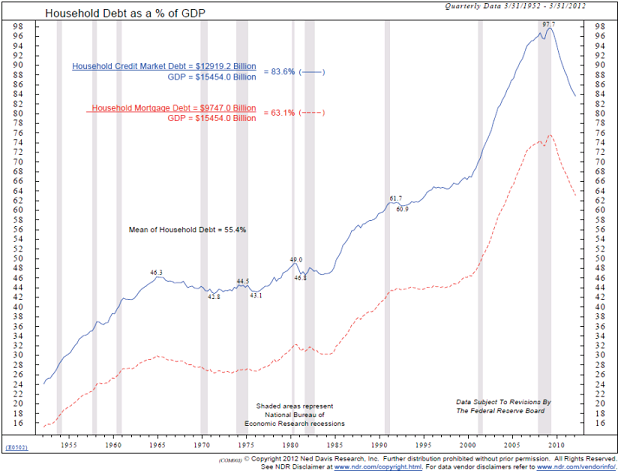
In our view, it is the overwhelming force of the debt deleveraging that has overcome government efforts to inflate. We have pointed out that household debt has dropped to 84% of GDP from its peak of 98% in 2008.  After rising for 284 consecutive quarters from the end of WW II to mid-2008, household debt has now declined for the last 16 quarters.  This is an astounding number, indicating a great change in the economy.  It still has a long way to go in order to reach the 66% level of 2000, let alone the 60-year average of 55%.  Households, therefore, have to continue to increase savings and reduce spending for, perhaps, years to come to get their balance sheets in order.  Since this reduces the demand for goods and services, businesses have little reason to hire new workers or increase capital expenditures.  Since household spending accounts for 70% of the GDP, the negative effects are felt throughout the economy. (emphasis mine)
Read it at Pragmatic Capitalism
DEFLATION REMAINS A BIGGER THREAT THAN HIGH INFLATION
By Comstock Partners

Over the past couple weeks, I have seen an increasing number of people argue that the private sector may be approaching levels of debt where credit expansion can once again begin in earnest. While countless others focus on the size of public debt, which is somewhat irrelevant for the US, the primary cause of the Great Recession and mediocre economy today was/is excessive household debt.

Unlike the US government, households cannot print money to repay their debts and therefore must rely on either income, savings or new borrowing. In the final stage of a bubble, termed “Ponzi finance” by Minsky, the last of these methods becomes the primary means of refinancing outstanding debt. When credit conditions eventually tightened, many households were forced to reduce consumption in order to repay previous debts. Unfortunately, when households attempt  to reduce debt through lower consumption in the aggregate, income decreases and the debt burden grows larger. The nature of this aggregate reduction in consumption is generally referred to as the “Paradox of Thrift” (a topic I’m told both Keynes and Hayek agreed on).

Having already written off massive losses on previous loans, private banks remain cautious in extending credit to households. Even though households have been deleveraging for 4 years, it will take at least another 4 years at the current pace to simply return debt levels to those existing in 2000. Returning to levels that preceded the Great Moderation may require another decade or more.

For the past several decades, private credit expansion has been the primary driver of economic growth. Government interventions, namely deficits, have been large enough the past few years to stabilize growth at a low level. If deficits continue to trend lower in the next couple years, the continued household deleveraging will once again spark fears of deflation. Given that current laws are already extremely supportive of private credit expansion, it’s hard to envision changes that would suddenly turn the tide. High inflation probably will return some day, but that day is a long way off. For now, disinflation remains the primary trend and deflation may still occur in the next few years.


Related posts:
Saving is NOT Enough for Consumer Led Recovery
Deflationary Monetary Policy

Monday, June 18, 2012

"Easy money has morphed into financial repression"


Think of it this way, just after the Euro came into being, the German economy was in what I labelled a soft depression due in large part to Germany’s own post-unification credit excesses. So the ECB decided to prop up the German economy with low interest rates, rates that produced negative real interest rates and housing bubbles in Ireland and Spain. This was a policy designed to "bail out" the indebted German economy. We called it easy money then because it allowed massive speculation to be funded by cheap loans in credit markets. Now that the bubbles have popped, easy money has morphed into financial repression. But the goal is the same as it ever was: to "bail out" the indebted by ‘repressing’ interest income that creditors can receive.
The interesting bit about this policy is that economic policies right across the indebted developed economies have been extremely favorable to creditors in bailing financial institutions out of their lending excesses at taxpayer expense. Yet, at the same time, creditors are being savaged by the sharp downturn in net interest income due to the easy money policy we are now calling financial repression.
Read it at Credit Writedowns
Chart of the Day: The smoking gun showing how the ECB wrecked the Spanish economy
By Edward Harrison

A couple months back I wrote a couple posts about how The Economy Needs a Bubble!
when interest rates are held below the growth rate of an economy (See also The Economy Needs a Bubble, but Treasuries are NOT it!). One point I might add to Edward’s post, is that the groups of creditors benefiting from bank bailouts and being hurt by financial repression may very well represent different groups based on income/wealth. In my opinion, this is an important distinction for understanding the political motives behind each policy and assessing any likely changes to policy down the road.

SNB Massively Increases Monetary Base to Maintain Currency Floor


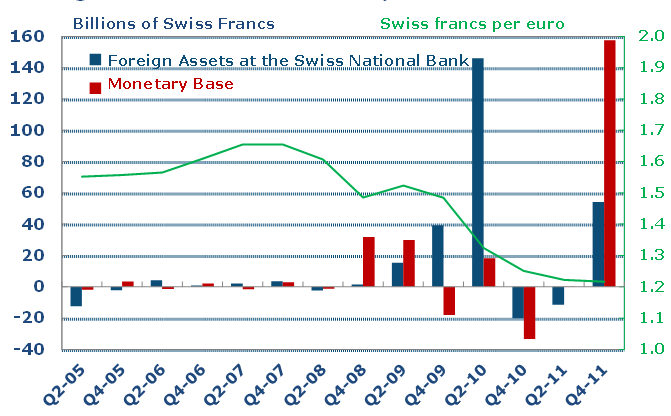
The Swiss National Bank then announced that it was prepared to buy foreign exchange in unlimited quantities to maintain a floor of SF 1.20 vis-à-vis the euro. The Bank’s holdings of foreign exchange increased substantially, but the Swiss monetary base increased by even more. Since September, the Swiss National Bank has maintained an exchange-rate floor, by giving up control of its monetary base in conformity to the fundamental trilemma.
Read it at VoxEU
Foreign-exchange intervention and the fundamental trilemma of international finance: Notes for currency wars
By Michael Bordo, Owen F Humpage and Anna J Schwartz
(h/t David Keohane at FT Alphaville)

Previously I detailed that the Swiss are struggling to maintain the currency floor as SNB Foreign-Currency Holdings Hit Record On Intervention. Apparently purchasing significant sums of foreign currency is not the only questionable byproduct of maintaining a currency floor against the euro. By setting a currency floor, the SNB has also given up control over monetary policy and thereby had to mimic the ECB’s balance sheet expansion. Although the monetary base expansion poses little cause for immediate concern, these actions can have the effect of reducing current interest income to the private sector and making future interest rate targeting more difficult.