Friday, August 31, 2012

1st Day of Micro - Households and Governments are NOT the Same

Classes began this week and for what its worth, I have successfully completed my first week of class as a PhD student in economics. My choice of school, George Mason University, was primarily due to the desire to join the mainline of economics, not the mainstream (see Living Economics: Yesterday, Today, and Tomorrow by Peter J. Boettke for details on the difference).

Although I am excited about the opportunity, one area of economics where I feel my incoming views might contradict those of professors’ is related to modern money regimes. An example of this distinction is the contrasting beliefs that governments with fiat currencies, who sell debt in their own currency, cannot become insolvent versus the seemingly widespread belief that the US government will default if drastic actions to cut deficits/spending are not promptly taken. You can imagine my joy/relief, when during my first microeconomics class, Walter Williams used the following example to demonstrate the fallacy of analogy (approximate quote):

If a household has expenditures greater than their income they’ll go bankrupt, therefore if governments have expenditures greater than their income, the government will go bankrupt. Well, the latter is not necessarily true. Why? Because governments can always pay their debt, can’t they? They’ll just print money.
While I can’t/won’t claim that all GMU econ professors, Austrians, or Libertarians recognize this distinction (I’m not even sure which of the latter two, if either, Williams’ associates with) , I imagine the percentage that do is higher than many critics believe. For my part, I’m excited about the potential for further intersections between my classes and readings on modern money.

(Note: Unfortunately, for those who enjoy this blog, my priorities are shifting to the PhD program for the foreseeable future. I will try to update the blog as much as possible, but in doing so, will probably focus more posts on class readings, topics and discussions. Thank you to all my readers for support and to commenters for helping further my education.)


Wednesday, August 29, 2012

Federal Reserve Admits Inability to Control Inflationary Expectations

Another solid post by Izabella Kaminska at FT Alphaville on The unintended consequences of QE. This one offers observations from a Federal Reserve Bank of Dallas working paper, by William White, about Ultra Easy Monetary Policy and the Law of Unintended Consequences“. Here is one section worth highlighting:
A further concern is that the reductions in real rates seen to date, associated with lower nominal borrowing rates and seemingly stable inflationary expectations, might at some point be offset by falling inflationary expectations. In the limit, expectations of deflation could not be ruled out. This in fact was an important part of the debt/ deflation process first described by Irving Fisher in 1936. The conventional counterargument is that such tendencies can be offset by articulation of explicit inflation targets to stabilize inflationary expectations. Even more powerful, a central bank could commit to a price level target, implying that any price declines would have subsequently to be offset by price increases.
However, there are at least two difficulties with such targeting proposals. The first is making the target credible when the monetary authorities’ room for maneuver has already been constrained by the zero lower bound problem (ZLB). The second objection is even more fundamental; namely, the possibility that inflationary expectations are not based primarily on central banker’s statements of good intent. Historical performance concerning inflation, changing perceptions about the central banks capacity and willingness to act, and other considerations could all play a role. The empirical evidence on this issue is not compelling in either direction.
Repeating a key statement there, contrary to the hopes and dreams of market monetarists, the Fed surprisingly admits that:
inflationary expectations are not based primarily on central banker’s statements of good intent.
Moving on, another portion of the paper expresses concern that low rates will hurt margins in various means of financial intermediation. Japan remains a good example in this matter as low interest rates and a flattening curve have drastically reduced net interest margins, almost entirely wiping out profitability among the banks. Separately, we should heed the lesson from Denmark that negative rates (which reduce margins) can pressure banks to compensate by charging higher rates on loans.

All of this gets back to an issue previously discussed by Ryan Avent, Steve Roth and others, which is the asymmetric nature of monetary policy. In short, the Fed’s ability to fight inflation is far greater than its ability to create it.

In conclusion, Kaminska and White are spot on:
Yet herein lies the irony. For, if it’s clear that low-yield policies and QE buy time, and only time, this inevitably puts the onus on governments, not central banks, to steer the economy out of the path of the unintended consequences of monetary policy.
Indeed, as White concludes:
If governments do not use this time wisely, then the ongoing economic and financial crisis can only worsen as the unintended consequences of current monetary policies increasingly materialize.
Monetary policy provides a bridge to an expected future outcome, but cannot ensure the structure (economy) on the other side is built high enough. Governments, through fiscal policy, must provide institutions and incentives to support (or at least not hinder) growth. The US government has performed far better than those in Europe, but has still fallen short. As we approach the end of the monetary bridge, it appears there may be a steep drop ahead.

Tuesday, August 28, 2012

Facing Decline, Will Australia Follow the US or Europe?

Is Australia… in the same boat as Europe? That is the question being posed by Izabella Kaminska at FT Alphaville following a report from Variant Perception. A main concern in their eyes is:
The Australian banking system is highly reliant on external funding and will likely become dependent on the RBA for liquidity in the near future. Our view is that the RBA will have to become much more activist in supporting its major banks as the structural slowdown in China and the housing market continues.
We believe the RBA will ultimately be forced to take similar action to developed market central banks either by aggressively cutting interest rates or propping up banks through domestic open market operations akin to the liquidity injections seen by the ECB.
Quantitative easing is also a possibility if the RBA is forced to buy bank debt to try to stave off a financial crisis. Under such a scenario, the AUD would fall considerably.
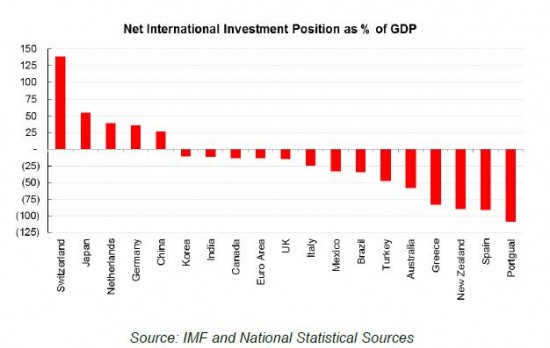
The crisis-stricken economies along the eurozone periphery share one key characteristic: their external debt is too high and their net international investment position (NIIP) – measuring the difference in stock value between assets held abroad and asset held domestically by foreigners – is deeply negative. Yet, a closer look and you will find Australia and its neighbour New Zealand in the same company, with negative NIIP well above countries such as Turkey and Brazil.
Here’s the chart that emphasizes the NIIP point:

When the RBA is ultimately forced to aggressively cut interest rates and supply liquidity, its struggles in maintaining and promoting growth will rival those of the Fed and ECB. Similar to the US and portions of Europe, a primary driver of previous growth and now deflationary force is excess household debt accompanied by a bursting housing bubble. The RBA’s actions will be necessary to try and forestall a banking crisis but will most likely fail in spurring renewed private credit expansion. If the RBA can prevent a major financial crisis, then the severity of the fall will largely be determined by the government’s budget deficit (and fallout from China). If the government attempts to balance its budget or constrict the deficit, Australia may start to truly resemble Europe.

Previously I posed the question, Australia: Market Monetarist Success or Post-Keynesian Failure? Recent data is starting to push the odds in favor of the latter.

Why Cash "Parked" at the Fed Will Remain There


Following the ECB’s decision in July to stop paying interest-on reserves (IOER), many economic pundits have been and continue to pressure the Fed to pursue a similar action in hopes it will revive bank lending. At that time, I was highly suspicious of these arguments are countered that Making IOER Negative Equates to Raising Taxes And Raises Potential Of New Recession. My reasoning was, in part, based on the view that banks cannot lend out reserves and the total amount of reserves in this system is largely determined by the Fed’s open market operations.

Apparently having heard enough of these arguments, the NY Fed has presented its own reply about Interest on Excess Reserves and Cash “Parked” at the Fed:
In this post, we use the structure of the Fed’s balance sheet to illustrate why lowering the interest rate paid on reserve balances to zero would have no meaningful effect on the quantity of balances that banks hold on deposit at the Fed.
For our discussion, here is the section that really stands out:
The View from the Balance Sheet
It’s important to keep in mind, however, what determines the total quantity of these balances. One way of understanding the issue is by looking at the Fed’s balance sheet, a simple version of which is presented in the table below.
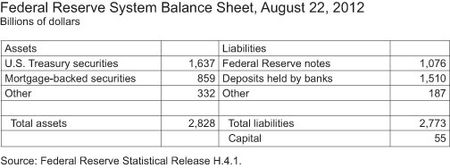

   As the table shows, the balances that banks hold on deposit at the Fed are liabilities of the Federal Reserve System. The other significant liability is currency in the form of Federal Reserve notes. Together, this currency and these deposits make up the monetary base, the most basic measure of the money supply in the economy. The composition of the monetary base between these two elements is determined largely by the amount of currency used by firms and households (both in the United States and abroad) to make transactions and by banks to stock their ATM networks.
   What determines the size of the monetary base? As with any other institution’s balance sheet, the Fed’s dictates that its liabilities (plus capital) equal its assets. The Fed’s assets are predominantly Treasury and mortgage-backed securities, most of which have been acquired as part of the large-scale asset purchase programs. In other words, the size of the monetary base is determined by the amount of assets held by the Fed, which is decided by the Federal Open Market Committee as part of its monetary policy.
   It’s now becoming clear where our story’s going. Because lowering the interest rate paid on reserves wouldn’t change the quantity of assets held by the Fed, it must not change the total size of the monetary base either. Moreover, lowering this interest rate to zero (or even slightly below zero) is unlikely to induce banks, firms, or households to start holding large quantities of currency. It follows, therefore, that lowering the interest rate paid on excess reserves will not have any meaningful effect on the quantity of balances banks hold on deposit at the Fed.
Reviewing the Fed’s balance sheet clearly illustrates that open market operations and large-scale asset purchases (QE) are no more than an asset swap with private banks in which the amount of reserves in the system expands. Banks cannot lend these reserves to the public and can only dispose of them through changes to the Fed’s balance sheet. Therefore, any hope that lowering or ending IOER will stimulate private credit creation can only come from a change in demand based on lower interest rates or revised expectations about future rates and asset prices.
Needless to say, I agree with the Fed that altering policy in this manner will have a negligible effect in spurring demand for loans. On the cost side, this policy presents uncertainty for the continued functioning of money market funds and reduces bank capital. Further, when the Fed eventually wishes to raise rates, IOER permits altering the Fed Funds rate without targeting the amount of reserves in the system. This NY Fed post appears to send a clear message that an "Interest-On-Reserves Regime" Will Rule Monetary Policy For The Foreseeable Future.

Monday, August 27, 2012

The US Dollar Currency Hegemony Will Persist

In the The Real Reason the US Dollar Can’t Lose, Michael Sankowski (Monetary Realism) comments:
One of the big scares out there is there will be a shift away from the U.S. dollar into the Chinese Yuan, and this shift will drive U.S. interest rates dramatically higher. Here’s the Economist throwing in a rather silly statement:

“The good news for the dollar is that the Chinese yuan is not yet widely accepted and suffers from higher inflation, reducing its usefulness. But a shift in the world’s reserve currency could be swifter than many assume.”

This is simply silly. A multi-trillion real value shift can’t happen quickly. The United States still has a huge proportion of valuable real assets. Foreigners want access to those [assets], and that involves getting U.S. dollars at some point. The value of the dollar is tied to the getting access to U.S. markets.
(Note: changed access to assets for clarity)

There is some good discussion in the comments, but I want to highlight a wonderful paper on this subject by David Fields and Matias Vernengo titled Hegemonic Currencies during the Crisis: The Dollar versus the Euro in a Cartalist Perspective (http://www.levyinstitute.org/publications/?docid=1374). The authors initially offer an introduction to money, comparing the Metallist versus Cartalist approach. Although debate about the historical creation of money continues, currently:

Money derives its properties from the state’s guarantee, and the monetary authority ensures the creditworthiness of the state by keeping its fiscal solvency.6 In its own domestic currency the national state is essentially always creditworthy, and default is impossible, since the central bank can always buy government bonds and monetize the debt. (p. 6)
With concerns of solvency removed from the equation, the authors move on to the fear of unsustainable trade deficits:
There is no balance of payments constraint for the hegemonic country and the principles of functional finance apply on a global basis. (p. 6)
Having alleviated these fears about the fall of the dollar, Fields and Vernengo conclude
It is the power to coerce other countries that is central for monetary hegemony. (p. 7)
While China’s remarkable growth has no doubt increased its ability to coerce other countries, it remains nowhere close to matching the US. Current economic struggles in both China and Europe further reduces the likelihood that any nation (or union) will challenge the US global position in the near future. The US dollar looks set to remain the monetary hegemony for the foreseeable future.