He believes that financial markets are single-digit years away from a crash that will present investors with opportunities of a lifetime. “Bad things are going to happen and I still think the closest analogy is the 1930s.”Professional money managers may not have the luxury staying defensive but, for other investors who believe Hendry’s view may prove true, the lesson is clear: Preserve capital.
Wednesday, July 18, 2012
Hugh Hendry - The Crash Ahead and Opportunities of a Lifetime
Hugh Hendry is one of a handful of legendary investors whose views on markets are always worth strong consideration. Among that group, none are more determined to generally remain out of the news. Luckily, Hendry was recently willing to discuss his opinions with the Financial Times. While he remains bearish on the BRICs and Europe, his take on the US is slightly more optimistic. But don’t get too excited:


Central Banker Admits to Failure of Monetary Policy
Here is something you don’t see everyday...a Central Banker admitting that monetary policy is ineffective:
Christian Noyer, a governor of the Central Bank of France (in an interview with Handelsblatt): “We are currently observing a failure of the transmission mechanism of monetary policy. From the markets’ perspective, the interest rate facing individual private banks depends on the funding costs of the state where they are domiciled and not on the ECB overnight interest rate… Hence the monetary policy transmission mechanism does not work.”Surprisingly, this quote may have slipped through the cracks if not for the watchful eye of Yanis Varoufakis. Based on comments from Noyer and results of recent ECB actions, Varoufakis concludes:
In summary, borrowing costs in the Eurozone have lost their two anchors: the inter-bank lending rate (courtesy of the sad reality that the banks no longer lend one another) and the overnight ECB interest rate (which banks ignore when lending). The key to understanding this breakdown is governor Noyer’s phrase “the interest rate facing individual private banks depends on the funding costs of the state where they are domiciled and not on the ECB overnight interest rate”. In short, the fear of a disintegration of the Eurozone (that is aided and abetted by silly talk of Greece’s and Portugal’s expulsion) has broken the umbilical cord that normally connects the ECB’s overnight rate with actual borrowing costs of the private sector. Now, the later reflect the fear that the member-state in which the firm or the household are will not be able to refinance itself. In a never-ending circle this fear ensures that the said member-state will not be able to refinance itself and, crucially, guarantees the ECB’s failure to lower interest rates even when it pushes its official rates to zero. This is what a monetary union on the verge of collapse looks like.Despite the continued patches of optimism over a European solution, economic growth continues to slow throughout the Eurozone. Without growth, efforts to reduce sovereign debt will only slow the rise, not reverse the trend. Since the transmission mechanism by which monetary policy is supposed to work has failed, fiscal policy remains the only real option. Sadly, at the moment, fiscal policy is generally moving in the wrong direction and a fiscal union remains a distant dream. My outlook is therefore similar to that of Varoufakis, the monetary union is nearing its end.
Tuesday, July 17, 2012
The Necessity of Private Banking
Yesterday, Rodger Malcolm Mitchell offered a second part to his view that private banking should be ended. He begins by accurately acknowledging the difficulty in writing and enforcing sufficient regulation, along with the bankers’ success in using the government system to bolster profits. The apparent impossibility of eradicating rent-seeking from bankers leads Mitchell to conclude:
Apart from the reasoning on corruption, there are two other discrepancies I brought up in the comments. First, removing the profit motive from banking effectively eliminates the market (price system) for credit/lending. Government agents will therefore have full discretion over who receives a loan, as well as the size and price, without an incentive to determine the borrower's ability to repay. As many economists in the Austrian tradition have previously explained, without knowledge from a market (i.e. prices), the allocation of resources will be highly inefficient.
Second, Mitchell’s usage of the term “money” to include credit obscures an important distinction between money and credit. Kurt Schuler of Free Banking recently addressed this confusion:
I entirely agree that the financial sector is a source of corruption and prime example of problems with rent-seeking. However, turning over the role of banking to the government will not reduce corruption or the country’s reliance on credit and will be significantly more inefficient.
*Ralph Musgrave, who also got involved with comments on Mitchell’s post followed up with a post of his own seeking clarity on the proportion of the money supply (broad version) created by private banks. Presumably, since loans create deposits:
When private individuals control vast amounts of money, and when they are compensated according to their control of this money, even the saints among us would be tempted. Bottom line, private banking is, and always has been, crooked, the bigger the bank, the greater the temptation, the more crooked.
In banking, the profit motive corrupts. And combining the profit motive with short-termism corrupts absolutely. Always has; always will.
All banks should be federally owned.Although I agree that the profit motive “corrupts” (though not absolutely), it dawns on me that this view can easily be extended to the entire private sector and holds a strong parallel in the public sector if one alters profits with power. All individuals, at some point, are tempted to work the system in their favor. Banking, whether done through the private or public sector, will therefore always be subject to some level of corruption.
Apart from the reasoning on corruption, there are two other discrepancies I brought up in the comments. First, removing the profit motive from banking effectively eliminates the market (price system) for credit/lending. Government agents will therefore have full discretion over who receives a loan, as well as the size and price, without an incentive to determine the borrower's ability to repay. As many economists in the Austrian tradition have previously explained, without knowledge from a market (i.e. prices), the allocation of resources will be highly inefficient.
Second, Mitchell’s usage of the term “money” to include credit obscures an important distinction between money and credit. Kurt Schuler of Free Banking recently addressed this confusion:
Money in the narrow sense is the monetary base, which, at least from the standpoint of the domestic monetary system, is a pure asset and not somebody's IOU. Payment with the monetary base extinguishes IOUs.…“Money” in the looser, broader sense includes IOUs, particularly those issued by banks, that are readily convertible at 1:1 into the monetary base.Private banks are the majority supplier of credit (IOUs)*, which acts as a money-like instrument. The Arthurian explains the significant difference:
The cost of interest is an "extra" cost, a largely unnecessary cost in our economy. Yes of course we need to use credit. But we don't need to use credit for everything. But we do. So, we have this extra cost to deal with, the factor cost of money. And it creates cost-push conditions. And cost-push conditions cause inflation. Inflation, or decline.Further, the added interest cost transfers wealth from borrowers to lenders. This increasing reliance on credit in the past three decades, supported and subsidized by government, is largely behind the enormous rise of profits in the financial sector and current economic struggles. Considering the public support for use of credit, making banks publicly owned is unlikely to address this issue.
I entirely agree that the financial sector is a source of corruption and prime example of problems with rent-seeking. However, turning over the role of banking to the government will not reduce corruption or the country’s reliance on credit and will be significantly more inefficient.
*Ralph Musgrave, who also got involved with comments on Mitchell’s post followed up with a post of his own seeking clarity on the proportion of the money supply (broad version) created by private banks. Presumably, since loans create deposits:
to get at the proportion of money created by central bank it strikes me we need take physical cash add total deposits and subtract total loans.
This site gives the deposit to loan ratio of U.S. FDIC insured banks as 79%. (loans are $7.28 trillion while total deposits are $9.22 trillion).
From that I deduce that about 20% of money in the U.S. is central bank created.
Debt Inequality Remains Major Headwind To Growth
Three months ago I discussed the potential of a forthcoming profit recession, in part, due to a declining govt deficit. Then a few weeks back I noted:
Yesterday Charles Hugh Smith offered a great post highlighting many of the same headwinds to corporate profits. The following chart, in particular, caught my attention: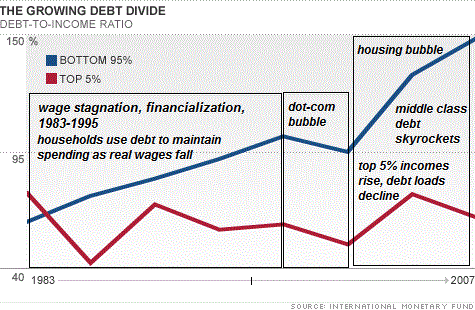
While I often discuss the importance of aggregate levels of debt in the economy, the distribution of that debt also has ramifications for economic growth. Since 2007, fiscal and monetary policy has largely attempted to spur growth by encouraging the private sector to once again embrace debt as a means of consumption and investment. Unfortunately, large government deficits and monetary stimulus have helped raise the income and wealth of the top 5% much more than the bottom 95%. As incomes continue to stagnate for the bottom 95%, interest costs on outstanding debt practically ensure that the above ratio will continue rising unless households actively deleverage.
Since many economists fail to include private debt in their models, policy recommendations continue to ignore the above problem that provides one of the major headwinds to greater economic growth and wealth equality. Resolving this issue, potentially through credit writedowns or a debt jubilee, should be the focus of policy going forward.
A significantly stronger dollar combined with weakening growth in Europe and China may have brought about a US profit recession even earlier than growth pessimists expected.Lastly, following revised Q1 data, I showed that a US corporate profit recession had already begun.
Yesterday Charles Hugh Smith offered a great post highlighting many of the same headwinds to corporate profits. The following chart, in particular, caught my attention:
While I often discuss the importance of aggregate levels of debt in the economy, the distribution of that debt also has ramifications for economic growth. Since 2007, fiscal and monetary policy has largely attempted to spur growth by encouraging the private sector to once again embrace debt as a means of consumption and investment. Unfortunately, large government deficits and monetary stimulus have helped raise the income and wealth of the top 5% much more than the bottom 95%. As incomes continue to stagnate for the bottom 95%, interest costs on outstanding debt practically ensure that the above ratio will continue rising unless households actively deleverage.
Since many economists fail to include private debt in their models, policy recommendations continue to ignore the above problem that provides one of the major headwinds to greater economic growth and wealth equality. Resolving this issue, potentially through credit writedowns or a debt jubilee, should be the focus of policy going forward.
Monday, July 16, 2012
Making IOER Negative Equates to Raising Taxes And Raises Potential Of New Recession
Earlier today an analyst from Jeffries’, David Zervos, published a research note implicating that the Fed may cut interest on excess reserves (IOER) from 0.25% to -0.25%. Here’s an excerpt courtesy of Zero Hedge:
Currently, banks are holding approximately $1.45 trillion in excess reserves: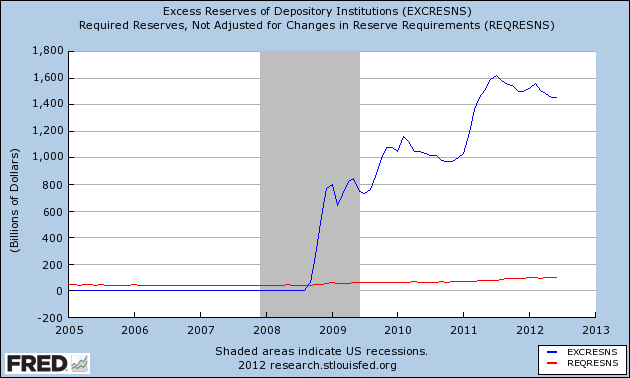
As Mish Shedlock and Steve Keen have recently reconfirmed, banks cannot lend reserves. Reserves are brought into existence and removed from the system through open market operations. The Fed therefore controls the amount of reserves in the system, as a helpful tool in maintaining its interest rate policy. Since members of the Fed/FOMC and most economists view QE as monetary stimulus, I presume that the Fed will not elect to accompany a reduction in IOER with a policy of reversing QE and reducing its balance sheet. If the IOER becomes negative, given that assumption, banks will face a decision between increasing lending to drive up required reserves or continuing to hold excess reserves at a penalty rate.
Faced with this decision, banks may initially seek to increase lending. The drop in IOER acts similarly to a rate cut and at a negative rate may encourage banks to even extend loans that, though not directly profitable, are expected to lose less than the cost of holding corresponding excess reserves. Regardless, the amount of new borrowing required to significantly reduce excess reserves is inconceivable (a 10% reserve requirement suggests $14 trillion). The current amount of excess reserves will therefore likely remain well above $1 trillion, which is bad for banks and stocks.
Why? Well, given the current IOER rate, banks are effectively earning $3.5 billion per year, risk-free ($1.4 trillion * 0.25%). Flipping the current IOR to negative and maintaining a similar level of excess reserves suggests a yearly drain from the financial system of $3.5 billion. This reduction in profitability will hurt bank capital, which is ultimately the real constraint on bank lending.
While a negative IOER will lower bank profits, it will likely increase profits at the Fed (which are transferred to the Treasury). As Zervos points out, this policy change could also push short-term Treasury rates (at least out to 2-years) negative. If that occurs, holders of short-term Treasury notes would join banks in effectively paying the Treasury to hold funds (ie. negative interest income). Although the combination of these factors will reduce the deficit, it will simultaneously reduce net financial assets of the private sector. In that sense, a negative IOER is equivalent to raising taxes.
Absent countervailing measures to increase the deficit, a reduced deficit will also result in declining corporate profits (ex-Fed). As I’ve noted previously, the federal deficit has been the primary factor supporting corporate profits over the past few years. With a corporate profit recession already in our midsts, this decision by the Fed could result in a corporate profit depression.
In my opinion, any optimism regarding a negative IOER is badly misplaced. Rather than sparking new lending, this change in monetary policy will likely bring about the reverse by hurting bank profits and capital. By inflicting a “tax” on the broader private sector, a negative IOER could even dampen corporate profitability and incomes. In the end, a policy of negative IOER might be enough to inspire a massive sell-off in stocks and push the US economy into recession.
To end on a positive note, I believe it is highly improbable that Bernanke or the Fed enacts such a policy. Apparently Goldman agrees.
(Note: Above I mentioned Zervos’ view that a negative IOER rate would lead to negative short-term Treasury rates. I haven’t had enough time to fully think through the possibility, but my initial reaction is skeptical. Other countries currently with negative rates on short-term government debt are either engaged in a monetary union or maintaining a currency floor. Government debt in those instances therefore, apart from safety, also provides an effective call option on higher relative currency valuations. Given that the US dollar is a floating currency, investors/savers could presumably hold dollars instead of Treasuries. This could cause a rise in the dollar exchange rate but would probably keep rates from going negative (absent the Fed adjusting lower the Fed Funds rate). I’ll plan to do a follow post on this topic in the near future but, in the meantime, does anyone have helpful thoughts on this topic?)
The quote from the last FOMC minutes suggested the Fed wanted a "new tool". Well here ya go Ben, take the IOER to -25bps, take 2s to -50bps and watch banks start setting LIBOR negative!! If you really want to push the portfolio balance channel this will wake up all the sleeply reserve managers with liquidity needs in USD. Of course as short rates plunge into negative territory, inflation expectations will rise sharply. It will be important to not expect too much love for the long end if this happens. And like I said above, even if this is a low probability event, the mere possibility of it happening makes levered longs in the front end a fantastic trade! No one is prepared for it. Just ask yourself how many risk management departments have shocked 2yr notes to -50bps and 3ml to -30bps in their VAR analytics. Not many!!Many investors seem to view this action positively, believing the resulting increase in bank lending will lead to higher growth and inflation. Before presenting the likelihood of such an action by the Fed, it’s important to clarify the major effects of making IOER negative.
Currently, banks are holding approximately $1.45 trillion in excess reserves:
As Mish Shedlock and Steve Keen have recently reconfirmed, banks cannot lend reserves. Reserves are brought into existence and removed from the system through open market operations. The Fed therefore controls the amount of reserves in the system, as a helpful tool in maintaining its interest rate policy. Since members of the Fed/FOMC and most economists view QE as monetary stimulus, I presume that the Fed will not elect to accompany a reduction in IOER with a policy of reversing QE and reducing its balance sheet. If the IOER becomes negative, given that assumption, banks will face a decision between increasing lending to drive up required reserves or continuing to hold excess reserves at a penalty rate.
Faced with this decision, banks may initially seek to increase lending. The drop in IOER acts similarly to a rate cut and at a negative rate may encourage banks to even extend loans that, though not directly profitable, are expected to lose less than the cost of holding corresponding excess reserves. Regardless, the amount of new borrowing required to significantly reduce excess reserves is inconceivable (a 10% reserve requirement suggests $14 trillion). The current amount of excess reserves will therefore likely remain well above $1 trillion, which is bad for banks and stocks.
Why? Well, given the current IOER rate, banks are effectively earning $3.5 billion per year, risk-free ($1.4 trillion * 0.25%). Flipping the current IOR to negative and maintaining a similar level of excess reserves suggests a yearly drain from the financial system of $3.5 billion. This reduction in profitability will hurt bank capital, which is ultimately the real constraint on bank lending.
While a negative IOER will lower bank profits, it will likely increase profits at the Fed (which are transferred to the Treasury). As Zervos points out, this policy change could also push short-term Treasury rates (at least out to 2-years) negative. If that occurs, holders of short-term Treasury notes would join banks in effectively paying the Treasury to hold funds (ie. negative interest income). Although the combination of these factors will reduce the deficit, it will simultaneously reduce net financial assets of the private sector. In that sense, a negative IOER is equivalent to raising taxes.
Absent countervailing measures to increase the deficit, a reduced deficit will also result in declining corporate profits (ex-Fed). As I’ve noted previously, the federal deficit has been the primary factor supporting corporate profits over the past few years. With a corporate profit recession already in our midsts, this decision by the Fed could result in a corporate profit depression.
In my opinion, any optimism regarding a negative IOER is badly misplaced. Rather than sparking new lending, this change in monetary policy will likely bring about the reverse by hurting bank profits and capital. By inflicting a “tax” on the broader private sector, a negative IOER could even dampen corporate profitability and incomes. In the end, a policy of negative IOER might be enough to inspire a massive sell-off in stocks and push the US economy into recession.
To end on a positive note, I believe it is highly improbable that Bernanke or the Fed enacts such a policy. Apparently Goldman agrees.
(Note: Above I mentioned Zervos’ view that a negative IOER rate would lead to negative short-term Treasury rates. I haven’t had enough time to fully think through the possibility, but my initial reaction is skeptical. Other countries currently with negative rates on short-term government debt are either engaged in a monetary union or maintaining a currency floor. Government debt in those instances therefore, apart from safety, also provides an effective call option on higher relative currency valuations. Given that the US dollar is a floating currency, investors/savers could presumably hold dollars instead of Treasuries. This could cause a rise in the dollar exchange rate but would probably keep rates from going negative (absent the Fed adjusting lower the Fed Funds rate). I’ll plan to do a follow post on this topic in the near future but, in the meantime, does anyone have helpful thoughts on this topic?)
Subscribe to:
Posts (Atom)