Over the course of this year, economic growth has been slowing considerably in many countries that were previously considered beacons of strength following the global financial crisis. Among those countries falling on harder times is Canada, eking out growth of 0.1 percent in the third quarter. Canada appears determined not to be outdone by Europe and Australia in reducing its budget deficit at the expense of economic growth. Canadian optimism based on the last round of austerity is badly misplaced for reasons outlined in this fantastic post on Austerity in Canada: Then and Now (at Fictional Reserve Barking). Taking a sectoral balances approach, here are three charts that highlight the differences: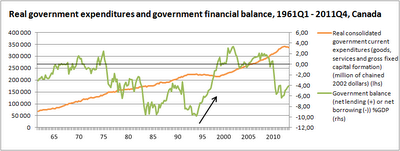
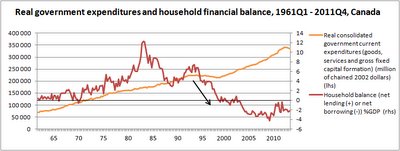
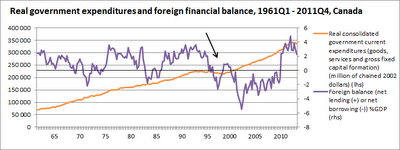
During the 1990’s, Canada witnessed a dramatic rise from a ten percent budget deficit to a fiscal surplus. That reduction in aggregate demand was countered by a significant decline in the household financial balance to a net borrowing position and a substantial trade surplus (foreign net borrowing). Keeping with global trends, the massive rise in Canadian household debt was primarily funneled into the domestic housing sector, pushing prices into bubble territory: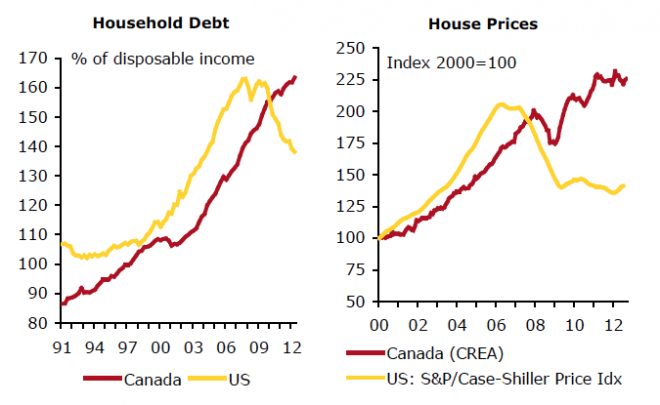
Source: Macleans.ca
The Canadian government’s hopes of repeating its “success” from over a decade ago will require a renewed surge in demand from one of the other sectors. Weak global growth, especially in China, suggests that commodity-rich Canada will not witness a dramatic reversal in their trade balance anytime soon. That leaves the household (or business) sector to pick up the slack.
As witnessed recently in the US and throughout Europe, there comes a point at which households can no longer credibly be expected to repay outstanding debts. Regardless of what event brings about this realization (possibly declining house prices), the ensuing household deleveraging will be a major headwind to growth.
A global commodity boom and domestic housing bubble bailed out the Canadian government last time it attempted to drastically reduce the budget deficit. This time around, the government’s actions may be enough to bust the housing bubble and push Canada into a recession.
What do I mean by Ponzi Austerity? It is not just a case of pretend austerity of the sort that we had, say, in the UK under Mrs Thatcher, when education, health etc. were cut back with a vengeance, in austerity’s name, while the public sector’s borrowing requirement grew on the back of a massive expansion of the state’s (primarily centralised, authoritarian) activities (and all in the name of a ‘smaller’ state). No, Ponzi Austerity requires more than that. It requires the symbiosis of:
(a) large scale reductions in public services and a squeeze on the taxpayer (in the name of reining in public finances), and of
(b) a new mechanism for refinancing the debt of one branch of the macro-economy (including bank losses) by creating new unsustainable debts in some other branches.
In short, Ponzi Austerity increases aggregate debt intentionally by shifting it about the macroeconomy in the hope that the public’s eye will be distracted from all this movement, time will purchased by the powers-that-be at the expense of solvency and, in the end, those with the most to gain from taking their money out of the ‘system’ before they inevitable collapse will manage to do so, leaving the hapless taxpayer to pick up the pieces when the whole thing ends up belly-up. One only needs to look furtively at what is happening in Europe today in order to draw the unavoidable conclusion that the austerity practiced in the Eurozone today is perhaps the most glaring case of Ponzi Austerity possible.
From Ponzi Growth to Ponzi Austerity
By Yanis Varoufakis
Related posts:
What is Austerity?
The Austerity Experiment Failed Without Really Starting
Krugman Reveals New, Flawed Definition of Austerity
Valuing the Future Over the Here and Now
Deficit spending in the euro zone has also been rising some, and after the latest rounds of austerity and subsequent deficit increasing weakness may total something close to 7% of GDP.
That should be enough to muddle through as well. Austerity hikes unemployment and deficits to the point where the resulting deficit is sufficient to sustain things. Without another round of austerity there should be some sort of stability of output and employment.
That is, while it’s doubtful the ‘new europe’ will engage in meaningful fiscal expansion, it may not proactively raise taxes and/or cut spending in any meaningful way, either.
Read it at The Center of the Universe
macro update
By Warren Mosler
A Euro zone deficit approaching 7% may not be enough stimulus to induce growth but it doesn’t ring of much austerity either. I agree with Warren that most of the promises for further cuts or tax hikes will likely not be implemented in the near future (politicians are recognizing their political careers don’t succeed for long with those plans).
In The Forthcoming Profit Recession, I looked at Kalecki’s Profit Equation and how “government deficits have been the primary driver during this recovery.” Given the comparable size of US and European deficits, it stands to reason that European corporate profit margins will continue to be supported by large deficits too. Although the economic picture in the US remains better than Europe, it’s not clear the difference is as large as suggested by current stock markets (SPX = S&P 500; SX5E = Euro Stoxx 50):

(Source: Bloomberg)
Despite current deficits, if headline risk pushes the private sector to further retrench than Euro zone growth may turn negative. Headline risk itself may pressure Euro stock prices lower as well. However, as Warren notes:
Yes, there will be all kinds of credit related vol, but under it all there will be sales and profits taking place. The businesses that are still around are the survivors who know how to get by in this kind of economy, where, while slower than it ought to be, there is still about $40 trillion worth of goods and services getting bought/sold in the US and Europe. GDP growth has gone to near 0, but not GDP itself.
Companies will still earn profits and still pay dividends. As fear grows, great opportunities to invest in lasting companies will multiply. Wise investors should be currently trying to figure out which companies will survive and at what price the risk/reward becomes a definite buy.
What the economics of illusion does is continually paper over economic disturbances with short run policies that provide the appearance of economic viability, but with the cost of distorting incentives for long run economic growth. This was hidden for a few of the decades after WWII because of technological innovations. As I have repeatedly argued here and elsewhere, if the Smithian gains from trade, and the Schumpeterian gains from innovation continue to outpace the stupidity of government policies, then economic growth will continue to happen to such an extent that tomorrow's trough will be higher than today's peak. But tomorrow's prosperity will not be as great or as generally shared as it otherwise would have been. In short, the economics of illusion just kicks the granade down the road.
Read it at Coordination Problem
Is This How the Myth of the Laissez Faire Herbert Hoover Was Invented?
By Peter Boettke
On Friday Chris Dillow (Stumbling and Mumbling) provided an argument in defence of austerity touching on a similar idea:
The focus of policy should be upon long-term prosperity, not the here and now.
There is widespread agreement that the economic situation today across the globe is far from ideal. Unemployment is high, especially compared to several years ago. Income inequality, though often exaggerated, is above many people’s comfort zone. Most economists will probably even agree that, in the short-run, further government stimulus could improve these factors.Where the austerity and stimulus camps differ is their respective views of how short-term actions will affect long-run prosperity. Those pushing for greater stimulus seem to believe that the benefits from relieving current economic strains (namely unemployment) greatly exceed any costs from the “stupidity of government policies.” Dillow argues the reverse, noting that:
in the long-run, social norms matter. The persistence of big government threatens to create a norm in which young people to look for safe public sector jobs in sclerotic hierarchies, which would divert talent away from the private sector towards low-productivity-growth work. This could choke off future growth.
Those who argue for austerity now (generally) do not maliciously wish to raise unemployment or increase inequality. The argument for austerity is that some economic pain is inevitable, but it is far better to get accept a little pain today than a lot of pain tomorrow. Some people may counter that the future is uncertain and therefore it is our responsibility to act now, if we can. I’d point out that uncertainty runs in both directions and that by acting now, there is equally good reason to believe future prosperity will be reduced or less dispersed. My natural tendency is to think in what Robin Hanson (Overcoming Bias) calls “far mode.” I recognize that others may think differently and hold different values. Either way, I think understanding this distinction between the two sides is critical to coming to one’s own conclusions.
Just to be clear, I’m not saying there aren’t good arguments for the BOE keeping a 2% inflation target. I don’t agree with those who support this target, but it’s an intellectually respectable argument. But only a complete lunatic would argue that the Cameron government should refuse to boost the inflation target above 2%, but then engage in fiscal stimulus which can only work by boosting inflation! That’s like shifting your car into neutral, than flooring the accelerator. They’d have to be complete masochists; “Let’s spend lots of money, run up a huge debt, and then watch the BOE sabotage our policy.”
Read it at TheMoneyIllusion
Austerity and Stimulus in northern Europe
By Scott Sumner
This comment is about the UK but it equally reflects current policy issues in the US, Japan and a whole host of other countries. My view is that central banks ability to affect inflation, and to a lesser extent growth, is heavily skewed in favor of slowing either measure. The government, however, can have a far larger impact on growth and inflation through use of budget deficits/surpluses. One of the primary lessons I’ve taken from MMT/MMR/Post-Keynesian thinking is that central banks should be thought of as part of central governments (for sovereign currency issuers). Unfortunately central banks and governments continue to work in opposition of one another. The economic costs of these policies is finally becoming clearer.
For the fact is that you can’t just look at spending levels to ask what is happening to spending programs. Here in the United States spending on unemployment insurance and food stamps has risen sharply, not because the welfare state has expanded, but because a lot more people are unemployed and poor. Similar effects are at work in European countries, which have stronger safety nets than we do. Also, some spending represents banking bailouts, not exactly what people have in mind when they talk about big government.
Read it at The Conscience of a Liberal
Austerity, Safety Nets, and Spending
By Paul Krugman
Krugman continues to argue against austerity but this time makes his distinction of the term a bit clearer. Basically, in his perspective, government spending that counts is limited to funds used for consumption and investment. All that government spending on “capital transfers” (bank bailouts) and “social transfers” (e.g. unemployment benefits and food stamps) doesn’t count as an expansion of government. While I certainly don’t oppose some “social transfers”, this separation of government spending strikes me as odd.
As I understand the situation, the purpose of governments increasing spending (or the deficit) is to add income to the private sector, alleviating the deflationary effects of private sector deleveraging. Whether spending money on bank bailouts or investment, both sources add income in the current period to the private sector. This is not to suggest that the longer-term effects of the two policies is the same or that I don’t prefer the latter to the former. The point is that either form of spending is the choice of (generally) elected political leaders. If the Spanish government decides tomorrow to spend a few hundred billion euros to recapitalise its banks, then in my mind it is electing not to pursue austerity.
The real issue here seems to be that government spending is not being directed to the types of uses that are favored by proponents of Keynesian stimulus (presumably because those uses have a larger multiplier). This may very well be true (bank bailouts, as structured, were an awful idea) but that is an argument against the current political institutional framework by which those decisions are made. Arguing simply for more government spending in no way guarantees, or even implies, that governments will choose to direct funds towards consumption or investment and away from “capital transfers” or “social transfers”.
The discussion is moving in a positive direction, away from abstract claims of general spending and towards specific policy measures. This distinction of austerity, however, simply dismisses some aspects of government for the sake of trying to prove a point. In my view that is no better than the comments from the other side Krugman rails against. Yes there were spending cuts in some areas. Yes there were spending increases in others. Neither argument explicitly proves or disproves austerity (especially when we all mean different things.) Let’s focus on where the spending is going and then, if we decide it’s not ideal, figure out how to make politicians alter the composition.
(Note: I definitely have in mind bank bailouts when I talk about “big government”.)
Most of the time “austerity” is a misleading word and more precise concepts — readily intelligible I might add — are available. There really are some times when we should relabel austerity as “mostly tax increases,” but many people are reluctant to do so.
Read it at Marginal Revolution
Economic growth is not contractionary, and other confusions about stimulus and spending
By Tyler Cowen
Recently I’ve been devoting significant space to the inconsistencies in how the term austerity is being used (See What is Austerity? and The Austerity Experiment Failed Without Really Starting). It’s great to see Tyler attacking this issue as well and attempting to clear up much of the confusion. One other highlight from his post is that:
when judging whether fiscal policy is contractionary or expansionary in macroeconomic terms, we do not automatically adjust for percentage of gdp and inflation. Start instead by looking at nominal government spending, and then perhaps take a glance at nominal gdp or related measures. The theory, after all, is about nominal values, most of all in the short run.
My second post above shows government revenue and spending, in nominal terms, for European countries over the past decade. Many countries, most notably France and the UK, have not reduced spending but have increased revenue.
Responding to John Cassidy’s the New Yorker, Russ Roberts writes of The austerity experiment:
I’d like some facts. I have seen many articles on austerity. I can’t remember seeing any that suggest that government spending in any European country has actually fallen. Yes, there is talk of spending cuts or cuts in growth rates. But I’d like to see the data that shows the cuts have actually been implemented.
Curious about the actual austerity implemented to date, I ventured over to Eurostat for some fact finding.
Ten days ago I posed the question, What is Austerity? Since that time the number of references to austerity I’ve read that imply different meanings has expanded rapidly. Since this confusion remains, I’ll try to present a couple ways of looking at the data. First, let’s consider budget deficits as a percentage of GDP: Overall budget deficits for the EU and Euro area have declined since 2009. Portugal, Italy, Ireland, Greece and Spain (the PIIGS) all similarly show declines from 2009 to 2011. Of note, however, is Ireland’s massive budget deficit increase in 2010. On the whole, this metric seems to support the notion of austerity.
Now let’s turn to actual total government expenditures (spending). Here is a graph of overall spending for the EU and Euro area:
 In both cases, spending was slowly increasing for the past decade before leveling off in the last year. With this picture in mind, we can now delve deeper into country level expenditure data:
 Here are some aspects that jumped out:
- Germany, France, Netherlands and the UK all spent more in 2011 than in 2009.
- Portugal and Italy spent an effectively equal amount in 2009 and 2011.
- Spain and Ireland cut government expenditures but only by a few percent
- Greece cut spending by over 10%
Of the PIIGS, Greece has clearly cut the most while the other countries have done very little cutting to date, if any. Meanwhile, France and the UK (the focus of Cassidy’s article) are actually among the least austere in Europe having increased government expenditures over the past couple years by several percent.
Rather than austerity stemming from reduced government expenditures, one might argue that the austerity is achieved through increased revenue (taxes). Here is a similar table showing EU revenue data: As this table shows, government revenues in Spain, Italy and Portugal have increased slightly while remaining flat in Greece and Ireland. The UK and France, however, have witnessed revenue increases of nearly 10 % or more.
Ultimately the debate over whether or not “The austerity experiment” has failed comes down to one’s definition of austerity. Moving beyond this debate requires policy makers and pundits to clarify their intended meaning of austerity before passing judgment on its effects. Hopefully illuminating these inconsistencies will lead to that outcome.
Data Source: http://epp.eurostat.ec.europa.eu/portal/page/portal/government_finance_statistics/data/main_tables
Anyone watching, listening or reading the news over the past few years has certainly heard the term “austerity” used more frequently than they probably imagined possible. In our minds, each of us likely has a particular interpretation of what “austerity” means and applies that view broadly across different instances. Unfortunately, if you pay close attention to the word’s usage it becomes clear that many very intelligent people are using the term with distinctly different meanings.
Earlier today, Peter Tchir of TF Market Advisors posed the question “When Did Austerity Become A 4 Letter Word?“ Tchir notes that:
In the rush to avoid supporting anything that could be viewed as “austerity” we have lost sight of what austerity is, and how it can impact the economy.
Although the latter topic is certainly worthwhile, answering the former question is more pressing issue (IMO).
Quoting from the Wikipedia page on Austerity :
In economics, austerity is a policy of deficit-cutting, lower spending, and a reduction in the amount of benefits and public services provided.
This definition conflicts with several ways I’ve seen and interpreted the term being used recently.
Jeff Madrick at TripleCrisis describes “austerity economics” as (No Mysteries in Eurozone Crisis) “higher taxes and reduced spending.”
Separately, in a post titled American Austerity, Paul Krugman points to “de facto austerity” under Obama in “an era of huge cuts in public employment compared with previous experience.” Krugman suggests that austerity is simply reducing the public workforce. He may be assuming that this lowers spending or the deficit, however data doesn’t support that view. In fact, US federal spending and deficits (in nominal terms) were higher in 2011 than in 2010 and are expected to increase again in 2012. (OMB Historical Table 1.1)
Before even attempting to discern the impact of “austerity” on an economy, it seems imperative to formulate a consistent meaning for the term. Must “austerity” include all the characteristics listed by Wikipedia? Is providing more public services and benefits for less money “austerity”? How about cutting the deficit without lowering spending (increasing taxes)? Does deficit-cutting and lower spending refer to nominal values or a percentage of GDP? What about a reduction in public employment?
My own personal view has been that “austerity” refers to attempts at reducing the deficit, regardless of the method. What are your views? How should we interpret “austerity”?
Update: On Friday I posed this question to Cullen Roche over at Pragmatic Capitalism in his new Q&A (which I highly recommend). Here is his response:
WOJ: Speaking either for yourself or MMR (or both), how would you define austerity? Are there specific measures involved or is it simply a policy goal?
CR: To me, austerity is an insufficient budget deficit. That depends on specifics in each nation, but in the USA for instance, austerity might involve a budget deficit that is not in excess of the current account deficit. That would result in a net drag on the country. We’re not imposing austerity in the USA though.


