Showing posts with label Public Debt. Show all posts

Friday, March 15, 2013

Hudson, Keen, Smith and Others Explain Why Private Debt is the Problem

This past Wednesday I attended The Atlantic’s Second Annual Economy Summit featuring many previously high ranking government officials (e.g. Federal Reserve Chairman Paul Volcker, Secretary of the Treasury Robert Rubin, and FDIC Chairman Sheila Bair). Though these former public officials and many others remained focus on the issue of public debt and deficits, the conference was actually promoted on the basis of turning the focus to private debt. Since my understanding of economics suggests concerns over private debt should be the main focus of current policy, I was personally excited to hear from Steve Keen, Michael Hudson and Yves Smith.

To provide a quick gist of the discussion during these morning panels and the detrimental effects of excessive private debt, here are a few snippets from Michael Hudson’s prepared remarks:

The result of the private-sector debt overhang is a self-feeding spiral of debt deflation. Revenue earmarked to pay bankers is not available to spend on goods and services. Lower consumer spending is a major reason why firms are not investing in tangible capital to produce more output. Markets shrink, shopping malls close down, and empty stores are appearing for rent on major shopping streets from New York City to London.
Slowing employment is causing a state and local budget squeeze. Something has to give – and it is largely pension plans, infrastructure spending and social programs.
However, the one kind of debt we are not worried about is government debt. That’s because governments have little problem paying it. They do not need to balance their budget with tax revenue, because their central bank can simply print the money. On balance, the overall public debt rarely needs to be paid down. As Adam Smith noted in The Wealth of Nations, no government in history ever has paid off its public debt.
…
The policy lesson for today is that to avoid debt deflation, falling markets and unemployment, the economy needs to be revived. The way to do this is what was called for and indeed promised four years ago: a write-down of debts in keeping with the ability to pay.
Once this debt overhead is addressed, tax reform is needed to prevent a debt bubble from recurring. A tax system that favors debt financing rather than equity, and that favors asset-price “capital” gains and windfall gains over wages and industrial profits earned by producing tangible output, has been largely to blame. Also needing reform is tax favoritism for the offshore fictitious accounting that has become increasingly unrealistic in recent years.
Unless government fiscal policy addresses these issues, the U.S. economy will face the same kind of debt-deflation pressures and fiscal austerity that is now tearing the eurozone apart.
As the only two economists in attendance who predicted the financial crisis and subsequent stagnation, Hudson and Keen’s panel stood out in offering practical policy responses that will not further increase wealth inequality or the financial sector’s profits/influence:
Good Debt, Bad Debt & Real Options for Economic Growth from The Atlantic on FORA.tv

A brief detour from discussion of the conference, Professor Steve Keen has been working hard on building a computer program for building & visually simulating dynamic, monetary economics models: http://kck.st/XhKtdX
There are only 2 days left to show your support for the project on Kickstarter and help reach the secondary funding goal of $100,000. Please check out the Kickstarter page for more information and consider making a pledge to improve the future of economics:
MINSKY: Reforming economics with visual monetary modeling

Returning to the conference and giving credit where its due, The Atlantic has been working with and, in the afternoon session, featured Richard Vague’s work on “How to Deal With America’s Private Sector Debt Challenge”:

How to Deal with America's Private Sector Debt Challenge from The Atlantic on FORA.tv

Slides from the presentation and a host of other fantastic data can be found at the Debt Economics website.

Lastly I’ll recommend watching the first panel of the day which included not only Yves Smith but deficit doves Paul McCulley and Robert Kuttner:

Robert Kuttner & Others Debate U.S.'s Addiction to Debt from The Atlantic on FORA.tv

(Unfortunately the moderator was particularly determined to focus the conversation on the Ryan budget and public debt issues).

While I don’t know how many conference attendees will have been swayed by the presentations above, I think it’s a step in the right direction that these discussions are at least taking place within the mainstream community.


(Note: Although I was already a big supporter of Keen, Hudson, and Smith’s work, I should note that all three were incredibly gracious in conversation when I approached them. Separately, I apologize for the lack of blogging during the past couple weeks. My last midterm is Monday night and I hope to return to more frequent shortly thereafter.)

Thursday, January 17, 2013

2012 Predictions: The Results

Last year I took a chance and threw my own projections into the ring. Similar to Byron Wien and Edward Harrison, I mostly selected events that were widely seen as having a low probability (less than 33%) but which I believed held a greater than 50% chance of occurring. Let’s see how I did...

1) Greece leaves the Euro - As the year progresses the Greek economy continues to contract and unemployment continues to rise, surpassing 50% for youth. This combination of factors offsets attempts to reduce the budget deficit as the country repeatedly misses EU and IMF required targets. Despite potential for further bailouts, the Greek people finally decide the consequences of tied promises outweigh the benefits of remaining in the Euro. Greece defaults on all debts, returning to a heavily depressed drachma.

Result - Wrong (0-1). During 2012, Greece was successful in reducing its budget deficit by 30 percent and staying in the Eurozone. This success was in large part due to further defaults on public debt and another bailout. Unfortunately for the Greek people. the price of these efforts remains extraordinarily high. The economy may have contracted as much as 6.5 percent in 2012, the fifth year of recession, according to forecasts in the 2013 budget. Meanwhile both the general and youth unemployment rates continue to soar, reaching ~27 percent and ~58 percent, respectively. At this point Greece is clearly in the midst of a Depression and showing no signs of recovering anytime soon. Greek tolerance of increasing unemployment and decreasing prosperity remains a surprise, although radical political parties have been gaining support. For now Greece remains in the Eurozone, but a future exit remains likely.

2) Italy and Spain lose access to credit markets - A Greek default raises concerns about the potential for creditors to face actual losses on EU sovereign debt. The ECB’s measured efforts are not strong enough to overcome fear and concern about future growth in Italy and Spain. Deep recessions take hold in both countries, pushing deficits higher.

Result - Wrong (0-2). A Greek default and concerns about the European economy weighed heavily on EU sovereign debt during the first half of the year. By the summer, ten-year bond yields in Spain and Italy were at 7.75 percent and 6.75 percent, respectively, and rising. With the countries at risk of losing access to credit markets, ECB President Mario Draghi came forth with a plan to cap sovereign interest rates using open-ended outright monetary transactions (OMT). Draghi’s threat was enough to generate a 180 degree turn in EU sovereign debt markets, but nowhere near enough to turn around the economies. Italy and Spain both returned to recession this past year, pushing fiscal deficits and unemployment higher. While Italy’s unemployment rate remains closely tied to the EU-wide level of ~11 percent, Spain’s general and youth unemployment rates have quickly caught up to Greece’s levels. Eventually Draghi’s Liquidity Bluff Will Be Called, potentially sooner rather than later as a strengthening euro may reignite the EU crisis.

3) The Eurozone enters recession - Practically the entire Eurozone falls into recession, including the likes of France and Germany. A deteriorating economic outlook causes deficit estimates to be raised across the board, facilitating credit rating downgrades. Agreements for greater austerity fail to stem the tide and other attempts to kick the can down the road are pursued.

Result - Correct (1-2). The euro zone economy contracted 0.2 percent in the second quarter and 0.1 percent in the third, meeting the technical definition of a recession. The fourth quarter drop is looking even worse following recent news that Germany  saw output shrink 0.5 per cent between October and December. Although Germany managed to run a slight fiscal surplus, at the expense of growth, Spain’s budget deficit probably exceeded 9 percent for a fourth year in 2012. The first half of the year did witness credit downgrades and austerity agreements, but Draghi’s big kick at the end of summer pushed any further actions into future years.

4) China’s GDP growth falls below 7% - As exports to Europe contract, the busting of China’s housing bubble continues unabated. Expectations for massive monetary easing in Europe and the US, along with fear of flare ups in the Middle East sets a floor under energy and food commodity prices. Monetary easing and fiscal stimulus in China are applied too slowly to prevent growth from slowing below the supposedly necessary 8%. (Note: This will be not be considered a hard-landing, which I deem growth below 5%. That may come in 2013, but for 2012 most economists/analysts will be able to maintain expectations of a soft-landing.)

Result - Wrong (1-3). During the third quarter China’s growth rate slowed to a three-year low of 7.4 percent, but the year-end tally will probably be around 7.7 percent. As growth slowed and housing prices fell early in the year, the government took action to allow a smoother transition between governments. Fiscal stimulus has pushed growth and inflation higher in the last few months, but at the expense of rebalancing the economy toward consumers for future sustainability.

5) Oil prices will spike above $120, finish year below $90 - (Using WTI crude prices, currently ~$102) At some point during the year Iran attempts to block the Strait of Hormuz. Further attempts to overthrow governments in the Middle East, possibly some that only recently gained power, hit the headlines again. Combined with global monetary easing, oil prices will move higher and gasoline will once again hit $4 per gallon in the US. These higher prices will exaggerate the reduction in global demand for other goods and push growth lower. As fears of a global recession take over, oil prices will fall, finishing the year down more than 10%.

Result - Wrong, but close (1-4). Fears about Iran and the Middle East never really materialized this year but that did not prevent a wild ride in oil prices. After rising to over $113 in April, WTI crude prices dropped all the way down to $80 in August (daily price history). A rally in the last week of the year brought the closing price slightly back above $90. Brent crude prices diverged significantly from WTI in 2012, keeping gas prices at the pump high throughout the summer. Gas prices peaked at $3.94, not quite $4, but nevertheless reached a record-high average of $3.62 per gallon.

6) US enters recession in 2nd half - Despite higher 4th quarter GDP in 2011, the lower savings rate and energy prices are unlikely to add much growth in 2012. With Europe contracting and China slowing down more than expected, US exports will take a hit. Extensions of the payroll tax cut and unemployment benefits will help ensure the federal deficit holds above 8%. Housing prices will continue to fall (based on Case-Shiller) causing the savings rate to once again reach 5%. By the end of 2012, the US will be in a recession (although NBER may not confirm this until 2013).

Result - Wrong (1-5). Despite Europe contracting, China slowing down and the federal deficit dropping to 7% (still over $1 trillion), US GDP growth remained positive throughout 2012. After falling to 1.3 percent in the second quarter, annualized GDP growth jumped to 3.1 percent in the third quarter. Although current estimates for fourth quarter GDP are below 1 percent, the US is most likely not in a recession at this time. Partially behind the positive growth was the impact of housing prices rising over 5 percent and the savings rate remaining below 4 percent.   

7) Federal Reserve extends forecasts for ~0% rates until 2015 - As growth in the US weakens once again and the global economy slows, expected inflation over the next ten years (based on Cleveland Fed estimates) will fall towards 1%. With unemployment holding steady around 9%, the Fed will move it’s forecasts for the first interest rate hike out to 2015. (Some form of QE3 is also likely, but aside from promoting short-term speculation, the effects on growth are likely to be muted.)

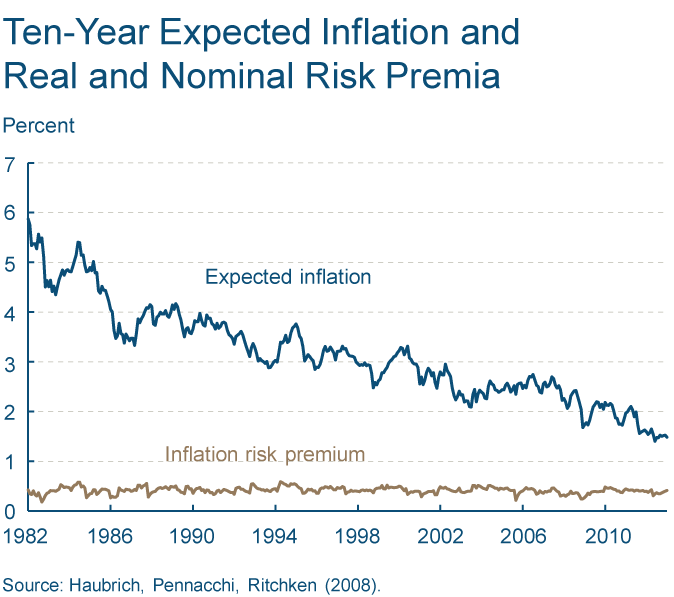
Result - Correct (2-5). Expected inflation over the next ten years fell consistently during the course of the year to approximately 1.5 percent (chart below). Although unemployment improved materially, dropping below 8 percent, the Federal Reserve still felt the urge to step up monetary stimulus. On September 13th, 2012, the FOMC extended its projections for maintaining “exceptionally low levels for the federal funds rate...at least through mid-2015” while enacting a plan to purchase “additional agency mortgage-backed securities at a pace of $40 billion per month” indefinitely. Since QEternity was insufficient to boost growth, the Fed also enacted QE4 to raise the rate of balance sheet expansion.


8) President Obama will win re-election - Generally a weakening economy has been poor for incumbents but this time will be seen as abnormal circumstances. The troubles in Europe and high unemployment will actually spark desire for a more interventionist government. Given the choice between Obama and Romney, the President will win re-election by a slim margin (2% or less).

Result - Correct (3-5). President Obama crushed Romney in the 2012 election based on the electoral college, however the popular vote was decided by less than 3 percent.

9) The US dollar rises over 5% - (Based on dollar index) In spite of QE efforts and another sizable deficit, the US dollar retains its safe haven status. As fears of European defaults spread and China’s slowing growth impacts commodity prices, the dollar will continue to trend higher.

Result - Wrong (3-6). As fears spread about European default and a slowdown in China, the dollar rose several percent into the summer months. When those fears were assuaged by politicians, not economic data, the euro began a strong rally. By the end of the year, the dollar had essentially finished flat.

10) Bonds outperform stocks - The consensus once again favors stocks, although US Treasuries have now outperformed stocks over the past 1, 10 and 30 year horizons. With global growth slowing, inflation expectations will fall. Before this bull market in bonds ends, 10- and 30-year Treasuries may reach 1% and 2%, respectively.

Result - Wrong (3-7). Slowing global growth, falling inflation expectations and stagnating corporate earnings were not enough to deter stocks from a very strong performance in 2012. The Bernanke put morphed into a proactive Fed determined to push asset prices higher and succeeding to the tune of over 15 percent. While stocks were riding towards new highs, the bull market in bonds also remained intact. The 10- and 30-year Treasuries hit their respective lows of 1.43 and 2.46 during the summer before heading higher into year end. Ultimately 10- and 30-year Treasuries last year posted returns of only 3 percent and 2.5 percent, respectively.   

That’s the end of it. 3-7 is certainly a bit of a disappointment, especially given the direction of events through the first half of the year. That being said, the logic behind each prediction was sound and far more on target than the end result suggests. My main takeaway is that politicians are far more determined to maintain the status quo than I had expected. The underlying economic (and social) problems have once again been kicked down the road for future governments to handle. As long as that pattern holds, current optimism and modest growth can persist for another couple years.

My hope is to have Predictions for 2013 out by the end of next week. Stay tuned.  

Wednesday, November 7, 2012

Election Results: Forecasting Accuracy and a 2013 Recession?

Nearly 10 months ago I put forth a list of predictions for 2012 that were “seen as having a low probability (less than 33%) but which I believe hold a greater than 50% chance of occurring.” From that list:
8) President Obama will win re-election - Generally a weakening economy has been poor for incumbents but this time will be seen as abnormal circumstances. The troubles in Europe and high unemployment will actually spark desire for a more interventionist government. Given the choice between Obama and Romney, the President will win re-election by a slim margin (2% or less).
And the results...
Candidate
Popular vote
Percentage
Electoral votes (270 to win)
Barack Obama
59725608
50%
303
Mitt Romney
57098650
48%
206
Pretty good, though Nate Silver deserves the real congratulations for accurately forecasting every state.

Now that the election is over (with no significant change in the national balance of power), a few prominent questions for the macro-economy must be resolved...

1) What portion(s) of the Bush-Obama tax cuts will be allowed to expire, if any?
2) Will the federal government allow the budget deficit to contract next year? If so, by how much?
3) Will the debt ceiling be raised again? If so, what concessions (presumably from the Democrats) will be necessary?

How long will it take to resolve these questions? That’s tough to say but, considering the players still involved, continuing gridlock looks like the smart bet. Stakes remain high, despite the election results, as the eventual resolution of these topics will likely determine whether or not the US enters a recession in 2013.

Friday, August 31, 2012

1st Day of Micro - Households and Governments are NOT the Same

Classes began this week and for what its worth, I have successfully completed my first week of class as a PhD student in economics. My choice of school, George Mason University, was primarily due to the desire to join the mainline of economics, not the mainstream (see Living Economics: Yesterday, Today, and Tomorrow by Peter J. Boettke for details on the difference).

Although I am excited about the opportunity, one area of economics where I feel my incoming views might contradict those of professors’ is related to modern money regimes. An example of this distinction is the contrasting beliefs that governments with fiat currencies, who sell debt in their own currency, cannot become insolvent versus the seemingly widespread belief that the US government will default if drastic actions to cut deficits/spending are not promptly taken. You can imagine my joy/relief, when during my first microeconomics class, Walter Williams used the following example to demonstrate the fallacy of analogy (approximate quote):

If a household has expenditures greater than their income they’ll go bankrupt, therefore if governments have expenditures greater than their income, the government will go bankrupt. Well, the latter is not necessarily true. Why? Because governments can always pay their debt, can’t they? They’ll just print money.
While I can’t/won’t claim that all GMU econ professors, Austrians, or Libertarians recognize this distinction (I’m not even sure which of the latter two, if either, Williams’ associates with) , I imagine the percentage that do is higher than many critics believe. For my part, I’m excited about the potential for further intersections between my classes and readings on modern money.

(Note: Unfortunately, for those who enjoy this blog, my priorities are shifting to the PhD program for the foreseeable future. I will try to update the blog as much as possible, but in doing so, will probably focus more posts on class readings, topics and discussions. Thank you to all my readers for support and to commenters for helping further my education.)


Monday, July 30, 2012

Reducing the Debt-per-Dollar Ratio: A Long Road Ahead


Last week, in response to a post by Scott Sumner, I argued that Debt Surges Don't Cause Recessions...Excessive Aggregate Amounts Do. A recent post from Pragmatic Capitalism, Failing to Connect the Boom to the Bust, offers the following chart to support the importance of credit expansions in understanding business cycles:
Commenting on the post from Pragmatic Capitalism, The Arthurian comes to a similar conclusion:
During the boom you get lots of credit expansion, so total debt goes up a lot. During the bust you get little credit expansion, and total debt goes up only a little. But total debt goes up, either way. (Until the crisis, of course. And that's why there eventually is a crisis.)
There ya go: When credit expansion declines, you have recession. When total debt declines, you have depression. There's a definition for you.
Don't worry, it's not set in stone. It's not fate. It's just stupidity. We *insist* on using credit for growth. We *insist* on using credit for everything. We *insist* on using bank-issued “inside money” as our primary form of money. Change that, and we change the world forever.
Always keep in mind the ratio between inside money and outside money.
Some people want to go back to gold. Some people want 100% reserve. I just want to reduce the debt-per-dollar ratio to a workable level, and keep it there. The same system we knew and loved for 60 years, only not so extreme.
Clearly in agreement with the conclusion, I decided to explore the italicized statement above. Earlier in the post, The Arthurian said:
you can get a feel for the ratio between inside money and outside money, by looking at a picture of debt per dollar of circulating money. Or at debt per dollar of base money.
Since the graphs at those links were a bit out of date, here are the updated versions:
Debt-per-Dollar of Circulating Money

Debt-per-Dollar of Base Money


Both charts depict the persistent rise in debt-per-dollar from the 1950’s until the late 2000’s. Although the decline is pronounced in the past few years using either metric, the degree to which the ratio has retraced its 60 year rise is markedly different. Choosing the appropriate measure is therefore necessary if we are going to implement The Arthurian’s plan “to reduce the debt-per-dollar ratio to a workable level.”

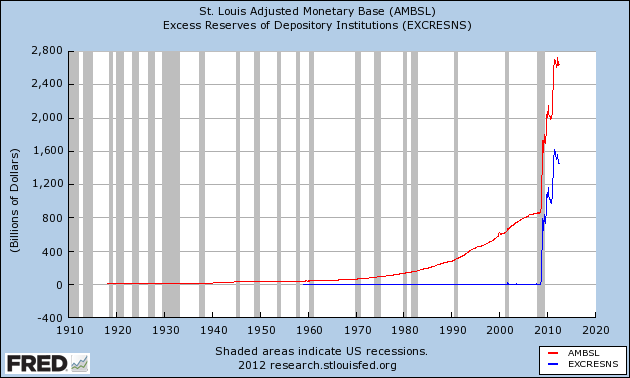
Since both graphs use the same measure of total debt, the stark difference in rate of decline is clearly due to changes in circulating money (M1) versus base money (MB), shown in the following chart:
Digging a bit deeper, the sharp rise in base money over the past few years is largely attributable to an increase in excess reserves:
This chart, which is incredibly important for our discussion, suggests that the rise in excess reserves is the primary driver between the diverging rates of decline in the two measures of debt-per-dollar. Why is this important? The increase in excess reserves, engineered by the Federal Reserve, is primarily just an asset swap with private financial institutions. Since the Federal Reserve is purchasing US Treasuries and agency-MBS (liabilities of the US government), the economic sector which is really witnessing a decline in its debt-per-dollar is the US government.

Deconstructing the argument one more time, this graph again shows total credit market debt owed, now also separated out by the federal government and the private sector (blue line):
For nearly 60 years, private debt growth (credit expansion) continued unabated both in nominal terms and relative to federal debt. Although this provided a tailwind for economic growth, the legacy of accumulated debt is burdensome interest costs. While spending by the federal government is unconstrained by income, due to monetary sovereignty, the private sector is not so fortunate. When accrued interest costs (debt) become large enough, an economic shock (either exogenous or endogenous) may cause the private sector to increase savings and/or debt repayment and thereby decrease consumption and investment. If these actions are pursued in the aggregate, a “paradox of thrift” debt-deflation can take hold. In the US, this has been partially offset by the rapid rise in federal debt, but not fully given the exorbitant relative size of private sector debt.

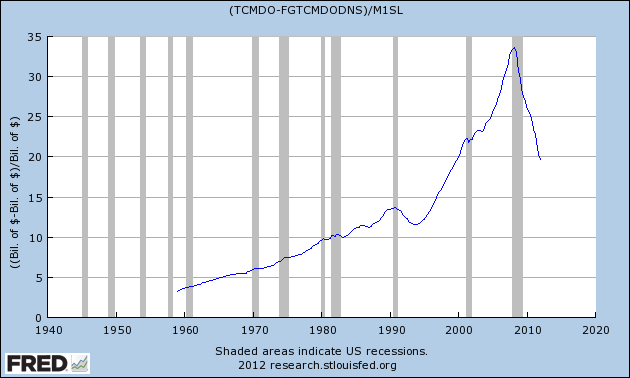
Since private sector debt expansion and contraction has been a primary driver of the economy for at least 60 years, the debt-per-dollar ratio that best depicts the private sector should be the desired metric for policy reduction and stabilization. As shown above, the decline in debt-per-dollar of base money largely reflects an increase in excess reserves that does little to reduce the private sector debt burden. This last chart, however, displays private sector debt-per-dollar of circulating money:
Having decreased sharply since the onset of the Great Recession, this ratio remains at heightened levels only last witnessed at the beginning of the new millennium. We may still have a long way to go but reducing this debt-per-dollar ratio to a reasonable level will be worth it.

Wednesday, July 11, 2012

Forgotten Lessons from Japan's Lost Decades

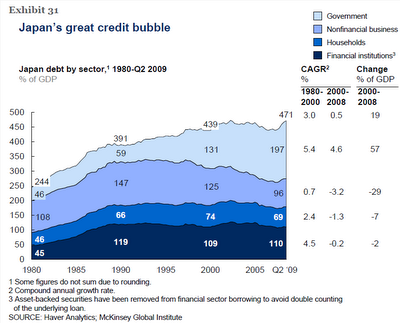
For nearly two decades Japan has witnessed stagnating growth and mild deflation. Over the course of this period, Japan has experimented with various forms of monetary “stimulus” as well as fiscal stimulus, increasing public sector debt by nearly 400%.
Source: The New Arthurian

By many accounts, Japan should be a shining example of functional finance,demonstrating the positive impact of fiscal and monetary stimulus working together. Reality, however, depicts a largely different story.


The New Arthurian offers four lessons from the struggles in Japan...

Lesson 1: No recovery was created by increasing the money.
Lesson 2: No recovery was created by replacing private debt with public.
Lesson 3: There was little or no "erosion" of debt by inflation.
Lesson 4: Try debt forgiveness.
Most economists are currently calling for either greater monetary or fiscal stimulus, or in some cases both. I fear that this apparent focus on broad macro stimulus overlooks some of the subtler inefficiencies within developed economies that played an equal, if not greater, role in the current economic crisis. Tax laws and regulations that encourage the use of credit over money, promote greater inequality and subsidize various industries with political favor will largely remain in place under most of the proposed policy solutions. Until these issues, and numerous others, are dealt with, our fate may follow a similar path as Japan, whereby monetary and fiscal stimulus are only enough to continue muddling through.   

Saturday, January 21, 2012

Points of Public Interest


  1. Money, credit and inflation - Sean Corrigan explains the difference between money and credit, highlighting the different nature of banks and individuals in creating credit. An often forgotten aspect of our current monetary system is that individual banks can create credit (which can turn into money) irrespective of Fed or Treasury policy. This unique ability generates the potential for inflationary and deflationary forces in the money supply outside of the federal government’s control.
  2. Death by Wealth Tax - Richard Epstein argues against the proposal for a wealth tax on assets.
  3. Trials and Errors: Why Science Is Failing Us - Jonah Lehrer details some failings in medicine stemming from the incorrect, basic “assumption—that understanding a system’s constituent parts means we also understand the causes within the system.” As Lehrer notes, centuries ago David Hume recognized a human desire to view the appearance of causation as an actual fact, rather than “fiction that helps us make sense of facts.” (HT: Russ Roberts)
  4. Debt, Deficits, and Modern Monetary Theory - Bill Mitchell, a founding member of Modern Monetary Theory (MMT), outlines the difference between MMT and mainstream economics. These differing conceptions about public debts and very important to the public policy battles in the news today. (HT: Neil Wilson)
  5. Peter Boettke on Austrian Economics - “Austrians want to talk about things like dispersed knowledge, heterogeneity, uncertainty – not just risk, but real uncertainty – and institutions, how institutions arise to allow us to cope with our ignorance and our uncertainty and to ameliorate the frictions that exist in the world.” Peter Boettke discusses contributions of Austrian economics and five books to read on the subject.

Tuesday, January 10, 2012

Predictions for 2012


With countless others offering predictions for the year ahead, I thought I’d take a chance and throw my own projections into the ring. Similar to Byron Wien and Edward Harrison, I mostly selected events that are widely seen as having a low probability (less than 33%) but which I believe hold a greater than 50% chance of occurring.

1) Greece leaves the Euro - As the year progresses the Greek economy continues to contract and unemployment continues to rise, surpassing 50% for youth. This combination of factors offsets attempts to reduce the budget deficit as the country repeatedly misses EU and IMF required targets. Despite potential for further bailouts, the Greek people finally decide the consequences of tied promises outweigh the benefits of remaining in the Euro. Greece defaults on all debts, returning to a heavily depressed drachma.

2) Italy and Spain lose access to credit markets - A Greek default raises concerns about the potential for creditors to face actual losses on EU sovereign debt. The ECB’s measured efforts are not strong enough to overcome fear and concern about future growth in Italy and Spain. Deep recessions take hold in both countries, pushing deficits higher.

3) The Eurozone enters recession - Practically the entire Eurozone falls into recession, including the likes of France and Germany. A deteriorating economic outlook causes deficit estimates to be raised across the board, facilitating credit rating downgrades. Agreements for greater austerity fail to stem the tide and other attempts to kick the can down the road are pursued.

4) China’s GDP growth falls below 7% - As exports to Europe contract, the busting of China’s housing bubble continues unabated. Expectations for massive monetary easing in Europe and the US, along with fear of flare ups in the Middle East sets a floor under energy and food commodity prices. Monetary easing and fiscal stimulus in China are applied too slowly to prevent growth from slowing below the supposedly necessary 8%. (Note: This will be not be considered a hard-landing, which I deem growth below 5%. That may come in 2013, but for 2012 most economists/analysts will be able to maintain expectations of a soft-landing.)

5) Oil prices will spike above $120, finish year below $90 - (Using WTI crude prices, currently ~$102) At some point during the year Iran attempts to block the Strait of Hormuz. Further attempts to overthrown governments in the Middle East, possibly some that only recently gained power, hit the headlines again. Combined with global monetary easing, oil prices will move higher and gasoline will once again hit $4 per gallon in the US. These higher prices will exaggerate the reduction in global demand for other goods and push growth lower. As fears of a global recession take over, oil prices will fall, finishing the year down more than 10%.

6) US enters recession in 2nd half - Despite higher 4th quarter GDP in 2011, the lower savings rate and energy prices are unlikely to add much growth in 2012. With Europe contracting and China slowing down more than expected, US exports will take a hit. Extensions of the payroll tax cut and unemployment benefits will help ensure the federal deficit holds above 8%. Housing prices will continue to fall (based on Case-Shiller) causing the savings rate to once again reach 5%. By the end of 2012, the US will be in a recession (although NBER may not confirm this until 2013).

7) Federal Reserve extends forecasts for ~0% rates until 2015 - As growth in the US weakens once again and the global economy slows, expected inflation over the next ten years (based on Cleveland Fed estimates) will fall towards 1%. With unemployment holding steady around 9%, the Fed will move it’s forecasts for the first interest rate hike out to 2015. (Some form of QE3 is also likely, but aside from promoting short-term speculation, the effects on growth are likely to be muted.)

8) President Obama will win re-election - Generally a weakening economy has been poor for incumbents but this time will be seen as abnormal circumstances. The troubles in Europe and high unemployment will actually spark desire for a more interventionist government. Given the choice between Obama and Romney, the President will win re-election by a slim margin (2% or less).

9) The US dollar rises over 5% - (Based on dollar index) In spite of QE efforts and another sizable deficit, the US dollar retains its safe haven status. As fears of European defaults spread and China’s slowing growth impacts commodity prices, the dollar will continue to trend higher.

10) Bonds outperform stocks - The consensus once again favors stocks, although US Treasuries have now outperformed stocks over the past 1, 10 and 30 year horizons. With global growth slowing, inflation expectations will fall. Before this bull market in bonds ends, 10- and 30-year Treasuries may reach 1% and 2%, respectively.

For some potential investment themes based on these predictions, I suggest taking a look at Gary Shilling’s 2012 Investment Themes.  

Sunday, September 11, 2011

Inflation is NOT the Answer


A couple weeks ago I argued against the numerous economists calling for the Fed to establish higher inflation targets as a remedy for excessive debt. My concerns were centered around the notion that inflation does not create wealth, but rather transfers it from creditors to debtors. Since that post, several FOMC members, including Chairman Bernanke, have spoken about the current state of the economy and potential stimulative actions the Fed could take at its next meeting. Much of the commentary has been typical Fed speak, which involves saying very little in a manner that is difficult to decipher. However, parsing through words and actions has led a majority to expect some form of new quantitative easing to be announced on September 21st.

Recently, on Project Syndicate, Raghuram Rajan (finance professor at the Univ. of Chicago) penned an article titled, Is Inflation the Answer?. Rajan is effectively arguing against the same calls for much higher, short-term, inflation. Although the piece makes a brief note about the distribution effects of such a policy, the focus is on the effectiveness of creating higher inflation.

One critical factor that could hinder effectiveness is the Fed’s credibility. Having maintained a specific target for a long time, the unintended consequences of suddenly changing policy are unknown. If the target can be changed once, why not again, and again? A moving inflation target would also be difficult to explain within the realm of price stability. Were the Fed to raise the target temporarily, given its prior track record, why should the market expect inflation to remain under control? Within this realm of possibility, its fairly easy to foresee an outcome where inflation rises well beyond new targets and ultimately needs to be reigned in Volcker-style. For anyone who lived through that experience, recollections of the early 1980’s recession and double-digit unemployment are probably not pleasant.  

The other significant deterrent Rajan notes relates to the maturity length of current debt. A policy of high inflation is primarily beneficial if nominal income growth outpaces interest on debt. However, if debt needs to be rolled over in the near future (due to maturity), the new debt will require much higher interest rate payments. In that scenario, higher inflation’s impact on reducing debt burdens is minimal. As Rajan notes, this largely reduces the positive influence on government debt, bank liabilities and households with floating rate mortgages.

While I agree with nearly all of Rajan’s points in this article, one point I must argue against is the notion that “[foreign] investors might be needed to finance future deficits.” As I’ve shown numerous times before through MMT, the US government never needs to finance deficits. Aside from that opposition, I think Rajan makes a wonderful case against higher inflation. In conclusion, he adds suggestions for outright debt relief through write-downs. I remain convinced that this method of reducing debt burdens should be the primary focus of current federal policy.

Monday, September 5, 2011

A September to Remember

Three years ago, on September 7th, 2008, the federal government nationalized Fannie Mae and Freddie Mac. The following week, Bank of America bought a Merrill Lynch, Lehman Brothers filed for bankruptcy and AIG was bailed out by the Federal Reserve. During the next couple weeks, Washington Mutual also went belly-up, Wachovia was acquired and the remaining investment banks converted into bank holding companies. In markets, credit spreads widened drastically and equity market volatility heightened substantially, including the S&P 500’s largest loss in history of over 100 points (nearly 9%).  

This year, following a weak August, credit and equity markets have gotten off to a miserable start in September. During the first two days of trading, the S&P lost nearly 4% and at the moment is down close to 3% in the futures market. Losses in Europe are even more staggering, with several major indices already losing nearly 10% this month, following grater than 15% drops last month. Sovereign and bank credit markets, especially in Europe, are also freezing up as the crisis worsens. These are ominous early signs of another September to rival its historic predecessor.

Although only three short years have passed, the global economy appears to be following a similar pattern. After trying to kick the can down the road for more than year, numerous underlying problems are unraveling around the world in concert with one another. Each successive attempt at papering over issues has a shorter shelf-life and the time for politicians to get ahead of the troubles is rapidly decreasing. A quick tour around the world’s major economies will shed light on the ensuing global crisis.

US-

Reminiscent of headlines in 2008, Friday witnessed new troubles stemming from apparently plagued mortgage-backed securities. From the FHFA website (http://www.fhfa.gov/webfiles/22599/PLSLitigation_final_090211.pdf):

Washington, DC -- The Federal Housing Finance Agency (FHFA), as conservator for Fannie Mae and Freddie Mac (the Enterprises), today filed lawsuits against 17 financial institutions, certain of their officers and various unaffiliated lead underwriters.  The suits allege violations of federal securities laws and common law in the sale of residential private-label mortgage-backed securities (PLS) to the Enterprises.  

Complaints have been filed against the following lead defendants, in alphabetical 
order:
1. Ally Financial Inc. f/k/a GMAC, LLC
2. Bank of America Corporation
3. Barclays Bank PLC
4. Citigroup, Inc.
5. Countrywide Financial Corporation
6. Credit Suisse Holdings (USA), Inc.
7. Deutsche Bank AG
8. First Horizon National Corporation
9. General Electric Company
10. Goldman Sachs & Co.
11. HSBC North America Holdings, Inc.  
12. JPMorgan Chase & Co.
13. Merrill Lynch & Co. / First Franklin Financial Corp.  
14. Morgan Stanley
15. Nomura Holding America Inc.
16. The Royal Bank of Scotland Group PLC
17. Société Générale  

These complaints were filed in federal or state court in New York or the federal court in Connecticut.  The complaints seek damages and civil penalties under the Securities Act of 1933, similar in content to the complaint FHFA filed against UBS Americas, Inc. on July 27, 2011.  In addition, each complaint seeks compensatory damages for negligent misrepresentation.  Certain complaints also allege state securities law violations or common law fraud.

Although the full repercussions cannot be known at this time, the fall out may prove very large. While the Obama Administration has been working hard to undermine an investigation by New York’s AG into similar matters, another part of the administration has seemingly subverted those goals. This lawsuit almost certainly dampens the Administration’s hope that the largest banks could avoid serious litigation in return for a small fee ($8.5 billion). Of the institutions listed above, several pose interesting related questions, yet the biggest questions are tied to Bank of America’s solvency.

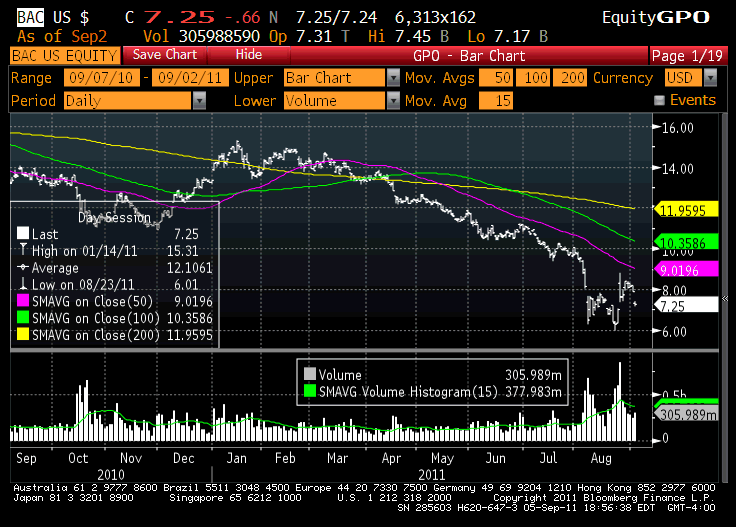
Witnessing its stock fall more than 50% this year (shown below), Bank of America has continually denied claims about needing to raise capital. Despite these apparently false claims, the bank raised capital by selling warrants and preferred stock, along with a significant stake in the China Construction Bank, at steep discounts. Even with these actions, confidence remains fragile, as shares tumbled again on Friday.


Due to its purchases of Countrywide and Merrill Lynch, Bank of America was effectively sued in three separate claims noted above. Combining these claims generates total claims against in excess of $50 billion. However, these claims only represent a small portion of potential liabilities outstanding related to the sale of MBS and foreclosure fraud. Whether the bank ultimately settles these claims or attempts to fight in court, losses will almost certainly be significant and uncertainty regarding the outcome will weigh on the firm for some time.

Apart from unknown losses discussed above, the bank is also currently sitting on untold losses related to its own mortgage holdings, as well as European bank and sovereign debt. Thanks to the ongoing suspension of mark-to-market accounting, the actual market value of current assets is highly unpredictable. Regardless, markets are suggesting current assets should be marked down by billions of dollars and those numbers can only increase as markets weaken.

How long will the confidence last? With Bear Stearns, Merrill Lynch and Lehman Brothers, the final straw seemed to be when institutional investors began pulling funds in mass. Considering recent votes in the US House, another TARP seems unlikely at this juncture. If Friday’s lawsuits spur another significant sell off in the bank’s stock, institutional investors may decide to seek safety elsewhere. Were a run on Bank of America to occur, it’s hard to envision several other weak banks not being targeted as well. The Dodd

Europe -

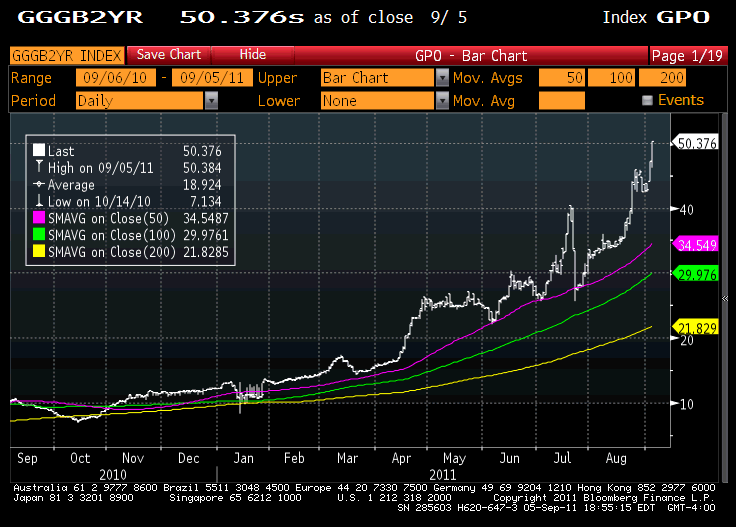
On a timeline basis, the sovereign debt crisis in Europe feels most similar to the US housing crisis. Nearly 18 months ago, problems began showing up in EU periphery countries, notably Greece. As yields widened, the country’s solvency was questioned and after ECB intervention, a bailout was concocted. Despite a couple more bailouts, Greece’s economy continues to deteriorate under the weight of austerity and a strong Euro. Over the past few days, short-term yields have exploded upwards, with the 2 year exceeding 50% (shown below). Not only are markets pricing in 100% chance of default, but far more significant losses than the most recent proposals by the EU/ECB. Apparently recognizing Greece represents a solvency issue, not liquidity problem, the IMF and several EU nations are reconsidering any further aid. 


After Greece, Portugal and Ireland also fell victim to economic deterioration and questions regarding their own solvency. These countries have been locked out of credit markets for more than a year now. Having also received bailouts for austerity measures, economic performance has not turned around and debt levels have worsened. Resolutions involving some form of default still appear almost certain.

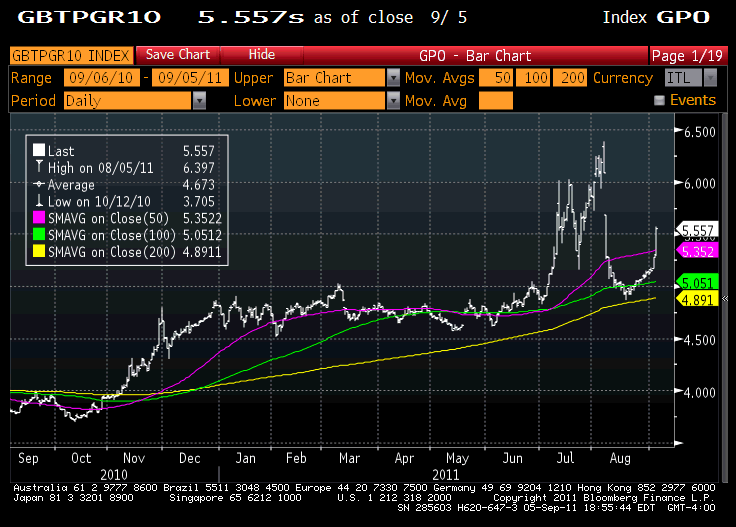
While most market participants expected Spain to become the next casualty of bond vigilantes, markets surprisingly leap frogged Spain, instead attacking Italy. Starting in July, 10 year yields quickly spiked from under 5% to early 6.5% (shown below). Fearful of the consequences, the ECB once again stepped in to purchase Italian and Spanish debt to stem the rising yields. After successfully pushing yields back below 5%, the markets have once again responded, sending Italian yields back above 5.5% today. 


The recent rise comes after Italy’s government attempted to roll back various austerity measures. As Kiron Sarkar notes in a post on The Big Picture (http://www.ritholtz.com/blog/2011/09/people-who-play-with-fire/):

“The Italians better reconsider their recent attempts to backslide from their commitments – they have a large debt maturity this week – some E14.6bn and E62bn by the end of September (the highest ever in a single month). In total, Italy must roll over E170bn by end December – Whoops.”  

Trying to sell that amount of debt may generate a further sell off in Italian debt, for which the ECB and EU appear unprepared.

Sovereign debt problems are on the verge of spiraling out of control, which is especially scary considering the lack of political unity in Europe. Time is running out on a grand solution and if politicians are forced into a reactive resolution, markets and economies will likely pay the price. As sovereign debt continues to be repriced lower, the resulting market losses are weighing heavily on European banks.

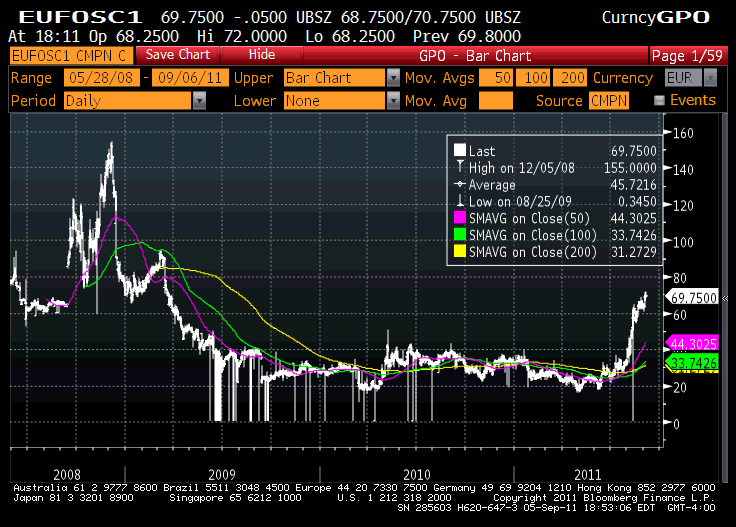
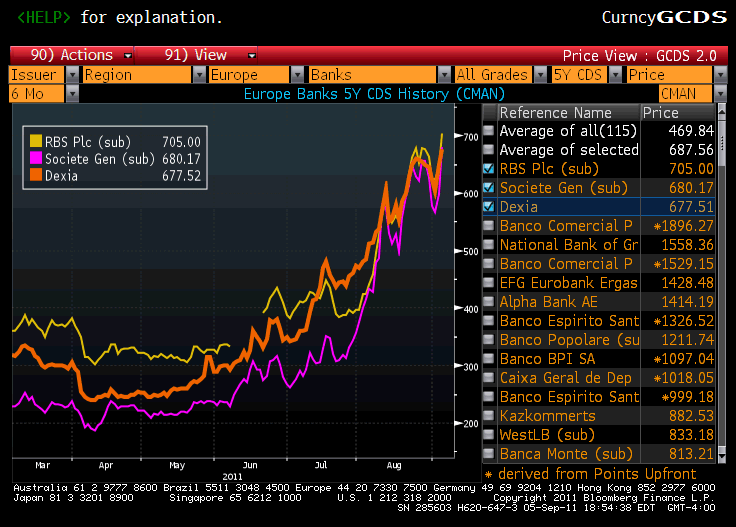
Stock prices of European banks have been falling precipitously over the past couple months. After a brief reprieve due to several countries banning short-selling on the securities, prices are once again falling. As I detailed in Europe Revives Failed Policies of 2008, these measures have been proven to fail and may even worsen the situation. Currently, credit spreads for interbank lending are showing significant strain and approaching levels last witnessed during the crisis of 2008 (shown below, top). Credit default swaps (CDS) on many banks are also reaching new records, potentially stemming from banks trying to hedge counter party risk (shown below, bottom).


Given the global nature of banking, credit problems in Europe may leak into US markets.  Once again, the ECB and Fed (primarily) will be forced to provide liquidity to the financial system. Similarly to the US, if one major bank faces a run, several others are likely to follow. With most of Europe already either in recession or experiencing sub-1% growth, the entire EU risks falling into another recession by year end. Risks are now increasing at a rapid pace, hence the next few weeks promise to be very interesting.

Asia -

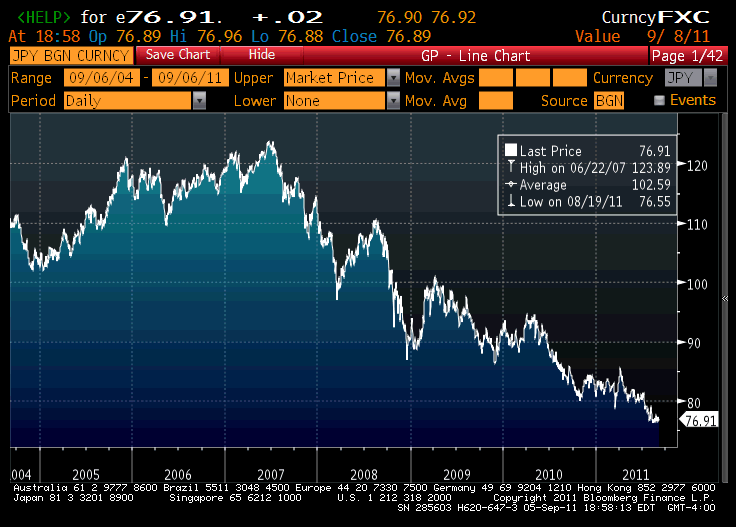
After suffering a horrendous earthquake and tsunami, the Japanese economy fell back into recession. While trying to rebuild, global economic fear has sent cash flocking to the safe-haven Yen. Recently hitting all-time highs against the dollar (shown below), a strong Yen has caused exports to falter and hindered the economic recovery. Attempts by the BOJ to intervene in exchange markets have proved woefully unsuccessful. Further hurting the potential for recovery has been an unwillingness to increase deficit spending, which could generate internal demand and weaken the currency. 


As for China, the country has been fighting inflation by raising reserve requirements. History shows that this measure is not particularly successful in reigning in inflation. Recent moves to let the Yuan float higher are more encouraging. China also faces trouble relating to a fixed investment rate near 50%, potential housing bubble and rapidly increasing bad bank debt. Regardless of specific measures taken to thwart these issues, history suggests the most likely outcome is a “hard landing,” which could represent GDP growth below 5%.

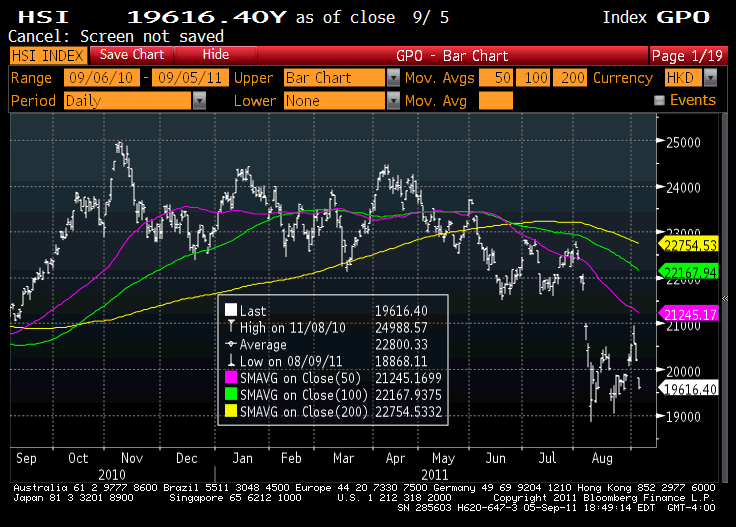
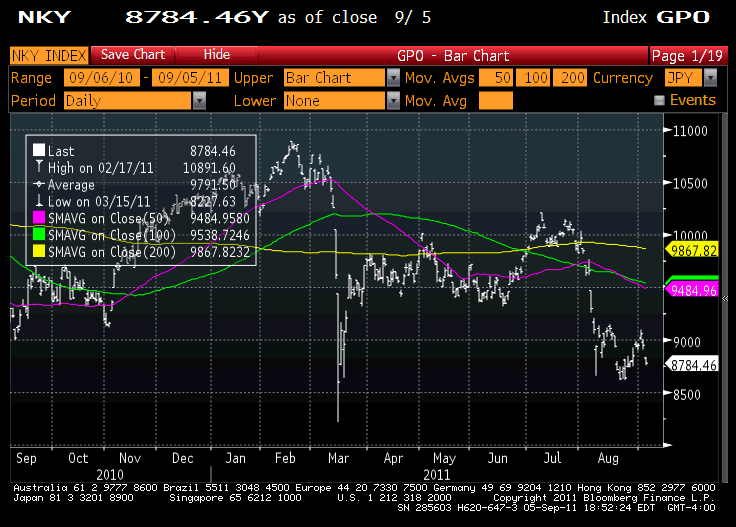
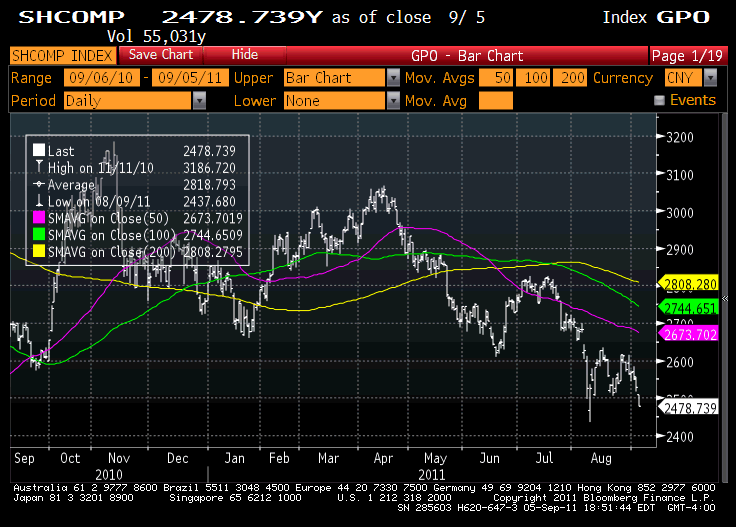
For both of these export driven countries, weakening demand from US and Europe will pose significant problems on top of those already established. As the financial crises of 2008 displayed, global economies are very intertwined in today’s world and the troubles of one large nation will exert pressure upon the others. With equity markets in both these counties having already joined Europe in bear market territory, the immediate future is not looking promising (shown below: Hang Seng, Nikkei, Shanghai).


Over the past two years, markets have responded positively to a stimulus led economic recovery across developed nations. Weakening within credit markets has been largely written off as excessive caution. As credit markets weaken further and economic recoveries falter, it appears this time is not different. Equities have been moving quickly to catch up with credit markets on the way down, however the remaining spread still seems quite wide. Unfortunately the global financial system is practically no more transparent than several years ago, which means questions of solvency, plaguing the market, will be hard to defend against. Measures taken in 2008 to provide liquidity and capital will also be significantly harder to pass in a world concerned with sovereign debt and monetary devaluation.

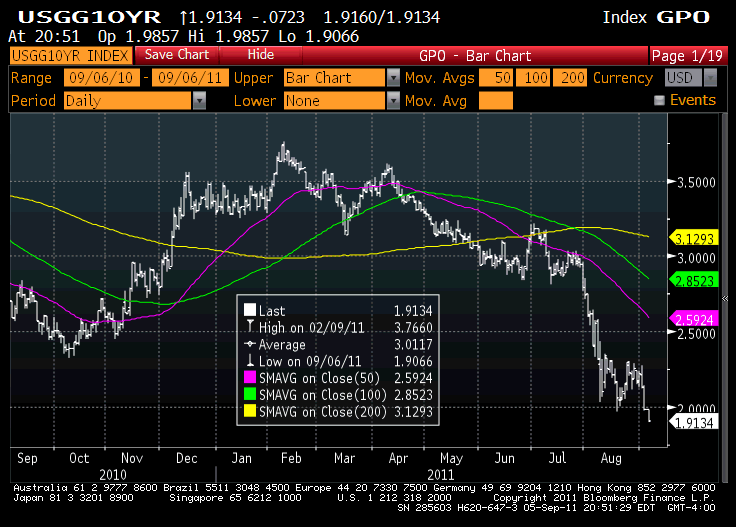
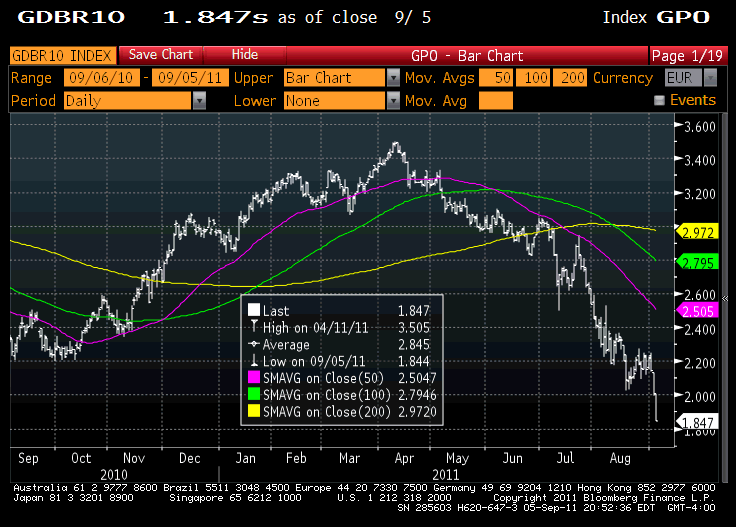
US and German 10 year yields have now joined Japan in the sub-2% club (shown below), which suggests a lengthy period of minimal economic growth and inflation. As equity markets price in a similar outcome, I expect much further declines. A focus on individual companies with strong balance sheets and high dividends should offer great relative value. As for the dollar, equity weakness, global risk and ultimately an interest rate cut by the ECB will likely provide strength. There are times to seek a return on capital and times to seek the return of capital, I believe now is the latter.


Only three years ago, the global economy witnessed the worst recession since the Great Depression. Few people imagined so short a time could pass before the world was once again faced with such enormous challenges. Back then, September marked the period where issues started to really unravel. Could September once again witness the unfolding of historical events? Only time will tell, but based on the first few days, it certainly appears this will be another September to remember.