When the Fed began paying IOR and IOER on October 9, 2008, the Fed Funds rate stood at 1.5%. With the US financial system already experiencing a liquidity crisis, the Fed was actively engaged in providing liquidity through various operations (see this Financial Turmoil Timeline). The rising demand for reserves was making it increasingly difficult for the Fed to maintain its interest rate target, through reserve management, while simultaneously ensuring liquidity. A clear solution, implementing an “interest-on reserves regime”, had been laid out by the Federal Reserve’s Marvin Goodfriend several years earlier in a paper on Interest On Reserves and Monetary Policy.
Goodfriend noted that:
the interest-on-reserves regime would differ from the Fed’s current operating procedures in one important respect. Open market operations would cease to support the interbank rate in the new regime. (p.3)
Instead, the rate of interest-on-reserves would maintain the interest rate target while:
open market operations would have the potential to manage productively the aggregate quantity of broad liquidity in the economy independently of interest rate policy. A central bank could increase broad liquidity in the economy by using newly created reserves to acquire less liquid assets or by financing a temporary government budget deficit. (p.3)
Previously the Fed’s ability to:
manage broad liquidity...by changing the composition of its assets, for example, by selling liquid short-term Treasury securities and acquiring less liquid longer term securities... [was] strictly limited by the size of its balance sheet. (p.4)
Changing the Fed’s operating procedures to use interest-on-reserves in setting interest rates, therefore allowed the Fed to engage in massive balance sheet expansion, via QE, and to increase the size of Operation Twist. Through these unconventional measures the Fed not only continues to increase liquidity and “finance” the federal budget deficit, but also manages to lower long-term interest rates.
Following the ECB’s decision to stop paying interest-on-reserves, proponents of monetary stimulus within the US are calling for the Fed to adopt a similar stance or potentially make the nominal rate negative. While I previously examined the potential fallout from a negative IOER rate, in light of the above information, a reversion back to previous monetary policy procedures seems even less probable.
The Federal Reserve’s decision to implement an “interest-on-reserves regime” has clearly been beneficial in permitting the use of previously conventional measures for unconventional purposes, including the provision of liquidity and “financing” of federal budget deficits. Eliminating the payment of interest-on-reserves will not prevent the Fed from continuing to use open market operations in this manner, as long as the Fed Funds rate remains at zero. However, departing from this new regime will ensure that any future rate hikes be preempted by a reversal of the balance sheet expansion (or excess sale of Treasuries). Balance sheet contraction, through open market operations, could very well depress asset values and raise long-term interest rates. If this occurs, the Fed would be effectively causing a new crisis just as the economy is becoming increasingly stable. Separately, a 25 basis point reduction in short-term interest rates is unlikely to cause a noticeable rise in credit demand but would reduce financial sector profits. Given that any decision to cease paying interest-on-reserves would likely be temporary and the potential benefit is limited, there is seemingly little reason for the Fed to change course. An “interest-on-reserves regime” appears likely to rule monetary policy for the foreseeable future.
1) Pettis: The Chinese rebound will be short by Houses and Holes
If we assume that China will have no problem sailing through its economic rebalancing, the European crisis, and everything else, then clearly we don’t need to worry about anything. But if China’s rebalancing is accompanied by a sharp slowdown in economic growth, or if it occurs during a worsening of the European crisis – both very likely scenarios – then we need to think about what the debt burden will be under those conditions.
So, for example, will commodity prices drop? I think they will, perhaps by as much as 50% over the next three years, and to the extent that there is still a lot of outstanding debt in China collateralized by copper and other metals (and there is), our debt count should include estimates for uncollateralized debt in the event of a sharp fall in metal prices. Will slower growth increase bankruptcies, or put further pressure on the loan guarantee companies? They almost certainly will, so we will need again to increase our estimates for non-performing loans.
Will capital outflows increase if growth slows sharply? Probably, and of course this puts additional pressure on liquidity and the banking system, and with refinancing becoming harder, otherwise-solvent borrowers will become insolvent. Will rebalancing require higher real interest rates, a currency revaluation, or higher wages? Since rebalancing cannot occur without an increase in the household income share of GDP, and since these are the biggest implicit “taxes” on household income, there must be a net increase in the combination of these three variables, in which case the impact on net indebtedness can be quite significant depending on which of these variables move most. Since I think rising real interest rates are a key component of rebalancing, clearly I would want to estimate the debt impact of a rise in real rates.
2) Guest Contribution: ‘The Making of America’s Imbalances’ by Paul Wachtel and Moritz Schularick
Last but not least, in the paper we point to a potentially important distinction that was lost in previous analyses of household savings behavior. When we delve deeper into the role of capital gains for savings and borrowing decisions, we uncover a close statistical relationship between gains in equity (but not housing) wealth and active savings decisions (i.e., acquisition of financial assets) by American households. Borrowing behavior, by contrast, depends much more closely on fluctuations in housing wealth, both directly because of higher values of the housing stock and indirectly through mortgage equity withdrawals. We think that this result challenges the (conventional) wisdom that non-leveraged equity market bubbles pose a lesser problem for macroeconomic balance than credit-fueled housing bubbles. Our results indicate that equity market bubbles too trigger substantial changes in the financial behavior of households. The economic and financial repercussions of those could be costly to reverse at a later stage.
3) Is the Fed Eyeing a New Kind of Twist? by David Schawel
An astute Credit Suisse analyst pointed out this week that the Fed could perform a “MBS Twist” operation in which they sell up in coupon premium MBS pools and buy lower coupon MBS which could have the affect of lowering mortgage rates to borrowers. In their own words:
“…this policy will specifically target the near par secondary MBS rate, the key driver of the primary rate that is offered to the consumer. Consumers spend “permanent income”, not temporary tax rebates…Operation MBS twist will reduce mortgage payments and redirect consumer cash to increase M-velocity and bump up inflation.”
To put this in perspective, the Fed owns ~$530bil of Fannie 4.5-5.5% pools (purchased during QE1) in which they have an unrealized gain of ~$32bil. 30yr 3.5’s (borrower rates of 4%) still comprise the lions share of origination volume, but 30yr 3.0’s are in production now as well. Pushing down on 3’s and 3.5’s by buying almost all new production could, as CS points out, help compress the primary-secondary spread.
Woj’s Thoughts - Very interesting policy idea here. In essence this is a reverse Operation Twist, although the maturities are equivalent. My three initial concerns are the following: Will the increase in interest income from higher coupon pools exceed the reduction in net interest margin from new pools (i.e. will it help or hurt bank capital)? Do the higher coupon pools represent borrowers unable to refinance (due to credit worthiness or underwater mortgages), suggesting credit risk is shifting back to the private sector? Will markets perceive the policy as a “risk-off” since it reduces the incentive to shift outwards on the risk/yield curve?
Great interview here with Warren Mosler. In his eyes, government deficits in Europe and the UK are now large enough to stabilize GDP but not promote growth. Meanwhile the US deficit will remain high enough to support ~2% growth. As for China, Warren notes that throughout history practically all attempts to rein in inflation have resulted in hard landings. Overall this suggests little concern for stocks at current levels.
Apart from the discussion of growth relating to stocks, Warren also provides his usual great insight on the actual monetary operations of our nation (and others). More specifically, he discusses the ineffectiveness of monetary “stimulus” due to lost interest income, the ECB’s back stop of illiquid (maybe insolvent?) banks and the role of deficits in supporting aggregate demand. These topics and more are presented in an extremely clear, concise manner in Warren’s book The 7 Deadly Innocent Frauds of Economic Policy (which I’m currently reading free online).
David Merkel offers a Redacted Version of the June 2012 FOMC Statement with comments on changes from the prior statement. Overall the Fed appears to have lowered its future growth and inflation expectations to a small degree. The specific change that market participants were all waiting on is the following:
The Committee also decided to continue through the end of the year its program to extend the average maturity of its holdings of securities. Specifically, the Committee intends to purchase Treasury securities with remaining maturities of 6 years to 30 years at the current pace and to sell or redeem an equal amount of Treasury securities with remaining maturities of approximately 3 years or less. This continuation of the maturity extension program should put downward pressure on longer-term interest rates and help to make broader financial conditions more accommodative.
As many forecasters predicted, the Fed is extending Operation Twist through the end of the year. Omitted from this statement is the specific size of the program, which was $400 billion for the previous round. One reason for this omission may be the limited remaining supply of short-term Treasury securities. Highlighting this topic in a recent post, Sober Look noted that:
BofA is projecting that by the time of the FOMC meeting this month, the Fed will have $175bn of short-term treasuries on its balance sheet.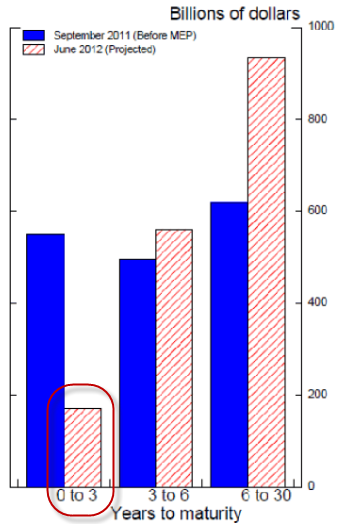
If these projections from BofA represent a valid approximation, the Fed will be unable to maintain the current pace of operations for the next six months. To comply with their statement, the Fed would therefore either have to lower the current pace, shorten the time span, or increase the maturity of securities being sold.
Regardless of the which option the Fed chooses, the effects of this program will be minimal, at best. As Gary Becker recently pointed out:
The Fed in what is called “Operation Twist” could try to further lower long term interest rates relative to the negligible rate on treasury bills by buying long term bonds. This might reduce further the spread in interest rates (that is, flatten the interest yield curve), but this effect is limited by a fundamental economic equilibrium condition. Long term interest rates tend to be an average of current and expected short term rates since more investors would shift into short term rates when long term rates are below this average; conversely, investors shift into long term rates when these are above the average of current and expected future short term rates.
With yields on 30-year Treasuries already below 3% (currently ~2.75%), it’s hard to envision much of an incremental gain from another 25-50 basis point reduction. Asset (primarily equity) markets may rally on this news, but the short-term wealth effects are proven to have little carry over to real economic variables.
Even if we accept some minor benefits from the reduction in yields and rise in asset prices, those benefits are largely offset by the reduction in interest income to the private sector. This aspect of Operation Twist is often overlooked but equally important to understanding its impact on the real economy. By swapping short-term Treasury securities for longer-term issues, the Fed is not only increasing the duration of its portfolio but also the yield. This means that the Fed will collect a greater amount of interest income which otherwise would have been accrued by the private sector. In this manner, it’s certainly possible that Operation Twist could have the unintended effect of reducing aggregate demand.
Lastly, the FOMC’s decision to extend Operation Twist for the remainder of the year suggests that the Fed will not enact another round of balance sheet expansion (QE) until after the election. This may disappoint many investors who were expecting that “stimulus” to provide support for equity markets. Since the Great Recession began, the Fed has waited for the completion of each unconventional measure before electing to engage in further actions. Unless Europe or equity markets start to really unravel, I doubt the Fed will alter this typical progression right before a Presidential election.
Overall, the Fed’s new actions should once again have minimal effect on real economic growth or unemployment. With further action now on hold through the election, it will be interesting to see how markets hold up.
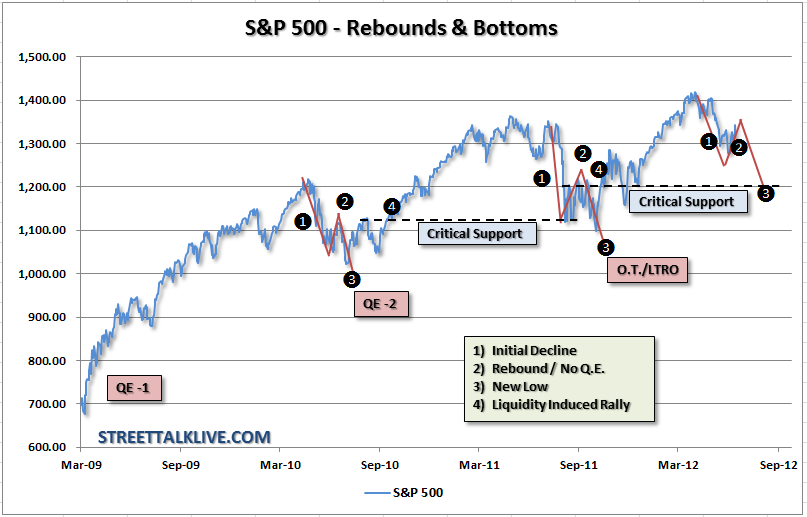
It is at this point that the calls for more stimulative actions are made by the media and Wall Street. The market then rallies on rumor and innuendo as expectations rise on hopes that the need for liquidity will soon be met - Point 2.
This is where we are today. Headlines, postings and tweets are filled with that hope of further accommodative action from the Fed.
Read it at Pragmatic Capitalism
NO QE3 COMING, REPLAY OF 2011 TO CONTINUE
By Lance Roberts, CEO StreetTalk Advisors
When the FOMC initiated both QE2 and Operation Twist, US stocks were approaching bear market territory (down 20%) and inflation expectations were falling rapidly. Although inflation expectations have been falling (along with oil prices), stocks are up ~7% in the past two weeks and nearly 8% for the year. Meanwhile, fears regarding Europe are subsiding following the Greek election and G-20 summit (though this optimism is misplaced). Bernanke was correct in calling high headline inflation temporary, but further action at this point may once again send money pouring into the energy and commodity space. If temporary effects are encouraged to persist for long enough, it becomes foolish to continue calling them temporary.
Given the upcoming elections, strength in equity markets and moderate expected growth going forward, this would be an odd moment for the Fed to start acting pre-emptively. As noted in my Predictions for 2012, I expect “the Fed will move it’s forecasts for the first interest rate hike out to 2015.” Beyond that, the Fed may continue Operation Twist (Sterilized QE) at some small scale. Neither of these actions is likely to be significant enough to satisfy investors. Markets may have jumped the gun with the recent rally.
Related posts:
Bernanke May Disappoint Pavlov's Dogs
Political Fears May Keep ECB Easing On Hold
Fed's Treasury Purchases Now About Asset Prices, Not Interest Rates
The Fed in what is called “Operation Twist” could try to further lower long term interest rates relative to the negligible rate on treasury bills by buying long term bonds. This might reduce further the spread in interest rates (that is, flatten the interest yield curve), but this effect is limited by a fundamental economic equilibrium condition. Long term interest rates tend to be an average of current and expected short term rates since more investors would shift into short term rates when long term rates are below this average; conversely, investors shift into long term rates when these are above the average of current and expected future short term rates.
Read it at The Becker-Posner Blog
Is Further Quantitative Easing by the Fed Warranted?
By Gary Becker
At least one Nobel laureate understands the reasoning behind current low yields on Treasuries. Edward Harrison has often made this point and though it’s been mentioned several times before here, it bears repeating.
(Note: I don’t interpret this use of “equilibrium” to mean some defined level at which interest rates become stable or clear other markets. I believe the term, in this sense, merely implies the normal give and take of market prices around fluctuating expectations that never resolves itself at any stable level. Also, this “equilibrium condition” only holds for sovereign currency issuers (eg. US, UK, China, Japan) and not sovereign currency users (eg. Europe).)
Related posts:
Permanent Zero: Record Low Treasury Yields and Banking Instability
Treasury Yields Low for Good Reason
Here’s another fun fallacy quashed! Most mainstream media continues to discuss the Federal Reserve’s easing actions as a means to monetise the debt and/or devalue the US dollar against foreign currencies. This presumption has led many to incorrectly forecast rising or hyper-inflation over the past few years. Well, after two rounds of QE and one round of Operation Twist, the US dollar now resides firmly above its level at the time of the Lehman bankruptcy and the last two attempts at monetary stimulus...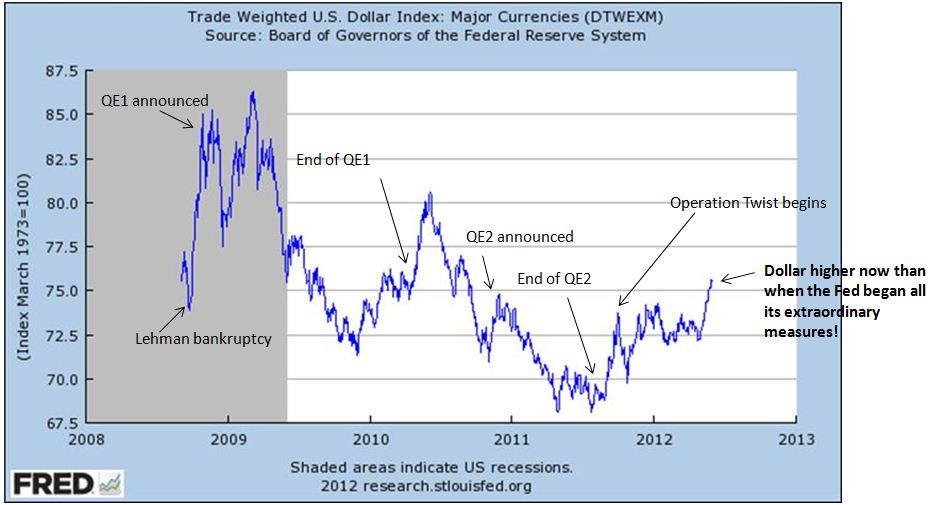
Source: Dollar has gone up since Lehman, QE1, QE2, Op Twist at Mike Norman Economics
Deleveraging by the private sector (and a large current account deficit) continues to negate inflationary pressures stemming from the Fed’s actions and the government deficits. With global growth slowing at an increasing pace, the dollar may still have plenty of room on the upside to run.
Yesterday Jon Hilsenrath of the Wall Street Journal, who doubles as spokesman for the Federal Reserve, published an article titled 'Sterilized' Bond Buying an Option in Fed Arsenal. Upon word of another possible round of quantitative easing (QE), stocks and commodities rallied as the dollar fell against most other currencies. In the article, Hilsenrath comments that:
“Under the new approach, the Fed would print new money to buy long-term mortgage or Treasury bonds but effectively tie up that money by borrowing it back for short periods at low rates.”
The first comment that jumped out was this notion of the Fed ‘printing money’. QE is nothing more than the Fed merely exchanging one financial asset (Federal Reserve notes) for another financial asset (Treasury bonds). Following the exchange, the private sector still holds the same exact amount of net financial assets. Asset durations in the private sector change, but QE alone will not cause inflation. Mike Norman expands on this issue and more in The Fed's "new and improved" QE.Apart from this misconception of ‘printing money’, the specific durations that the Fed might buy and sell piqued my interest. Just last September Operation Twist was enacted, whereby the Fed purchased long-term Treasury bonds in exchange for short-term Treasury bonds. Read the description of Sterilized QE again. Under this program, the Fed plans to buy long-duration bonds and sell short-duration bonds. The size of the Fed’s balance sheet remains the same. Aside from the possible inclusion of long-term mortgages, Operation Twist and Sterilized QE are, in practice, exactly the same. The Fed appears to have recognized the ineffectiveness of QE on the real economy, resolving to adjust perceptions by changing the name of its programs. While this may encourage greater speculation in stocks, commodities and MBS once again, one has to wonder how many versions of QE the Fed can perform before investors realize the truth behind these actions.

