Showing posts with label Cullen Roche. Show all posts

Sunday, August 19, 2012

Bubbling Up...8/19/12

1) Chart of the Day: Public deficits and private savings in the euro zone by Edward Harrison @ Credit Writedowns
Budget deficits are what results ex-post from an accounting identity between the sectoral balances and should not be a primary goal of public policy. What we want to do is target the cause of the deficits, insufficient demand which I believe is the result of the overhang of debt after a period of excess private sector credit growth. What you want to do is eliminate that debt overhang by reducing the debt or increasing private sector incomes to support the debt. That’s getting at root causes.

2) How the Economic Machine Works by Ray Dalio @ Bridgewater (h/t Humble Student of the Markets)

[I]f you understand the game of Monopoly®, you can pretty well understand credit and economic cycles. Early in the game of Monopoly®, people have a lot of cash and few hotels, and it pays to convert cash into hotels. Those who have more hotels make more money. Seeing this, people tend to convert as much cash as possible into property in order to profit from making other players give them cash. So as the game progresses, more hotels are acquired, which creates more need for cash (to pay the bills of landing on someone else’s property with lots of hotels on it) at the same time as many folks have run down their cash to buy hotels. When they are caught needing cash, they are forced to sell their hotels at discounted prices. So early in the game, “property is king” and later in the game, “cash is king.” Those who are best at playing the game understand how to hold the right mix of property and cash, as this right mix changes.
Now, let’s imagine how this Monopoly® game would work if we changed the role of the bank so that it could make loans and take deposits. Players would then be able to borrow money to buy hotels and, rather than holding their cash idly, they would deposit it at the bank to earn interest, which would provide the bank with more money to lend. Let’s also imagine that players in this game could buy and sell properties from each other giving each other credit (i.e., promises to give money and at a later date). If Monopoly® were played this way, it would provide an almost perfect model for the way our economy operates. There would be more spending on hotels (that would be financed with promises to deliver money at a later date). The amount owed would quickly grow to multiples of the amount of money in existence, hotel prices would be higher, and the cash shortage for the debtors who hold hotels would become greater down the road. So, the cycles would become more pronounced. The bank and those who saved by depositing their money in it would also get into trouble when the inability to come up with needed cash caused withdrawals from the bank at the same time as debtors couldn’t come up with cash to pay the bank.
Woj’s Thoughts - Although Dalio’s fund may be struggling this year as markets increasingly deviate from economic growth, his insights regarding economic cycles remain a great source of knowledge. In many advanced economies, property was clearly king until the shortfall in cash among households became so pronounced that a debt deflation ensued. The productive portion of the private sector (non-financial) continues to hold too much property and debt relative to cash (savings and income). Rather than encouraging and aiding a “smooth” shift towards cash, public policy remains supportive of reverting back towards property and debt. As long as this mix remains highly unbalanced, economies will prove fragile and prone to crises. (Fun tidbit about me...as a child I loved playing the game of Monopoly. This may have been an early sign that I was destined for a future in economics and finance.)

3) How Long Can Japanese Bond Prices Defy Gravity? by Cullen Roche @ Pragmatic Capitalism

As you likely know, Japan has been suffering a horrid deflation for 20 years as a result of a multitude of factors.  So we’ve witnessed an endless stream of JGB bond traders diving out of windows as they short JGB’s and lose out to ever increasing prices.  One interesting conclusion in the Hoshi/Ito paper is their view on Japan’s ”unrealistically optimistic assumption that Japan’s GDP will grow at 2% annually for the next 40 years”.   If growth is to stagnate then where will the inflation come from?  What could scare these bondholders into a massive JGB revolt leading to higher rates (something which, mind you, did not even occur in the USA during the great stagflation of the 1970′s)?   I am lost for a cause here because Japan’s central bank controls interest rates and as the supplier of reserves to the banking system they can always control the entire yield curve (yes, if they wanted to pin the 30 year bond at a specific rate they would just have to name it and challenge the bond traders to compete with their endless reserve position – the bond traders would lose quickly).
So the question remains – how long can Japanese bond prices defy gravity?  Well, the short answer is – as long as the Japanese central bank is willing to keep rates low.  The more important question is when will Japan experience an environment which forces their central bank to alter the current structure of the yield curve?  Will a stagflation occur similar to the 70s in the USA?  Will a hyperinflation occur for whatever reason?  Will growth rebound?   Or what if Hoshi and Ito’s pessimistic GDP projections are correct?  Then we’re likely to continue seeing JGB traders jumping out of windows following unsuccessful attempts to fight the Bank of Japan.
Woj’s Thoughts - So yes, the Fed can (and to a degree currently does) control long-term interest rates. These questions are equally important for investors currently betting against US Treasuries. When will economic factors cause the Fed to raise interest rates in the foreseeable future? Private sector deleveraging is likely to persist for a few more years and government deficits are decreasing. This suggests a still lengthy period of low growth and inflation, which is consistent with the Fed maintaining short-term rates near zero. The recent sell-off in Treasuries is approaching a level at which the long-side again becomes enticing.  

Friday, July 27, 2012

The Fed Controls Long-Term Interest Rates

Casey Mulligan recently offended a significant portion of the economics blogosphere by stating that:
New research confirms that the Federal Reserve’s monetary policy has little effect on a number of financial markets, let alone the wider economy. Politicians, and a few economists, have been imploring the Federal Reserve to help the economy grow before November. But the effects of monetary policy on the wider economy are small.
Although I have repeatedly attempted to show that, under current conditions, monetary policy would be largely ineffective at stimulating the broader economy, this should not be taken as a dismissal of the general potential for monetary policy. Cullen Roche chimes in on the subject with a conclusion that sums up my views:
monetary policy has been very weak in the current environment for several reasons.  The primary reason is due to a lack of demand for debt.  Consumers are saddled with excessive debt so demand for “inside money” has been abnormally weak in recent years.  This is perfectly normal following a credit driven bubble.  And since monetary policy primarily works through altering the cost of “inside money” it’s not surprising that the actions of the Fed have appeared rather ineffective in recent years.  But this unusual environment should not be taken to mean that the Fed has zero options or that monetary policy is never effective.    To do so would be a vast misunderstanding of the basics of banking and the way our monetary system works.  Monetary policy might be a blunt instrument at times, but let’s not make extreme comments that sound ideological or take the uniqueness of today’s environment to make sweeping generalizations.
Beyond this main issue concerning the effectiveness of monetary policy, Mulligan’s post raised the question of whether the Federal Reserve controls long-term interest rates. Since the Federal Reserve could purchase all outstanding Treasuries at a given price/yield, I think it’s fair to say the potential power for strict control exists. A more basic question, however, is whether past and current policy displays control over long-term Treasury rates. I’ve argued affirmatively, drawing on comments from Edward Harrison, Gary Becker and others, that long-term Treasury rates are primarily a function of expected short-term rates over a given period. JW Mason, whose work I highly regard, disputes this claim:
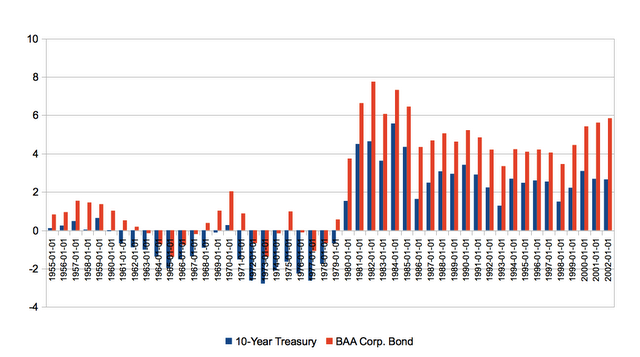
it's not at all obvious that long rates follow expected short rates either. Here's another figure. This one shows the spreads between the 10-Year Treasury and the Baa corporate bond rates, respectively, and the (geometric) average Fed Funds rate over the following 10 years.
If DeLong were right that "the long government bond rate is made up of the sum of (a) an average of present and future short-term rates and (b) term and risk premia" then the blue bars should be roughly constant at zero, or slightly above it. [2] Not what we see at all. It certainly looks as though the markets have been systematically overestimating the future level of the Federal Funds rate for decades now. But hey, who are you going to believe, the efficient markets theory or your lying eyes?
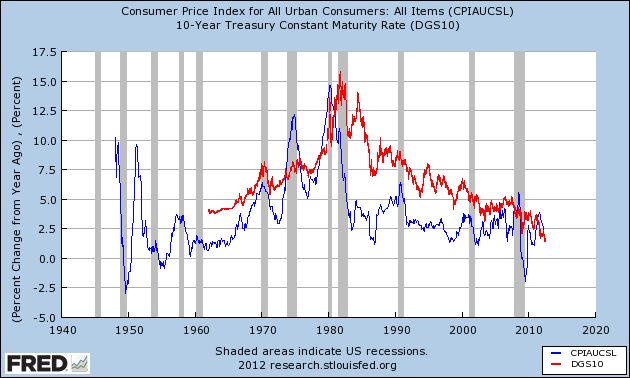
From my perspective, this preliminary conclusion from Mason confuses expected average rates with actual outcomes. Although I can’t speak for DeLong (or others), the notion that markets might/have systematically overestimated and underestimated future Fed Funds rates does not undermine the theory. As the following chart shows, inflation and 10-year Treasury rates were primarily rising from the early 1960’s until the early 1980’s. Based on economic theory at the time (e.g. Phillips curve), it was not unreasonable to expect that inflation would subside with increasing unemployment and the Federal Reserve would lower rates in response. The unexpected persistence of inflation likely caused many investors to consistently underestimate future Fed Funds rates during this period.

By the time Paul Volcker took over as Chairman of the Federal Reserve, many (most) investors had probably come to expect persistent inflation. When inflation crashed in the early 1980’s, it would have been equally reasonable to expect a return to high inflation and Fed Funds rates. The actual outcome has been largely subdued inflation, now going on 30 years. To understand how unexpected this outcome was, one only has to consider that returns on long-term Treasuries has exceeded returns on stocks during this 30-year period (a previously unthinkable feat missed by nearly all investors).

Mason continues his post with the counter claim that:
What profit-maximizing bond traders do, is set long rates equal to the expected future value of long rates.
I went through this in that other post, but let's do it again. Take a long bond -- we'll call it a perpetuity to keep the math simple, but the basic argument applies to any reasonably long bond. Say it has a coupon (annual payment) of $40 per year. If that bond is currently trading at $1000, that implies an interest rate of 4 percent. Meanwhile, suppose the current short rate is 2 percent, and you expect that short rate to be maintained indefinitely. Then the long bond is a good deal -- you'll want to buy it. And as you and people like you buy long bonds, their price will rise. It will keep rising until it reaches $2000, at which point the long interest rate is 2 percent, meaning that the expected return on holding the long bond and rolling over short bonds is identical, so there's no incentive to trade one for the other. This is the arbitrage that is supposed to keep long rates equal to the expected future value of short rates. If bond traders don't behave this way, they are missing out on profitable trades, right?
Not necessarily. Suppose the situation is as described above -- 4 percent long rate, 2 percent short rate which you expect to continue indefinitely. So buying a long bond is a no-brainer, right? But suppose you also believe that the normal or usual long rate is 5 percent, and that it is likely to return to that level soon. Maybe you think other market participants have different expectations of short rates, maybe you think other market participants are irrational, maybe you think... something else, which we'll come back to in a second. For whatever reason, you think that short rates will be 2 percent forever, but that long rates, currently 4 percent, might well rise back to 5 percent. If that happens, the long bond currently trading for $1000 will fall in price to $800. (Remember, the coupon is fixed at $40, and 5% = 40/800.) You definitely don't want to be holding a long bond when that happens. That would be a capital loss of 20 percent. Of course every year that you hold short bonds rather than buying the long bond at its current price of $1000, you're missing out on $20 of interest; but if you think there's even a moderate chance of the long bond falling in value by $200, giving up $20 of interest to avoid that risk might not look like a bad deal.
Once again, I think this example confuses some aspects of bond trading. While Mason considers a bond in perpetuity, let’s instead consider a 10-year Treasury with a 4% yield and 2% Fed Funds rate expected to continue indefinitely. Now assume that this expectation for the Fed Funds rate holds true. Entering year ten, if prices don’t adjust, investors will have the option of purchasing notes with equal maturities (the 10-year Treasury only has a year remaining before maturity) that offer either a 2% or 4% yield. Given the option, investors will purchase the 4% note, pushing the price up and yield down until it reaches approximately 2%. Even if 10-year Treasury rates are still 4% at that time, the previously held bond no longer has a long-term maturity and becomes the equivalent of a short-term note/bill. This is why the expected short term rates, and not long-term rates, matter for controlling long-term Treasury rates.     

Despite our differences in opinion over influencing long-term Treasury rates, Mason and I agree that:
for policy to affect long rates, it must include (or be believed to include) a substantial permanent component, so stabilizing the economy this way will involve a secular drift in interest rates -- upward in an economy facing inflation, downward in one facing unemployment. (As Steve Randy Waldman recently noted, Michal Kalecki pointed this out long ago.)
Currently, unemployment and disinflation are persisting far longer than most economists, politicians and investors expected. These outcomes have led the Federal Reserve to maintain a zero percent Federal Funds rate for three years and predict continuation of that policy for at least a couple more. As investors become increasingly convinced that short-term rates will remain at or near zero indefinitely, long-term Treasury rates have continued the secular drift lower that began in the early 1980’s.

So yes, the Federal Reserve can control long-term Treasury rates and has been doing so by adjusting market perceptions of future Fed Funds rates. Unfortunately, as Mason says:
adjusting expectations in this way is too slow to be practical for countercyclical policy.
Monetary policy, in a future crisis, will once again have its time to shine. For now, fiscal policy must take center stage to reduce household debt burdens and counteract previous measures aimed at inducing a credit bubble.  

Wednesday, March 21, 2012

The Forthcoming Profit Recession

During the past few years many individuals, including myself, have been surprised by how strong the rebound in corporate profits has been amidst a weak recovery in GDP and unemployment. New all-time highs in corporate profits have seemingly been the main driver behind the more than 100% rise in the S&P 500 since its lows in March 2009.
Richard Bernstein supports this view in The First Sign of Weakness in Corporate America:

“Our research over the past twenty-five years has consistently suggested that profit cycles, rather than economic cycles, drive equity markets.”
Bernstein’s research note comments on the recent rise in companies reporting negative earnings surprises and negative earnings growth (year/year). Although corporate balance sheets are much improved over a few years ago, these factors are warning signs that profit growth is slowing and may turn negative.

Another highly regarded investor/analyst, James Montier of GMO, is also now expressing concern over a profit recession in his recent commentary What Goes Up Must Come Down. Montier is part of a relatively small group of individuals/investors that foresaw the large rise in corporate profits based on its relationship with government deficits. A common trait among this cohort is a view of economics consistent with Post-Keynesian macro, including its different branches e.g. MMT and MMR.

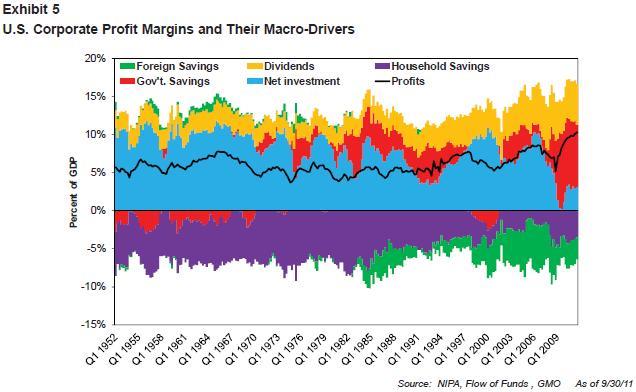
Montier breaks down the components of corporate profit margins in a flow of funds framework:

Profits = Investment – Household Savings – Government Savings – Foreign Savings + Dividends

This arrangement is an expanded derivation of (Michal) Kalecki’s profit equation, which says

Retained Earnings = Investment + Government Deficit - Household 
Savings

The insightful blogger, Ramanan, recently provided a more detailed background of Kalecki’s Profit Equation. Looking at corporate profits in this manner displays that government deficits have been the primary driver during this recovery.

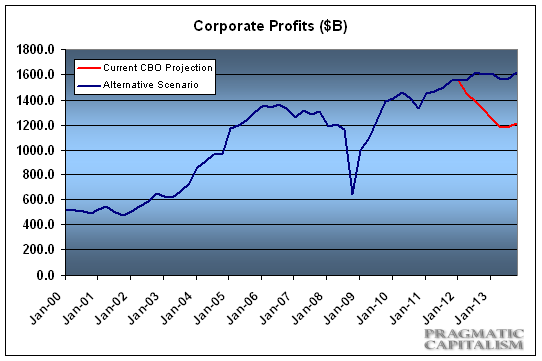
For the current fiscal year (2012), the budget deficit (Gov’t Savings) is still expected to be more than 8% of GDP (over $1 trillion). However, with tons of tax breaks potentially expiring at the end of this year, next year’s budget deficit could be significantly lower (~5% of GDP). If this occurs then corporate profits are likely to decline in 2013. Regarding the murkiness of next year’s budget outlook, Cullen Roche also chimed in on WHERE ARE CORPORATE PROFITS HEADED? He comments, and I agree, that regardless of upcoming elections the budget deficit next year may very well end up being higher than current CBO projections. The following chart depicts possible outcomes for profits based on his assumptions:

Looking ahead I doubt much, if any, of the decisions on future tax rates get decided before the November elections. If recent debates in Congress offer any insight, decisions on the budget will remain on hold until the last possible minute. Fearing the potential outcome in red above, investors may seek safety in advance...  

Thursday, February 16, 2012

Returning Economics to Reality


As I mentioned recently in the Quote of the Week, Hyman Minsky’s work on financial instability continues to play a major role in my own thinking and in several strands of heterodox economics. A dissertation advisee of Minsky’s, Randall Wray, partially founded Modern Monetary Theory (MMT) which falls within a similar realm of economic thinking. When I began exploring economic blogs nearly two years ago, MMT offered an escape from mainstream (neo-classical synthesis) thinking and provided a better fit with my perception of reality. Diving deeper into the theory, I continued to learn a great deal from the descriptive aspects but felt there lay an inconsistency with the prescriptive, political policy recommendations. Luckily Cullen Roche of Pragmatic Capitalism (who has played an invaluable role in my learning) has helped create a solution.

Just over one week ago, Modern Monetary Realism: Economics Without Politics... was launched. Attempting to remove the prescriptive aspects from MMT and basic economic thinking, “Modern Monetary Realism (MMR) is a description of the monetary system within a nation operating a fiat currency which involves an autonomous monetary system, monopoly supply of currency and floating exchange rates.” Only days after posting a primer, Understanding Modern Monetary Realism, a fascinating discussion broke out in the comments section involving Cullen and JKH, among others. Although I recommend reading through the entirety of the page, the general conclusion is that MMT relies upon a federal Job Guarantee program and corresponding nationalization of the financial sector. As with any grouping of individuals, there will certainly be some MMTers whom only align with certain aspects (myself included). Regardless, these policy positions are clearly at the heart of my concern in accepting the prescriptive measures of MMT. (I hope to elaborate on both the positive and negative aspects of MMT in a future post.)

The Great Recession has exposed many ways in which mainstream economic theories are devoid of any realistic application to our current social (human) environment. Modern Monetary Realism, in its limited time, has already made a significant impact in bringing economics back to reality. My hunch is that MMR will ultimately play an important role in defining the future direction of economics. Understanding the operational aspects of our monetary system is a critical first step in grounding policy discussions. Hopefully more widespread recognition of these descriptive factors will lead to better, more informed policy decisions in the future.