This summer is set up to be as sloppy as the previous two. The recent sell off in the market is overdone on a short term basis and with weekly technical sell signals currently in place the easiest path for the market at this point is to the downside. Therefore, raising cash to hedge portfolios until the next “buy signals” are generated is recommended.
- Liquidate weak and underperforming positions as the market approaches the 1350 and 1360 levels.
- Rebalance winning positions by taking profits and resizing positions back to original weights,
- Look for rotation into precious metals as a “safe haven” investment which are currently very oversold and holding support. (We are currently long GLD and GDX)
- Short duration fixed income is still an alternative to “money markets” as rates will likely remain under pressure as rotation out of stocks continue.
- Our call to buy bonds over the past month has played out well. They are currently overbought and extended. Hold current positions but be selective on new additions at this time. Wait for a move in interest rates to 2.2% on the 10-year treasury before aggressively adding more
- Be careful with dividend yielding stocks — while they will likely hold up better during a market correction they are already overbought in many cases. Sometimes “cash” is a better alternative for protecting portfolios versus “less of a decline”.”
- Hold cash for the next “buy” signal becomes apparent.
The next few months heading into the political election are likely to be fraught with volatility, uncertainty and fear. There is currently little question that the Fed will intervene at some point soon with QE 3 as there is little evidence that any assistance will be coming from much of anywhere else to support the economy. The potential collapse of the Eurozone and the impact on the financial system will reign supremely in the coming months which is why it will most likely pay for investors to remain more cautious.
Read it at Pragmatic Capitalism
4 BIG RISKS FOR THE MARKET
By Lance Roberts, CEO, StreetTalk Advisors
After numerous overnight sell-offs followed by intra-day rallies, the S&P 500 finished the week down a little over 1% and nearly 5% off the recent highs hit on April 2nd. This week I added a couple positions to my portfolio for the first time in several months. The two new additions are Ensco PLC (ESV) and Sohu.com Inc. (SOHU), which offer global exposure to a couple sectors I remain long-term bullish on (oil drilling, Chinese Internet). Both stocks have declined substantially enough in recent weeks to trigger buy orders, however in my opinion the long-term outlooks remain intact.
To be clear, these purchases are not a sign of bullishness on my part but rather an opportunity to invest in strong companies at reasonable valuations. Also, after primarily selling into strength from December through March, my equity exposure was below the preferred level. If markets continue to move lower in the coming weeks it’s likely that I will continue to add equity exposure. However, for the time being, I remain a believer in long-term Treasuries over stocks.
“The world is very bearish on bonds. It is hard to make a case for value in the bond market. Our only concern is this bearishness is well understood and has been priced into the market for a while now. The long bond has had a 34% total return in the last 12 months versus a 5.1% return for the S&P 500 over the same period. The bond market has also outperformed stocks over the last 30 years for the first time since the Civil War.
At some point the bond bears are going to be right. But after a decade of crying wolf, it is hard to listen to these calls.”
Read it at The Big Picture
More Bond Haters
By James Bianco
Anyone who has taken a class in finance will tell you that the stock market has to outperform bonds over the long-term to make up for the higher risk being taken. But how long is the long-term? Recent history shows that it must be longer than 30 years, which is probably longer than the time horizon of most investors. The following chart shows the portfolio allocation of investors in the AAII Survey (h/t PRAGMATIC CAPITALISM):
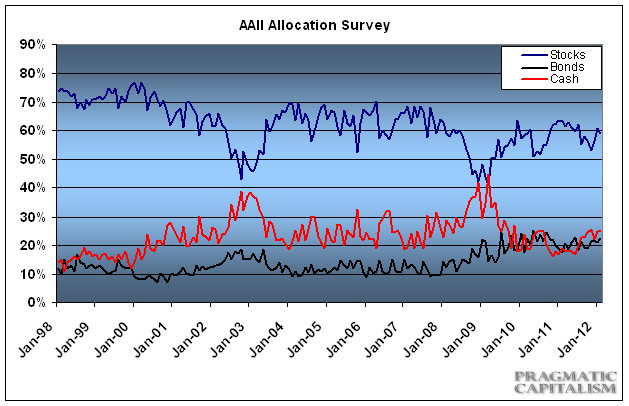
Despite the extreme outperformance of bonds during this period, allocations have remained relatively constant with a nearly 40% current differential between stocks and bonds. The current bearishness noted in the article has existed over this entire period and certainly should be well priced in by now.
The lingering fear for bond investors is whether inflation will push higher in the coming months and years. As Steve Randy Waldman highlights in the previous post, Depression is a choice, our current political choice clearly favors creditors and a low-inflation environment. Based on this view of political actions and the remaining over-indebtedness of households, I continue to believe that fears of higher inflation are also misplaced. In this light, long-term Treasury bonds will likely continue to provide returns competitive with stocks for the next few years.

