Showing posts with label Banking Crisis. Show all posts

Friday, March 29, 2013

"Cyprus Should Leave The Euro. Now."

Yesterday banks in Cyprus opened for the first time in a week. Markets were seemingly calmed by the absence of immediate bank runs, however the ability of depositors to actually create a bank run has been prevented by strict capital controls. The real test for Cyprus banks will come when the capital controls are finally lifted. Although the restrictions are only supposed to be in place for 7 days, recent experience in Iceland suggests the better question is not when but IF the capital controls will be lifted. Based on the IMF’s recommendation, Iceland instituted capital controls back in 2008 for what was supposed to be a few months. Five years later the capital controls remain in place and are expected to continue for at least a couple more years. As a base case we should expect an announcement next week that Cyprus’ capital controls will remain in place for a few more weeks (possibly months).

While the implementation of capital controls presents an interesting storyline, Paul Krugman has raised a much bigger question into the public spotlight. After being challenged to expand the boundaries of political possibility, Krugman offered the following recommendation (emphasis added):
So here it is: yes, Cyprus should leave the euro. Now.
The reason is straightforward: staying in the euro means an incredibly severe depression, which will last for many years while Cyprus tries to build a new export sector. Leaving the euro, and letting the new currency fall sharply, would greatly accelerate that rebuilding.
The question for Cyprus is therefore whether “internal” or “external” devaluation offers the best prospects for the future? Let’s consider both of the options...

“Internal devaluation” (i.e. income deflation) - In return for continued assistance from the Troika (EU/ECB/IMF), Cyprus has agreed to impose losses on equity and debt holders, as well as uninsured depositors, of the two largest banks (Bank of Cyprus and Laiki Bank). This marks a distinct change in policy, especially with regard to the latter two groups.* Since uninsured depositors held a majority of those banks’ liabilities, the focus has naturally been on that group. Based on recent estimates uninsured depositors in the Bank of Cyprus may lose approximately 40%, while Laiki Bank’s uninsured depositors will be entirely wiped out.

The sharp reduction in (perceived) wealth stemming from these actions will put severe downward pressure on national income. Individuals and businesses experiencing losses will try to increase saving by reducing spending. Banks fearing deposit flight and falling asset prices will try build a stronger base of capital by restricting the supply of credit and possibly selling assets. Adding to the fall, the government will be forced to accept a MoU (Memorandum of Understanding) that establishes policies to increase taxes and reduce spending. Combining these deflationary pressures, the overall economic results may rival (or exceed) Greece’s recent history.

During the past 5 years Greece’s real GDP has declined by 20%
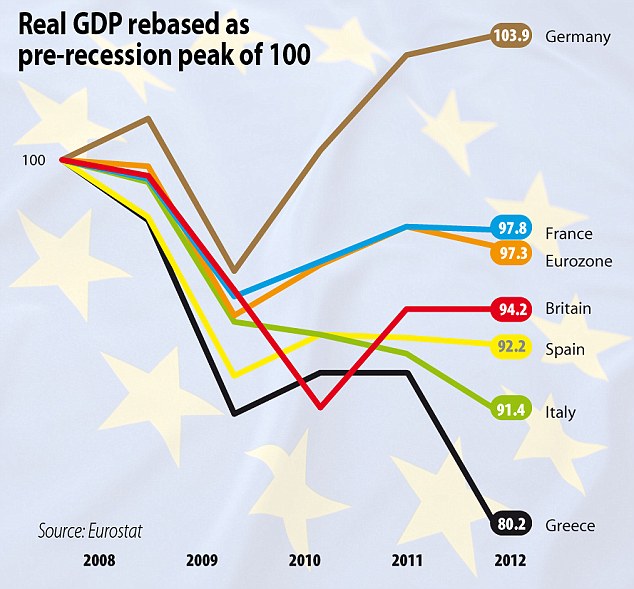
and unemployment has nearly quadrupled from ~7% to ~27%.


To offer some historical perspective, US unemployment during the Great Depression peaked at 25% and real GDP loss only exceeded 16% for one major European nation (Austria). Perhaps even more disheartening than the current data is recognition that output and unemployment appear unlikely to improve anytime soon.

Returning to Cyprus, unemployment has already quadrupled over the past 5 years (~3.5% to ~14%; shown above). Based on current estimates of a 20-30% drop in real GDP, Cyprus’ unemployment rate could easily approach or eclipse Greece’s in the next few years.

“External devaluation” (i.e. new currency) - If Cyprus were to leave the Eurozone, one of the first actions would be re-introducing the Cypriot pound at a heavily devalued rate against the euro. Not unlike the imposed losses on uninsured depositors, currency devaluation immediately imposes significant losses on all depositors. In this sense the impact on private demand would still be extremely deflationary, perhaps even more so. Though output and employment would fall dramatically, external devaluation presents reasons for potential optimism on both the foreign trade and government fronts.

Based on the recent bank losses and capital controls, Cyprus can no longer rely on its financial sector to support exports. By heavily devaluing its currency, Cyprus would be increasing its price competitiveness on the foreign market. However, as Barkley Rosser points out:
even with large elasticities [of trade relative to the exchange rate], there is the J-curve effect. Exports do not increase immediately, whereas the value of imports tends to jump up immediately with their price increases.
Aside from these timing issues, there is also a concern regarding the certainty of each effect. A large devaluation will definitely raise the cost of living for Cypriots but as JW Mason comments, it:
might not lead to higher net exports in the next few years, or ever. That’s the question -- not how big the devaluation would be, but how strongly it will affect trade flows.
As for the government sector, returning to the Cypriot pound would remove some of the current fiscal constraints. This would permit the government to increase spending (ideally investment in a new export sector) and not raise taxes, raising private sector income. While these adjustments will not come remotely close to overcoming the other deflationary effects in the short-run, the counterbalance provided will be a significant improvement over current policy.

In asking “Why Won’t Cyprus Obey Krugman?” Rosser concludes:
While this devaluation might make it easier for Cyprus to recover several years down the road, that recovery would indeed be several years down the road, and in the meantime there would be a lot of pain for the entire citizenry that will not happen if they stay with the euro.
If Greece has taught us anything about remaining with the euro, it’s that a lot of pain for the entire citizenry will happen regardless and a recovery may be decades down the road.

Cyprus is therefore faced with a choice between two terrible outcomes:
1) Remain in the Eurozone and experience a relatively slower “internal devaluation” whereby real output and employment experience large declines spread out over several years. A potential recovery is pushed even further into the future.
2) Leave the Eurozone and experience a quick “external devaluation” whereby real output and employment fall dramatically in the next year or two, but a recovery several years down the road becomes far more probable.

Where Rosser and I find agreement:
is that the real real issue here has to do with time preferences. It may get down to hyperbolic discounting. People do not want to have pain in the near term. So, the fear by the whole population of near term pain in terms of standard of living may outweigh fear of a more gradual decline with rising unemployment, even though the shorter term sharp pain is likely to lead to a sooner turnaround to growth.
Although this psychological tendency is very normal, it can at times be detrimental to achieving longer-term goals. The cases of Greece, Spain, Italy, Portugal, Ireland, and now Cyprus are examples of such times. The severe pain of reduced standards of living and high unemployment will be felt one way or another, but the option of “external devaluation” offers potential for a better future five and ten years down the road. Therefore I concur with Krugman, “Cyprus should leave the euro. Now.”        


* From my perspective, imposing losses on debt holders should have been done from the outset in the US and Europe. The apparent change in policy may raise costs of debt financing for the largest banks, but that should be a welcome change after years of enjoying a TBTF subsidy.

Tuesday, September 11, 2012

Forgotten Lessons from the Shadow Banking Crisis of 1763

An area of concern during and after the most recent financial crisis is the shadow banking system. For many people, the important and troubling notion of shadow banking is that it rests outside the purview of many regulatory structures. However, there is a subtler distinction which has persisted throughout history and may offer guidance for future crises. That distinction is the reliance on short-term funding through sales of commercial paper (or repos), rather than deposits, which increases susceptibility to bank runs. Although shadow banking may seem like a relatively new phenomenon, the practice actually goes back at least 250 years.

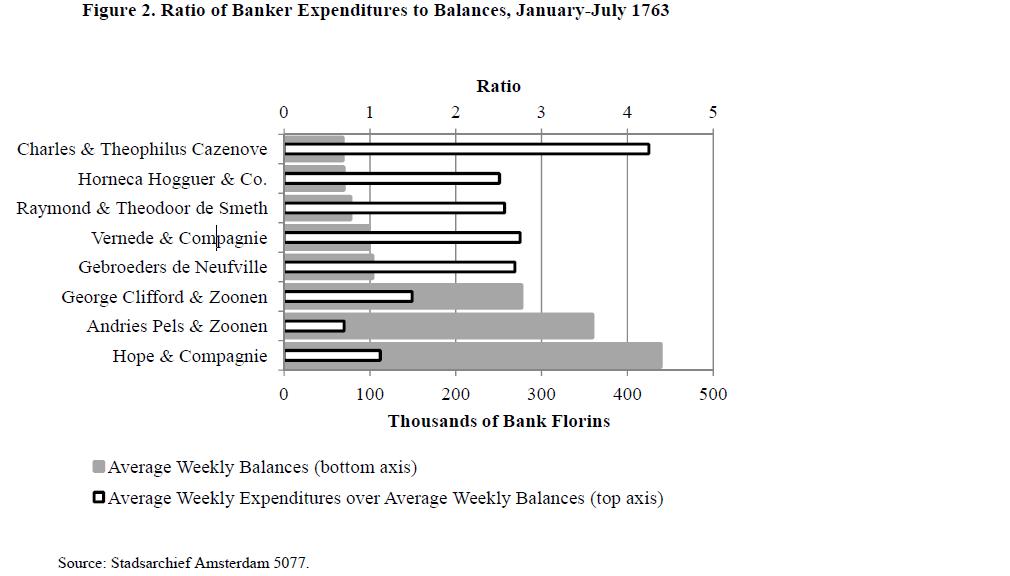
In Responding to a Shadow Banking Crisis: the Lessons of 1763, Stephen Quinn and William Roberds guide us through events leading up to Amsterdam’s banking panic and analyze the central bank’s corresponding actions. There are numerous similarities between the different periods ranging from “the Lehman-like failure of the banking house Gebroeders de Neufville (p. 3)” to the expansion of central bank liquidity “in an unprecedented and ad hoc basis. (p. 3)” Leverage also played an important role in both crises. The following chart compares the average weekly starting balances of the eight largest banks in 1763 with their average weekly turnover (i.e. the amount of borrowing necessary to fund their positions):


While credit was initially accepted from and provided to these institutions equally, those banks most highly leveraged and reliant on short-term funding found themselves in the most precarious positions following the first bank failure. It should be no surprise then that the fall of Bear Stearns, Merrill Lynch, Lehman Brothers, and potential others preceded in a similar order.


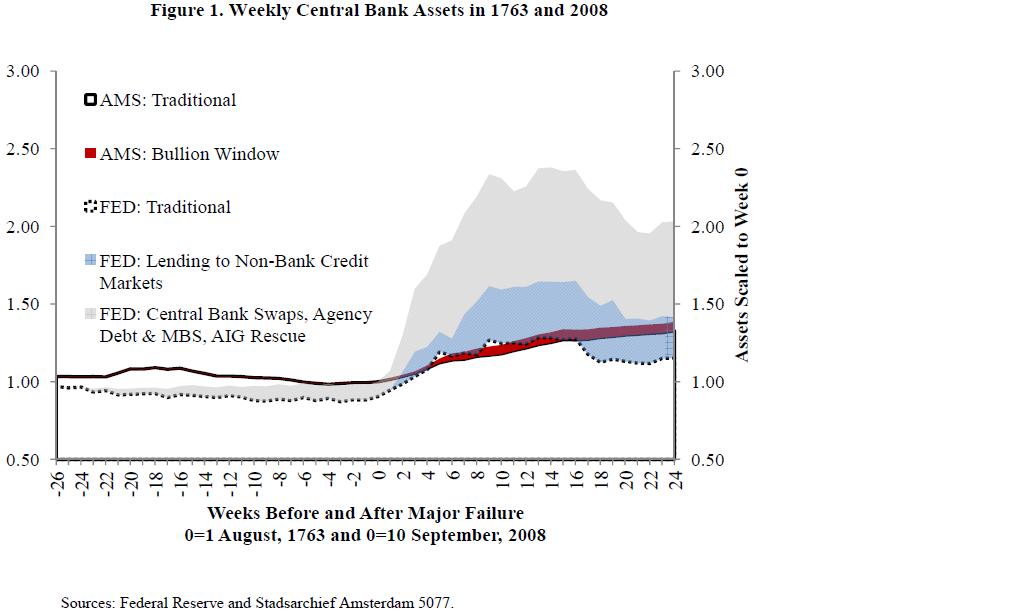
Seeking to stem the crisis, the Bank of Amsterdam (the central bank) initially allowed its balance sheet to respond endogenously to market demand through its coin window. As the stock of eligible collateral grew thin, the Bank of Amsterdam relaxed its eligibility constraints to include  silver bullion. The following chart compares the rise in central bank balance sheets through various measures in each of the crises:


In 1763 and 2008, under highly different regulatory constructs, the largest banks were highly leveraged and increasingly reliant on short-term funding. Although these factors were of little concern while markets remained liquid, a sudden dearth of liquidity nearly caused numerous large bank failures and led to severe economic fallout in the surrounding areas. Responding to the crisis in 1763, notable differences were the lack of federal bailouts and the central bank’s decision to only lend against good collateral at above market rates.

The crisis of 1763 teaches us that shadow banking is not necessarily a function of eluding regulations but rather an effective means for banks to increase their extension of credit and disperse the associated risks. Unlike the measures taken in 1763, responses to the 2008 financial crisis have further reduced the incentives of bank creditors and managers to worry about leverage or liquidity. Shadow banking has a long history and will probably have a long future as well. If we are to either avoid more frequent recurrences of these crises or reduce their impact on the broader economy, we must learn and practice the lessons from history.

Thursday, July 12, 2012

How Out-of-Control Credit Markets Threaten Liberty, Democracy and Economic Security


Think back to the Great Depression. What we lost then and now and what we need to regain is trust. To be frank, I don't know how we can win that trust in our system back. But, when it comes to credit markets, I know where we can start.
First, we need to make sure there are no more bailouts. While the bailouts have prevented a Great Depression for now, they have engendered a deep sense of cynicism and resentment which has negatively impacted credit and growth. Second, we need to know that our largest financial institutions are well-capitalized enough to withstand large economic shocks. Without this knowledge, no one can separate liquidity from solvency — exactly the problems banks had during the Great Depression. Third, we need to enforce regulations through sound regulatory oversight and civil or criminal penalties. Self-regulation is a pipedream promoted by corporatists. And we see that time and again where regulations are not enforced, financial institutions turn to excess that leads to panic and crisis.
Doing these three things will not magically turn our economy around and get credit flowing again. But these steps are essential to restoring trust in our financial institutions and government. Restoring that trust is the first and most important step in getting our credit markets to work the way they are supposed to — in a way that enhances and insures our individual liberty, rather than the false privileges of corrupt financial institutions.
Read it at Naked Capitalism
How Out-of-Control Credit Markets Threaten Liberty, Democracy and Economic Security
By Ed Harrison

In trying to understand our modern monetary system and the problems at the heart of the current crisis, the most important aspect is credit. Although I currently believe demand for credit is a greater issue, problems within financial institutions remain serious. Harrison’s third point, which seems to contrast an earlier view about the need for more regulation, is worth highlighting. In the US there are already thousands of regulations for financial institutions. The trouble is that many are simply not enforced or hold penalties so small as to make breaking the rule still worthwhile. Greater transparency and enforcement are clearly needed in light of the recent PFG bankruptcy, LIBOR scandal and countless other known and unknown transgressions.

Thursday, June 28, 2012

Forget Europe, China Could Be Lehman 2.0

David Keohane at FT Alphaville points out that
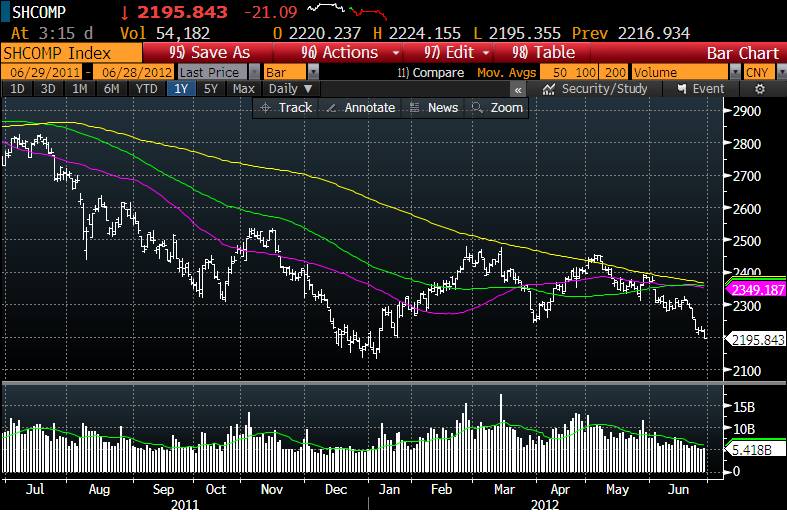
The Shanghai composite index has now fallen for the past 7 days in a row and is down some 10 per cent since a high on May 4th.
Here’s a chart from Bloomberg displaying the index over the past year:
Not only has the index declined about 10% on the last two months, but it is down more than 20% in the past year. For all the recent bullish talk over further stimulus from China, the domestic market is certainly not buying it.

Although this chart provides a disturbing outlook for China, it has been largely overlooked by the mainstream media which continues to focus on a possible Lehman 2.0 moment out of Europe. What if the next Lehman moment actually comes from China instead? Discussing the risks posed by credit guarantee companies, Patrick Chovanec suggests:
The web of interlocking, often incestuous, and sometimes circular credit arrangements is reminiscent of Wall Street in the lead-up to the subprime crisis, in which a relatively small amount of mortgage losses, which most people believed could be contained, triggered a chain reaction that brought down major banks and froze credit across the entire global economy.
According to the article from Caixin magazine, banks were effectively outsourcing their loan review processes to these credit guarantors. Similar to mortgage lenders during the US housing boom, it appears the interests of banks and credit guarantee companies aligned to produce a massive extension of credit with little consideration about the borrowers’ ability to repay. With housing prices falling and property development no longer booming, it appears these financial institutions have begun the Ponzi finance portion of a Minsky cycle, whereby in Patrick’s words:
a lot of these firms are actually insolvent and are just borrowing from Peter to pay Paul, in order to postpone the day of reckoning.
That day of reckoning will come, but the question of timing remains uncertain. The larger concern is, how big and systemic will losses be? If it was difficult to determine the extent of the issue in the US, trying to do so in China will be nearly impossible given the general uncertainty surrounding any publicly reported economic/financial data. Could the fallout from these lending schemes actually be the next black swan? Only time will tell. For now it appears that as China’s growth is slowing, risks within the financial system and chances of a hard landing are growing.

Tuesday, June 26, 2012

Cullen Roche - Misunderstanding Banking is Helping Bankrupt an Entire Society


What is Wall Street’s job?  Wall Street’s job is simple.  It is to increase earnings for their shareholders.  It is not to provide jobs for the private sector.  It is not to make sure the US economy is running smoothly.  It is not to make sure you feel good about your day to day life.  It is to generate a profit for its owners.  This is the essence of private banking.  To generate a profit.  But banks play a unique role in our capitalist system.  I’ve explained before that banks are not the engine of capitalism.  They are simply the oil in the machine.  As the oil in our machine, banks must be functioning smoothly in order for the machine as a whole to be functioning smoothly.  So when big banks do bad things that threaten their well-being parts of the system begin to malfunction.  And sometimes when these mistakes are big enough the contagion leads to the entire machine malfunctioning and requiring a major repair (hello 2008!).
But make no mistake, your local bank is not your best friend or a public purpose serving charity.  For instance, when a bank extends a mortgage (a word literally meaning “death security pledge” from the latin root “mortuus” for death and germanic “security pledge”) they are not doing you some charitable service to help you buy your home.  They are rating your credit risk and evaluating you as a potential profit engine for their shareholders.  That might not be the most pleasant way to think about it, but it is what it is.  A bank is not a charity.  It does not really care if your mortgage results in jobs or happiness for you.  Of course, it would be great if this did because that might result in more future business, but the bank does not need these things from you in order to generate a profit.  It really just wants to manage its risks in a way that helps to generate a profit for their shareholders without excessive risk.  Obviously, the debtor finds the mortgage advantageous, but don’t confuse this service for charity work.  It’s just good old fashioned profit seeking and offering a service where one is needed (in this case, the debtor being able to obtain money they could not otherwise currently obtain).
Read it at Pragmatic Capitalism
Misunderstanding Banking is Helping Bankrupt an Entire Society
By Cullen Roche

Cullen remains one of my primary go-to sources for a clear, objective view of our monetary system. While this post is strong in many facets, it appears to downplay the role of government in the current environment. Deposit guarantees, creditor bailouts and tax laws are just a few of the ways in which government alters the price of credit. These actions, which impact the decisions of both banks and consumers, may unintentionally exacerbate the normal boom/bust cycle.

Wednesday, May 30, 2012

Permanent Zero: Record Low Treasury Yields and Banking Instability


The Fed is squeezing interest rates down to levels where you see private portfolio preference shifts, a euphemism for the risk seeking return mentality that arises from artificially low real fixed income returns and that forces up risk assets. But this can only go one for so long.
See, eventually there will be another recession and the question should be what happens to all those toxic assets on bank balance sheets. What happens if new loans go sour too? If you recall, US FDIC-insured institutions recorded $35 billion in Q1 2012 accounting gains. But the quality of those accounting gains was dubious. Here’s the key line to note:
Lower provisions for loan losses and higher noninterest income were responsible for most of the year-over-year improvement in earnings.
Read it at Credit Writedowns
What record low 10-year rates tell us about the toxic effects of permanent zero
By Edward Harrison

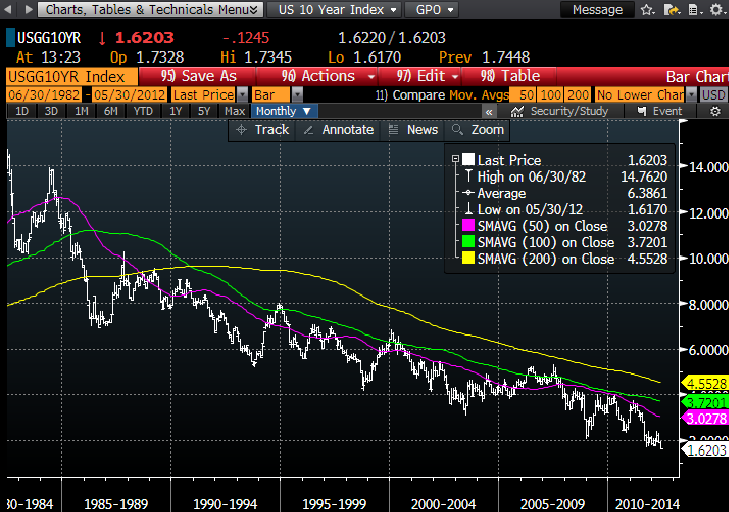
Yields on 10-year Treasuries reached a new record low of 1.617% today.
Regarding the continuing decline, Harrison explains that Long-term interest rates are a series of future short-term rates. The Fed has already “promised” to hold rates near zero through 2014 and I suspect that target date will be extended further by year end. Separately, when the Fed altered policy to begin paying interest-on-reserves (IOR) it also changed the direct measure by which monetary policy is adjusted. Given the enormous size of the Fed’s balance sheet (and outstanding Treasury debt), going forward it may be easier to effectively raise interest rates by hiking the IOR rate rather than actually altering the Fed’s target rate. With these concepts in mind, it should come as no surprise that 10-year (and 30-year) yields continue to move lower in similar fashion to Japan (although I currently don’t expect Treasury rates to reach the JGB lows).

Over the past couple years I have also remained suspect of US banking profits (and by extension S&P 500 operating profits) for the reason highlighted above from the FDIC. Much of the gains appear to be merely accounting profits. When the next recession/crisis hits, those accounting profits can (and probably will) easily flip to large accounting losses. In my view, the risk of serious shortfalls in capital during the next downturn remains extremely present today. As Minsky often pointed out, complacency about risk is often a warning of building risks in the background.  

The next crisis/recession will probably occur with short-term rates still at zero and without many aspects of the Dodd-Frank Act or Basel III provisions in place. Given the public response to previous bailouts, the Treasury/Fed response will be a wild card. Any bets on what their initial actions will be?


Related posts:
Fed Stands in Own Way on Monetary Policy
Treasury Yields Low for Good Reason

Tuesday, March 20, 2012

"Stress" Tests Succeed as Bank Marketing Tool

Last Tuesday, JP Morgan announced plans to increase its dividend and buy back stock after passing the Federal Reserve’s stress tests, which were set to be reported two days later. Since the announcement, JP Morgan’s stock has rallied over 10%. Other banks followed suit, forcing the Fed’s hand in announcing all their results early. In total, 15 of the 19 banks analyzed officially passed the test. Bank of America’s stock has risen nearly 25% since passing and is up over 75% so far this year, leading a more than 20% year-to-date rise in the broader financial sector.

From the perspective of improving sentiment, the stress tests are clearly a roaring success. However, investors should remember that the purpose of the stress tests was to inspire confidence and NOT to test the liquidity or solvency of banks in a crisis. As Bloomberg’s Jonathan Weil highlights in Class Dunce Passes Fed’s Stress Test Without a Sweat:

“Citigroup Inc. (C) was deemed well capitalized under the government’s methodology when it got bailed out in 2008. So was CIT Group Inc. when it filed for bankruptcy in 2009.”
The stress tests then and now continue to use Tier 1 Capital ratios, which is simply the amount of Tier 1 capital divided by a firm’s risk-weighted assets. Risk-weightings are often decided by the regulator based on credit ratings. Many AAA-rated securities are assigned 0% risk and removed from the calculation. As various assets are downgraded during a crisis, total risk-weighted assets rise and the Tier 1 Capital ratio declines. Rating changes, which played a major role in both the financial and European debt crisis, depict one of many flaws in using Tier 1 Capital Ratios to assess a bank’s health.

Although the Fed continues to use this poor indicator, Weil notes that:
“Tangible common equity became the capital benchmark of choice for many investors during the last U.S. banking crisis, because the government’s main capital measures lost credibility.”
Expanding his investigation into the current realistic health of banks, Weil found that:
“if it weren’t for the inflated loan values, [Regions Financial’s] tangible common equity would have been less than zero, with liabilities exceeding hard assets.”
Despite still not having paid back TARP funds and potentially being insolvent, Regions passed the stress tests.

Apart from testing somewhat irrelevant capital measures, the stress tests also provided an estimate of bank losses during the projection period (Q3 2011-Q4 2013). During that year and a half the Fed projects these 19 banks will, on net, lose nearly $250 billion. These estimates are almost surely optimistic and don’t account for future losses on these assets, among other things. Daniel Alpert of Westwood Capital, LLC has great, detailed report on the expected losses over time,  Deconstructing the Federal Reserve’s 2012 Comprehensive Capital Analysis and Review: What Does the CCAR Really Tell Us About the Big 4 Commercial Banks? As the title suggests, the Big 4 banks may be significantly more vulnerable than many expect.

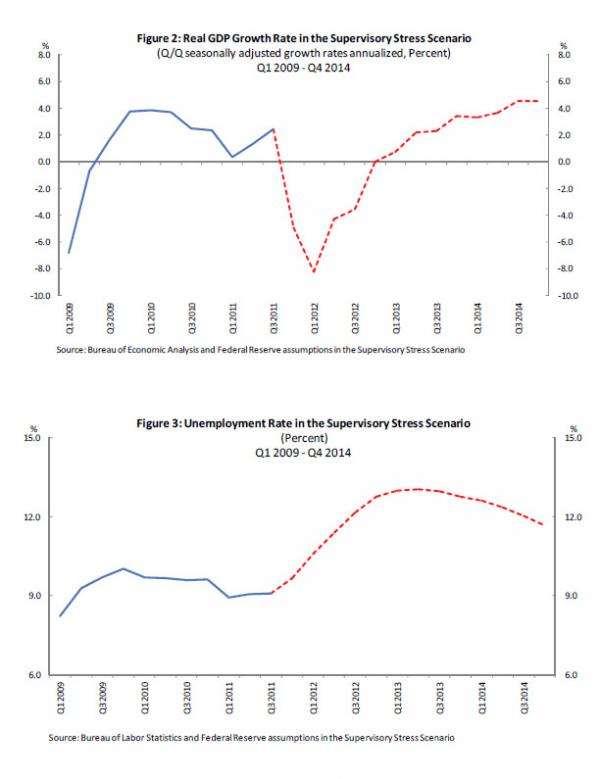
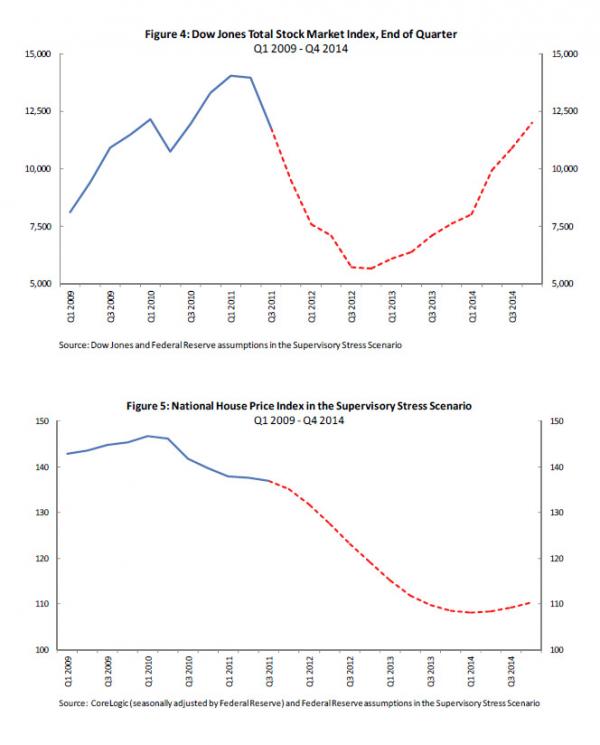
One final point of interest regarding the stress tests relates to the underlying assumptions made by the Fed. The following graphs outline the assumptions made (courtesy of Zero Hedge):
Reflecting similarities to the most recent crisis, GDP and the stock market move sharply upward after the initial decline, while unemployment and housing prices languish. The aspect I’ve yet to see mentioned with these assumptions is that the bailouts (Fed and TARP) along with stimulus measures are supposedly the reason behind the rebound. One might then infer that the Fed’s stress tests assume future bailouts and stimulus measures, of similar proportions, to achieve comparable results.

Overall the Fed’s stress tests have been wildly successful as a promotional tool for the largest banks. Many of these banks are now increasing the return of capital to shareholders that will prove critical in the next crisis. Maybe after the next round of bailouts regulators will be forced to change their approach.

Monday, September 5, 2011

A September to Remember

Three years ago, on September 7th, 2008, the federal government nationalized Fannie Mae and Freddie Mac. The following week, Bank of America bought a Merrill Lynch, Lehman Brothers filed for bankruptcy and AIG was bailed out by the Federal Reserve. During the next couple weeks, Washington Mutual also went belly-up, Wachovia was acquired and the remaining investment banks converted into bank holding companies. In markets, credit spreads widened drastically and equity market volatility heightened substantially, including the S&P 500’s largest loss in history of over 100 points (nearly 9%).  

This year, following a weak August, credit and equity markets have gotten off to a miserable start in September. During the first two days of trading, the S&P lost nearly 4% and at the moment is down close to 3% in the futures market. Losses in Europe are even more staggering, with several major indices already losing nearly 10% this month, following grater than 15% drops last month. Sovereign and bank credit markets, especially in Europe, are also freezing up as the crisis worsens. These are ominous early signs of another September to rival its historic predecessor.

Although only three short years have passed, the global economy appears to be following a similar pattern. After trying to kick the can down the road for more than year, numerous underlying problems are unraveling around the world in concert with one another. Each successive attempt at papering over issues has a shorter shelf-life and the time for politicians to get ahead of the troubles is rapidly decreasing. A quick tour around the world’s major economies will shed light on the ensuing global crisis.

US-

Reminiscent of headlines in 2008, Friday witnessed new troubles stemming from apparently plagued mortgage-backed securities. From the FHFA website (http://www.fhfa.gov/webfiles/22599/PLSLitigation_final_090211.pdf):

Washington, DC -- The Federal Housing Finance Agency (FHFA), as conservator for Fannie Mae and Freddie Mac (the Enterprises), today filed lawsuits against 17 financial institutions, certain of their officers and various unaffiliated lead underwriters.  The suits allege violations of federal securities laws and common law in the sale of residential private-label mortgage-backed securities (PLS) to the Enterprises.  

Complaints have been filed against the following lead defendants, in alphabetical 
order:
1. Ally Financial Inc. f/k/a GMAC, LLC
2. Bank of America Corporation
3. Barclays Bank PLC
4. Citigroup, Inc.
5. Countrywide Financial Corporation
6. Credit Suisse Holdings (USA), Inc.
7. Deutsche Bank AG
8. First Horizon National Corporation
9. General Electric Company
10. Goldman Sachs & Co.
11. HSBC North America Holdings, Inc.  
12. JPMorgan Chase & Co.
13. Merrill Lynch & Co. / First Franklin Financial Corp.  
14. Morgan Stanley
15. Nomura Holding America Inc.
16. The Royal Bank of Scotland Group PLC
17. Société Générale  

These complaints were filed in federal or state court in New York or the federal court in Connecticut.  The complaints seek damages and civil penalties under the Securities Act of 1933, similar in content to the complaint FHFA filed against UBS Americas, Inc. on July 27, 2011.  In addition, each complaint seeks compensatory damages for negligent misrepresentation.  Certain complaints also allege state securities law violations or common law fraud.

Although the full repercussions cannot be known at this time, the fall out may prove very large. While the Obama Administration has been working hard to undermine an investigation by New York’s AG into similar matters, another part of the administration has seemingly subverted those goals. This lawsuit almost certainly dampens the Administration’s hope that the largest banks could avoid serious litigation in return for a small fee ($8.5 billion). Of the institutions listed above, several pose interesting related questions, yet the biggest questions are tied to Bank of America’s solvency.

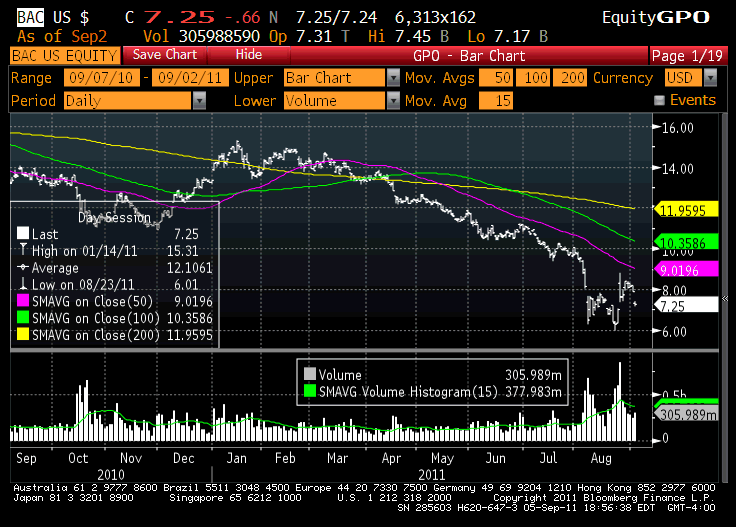
Witnessing its stock fall more than 50% this year (shown below), Bank of America has continually denied claims about needing to raise capital. Despite these apparently false claims, the bank raised capital by selling warrants and preferred stock, along with a significant stake in the China Construction Bank, at steep discounts. Even with these actions, confidence remains fragile, as shares tumbled again on Friday.


Due to its purchases of Countrywide and Merrill Lynch, Bank of America was effectively sued in three separate claims noted above. Combining these claims generates total claims against in excess of $50 billion. However, these claims only represent a small portion of potential liabilities outstanding related to the sale of MBS and foreclosure fraud. Whether the bank ultimately settles these claims or attempts to fight in court, losses will almost certainly be significant and uncertainty regarding the outcome will weigh on the firm for some time.

Apart from unknown losses discussed above, the bank is also currently sitting on untold losses related to its own mortgage holdings, as well as European bank and sovereign debt. Thanks to the ongoing suspension of mark-to-market accounting, the actual market value of current assets is highly unpredictable. Regardless, markets are suggesting current assets should be marked down by billions of dollars and those numbers can only increase as markets weaken.

How long will the confidence last? With Bear Stearns, Merrill Lynch and Lehman Brothers, the final straw seemed to be when institutional investors began pulling funds in mass. Considering recent votes in the US House, another TARP seems unlikely at this juncture. If Friday’s lawsuits spur another significant sell off in the bank’s stock, institutional investors may decide to seek safety elsewhere. Were a run on Bank of America to occur, it’s hard to envision several other weak banks not being targeted as well. The Dodd

Europe -

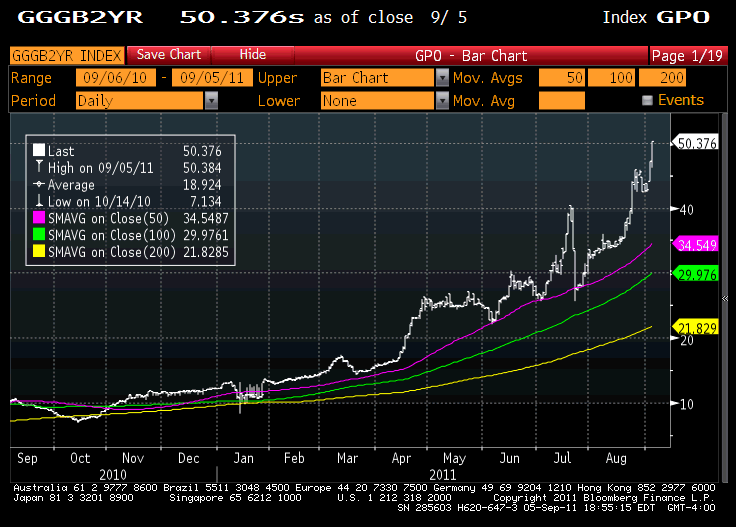
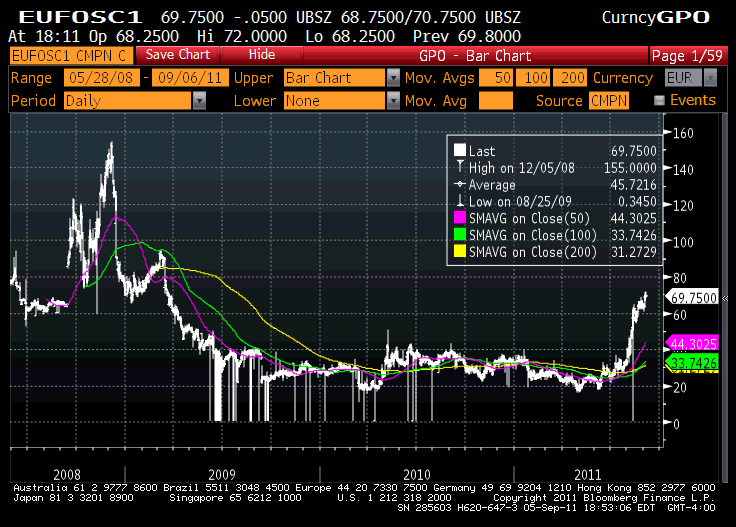
On a timeline basis, the sovereign debt crisis in Europe feels most similar to the US housing crisis. Nearly 18 months ago, problems began showing up in EU periphery countries, notably Greece. As yields widened, the country’s solvency was questioned and after ECB intervention, a bailout was concocted. Despite a couple more bailouts, Greece’s economy continues to deteriorate under the weight of austerity and a strong Euro. Over the past few days, short-term yields have exploded upwards, with the 2 year exceeding 50% (shown below). Not only are markets pricing in 100% chance of default, but far more significant losses than the most recent proposals by the EU/ECB. Apparently recognizing Greece represents a solvency issue, not liquidity problem, the IMF and several EU nations are reconsidering any further aid. 


After Greece, Portugal and Ireland also fell victim to economic deterioration and questions regarding their own solvency. These countries have been locked out of credit markets for more than a year now. Having also received bailouts for austerity measures, economic performance has not turned around and debt levels have worsened. Resolutions involving some form of default still appear almost certain.

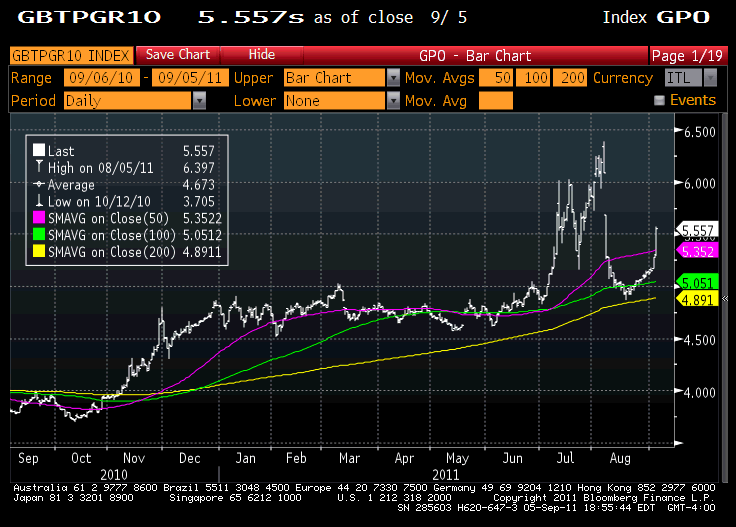
While most market participants expected Spain to become the next casualty of bond vigilantes, markets surprisingly leap frogged Spain, instead attacking Italy. Starting in July, 10 year yields quickly spiked from under 5% to early 6.5% (shown below). Fearful of the consequences, the ECB once again stepped in to purchase Italian and Spanish debt to stem the rising yields. After successfully pushing yields back below 5%, the markets have once again responded, sending Italian yields back above 5.5% today. 


The recent rise comes after Italy’s government attempted to roll back various austerity measures. As Kiron Sarkar notes in a post on The Big Picture (http://www.ritholtz.com/blog/2011/09/people-who-play-with-fire/):

“The Italians better reconsider their recent attempts to backslide from their commitments – they have a large debt maturity this week – some E14.6bn and E62bn by the end of September (the highest ever in a single month). In total, Italy must roll over E170bn by end December – Whoops.”  

Trying to sell that amount of debt may generate a further sell off in Italian debt, for which the ECB and EU appear unprepared.

Sovereign debt problems are on the verge of spiraling out of control, which is especially scary considering the lack of political unity in Europe. Time is running out on a grand solution and if politicians are forced into a reactive resolution, markets and economies will likely pay the price. As sovereign debt continues to be repriced lower, the resulting market losses are weighing heavily on European banks.

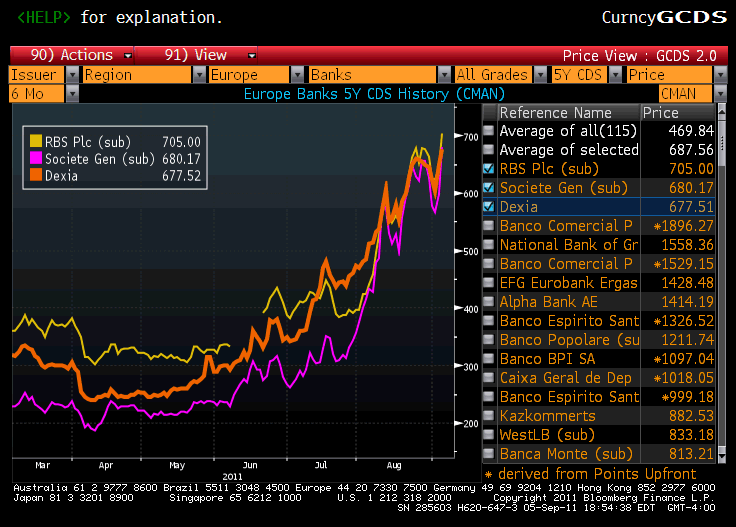
Stock prices of European banks have been falling precipitously over the past couple months. After a brief reprieve due to several countries banning short-selling on the securities, prices are once again falling. As I detailed in Europe Revives Failed Policies of 2008, these measures have been proven to fail and may even worsen the situation. Currently, credit spreads for interbank lending are showing significant strain and approaching levels last witnessed during the crisis of 2008 (shown below, top). Credit default swaps (CDS) on many banks are also reaching new records, potentially stemming from banks trying to hedge counter party risk (shown below, bottom).


Given the global nature of banking, credit problems in Europe may leak into US markets.  Once again, the ECB and Fed (primarily) will be forced to provide liquidity to the financial system. Similarly to the US, if one major bank faces a run, several others are likely to follow. With most of Europe already either in recession or experiencing sub-1% growth, the entire EU risks falling into another recession by year end. Risks are now increasing at a rapid pace, hence the next few weeks promise to be very interesting.

Asia -

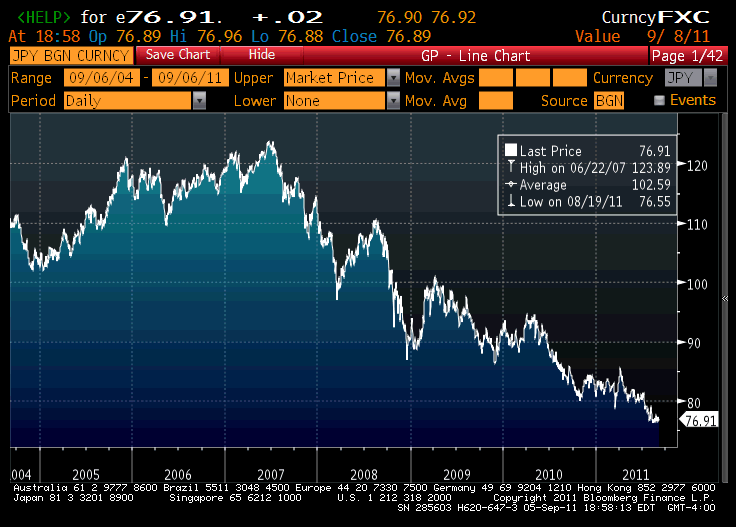
After suffering a horrendous earthquake and tsunami, the Japanese economy fell back into recession. While trying to rebuild, global economic fear has sent cash flocking to the safe-haven Yen. Recently hitting all-time highs against the dollar (shown below), a strong Yen has caused exports to falter and hindered the economic recovery. Attempts by the BOJ to intervene in exchange markets have proved woefully unsuccessful. Further hurting the potential for recovery has been an unwillingness to increase deficit spending, which could generate internal demand and weaken the currency. 


As for China, the country has been fighting inflation by raising reserve requirements. History shows that this measure is not particularly successful in reigning in inflation. Recent moves to let the Yuan float higher are more encouraging. China also faces trouble relating to a fixed investment rate near 50%, potential housing bubble and rapidly increasing bad bank debt. Regardless of specific measures taken to thwart these issues, history suggests the most likely outcome is a “hard landing,” which could represent GDP growth below 5%.

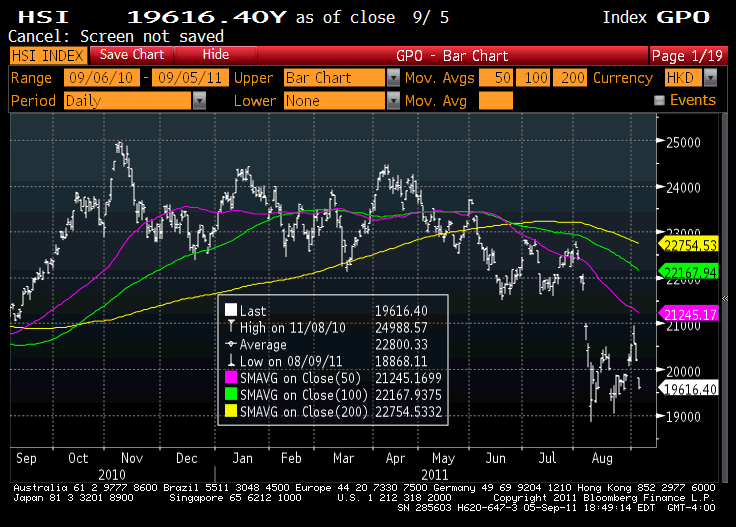
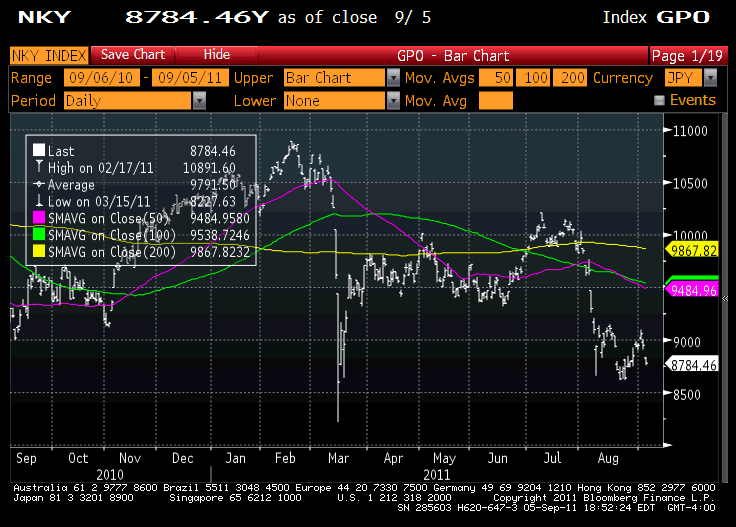
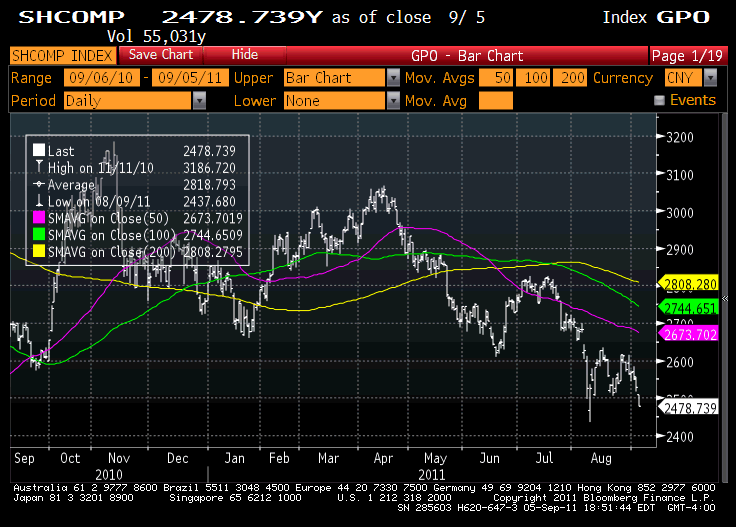
For both of these export driven countries, weakening demand from US and Europe will pose significant problems on top of those already established. As the financial crises of 2008 displayed, global economies are very intertwined in today’s world and the troubles of one large nation will exert pressure upon the others. With equity markets in both these counties having already joined Europe in bear market territory, the immediate future is not looking promising (shown below: Hang Seng, Nikkei, Shanghai).


Over the past two years, markets have responded positively to a stimulus led economic recovery across developed nations. Weakening within credit markets has been largely written off as excessive caution. As credit markets weaken further and economic recoveries falter, it appears this time is not different. Equities have been moving quickly to catch up with credit markets on the way down, however the remaining spread still seems quite wide. Unfortunately the global financial system is practically no more transparent than several years ago, which means questions of solvency, plaguing the market, will be hard to defend against. Measures taken in 2008 to provide liquidity and capital will also be significantly harder to pass in a world concerned with sovereign debt and monetary devaluation.

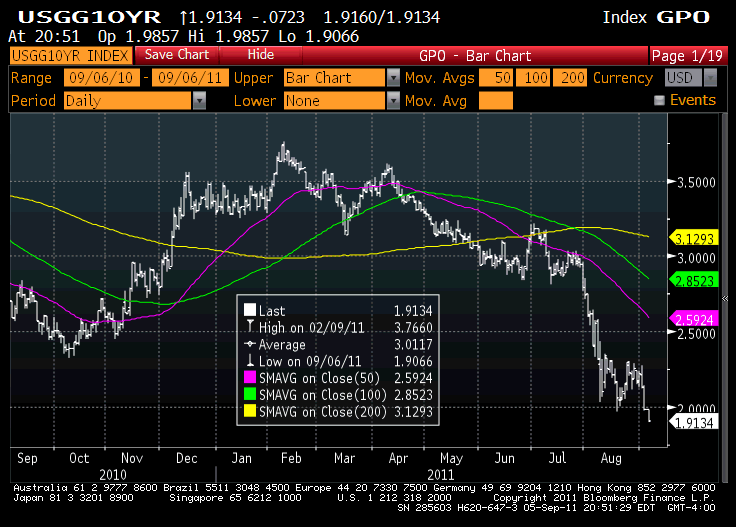
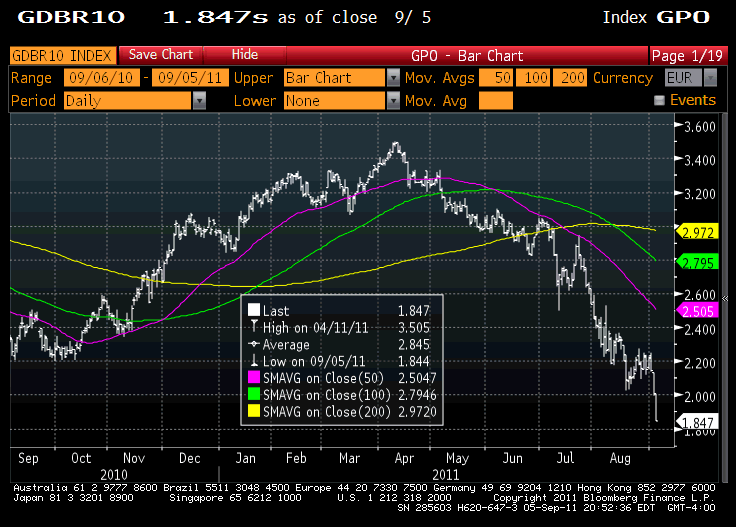
US and German 10 year yields have now joined Japan in the sub-2% club (shown below), which suggests a lengthy period of minimal economic growth and inflation. As equity markets price in a similar outcome, I expect much further declines. A focus on individual companies with strong balance sheets and high dividends should offer great relative value. As for the dollar, equity weakness, global risk and ultimately an interest rate cut by the ECB will likely provide strength. There are times to seek a return on capital and times to seek the return of capital, I believe now is the latter.


Only three years ago, the global economy witnessed the worst recession since the Great Depression. Few people imagined so short a time could pass before the world was once again faced with such enormous challenges. Back then, September marked the period where issues started to really unravel. Could September once again witness the unfolding of historical events? Only time will tell, but based on the first few days, it certainly appears this will be another September to remember.

Wednesday, August 17, 2011

Why QE2 Failed, Part 1


Following last week’s severe volatility and steep drops, equity markets have regained their footing this week. Renewed confidence in the economic outlook has come despite continued weakness in economic data as evidenced by a 30-year low in U.S. consumer confidence, deteriorating manufacturing reports and nearly stalled growth in Germany, as well as the rest of the Eurozone. Some of the confidence may stem from expectations that Eurobonds are becoming a more realistic option, providing support for the Euro. Other investors appear to be holding out hope that Fed Chairman Bernanke will hint at QE3 during the forthcoming economic conference at Jackson Hole. Having previously highlighted aspects of zero percent interest rates and monetary illusions, the operations of quantitative easing can be further explained. Understanding this process will help explain why QE2 failed to have a noticeable impact on the economy or create sustained inflation.

As I noted in Monetary Illusions, as long as individuals maintain confidence in a bank’s solvency, banks can grant credit through fiduciary media that is uncovered by current capital. A bank’s ability to provide loans is therefore never constrained by the amount of capital. Loan creation, however, is constrained by price and demand. To recognize the effects of QE it is important to consider the impact on price, demand and the quantity of “money” within the economy. Before looking into the Fed’s actions, further consideration of non-central banks is necessary.

An obvious function of banks is holding deposits and making loans. A less obvious observation is that most credit is granted without the backing of money. Although this credit is treated equivalent to money, for our purposes it will be considered money substitutes. During normal economic periods, the demand for credit vastly exceeds the money held by banks. Seeking to earn interest income, banks provide loans through fiduciary media to customers. The interest rate (price) on the loan corresponds to market interest rates and the perceived credit risk, or potential of the loan not being repaid.

When banks grant credit uncovered by money, customers simply promise to repay the loan plus interest in the future. Based on this action, the total base money (money and money substitutes) is actually increased. The extra funds are free to circulate through the economy. Since the supply of “money” has expanded, holding the number of goods in the economy constant, the price of goods initially rises. Also, because one person’s spending is another person’s income, total income temporarily rises. In theory this process could continue indefinitely, if production of goods doesn’t exceed growth in base money and confidence in the banking system is maintained. Unfortunately, maintaining this balance has proved elusive throughout history.

At this point it should be clear that banks have the ability to create “money” (money substitutes) out of thin air. Many people seem to believe that the Fed is undertaking this process through quantitative easing. Yet there is a very distinct difference between QE and granting credit through fiduciary media. As stated earlier, when banks provide credit through fiduciary media, consumers only promise repayment in the future. No current assets are exchanged for the loan. During QE it’s true that the Fed created new reserves separate from any capital. The crucial difference is that the reserves were exchanged for another current asset, Treasury notes. Although the Fed’s balance sheet expanded, this process in no different than normal open market operations used to control short-term interest rates and the supply of base money. As for banks involved in the process, their balance sheets were not expanded, but rather the composition of assets was changed.

Many economists and investors have focused on charts that display monetary growth including banks’ excess reserves. Using this definition of “money” has led many individuals to believe that QE will create high inflation as more money chases the same number of goods. This assumption misses the critical point that bank lending is not constrained by reserves. Net financial assets in the real economy (excluding the Fed) remain unchanged. Since no base money has been added to the real economy, the long-run exchange value also holds steady.

These concepts are certainly clear to the Federal Reserve Board, so an interesting question is, why would the Fed perform QE? As stated by the Fed, a primary goal was to reduce interest rates. Through QE2, the Fed swapped short-term reserves for longer-term Treasury notes. This process reduced the number of Treasury notes freely traded in the economy, lessening the amount of effectively risk-free securities. With the demand for risk-free securities expected to remain relatively constant, reducing the supply drives up prices and lowers interest rates.

The Fed also intended to generate a positive wealth effect through QE2. This expectation stemmed from the belief that the remaining supply of risk-free securities would not satisfy demand. Funds resulting from this excess demand would be invested in slightly riskier securities rather than simply held in cash. By increasing demand for riskier securities, asset prices would be pushed higher. Ultimately, increasing paper wealth should reduce the desire to save and increase spending.

Despite the Fed’s best efforts, unintended consequences of their policy resulted in failure on the first goal and only temporary success on the latter. Due to a common misconception that the Fed was “printing money, “ inflation expectations rose. Fear of losses in real purchasing power countered the reduction of Treasury note supply and potential decrease in interest rates. These fears, coupled with increasing asset prices, spurred demand for hard commodities rather than finished goods that might require subsequent increases in production. The resulting commodity inflation actually reduced aggregate demand for finished goods, creating a drag on the economy.


At the onset of QE2, the solvency of banks was not in question. Rather than removing illiquid securities from the economy, the Fed exchanged one liquid asset for another. Without altering net financial assets in the system, the main goal was to reduce real interest rates, convincing individuals to increase loan and aggregate demand. Misunderstanding of the monetary system, by much of the public, created outcomes far less stimulative than hoped. Future risks to the system have also been heightened by continued intervention. Had policy makers looked beyond neoclassical economics and considered the impact of private sector debt burdens, it’s hard to envision QE2 having been practiced. A future post will delve further into these unresolved issues. For now, I hope readers will recognize the non-inflationary impacts of QE and invest wisely on any further mention of the Fed continuing these policies.