Showing posts with label Student Loans. Show all posts

Wednesday, June 13, 2012

25 Key Twitter Feeds for Following the Student Loan Debate


If Congress doesn't take action before July 1, many federal student loans will jump from a 3.4% rate to 6.8%, effectively doubling rates. The debate surrounding this issue has caught the attention of those in education, politics, and beyond. Many have taken to Twitter, sharing the latest updates, opinions, and musings. We've discovered 25 of the most informative and insightful Twitter feeds that you can check out to learn about what's going on in the student loan debate, right as it happens.
Read it at Online College Courses
25 Key Twitter Feeds for Following the Student Loan Debate
By Staff Writers


Related posts:
Zero Hedge - Student Debt Bubble Delinquencies Surge
James Bianco - Consumer Credit – Worse Than You Think
Mark Cuban - The Coming Meltdown in College Education & Why The Economy Won’t Get Better Any Time Soon

Friday, June 1, 2012

Zero Hedge - Student Debt Bubble Delinquencies Surge

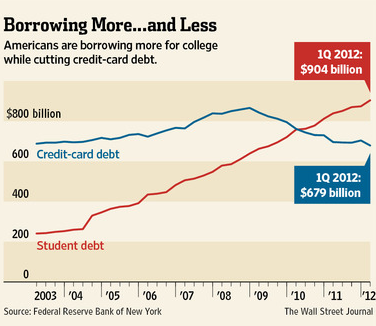
Student Loan Debt is growing while the rest of the household sector is delevering...

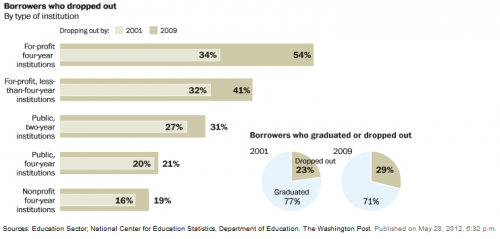
But pressures from repayments and the debt overhang causing dropout rates to soar...


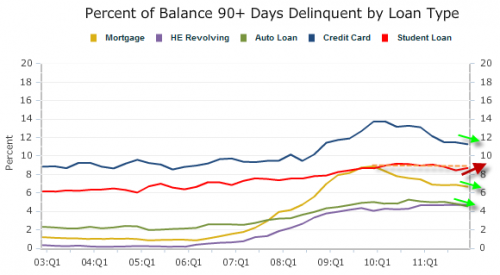
but even as the supposedly better-educated leave college, jobs are few and far between and delinquency rates are surging - even as every other form of household debt sees lower delinquency rates...


Read it at Zero Hedge
Student Debt Bubble Delinquencies Surge
By Tyler Durden

Overall consumer credit continues to fall due primarily to write downs in mortgage debt. Meanwhile, the remarkable growth in student loan debt continues unabated. The dropout rates at for-profit institutions are particularly troubling given that industry is heavily subsidized. Rising delinquency rates should also be watched closely.

Although these debts may cause economic trouble down the road, I don’t think it’s correct to call student loan debt a bubble. Mortgage debt was nearly $10 trillion at its peak, while student loan debt has yet to reach $1 trillion. Separately, a significant portion of the student debt is directly held by the government, reducing the need for any bailouts. The real trouble will stem from the fact that student debt cannot be written off through bankruptcy and may therefore act as a drag on consumer spending and home purchases for decades to come.

Friday, May 11, 2012

James Bianco - Consumer Credit – Worse Than You Think


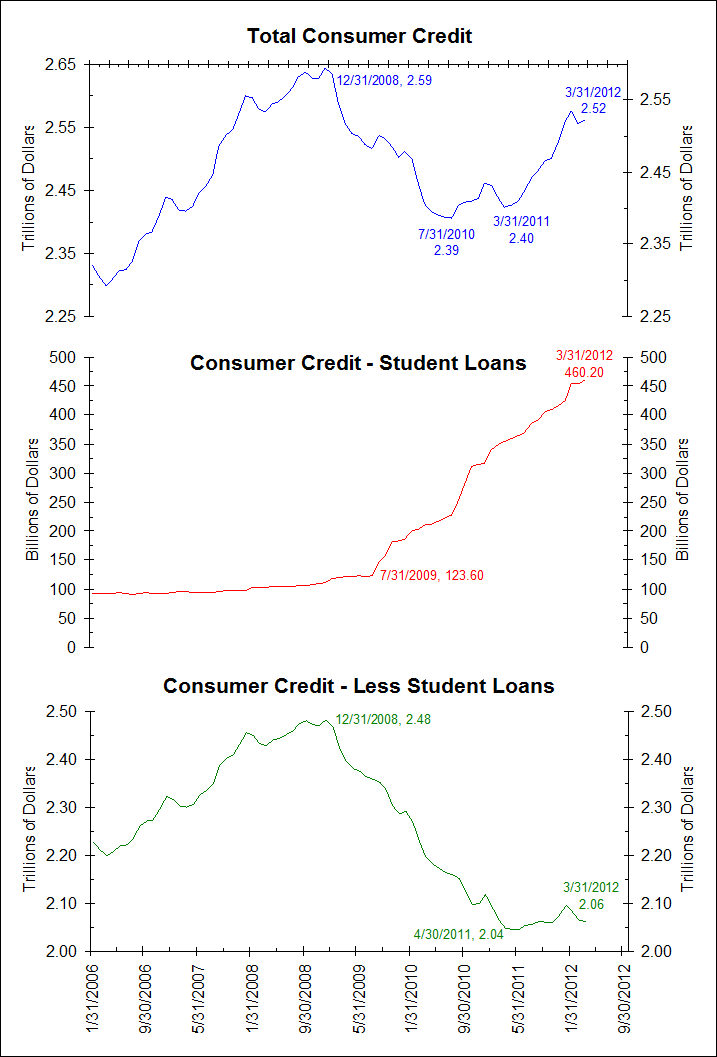
How important are student loans to overall consumer credit growth?  The next chart below shows total consumer credit in the top panel (the series that gets reported and analyzed), student loans in the middle panel (same series as in the chart above) and consumer credit less student loans in the bottom panel.
Take out government-owned student loans and there has been virtually no rebound in consumer credit since the Great Recession ended. Restated, the consumer has not been borrowing since the Great Recession has ended.  Rather, students took advantage of below-market rates on loans provided by the government starting in 2009.

Read it at The Big Picture
Consumer Credit – Worse Than You Think
By James Bianco

The sharp rise in student loans over the past 3 years is a perfect example of what happens when credit is under-priced. Although lowering interest rates can drastically increase the demand for credit, it does not necessarily improve the ability of borrowers to repay by the same amount. Default rates on these recent loans will likely be higher than history has shown and the losses will ultimately be assumed by taxpayers. In the meantime, the burden of this debt will weigh heavily on younger generations forcing many individuals to put off buying a home.

Stagnant consumer credit outside of student loans has also been boosted by improving auto loans, for which sub-prime is back in fashion. The overall picture for consumer credit is therefore far less rosy than many in the media try to portray. Until this data picks up, inflation and economic growth will continue to underwhelm.