Three months ago I discussed the potential of a forthcoming profit recession, in part, due to a declining govt deficit. Then a few weeks back I noted:
A significantly stronger dollar combined with weakening growth in Europe and China may have brought about a US profit recession even earlier than growth pessimists expected.
Lastly, following revised Q1 data, I showed that a US corporate profit recession had already begun.
Yesterday Charles Hugh Smith offered a great post highlighting many of the same headwinds to corporate profits. The following chart, in particular, caught my attention: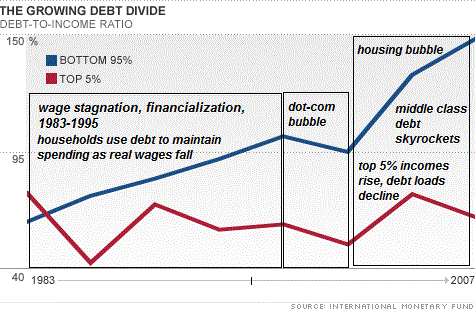
While I often discuss the importance of aggregate levels of debt in the economy, the distribution of that debt also has ramifications for economic growth. Since 2007, fiscal and monetary policy has largely attempted to spur growth by encouraging the private sector to once again embrace debt as a means of consumption and investment. Unfortunately, large government deficits and monetary stimulus have helped raise the income and wealth of the top 5% much more than the bottom 95%. As incomes continue to stagnate for the bottom 95%, interest costs on outstanding debt practically ensure that the above ratio will continue rising unless households actively deleverage.
Since many economists fail to include private debt in their models, policy recommendations continue to ignore the above problem that provides one of the major headwinds to greater economic growth and wealth equality. Resolving this issue, potentially through credit writedowns or a debt jubilee, should be the focus of policy going forward.
For nearly two decades Japan has witnessed stagnating growth and mild deflation. Over the course of this period, Japan has experimented with various forms of monetary “stimulus” as well as fiscal stimulus, increasing public sector debt by nearly 400%. 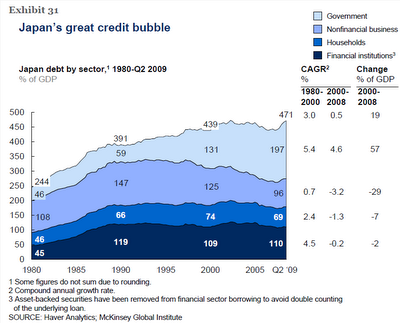
Source: The New Arthurian
By many accounts, Japan should be a shining example of functional finance,demonstrating the positive impact of fiscal and monetary stimulus working together. Reality, however, depicts a largely different story.
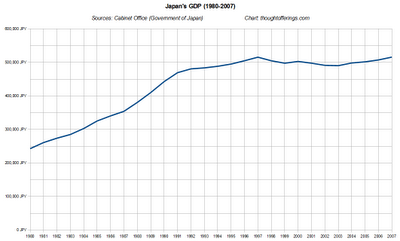
The New Arthurian offers four lessons from the struggles in Japan...
Lesson 1: No recovery was created by increasing the money.
Lesson 2: No recovery was created by replacing private debt with public.
Lesson 3: There was little or no "erosion" of debt by inflation.
Lesson 4: Try debt forgiveness.
Most economists are currently calling for either greater monetary or fiscal stimulus, or in some cases both. I fear that this apparent focus on broad macro stimulus overlooks some of the subtler inefficiencies within developed economies that played an equal, if not greater, role in the current economic crisis. Tax laws and regulations that encourage the use of credit over money, promote greater inequality and subsidize various industries with political favor will largely remain in place under most of the proposed policy solutions. Until these issues, and numerous others, are dealt with, our fate may follow a similar path as Japan, whereby monetary and fiscal stimulus are only enough to continue muddling through.
Centrist governments across the Mediterranean are increasingly seen by their citizens as powerless. They have no independent monetary policy; no capacity to devalue; no right to impose capital controls; limited ability to support failing national enterprises; and now they are mandated to tighten fiscal policy. When moderation fails, the time comes for citizens to turn to those promising to take power into their hands, be they from the right or the left – anything but the pusillanimous centre!
That is what happened in the 1930s. It is a historical irony that European countries that avoided a repeat of the Great Depression after the banking crisis are now driving into the blind cul-de-sac that led to extremism in that earlier disaster.
Read it at The Financial Times
How Keynes would solve the eurozone crisis
By Marcus Miller and Robert Skidelsky
In The Economic Consequences of the Peace, John Maynard Keynes showed remarkable foresight in recognizing that the burden of restitution placed on Germany and Austria-Hungary was so great that it would lead to further war in the future. Miller and Skidelsky note that Keynes:
recommended a round of debt cancellation among European countries, a plan that would – at the stroke of a pen – remove much of the problem.
Apparently the political feasibility of a debt jubilee has not changed much in the last 90 years.

