More than forty years ago, Milton Friedman famously quipped that price deflation can be fought by "dropping money out of a helicopter."[37] Friedman was referring to central bank policy and, to this day, a “helicopter drop” is typically associated with monetary policies, such as quantitative easing (QE). This is an unfortunate interpretation of monetary policy since most central banks, including the Federal Reserve, are as equally unable to actually implement a “helicopter drop” today as they were back in 1969. Willem Buiter clarifies how the policy could realistically be implemented in a paper on “Helicopter Money” (equations omitted):
Technically, if the Central Bank could make transfer payments to the private sector, the entire (real-time) Friedmanian helicopter money drop could be implemented by the Central Bank without Treasury assistance.
…
The legality of such an implementation of the helicopter drop of money by the Central Bank on its own would be doubtful in most countries with clearly drawn boundaries between the Central Bank and the Treasury. The Central Bank would be undertaking an overtly fiscal act, something which is normally the exclusive province of the Treasury.47
An economically equivalent (albeit less entertaining) implementation of the helicopter drop of money would be a tax cut (or a transfer payment) implemented by the Treasury, financed through the sale of Treasury debt to the Central Bank, which would then monetise the transaction. If the direct sale of Treasury debt to the Central Bank (or direct Central Bank lending to the Treasury) is prohibited (as it is for the countries that belong to the Euro area), the monetisation of the tax cut could be accomplished by the Treasury financing the tax through the sale of Treasury debt to the domestic private sector (or overseas), with the Central Bank purchasing that same amount of non-monetary interest bearing debt in the secondary market, thus expanding the base money supply. (2004: p. 59-60)One might inquire whether changing to a “permanent floor” monetary policy regime alters the necessity of monetisation. Apparently prepared for such a future outcome, Buiter says:
This difference between the effects of monetising a government deficit and financing it by issuing non-monetary debt persists even if the interest rates on base money and on non-monetary debt are the same (say zero), now and in the future. When both money and bonds bear a zero nominal interest rate, there remains a key difference between them: the principal of the bonds is redeemable, the principal of base money is not. (2004: p. 10)Although monetisation may be necessary to achieve the full effect of “helicopter money,” this practice does not alter the dangers associated with the Treasury’s actions. As Ashwin points out:
Whether they are monetised or not, excessive fiscal deficits are inflationary.On the topic of inflation, I have recently been engaging in a debate with Mike Sax (see here and here) about the potential benefits of targeting a higher inflation rate. This policy has garnered support from both sides of the political and economic aisle (New Keynesians and Monetarists), yet I think its potential benefits are being extremely oversold. My two basic arguments against such a policy are the following:
1) Higher inflation does not necessarily entail higher nominal wages (which many people clearly assume).
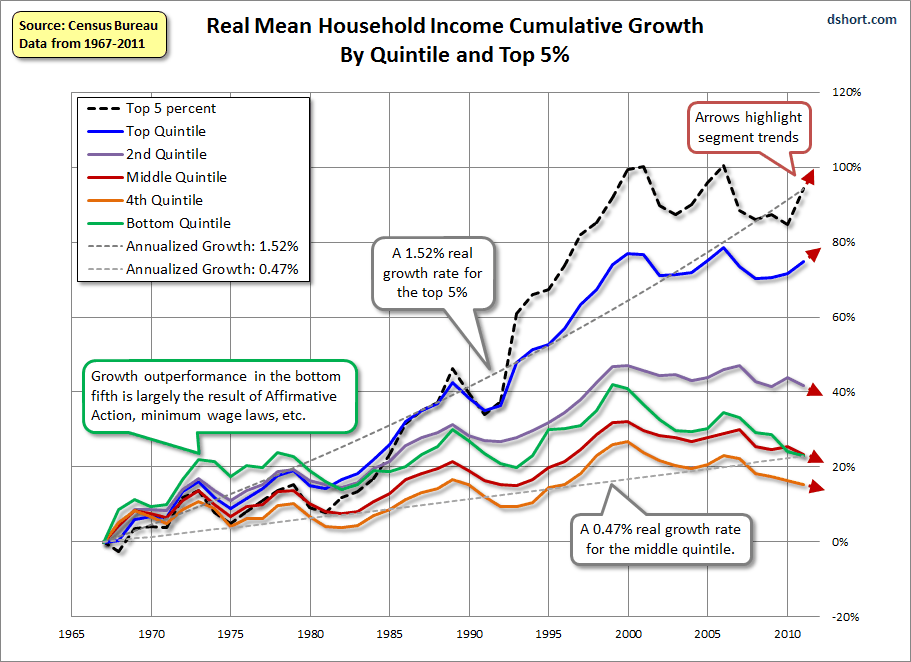
Aside from the top quintile of households, real income has been declining for nearly 15 years. The only way higher inflation helps reduce real debt burdens is if nominal wages increase faster than nominal interest rates on debt. If instead higher inflation stems primarily from higher costs-of living (nominal food and energy prices), than most Americans may find themselves in the precarious position of requiring even more debt to maintain current living standards.
2) Higher inflation alters saving, investment and consumption decisions which can lead to a misallocation of capital. On this second point is where Ashwin’s post really hits home:
During most significant hyperinflations throughout history, the catastrophic phase where money loses all value has been triggered by the central bank’s enforcement of highly negative real interest rates which encourages the rich and the well-connected to borrow at negative real rates and invest in real assets. The most famous example was the Weimar hyperinflation in Germany in the 1920s during which the central bank allowed banks and industrialists to borrow from it at as low an interest rate of 5% when inflation was well above 100%. The same phenomenon repeated itself during the hyperinflation in Zimbabwe during the last decade (For details on both, see my post ‘Hyperinflation, Deficits and Real Interest Rates’).
This also highlights the danger in simply enforcing a higher inflation target without taking the level of real interest rates into account. For example, if the Bank of England decided to target an inflation rate of 6% with the bank rates remaining at 0.50%, the risk of an inflationary spiral will increase dramatically as more and more private actors are tempted to borrow at a negative real rate and invest in real assets. Large negative real rates rarely incentivise those with access to cheap borrowing to invest in businesses. After all, why bother with building a business when borrowing and buying a house can make you rich? Moreover, just as was the case during the Weimar hyperinflation, it is only the rich and the well-connected crony capitalists and banks who benefit during such an episode. If the “danger” from macroeconomic policy is defined as the possibility of a rapid and spiralling loss of value in money, then negative real rates are far more dangerous than helicopter money.These pernicious traits of higher inflation and especially negative real interest rates are entirely compatible with recent experience. Households and businesses “with access to cheap borrowing” have been pouring money into stock, bond, housing and commodity markets rather than investing in tangible capital. The remarkable rise in asset prices has unfortunately not funneled down to households in the bottom four quintiles of income and wealth, only furthering the inequality gap. Recognition of these effects is precisely why a Federal Reserve fearing bubbles, not inflation, would be a significant step in the right direction.
To be clear, similar to Ashwin, I am in favor of “helicopter money” and believe higher wages for the bottom 80 percent are key to ending the balance sheet recession as well as ensuring more sustainable growth and unemployment going forward. Targeting higher inflation and larger negative real interest rates is the wrong approach to achieve these goals and may actually work in the opposite direction. Yes, all macroeconomic policy is dangerous. But even more dangerous is misunderstood and misrepresented macroeconomic policy.
Bibliography
Buiter, Willem H., Helicopter Money: Irredeemable Fiat Money and the Liquidity Trap (December 2003). NBER Working Paper No. w10163. Available at SSRN: http://ssrn.com/abstract=478673